Hubbry Logo
Folk musicFolk musicMain
Open search
Folk music
Community hub
Folk music
logo
8 pages, 0 posts
0 subscribers
Be the first to start a discussion here.
Folk music
Folk music
from Wikipedia

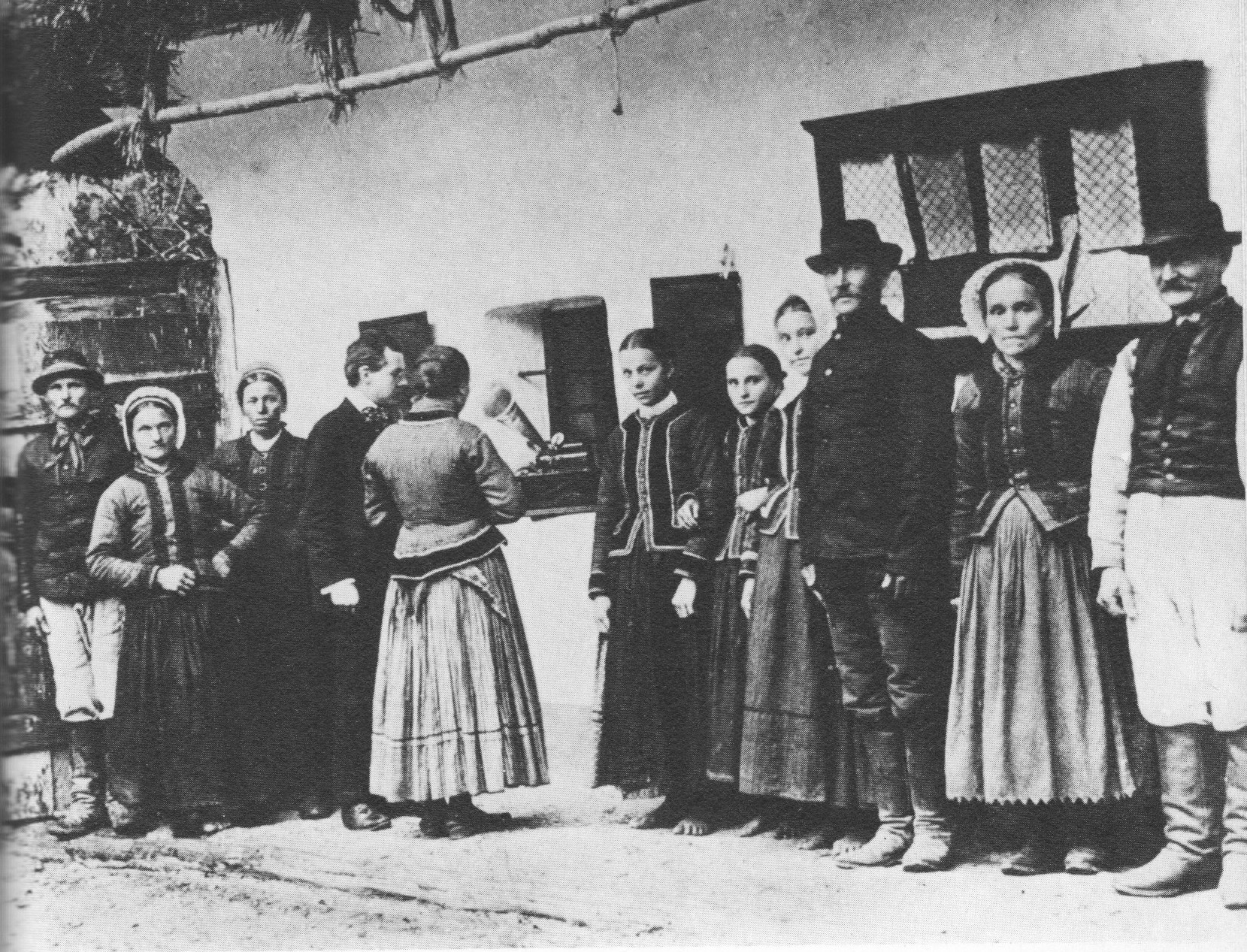
Béla Bartók recording peasant singers in Zobordarázs, Kingdom of Hungary (now Nitra, Slovakia), 1907
TraditionsList of folk music traditions
MusiciansList of folk musicians
InstrumentsFolk instruments
Other topics

Folk music is a music genre that includes traditional folk music and the contemporary genre that evolved from the former during the 20th-century folk revival. Some types of folk music may be called world music. Traditional folk music has been defined in several ways: as music transmitted orally, music with unknown composers, music that is played on traditional instruments, music about cultural or national identity, music that changes between generations (folk process), music associated with a people's folklore, or music performed by custom over a long period of time. It has been contrasted with commercial and classical styles. The term originated in the 19th century, but folk music extends beyond that.

Starting in the mid-20th century, a new form of popular folk music evolved from traditional folk music. This process and period is called the (second) folk revival and reached a zenith in the 1960s. This form of music is sometimes called contemporary folk music or folk revival music to distinguish it from earlier folk forms.[1] Smaller, similar revivals have occurred elsewhere in the world at other times, but the term folk music has typically not been applied to the new music created during those revivals. This type of folk music also includes fusion genres such as folk rock, folk metal, and others. While contemporary folk music is a genre generally distinct from traditional folk music, in U.S. English it shares the same name, and it often shares the same performers and venues as traditional folk music.

Traditional folk music

[edit]

Definition

[edit]

Folk music is fascinating – in that just about everybody and their uncle has an opinion on what it is, and what it isn’t!

Goldmine (September 19, 2019)[2]

The terms folk music, folk song, and folk dance are comparatively recent expressions. They are extensions of the term folklore, which was coined in 1846 by the English antiquarian William Thoms to describe "the traditions, customs, and superstitions of the uncultured classes".[3] The term further derives from the German expression Volk, in the sense of "the people as a whole" as applied to popular and national music by Johann Gottfried Herder and the German Romantics over half a century earlier.[4] Though it is understood that folk music is the music of the people, observers find a more precise definition to be elusive.[5][6] Some do not even agree that the term folk music should be used.[5] Folk music may tend to have certain characteristics[3] but it cannot clearly be differentiated in purely musical terms. One meaning often given is that of "old songs, with no known composers,"[7] another is that of music that has been submitted to an evolutionary "process of oral transmission... the fashioning and re-fashioning of the music by the community that give it its folk character."[8]

Such definitions depend upon "(cultural) processes rather than abstract musical types...", upon "continuity and oral transmission...seen as characterizing one side of a cultural dichotomy, the other side of which is found not only in the lower layers of feudal, capitalist and some oriental societies but also in 'primitive' societies and in parts of 'popular cultures'".[9] One widely used definition is simply "Folk music is what the people sing."[10]

For Scholes,[3] as well as for Cecil Sharp and Béla Bartók,[11] there was a sense of the music of the country as distinct from that of the town. Folk music was already, "...seen as the authentic expression of a way of life now past or about to disappear (or in some cases, to be preserved or somehow revived),"[12] particularly in "a community uninfluenced by art music"[8] and by commercial and printed song. Lloyd rejected this in favor of a simple distinction of economic class[11] yet for him, true folk music was, in Charles Seeger's words, "associated with a lower class"[13] in culturally and socially stratified societies. In these terms, folk music may be seen as part of a "schema comprising four musical types: 'primitive' or 'tribal'; 'elite' or 'art'; 'folk'; and 'popular'."[14]

Music in this genre is also often called traditional music. Although the term is usually only descriptive, in some cases people use it as the name of a genre. For example, the Grammy Award previously used the terms "traditional music" and "traditional folk" for folk music that is not contemporary folk music.[15] Folk music may include most indigenous music.[5]

Characteristics

[edit]
Viljandi Folk Music Festival held annually within the castle ruins in Viljandi, Estonia

From a historical perspective, traditional folk music had these characteristics:[13]

  • It was transmitted through an oral tradition. Before the 20th century, ordinary people were usually illiterate and learned songs by memory. Primarily, this was not mediated by books or recorded or transmitted media. Singers may extend their repertoire using broadsheets or song books, but these secondary enhancements are of the same character as the primary songs experienced in the flesh.
  • The music was often related to national culture. It was culturally particular; from a particular region or culture. In the context of an immigrant group, folk music acquires an extra dimension for social cohesion. It is particularly conspicuous in immigrant societies, where Greek Australians, Somali Americans, Punjabi Canadians, and others strive to emphasize their cultural identity. They learn songs and dances that originate in the countries their grandparents came from.
  • They commemorate historical and personal events. On certain days of the year, including such holidays as Christmas, Easter, and May Day, particular songs celebrate the yearly cycle. Birthdays, weddings, and funerals may also be noted with songs, dances and special costumes. Religious festivals often have a folk music component. Choral music at these events brings children and non-professional singers to participate in a public arena, giving an emotional bonding that is unrelated to the aesthetic qualities of the music.
  • The songs have been performed, by custom, over a long period of time, usually several generations.

As a side-effect, the following characteristics are sometimes present:

  • There is no copyright on the songs. Hundreds of folk songs from the 19th century have known authors but have continued in oral tradition to the point where they are considered traditional for purposes of music publishing. This has become much less frequent since the 1940s. Today, almost every folk song that is recorded is credited with an arranger.
  • Fusion of cultures: Because cultures interact and change over time, traditional songs evolving over time may incorporate and reflect influences from disparate cultures. The relevant factors may include instrumentation, tunings, voicings, phrasing, subject matter, and even production methods.

Tune

[edit]

In folk music, a tune is a short instrumental piece, a melody, often with repeating sections, and usually played a number of times.[16] A collection of tunes with structural similarities is known as a tune-family. America's Musical Landscape[17] says "the most common form for tunes in folk music is AABB, also known as binary form."[18][page needed]

In some traditions, tunes may be strung together in medleys or sets.[19] Studies demonstrate that specific traditional music patterns from European musical heritage follow mathematical sequences helping traditional songs survive through oral passing of melodies between generations.[20]

Origins

[edit]
Indians always distinguished between classical and folk music, though in the past even classical Indian music used to rely on the unwritten transmission of repertoire.
Indian Nepali folk musician Navneet Aditya Waiba

Throughout most of human history, listening to recorded music was not possible.[21][22] Music was made by common people during both their work and leisure, as well as during religious activities. The work of economic production was often manual and communal.[23] Manual labor often included singing by the workers, which served several practical purposes.[24] It reduced the boredom of repetitive tasks, it kept the rhythm during synchronized pushes and pulls, and it set the pace of many activities such as planting, weeding, reaping, threshing, weaving, and milling. In leisure time, singing and playing musical instruments were common forms of entertainment and history-telling—even more common than today when electrically enabled technologies and widespread literacy make other forms of entertainment and information-sharing competitive.[25]

Some believe that folk music originated as art music that was changed and probably debased by oral transmission while reflecting the character of the society that produced it.[3] In many societies, especially preliterate ones, the cultural transmission of folk music requires learning by ear, although notation has evolved in some cultures.[26] Different cultures may have different notions concerning a division between "folk" music on the one hand and of "art" and "court" music on the other. In the proliferation of popular music genres, some traditional folk music became also referred to as "World music" or "Roots music".[27]

The English term "folklore", to describe traditional folk music and dance, entered the vocabulary of many continental European nations, each of which had its folk-song collectors and revivalists.[3] The distinction between "authentic" folk and national and popular song in general has always been loose, particularly in America and Germany[3] – for example, popular songwriters such as Stephen Foster could be termed "folk" in America.[3][28] The International Folk Music Council definition allows that the term can also apply to music that, "...has originated with an individual composer and has subsequently been absorbed into the unwritten, living tradition of a community. But the term does not cover a song, dance, or tune that has been taken over ready-made and remains unchanged."[29]

The post–World War II folk revival in America and in Britain started a new genre, contemporary folk music, and brought an additional meaning to the term "folk music": newly composed songs, fixed in form and by known authors, which imitated some form of traditional music. The popularity of "contemporary folk" recordings caused the appearance of the category "Folk" in the Grammy Awards of 1959;[30] in 1970 the term was dropped in favor of "Best Ethnic or Traditional Recording (including Traditional Blues)",[31] while 1987 brought a distinction between "Best Traditional Folk Recording" and "Best Contemporary Folk Recording".[32] After that, they had a "Traditional music" category that subsequently evolved into others. The term "folk", by the start of the 21st century, could cover singer-songwriters, such as Donovan[33] from Scotland and Bob Dylan[34] from the United States, who emerged in the 1960s, and much more. This completed a process to where "folk music" no longer meant only traditional folk music.[7]

Subject matter

[edit]
Turkish traditional folk singer Ahmet Kaya
Assyrian folk music
Assyrians playing a zurna and a davul, instruments typically used for Assyrian folk music and dance

Traditional folk music often includes sung words, although folk instrumental music occurs commonly in dance music traditions. Narrative verse looms large in the traditional folk music of many cultures.[35][36] This encompasses such forms as traditional epic poetry, much of which was meant originally for oral performance, sometimes accompanied by instruments.[37][38] Many epic poems of various cultures were pieced together from shorter pieces of traditional narrative verse, which explains their episodic structure, repetitive elements, and their frequent in medias res plot developments. Other forms of traditional narrative verse relate the outcomes of battles or lament tragedies or natural disasters.[39]

Sometimes, as in the triumphant Song of Deborah[40] found in the Biblical Book of Judges, these songs celebrate victory. Laments for lost battles and wars, and the lives lost in them, are equally prominent in many traditions; these laments keep alive the cause for which the battle was fought.[41][42] The narratives of traditional songs often also remember folk heroes such as John Henry[43][44] or Robin Hood.[45] Some traditional song narratives recall supernatural events or mysterious deaths.[46]

Hymns and other forms of religious music are often of traditional and unknown origin.[47] Western musical notation was originally created to preserve the lines of Gregorian chant, which before its invention was taught as an oral tradition in monastic communities.[48][49] Traditional songs such as Green grow the rushes, O present religious lore in a mnemonic form, as do Western Christmas carols and similar traditional songs.[50]

Work songs frequently feature call and response structures and are designed to enable the laborers who sing them to coordinate their efforts in accordance with the rhythms of the songs.[51] They are frequently, but not invariably, composed. In the American armed forces, a lively oral tradition preserves jody calls ("Duckworth chants") which are sung while soldiers are on the march.[52] Professional sailors made similar use of a large body of sea shanties.[53][54] Love poetry, often of a tragic or regretful nature, prominently figures in many folk traditions.[55] Nursery rhymes, children's songs and nonsense verse used to amuse or quiet children also are frequent subjects of traditional songs.[56]

Folk song transformations and variations

[edit]
Korean traditional musicians

Music transmitted by word of mouth through a community, in time, develops many variants, since this transmission cannot produce word-for-word and note-for-note accuracy. In addition, folk singers can choose to modify the songs they hear.

For example, around 1970 the song Mullā Mohammed Jān spread from Herat to the rest of Afghanistan, and Iran where it was recorded. Due to its repetitive refrain and the predictability of the second half of each verse, it allowed for both its popularization, and for each singer to create their own version of the song without being overly-concerned for a melody or restrictive poetic rhythm.[57]

Because variants proliferate naturally, there is generally no "authoritative" version of song. Researchers in traditional songs have encountered countless versions of the Barbara Allen ballad throughout the English-speaking world, and these versions often differ greatly from each other. The original is not known; many versions can lay an equal claim to authenticity.

Influential folklorist Cecil Sharp felt that these competing variants of a traditional song would undergo a process of improvement akin to biological natural selection: only those new variants that were the most appealing to ordinary singers would be picked up by others and transmitted onward in time. Thus, over time we would expect each traditional song to become more aesthetically appealing, due to incremental community improvement.

Literary interest in the popular ballad form dates back at least to Thomas Percy and William Wordsworth. English Elizabethan and Stuart composers had often evolved their music from folk themes, the classical suite was based upon stylised folk-dances, and Joseph Haydn's use of folk melodies is noted. But the emergence of the term "folk" coincided with an "outburst of national feeling all over Europe" that was particularly strong at the edges of Europe, where national identity was most asserted. Nationalist composers emerged in Central Europe, Russia, Scandinavia, Spain and Britain: the music of Dvořák, Smetana, Grieg, Rimsky-Korsakov, Brahms, Liszt, de Falla, Wagner, Sibelius, Vaughan Williams, Bartók, and many others drew upon folk melodies.[citation needed]

Regional forms

[edit]
Naxi traditional musicians
The Steinegger brothers, traditional fifers of Grundlsee, Styria, 1880

While the loss of traditional folk music in the face of the rise of popular music is a worldwide phenomenon,[58] it is not one occurring at a uniform rate throughout the world.[59] The process is most advanced "where industrialization and commercialisation of culture are most advanced"[60] but also occurs more gradually even in settings of lower technological advancement. However, the loss of traditional music is slowed in nations or regions where traditional folk music is a badge of cultural or national identity.[citation needed] Ethnomusicologists notes that the Intangible cultural heritage program organized by UNESCO stands among the principal measures implemented by governments which protect regional music traditions from disappearing.[61]

Early folk music, fieldwork and scholarship

[edit]

Much of what is known about folk music prior to the development of audio recording technology in the 19th century comes from fieldwork and writings of scholars, collectors and proponents.[62]

19th-century Europe

[edit]

Starting in the 19th century, academics and amateur scholars, taking note of the musical traditions being lost, initiated various efforts to preserve the music of the people.[63] One such effort was the collection by Francis James Child in the late 19th century of the texts of over three hundred ballads in the English and Scots traditions (called the Child Ballads), some of which predated the 16th century.[10]

Contemporaneously with Child, the Reverend Sabine Baring-Gould and later Cecil Sharp worked to preserve a great body of English rural traditional song, music and dance, under the aegis of what became and remains the English Folk Dance and Song Society (EFDSS).[64] Sharp campaigned with some success to have English traditional songs (in his own heavily edited and expurgated versions) to be taught to school children in hopes of reviving and prolonging the popularity of those songs.[65][66] Throughout the 1960s and early to mid-1970s, American scholar Bertrand Harris Bronson published an exhaustive four-volume collection of the then-known variations of both the texts and tunes associated with what came to be known as the Child Canon.[67] He also advanced some significant theories concerning the workings of oral-aural tradition.[68]

Similar activity was also under way in other countries. One of the most extensive was perhaps the work done in Riga by Krisjanis Barons, who between the years 1894 and 1915 published six volumes that included the texts of 217,996 Latvian folk songs, the Latvju dainas.[69] In Norway the work of collectors such as Ludvig Mathias Lindeman was extensively used by Edvard Grieg in his Lyric Pieces for piano and in other works, which became immensely popular.[70]

Around this time, composers of classical music developed a strong interest in collecting traditional songs, and a number of composers carried out their own field work on traditional music. These included Percy Grainger[71] and Ralph Vaughan Williams[72] in England and Béla Bartók[73] in Hungary. These composers, like many of their predecessors, both made arrangements of folk songs and incorporated traditional material into original classical compositions.[74][75]

North America

[edit]
Locations in Southern and Central Appalachia visited by the British folklorist Cecil Sharp in 1916 (blue), 1917 (green), and 1918 (red). Sharp sought "old world" English and Scottish ballads passed down to the region's inhabitants from their British ancestors. He collected hundreds of such ballads, the most productive areas being the Blue Ridge Mountains of North Carolina and the Cumberland Mountains of Kentucky.

The advent of audio recording technology provided folklorists with a revolutionary tool to preserve vanishing musical forms.[76] The earliest American folk music scholars were with the American Folklore Society (AFS), which emerged in the late 1800s.[77] Their studies expanded to include Native American music, but still treated folk music as a historical item preserved in isolated societies as well.[78] In North America, during the 1930s and 1940s, the Library of Congress worked through the offices of traditional music collectors Robert Winslow Gordon,[79] Alan Lomax[80][81][82] and others to capture as much North American field material as possible.[83] John Lomax (the father of Alan Lomax) was the first prominent scholar to study distinctly American folk music such as that of cowboys and southern blacks. His first major published work was in 1911, Cowboy Songs and Other Frontier Ballads.[84] John Lomax was arguably the most prominent US folk music scholar of his time, notably during the beginnings of the folk music revival in the 1930s and early 1940s. Cecil Sharp also worked in America, recording the traditional songs of the Appalachian Mountains in 1916–1918 in collaboration with Maud Karpeles and Olive Dame Campbell, and is considered the first major scholar covering American folk music.[85] Campbell and Sharp are represented under other names by actors in the modern movie Songcatcher.[86]

One strong theme amongst folk scholars in the early decades of the 20th century was regionalism,[87] the analysis of the diversity of folk music (and related cultures) based on regions of the US rather than based on a given song's historical roots.[88][89] Later, a dynamic of class and circumstances was added to this.[90] The most prominent regionalists were literary figures with a particular interest in folklore.[91][92] Carl Sandburg often traveled the U.S. as a writer and a poet.[93] He also collected songs in his travels and, in 1927, published them in the book The American Songbag.[94] Rachel Donaldson, a historian who worked for Vanderbilt, later stated this about The American Songbag in her analysis of the folk music revival: "In his collections of folk songs, Sandburg added a class dynamic to popular understandings of American folk music. This was the final element of the foundation upon which the early folk music revivalists constructed their own view of Americanism. Sandburg's working-class Americans joined with the ethnically, racially, and regionally diverse citizens that other scholars, public intellectuals, and folklorists celebrated their own definitions of the American folk, definitions that the folk revivalists used in constructing their own understanding of American folk music, and an overarching American identity."[95]

Prior to the 1930s, the study of folk music was primarily the province of scholars and collectors. The 1930s saw the beginnings of larger scale themes, commonalities, and linkages in folk music developing in the populace and practitioners as well, often related to the Great Depression.[96] Regionalism and cultural pluralism grew as influences and themes. During this time folk music began to become enmeshed with political and social activism themes and movements.[96] Two related developments were the U.S. Communist Party's interest in folk music as a way to reach and influence Americans,[97] and politically active prominent folk musicians and scholars seeing communism as a possible better system, through the lens of the Great Depression.[98] Woody Guthrie exemplifies songwriters and artists with such an outlook.[99]

Folk music festivals proliferated during the 1930s.[100] President Franklin Roosevelt was a fan of folk music, hosted folk concerts at the White House, and often patronized folk festivals.[101] One prominent festival was Sarah Gertrude Knott's National Folk Festival, established in St. Louis, Missouri, in 1934.[102] Under the sponsorship of The Washington Post, the festival was held in Washington, DC, at Constitution Hall from 1937 to 1942.[103] The folk music movement, festivals, and the wartime effort were seen as forces for social goods such as democracy, cultural pluralism, and the removal of culture and race-based barriers.[104]

The American folk music revivalists of the 1930s approached folk music in different ways.[105] Three primary schools of thought emerged: "Traditionalists" (e.g. Sarah Gertrude Knott and John Lomax) emphasized the preservation of songs as artifacts of deceased cultures. "Functional" folklorists (e.g. Botkin and Alan Lomax) maintained that songs only retain relevance when used by those cultures which retain the traditions which birthed those songs. "Left-wing" folk revivalists (e.g. Charles Seeger and Lawrence Gellert) emphasized music's role "in 'people's' struggles for social and political rights".[105] By the end of the 1930s these and others had turned American folk music into a social movement.[105]

Sometimes folk musicians became scholars and advocates themselves. For example, Jean Ritchie (1922–2015) was the youngest child of a large family from Viper, Kentucky, that had preserved many of the old Appalachian traditional songs.[106] Ritchie, living in a time when the Appalachians had opened up to outside influence, was university educated and ultimately moved to New York City, where she made a number of classic recordings of the family repertoire and published an important compilation of these songs.[107]

In January 2012, the American Folklife Center at the Library of Congress, with the Association for Cultural Equity, announced that they would release Lomax's vast archive of 1946 and later recording in digital form. Lomax spent the last 20 years of his life working on an interactive multimedia educational computer project he called the Global Jukebox, which included 5,000 hours of sound recordings, 400,000 feet of film, 3,000 videotapes, and 5,000 photographs.[108] As of March 2012, this had been accomplished. Approximately 17,400 of Lomax's recordings from 1946 and later have been made available free online.[109][110] This material from Alan Lomax's independent archive, begun in 1946, which has been digitized and offered by the Association for Cultural Equity, is "distinct from the thousands of earlier recordings on acetate and aluminum discs he made from 1933 to 1942 under the auspices of the Library of Congress. This earlier collection—which includes the famous Jelly Roll Morton, Woody Guthrie, Lead Belly, and Muddy Waters sessions, as well as Lomax's prodigious collections made in Haiti and Eastern Kentucky (1937) — is the provenance of the American Folklife Center"[109] at the Library of Congress.

National and regional forms

[edit]

Africa

[edit]
The African lamellophone, thumb piano or mbira

Africa is a vast continent[111] and its regions and nations have distinct musical traditions.[112][113] The music of North Africa for the most part has a different history from Sub-Saharan African music traditions.[114]

The music and dance forms of the African diaspora, including African American music and many Caribbean genres like soca, calypso and Zouk; and Latin American music genres like the samba, Cuban rumba, salsa; and other clave (rhythm)-based genres, were founded to varying degrees on the music of enslaved Africans, which has in turn influenced African popular music.[115][116]

Asia

[edit]
Paban Das Baul, baul singer at Nine Lives concert, 2009

Many Asian civilizations distinguish between art/court/classical styles and "folk" music.[117][118] For example, the late Alam Lohar is an example of a South Asian singer who was classified as a folk singer.[119]

Khunung Eshei/Khuland Eshei is an ancient folk song from India, a country of Asia, of Meiteis of Manipur, that is an example of Asian folk music, and how they put it into its own genre.[120]

Folk music of China
[edit]

Archaeological discoveries date Chinese folk music back 7000 years;[121] it is largely based on the pentatonic scale.[122]

Han traditional weddings and funerals usually include a form of oboe called a suona,[123] and apercussive ensembles called a chuigushou.[124] Ensembles consisting of mouth organs (sheng), shawms (suona), flutes (dizi) and percussion instruments (especially yunluo gongs) are popular in northern villages;[125] their music is descended from the imperial temple music of Beijing, Xi'an, Wutai shan and Tianjin. Xi'an drum music, consisting of wind and percussive instruments,[126] is popular around Xi'an, and has received some commercial popularity outside of China.[127] Another important instrument is the sheng, a type of Chinese pipe, an ancient instrument that is ancestor of all Western free reed instruments, such as the accordion.[128] Parades led by Western-type brass bands are common, often competing in volume with a shawm/chuigushou band.

In southern Fujian and Taiwan, Nanyin or Nanguan is a genre of traditional ballads.[129] They are sung by a woman accompanied by a xiao and a pipa, as well as other traditional instruments.[130] The music is generally sorrowful and typically deals with love-stricken people.[131][132] Further south, in Shantou, Hakka and Chaozhou, zheng ensembles are popular.[133] Sizhu ensembles use flutes and bowed or plucked string instruments to make harmonious and melodious music that has become popular in the West among some listeners.[134] These are popular in Nanjing and Hangzhou, as well as elsewhere along the southern Yangtze area.[135] Jiangnan Sizhu (silk and bamboo music from Jiangnan) is a style of instrumental music, often played by amateur musicians in tea houses in Shanghai.[136] Guangdong Music or Cantonese Music is instrumental music from Guangzhou and surrounding areas.[137] The music from this region influenced Yueju (Cantonese Opera) music,[138] which would later grow popular during the self-described "Golden Age" of China under the PRC.[139]

Folk songs have been recorded since ancient times in China. The term Yuefu was used for a broad range of songs such as ballads, laments, folk songs, love songs, and songs performed at court.[140] China is a vast country, with a multiplicity of linguistic and geographic regions. Folk songs are categorized by geographic region, language type, ethnicity, social function (e.g. work song, ritual song, courting song) and musical type. Modern anthologies collected by Chinese folklorists distinguish between traditional songs, revolutionary songs, and newly invented songs.[141] The songs of northwest China are known as "flower songs" (hua'er), a reference to beautiful women, while in the past they were notorious for their erotic content.[142] The village "mountain songs" (shan'ge) of Jiangsu province were also well known for their amorous themes.[143][144] Other regional song traditions include the "strummed lyrics" (tanci) of the Lower Yangtze Delta, the Cantonese Wooden Fish tradition (muyu or muk-yu) and the Drum Songs (guci) of north China.[145]

In the twenty-first century many cherished Chinese folk songs have been inscribed in the UNESCO Representative List of the Intangible Cultural Heritage of Humanity.[146] In the process, songs once seen as vulgar are now being reconstructed as romantic courtship songs.[147] Regional song competitions, popular in many communities, have promoted professional folk singing as a career, with some individual folk singers having gained national prominence.[148]

Traditional folk music of Sri Lanka
[edit]

The art, music and dance of Sri Lanka derive from the elements of nature, and have been enjoyed and developed in the Buddhist environment.[149] The music is of several types and uses only a few types of instruments.[150] The folk songs and poems were used in social gatherings to work together. The Indian influenced classical music has grown to be unique.[151][152][153][154] The traditional drama, music and songs of Sinhala Light Music are typically Sri Lankan.[155] The temple paintings and carvings feature birds, elephants, wild animals, flowers, and trees, and the Traditional 18 Dances display the dancing of birds and animals.[156] For example:

  • Mayura Wannama – The dance of the peacock[157][158]
  • Hanuma Wannama – The dance of the monkey[159]
  • Gajaga Wannama – The dance of the elephant Musical types include:
  • Local drama music includes Kolam[160] and Nadagam types.[161] Kolam music is based on low country tunes primarily to accompany mask dance in exorcism rituals.[162][163] It is considered less developed/evolved, true to the folk tradition and a preserving of a more ancient artform.[164] It is limited to approximately 3–4 notes and is used by the ordinary people for pleasure and entertainment.[165]
  • Nadagam music is a more developed form of drama influenced from South Indian street drama which was introduced by some south Indian artists. Phillippu Singho from Negombo in 1824 performed "Harishchandra Nadagama" in Hnguranketha which was originally written in the Telingu language. Later "Maname",[166] "Sanda kinduru"[167] and others were introduced. Don Bastian of Dehiwala introduced Noorthy firstly by looking at Indian dramas and then John de Silva developed it as did Ramayanaya in 1886.[168]
  • Sinhala light music is currently the most popular type of music in Sri Lanka and enriched with the influence of folk music, kolam music, nadagam music, noorthy music, film music, classical music, Western music, and others.[169] Some artists visited India to learn music and later started introducing light music. Ananda Samarakone was the pioneer of this[170][171] and also composed the national anthem.[172]

The classical Sinhalese orchestra consists of five categories of instruments, but among the percussion instruments, the drum is essential for dance.[173] The vibrant beat of the rhythm of the drums form the basic of the dance.[174] The dancers' feet bounce off the floor and they leap and swirl in patterns that reflect the complex rhythms of the drum beat. This drum beat may seem simple on the first hearing but it takes a long time to master the intricate rhythms and variations, which the drummer sometimes can bring to a crescendo of intensity. There are six common types of drums falling within 3 styles (one-faced, two-faced, and flat-faced):[175][176]

  • The typical Sinhala Dance is identified as the Kandyan dance and the Gatabera drum is indispensable to this dance.[177]
  • Yak-bera is the demon drum or the drum used in low country dance in which the dancers wear masks and perform devil dancing, which has become a highly developed form of art.[178]
  • The Daula is a barrel-shaped drum, and it was used as a companion drum with a Thammattama in the past, to keep strict time with the beat.[179]
  • The Thammattama is a flat, two-faced drum. The drummer strikes the drum on the two surfaces on top with sticks, unlike the others where you drum on the sides. This is a companion drum to the aforementioned Dawula.[180]
  • A small double-headed hand drum is used to accompany songs. It is primarily heard in the poetry dances like vannam.[clarification needed]
  • The Rabana is a flat-faced circular drum and comes in several sizes.[181] The large Rabana – called the Banku Rabana – has to be placed on the floor like a circular short-legged table and several people (traditionally women) can sit around it and beat on it with both hands.[182] This is used in festivals such as the Sinhalese New Year and ceremonies such as weddings.[183] The resounding beat of the Rabana symbolizes the joyous moods of the occasion. The small Rabana is a form of mobile drum beat since the player carries it wherever the person goes.[184]

Other instruments include:

  • The Thalampata – 2 small cymbals joined by a string.[185]
  • The wind section, is dominated by an instrument akin to the clarinet.[clarification needed] This is not normally used for dances. This is important to note because the Sinhalese dance is not set to music as the western world knows it; rhythm is king.
  • The flutes of metal such as silver & brass produce shrill music to accompany Kandyan Dances, while the plaintive strains of music of the reed flute may pierce the air in devil-dancing. The conch-shell (Hakgediya) is another form of a natural instrument, and the player blows it to announce the opening of ceremonies of grandeur.[186]
  • The Ravanahatha (ravanhatta, rawanhattha, ravanastron or ravana hasta veena) is a bowed fiddle that was once popular in Western India.[187][188] It is believed to have originated among the Hela civilisation of Sri Lanka in the time of King Ravana.[189] The bowl is made of cut coconut shell, the mouth of which is covered with goat hide. A dandi, made of bamboo, is attached to this shell.[189] The principal strings are two: one of steel and the other of a set of horsehair. The long bow has jingle bells[190][191]

Australia

[edit]

Indigenous Australian music includes the music of Aboriginal Australians and Torres Strait Islanders, who are collectively called Indigenous Australians;[192] it incorporates a variety of distinctive traditional music styles practiced by Indigenous Australian peoples, as well as a range of contemporary musical styles of and fusion with European traditions as interpreted and performed by indigenous Australian artists.[193] Music has formed an integral part of the social, cultural and ceremonial observances of these peoples, down through the millennia of their individual and collective histories to the present day.[194][195] The traditional forms include many aspects of performance and musical instruments unique to particular regions or Indigenous Australian groups.[196] Equal elements of musical tradition are common through much of the Australian continent, and even beyond.[197] The culture of the Torres Strait Islanders is related to that of adjacent parts of New Guinea and so their music is also related. Music is a vital part of Indigenous Australians' cultural maintenance.[198]

Folk song traditions were taken to Australia by early settlers from England, Scotland and Ireland and gained particular foothold in the rural outback.[199][200] The rhyming songs, poems and tales written in the form of bush ballads often relate to the itinerant and rebellious spirit of Australia in The Bush, and the authors and performers are often referred to as bush bards.[201] The 19th century was the golden age of bush ballads.[202] Several collectors have catalogued the songs including John Meredith whose recording in the 1950s became the basis of the collection in the National Library of Australia.[201]

The songs tell personal stories of life in the wide open country of Australia.[203][204] Typical subjects include mining, raising and droving cattle, sheep shearing, wanderings, war stories, the 1891 Australian shearers' strike, class conflicts between the landless working class and the squatters (landowners), and outlaws such as Ned Kelly, as well as love interests and more modern fare such as trucking.[205] The most famous bush ballad is "Waltzing Matilda", which has been called "the unofficial national anthem of Australia".[206]

Europe

[edit]
Battlefield Band performing in Freiburg in 2012
Celtic traditional music
[edit]

Celtic music is a term used by artists, record companies, music stores and music magazines to describe a broad grouping of musical genres that evolved out of the folk musical traditions of the Celtic peoples.[207] These traditions include Irish, Scottish, Manx, Cornish, Welsh, and Breton traditions.[208] Asturian and Galician music is often included, though there is no significant research showing that this has any close musical relationship.[209][210] Brittany's Folk revival began in the 1950s with the "bagadoù" and the "kan-ha-diskan" before growing to world fame through Alan Stivell's work since the mid-1960s.[211]

In Ireland, The Clancy Brothers and Tommy Makem (although its members were all Irish-born, the group became famous while based in New York's Greenwich Village[212]), The Dubliners,[213] Clannad,[214] Planxty,[215] The Chieftains,[216][217] The Pogues,[218] The Corrs,[219] The Irish Rovers,[220] and a variety of other folk bands have done much over the past few decades to revitalise and re-popularise Irish traditional music.[221] These bands were rooted, to a greater or lesser extent, in a tradition of Irish music and benefited from the efforts of artists such as Seamus Ennis and Peter Kennedy.[211]

In Scotland, The Corries,[222] Silly Wizard,[223][224] Capercaillie,[225] Runrig,[226] Jackie Leven,[227] Julie Fowlis,[228] Karine Polwart,[229] Alasdair Roberts,[230][231] Dick Gaughan,[232] Wolfstone,[233] Boys of the Lough,[234] and The Silencers[235] have kept Scottish folk vibrant and fresh by mixing traditional Scottish and Gaelic folk songs with more contemporary genres.[236] These artists have also been commercially successful in continental Europe and North America.[237] There is an emerging wealth of talent in the Scottish traditional music scene, with bands such as Mànran,[238] Skipinnish,[239] Barluath[240] and Breabach[241] and solo artists such as Patsy Reid,[242] Robyn Stapleton[243] and Mischa MacPherson[244] gaining a lot of success in recent years.[245]

Central and Eastern Europe
[edit]

During the Eastern Bloc era, national folk dancing was actively promoted by the state.[246] Dance troupes from Russia and Poland toured non-communist Europe from about 1937 to 1990.[247] The Red Army Choir recorded many albums, becoming the most popular military band.[248] Eastern Europe is also the origin of the Jewish Klezmer tradition.[249]

Ľubomír Párička playing bagpipes, Slovakia

The polka is a central European dance and also a genre of dance music familiar throughout Europe and the Americas. It originated in the middle of the 19th century in Bohemia.[250] Polka is still a popular genre of folk music in many European countries and is performed by folk artists in Poland, Latvia, Lithuania, Czech Republic, Netherlands, Croatia, Slovenia, Germany, Hungary, Austria, Switzerland, Italy, Ukraine, Belarus, Russia and Slovakia.[251] Local varieties of this dance are also found in the Nordic countries, United Kingdom, Republic of Ireland, Latin America (especially Mexico), and in the United States.

German Volkslieder perpetuated by Liederhandschriften manuscripts like Carmina Burana[252] date back to medieval Minnesang and Meistersinger traditions.[253] Those folk songs revived in the late 18th century period of German Romanticism,[254] first promoted by Johann Gottfried Herder[255][256] and other advocates of the Enlightenment,[257] later compiled by Achim von Arnim[258] and Clemens Brentano (Des Knaben Wunderhorn)[259] as well as by Ludwig Uhland.[260]

The Volksmusik and folk dances genre, especially in the Alpine regions of Bavaria, Austria, Switzerland (Kuhreihen) and South Tyrol, up to today has lingered in rustic communities against the backdrop of industrialisation[261]—Low German shanties or the Wienerlied[262] (Schrammelmusik) being notable exceptions. Slovene folk music in Upper Carniola and Styria also originated from the Alpine traditions, like the prolific Lojze Slak Ensemble.[263] Traditional Volksmusik is not to be confused with commercial Volkstümliche Musik, which is a derivation of that.[264]

The Hungarian group Muzsikás played numerous American tours[265] and participated in the Hollywood movie The English Patient[266] while the singer Márta Sebestyén worked with the band Deep Forest.[267] The Hungarian táncház movement, started in the 1970s, involves strong cooperation between musicology experts and enthusiastic amateurs.[268] However, traditional Hungarian folk music and folk culture barely survived in some rural areas of Hungary, and it has also begun to disappear among the ethnic Hungarians in Transylvania. The táncház movement revived broader folk traditions of music, dance, and costume together and created a new kind of music club.[269] The movement spread to ethnic Hungarian communities elsewhere in the world.[269]

Balkan music
[edit]
The Mystery of the Bulgarian Voices

Balkan folk music was influenced by the mingling of Balkan ethnic groups in the period of the Ottoman Empire.[270] It comprises the music of Bosnia and Herzegovina, Bulgaria, Croatia, Greece, Montenegro, Serbia, Romania, North Macedonia, Albania, some of the historical states of Yugoslavia or Serbia and Montenegro and geographical regions such as Thrace.[271] Some music is characterised by complex rhythm.[272]

A notable act is the Mystery of the Bulgarian Voices, which won the Grammy Award for Best Traditional Folk Recording at the 32nd annual ceremony.[273][274]

An important part of the whole Balkan folk music is the music of the local Romani ethnic minority, which is called tallava and brass band music.[275][276]

Nordic folk music
[edit]
Latvian men's folk ensemble Vilki, performing at the festival of Baltic crafts and warfare Apuolė 854 in Apuolė, August 2009

Nordic folk music includes a number of traditions in Northern European, especially Scandinavian, countries. The Nordic countries are generally taken to include Iceland, Norway, Finland, Sweden, Denmark and Greenland.[277] Sometimes it is taken to include the Baltic countries of Estonia, Latvia and Lithuania.[278]

Maria Gasolina performing at 2008 Faces Festival in Raseborg, Finland

The many regions of the Nordic countries share certain traditions, many of which have diverged significantly, like Psalmodicon of Denmark, Sweden, and Norway.[279] It is possible to group together the Baltic states (or, sometimes, only Estonia) and parts of northwest Russia as sharing cultural similarities,[280] although the relationship has gone cold in recent years.[281] Contrast with Norway, Sweden, Denmark and the Atlantic islands of Iceland and the Faroe Islands, which share virtually no similarities of that kind. Greenland's Inuit culture has its own unique musical traditions.[282] Finland shares many cultural similarities with both the Baltic nations and the Scandinavian nations. The Sami of Sweden, Norway, Finland and Russia have their own unique culture, with ties to the neighboring cultures.[283]

Swedish folk music is a genre of music based largely on folkloric collection work that began in the early 19th century in Sweden.[284] The primary instrument of Swedish folk music is the fiddle.[285] Another common instrument, unique to Swedish traditions, is the nyckelharpa.[286] Most Swedish instrumental folk music is dance music; the signature music and dance form within Swedish folk music is the polska.[287] Vocal and instrumental traditions in Sweden have tended to share tunes historically, though they have been performed separately.[288] Beginning with the folk music revival of the 1970s, vocalists and instrumentalists have also begun to perform together in folk music ensembles.

Latin America

[edit]

The folk music of the Americas consists of the encounter and union of three main musical types: European traditional music, traditional music of the American natives, and tribal African music that arrived with slaves from that continent.

The particular case of Latin and South American music points to Andean music[289] among other native musical styles (such as Caribbean[290] and pampean), Iberian music of Spain and Portugal, and generally speaking African tribal music, the three of which fused together evolving in differentiated musical forms in Central and South America.

Andean music comes from the region of the Quechuas, Aymaras, and other peoples that inhabit the general area of the Inca Empire prior to European contact.[291] It includes folklore music of parts of Bolivia, Ecuador,[292] Chile, Colombia, Peru and Venezuela. Andean music is popular to different degrees across Latin America, having its core public in rural areas and among indigenous populations. The Nueva Canción movement of the 1970s revived the genre across Latin America and brought it to places where it was unknown or forgotten.

Nueva canción (Spanish for 'new song') is a movement and genre within Latin American and Iberian folk music, folk-inspired music, and socially committed music. In some respects its development and role is similar to the second folk music revival in North America. This includes evolution of this new genre from traditional folk music, essentially contemporary folk music except that that English genre term is not commonly applied to it. Nueva cancion is recognized as having played a powerful role in the social upheavals in Portugal, Spain and Latin America during the 1970s and 1980s.

Nueva cancion first surfaced during the 1960s as "The Chilean New Song" in Chile. The musical style emerged shortly afterwards in Spain and areas of Latin America where it came to be known under similar names. Nueva canción renewed traditional Latin American folk music, and with its political lyrics it was soon associated with revolutionary movements, the Latin American New Left, Liberation Theology, hippie and human rights movements. It would gain great popularity throughout Latin America, and it is regarded as a precursor to Rock en español.

Cueca is a family of musical styles and associated dances from Chile, Bolivia and Peru.

Trova and Son are styles of traditional Cuban music originating in the province of Oriente that includes influences from Spanish song and dance, such as Bolero and contradanza as well as Afro-Cuban rhythm and percussion elements.

Moda de viola is the name designated to Brazilian folk music. It is often performed with a 6-string nylon acoustic guitar, but the most traditional instrument is the viola caipira. The songs basically detailed the difficulties of life of those who work in the country. The themes are usually associated with the land, animals, folklore, impossible love and separation. Although there are some upbeat songs, most of them are nostalgic and melancholic.

North America

[edit]
Canada
[edit]
French-Canadian lumberjacks playing the fiddle, with sticks for percussion, in a lumber camp in 1943

Canada's traditional folk music is particularly diverse.[293] Even prior to liberalizing its immigration laws in the 1960s, Canada was ethnically diverse with dozens of different Indigenous and European groups present. In terms of music, academics do not speak of a Canadian tradition, but rather ethnic traditions (Acadian music, Irish-Canadian music, Blackfoot music, Innu music, Inuit music, Métis fiddle, etc.) and later in Eastern Canada regional traditions (Newfoundland music, Cape Breton fiddling, Quebecois music, etc.)

Traditional folk music of European origin has been present in Canada since the arrival of the first French and British settlers in the 16th and 17th centuries....They fished the coastal waters and farmed the shores of what became Newfoundland, Nova Scotia, New Brunswick, Prince Edward Island, and the St Lawrence River valley of Quebec.

The fur trade and its voyageurs brought this farther north and west into Canada; later lumbering operations and lumberjacks continued this process.

Agrarian settlement in eastern and southern Ontario and western Quebec in the early 19th century established a favorable milieu for the survival of many Anglo-Canadian folksongs and broadside ballads from Great Britain and the US. Despite massive industrialization, folk music traditions have persisted in many areas until today. In the north of Ontario, a large Franco-Ontarian population kept folk music of French origin alive.

Populous Acadian communities in the Atlantic provinces contributed their song variants to the huge corpus of folk music of French origin centred in the province of Quebec. A rich source of Anglo-Canadian folk music can be found in the Atlantic region, especially Newfoundland. Completing this mosaic of musical folklore is the Gaelic music of Scottish settlements, particularly in Cape Breton, and the hundreds of Irish songs whose presence in eastern Canada dates from the Irish famine of the 1840s, which forced the large migrations of Irish to North America.[293]

"Knowledge of the history of Canada", wrote Isabelle Mills in 1974, "is essential in understanding the mosaic of Canadian folk song. Part of this mosaic is supplied by the folk songs of Canada brought by European and Anglo-Saxon settlers to the new land."[13] She describes how the French colony at Québec brought French immigrants, followed before long by waves of immigrants from Great Britain, Germany, and other European countries, all bringing music from their homelands, some of which survives into the present day. Ethnographer and folklorist Marius Barbeau estimated that well over ten thousand French folk songs and their variants had been collected in Canada. Many of the older ones had by then died out in France.

Music as professionalized paid entertainment grew relatively slowly in Canada, especially remote rural areas, through the 19th and early 20th centuries. While in urban music clubs of the dance hall/vaudeville variety became popular, followed by jazz, rural Canada remained mostly a land of traditional music. Yet when American radio networks began broadcasting into Canada in the 1920s and 1930s, the audience for Canadian traditional music progressively declined in favour of American Nashville-style country music and urban styles like jazz.

The Americanization of Canadian music led the Canadian Radio League to lobby for a national public broadcaster in the 1930s, eventually leading to the creation of the Canadian Broadcasting Corporation (CBC) in 1936. The CBC promoted Canadian music, including traditional music, on its radio and later television services, but the mid-century craze for all things "modern" led to the decline of folk music relative to rock and pop. Canada was however influenced by the folk music revival of the 1950s and 60s, when local venues such as the Montreal Folk Workshop, and other folk clubs and coffee houses across the country, became crucibles for emerging songwriters and performers as well as for interchange with artists visiting from abroad.

United States
[edit]

American traditional music is also called roots music. Roots music is a broad category of music including bluegrass, country music, gospel, old time music, jug bands, Appalachian folk, blues, Cajun and Native American music. The music is considered American either because it is native to the United States or because it developed there, out of foreign origins, to such a degree that it struck musicologists as something distinctly new. It is considered "roots music" because it served as the basis of music later developed in the United States, including rock and roll, contemporary folk music, rhythm and blues, and jazz. Some of these genres are considered to be traditional folk music.

Early recorded Appalachian musicians include Fiddlin' John Carson, Henry Whitter, Bascom Lamar Lunsford, the Carter Family, Clarence Ashley, Frank Proffitt, and Dock Boggs, all of whom were initially recorded in the 1920s and 1930s. Several Appalachian musicians obtained renown during the folk revival of the 1950s and 1960s, including Jean Ritchie, Roscoe Holcomb, Ola Belle Reed, Lily May Ledford, and Doc Watson. Country and bluegrass artists such as Loretta Lynn, Roy Acuff, Dolly Parton, Earl Scruggs, Chet Atkins, and Don Reno were heavily influenced by traditional Appalachian music.[294] Artists such as Bob Dylan, Dave Van Ronk, Jerry Garcia, and Bruce Springsteen have performed Appalachian songs or rewritten versions of Appalachian songs.
  • The Carter Family was a traditional American folk music group that recorded between 1927 and 1956. Their music had a profound impact on bluegrass, country, Southern gospel, pop and rock musicians. They were the first vocal group to become country music stars; a beginning of the divergence of country music from traditional folk music. Their recordings of such songs as "Wabash Cannonball" (1932), "Will the Circle Be Unbroken" (1935), "Wildwood Flower" (1928), and "Keep On the Sunny Side" (1928) made them country standards.[295]
  • Oklahoma and southern US plains: Before recorded history American Indians in this area used songs and instrumentation; music and dance remain the core of ceremonial and social activities.[296] "Stomp dance" remains at its core, a call and response form; instrumentation is provided by rattles or shackles worn on the legs of women.[296] "Other southeastern nations have their own complexes of sacred and social songs, including those for animal dances and friendship dances, and songs that accompany stickball games. Central to the music of the southern Plains Indians is the drum, which has been called the heartbeat of Plains Indian music. Most of that genre can be traced back to activities of hunting and warfare, upon which plains culture was based."[296] The drum is central to the music of the southern plains Indians. During the reservation period, they used music to relieve boredom. Neighbors gathered, exchanged and created songs and dances; this is a part of the roots of the modern intertribal powwow. Another common instrument is the courting flute.[296]
  • African-American folk music in the area has roots in slavery and emancipation. Sacred musica capella and instrumentally-accompanied—is at the heart of the tradition. Early spirituals framed Christian beliefs within native practices and were heavily influenced by the music and rhythms of Africa."[296] Spirituals are prominent, and often use a call and response pattern.[296] "Gospel developed after the Civil War (1861–1865). It relied on biblical text for much of its direction, and the use of metaphors and imagery was common. Gospel is a "joyful noise", sometimes accompanied by instrumentation and almost always punctuated by hand clapping, toe tapping, and body movement."[296] "Shape-note or Sacred Harp singing developed in the early 19th century as a way for itinerant singing instructors to teach church songs in rural communities. They taught using song books in which musical notations of tones were represented by geometric shapes that were designed to associate a shape with its pitch. Sacred harp singing became popular in many Oklahoma rural communities, regardless of ethnicity."[296] Later the blues tradition developed, with roots in and parallels to sacred music.[296] Then jazz developed, born from a "blend of ragtime, gospel, and blues"[296]
  • Anglo-Scots-Irish music traditions gained a place in Oklahoma after the Land Run of 1889. Because of its size and portability, the fiddle was the core of early Oklahoma Anglo music, but other instruments such as the guitar, mandolin, banjo, and steel guitar were added later. Various Oklahoma music traditions trace their roots to the British Isles, including cowboy ballads, western swing, and contemporary country and western."[296] Other Europeans (such as Bohemians and Germans) settled in the late 19th century. Their social activities centered on community halls, "where local musicians played polkas and waltzes on the accordion, piano, and brass instruments".[296]
Mexican immigrants began to reach Oklahoma in the 1870s, bringing beautiful canciones and corridos love songs, waltzes, and ballads along with them. Like American Indian communities, each rite of passage in Hispanic communities is accompanied by traditional music. The acoustic guitar, string bass, and violin provide the basic instrumentation for Mexican music, with maracas, flute, horns, or sometimes accordion filling out the sound.[296] Later, Asians contributed to the musical mix. "Ancient music and dance traditions from the temples and courts of China, India, and Indonesia are preserved in Asian communities throughout the state, and popular song genres are continually layered on to these classical music forms"[296]

Folk music revivals

[edit]

"It's self-perpetuating, regenerative. It's what you'd call a perennial American song. I don't think it needs a revival, resuscitation. It lives and flourishes. It really just needs people who are 18 years old to get exposed to it. But it will go on with or without them. The folk song is more powerful than anything on the radio, than anything that's released...It's that distillation of the voices that goes on for a long, long time, and that's what makes them strong."[297]

"Folk music revival" refers to either a period of renewed interest in traditional folk music, or to an event or period which transforms it; the latter usually includes a social activism component. A prominent example of the former is the British folk revival of approximately 1890–1920. The most prominent and influential example of the latter – to such an extent that it is usually referred to as "the folk music revival" – is the folk revival of the mid-20th Century, centered in the English-speaking world, in particular the United States, which gave birth to contemporary folk music.[298]

One earlier revival influenced Western classical music. Composers such as Percy Grainger, Ralph Vaughan Williams, and Béla Bartók made field recordings or transcriptions of folk singers and musicians.

In Spain, Isaac Albéniz (1860–1909) produced piano works reflect his Spanish heritage, including the Suite Iberia (1906–1909). Enrique Granados (1867–1918) composed zarzuela, Spanish light opera, and Danzas Españolas – Spanish Dances. Manuel de Falla (1876–1946) became interested in the cante jondo of Andalusian flamenco, the influence of which can be strongly felt in many of his works, which include Nights in the Gardens of Spain and Siete canciones populares españolas ("Seven Spanish Folksongs", for voice and piano). Composers such as Fernando Sor and Francisco Tarrega established the guitar as Spain's national instrument. Modern Spanish folk artists abound (Mil i Maria, Russian Red, et al.) modernizing while respecting the traditions of their forebears.

Flamenco grew in popularity through the 20th century, as did northern styles such as the Celtic music of Galicia. French classical composers, from Bizet to Ravel, also drew upon Spanish themes, and distinctive Spanish genres became universally recognized.

Folk music revivals or roots revivals also encompass a range of phenomena around the world where there is a renewed interest in traditional music. This is often by the young, often in the traditional music of their own country, and often included new incorporation of social awareness, causes, and evolutions of new music in the same style. Nueva canción, a similar evolution of a new form of socially committed music occurred in several Spanish-speaking countries.

Contemporary folk music

[edit]

Festivals

[edit]

United States

[edit]

It is sometimes claimed that the earliest United States folk music festival was the Mountain Dance and Folk Festival,[299][300] 1928, in Asheville, North Carolina, founded by Bascom Lamar Lunsford.[301] The National Folk Festival (USA) is an itinerant folk festival in the United States.[302] Since 1934, it has been run by the National Council for the Traditional Arts (NCTA) and has been presented in 26 communities around the nation.[303] After leaving some of these communities, the National Folk Festival has spun off several locally run folk festivals in its wake including the Lowell Folk Festival,[304] the Richmond Folk Festival,[305] the American Folk Festival[306] and, most recently, the Montana Folk Festival.[307]

The Newport Folk Festival is an annual folk festival held near Newport, Rhode Island.[308] It ran most years from 1959 to 1970 and from 1985 to the present, with an attendance of approximately 10,000 people each year.[309]

The four-day Philadelphia Folk Festival began in 1962.[310] It is sponsored by the non-profit Philadelphia Folksong Society.[311] The event hosts contemporary and traditional artists in genres including World/Fusion, Celtic, Singer-Songwriter, Folk Rock, Country, Klezmer, and Dance.[312][313] It is held annually on the third weekend in August.[314] The event now hosts approximately 12,000 visitors, presenting bands on 6 stages.[315]

The Feast of the Hunters' Moon in Indiana draws approximately 60,000 visitors per year.[316]

United Kingdom

[edit]

Sidmouth Festival began in 1954,[317] and Cambridge Folk Festival began in 1965.[318] The Cambridge Folk Festival in Cambridge, England is noted for having a very wide definition of who can be invited as folk musicians.[319] The "club tents" allow attendees to discover large numbers of unknown artists, who, for ten or 15 minutes each, present their work to the festival audience.[320]

Australia

[edit]

The National Folk Festival is Australia's premier folk festival event and is attended by over 50,000 people.[321][322] The Woodford Folk Festival and Port Fairy Folk Festival are similarly amongst Australia's largest major annual events, attracting top international folk performers as well as many local artists.[323][324]

Canada

[edit]

Stan Rogers is a lasting fixture of the Canadian folk festival Summerfolk, held annually in Owen Sound, Ontario, where the main stage and amphitheater are dedicated as the "Stan Rogers Memorial Canopy".[325] The festival is firmly fixed in tradition, with Rogers' song "The Mary Ellen Carter" being sung by all involved, including the audience and a medley of acts at the festival.[326][327] The Canmore Folk Music Festival is Alberta's longest running folk music festival.[328]

There are multitudes of folk festivals across Canada. Canso, Nova Scotia, has hosted the Stan Rogers Folk Festival the last weekend of July each year since 1997. The town of Wolfville hosts the Deep Roots Music Festival in September of each year. The Celtic Colours Celtic music festival is held each fall around the time that tree leaves are changing their colours, on Cape Breton Island, with venues across the island. Lunenburg, Nova Scotia has hosted the Lunenburg Folk Harbour Festival since 1986.

Other

[edit]

Urkult Näsåker, Ångermanland held August each year is purportedly Sweden's largest world-music festival.[329]

See also

[edit]

References

[edit]

Further reading

[edit]
[edit]
Revisions and contributorsEdit on WikipediaRead on Wikipedia
from Grokipedia

Folk music denotes the musical expressions arising from oral traditions within rural or working-class communities, transmitted across generations without written notation, and shaped by communal practices of continuity, variation, and selection. This form emphasizes strophic structures, where a single repeats with changing verses, often accompanied by rudimentary acoustic instruments like fiddles, accordions, or percussion suited to local materials and availability. Unlike composed or commercially driven popular genres, folk music evolves organically through performance, adapting to cultural contexts while preserving core elements reflective of daily labors, rituals, and narratives of the originating groups. Its defining traits include anonymity of authorship, regional stylistic idiosyncrasies, and a primary role in social bonding rather than individual or market appeal.
Historically, folk music traditions trace to pre-industrial societies worldwide, serving practical functions such as work coordination, seasonal celebrations, and oral before widespread. Empirical collections from the 19th and early 20th centuries, often by ethnomusicologists documenting rural variants, reveal causal links between musical forms and environmental or occupational demands, like rhythmic patterns mirroring agricultural cycles or maritime chants aiding labor . Notable revivals, driven by nationalist interests and later countercultural movements, have blurred lines with composed works, prompting debates over authenticity wherein revived "folk" often incorporates urban influences, challenging purist notions of unadulterated communal . These efforts, while preserving endangered repertoires, sometimes imposed external categorizations that overstated uniformity or antiquity, as variant analyses show many purported ancient tunes emerged from recent improvisations. Key characteristics persist in diverse manifestations, from European balladry to Asian ensemble drumming, underscoring folk music's adaptive resilience amid modernization pressures that threaten oral lineages.

Definition and Characteristics

Core Definition

Folk music constitutes the music produced and sustained within the oral traditions of a , featuring anonymous origins, transmission by ear across generations, and continual adaptation through processes of variation, selection, and communal approval. This form emerges from the collective creativity of ordinary people, often in rural or working-class settings, without reliance on written notation or identified composers. The designation "folk music" first appeared in English in , derived from the German Volksmusik meaning "people's music," to describe the unpretentious tunes circulating among the populace, distinct from composed . By the late , it encompassed musical expressions tied to ethnic or , evolving organically via performance rather than authorship. Central to folk music is its subjection to oral processes, yielding variability in texts and melodies while preserving core elements through community consensus; pieces endure if favored in social contexts like work, ritual, or entertainment, or dissipate otherwise. This contrasts with fixed-score compositions, emphasizing evolutionary dynamics over static preservation.

Musical and Lyrical Features

Traditional folk music features simple, repetitive melodies often derived from modal scales, including the Dorian, Mixolydian, and Aeolian modes, or pentatonic structures, which differ from the major-minor of Western by emphasizing stepwise motion and avoiding strong leading tones. These scales produce a characteristic archaic or earthy , as noted by collector in his analysis of English tunes, where modal inflections reflect organic evolution through oral transmission rather than composed . Rhythms are functional and unadorned, typically in binary or ternary meters synchronized with dances, labor rhythms, or speech patterns, with minimal to facilitate group performance. Harmony, when present, is rudimentary—often consisting of drones, ostinatos, or basic triadic progressions limited to two or three chords—prioritizing melodic clarity over contrapuntal complexity. Forms are predominantly strophic, repeating a single tune across multiple verses, or ballad-like with incremental narrative development, enabling memorization and adaptation in communal settings. Instrumentation centers on acoustic, regionally specific tools such as fiddles, accordions, or hurdy-gurdies in ; banjos or dulcimers in ; or flutes and in various non-Western traditions, selected for portability and ease in informal gatherings. Polyphony occasionally emerges in heterophonic textures, where performers vary a core simultaneously, as documented in Eastern European and some African folk practices. Lyrically, folk songs prioritize narrative functionality, conveying stories of everyday toil, historical events, migration, romance, conflict, and moral instruction through anonymous, collectively shaped verses that evolve via oral retelling. Common themes encompass agrarian labor, seafaring hardships, familial bonds, and supernatural folklore, grounded in the lived realities of pre-industrial societies rather than abstract philosophy. Structures include lyric forms expressing personal emotion, chorus songs with participatory refrains, and cumulative ballads building sequential detail, often in quatrains with rhyme schemes like ABAB or AABB to aid recall. Variations across versions highlight communal authorship, with alterations reflecting local dialects, events, or singers' memories, as evidenced in Appalachian collections where texts adapt to regional contexts. Singing styles range from solo unaccompanied delivery to call-and-response ensembles, emphasizing textual intelligibility over vocal virtuosity.

Distinctions from Other Music Forms

Folk music is distinguished from , such as classical compositions, primarily by its origins in anonymous collective creation rather than individual authorship by trained composers. In traditions, works are typically notated in detailed scores by professionals like Johann Sebastian Bach, who composed over 1,100 works preserved through written manuscripts, allowing precise replication across performances. In contrast, folk music emerges from communal oral transmission within specific cultural groups, where songs evolve through successive retellings without fixed notation, often incorporating regional variations in and as evidenced in ethnographic collections like those of the in early 19th-century , which documented orally inherited tales and songs altered by tellers. This process reflects causal dynamics of cultural adaptation, where music serves immediate social functions like labor accompaniment or rituals, differing from art music's emphasis on abstract structural complexity and institutional performance venues. Performance characteristics further separate folk from : folk employs simpler harmonic structures, modal scales, and repetitive forms suited to participatory singing or playing by non-specialists, using locally available instruments like the in American traditions. , however, prioritizes intricate , dynamic ranges from pianissimo to fortissimo, and virtuoso execution on standardized instruments like the symphony orchestra, as standardized in European conservatories since the . Vocal delivery in folk often features raw, tense timbres aligned with narrative storytelling, prioritizing emotional directness over polished technique, whereas demands refined or instrumental precision trained in formal academies. Relative to , folk maintains distinctions in non-commercial genesis and resistance to mass . Popular genres, dominant since the recording industry's rise around 1920 with sales exceeding billions of units annually by the , rely on named songwriters, verse-chorus formats optimized for radio play, and amplification for large audiences, as seen in chart methodologies tracking commercial hits. Folk, by core definition, avoids such , preserving anonymous origins and oral tied to pre-industrial communities, where tunes like the English "" (documented circa 1580 but orally predating) persist through local adaptation rather than profit-driven production. While modern "folk revival" artists like in the blended elements, purist distinctions hold that true folk eschews electronic production and global marketing, maintaining cultural specificity against pop's homogenizing tendencies driven by market forces. These boundaries, though sometimes blurred in contemporary hybrids, underscore folk's rootedness in organic, community-sustained expression over engineered appeal.

Historical Origins

Ancient and Oral Transmission Evidence

The earliest archaeological evidence of musical instruments, such as bone flutes crafted from vulture bones and mammoth ivory dating to approximately 43,000–35,000 years ago in the region of , indicates that music-making occurred in societies long before the advent of written notation. These artifacts, found in caves associated with culture, suggest communal performance practices in small, mobile groups, where melodies and rhythms would have been transmitted aurally across generations without reliance on visual or written aids. Such oral dissemination aligns with the core mechanism of folk music, enabling adaptation and variation through direct imitation and memory, as opposed to fixed composition. In ancient Near Eastern civilizations, further evidence emerges from depictions and artifacts predating systematic notation, including Sumerian tablet illustrations of harps around 3000 BCE, which imply widespread use of stringed instruments in ritual and daily contexts. Prior to the earliest known musical notations—such as the Hurrian Hymn No. 6 from circa 1400 BCE in ancient —music in these literate societies retained strong oral components, with performers memorizing and improvising on hymns, laments, and work songs passed through apprenticeships and communal repetition. This oral process facilitated the persistence of regional variants, as seen in the gradual evolution of scales and cadences through transmission, where elements like certain melodic degrees could shift or drop out due to mnemonic simplification. Ethnographic parallels from non-literate or semi-literate ancient traditions underscore the causal role of oral transmission in preserving musical knowledge: in pre-notation eras, the absence of durable records necessitated reliance on embodied learning, fostering resilience against loss but introducing incremental changes that reflect cultural and environmental pressures. For instance, Mesopotamian references to lyres and drums in the third millennium BCE describe their use in both elite and popular settings, yet the lack of full scores points to performers reconstructing pieces from oral cues, a practice mirroring later folk traditions. This evidence collectively positions oral transmission as the foundational vector for folk music's antiquity, predating institutional documentation by tens of thousands of years and enabling its diffusion across prehistoric migrations.

Pre-Industrial Regional Developments

In , folk music traditions emerged from oral transmission among rural populations, with songs and instrumental pieces often linked to agricultural cycles, festivals, and communal labor, as evidenced by surviving medieval records of ballads and dances from the 12th to 17th centuries. Instrumental development paralleled secular practices, featuring fiddles, , and hurdy-gurdies by the , used in both courtly and village settings across regions like the and . These forms emphasized rhythmic patterns suited to and work, with regional variations such as the traditions in Ireland dating to at least the , preserved through guild-like musician families. Across , folk music integrated ritual, narrative, and instrumental elements, with Chinese traditions tracing to bone flutes dated around 7000 BCE and later imperial collections of peasant songs under dynasties like the Han (206 BCE–220 CE) to gauge public sentiment. In , village ensembles employed drums, stringed instruments like the , and vocal forms tied to epics and harvest rites, as seen in pre-Mughal (before 1526) regional styles. Korean pungmul traditions, involving percussion ensembles for communal farming and shamanic rites, evolved by the period (57 BCE–668 CE), emphasizing polyrhythms and call-response singing. These practices reflected causal ties to agrarian societies, where music reinforced social cohesion without written notation. African folk traditions pre-colonial centered on percussion-dominated ensembles for rituals, initiations, and oral histories, with instruments like the (thumb piano) in Zimbabwean Shona culture used for spirit communication since at least the 16th century, and West African talking drums mimicking speech tones for long-distance signaling. Drumming complexes in regions like the Yoruba kingdoms (pre-1800) integrated complex interlocking rhythms across multiple players, serving causal roles in governance and conflict resolution through performers who preserved genealogies orally. Vocal and dance integration varied by ecology, with nomadic groups favoring frame drums and herding songs in the . In the pre-contact Americas, Indigenous music functioned integrally in cosmology and subsistence, with Plains tribes employing vocables and frame drums for vision quests and buffalo hunts by the , while Mesoamerican cultures like the Maya used trumpets and turtle-shell in calendrical ceremonies documented in codices predating 1492. Andean panpipe ensembles (zamponas) and stringed charangos supported communal reciprocity rituals, tied to agricultural terraces developed from 1000 BCE. These oral systems prioritized melodic contours over , reflecting environmental adaptations without European tonal influences. Middle Eastern folk origins drew from pre-Islamic poetry recitation () accompanied by rabab strings and frame drums, evolving into regional maqam-based modes by the under Abbasid caliphates, where causally bridged nomadic and urban life through of tribal histories. In and the , saz lutes and flutes featured in Sufi whirling rites from the 13th century, blending Persian and Turkic elements to foster communal states. These traditions maintained modal , distinct from Western scales, sustained by itinerant bards until Ottoman expansions pre-1800.

19th-Century Documentation and Analysis

In the , prompted systematic documentation of folk music as embodiments of ethnic and , building on late-18th-century precedents like Johann Gottfried Herder's promotion of Volkslieder as orally transmitted expressions of a people's collective soul. Collectors sought to notate melodies and texts from rural singers, often prioritizing perceived authenticity over artistic embellishment, though many efforts involved editorial interventions to align with nationalist ideals. This era distinguished folk music analytically as communal, variant-rich, and modally simple—rooted in pentatonic or church-mode scales—contrasting it with the individualized, harmonically evolved forms of composed . Such analysis posited folk traditions as relics of pre-industrial, "natural" creativity, influencing both preservation and artistic appropriation. Prominent collections included and Clemens Brentano's (1805–1808), which assembled over 700 German folk poems and songs from manuscripts and oral sources, blending genuine rural material with Romantic literary enhancements to foster a sense of cultural continuity amid Napoleonic upheavals. In Britain, Francis James Child's The English and Scottish Popular Ballads (1882–1898) documented 305 ballads across five volumes, compiling variants from prints, manuscripts, and informants to illustrate evolutionary transmission, with rigorous comparative analysis revealing shared narrative motifs and melodic stability despite textual divergence. Child's methodology emphasized empirical variant collection over idealization, establishing ballads as a scholarly corpus for studying . Continental efforts mirrored this; for example, in the , the early-19th-century Gubernial Collecting Action systematically gathered folk tunes from diverse ethnic groups to catalog imperial musical diversity. Analytical writings framed these documented repertoires as evidence of causal links between music and societal origins, with scholars like those in Scottish antiquarian circles identifying pentatonic structures as markers of ancient Celtic or Gaelic precedence, predating diatonic influences from . This view, echoed in German Romantic discourse, treated folk music's impersonality and regional modalism as antidotes to urbanization's homogenizing effects, though collectors' urban educations often introduced biases toward "pure" sources while overlooking hybridizations from itinerant performers. By century's end, the phonograph's in enabled preliminary audio captures, augmenting notation but highlighting discrepancies between live variability and fixed recordings. These endeavors laid groundwork for 20th-century , prioritizing causal realism in tracing melodies' communal evolution over mythologized purity.

Traditional Folk Music

European Traditions

European folk music traditions vary widely by region, rooted in oral transmission among rural populations, often tied to agricultural cycles, communal dances, and seasonal festivals. In the , these include English ballads and dance forms like morris dancing, which emerged from medieval rural practices and were sustained through community performance rather than written notation. Irish and Scottish variants emphasize melodic tunes and unaccompanied vocal laments, with instruments such as the in Ireland developing from bagpipe traditions by the 18th century to support in Gaelic-speaking areas. Scandinavian traditions feature fiddle-based dance music, including polskas and waltzes that gained prominence after the 17th century, alongside ancient vocal forms like Swedish —high-pitched herding calls used by women to communicate across distances—and Sami , an improvisational chanting style without words, integral to indigenous spiritual and narrative practices. Instruments such as the , a keyed originating in around the 16th century, exemplify regional adaptations for chordal accompaniment in communal settings. In , Hungarian and Romanian folk repertoires consist predominantly of modal melodies collected extensively by starting in 1906, amassing over 3,500 Romanian, 3,000 Slovak, and 2,700 Hungarian tunes, many featuring asymmetric rhythms reflective of agricultural work patterns. Balkan styles incorporate brass ensembles with trumpets, clarinets, and tubas for energetic dance music, alongside end-blown flutes like the and bowed lutes such as the , which accompany epic storytelling in traditions. These forms persisted through oral lineages, with early examples primarily vocal supported by percussion like drums, evolving under influences from nomadic and Ottoman interactions without standardized notation until 19th-century ethnographic efforts.

North American Variants


North American traditional folk music emerged from European settler traditions, primarily Anglo-Celtic ballads and dance tunes brought by immigrants from the British Isles between the early 18th century and 1900, which adapted in isolated rural regions amid geographic barriers and limited external influence. These variants preserved archaic forms due to oral transmission within families and communities, with later incorporations of African American elements like the banjo after the 1860s.
The Appalachian tradition, spanning southern states including , , and , centers on unaccompanied ballad singing—typically by women—recounting narratives of personal tragedy and romance, exemplified by tunes like "Barbary Allen," alongside fiddle-driven instrumental dance music such as and breakdowns featuring nasal vocals, syncopated rhythms, and sparse instrumentation. ry represents one of the earliest expressions, while the 's integration reflects post-Civil War cultural exchanges. Closely related Ozark variants in and mirror these roots, emphasizing and old-time stringband styles with , , and mountain dulcimer, as documented in extensive field recordings like Max Hunter's archive of nearly 1,600 songs captured from 1956 to 1976 directly from local singers. Canadian traditions vary regionally, with Maritime provinces—particularly Nova Scotia's Cape Breton—sustaining vigorous Scottish styles imported in the , marked by hard rhythmic drive, techniques like bow cuts and lifts, and accompaniment for ceilidhs and square dances. The country encompasses over 30,000 folk songs and variants, including ancient ballads, French-derived tunes, and indigenous "home-made" compositions by laborers such as lumberjacks and miners, often categorized as legendary, love, work, or social songs. In , derives from Acadian refugees expelled from in 1755, who resettled in areas and maintained French-language ballads, waltzes, and two-steps played on and , infused with Irish, German, African, and Native influences for communal fais-do-do dances; first commercial recordings appeared in the with artists like Joe Falcon. Adjacent Creole traditions among black prairie communities blend similar European forms with African rhythms and , fostering vernacular styles distinct from but parallel to Cajun expressions.

Non-Western Traditions

Non-Western folk music encompasses a vast array of traditions from , , and the , characterized by oral transmission, regional dialects, and integration with daily life, rituals, and community events. These forms emphasize rhythmic complexity, melodic modes distinct from Western scales, and instruments crafted from local materials, often serving to preserve historical narratives and cultural identity without formal notation. In , folk music varies by region and language, featuring repetitive structures, accompaniment, and themes of , love, and festivals, performed without rigid classical rules. Examples include songs from , blending Sufi and Vaishnava with simple stringed instruments like the ; from , tied to agricultural cycles with pepa horns and drums; and from , narrative-driven performances with vigorous rhythms. This diversity reflects India's cultural mosaic, with songs evolving through communal singing rather than fixed compositions. Chinese folk music exhibits strong regional differences, influenced by and , with northern styles often plain and robust, using instruments like the fiddle, while southern variants are more melodious and lyrical on lutes or bamboo flutes. Songs narrate local lifestyles, such as ballads in the region or mountain work chants in the northwest, transmitted orally and adapted across Han and minority groups like . These traditions maintain ties to agrarian and nomadic roots, with over 1,000 documented folk song variants collected in the . African folk traditions rely heavily on oral history, with griots—professional musicians and storytellers—using instruments like the kora harp-lute, xylophone, and talking drums to recount epics and genealogies through call-and-response vocals and polyrhythms. In , Yoruba dùndún drums mimic speech tones for praise , while Central African thumb pianos accompany spirit rituals in Shona culture, emphasizing communal participation over individual performance. These practices, dating back millennia, integrate music with social functions like rites of passage, sustaining cultural continuity amid diverse ethnic groups exceeding 2,000. Middle Eastern folk music, spanning , Turkish, and Persian spheres, employs maqam modal systems with quarter tones, performed on lutes or flutes, focusing on melodic and rhythmic cycles. Turkish examples include aşık songs with saz long-necked lutes narrating heroic tales, while dabke dances feature frame drums and vocals in village celebrations; these forms preserve pre-Islamic and regional dialects, with variations like Levantine laments differing from Gulf sea shanties.

Folk Revivals and Adaptations

19th- and Early 20th-Century Nationalist Efforts

In the , Romantic nationalism spurred intellectuals and composers across to systematically collect and analyze folk music as a means to cultivate national consciousness and cultural distinctiveness, particularly in regions seeking autonomy from larger empires. This movement viewed folk songs as authentic expressions of a people's inherent spirit, or Volksgeist, which could unify disparate groups and counterbalance foreign cultural dominance. Efforts often involved transcribing oral traditions into notation, publishing collections, and integrating folk elements into composed works to symbolize national heritage. Johann Gottfried Herder's late-18th-century advocacy for Volkslieder as carriers of national essence profoundly influenced these initiatives, prompting 19th-century scholars to extend collection efforts nationwide. By mid-century, similar projects proliferated in nearly every European country, emphasizing preservation amid industrialization's threat to oral traditions. In Bohemia, Bedřich Smetana (1824–1884) pioneered this approach during the 1848 uprisings, incorporating Czech folk rhythms and dances into operas like The Bartered Bride (premiered 1866) and symphonic cycles such as Má vlast (1874–1879), which evoked national landscapes and history to assert Bohemian identity under Habsburg rule. In Hungary, early 20th-century collectors Béla Bartók (1881–1945) and Zoltán Kodály advanced scientific ethnomusicology by recording and transcribing thousands of peasant melodies using wax cylinders starting around 1905, focusing on authentic Magyar styles distinct from earlier romanticized Gypsy-influenced tunes. Their work, which documented over 3,000 Hungarian variants and extended to neighboring regions, aimed to purify national music from urban adulterations and support cultural revival amid post-Austro-Hungarian Empire reconfiguration. Bartók's field trips, often in remote Transylvanian villages, revealed pentatonic scales and asymmetric rhythms as core to Hungarian folk essence. English collector (1859–1924) from 1903 onward gathered nearly 5,000 folk songs and dances, primarily from rural and later Appalachian communities, positing that reviving these traditions would instill patriotism and moral fiber eroded by industrialization. Sharp's publications, such as Folk Songs from (1904–1921), framed as a communal, evolutionary product unfit for individual authorship, aligning with nationalist goals to reclaim pre-imperial purity against continental influences. These endeavors, while preserving repertoires, sometimes imposed collectors' interpretive frameworks, prioritizing modal purity over variant diversity observed in oral practice.

Mid-20th-Century Urban Revivals

The urban folk music revivals of the mid-20th century, spanning roughly the late 1940s to the mid-1960s, emerged in cities across the and as middle-class enthusiasts, often influenced by leftist political movements, sought to reclaim and reinterpret rural traditions amid industrialization and post-World War II social changes. In the U.S., these revivals contrasted with earlier rural folk practices by emphasizing performative authenticity in urban settings like coffeehouses, where amateur and professional singers adapted Appalachian ballads, , and work songs for contemporary audiences. This movement drew from field recordings by collectors like , whose 1930s-1940s documentation of Southern traditions informed urban performers, though revivals often prioritized ideological reinterpretation over strict historical fidelity. New York City's became a focal point in the 1950s, hosting informal gatherings in parks and venues that evolved into organized scenes by the early 1960s, with figures like and honing craft among diverse ethnic influences including Jewish, Irish, and African American styles. The 1958 hit "Tom Dooley" by sold over 3 million copies, commercializing folk and broadening appeal beyond niche political circles, while Pete Seeger's banjo-driven advocacy linked music to labor and civil rights causes. The inaugural in 1959, organized by Seeger and others, attracted 13,000 attendees in its first year, featuring traditionalists alongside emerging singer-songwriters and establishing a template for annual events that peaked at over 70,000 visitors by 1964. In the , the revival intertwined with the craze of the mid-1950s, sparked by Donegan's 1955 recording of "Rock Island Line," which sold 1.5 million copies and inspired thousands of amateur groups blending American folk, , and on rudimentary instruments like washboards and tea-chest basses. This urban phenomenon, centered in and , transitioned into a purist folk movement by the late 1950s, with and advocating for regional English and Scottish songs through clubs like the Ballads and Blues Club, emphasizing class-based narratives drawn from industrial heritage. MacColl's 1950s compositions, such as "," reflected Manchester's urban decay while claiming folk roots, though critics noted their constructed authenticity over empirical tradition. By the mid-1960s, these revivals waned in the U.S. as electric amplification and rock fusion—exemplified by Bob Dylan's controversial 1965 Newport performance with —signaled hybridization, reducing pure acoustic folk's dominance amid rising genres. In Britain, skiffle's decline paralleled ' rise from folk-blues roots, shifting youth toward amplified pop, though dedicated clubs sustained traditional performance into the . These urban efforts, while boosting recordings and tourism for folk traditions, faced critiques for romanticizing and imposing modern on apolitical source material.

Late 20th- and 21st-Century Global Resurgences

In the late 1980s, the establishment of the "" marketing category marked a pivotal resurgence in global interest for folk traditions outside Western pop and rock. On June 29, 1987, representatives from record labels and promoters met in to coin the term, aiming to bundle non-Western folk and traditional sounds for broader commercial appeal amid growing crossover successes. This followed initiatives like the WOMAD festival, founded in 1982 by to showcase diverse folk-derived performances, starting with acts such as the Drummers of alongside Western groups, which drew thousands and expanded annually. Paul Simon's 1986 album , recorded in with South African township musicians like , amplified this trend by introducing and styles to international audiences, achieving multimillion sales and sparking debates over cultural appropriation while boosting visibility for African folk elements. These developments fueled a late-20th-century boom in folk fusions, with European acts incorporating or Celtic reels into global tours, and non-Western traditions gaining platforms through labels like , established by in 1989. By the 1990s, events like WOMEX (founded ) facilitated artist exchanges, drawing professionals from over 100 countries to promote folk-rooted genres. Entering the , digital platforms accelerated folk resurgences by enabling direct artist-to-audience connections and preservation of oral traditions. Streaming services reported surges in folk listens, with Gen Z favoring acoustic authenticity amid electronic dominance, as seen in artists like and modern interpreters drawing millions of plays. Sites like supported niche folk releases, fostering micro-communities for global traditions from Appalachian banjo to Indian baul songs. Festivals proliferated, with ongoing events like Vancouver's (since 1978, attracting 50,000+ annually by 2010s) and Europe's Viljandi Folk Music Festival (, peaking at 20,000 attendees in the 2010s) blending traditional ensembles with contemporary twists. This era's revivals emphasized causal links between and renewed folk value: economic migration preserved traditions, while backlash against homogenized pop drove quests for rooted narratives, evidenced by hybrid successes like Irish folk's post-1990s export via groups such as , sustaining sales into the 2020s. However, commercial pressures often diluted purity, as labels repackaged folk for algorithms, prompting critiques of authenticity erosion despite empirical gains in accessibility.

Contemporary Folk Music

Genre Evolution and Hybridization

Contemporary folk music has evolved through extensive hybridization, integrating traditional acoustic instrumentation and lyrical themes with elements from , , and pop since the late 1990s. This process expanded the genre's appeal by leveraging digital production techniques and cross-genre collaborations, resulting in subgenres that retain folk's narrative core while adopting modern sonic textures. Indie folk, a prominent hybrid, arose in the 1990s from scenes influenced by folk traditions, gaining traction in the 2000s with artists emphasizing lo-fi aesthetics, intricate harmonies, and introspective storytelling. Key figures include , whose 2002 debut showcased sparse acoustic arrangements blended with indie experimentation, and , whose 2007 album —recorded in isolation—propelled the style's popularity through raw emotional delivery fused with subtle rock influences. Bands like and further hybridized folk with and orchestral elements, as evident in Fleet Foxes' 2008 self-titled debut featuring multi-layered vocals over folk-rock structures. These developments marked a shift from pure traditionalism, with indie folk albums comprising a notable portion of alternative releases by the 2010s. Folktronica represents another key evolution, combining folk's organic acoustic elements—such as guitars, banjos, and fiddles—with machines, synthesizers, and ambient textures, originating in the UK during the late and early . Festivals like Homefires (2003–2006) and catalyzed its growth by showcasing acts that merged these disparate sounds. Artists including integrated traditional instrumentation with IDM-inspired beats, while groups like and experimented with looped folk samples over electronic backdrops, creating hypnotic, genre-defying compositions. This fusion broadened folk's experimental scope, influencing subsequent works by established acts seeking innovative production. Nu folk, emerging around the 2010s particularly on the West Coast, hybridized traditional forms with contemporary pop arrangements and youthful ensembles, often featuring unconventional instrumentation like electronic enhancements or rock percussion alongside banjos and accordions. Exemplified by ' 2009 album Sigh No More, which sold over 3 million copies worldwide by blending folk revival energy with stadium-rock dynamics, nu folk prioritized accessibility and live spectacle. Critics noted its departure from folk's historical cadences toward boisterous, commercial structures, yet it spurred global interest in hybrid acts. These hybridizations, facilitated by accessible recording technology and streaming platforms, underscore folk's adaptability, with fusions continuing to proliferate into the through global ethno-electronic experiments.

Commercial Dynamics and Economic Realities

Contemporary folk music operates within a niche segment of the global recorded , where commercial viability often hinges on crossover appeal rather than mass-market dominance. Artists blending folk elements with rock or indie styles, such as , achieved significant breakthroughs in the 2010s; their 2009 debut album Sigh No More sold over 3 million copies worldwide and topped charts in multiple countries, catalyzing a broader mainstream interest in Americana and . Similarly, bands like and expanded the genre's reach, with by garnering over 1 billion streams on by 2019, demonstrating how viral singles can drive album sales and touring revenue. However, such successes remain exceptional, as the genre's acoustic, narrative-driven sound limits its algorithmic favorability on streaming platforms compared to electronic or hip-hop genres. Live performances and festivals constitute the primary economic engine for most contemporary folk musicians, generating revenue through ticket sales, merchandise, and ancillary spending that bolsters local economies. The Folk Festival, for instance, injected an estimated $20-30 million into Greensboro's economy in 2025 via visitor expenditures on lodging, food, and transport. National Folk Festivals hosted by the National Council for the Traditional Arts have produced annual economic impacts exceeding $15 million in host cities, often doubling attendance and stimulating year-round tourism. For artists, touring yields higher per-unit earnings than recordings; independent folk acts report that gigs and festivals account for 60-80% of income, supplemented by direct fan support like or sales. Yet, rising operational costs—fuel, venue fees, and production—have eroded margins post-2020, with many festivals facing cancellations or scaled-back events due to and shifting consumer preferences. Streaming royalties exacerbate economic for folk artists, as payouts average 0.0030.003-0.005 per play across platforms, requiring millions of streams for modest returns—a threshold harder to reach for niche genres with smaller, less algorithmically amplified audiences. A 2024 survey of musicians, including folk practitioners, pegged average annual music income at $28,000, often necessitating side gigs like teaching or session work to sustain careers. Broader industry data underscores this: while global recorded music revenues hit $29.6 billion in 2024, folk's share lags behind pop and hip-hop, with independents capturing fragmented royalties amid label consolidations and platform dominance. platforms like have waned in efficacy for music projects, yielding rates below 40% for folk releases due to donor and from visual media. These dynamics compel many artists toward hybridization—incorporating electronic or pop elements—to vie for visibility, though purists critique this as diluting folk's essence for commercial survival. In the 2010s, indie folk emerged as a prominent subgenre, characterized by introspective songwriting, acoustic instrumentation, and lo-fi production techniques that echoed traditional folk while incorporating indie rock influences. Artists such as Bon Iver, with albums like Bon Iver, Bon Iver (2011), and Sufjan Stevens, via Carrie & Lowell (2015), exemplified this shift, achieving critical acclaim and commercial success through innovative layering of vocals and minimal electronic elements over folk roots. Similarly, Mumford & Sons' Sigh No More topped Billboard's Americana/folk chart for seven weeks starting July 17, 2010, propelling banjo-driven folk-rock into mainstream arenas and influencing a wave of festival-headlining acts. This period saw folk's hybridization with pop and rock, as evidenced by the Avett Brothers and Old Crow Medicine Show's contributions to the Americana surge, which expanded folk's audience beyond niche revivalism. The 2020s marked a Gen Z-driven resurgence, with folk-pop hybrids dominating streaming platforms and social media, driven by artists like Noah Kahan, whose 2022 album Stick Season amassed over 2 billion Spotify streams by 2024, and Phoebe Bridgers, known for emotive narratives in releases like Punisher (2020). Lizzy McAlpine and Hozier further popularized this trend, blending confessional lyrics with subtle production tweaks, such as orchestral swells and indie electronics, appealing to younger listeners amid social uncertainties including economic instability and environmental concerns. Even established pop figures like Taylor Swift incorporated folk motifs in Folklore and Evermore (both 2020), which debuted at No. 1 on the Billboard 200, signaling folk's integration into broader commercial pop without diluting its narrative core. Innovations in the period included genre fusions like folk-electronica, where traditional acoustic elements merged with synthetic beats and loops, as seen in emerging acts experimenting with "electro-folk" to create playlist-friendly hybrids that preserved while enhancing via digital tools. By 2025, this evolution continued with releases such as Big Thief's Double Infinity and Folk Bitch Trio's Now Would Be a Good Time, emphasizing raw, unpolished aesthetics amid predictions of folk's fueled by independent artists leveraging affordable recording tech and direct-to-fan platforms. These developments reflect folk's adaptability, prioritizing authenticity over rigid while navigating commercialization pressures.

Cultural and Social Dimensions

Role in National Identity Formation

Folk music contributed significantly to formation during the 19th-century Romantic nationalist movements in , as collectors and composers documented vernacular traditions to articulate cultural distinctiveness amid industrialization and political unification efforts. Intellectuals viewed folk songs as authentic expressions of a people's historical essence, distinct from urban or cosmopolitan influences, thereby serving as tools to unify disparate regions under shared heritage narratives. In , composers and initiated extensive field recordings starting around 1905, capturing over 13,000 Hungarian peasant melodies by the 1940s to preserve archaic pentatonic structures and rhythms that contradicted prior romanticized portrayals dominated by gypsy-style adaptations. These efforts, grounded in empirical transcription using wax cylinders, informed Bartók's compositions like the Hungarian Sketches (1911), embedding folk modalities into to assert Hungarian uniqueness against Austro-German . Parallel initiatives occurred across , such as in where collected over 3,000 songs and dances from 1903 to 1918, promoting them as embodiments of Anglo-Saxon resilience to counteract perceived continental dilutions of English character. In , integrated folk-inspired themes into symphonic works like (1874–1879), symbolizing Czech aspirations for autonomy from Habsburg rule. Beyond Europe, folk music similarly bolstered identity in post-colonial settings; in , drew on indigenous sonorities in pieces like Sinfonía India (1936) to synthesize heritage, reflecting revolutionary ideals of 1910–1920 by elevating native rhythms over purely European forms. Such integrations empirically linked oral traditions to , though often selectively curated to fit ideological aims.

Political Instrumentalization Across Ideologies

In the 19th century, European nationalist movements instrumentalized folk music to foster cultural unity and ethnic identity amid rising independence struggles, with collectors like the in compiling songs to evoke a shared Germanic heritage dating back to medieval times. Similarly, in , figures such as in transcribed rural tunes to underpin claims of ancient Magyar roots, aligning folkloric preservation with anti-imperial sentiments against Austro-Hungarian rule by the early 1900s. These efforts reflected a causal link between romanticized peasant traditions and political mobilization, where music served as of pre-modern continuity to legitimize emerging nation-states, though often selectively curated to exclude minority influences. Under from 1933 to 1945, folk songs were systematically adapted for to glorify rural purity and militaristic camaraderie, with the incorporating adapted Heimatlieder (homeland songs) into indoctrination programs that reached millions of adolescents by 1939. The regime's Reich Music Chamber mandated performances of volkstümliche Lieder emphasizing blood-and-soil ideology, suppressing urban or Jewish-influenced variants, as evidenced by over 1,000 approved songbooks distributed through state channels. This instrumentalization drew on pre-existing nationalist collections but distorted them causally toward eugenic narratives, contrasting with the Soviet approach yet sharing authoritarian control over cultural outputs. In Fascist Italy under Mussolini from 1922 onward, folk music elements were woven into imperial propaganda to evoke Roman grandeur and rural vigor, particularly through state-sponsored festivals like the 1930s Concorso per la Canzone dell'Impero that promoted tunes celebrating Ethiopian conquests and agricultural self-sufficiency. Composers integrated dialect songs from regions like Sicily into marches for Blackshirt rallies, aiming to unify disparate dialects under a singular fascist ethos by 1936, though this often clashed with modernist tendencies in official culture. Such uses paralleled Nazi tactics in leveraging folk authenticity for expansionist aims, revealing a pattern where right-authoritarian regimes repurposed oral traditions to causal ends of territorial and racial consolidation. The Soviet Union, from the 1930s through the 1970s, state-sponsored ensembles like Pesnyary adapted Belarusian and Russian folk motifs into propagandistic "folk'n'pop" hybrids to project proletarian harmony and anti-Western resilience, performing for international tours that reached over 100 countries by the 1970s. Under socialist realism decrees, such as Zhdanov's 1948 critique, folk elements were mandated in compositions to symbolize collective labor triumphs, with millions of copies of adapted songs like those glorifying collectivization distributed via state media. This differed from fascist romanticization by emphasizing class struggle over ethnicity, yet both ideologies empirically curated repertoires to suppress dissent, as underground folk variants later fueled dissident movements in the 1960s. In the United States, folk music became a vehicle for leftist ideologies during the and , with the —formed in 1940 by and —producing over 100 union anthems like "Union Maid" for the , aligning with efforts that mobilized thousands of workers by 1941. The People's Songs collective, founded in 1945, distributed to labor rallies, fostering a causal chain from rural ballads to urban agitation that peaked with civil rights adaptations in the 1960s, though FBI surveillance files exceeding 1,000 pages on Seeger by 1950 highlight the perceived subversive threat. This left-wing dominance in American contexts stemmed from folk's empirical ties to working-class narratives, yet overlooked earlier conservative uses in Appalachian mining songs, illustrating ideology's selective amplification of source material. Across these cases, folk music's instrumentalization reveals a shared causal realism: its perceived organic authenticity lent credibility to ideological claims of popular will, but frequent distortions—evident in censored lyrics and state ensembles—undermined claims of purity, with source biases in post-war academia often downplaying right-wing precedents in favor of protest narratives.

Key Debates and Critiques

Authenticity Versus Commercialization

The core tension in folk music discourse pits the genre's purported authenticity—rooted in anonymous, orally transmitted traditions arising organically from communal life without commercial intent—against pressures to adapt for mass-market viability through recordings, polished arrangements, and professional staging. Purists maintain that such commercialization inevitably sanitizes raw cultural expressions, substituting market-driven appeal for historical fidelity, as evidenced by critiques in revival-era publications like Sing Out!, where folklorists argued that profit motives foster "folklore-faking" that undermines the music's unadorned, community-sourced essence. This view posits causal realism: folk evolves through lived, iterative transmission among practitioners, not top-down commodification by urban intermediaries seeking broad consumption. A landmark case emerged in the late 1950s American revival, when the Kingston Trio's 1958 rendition of the traditional "Tom Dooley" propelled folk into commercial prominence, selling nearly four million copies and topping for a week, while sparking backlash for its upbeat, harmonized simplification of a somber narrative originally documented in 1933 field recordings. Critic Ron Radosh, in a 1959 Sing Out! article, condemned such acts for devolving folk to "" frivolity, prioritizing sales over substantive tradition; ethnomusicologist echoed this in 1959, faulting urban singers for lacking the visceral depth of rural forebears. Folklorist G. Legman amplified the charge in 1960, decrying revivalists' profitable distortions as exploitative dilutions that erode empirical ties to source communities. These criticisms highlight how commercialization, while boosting visibility—evident in U.S. guitar sales surging from 420,000 units in 1960 to over 1 million by 1965—often yields hybridized outputs detached from folk's causal origins in labor, migration, and oral continuity. The 1965 Newport Folk Festival crystallized the schism when , transitioning from acoustic protest anthems, performed electric rock tracks like "" on July 25, drawing boos from an audience of purists who perceived the amplified, band-backed sound as a sell-out to commercial rock circuits, abandoning folk's unplugged intimacy. Though , a revival architect, later clarified his frustration stemmed from audio distortion obscuring lyrics rather than the electric instrumentation itself, the incident underscored broader empirical divides: data from contemporaneous accounts show audience rejection tied to fears of authenticity loss amid Dylan's pivot to albums like (March 1965), which blended folk with electric elements for wider appeal. Defenders countered that such evolutions reflect folk's adaptive history—evident in pre-20th-century broadsides printed for sale—yet purist sources, often from left-leaning folk circles, reveal ideological undercurrents favoring politicized acoustic forms over apolitical market innovations. Persistent critiques frame as eroding folk's empirical grounding, with later revivals showing standardized productions yielding repetitive, less variant outputs compared to field-recorded traditions; for instance, global folk fusions in the often prioritize streaming metrics over regional idiosyncrasies, prompting scholars to note diminished sonic diversity in commercial archives versus ethnographic collections. Nonetheless, verifiable preservation benefits exist: commercial releases have archived thousands of variants otherwise lost to oral decay, as Lomax's own efforts demonstrate, though biased academic narratives sometimes overemphasize purism to romanticize pre-modern purity against capitalist causality. The debate thus endures, weighing folk's communal causality against economic realities that sustain its transmission.

Ideological Distortions and Romanticization

Romantic nationalism in the prompted collectors to idealize folk music as an untainted expression of ethnic essence, often selecting and adapting songs to evoke a mythical pre-modern past while disregarding contemporary hybridizations or urban influences. Johann Gottfried Herder's advocacy for gathering Volkslieder in the late framed folk traditions as organic national spirits, influencing subsequent efforts across to compile repertoires that symbolized cultural purity amid industrialization. This approach, however, frequently involved harmonizing modal melodies to align with classical conventions and censoring bawdy or irreverent lyrics, thereby distorting the raw, variant-rich nature of oral transmission. Cecil Sharp's early 20th-century collections exemplified such romanticization, amassing nearly 5,000 English and Appalachian tunes between 1903 and 1918, which he portrayed as communal artifacts from a vanishing agrarian resistant to modernity's corruptions. Sharp privileged rural singers and modal variants, dismissing urban or recent compositions as inauthentic, and edited texts to excise sexual content, imposing a sanitized morality that aligned with his imperialist and eugenicist views on cultural preservation. Critics, including David Harker, have argued this process fabricated a selective canon, prioritizing ideological purity over empirical diversity, as Sharp's notations often standardized fluid performances into fixed forms suitable for curricula and national revival. In the 20th century, totalitarian regimes further ideologically contorted folk music for , with elevating Volkslieder as emblems of Blut und Boden from 1933 onward, censoring "degenerate" elements and promoting alpine folk in youth organizations to foster racial solidarity. The , conversely, repurposed folk traditions through state ensembles like Pesnyary, established in the 1970s, to project proletarian unity and cultural superiority during the , blending authentic motifs with socialist realist compositions that glorified collective labor while suppressing dissident variants. These manipulations overlooked folk music's inherent adaptability and subversive potential, reducing it to a static tool for state cohesion rather than a dynamic communal practice. Such distortions persist in scholarly narratives, where left-leaning academia often emphasizes folk's progressive associations while understating right-wing appropriations, despite evidence of bidirectional ideological co-optation; for instance, fascist regimes' völkisch paralleled communist folkloric in fabricating "authentic" identities to mobilize masses. Empirical analysis reveals that romanticization frequently stemmed from collectors' class biases, projecting onto proletarian or sources, thus obscuring the causal realities of economic migration and cultural exchange that shaped traditions.

References

Add your contribution
Related Hubs
User Avatar
No comments yet.