Hubbry Logo
ArrangementArrangementMain
Open search
Arrangement
Community hub
Arrangement
logo
8 pages, 0 posts
0 subscribers
Be the first to start a discussion here.
Arrangement
Arrangement
from Wikipedia

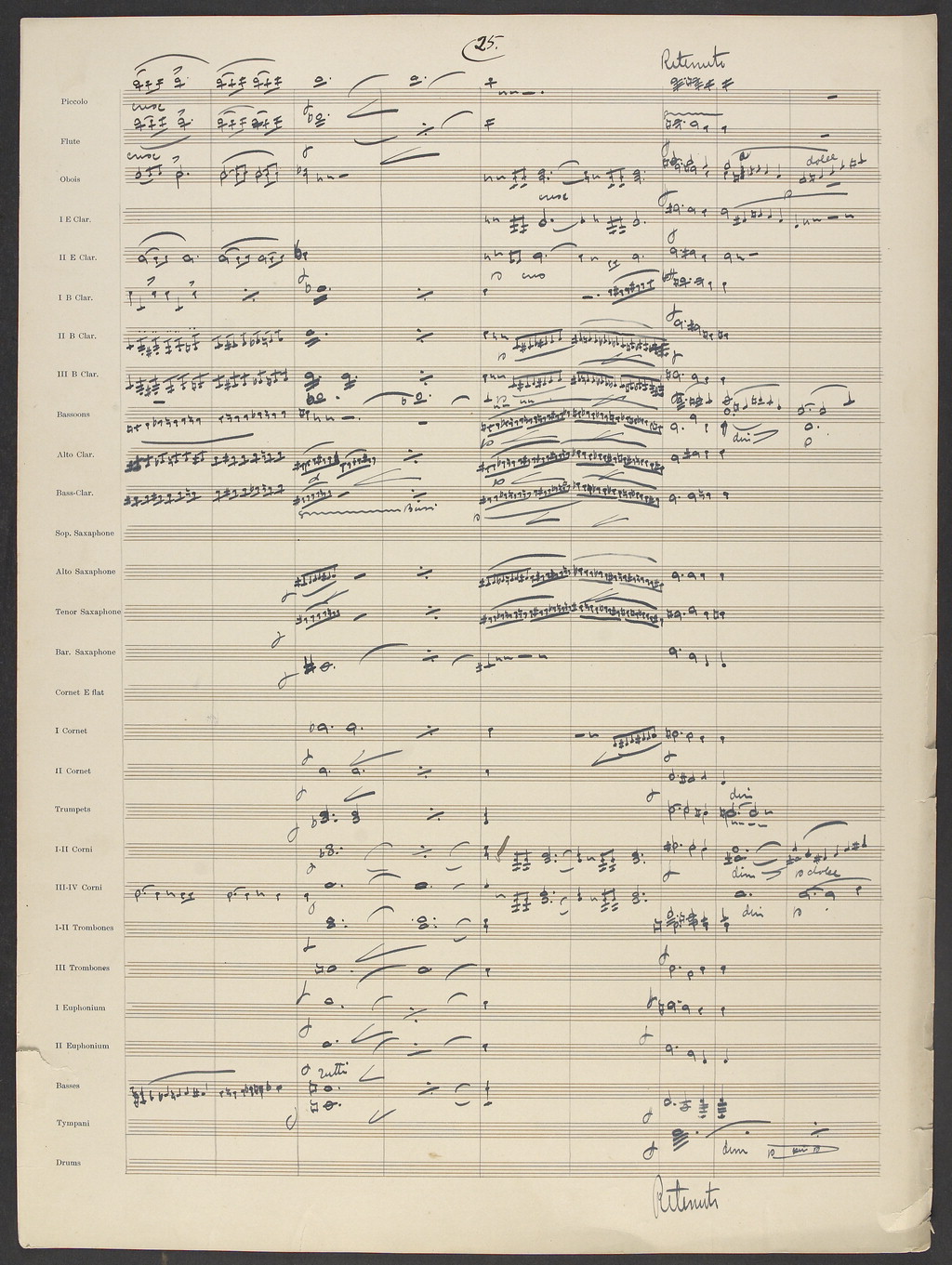
John Philip Sousa's manuscript arrangement of Richard Wagner's The Flying Dutchman overture (page 25 of 37).

In music, an arrangement is a musical adaptation of an existing composition.[1] Differences from the original composition may include reharmonization, melodic paraphrasing, orchestration, or formal development. Arranging differs from orchestration in that the latter process is limited to the assignment of notes to instruments for performance by an orchestra, concert band, or other musical ensemble.[2] Arranging "involves adding compositional techniques, such as new thematic material for introductions, transitions, or modulations, and endings. Arranging is the art of giving an existing melody musical variety".[3] In jazz, a memorized (unwritten) arrangement of a new or pre-existing composition is known as a head arrangement.[4]

Classical music

[edit]

Arrangement and transcriptions of classical and serious music go back to the early history of classical music.

Eighteenth century

[edit]

J. S. Bach frequently made arrangements of his own and other composers' pieces. One example is the arrangement that he made of the Prelude from his Partita No. 3 for solo violin, BWV 1006.

Bach Partita 3 for Violin Prelude

Bach transformed this solo piece into an orchestral Sinfonia that introduces his Cantata BWV29. "The initial violin composition was in E major but both arranged versions are transposed down to D, the better to accommodate the wind instruments".[5]

Bach Cantata 29 Sinfonia

"The transformation of material conceived for a single string instrument into a fully orchestrated concerto-type movement is so successful that it is unlikely that anyone hearing the latter for the first time would suspect the existence of the former".[6]

Nineteenth and twentieth centuries

[edit]

Piano music

[edit]

In particular, music written for the piano has frequently undergone this treatment, as it has been arranged for orchestra, chamber ensemble, or concert band.[7] Beethoven made an arrangement of his Piano Sonata No. 9 for string quartet. Conversely, he also arranged his Grosse Fuge (one of his late string quartets) for piano duet. The American composer George Gershwin, due to his own lack of expertise in orchestration, had his Rhapsody in Blue arranged and orchestrated by Ferde Grofé.[8]

Erik Satie wrote his three Gymnopédies for solo piano in 1888.

Satie Gymnopedie No. 3 for piano solo

Eight years later, Debussy arranged two of them, exploiting the range of instrumental timbres available in a late 19th-century orchestra. "It was Debussy whose 1896 orchestrations of the Gymnopédies put their composer on the map."[9]

Debussy Gymnopedie 1, arrangement of Satie's Gymnopedie 3.
Debussy Gymnopedie 1, arrangement of Satie's Gymnopedie 3

Pictures at an Exhibition, a suite of ten piano pieces by Modest Mussorgsky, has been arranged over twenty times, notably by Maurice Ravel.[citation needed] Ravel's arrangement demonstrates an "ability to create unexpected, memorable orchestral sonorities".[10] In the second movement, "Gnomus", Mussorgsky's original piano piece simply repeats the following passage:

Mussorgsky Gnomus original bars 19-24
Mussorgsky "Gnomus", original bars 19–25

Ravel initially orchestrates it as follows:

Mussorgsky-Ravel "Gnomus", first orchestration

Repeating the passage, Ravel provides a fresh orchestration "this time with the celesta (replacing the woodwinds) accompanied by string glissandos on the fingerboard".[10]

Mussorgsky-Ravel Gnomus, second orchestration
Mussorgsky-Ravel "Gnomus", second orchestration

Songs

[edit]

A number of Franz Schubert's songs, originally for voice with piano accompaniment, were arranged by other composers. For example, his "highly charged" and "graphic" song "Erlkönig" ("The Erl King") has a piano introduction that conveys "unflagging energy" from the start.[11]

Schubert "Erlkönig", piano introduction

The arrangement of this song by Hector Berlioz uses strings to convey faithfully the driving urgency and threatening atmosphere of the original.

"Erlkönig", arrangement by Berlioz

Berlioz adds colour in bars 6–8 through the addition of woodwind, horns, and a timpani. With typical flamboyance, Berlioz adds spice to the harmony in bar 6 with an E flat in the horn part, creating a half-diminished seventh chord which is not in Schubert's original piano part.

"Erlkönig", arrangement by Berlioz

There are subtle differences between this and the arrangement of the song by Franz Liszt. The upper string sound is thicker, with violins and violas playing the fierce repeated octaves in unison and bassoons compensating for this by doubling the cellos and basses. There are no timpani, but trumpets and horns add a small jolt to the rhythm of the opening bar, reinforcing the bare octaves of the strings by playing on the second main beat.

Erl King - arrangement by Liszt opening bars
Erl King – arrangement by Liszt, bars 1–4

Unlike Berlioz, Liszt does not alter the harmony, but changes the emphasis somewhat in bar 6, with the note A in the oboes and clarinets grating against rather than blending with the G in the strings.

Erl King – arrangement by Liszt, bars 5–8

"Schubert has come in for his fair share of transcriptions and arrangements. Most, like Liszt's transcriptions of the Lieder or Berlioz's orchestration for Erlkönig, tell us more about the arranger than about the original composer, but they can be diverting so long as they are in no way a replacement for the original".[12]

Gustav Mahler's Lieder eines fahrenden Gesellen ("Songs of a Wayfarer") were originally written for voice with piano accompaniment. The composer's later arrangement of the piano part shows a typical ear for clarity and transparency in rewriting for an ensemble. Below is the original piano version of the closing bars of the second song, "Gieng heit' Morgen über's Feld".

Mahler Gieng heut' Morgen uber's feld final bars of the piano version
Mahler "Gieng heut' Morgen uber's feld", final bars of the piano version

The orchestration shows Mahler's attention to detail in bringing out differentiated orchestral colours supplied by woodwind, strings and horn. He uses a harp to convey the original arpeggios supplied by the left hand of the piano part. He also extracts a descending chromatic melodic line, implied by the left hand in bars 2–4 (above), and gives it to the horn.

Mahler Gieng heut' Morgen uber's feld final bars of the orchestral arrangement
Mahler "Gieng heut' Morgen uber's feld", final bars of the orchestral arrangement
[edit]

Popular music recordings often include parts for brass horn sections, bowed strings, and other instruments that were added by arrangers and not composed by the original songwriters. Some pop arrangers even add sections using full orchestra, though this is less common due to the expense involved. Popular music arrangements may also be considered to include new releases of existing songs with a new musical treatment. These changes can include alterations to tempo, meter, key, instrumentation, and other musical elements.

Well known examples include Joe Cocker's version of the Beatles' "With a Little Help from My Friends", Cream's "Crossroads", and Ike and Tina Turner's version of Creedence Clearwater Revival's "Proud Mary". The American group Vanilla Fudge and the British group Yes based their early careers on radical rearrangements of contemporary hits.[13][14] Bonnie Pointer performed disco and Motown-styled versions of "Heaven Must Have Sent You".[15] Remixes, such as in dance music, can also be considered arrangements.[16] Gene Kelly once remarked that the most important people in the MGM music department were the arrangers.[17]

Jazz

[edit]

Arrangements for small jazz combos are usually informal, minimal, and uncredited. Larger ensembles have generally had greater requirements for notated arrangements, though Count Basie's early big band is known for its many head arrangements, so called because they were worked out by the players themselves, memorized ("in the player's head"), and never written down.[18] Most arrangements for big bands, however, were written down and credited to a specific arranger, as with arrangements by Sammy Nestico and Neal Hefti for Count Basie's later big bands.[19]

Don Redman made innovations in jazz arranging as a part of Fletcher Henderson's orchestra in the 1920s. Redman's arrangements introduced a more intricate melodic presentation and soli performances for various sections of the big band.[20] Benny Carter became Henderson's primary arranger in the early 1930s, becoming known for his arranging abilities in addition to his previous recognition as a performer.[20] Beginning in 1938, Billy Strayhorn became an arranger of great renown for the Duke Ellington orchestra. Jelly Roll Morton is sometimes considered the earliest jazz arranger. While he toured around the years 1912 to 1915, he wrote down parts to enable "pickup bands" to perform his compositions.

Big-band arrangements are informally called charts. In the swing era they were usually either arrangements of popular songs or they were entirely new compositions.[21] Duke Ellington's and Billy Strayhorn's arrangements for the Duke Ellington big band were usually new compositions, and some of Eddie Sauter's arrangements for the Benny Goodman band and Artie Shaw's arrangements for his own band were new compositions as well. It became more common to arrange sketchy jazz combo compositions for big band after the bop era.[22]

After 1950, the big bands declined in number. However, several bands continued and arrangers provided renowned arrangements. Gil Evans wrote a number of large-ensemble arrangements in the late 1950s and early 1960s intended for recording sessions only. Other arrangers of note include Vic Schoen, Pete Rugolo, Oliver Nelson, Johnny Richards, Billy May, Thad Jones, Maria Schneider, Bob Brookmeyer, Lou Marini, Nelson Riddle, Ralph Burns, Billy Byers, Gordon Jenkins, Ray Conniff, Henry Mancini, Ray Reach, Vince Mendoza, and Claus Ogerman.

In the 21st century, the big-band arrangement has made a modest comeback. Gordon Goodwin, Roy Hargrove, and Christian McBride have all rolled out new big bands with both original compositions and new arrangements of standard tunes.[23]

For instrumental groups

[edit]

Strings

[edit]

The string section is a body of instruments composed of various bowed stringed instruments. By the 19th century orchestral music in Europe had standardized the string section into the following homogeneous instrumental groups: first violins, second violins (the same instrument as the first violins, but typically playing an accompaniment or harmony part to the first violins, and often at a lower pitch range), violas, cellos, and double basses. The string section in a multi-sectioned orchestra is sometimes referred to as the "string choir".[24]

The harp is also a stringed instrument, but is not a member of nor homogeneous with the violin family, and is not considered part of the string choir. Samuel Adler classifies the harp as a plucked string instrument in the same category as the guitar (acoustic or electric), mandolin, banjo, or zither.[25] Like the harp, these instruments do not belong to the violin family and are not homogeneous with the string choir. In modern arranging these instruments are considered part of the rhythm section. The electric bass and upright string bass—depending on the circumstance—can be treated by the arranger as either string section or rhythm section instruments.[26]

A group of instruments in which each member plays a unique part—rather than playing in unison with other like instruments—is referred to as a chamber ensemble.[27] A chamber ensemble made up entirely of strings of the violin family is referred to by its size. A string trio consists of three players, a string quartet four, a string quintet five, and so on.

In most circumstances the string section is treated by the arranger as one homogeneous unit and its members are required to play preconceived material rather than improvise.

A string section can be utilized on its own (this is referred to as a string orchestra)[28] or in conjunction with any of the other instrumental sections. More than one string orchestra can be utilized.

A standard string section (vln., vln 2., vla., vcl, cb.) with each section playing unison allows the arranger to create a five-part texture. Often an arranger will divide each violin section in half or thirds to achieve a denser texture. It is possible to carry this division to its logical extreme in which each member of the string section plays his or her own unique part.

Size of the string section

[edit]

Artistic, budgetary and logistical concerns, including the size of the orchestra pit or hall will determine the size and instrumentation of a string section. The Broadway musical West Side Story, in 1957, was booked into the Winter Garden theater; composer Leonard Bernstein disliked the playing of "house" viola players he would have to use there, and so he chose to leave them out of the show's instrumentation; a benefit was the creation of more space in the pit for an expanded percussion section.[29]

George Martin, producer and arranger for the Beatles, warns arrangers about the intonation problems when only two like instruments play in unison: "After a string quartet, I do not think there is a satisfactory sound for strings until one has at least three players on each line ... as a rule two stringed instruments together create a slight 'beat' which does not give a smooth sound."[30] Different music directors may use different numbers of string players and different balances between the sections to create different musical effects.

While any combination and number of string instruments is possible in a section, a traditional string section sound is achieved with a violin-heavy balance of instruments.

Suggested string section sizes
Reference Author Section size Violins Violas Celli Basses
"Arranged By Nelson Riddle"[31] Nelson Riddle 12 players 8 2 2 0
15 players 9 3 3 0
16 players 10 3 3 0
20 players 12 4 4 0
30 players 18 6 6 0
"The Contemporary Arranger"[32] Don Sebesky 9 players 7 0 2 0
12 players 8 2 2 0
16 players 12 0 4 0
20 players 12 4 4 0

Further reading

[edit]

See also

[edit]

References

[edit]
[edit]
Revisions and contributorsEdit on WikipediaRead on Wikipedia
from Grokipedia
Arrangement in music refers to the of a pre-existing composition to fit a different medium, , or performance context than its original form, often involving modifications to , , or to enhance expressiveness or practicality. This distinguishes itself from mere transcription by allowing creative liberties, such as reharmonization or added embellishments, to reinterpret the work while preserving its core identity. The practice of musical arrangement has deep historical roots, emerging prominently in the as composers and publishers adapted orchestral and operatic works for smaller ensembles like or chamber groups to broaden accessibility and facilitate domestic . By the , arrangements proliferated in , with figures like creating versions of symphonies, reflecting a cultural shift toward versatile music dissemination amid growing print publishing. In the 20th century, innovators like produced elaborate orchestral arrangements of and Romantic works by composers such as Bach and Brahms, effectively recomposing them for modern symphonic forces. This evolution continued into and , where arrangers like shaped iconic recordings by blending genres and , underscoring arrangement's in revitalizing familiar material. Key aspects of musical arrangement include decisions on instrumentation, which determines timbre and texture; harmonic alterations to refresh emotional impact; rhythmic and tempo adjustments for stylistic fit; and overall form to guide narrative flow. These elements collectively transform a composition's presentation, making arrangement essential across genres—from classical transcriptions for study to contemporary productions enhancing recordings—while navigating copyright considerations when adapting protected works.

Fundamentals

Definition and Purpose

In music, an arrangement is the of an existing composition through the selection, combination, and modification of its core elements—such as , , , and —to fit specific performers, ensembles, venues, or interpretive goals while preserving the work's essential character. This process often involves decisions on , , dynamics, and structural form to create a fresh yet recognizable version of the original. Unlike composition, which originates new material, arrangement reinterprets established music, ranging from minor adjustments to substantial elaborations. The primary purposes of musical arrangement include enhancing the expressiveness of a piece by tailoring its emotional depth and narrative flow to suit the medium or , adapting works for instruments or voices not originally intended, and introducing variety to prevent repetitive performances of the source material. By influencing and texture, arrangements can amplify the music's impact, evoking specific moods or highlighting that might be subdued in the original. Ultimately, this practice allows composers and performers to extend the life of a work across diverse contexts, fostering innovation without altering its fundamental identity. The term "arrangement" entered musical lexicon in the , derived from the French word denoting or ordering, and initially overlapped with "transcription" to describe adaptations like keyboard reductions of orchestral scores. Over time, it evolved to emphasize creative reinterpretation beyond mere copying. For example, simple arrangements might involve transposition—shifting the key to accommodate a singer's range—while more elaborate ones entail full re-orchestration, such as Johann Sebastian Bach's harmonizations of melodies, where he added intricate four-part vocal textures to preexisting tunes for use in cantatas and organ works.

Core Principles

Core principles of musical arrangement revolve around adapting and enhancing the essential components of a composition to suit specific ensembles and expressive goals. Melody adaptation involves reshaping the primary theme to fit instrumental ranges and timbres, such as transposing lines to cellos for lyrical depth or doubling with for added , ensuring the line retains its contour while gaining new color. Harmonic progression provides structural support, employing close or open voicings based on instrument overtones—strings favor rich, clustered harmonies, while suits block chords for climactic reinforcement—progressing through cycles like movements by fifths and sevenths to maintain tonal coherence. Rhythmic variation introduces or accent shifts via , with drums and bass establishing groove through slash notation and idiomatic articulations like in , preventing monotony. Textural layering builds density from sparse unisono to full , using for interplay, while dynamic contrast employs crescendos and terraced levels to heighten emotional arcs. Balance and proportion form the bedrock of effective arrangements, ensuring no single element overwhelms the whole through principles of unity and variety. Unity arises from consistent motivic development and , where melodies connect logically via stepwise motion or passing tones, fostering cohesion across sections. Variety counters repetition by alternating textures—thin accompaniments for melodic clarity versus dense homophonic blocks—and timbral shifts, such as juxtaposing sustains with percussive stabs, to sustain listener engagement without disrupting formal flow. Proportion demands careful distribution, like maintaining a 2:3 in sections relative to , to achieve acoustic equilibrium and prevent bass-heavy imbalances. Instrumentation choices emphasize matching timbres to the intended mood, with homogeneous groups like saxophones for blended warmth in intimate passages or heterogeneous combinations such as and vibes for ethereal contrast. Doubling reinforces lines—octave unisons in for power or heterophonic variations in strings for subtle enrichment—while basic introduces independent voices, like inner pedal tones in sections, to add depth without clutter. Structural forms guide the overall architecture, adapting source material like lead sheets into verse-chorus frameworks for popular styles, where verses build tension through sparse textures and choruses expand to tutti for release, or through-composed layouts for narrative-driven works that evolve continuously without strict repetition. Strophic arrangements, by contrast, repeat a fixed form with varying embellishments, such as escalating harmonic substitutions, to highlight thematic unity. Practical guidelines begin with analyzing a for core melody, , and , then layering via —bass outlining roots, providing comping chords—before integrating horns and strings for color. Finalization involves adding cues for entrances, dynamics, and articulations, ensuring idiomatic playability and a tension curve that peaks strategically, often around 60-70% of the form's length.

Historical Development

Pre-20th Century

The origins of musical arrangement trace back to ancient and medieval practices, where adaptations of monophonic laid the groundwork for polyphonic developments. During the , emerged as a form of arrangement by adding one or more parallel voices—often at the interval of a fourth or fifth—to existing melodies, creating the earliest notated around the 9th to 12th centuries at institutions like the Cathedral of Notre-Dame in . By the 13th century, polyphonic s evolved as more elaborate arrangements, layering texted upper voices over a derived from fragments ( motet), allowing for rhythmic complexity and contrapuntal interplay while preserving the sacred source material. These adaptations were not mere copies but interpretive expansions, adapting vocal for liturgical or educational use in monastic and cathedral settings. In the and eras, arrangement practices advanced through keyboard intabulations of vocal works and the realization of . composers and performers frequently intabulated polyphonic vocal pieces—such as madrigals or lute songs—for keyboard instruments like the organ or , transcribing multi-voice ensembles into idiomatic solo formats to facilitate private study or performance; for instance, Antico's 1517 publication Frottole intabulate arranged frottola songs for keyboard, emphasizing melodic lines with ornamental flourishes. This practice continued into the , where keyboard arrangements of vocal works, including arias and motets, became common, often incorporating diminutions and variations to suit the instrument's expressive capabilities. realization further exemplified arrangement, as performers improvised harmonic accompaniments from lines in vocal and instrumental scores, filling out textures with chords and ; in works by composers like , this involved adapting sparse notations into full realizations for ensembles, blending literal support with creative embellishment. The 18th-century Classical period saw arrangements focused on piano reductions and chamber adaptations, enabling domestic performance of orchestral works. Wolfgang Amadeus Mozart produced piano reductions of his own symphonies, such as the four-hand piano score of Symphony No. 40 in G minor (K. 550), condensing orchestral parts into playable formats for study, rehearsal, or salon concerts, a practice that democratized access to symphonic music amid the era's growing culture. adaptations also proliferated, rearranging symphonies for intimate chamber settings to highlight thematic dialogues among instruments, reflecting the period's emphasis on clarity and balance in musical discourse. Key figures like Johann Sebastian Bach and exemplified innovative arrangements bridging and Classical styles. Bach transcribed several of Antonio Vivaldi's violin concertos for solo organ, such as the Concerto in A minor (BWV 593, after Vivaldi's RV 522), adapting string textures to the organ's registration and pedalwork while preserving forms and adding idiomatic flourishes, a process he undertook around 1713–1714 to study Italian concerto techniques. , in turn, oversaw or influenced chamber versions of his symphonies, such as Ferdinand Ries's arrangement of the Symphony No. 3 (Eroica), which reduced orchestral forces to emphasize contrapuntal intimacy and were popular in 19th-century Viennese salons. The 19th-century Romantic period marked a shift toward interpretive freedom in arrangements, particularly through piano transcriptions of orchestral and operatic works. Franz Liszt pioneered elaborate piano transcriptions of Beethoven's symphonies, such as his version of Symphony No. 9 (S. 464), transforming orchestral grandeur into virtuosic solo piano idioms with added octaves, arpeggios, and thematic expansions to evoke symphonic timbre on the keyboard; these were composed between 1837 and 1861 and performed in recitals to popularize Beethoven's music. Liszt's opera paraphrases, like those on themes from Bellini's Norma (S. 394), further exemplified this evolution, freely reworking arias and ensembles into fantasia-like structures with improvisatory passages and harmonic liberties, moving beyond literal transcription to creative reinterpretation that prioritized pianistic expression and narrative drama. This transition from faithful replication to artistic license reflected broader Romantic ideals of individualism, influencing subsequent arrangers by elevating transcription to a compositional art form.

20th Century and Beyond

In the early , the emergence of recording technology transformed musical arrangements by enabling the capture and dissemination of complex orchestrations beyond live performance venues. In Broadway productions, exemplified this evolution through his innovative orchestrations that integrated rhythms, inflections, and symphonic elements, as seen in shows like Lady, Be Good! (1924) and (1924), which were adapted for both stage and early recordings to highlight melodic accessibility and ensemble interplay. These arrangements bridged popular and classical idioms, setting a precedent for technology-driven composition in American musical theater. The 1920s marked a key period of standardization in arrangements, as ensembles expanded from smaller New Orleans groups to 14–16-piece orchestras, incorporating scored sections for reeds, , and rhythm to support call-and-response patterns, riffs, and improvised solos. Pioneers like , whose orchestra formed in 1924, and , with his Washingtonians starting in 1923, developed these formats through works such as Henderson's "The Stampede" (1926) and Ellington's "Black and Tan Fantasy" (1927), which formalized syncopated rhythms and sectional writing for dance halls and recordings. This standardization facilitated the genre's growth amid the migration of Southern musicians to urban centers like and New York, blending and folk traditions into structured yet flexible arrangements. Post-World War II developments in the mid-20th century expanded arrangements into film scores and radio broadcasts, where composers adapted music to narrative pacing and technological constraints like mono audio. In film, Bernard Herrmann's string-only score for Psycho (1960) used tremolo and arco techniques for psychological tension, while Miklós Rózsa's epic orchestration for Ben-Hur (1959) incorporated researched ancient modes with a full symphony to evoke historical grandeur over three hours. Radio adaptations, particularly in postwar Germany, gave rise to Funkoper (radio opera), an intimate genre born from destroyed theaters, featuring scaled-down arrangements for voice and minimal ensembles broadcast directly to homes, as in early 1950s productions that emphasized dialogue integration and spatial effects via single microphones. These media-driven forms prioritized emotional immediacy and reproducibility, influencing global arrangement practices amid cultural reconstruction. A pivotal technological advancement was , pioneered by in the late 1940s using to layer sounds independently, which revolutionized arrangements by allowing overdubs and isolated processing of elements like vocals and instruments. This technique enabled richer, more intricate textures without requiring simultaneous performance, as demonstrated in Paul's 1948 recordings where guitar lines were stacked for depth. By the 1960s, the adoption of four-track machines at studios like amplified this impact; , under producer , exploited it for experimental arrangements, such as splicing disparate takes and speeds in "" (1967) or inventing Artificial Double Tracking for vocals, turning the studio into a compositional space that blended live and manipulated elements. These innovations democratized complex layering, shifting arrangements from fixed scores to fluid, post-production constructions. In the late , the origins of sampling and remixing reshaped arrangements in hip-hop, emerging in the as producers used devices like the and to loop and manipulate fragments from , , and records into new beats and textures. Albums like the ' Paul's Boutique (1989) layered hundreds of samples into dense collages, creating rhythmic foundations and atmospheric hybrids that bypassed traditional instrumentation. This approach, rooted in DJ culture, fostered a DIY ethic and genre fusion but faced legal challenges, as in the 1991 Gilbert vs. Biz case, which curtailed unlicensed use and professionalized sampling techniques. The has seen drive fusion arrangements in , blending Western and non-Western traditions through intercultural hybrids that reflect migration, digital exchange, and postcolonial dialogues. Composers like have pioneered such works, as in (1994) for and , which integrates gestures with Western and spatial acoustics, or Symphony 1997 incorporating sheng and with orchestral forces to symbolize Hong Kong's . Similarly, Toshiro Mayuzumi's Bugaku (1962, influential into the 2000s) fuses Japanese with , while contemporary ensembles like Yo-Yo Ma's project create arrangements hybridizing Central Asian and with symphony, promoting transnational identity through live electronics and improvisation. These fusions challenge cultural boundaries, often drawing on philosophical frameworks like Homi Bhabha's "third space" to critique and foster inclusive musical narratives amid super-diversity.

By Musical Genre

Classical Music

In the Western classical tradition, arrangements have played a crucial role in adapting works across ensembles while adhering to period-specific stylistic conventions. During the , the emphasized melodic simplicity, clarity, and elegant phrasing in , often influencing reductions of larger forms to intimate settings. Composers like and early Haydn incorporated galant principles into chamber arrangements, prioritizing light textures and balanced dialogues among instruments to evoke courtly refinement, as seen in reductions of operatic arias or sinfonias for string quartets or keyboard ensembles. This approach contrasted with the denser of the , focusing instead on graceful, homophonic structures that facilitated domestic performance. The 19th-century Romantic era expanded arrangement techniques through lush orchestration and thematic development, particularly in adaptations involving leitmotifs. Richard Wagner's innovative use of leitmotifs—recurring musical themes associated with characters, ideas, or objects—lent itself to rearrangements that preserved dramatic continuity, such as orchestral excerpts or piano versions of his Ring cycle motifs. These adaptations, like those extracting leitmotifs for concert suites, maintained the psychological depth of Wagner's by reorchestrating themes for smaller forces while enhancing emotional resonance through expanded harmonic progressions. arrangements of symphonies became a hallmark of this period, with Franz Liszt's solo transcriptions of Beethoven's symphonies (S. 464) capturing orchestral grandeur through virtuoso techniques like octave doublings and arpeggiated figurations, allowing the full symphonic narrative to unfold on a single instrument. Similarly, arranged his own symphonies, such as Nos. 3 and 4, for piano four-hands, distilling complex orchestral layers into playable duets that retained motivic unity and contrapuntal interplay. Song arrangements, particularly of German Lieder, highlighted the tension between intimacy and expansion in classical adaptations. orchestrated nearly 60 Schubert songs, transforming piano-vocal originals into orchestral versions that preserved the vocal line's primacy through subtle instrumental coloration, as in his adaptation of "," where thematic transformation amplified Schubert's melodic contour without overshadowing the singer. followed suit, orchestrating select Schubert Lieder like "Geheimes" and "An Schwager Kronos" in the 1860s, employing reduced strings and winds to evoke the original's emotional nuance while ensuring the voice remained the focal point. Orchestral reductions to piano-vocal scores, common for operas and choral works, demanded meticulous preservation of contrapuntal integrity; arrangers like Singer condensed full scores by prioritizing linear and cueing key instrumental lines, adapting dense into idiomatic keyboard writing without sacrificing structural coherence. In modern classical music, serialist composers like Karlheinz Stockhausen extended arrangement principles through parametric reorganization and instrumental substitutions. Stockhausen's works, such as adaptations from his operas into solo percussion or chamber formats, applied total serialism to rearrange pitches, durations, and timbres, creating variant realizations that honored the original's aleatoric elements while suiting new ensembles, as in his derivations from Licht cycle for diverse instrumental forces. These rearrangements emphasized modular structures, allowing serial formulas to be recomposed for spatial or timbral exploration. A persistent challenge in classical arrangements involves balancing fidelity to the composer's intent with practical adaptations for smaller forces. Reductions often require redistributing contrapuntal lines and timbres—such as mimicking orchestral brass with clusters or sustains with pedal effects—while avoiding dilution of thematic clarity, as evidenced in chamber versions of Stravinsky's , where dominance is preserved through selective voicing to maintain character associations. Similarly, Mahler symphony excerpts for nonet demand dynamic adjustments and extended techniques to replicate dramatic swells, ensuring the evokes the original's scale without full orchestral resources. Arrangers must navigate these constraints to uphold harmonic progression and motivic integrity, often drawing on core principles like to bridge the gap between conception and performance. In , arrangement involves structuring songs to maximize commercial appeal and emotional impact, often prioritizing catchy, repeatable elements over complex . The verse-chorus form dominates, where verses advance the with varying and melodies, while choruses deliver —a memorable, repetitive —for broad . Arrangements typically build by adding an intro to establish mood, pre-choruses for tension buildup, bridges for contrast and variety, and outros for resolution, creating a balanced arc that sustains listener engagement across 3-4 minutes. Instrumentation in pop and rock arrangements evolved from simple guitar-vocal setups in the to layered full-band configurations by the , incorporating multiple guitars for rhythmic and harmonic depth, bass for groove foundation, drums for drive, and auxiliary elements like keyboards or percussion. In 1960s rock, producers layered overdubs—such as doubled guitars and backing vocals—to create dense textures, enhancing the stereo soundscape without overwhelming the lead melody, as heard in tracks by and . The arranger plays a pivotal role in pop production, shaping demos into polished mixes by selecting timbres, dynamics, and spatial placement to suit radio-friendly formats. Phil Spector's "" exemplifies this, layering multiple guitars, pianos, and orchestral strings with percussion in echo chambers to produce a dense, symphonic density that masked individual instruments for a unified, immersive effect in hits like "" by . Genre variations within pop highlight arrangement's adaptability: ballads emphasize sparse, emotive setups with slow tempos (60-80 BPM) and minor keys for introspection, building gradually through string swells or arpeggios, whereas upbeat tracks use faster tempos (100-130 BPM), major keys, and pulsating rhythms with synths or horns to drive energy and facilitate movement. Key changes often occur in dance arrangements during choruses to heighten , contrasting the static in ballads for lyrical focus. Iconic examples illustrate these techniques; in The Beatles' "Yesterday" (1965), producer arranged a —two violins, viola, and —to underscore Paul McCartney's solo acoustic performance, providing subtle harmonic support and emotional swell without overpowering the vocals. arrangements, meanwhile, featured punchy horn sections—typically two trumpets, tenor sax, and —delivering riff-based stabs and fills to accentuate grooves in upbeat tracks like The Temptations' "" (1966), blending pop accessibility with R&B vitality. Commercially, pop arrangements shifted from the sheet music era of the early , where publishers distributed lead sheets for live performances, to MIDI-based sketching in the onward, enabling of multi-track layers on digital workstations for cost-effective demos and global distribution. This transition democratized production, allowing arrangers to iterate virtual ensembles before studio commitments, influencing the polished, hook-driven sound of modern pop.

Jazz

In jazz, arrangements serve as flexible frameworks that balance composed elements with improvisation, enabling ensemble coordination while allowing soloists freedom to interpret melodies and harmonies spontaneously. Unlike more rigid structures in other genres, jazz arrangements often prioritize interactive dynamics, where the written score supports collective expression and rhythmic interplay among musicians. This approach emerged prominently in the early 20th century, adapting African American musical traditions like call-and-response into orchestral formats for larger groups. Head charts and lead sheets form the foundational tools for many jazz arrangements, providing a notated melody line accompanied by chord symbols to guide group improvisation without dictating every detail. These charts typically include the "head"—the main theme—along with basic cues for form, dynamics, and repeats, allowing performers to collectively realize the arrangement on the spot, as seen in Count Basie's loosely organized head arrangements that emphasized rhythmic flexibility. Lead sheets promote efficiency and creative liberty, serving as concise blueprints for combos where musicians build upon the core structure through spontaneous interaction. Big band arrangements in jazz expanded on sectional writing, dividing the ensemble into brass, reed, and rhythm sections to create layered textures and antiphonal effects. pioneered these innovations in the 1920s and 1930s by breaking bands into distinct sections for precise execution and call-and-response patterns, which fostered interaction between soloists and the ensemble while establishing swing-era standards. further refined this through unique voicings that blended brass and reeds unconventionally, producing rich timbres and harmonic depth, as in his compositional style that treated the orchestra as a collective voice rather than isolated parts. In small combos, the arranger's role shifts toward enhancing intimacy and dialogue, often collaborating closely with performers to craft subtle backdrops for extended solos. exemplified this in his work with Miles Davis's nonet for the 1949–1950 sessions, where arrangements like "Boplicity" and "Moon Dreams" used innovative voicings and sparse ensembles to create atmospheric support, drawing from pop and sources for a chamber-like that prioritized over dense . These setups highlight the arranger's function as a re-composer, adapting material to the group's improvisational strengths. Key techniques in jazz arrangements include call-and-response, where sections or soloists alternate phrases to build energy; harmonic substitutions, such as or diatonic replacements, to add tension and variety within chord progressions; and rhythmic comping by , which provides syncopated accents and chordal punctuations to propel solos without overpowering them. Comping, in particular, relies on guide-tone voicings and interactive phrasing to maintain groove, often incorporating passing chords for fluid transitions. These methods ensure arrangements remain dynamic, supporting improvisation while maintaining cohesion. The evolution of jazz arrangements reflects stylistic shifts, from the standardized sectional formats of the swing era's big bands in the 1930s–1940s, which emphasized danceable rhythms and full ensembles, to the lighter textures of in the , featuring smaller groups and subtler harmonies for introspective expression. This transition, influenced by bebop's complexity, favored arrangements with open spaces for improvisation, as in the nonet formats that reduced density while preserving harmonic sophistication. In modern nu-jazz fusions, arrangements integrate electronic elements like sampling and sequencing to create hybrid backdrops, allowing acoustic improvisation over programmed beats, as pioneered by artists like and Dave Douglas in works blending drum 'n' bass with traditional forms.

For Ensembles and Instruments

Orchestral and Large Groups

Arranging for symphonic orchestras and big bands involves careful section balancing to achieve sonic cohesion across large-scale instrumentation. The string section typically features 16 first violins, 14 second violins, 12 violas, 10 cellos, and 8 double basses, forming the core volume and sustain of the ensemble. Woodwinds integrate by providing agile melodic lines and harmonic fills in the mid-to-upper registers, brass contribute foundational support and climactic power in lower ranges, and percussion adds rhythmic punctuation and textural accents, with all sections calibrated to prevent dominance while enhancing overall transparency. Orchestration principles emphasize range distribution to optimize each instrument's idiomatic capabilities, avoiding overcrowding in shared registers and ensuring tessituras align with natural tone production for clarity and expressivity. Blend is pursued through compatibility, such as pairing similar across sections for seamless fusion, whereas contrast highlights motivic or structural shifts via oppositional colors, like piercing brass against veiled strings. exemplified coloristic approaches by manipulating timbres to evoke illusions—transforming a horn into a clarinet-like blend or fusing and to mimic a —thus prioritizing perceptual effects over literal . Adaptations for large ensembles often transform into orchestral forms by expanding textures through sectional layering and dynamic gradation, passing melodies across strings, woodwinds, and to build emotional arcs, as demonstrated in video game theme arrangements like "Fountain of Dreams," where rhythmic percussion underscores evolving harmonies. Film cues leverage full resources for narrative immersion, with Hollywood studio orchestras employing expansive forces to craft thematic motifs and atmospheric underscoring, evident in scores like those for Avatar and , where integrated sections amplify dramatic tension. Challenges in these arrangements include logistical demands of coordinating 80–100 musicians across rehearsals and venues, necessitating precise scheduling to manage , setup, and union regulations. Cueing poses additional hurdles for conductors, requiring notation that signals entrances clearly amid dense , often relying on principal players for sectional to mitigate synchronization issues in live performances. Notable examples include Igor Stravinsky's arrangements, such as Pulcinella (1919–20), which reorchestrates Pergolesi arias for a large ensemble, blending historical with modern timbres through witty sectional dialogues between woodwinds and strings. Hollywood studio orchestras further illustrate this in film scoring, as in John Williams' Star Wars suite adaptations, where fanfares and percussion ostinatos integrate with sweeping strings to evoke epic scope. Notation for large groups distinguishes the full score, which compiles all instrumental lines in vertical alignment for the conductor's overview of contrapuntal interplay and balance, from extracted parts, which provide standalone excerpts tailored to each player's focus during readings. This format supports rehearsal efficiency, with cues in parts referencing adjacent sections to aid blend and timing.

Chamber and Small Groups

Arrangements for chamber and small groups, typically involving 3 to 10 players such as string quartets or woodwind quintets, prioritize the equitable distribution of musical lines to foster collaborative interplay among performers. Unlike larger ensembles, part assignment emphasizes independence and equality, where each instrument receives melodic, harmonic, or rhythmic responsibilities without hierarchical dominance, ensuring no player is relegated to mere . This approach, rooted in the "one player per part" principle, allows for nuanced dialogue and requires arrangers to balance technical demands across instruments while respecting their idiomatic ranges and timbres. Texture management in these settings relies heavily on to achieve density and expressiveness with limited forces, weaving independent lines that interlock to create intricate . exemplified this in his string quartets, such as (1927), where motifs are proposed and countered across voices, resulting in a complex, passionate interplay that highlights the equality of parts in a continuous, seamless structure. Adaptations often reduce orchestral works for chamber scale—Arnold Schoenberg's Chamber Symphony No. 1 (1906), originally for 15 players, demonstrates economical that condenses symphonic gestures into intimate textures—or expand pieces into ensembles, redistributing chords and figures idiomatically to exploit timbral contrasts. Acoustic considerations are paramount, as these unconducted groups depend on natural balance and direct communication; room acoustics must provide clarity with shorter times than those for halls (typically 1.5–2.0 seconds), often around 1.0–1.5 seconds, to support rhythmic precision and prevent muddiness, while early reflections aid cohesion without amplification. Modern examples include the Kronos Quartet's crossover arrangements, which adapt diverse global and contemporary works for strings, incorporating extended techniques to maintain textural vitality in small forces. Notation for such arrangements features detailed, self-contained parts with minimal doubling to preserve transparency and avoid redundancy, often including cue notes for continuity during rests. Historical developments in , as explored in pre-20th century practices, laid the groundwork for this emphasis on intimate equality.

Vocal and Choral Arrangements

Vocal arrangements require careful consideration of singers' ranges and tessitura to ensure comfort and expressiveness. The tessitura refers to the portion of a singer's range where they can perform most comfortably and with optimal tone quality, distinct from the full vocal range which encompasses the lowest and highest sustainable notes. In choral settings, arrangements typically divide voices into soprano (high female or boy, range approximately C4 to A5, tessitura F4 to F5), alto (low female or boy, E3 to E5, tessitura A3 to D5), tenor (high male, C3 to A4, tessitura F3 to C4), and bass (low male, E2 to E4, tessitura A2 to E3), allowing adaptation of melodies to fit these categories while incorporating divisi for larger choirs to distribute vocal load. For solo vocal arrangements, such as art song cycles, composers select tessituras that highlight the performer's strengths, often centering the melody in the middle of the range to maintain lyrical flow. Harmonic support in vocal arrangements emphasizes voicings or that complements the voice without overpowering it. In settings, close-position voicings—such as triads or seventh chords spaced within an —provide dense, resonant , while open voicings spread parts over larger intervals to enhance clarity and tuning, particularly in unaccompanied choral works. prioritizes smooth, conjunct motion between chords, avoiding parallel fifths or to maintain part independence, and resolving dissonances like the leading tone upward to the tonic for harmonic stability. For accompanied solos, or other instruments often serve as an obbligato line, weaving around the vocal to underscore textual emotions, as seen in art songs where the mirrors themes of through motifs like trills or silences. Choral arrangements focus on balancing parts to achieve a unified , with techniques like contrary motion between and bass for structural support and stepwise resolution of leaps greater than a third to ensure singability. Antiphonal effects, such as call-and-response between sections, add dynamic contrast, while text-driven phrasing aligns harmonic shifts with poetic stresses to enhance and breath flow. Considerations include inserting breath marks at natural pauses to accommodate ensemble phrasing and integrating clear vowel shapes for precise enunciation, preventing muddiness in dense voicings. In jazz choral contexts, drop-2 voicings and neutral syllables like "doo" facilitate scatting and riffing, imitating textures while preserving vocal naturalness. Representative examples illustrate these principles across styles. Gospel choir arrangements often employ block triads and passing diminished chords for rhythmic drive and emotional intensity, stacking voices in close to evoke communal uplift, as in traditional arrangements of . Barbershop harmony features the lead carrying the with above, baritone filling inner voices, and bass providing root motion, using swipes (rapid chromatic shifts) and symmetrical chord progressions for signature resonance, without doubling the lead to preserve clarity. Modern pop vocal stacks, common in groups, layer leads with and harmonies in parallel thirds or sixths, building to full choral climaxes while adhering to comfortable tessituras for layered production effects.

Contemporary Applications

Film and Media Scoring

Arrangement in and media scoring focuses on crafting musical cues that synchronize with visual narratives, enhancing emotional depth and through precise timing and thematic integration. Composers create cue sheets that detail the start and end times of each musical segment, aligned to specific scene beats such as character entrances or action peaks, ensuring the music supports rather than distracts from the visuals. These sheets often incorporate sync points—hard alignments like explosions or soft ones like subtle gestures—to dictate the structure and length of cues, allowing arrangements to adapt dynamically to the 's rhythm. Leitmotifs play a central role in these arrangements, serving as short, recurring themes tied to characters, locations, or ideas that evolve to mirror narrative progression. Arrangers vary these motifs through , , and to reflect emotional or plot developments, fostering subconscious audience recognition and cohesion across the score. For instance, employs leitmotifs in scores like Star Wars, developing themes linearly through symphonic —such as the "Force" motif built via melodic threads and traditional phrasing—to underscore character arcs and thematic unity. Hybrid ensembles expand arrangement possibilities by blending orchestral instruments with electronic elements, creating layered textures that amplify a film's atmosphere, from epic tension to futuristic unease. In modern superhero scores, such as Ludwig Göransson's work on (2018), arrangements fuse a 92-piece and 40-person with African instruments like the kora and electronic trap beats, using leitmotifs (e.g., T'Challa's horn-driven theme) to delineate character conflicts and cultural duality. This hybrid approach draws on orchestral techniques like dynamic layering while incorporating synthesized sounds for contemporary narrative enhancement. Temp tracks—pre-existing music temporarily edited into rough cuts—guide final arrangements by demonstrating desired pacing and mood, prompting composers to adapt similar stylistic elements to the film's edit. Directors and editors compile these tracks from other scores to test scene flow, influencing cue durations and transitions before original composition begins. Post-production refinements occur during spotting sessions, collaborative meetings where composers and directors identify cue placements and emotional hit points, followed by iterative tweaks like adding layers of to build tension or resolve arcs. These sessions use timecodes to mark precise alignments, enabling arrangers to layer motifs or adjust densities for heightened dramatic impact, such as swelling strings during climactic reveals. A seminal example is Bernard Herrmann's arrangement for Psycho (1960), which employs an all-string to evoke psychological dread, with high-pitched, shrieking clusters synchronized to the shower scene's stabs for visceral intensity; later editions, like the Mauceri adaptation, reorder and recompose cues into a cohesive string narrative. Industry standards emphasize mockups as a bridge from composition to , where virtual instruments simulate full arrangements to verify timing, balance, and emotional delivery before transitioning to live orchestral recordings. These mockups, created with professional sample libraries and DAWs, allow for rapid revisions in spotting and layering, ensuring the final score meets production deadlines while emulating acoustic realism through techniques like articulation mapping and spatial mixing.

Digital and Electronic Production

Digital and electronic production has transformed music arrangement by leveraging software tools to create layered, dynamic compositions without traditional . Digital audio workstations (DAWs) like and enable producers to arrange tracks through non-linear workflows, where clips and loops are manipulated in real time to build structures. In DAW-based workflows, arrangement involves layering virtual instruments to construct harmonic and rhythmic foundations. For instance, in , producers assemble song layouts along a timeline by duplicating and varying musical ideas, such as stacking synth layers for evolving textures. Similarly, Logic Pro's Live Loops grid allows real-time triggering of phrases, transitioning to linear arrangement in the Tracks area, where Track Stacks consolidate multiple virtual instruments like synthesizers and samplers into unified layers. This approach facilitates iterative experimentation, with virtual instruments from libraries providing instant access to diverse sounds, reducing reliance on physical recording sessions. MIDI orchestration further enhances digital arrangements by programming precise control over virtual ensembles. Producers use MIDI data to dictate note velocities, durations, and articulations, simulating dynamic performances that mimic acoustic instruments. In electronic contexts, automation curves in DAWs like automate parameters such as volume fades or filter cutoffs to create builds—gradual tension rises via high-pass filters—and drops, where abrupt spikes in reverb or deliver release. For example, binary on/off automation signals section changes, ensuring rhythmic drive in genres like EDM. Electronic timbres form the core of these arrangements, achieved through synth patches and sampling that rearrange sonic elements for novel effects. generates dynamic timbres by cross-fading stored waveforms, allowing interpolation for smooth shifts independent of pitch. Subtractive synthesis employs voltage-controlled filters (VCFs) with ADSR envelopes to sculpt , evolving patches from muted to resonant during builds. Sampling rearrangements, such as in EDM drops, involve looping and time-stretching audio segments—e.g., chopping vocal or percussive samples into rhythmic motifs—while phase-aligned looping prevents clicks for seamless integration. Hybrid digital-acoustic arrangements blend these electronic methods with live elements, integrating organic recordings into looped structures for added expressiveness. Techniques include layering or samples over synth beds, using to trigger electronic responses from live inputs, or processing acoustic recordings with pitch-shifting for textural depth. This fusion, as in ' "Clair de Lune," overlays live instrumentation onto electronic loops to evoke spontaneity within structured arrangements. Daft Punk exemplifies sample-based arrangements in electronic production, particularly on their 2001 album Discovery, where micro-chops and layered samples from and sources create dense, evolving tracks. In "One More Time," they rearrange a cleared sample from ' "More Spell On You" into a looping vocal , augmented by chase samples for harmonic progression. Tracks like "Face To Face" employ multiple unidentified samples, sliced and automated for builds that culminate in filtered drops. Chiptune evolutions highlight early digital arrangement constraints turned into stylistic strengths, originating from limited sound chips in 1980s video game hardware. Arrangements relied on and simple arpeggios for melodic density, evolving into modern software emulations that layer timbres with contemporary effects for nostalgic yet complex builds. The evolution of these tools traces from 1980s MIDI sequencers, like , which enabled basic note sequencing on early computers, to 1990s DAWs such as for multi-track editing. By the 2000s, introduced clip-based real-time arrangement, democratizing electronic production. AI-assisted methods, such as those in AIVA (developed since 2016), automate harmonic suggestions and arrangement structuring to enhance efficiency while preserving creative intent. More recent advancements as of 2025 include generative AI tools like Suno (launched 2023) and Udio (launched 2024), which create full song arrangements—including vocals, instrumentation, and structure—from text prompts, further streamlining digital production workflows.

References

Add your contribution
Related Hubs
User Avatar
No comments yet.