


Community hub
Recent from talks
Contribute something
Nothing was collected or created yet.
Bathurst 12 Hour
View on Wikipedia
 | |
 | |
| Intercontinental GT Challenge | |
|---|---|
| Venue | Mount Panorama Circuit |
| Corporate sponsor | Meguiar's |
| First race | 1991 |
| First IGTC race | 2016 |
| Last race | 2026 |
| Duration | 12 Hours |
| Most wins (driver) | John Bowe (3) Jules Gounon (3) |
| Most wins (manufacturer) | Mazda Mercedes-AMG (4) |
The Bathurst 12 Hour, currently known as the Meguiar's Bathurst 12 Hour for sponsorship reasons, is an annual endurance race for GT and production cars held at the Mount Panorama Circuit, in Bathurst, Australia. The race was first held in 1991 for Series Production cars and moved to Sydney's Eastern Creek Raceway in 1995 before being discontinued.[1] The race was revived in 2007, again for production cars, before adding a new class for GT3 and other GT cars in 2011. This has led to unprecedented domestic and international exposure for the event. In all, twenty one races have taken place; twenty at Mount Panorama and one at Eastern Creek Raceway (Sydney Motorsport Park).
Background
[edit]The event was inspired by the long-running Bathurst 500 production car race, which began at the Phillip Island Grand Prix Circuit in Victoria in 1960 (before moving to Bathurst in 1963) as a race for standard production cars with minimal modifications. In 1973 when the race was lengthened from 500 miles to 1000 kilometres, the regulations for cars entering the race changed from standard "series production" cars to improved touring cars. The Bathurst 12 Hour was intended to re-create the original feel of the Bathurst 1000, while providing a unique test in the longer race distance, rather than replicating the 1000 kilometre event.[2]
History
[edit]


Production origins
[edit]In 1990, Vincent Tesoriero, a race promoter and former Bathurst 1000 competitor, looked at the decline of Group A touring cars in Australia and saw an opportunity to run a 12-hour endurance race for Series Production cars at Mount Panorama. Tesoriero secured long time Bathurst 1000 sponsor James Hardie as a sponsor for the event in late 1990, leaving limited time to launch and organise the event for the Easter weekend in 1991.[2] The race regulations were based on the Group 3E Series Production Car rules then in use in the Australian Production Car Championship for naturally aspirated four- and six-cylinder passenger sedans, but also allowed turbocharged and V8-engined cars which had been outlawed from the Production Car Championship in 1990. Despite the short deadline, twenty-four cars were entered for the first race, spread over six different classes based on engine capacity and sporting specification.[3] Exotic mid-engined sports cars and GT cars were not eligible to enter.
The race was originally scheduled to run from 9am to 9pm but this was disallowed by Bathurst Regional Council. The race would instead run from 5:15am to 5:15pm, with the final two hours televised by Network Ten.[2] Despite the event's length, the competitors proved extremely reliable, with twenty cars finishing the race. The race was won by Allan Grice, Peter Fitzgerald and Nigel Arkell racing Fitzgerald's 1989 Production Car Championship specification Toyota Supra Turbo.[3]
In 1992, manufacturer-backed teams began to appear with large teams entered and funded by Mazda, Holden, Citroën and Peugeot. Porsche would also provide factory support from 1993 onwards. Honda, Nissan, Maserati, BMW and Lotus were also represented but not by factory-supported teams. The Mazda team would go on to dominate the event with the Mazda RX-7, winning the next three consecutive races at Mount Panorama.[2]
Facing rising costs, the 1995 event was moved from Bathurst to Eastern Creek Raceway in Sydney, and from the Easter weekend to August, before the race was discontinued in 1996.[2]
Hiatus
[edit]After no major race for production cars for a number of years, the concept was revived with the short-lived Bathurst 24 Hour races in 2002 and 2003. The races were run by Nations Cup owners PROCAR and were dominated by the Holden Monaro 427Cs of Garry Rogers Motorsport. The Bathurst 24 Hour only lasted two years before PROCAR owner Ross Palmer was forced to abandon the race due to rising costs.
Revival
[edit]The Bathurst 12 Hour was successfully revived in 2007 as part of the Bathurst Motorsport Festival[4] While James O'Brien, who masterminded the return of the event, planned for GT cars to share the event with production cars, the return of the race began with regulations close to its original concept as a race for production cars.[2][5] 32 cars were entered for the 2007 race,[6] which was won by Garry Holt, Paul Morris and Craig Baird in a BMW 335i.[7] The win was ten years after Morris and Baird had won the 1997 AMP Bathurst 1000 in a BMW only to later be disqualified for exceeding driver time regulations. The race proved a preview of this period of the race, which saw BMW and Mitsubishi as the main combatants. The 2007 Subaru entry of rally drivers Chris Atkinson, Dean Herridge and Cody Crocker would be the only other manufacturer to finish the race in the top two between 2007 and 2010.[2]
The 2008 and 2009 races were won by Mitsubishi Lancers, with Rod Salmon and Damien White amongst both line-ups. The 2009 race was particularly dominated by Mitsubishi, with the marque finishing in the first four positions.[2] Garry Holt would then repeat his 2007 victory in 2010, driving again with Morris and also with John Bowe. The race was interrupted for an hour after a tree fell across Conrod Straight.[8] The number of entries grew over this production-based period, peaking at 48 in 2009, while the final race held strictly to production car regulations in 2010 attracted 42 entries.[5] During this time, the event itself grew in stature each year, firmly entrenching itself as one of the biggest race meetings at the start of the domestic Australian racing season, along with the Adelaide 500 and the Australian Grand Prix.
International expansion
[edit]In 2011, GT3-specification cars were allowed into the 12 hour race for the first time.[9] Despite this, the number of entries dropped dramatically as many of the production car teams, disillusioned by the move towards GT, decided not to race.[2] Of the 26 cars that competed in 2011, just eight raced in the production car classes, compared with the 42 that made up the full 2010 field.[5][10] The German-based Joest Racing dominated the 2011 event, with the team's two Audi R8 LMS GT3s finishing first and second, a lap ahead of the third-placed Porsche.[11] 2012 saw another small field of just 25 cars. Audi won the race for the second consecutive year, this time with DTM and FIA GT1 team Phoenix Racing.[12]
The 2013 event ended the two-year run of poor entry numbers, with a record field of over 50 cars.[13] Another first for the event saw the opening round of the 2013 Australian GT Championship incorporated into the first hour of the race. The results of the GT Championship round were based on the positions of the cars that had elected to race for GT Championship points at the end of the first hour of racing. Teams could then either continue on and complete the full race, or withdraw their car after the first hour. Drivers were allowed to cross-enter between cars so that they could race one car in the one-hour GT Championship race and then drive another car that was entered for the full 12 hours.[14] Erebus Motorsport took the first win for an Australian team under the GT regulations with German drivers Bernd Schneider, Thomas Jäger and Alexander Roloff taking their Mercedes-Benz SLS AMG to victory.[15]
Maranello Motorsport took a poignant win in the 2014 event—the team's former driver Allan Simonsen was killed in a crash at the 2013 24 Hours of Le Mans—with V8 Supercar driver Craig Lowndes holding off a late charge from German driver Maximilian Buhk to take victory.[16] 2014 also saw the introduction of the Allan Simonsen Pole Position Trophy, named in honour of Simonsen, to be awarded to the fastest car in qualifying.[17] The 2015 race featured a record twenty safety car periods, the last coming just minutes from the end of the race. Katsumasa Chiyo, driving a Nissan GT-R, took the lead with two laps remaining to give Nissan its first major victory at Mount Panorama since the 1992 Bathurst 1000.[18]
In August 2015, the V8 Supercars-owned company Supercars Events purchased 50% of the Bathurst 12 Hour, joining existing part-owners Bathurst Regional Council. This followed a date clash between the 2015 12 Hour and V8 Supercars' 2015 pre-season test day which saw V8 Supercar drivers, such as 2014 12 Hour-winner Lowndes, forced to take part in the test day and be unable to race in the 12 Hour.[19] With an increasing focus on the outright GT3 cars and a dwindling number of production cars in the race, the former organisers of the 12 Hour, Yeehah Events, announced the production car-based Bathurst 6 Hour for 2016, to restore a Bathurst endurance race for the production category. The 6 Hour is now part of the Bathurst Motor Festival at Easter.[20]
Intercontinental GT Challenge
[edit]The 2016 race was the inaugural race of the newly formed Intercontinental GT Challenge, which in its first year also included the Sepang 12 Hours and Spa 24 Hours and is managed by the Stéphane Ratel Organisation.[21] The event itself saw record pace from Shane van Gisbergen in qualifying and the race to lead his Tekno Autosports McLaren 650S GT3 to victory alongside McLaren factory driver Álvaro Parente[22] and Tekno team owner/driver Jonathon Webb.[23] The 2017 event saw the introduction of an all-pro GT3 class for the first time, with the race receiving 55 entries, the highest in the event's revival.[24] In the race itself, Maranello Motorsport repeated their 2014 triumph, with Finnish driver Toni Vilander teaming up with Lowndes and Jamie Whincup to receive the Australian Tourist Trophy, which became the perpetual trophy for the outright winner.[25][26]
The 2018 race finished before the twelve hour duration due to a major crash at Sulman Park involving Ash Walsh, Bryce Fullwood and John Martin which saw Walsh and Martin transported to hospital.[27] This meant that the Audi Sport Team WRT entry of Robin Frijns, Stuart Leonard and Dries Vanthoor took the flag, despite doubts over whether they had the fuel to win the race if there was no disruption.[28] In 2019, the race had unprecedented amounts of green flag running leading to a distance record being set. After dropping from first to fourth in the final pit-stop phase, Matt Campbell completed three overtakes, including one on Chaz Mostert that required a post-race investigation, to take Porsche's first victory in the race alongside Dennis Olsen and Dirk Werner.[29] The 2020 race again broke the distance record with Bentley taking their first victory in the event in six attempts.[30] The field was reduced by five cars prior to the race with several heavy crashes in practice and qualifying.[31]
Impact of COVID-19
[edit]In October 2020, the 2021 race was cancelled, predominantly due to the international travel restrictions caused by the COVID-19 pandemic in Australia.[32] Supercars, part-owners of the event, instead ran the Mount Panorama 500 in February as the opening round of the 2021 Supercars Championship.[33] After further COVID-19 concerns, the 2022 race was delayed from February to May.[34] The 2022 event also featured several major regulation changes, including the removal of the all-professional class for the first time since 2016.[35] Twenty cars entered the race, which featured extended pre-dawn running, cooler temperatures and rolling fog due to the autumn date, plus intermittent rain throughout the day. Having finished second in 2018, Kenny Habul, who owns a property on Conrod Straight, led his SunEnergy1 Racing team to victory. The driver line-up included Jules Gounon who won the event in consecutive runnings, having been part of the Bentley line-up in 2020.[36]
Winners
[edit]Events which were not held at Mount Panorama Circuit are indicated by a pink background.


- Notes
^1 – The 1995 race was staged at Eastern Creek Raceway as the 1995 Eastern Creek 12 Hour.
^2 – The 2010 race was red flagged for approximately an hour after a tree fell across Conrod Straight and had to be removed.[8]
^3 – The 2018 race was red flagged on lap 273 following a multi-car accident at Sulman Park at 5:25 PM, with twenty minutes remaining in the race. As the debris was unable to be cleared to allow the race to restart before the deadline of 5:43 PM (race regulations state the race starts at 5:45 AM and ends with one full completed lap once the leader crosses the finish line after 5:43 PM), the race results were backdated to lap 271 meaning that two of the three cars involved in the incident were classified.[37]
^4 – Race record for laps & distance covered.
^5 – The 2026 race was red flagged for approximately 55 minutes after a collision at Forrest’s Elbow, resulting in a field of debris.[38]
Multiple winners (outright)
[edit]By driver
[edit]| Wins | Driver | Years |
|---|---|---|
| 3 |  John Bowe John Bowe
|
1995, 2010, 2014 |
 Jules Gounon Jules Gounon
|
2020, 2022, 2023 | |
| 2 | Garry Waldon
|
1992, 1993 |
| Rod Salmon
|
2008, 2009 | |
| Damien White
|
2008, 2009 | |
| Garry Holt
|
2007, 2010 | |
| Paul Morris
|
2007, 2010 | |
 Christopher Mies Christopher Mies
|
2011, 2012 | |
 Darryl O'Young Darryl O'Young
|
2011, 2012 | |
| Craig Lowndes
|
2014, 2017 | |
| Matt Campbell
|
2019, 2024 | |
| Kenny Habul
|
2022, 2023 | |
| Luca Stolz
|
2022, 2023 |
By manufacturer
[edit]| Wins | Manufacturer | Years |
|---|---|---|
| 4 |  Mazda Mazda
|
1992, 1993, 1994, 1995 |
| Mercedes-AMG
|
2013, 2022, 2023, 2026 | |
| 3 | Audi
|
2011, 2012, 2018 |
| BMW
|
2007, 2010, 2025 | |
| 2 | Mitsubishi
|
2008, 2009 |
 Ferrari Ferrari
|
2014, 2017 | |
| Porsche
|
2019, 2024 |
Allan Simonsen Pole Position Trophy
[edit]In 2014, a trophy was introduced for the fastest time in qualifying, named after Allan Simonsen who died at the 2013 24 Hours of Le Mans. Simonsen, who had raced several times in Australia as part of a long and varied career, held the Bathurst 12 Hour race lap record at the time, as well as driving the fastest officially timed lap around Mount Panorama in a closed-wheel car.[17] The introduction of the trophy coincided with the relaxing of qualifying restrictions from previous years, with the removal of the minimum allowed lap time (two minutes and six seconds), therefore allowing a major improvement in qualifying times.[17] Despite the name, the trophy is given to the fastest qualifying time, not the car that starts on pole position in the case of a grid penalty, as initially occurred in 2019.[39]
In 2014, Simonsen's former team at the 12 Hour, Maranello Motorsport, narrowly missed pole to Maro Engel by less than a tenth of a second.[40] Maranello went on to win the race itself. In 2015, Laurens Vanthoor set the fastest ever officially recorded time of Mount Panorama in qualifying.[41] This time was only to last twelve months, with Shane van Gisbergen beating the time by over one second in qualifying for the 2016 race.[42] In 2017 a top ten shootout was introduced, as per the Bathurst 1000, with the fastest time winning the trophy.[43] In 2018, Chaz Mostert became the first Australian to take the trophy as well as making BMW the fifth manufacturer to win the trophy in the five years since its inception.
The 2019 battle for the trophy had several twists, with the Aston Martin V12 Vantage GT3 of Jake Dennis initially taking the trophy after setting the fastest time in the Top 10 Shootout, despite a two-place grid penalty that he had earlier received for pit-lane speeding.[39] Later, the car was excluded from the Top 10 Shootout for a technical infringement, granting the trophy to the Mercedes-AMG GT3 of Raffaele Marciello.[44] On the race's return in 2022 from a one-year hiatus, the one-lap shootout was replaced by two fifteen minute sessions due to concerns over low tyre temperature, the first for 6th to 10th and the second from 1st to 5th in the earlier qualifying session.[45] Over the sessions, Chaz Mostert became the first driver to win the trophy for the second occasion, taking pole by the smallest margin in the race's history.[46]
| Year | Driver | Vehicle | Entrant | Lap Time |
|---|---|---|---|---|
| 2014 | Maro Engel
|
Mercedes-Benz SLS AMG GT3 | Erebus Motorsport
|
2:03.8586 |
| 2015 |  Laurens Vanthoor Laurens Vanthoor
|
Audi R8 LMS ultra | Phoenix Racing
|
2:02.5521 |
| 2016 |  Shane van Gisbergen Shane van Gisbergen
|
McLaren 650S GT3 | Tekno Autosports
|
2:01.2860 |
| 2017 |  Toni Vilander Toni Vilander
|
Ferrari 488 GT3 | Maranello Motorsport
|
2:02.8610 |
| 2018 | Chaz Mostert
|
BMW M6 GT3 | Schnitzer Motorsport
|
2:01.9340 |
| 2019 | Raffaele Marciello
|
Mercedes-AMG GT3 | GruppeM Racing
|
2:02.9348 |
| 2020 | Matt Campbell
|
Porsche 911 GT3 R |  Absolute Racing Absolute Racing
|
2:03.5554 |
| 2021 | Not awarded | |||
| 2022 | Chaz Mostert
|
Audi R8 LMS Evo II | Melbourne Performance Centre
|
2:02.4930 |
| 2023 | Maro Engel
|
Mercedes-AMG GT3 Evo | GruppeM Racing
|
2:00.8819 |
| 2024 |  Sheldon van der Linde Sheldon van der Linde
|
BMW M4 GT3 | Team WRT
|
2:01.9810 |
| 2025 |  Lucas Auer Lucas Auer
|
Mercedes-AMG GT3 Evo | Mercedes-AMG Team Craft-Bamboo Racing
|
2:01.2760 |
| 2026 | Cam Waters
|
Mercedes-AMG GT3 Evo | Scott Taylor Motorsport
|
2:01.0790 |
Broadcasts
[edit]In the early days of the race in the 1990s, the race was broadcast on free-to-air television by Network Ten.[3] On the race's return, the race was broadcast initially as a highlights package on SBS as well as being streamed online.[47] In 2012, the event received its first live coverage since the 1990s, with pay television network Speed airing the final 90 minutes of the race, as well as producing a three-hour highlights package.[48] Since the 2013 event, which was not broadcast live on television, commentary has been provided by Radio Show Limited who broadcast every session live on Radio Le Mans, building an international audience for the event. In 2014, RSL provided their commentary to SBS, who broadcast the final three hours of the race live on free-to-air.[49] From 2015 onward, the entire race has been broadcast live on the Seven Network and 7mate, still in partnership with RSL, and has continued to be streamed online.[50] In 2020 and 2022, pay television channel Fox Sports and its streaming service Kayo Sports broadcast the event in addition to 7mate.[51]
The estimated viewing audience for the 2014 race was over half a million people from 150 countries.[49]
Event sponsors
[edit]- 1991–94: James Hardie
- 2007–09: Wright Patton Shakespeare (WPS)
- 2010–12: Armor All
- 2013–2020, 2022–2023: Liqui Moly[52]
- 2024: Repco
- 2025
--present : Meguiar's[53]
See also
[edit]References
[edit]- ^ Barnett, Josh (21 February 2012). "From Lowndes's Audi R8 to Brock's Peugeot, SPEED's ultimate guide to the Armor All Bathurst 12 hour". Fox Sports Australia. Retrieved 1 September 2015.
- ^ a b c d e f g h i Normoyle, Steven; Greenhalgh, David (2018). The History of the Bathurst 12 Hour: A Race Around the Clock. St Leonards, New South Wales, New South Wales: Chevron Publishing.
- ^ a b c McNally, Connor; Normoyle, Steve. "Easter Racing at Mount Panorama". Mount Panorama Motor Racing Circuit. Retrieved 22 February 2013.
- ^ "Alfa Romeo Submit the First Entry For 2008 WPS Bathurst 12 Hour". Italia Speed. 25 October 2007. Retrieved 22 February 2013.
- ^ a b c "Armor All withdraws support from Bathurst 12 Hour". Speedcafe. 3 May 2012. Archived from the original on 9 October 2012. Retrieved 22 February 2013.
- ^ "WPS Bathurst 12 Hour - Qualifying". National Software. 7 April 2007. Retrieved 22 February 2013.[permanent dead link]
- ^ "WPS Bathurst 12 Hour Race". National Software. 8 April 2007. Retrieved 22 February 2013.[permanent dead link]
- ^ a b "Fallen tree shortens Bathurst race". Drive.com.au. 14 February 2010. Archived from the original on 17 February 2015. Retrieved 17 February 2015.
- ^ "Australian GT cars confirmed for 12 Hour". Speedcafe. 29 March 2010. Archived from the original on 5 January 2011. Retrieved 22 February 2012.
- ^ "Bathurst 12 Hour entry list released". Speedcafe. 10 January 2011. Archived from the original on 29 March 2011. Retrieved 22 February 2012.
- ^ "Audi takes one-two in Bathurst 12 Hour". Speedcafe. 6 February 2011. Archived from the original on 7 March 2011. Retrieved 22 February 2012.
- ^ "Team Phoenix picks up from Team Joest and delivers a second-straight Bathurst 12 Hour win for Audi". Fox Sports News. 26 February 2012. Retrieved 22 February 2013.
- ^ "Touring Car Star Showdown at Bathurst (+ Entry List)". Bathurst 12 Hour. 25 January 2013. Archived from the original on 4 February 2013. Retrieved 22 February 2013.
- ^ "Aussie GT in 12 Hour Explained + Entry List". Bathurst 12 Hour. 21 December 2012. Archived from the original on 15 January 2013. Retrieved 22 February 2013.
- ^ "Erebus holds on for dramatic Bathurst 12 Hour victory". Speedcafe. 10 February 2013. Archived from the original on 16 February 2013. Retrieved 22 February 2013.
- ^ "Ferrari Wins Bathurst 12-Hour Thriller". Bathurst 12 Hour. 9 February 2014. Archived from the original on 10 February 2015. Retrieved 10 February 2015.
- ^ a b c "New Format and Allan Simonsen Pole Position Trophy set for 2014 Bathurst Qualifying". Bathurst 12 Hour. 10 December 2013. Archived from the original on 10 February 2015. Retrieved 10 February 2015.
- ^ "Nismo Nissan GTR Wins the 2015 Liqui-Moly Bathurst 12 Hour". Bathurst 12 Hour. 8 February 2015. Archived from the original on 10 February 2015. Retrieved 10 February 2015.
- ^ Ottley, Stephen (1 August 2015). "V8 Supercars takes over Bathurst 12 Hour". Sydney Morning Herald. Retrieved 1 September 2015.
- ^ "Green light for Bathurst Easter 6 Hour race". Speedcafe. 15 April 2015. Archived from the original on 22 August 2015. Retrieved 1 September 2015.
- ^ "Bathurst to begin 2016 Intercontinental GT Series". Speedcafe. 25 November 2015. Archived from the original on 22 December 2015. Retrieved 20 December 2015.
- ^ "Álvaro Parente renova contrato com McLaren". Diário de Notícias. 13 January 2012. Archived from the original on 2 April 2015. Retrieved 18 September 2013.
- ^ "SVG leads McLaren to Bathurst 12 Hour victory". Speedcafe. 7 February 2016. Archived from the original on 8 February 2016. Retrieved 8 February 2016.
- ^ "Bathurst 12 Hour to adopt all-pro class". Speedcafe. 1 July 2016. Retrieved 6 February 2017.
- ^ Lomas, Gordon (5 February 2017). "Lowndes, Whincup, Vilander take Bathurst 12H". Speedcafe. Archived from the original on 5 February 2017. Retrieved 6 February 2017.
- ^ "Tourist Trophy awarded to B12H winners". Speedcafe. 28 June 2016. Archived from the original on 20 December 2016. Retrieved 6 February 2017.
- ^ Coch, Mat (4 February 2018). "Martin, Walsh, to be transferred to hospital after B12Hr crash". Speedcafe. Archived from the original on 5 February 2018. Retrieved 5 February 2018.
- ^ Grant, Alexander (4 February 2018). "Robin Frijns, Stuart Leonard and Dries Vanthoor win 12 Hour for Audi under reg flag". The Western Advocate. Retrieved 5 February 2018.
- ^ Goodwin, Graham (3 February 2019). "Earl Bamber Motorsport Wins Dramatic Bathurst 12 Hour – dailysportscar.com". www.dailysportscar.com. Retrieved 4 February 2019.
- ^ Dagys, John (2 February 2020). "Bentley Breaks Through for Bathurst 12H Win – Sportscar365". sportscar365.com. Retrieved 17 February 2020.
- ^ Dagys, John (1 February 2020). "Grid Reduced to 34 Cars After Carnage-Filled Saturday – Sportscar365". sportscar365.com. Retrieved 17 February 2020.
- ^ McAlpine, Heath (19 October 2020). "2021 BATHURST 12 HOUR CANCELLED". Auto Action. Retrieved 16 May 2022.
- ^ "Supercars 2021 Calendar Revealed". Supercars. 3 December 2020. Retrieved 16 May 2022.
- ^ Mulach, Jordan (14 January 2022). "2022 Bathurst 12 Hour pushed back to May". WhichCar. Retrieved 16 May 2022.
- ^ McCarthy, Dan (25 February 2022). "BATHURST 12 HOUR CLASS STRUCTURE CONFIRMED". Auto Action.
- ^ O'Brien, Connor (15 May 2022). "Gounon leads SunEnergy1 Racing to Bathurst 12 Hour glory". Speedcafe. Archived from the original on 16 May 2022. Retrieved 16 May 2022.
- ^ "Live blog: The 2018 Liqui-Moly Bathurst 12 Hour at Mount Panorama". Fox Sports Australia. 4 February 2018. Retrieved 4 February 2018.
- ^ Klein, Jamie (14 February 2026). "Bathurst 12H Red-Flagged After Massive Crash". Sportscar365. Retrieved 15 February 2026.
- ^ a b Goodwin, Graham (2 February 2019). "Marciello Takes Pole At Bathurst For Mercedes AMG – dailysportscar.com". www.dailysportscar.com. Retrieved 4 February 2019.
- ^ "Erebus Steals Pole from Favourites on the Mountain". Bathurst 12 Hour. 8 February 2014. Archived from the original on 7 September 2015. Retrieved 3 September 2015.
- ^ "Vanthoor sets fastest-ever lap at Bathurst to snatch 12 Hours pole". Motorsport.com. 7 February 2015. Retrieved 3 September 2015.
- ^ "Shane van Gisbergen puts Tekno McLaren on Bathurst 12 Hour pole". Autosport. 6 February 2016. Retrieved 8 February 2016.
- ^ Bartholomaeus, Stefan (10 November 2016). "Top 10 Shootout for Bathurst 12 Hour". Speedcafe. Archived from the original on 11 November 2016. Retrieved 10 November 2016.
- ^ Howard, Tom (2 February 2019). "Pole winning Aston excluded from B12H shootout". Speedcafe. Archived from the original on 4 February 2019. Retrieved 4 February 2019.
- ^ van Leeuwen, Andrew (14 May 2022). "Shootout dumped from Bathurst 12 Hour". Motorsport.com. Retrieved 16 May 2022.
- ^ Perrins, Slade (14 May 2022). "Mostert stuns van der Linde to snatch Bathurst 12 Hour pole". Speedcafe. Archived from the original on 15 May 2022. Retrieved 16 May 2022.
- ^ "Free to Air and Online Coverage to Return in 2013". Bathurst 12 Hour. 24 July 2012. Archived from the original on 1 January 2013. Retrieved 23 February 2013.
- ^ "SPEED Australia to broadcast Bathurst 12 hour race live and exclusive from Mt Panorama in 2012". Fox Sports News. 14 December 2011. Retrieved 19 December 2016.
- ^ a b "Record Audiences Watch 12-Hour Thriller on the Mountain". Bathurst 12 Hour. 9 February 2014. Archived from the original on 2 March 2014. Retrieved 27 February 2014.
- ^ "2015 Bathurst 12 Hour: Live on Seven". Bathurst 12 Hour. 17 June 2014. Archived from the original on 2 July 2014. Retrieved 17 June 2014.
- ^ "New broadcast deal announced for 2020 Liqui-Moly Bathurst 12 Hour". Liqui-Moly Bathurst 12 Hour. 12 December 2019. Retrieved 17 February 2020.
- ^ "Liqui Moly extends Bathurst 12 Hour backing". Speedcafe. 8 February 2015. Archived from the original on 24 September 2015. Retrieved 1 September 2015.
- ^ Miles, Thomas (17 October 2024). "New backer of Bathurst 12 Hour". Auto Action. Action Media Partners. Retrieved 2 February 2025.
External links
[edit]Bathurst 12 Hour
View on GrokipediaOverview
Event description
The Bathurst 12 Hour is an annual 12-hour endurance race primarily for GT3-specification cars, along with invited production vehicles in separate classes, held at the Mount Panorama Circuit in Bathurst, New South Wales, Australia.[6][4] The event emphasizes high-stakes competition among professional and amateur drivers, testing team strategy, vehicle reliability, and driver endurance over the demanding 6.213-kilometer circuit.[6][4] Scheduled annually in late January or early February, the race serves as the opening round of the Intercontinental GT Challenge (IGTC) since its integration into the series in 2016, awarding full championship points to eligible GT3 entries.[6][4] For the 2025 edition, it took place from January 31 to February 2.[6] The field typically comprises up to 40 cars, dominated by homologated GT3 models from leading manufacturers such as BMW, Mercedes-AMG, Audi, Ferrari, Porsche, and others, with occasional invitational classes for GT4 or production-based vehicles to broaden participation.[7][6] The core objective is for teams to complete the maximum number of laps within the 12-hour window, incorporating mandatory driver changes, pit stops for refueling and tire changes, and strict adherence to Balance of Performance (BoP) regulations that adjust vehicle weight, power, and aerodynamics to ensure competitive equity across models.[7][8] With an average lap time around 2 minutes, winning teams historically cover approximately 300 laps, covering over 1,800 kilometers in total.[5] The event draws significant crowds, with historical attendance exceeding 40,000 spectators, peaking at over 53,000 in recent years, underscoring its status as a premier motorsport spectacle.[9][10]Significance in motorsport
The Bathurst 12 Hour holds a prestigious position among global GT endurance races, recognized as Australia's premier international motorsport event and a crown jewel on the international calendar.[11][1] Often regarded as the leading GT spectacle in the Southern Hemisphere, it showcases high-performance GT3 machinery in a demanding 12-hour format that tests driver skill, team strategy, and vehicle reliability on the challenging Mount Panorama Circuit.[12] Within Australia, the event builds directly on the storied legacy of the Bathurst 1000, drawing in Supercars enthusiasts and solidifying Bathurst's status as a motorsport mecca that attracts pilgrims from across the nation and beyond.[13] The race's global appeal is evident in its ability to assemble elite talent from major series worldwide, including drivers from the DTM and IMSA WeatherTech SportsCar Championship, such as DTM runners-up Lucas Auer and Ricardo Feller, and IMSA champions Laurin Heinrich and Zacharie Robichon in the 2025 edition.[14] This international influx fosters intense manufacturer rivalries in the GT3 category, with seven brands—Audi, BMW, Ferrari, Mercedes-AMG, Porsche, Aston Martin, and Lamborghini—competing head-to-head, often featuring former winners and series champions vying for supremacy.[15] The 2025 event exemplified this draw, with 27 international drivers representing 15 nationalities, including high-profile figures like MotoGP legend Valentino Rossi.[15][14] As the season-opening round of the Intercontinental GT Challenge, the Bathurst 12 Hour sets the competitive tone for the year, awarding points that significantly influence driver, team, and manufacturer standings across the five-event championship.[16] Economically, it provides a vital boost to the Bathurst region, acting as an "economic espresso" by generating tourism revenue through international visitors and event-related spending, with the 2025 edition highlighting debuts like the Ferrari 296 GT3 amid a record field of global entries.[17][6] This impact underscores its role in sustaining local prosperity post the summer slowdown.[18]Circuit and venue
Mount Panorama Circuit
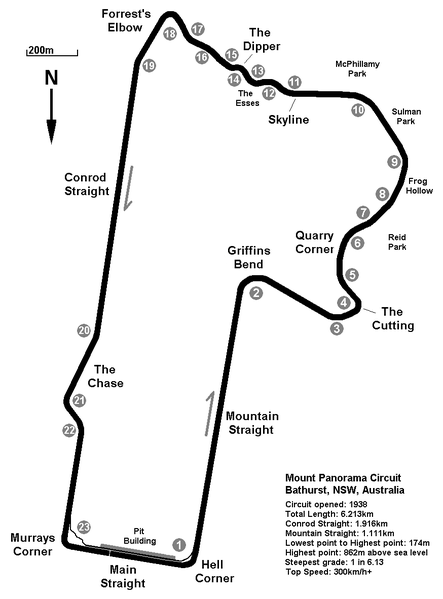
The Mount Panorama Circuit is a 6.213 km public street circuit located in Bathurst, New South Wales, Australia, renowned for its demanding layout consisting of 23 turns that combine high-speed straights with technical corners.[19] Key sections include The Esses, a sequence of five tight, flowing corners descending the mountain; The Dipper, a steep, blind right-hander that tests driver commitment; Skyline, the high-point crest offering panoramic views before a sharp plunge; and Conrod Straight, a 1.916 km downhill run reaching speeds over 300 km/h, followed by the challenging Chase and Mount Panorama climb.[20] These elements create a unique blend of high-speed demands and precise handling requirements, making the track one of the most challenging in international motorsport.[21] The circuit features significant elevation changes of 174 meters between its lowest point at Hell Corner and the highest at Skyline, with gradients as steep as 1:6, which amplify braking zones, corner entry speeds, and overall physical strain on vehicles and drivers.[22] This topography, combined with narrow widths averaging 9 meters and unyielding concrete walls, demands exceptional car control, particularly in the mountain descent where minor errors can lead to severe consequences.[23] Mount Panorama has hosted motorsport events since its first race meeting on April 18, 1938, as the venue for the Australian Grand Prix, establishing it as a historic site for endurance racing with its unforgiving barriers and variable weather conditions that often include rain, fog, or wind, contributing to high attrition rates in long-distance events like the 12 Hour.[24][25] The circuit's public road status outside race weekends adds to its raw character, though this also influences surface evolution with rubber buildup affecting grip over sessions.[26] It is also the longstanding home of the Bathurst 1000 endurance race. For the Bathurst 12 Hour, the circuit undergoes event-specific modifications to meet safety standards, including the installation of temporary barriers such as six-foot cyclone fencing at high-risk areas like Skyline to prevent unauthorized access and enhance spectator safety.[27] Night racing, which forms a significant portion of the 12-hour format, is supported by temporary floodlighting installations along key sections to ensure visibility during low-light conditions.[28] The track holds FIA Grade 3 certification, permitting GT3 and similar prototype events, with upgrades in safety infrastructure since 2016 aligning it for international endurance competitions.[22] Lap records reflect the circuit's evolution from production cars to modern GT machinery. The outright GT3 qualifying record stands at 2:01.276, set by Lucas Auer in a Mercedes-AMG GT3 Evo during the 2025 Pirelli Pole Battle.[29] In the production car era (1991–1996), lap times were significantly slower due to less advanced vehicles, with the 1991 race's fastest lap at 2:42.83 by Peter Fitzgerald in a Toyota Supra Turbo, highlighting the performance gains in GT3 specifications.Event organization and logistics
The Bathurst 12 Hour event weekend spans four days, typically from Thursday to Sunday, with practice sessions held on Thursday and Friday, qualifying on Saturday, and the main race commencing on Sunday morning at 5:45 AM local time and concluding at 5:45 PM, creating a signature night-into-day format that transitions from darkness to daylight over the 12-hour duration.[30][31] This schedule allows for multiple practice runs, including sessions dedicated to bronze-rated drivers, ensuring teams can adapt to the circuit's challenges before the competitive phases.[31] The event is organized by SRO Australia in partnership with Supercars as the event promoter and the Bathurst Regional Council, which oversees local approvals and infrastructure support under the oversight of the Intercontinental GT Challenge regulations.[32][4] This collaboration ensures compliance with Motorsport Australia standards for safety, operations, and environmental protocols.[33] Logistics for the event include extensive paddock facilities accommodating multiple international teams, with garage allocations for up to around 40 entries in larger fields, managed by a dedicated paddock manager to handle equipment, shipping containers, and team setups outside standard access times. For the 2025 event, the field was reduced to 23 cars, reflecting manufacturer participation variations.[34][35] A medical center is on-site for immediate response, supplemented by helicopter evacuation capabilities for the circuit's more isolated sections, while traffic management on the public roads forming Mount Panorama ensures safe closure and controlled access during sessions.[33][36] Spectators benefit from a range of viewing options, including reserved grandstands, general admission areas with free paddock access, and fan zones offering entertainment, food vendors, and driver interactions, enhanced by live timing apps for real-time race tracking.[37][38] The 2025 event drew an attendance of 51,372 over three days, reflecting its growing appeal among motorsport enthusiasts.[39] Environmental measures are integral due to the circuit's proximity to residential areas, including strict noise regulations enforced by a dedicated noise judge to ensure vehicles do not exceed specified decibel limits, alongside waste management protocols to minimize litter and promote recycling during the event weekend.[33][40] These efforts align with Bathurst Regional Council's local environmental plan, which addresses potential land use conflicts around Mount Panorama.[41]History
Production car origins (1991–1996)
The Bathurst 12 Hour was established in 1991 by race promoter Vincent Tesoriero, a former competitor in the Bathurst 1000, as a means to revive interest in production car endurance racing following the decline of Group A touring car regulations in Australia.[42][43][44] Held over the Easter weekend at the Mount Panorama Circuit, the inaugural event drew 24 entries despite a tight preparation timeline, marking a successful return to multi-class production car racing at the iconic venue.[3][45] The race format emphasized durability and reliability over raw speed, with cars limited to series production specifications and divided into classes primarily based on engine displacement, such as those for vehicles under 1.6 liters, between 1.6 and 2.5 liters, 2.5 to 4.0 liters, and over 4.0 liters, alongside a separate GT category for sports cars.[3][46] Balance of performance measures, including weight adjustments and restrictions on modifications, were applied class-by-class to ensure competitive balance, particularly in lower divisions where closer racing often emerged.[47] The 12-hour duration, starting in the morning and running into the evening, tested teams under variable weather conditions typical of the Australian autumn, including rain that could dramatically affect strategies and outcomes.[42] Key highlights from the era included the 1991 outright victory by the Toyota Supra Turbo driven by Peter Fitzgerald, Allan Grice, and Nigel Arkell, which completed 242 laps to secure the win in a field featuring notable drivers like Alan Jones and Peter Brock.[46][47][45] The event remained at Mount Panorama through 1994, attracting manufacturer-backed entries and growing in popularity, but faced mounting operational challenges. High preparation and logistics costs, exacerbated by the demanding nature of endurance racing, strained promoters, while the need for extensive safety upgrades at the circuit added financial pressure.[42][3] In 1995, the race shifted to Eastern Creek Raceway in Sydney after title sponsor James Hardie declined to renew its deal, leaving promoter International Motor Sport unable to secure alternative funding to host at Bathurst amid rising expenses.[42] The move, combined with declining entry numbers and ongoing economic pressures on production car racing, led to the event's discontinuation following that year, ending the original production car era after five runnings.[42][3]Hiatus (1997–2006)
The 1996 edition of the Bathurst 12 Hour was cancelled primarily due to insufficient entries, with fewer than 20 cars registered, alongside persistent financial losses that made the event unsustainable.[42] The previous year's race had relocated to Eastern Creek Raceway after the Bathurst Regional Council reallocated Mount Panorama's available date to the Australian Racing Drivers Club, depriving the event of its iconic venue.[42] Eastern Creek's shorter layout and flatter terrain proved ill-suited for a 12-hour endurance format, diminishing the race's appeal and failing to attract adequate manufacturer support or spectators, despite a modest profit in 1995.[42] Title sponsor James Hardie also declined to renew its partnership, further straining resources for promoter Vince Tesoriero.[42] In the broader Australian motorsport landscape, the hiatus reflected a waning interest in production car racing during the late 1990s and early 2000s, as resources and attention shifted to the burgeoning V8 Supercars Championship, which emphasized modified V8-powered vehicles and drew stronger commercial backing from Holden and Ford. Efforts to integrate the 12 Hour with emerging GT categories, such as the short-lived Australian GT Production Car Championship, faltered amid these shifts, preventing a seamless evolution of the event. Prominent figures like original promoter Vince Tesoriero advocated for its continuation, while international series like the FIA GT expressed preliminary interest in Australian endurance racing, though no formal commitments materialized during the decade.[48] During the hiatus, the Australian Nations Cup Championship (2001–2005) partially filled the void by featuring GT and sports cars in multi-hour races at Mount Panorama, including a notable three-hour event in 2002 that highlighted international machinery like the Ferrari 550 Maranello. However, these races lacked the 12-hour prestige and production car focus of the original Bathurst event, serving more as a bridge to specialized GT competition rather than a direct successor. Revival efforts gained traction in 2005–2006 under promoter James O'Brien, who negotiated with the Bathurst Regional Council and stakeholders to secure a return to Mount Panorama as part of the inaugural Bathurst Motor Festival.[3] These discussions emphasized a GT-oriented format to align with global trends, laying the foundation for the 2007 relaunch with production cars and foreshadowing deeper involvement from SRO Motorsports Group for enhanced international appeal.[3]Revival and GT transition (2007–2010)
The Bathurst 12 Hour was revived in 2007 after an 11-year absence, organized by local promoter James O’Brien as part of the Bathurst Motor Festival and sponsored by WPS. The event adopted a multi-class format centered on the Australian Production Cars '3E' category, drawing 26 entries and instantly captivating audiences across Australia with its return to Mount Panorama. This relaunch successfully re-established the endurance race, building on the legacy of the original production car era while addressing the hiatus caused by declining interest and logistical challenges in the late 1990s.[3] Over the next few years, the format evolved to incorporate hybrid classes, blending traditional production cars with invitational GT vehicles, including GT3 prototypes, to test the waters for a broader grand touring focus. The 2008 edition, held under WPS sponsorship, featured notable participation in the emerging GT categories, with a Porsche 997 GT3 Cup securing a class victory driven by David Wall, Des Wall, Martin Notaras, and Trevor Symonds, underscoring the growing appeal of GT machinery amid the production car dominance. Entries steadily increased during this transitional phase, surpassing 30 by 2010, reflecting the event's rising stature and the introduction of enhancements for night racing portions, such as improved track lighting to accommodate the early-morning start and extend visibility into dawn.[49][50] The period was not without challenges, including weather disruptions that tested the event's resilience. The 2009 race saw peak entries of around 48 cars, but variable conditions highlighted the demands of endurance racing at Mount Panorama. In 2010, under new title sponsor Armor All, heavy rain plagued the event from the outset, leading to multiple safety car periods and a dramatic stoppage when a large gum tree fell onto the track during wet conditions, underscoring the circuit's exposure to environmental factors. Following incidents in 2008 that prompted seven safety car deployments, organizers implemented safety upgrades, including enhanced barriers and response protocols, to mitigate risks on the demanding public road circuit.[51][50] By 2010, the event had solidified its shift toward a GT emphasis, attracting international teams like the UK-based Prospeed Competition with a Porsche 997 GT3 R entry, signaling the impending full adoption of GT3 regulations in 2011 under SRO Australia management. This milestone year drew 42 entries overall, blending production and GT classes to bridge the eras and position the Bathurst 12 Hour as a premier global endurance challenge.[3]International GT3 expansion (2011–2015)
In 2011, the Bathurst 12 Hour underwent a significant pivot by adopting exclusive GT3 and GT4 classes, aligning with the emerging standards of the inaugural Blancpain Endurance Series to emphasize high-performance grand touring machinery. This shift attracted 26 entries, including European teams such as Germany's Joest Racing running an Audi R8 LMS for factory-supported drivers, marking the event's transition from mixed production car formats to a more globally oriented GT showcase. The faster GT3 prototypes enabled the winning Audi, driven by Christopher Mies, Darryl O'Young, and Marc Basseng, to shatter the previous distance record by 29 laps, completing 292 circuits of Mount Panorama.[52][53][54] The period saw heightened international appeal through factory-supported debuts and the influx of elite drivers, building on the GT foundations established from 2007 to 2010. Audi's official factory team, managed by Joest Racing, debuted in 2011 with multiple R8 LMS entries, while BMW fielded competitive M3 GT2 and later Z4 GT3 cars from 2011 onward through customer programs with increasing manufacturer backing. Nissan's factory-supported GT-R NISMO GT3 made its debut in 2014 via the NISMO Athlete Global Team, drawing Le Mans and Blancpain veterans like Katsumasa Chiyo. These efforts lured prominent international talent, including Le Mans 24 Hours participants such as Allan Simonsen and Christopher Mies, elevating the race's status as a key early-season test for global GT3 campaigns.[53][55] Key races highlighted the growing competitiveness and drama. In 2012, Phoenix Racing's Audi R8 LMS, piloted by Mies, O'Young, and Jöns, secured victory amid intense battles under Blancpain-influenced qualifying rules that emphasized professional driver lineups. The 2013 event delivered a thrilling Mercedes-Benz SLS AMG GT3 win for Erebus Motorsport, with Bernd Schneider, Thomas Jäger, and Alexander Roloff overcoming late-race chaos to finish a lap ahead. The 2014 edition set a provisional distance record of 296 laps (1,839 km) despite multiple safety car periods, including a contentious late deployment that bunched slower production cars like Fiats with the leading GT3 pack, sparking debates over restart procedures and cold tire challenges at Mount Panorama's demanding layout. Record lap times, such as René Rast's 2:01.840 qualifying lap in an Audi R8 LMS in 2016, underscored the GT3 cars' pace on the 6.213 km circuit.[56][57][58][59] Tragic developments in 2013 amplified the event's focus on safety and legacy. Danish driver Allan Simonsen, who had set the fastest-ever closed-cockpit lap record of 2:03.713 at Bathurst earlier that year in a Ferrari F430, suffered a fatal crash at the Le Mans 24 Hours. In response, organizers introduced the Allan Simonsen Pole Position Trophy starting in 2014, honoring the top qualifier and symbolizing Simonsen's contributions to GT racing. By 2015, entries swelled to a record 54 cars across GT3, GT4, and production classes, reflecting the race's burgeoning global draw with 29 GT3 machines alone.[60][61][62] Economic momentum grew through strategic sponsorships and media innovations. Liqui Moly became the title sponsor in 2013 under a multi-year deal, providing financial stability and branding visibility that supported the event's expansion into a premier GT3 platform. Live streaming debuted in 2012 via SBS and online platforms, with full coverage accelerating in 2014 through YouTube and dedicated channels, broadening international viewership and contributing to the race's economic uplift via tourism and broadcast rights. These elements positioned the Bathurst 12 Hour as a vital precursor to its 2016 integration into the Intercontinental GT Challenge.[63][64][65]Intercontinental GT Challenge integration (2016–present)
In 2016, the Bathurst 12 Hour marked the launch of the Intercontinental GT Challenge (IGTC), organized by SRO Motorsports Group, establishing it as the season-opening round with standardized GT3 technical regulations and a points system awarding titles to drivers, teams, and manufacturers across five global events.[66][67] The inaugural IGTC edition saw Australian driver Craig Lowndes, alongside Jamie Whincup and Toni Vilander, secure victory in a McLaren 650S GT3 for Triple Eight Race Engineering, completing 297 laps amid intense competition from 28 entries.[68] The integration into the IGTC spurred significant growth in manufacturer participation and technological development, intensifying rivalries among brands like Audi, Porsche, Mercedes-AMG, and BMW. A prime example occurred in 2018, when Audi dominated the field, with Audi Sport Team WRT's Audi R8 LMS—driven by Robin Frijns, Stuart Leonard, and Dries Vanthoor—winning a rain-shortened race for a historic 1-2-3 finish, highlighting the brand's early stronghold in the series.[69][70] This era also saw the introduction of new GT3 models, such as the Ferrari 296 GT3's competitive debut in 2025 with Arise Racing GT's two-car entry, featuring drivers including Chaz Mostert and Alessio Rovera, which challenged frontrunners early in the race before finishing mid-pack.[71][72] Recent editions have showcased escalating competitiveness and record performances within the IGTC framework. In 2020, Bentley Team M-Sport achieved a breakthrough victory and set a new distance record of 314 laps with the Bentley Continental GT3 driven by Jules Gounon, Maxime Soulet, and Jordan Pepper, overcoming mechanical challenges and a late puncture to edge out Mercedes-AMG by 49 seconds.[73][74] Mercedes-AMG then demonstrated sustained prowess in 2023, repeating their 2022 success as SunEnergy1's GT3—piloted by Gounon, Kenny Habul, Luca Stolz, and others—prevailed in a thriller, breaking the lap record and securing back-to-back wins amid 31 starters.[75] The 2025 race culminated in BMW's dominant 1-2 finish for Team WRT, with the #32 BMW M4 GT3 of Augusto Farfus, Kelvin van der Linde, and Sheldon van der Linde covering 306 laps to claim BMW's first IGTC Bathurst win since 2010, ahead of their sister #31 entry.[76][77] To promote fairness and align with the series' pro-am ethos, IGTC organizers have iteratively refined Balance of Performance (BoP) parameters, adjusting elements like power output, weight, and aerodynamics based on pre-event testing to equalize diverse GT3 homologues.[78][79] Driver regulations have also evolved, with 2025 updates mandating increased minimum stint time for Bronze-rated drivers in Pro-Am crews—rising to at least one hour within the first six hours—to enhance amateur involvement and safety.[80] The event's format supports FIA GT3-spec cars alongside invited vehicles, fostering potential expansion into hybrid or hypercar categories in future IGTC seasons.COVID-19 disruptions and recovery
The 2020 Liqui Moly Bathurst 12 Hour took place on February 1–2 at Mount Panorama Circuit, marking one of the final major international motorsport events in Australia before widespread COVID-19 restrictions took effect.[81] The race featured a record entry of 40 cars across 11 GT3 brands, including strong international participation from teams in Europe and Asia, and was won outright by a Bentley Continental GT3 entered by Team M-Sport, driven by Maxime Soulet, Jordan Pepper, and Jules Gounon—the manufacturer's first victory in the event.[82][83] Although early pandemic concerns were emerging globally, no significant border closures or quarantine measures impacted the event at that stage, allowing full attendance and logistics as usual.[81] The escalating COVID-19 crisis led to the outright cancellation of the 2021 edition, originally scheduled for February 26–28, due to stringent international travel bans and quarantine requirements imposed by the Australian government.[84] This marked the first absence of the Bathurst 12 Hour since its decade-long hiatus from 1997 to 2006, severely limiting entries from overseas teams and disrupting the Intercontinental GT Challenge (IGTC) calendar.[85] Organizers cited the inability to secure sufficient international competitors amid closed borders as the primary reason, with domestic participation also hampered by national lockdowns.[86] Recovery began in 2022, when the event was rescheduled from February to May 13–15 to align with easing quarantine rules and avoid peak Omicron variant surges in New South Wales.[87] Attendance was reduced compared to pre-pandemic levels, with crowds described as slightly down due to lingering health concerns and weather, though the circuit remained open to spectators.[88] To accommodate lower international uptake—exacerbated by elevated freight costs and the date shift—SRO Motorsports Group implemented temporary format adaptations, including a Pro-Am-only GT3 class structure, suspension of Pro and Silver categories, and no overall drivers' championship points, focusing instead on invitational and support races.[89] Broadcasts adopted a hybrid model, streaming live on GT World via YouTube alongside traditional Australian TV coverage on Fox Sports and the Seven Network, enhancing global accessibility amid travel barriers.[89] By 2023, the race returned to its traditional February 3–5 slot with a full IGTC field, reinstating all-professional line-ups in the outright GT3 class for the first time since 2020, alongside Pro-Am, Silver Cup, GT4, and invitational GT2 categories.[90] This revival reflected improved biosecurity protocols, including mandatory vaccinations and testing for participants, which facilitated broader manufacturer involvement after two years of constraints.[91] The event drew strong international entries, signaling a robust rebound in logistics and team confidence.[90] Post-recovery editions in 2024 and 2025 saw record GT3 participation, with 2024 featuring 10 Mercedes-AMG entries—equaling the single-brand high—and 2025 boasting 23 cars overall, including new manufacturers like Lexus.[92][35] The 2025 BMW 1-2 finish by Team WRT served as a milestone, underscoring sustained IGTC continuity.[93] Long-term effects included accelerated digital engagement through expanded online streaming, boosting global viewership, and sponsor transitions, such as the shift from Liqui Moly to Meguiar's as title partner in 2025.[89][94]Race format
Duration, structure, and procedures
The Bathurst 12 Hour is a 12-hour endurance race held annually at the Mount Panorama Circuit, commencing at dawn with a start time of 5:45 AM AEDT to capture the transition from low light to daylight conditions.[95][7] The event emphasizes strategic pit management, including mandatory driver changes and refueling stops, with each driver limited to a maximum continuous stint of 150 minutes for Platinum, Gold, and Silver-rated drivers, or 120 minutes for Bronze-rated drivers.[33] In Pro-Am, Silver Cup, and Bronze classes, each Bronze-rated driver must complete a total of 180 minutes of driving time, including at least one continuous stint of 60 minutes after the seventh hour of the race.[33] The race structure begins with a pre-race parade and two formation laps behind a safety car at 75–85 km/h, followed by a traditional two-by-two rolling start once the green flag is displayed.[7][33] During the event, full-course yellow (FCY) periods are deployed for incidents, enforcing an 80 km/h speed limit with no overtaking allowed except under specific safety conditions, and these may transition to full safety car deployments if needed.[33] The race incorporates night and early morning racing from the outset, with visibility challenges mitigated by track lighting and driver familiarity, continuing until approximately midday as daylight strengthens.[95] Operational procedures mandate that all pit stops for refueling, tire changes, or driver swaps occur in designated bays, with engines shut off and vehicles raised on air jacks; refueling personnel are limited to four team members, alongside a maximum of nine total personnel over the pit line, including one car controller, three mechanics, and one driver assistant.[33] There are no fixed compulsory pit stops, but minimum timed durations apply for certain activities, and success penalties—such as additional time added to pit stops or weight ballast—may be imposed on top performers to promote parity, with breaches of rules like tire limits incurring lap penalties.[80][33] Tire usage is capped at 48 dry-weather Pirelli P Zero tires per car, with unlimited wet tires permitted, and all changes must comply with powered tool limits (maximum two for GT3 classes).[95] In adverse weather, the race director may deploy red flags to suspend proceedings if the track is blocked or conditions render it unsafe, requiring all cars to return to the grid or pits without repairs except in the garage under supervision; such interruptions can extend the total duration if approved by stewards.[33] Historically, severe rain has led to significant delays, as seen in the 2010 edition where torrential conditions halted racing for nearly 40% of the event under red flags and safety cars.[96] The race concludes with the chequered flag shown to the leading car on its second crossing of the finish line after the 12-hour mark (17:43 AEDT), with classifications determined by distance covered—specifically, the number of laps completed—regardless of interruptions, provided at least two laps have been run; if a red flag prevents resumption, results revert to the order from the lap prior to suspension.[33][95]Vehicle classes and regulations
The Bathurst 12 Hour features a structured class system primarily centered on GT3 vehicles, with invitational categories for lower-specification cars to broaden participation while maintaining competitive balance. The primary competing class for the outright victory is the Pro GT3 division, comprising FIA-homologated GT3 cars such as the BMW M4 GT3, Mercedes-AMG GT3, Porsche 911 GT3 R (992), and Acura NSX GT3 EVO 2, operated by fully professional teams with no driver ranking restrictions.[33][97] Adjacent to this is the Pro-Am GT3 class, which uses similar GT3 machinery but incorporates amateur driver quotas to encourage gentleman racing; teams must field either three drivers consisting of one Platinum-, Gold-, or Silver-rated driver and two Bronze-rated drivers, or four drivers consisting of the above plus one driver of any category, as defined by FIA driver categorization criteria.[33][97] Additional GT3 subclasses include Silver Cup (all Silver- or Bronze-rated drivers) and Bronze Cup (lineups of three drivers consisting of one Platinum/Gold-rated, one Silver-rated, and one Bronze-rated driver; or four drivers consisting of the above plus one Silver- or Bronze-rated driver), further segmenting the field by experience levels.[33] Invitational classes provide opportunities for non-GT3 entries, including GT4 vehicles in Class C—such as the BMW M4 GT4 G82 and Porsche 718 Cayman GT4 CS MR—which are FIA-homologated but offer lower performance for more accessible competition.[33] GT2 cars and select production-based or one-make entries, like Porsche 911 GT3 Cup in Class B or unique invitational machinery (e.g., MARC Cars), are permitted on application, provided they meet a minimum lap time benchmark of 2:06 at Mount Panorama and do not exceed GT3 performance levels; hypercars remain excluded from eligibility as of 2025.[33][97] All GT3 cars adhere to SRO and FIA standards under Appendix J Article 257A, featuring rear-wheel-drive layouts with engines typically limited to 3.0-liter turbocharged V6 or V8 configurations producing approximately 500-600 horsepower, and minimum weights ranging from 1,200 to 1,300 kg depending on the model.[98] Balance of Performance (BoP) measures, determined by SRO and adjusted per event via data loggers and telemetry, equalize competition through modifications to power output (e.g., air restrictors), vehicle weight, and aerodynamic elements like ride height or ballast placement.[33] Teams are limited to two or three drivers per car in the Pro class (up to four in others), with engines sealed per homologation to prevent modifications.[33] Pirelli tires are mandatory, with allocations of 48 dry-weather sets per car, plus extras for certain classes or qualifying participants, and no alterations permitted.[33] The class structure has evolved since the event's revival under SRO management, transitioning from a mix of production and GT cars in 2007 to a GT3-focused format by 2011, emphasizing standardized, high-performance prototypes for closer racing.[99] This shift aligned the Bathurst 12 Hour with international GT series, incorporating driver grading and BoP to integrate professional and amateur competitors equitably.[33]Qualifying and safety measures
The qualifying process for the Bathurst 12 Hour consists of two 30-minute sessions held on Friday, known as Qualifying 1 and Qualifying 2, which determine the top 10 fastest cars based on combined results from recent practice sessions.[7][100] These sessions are split by performance brackets, with Qualifying 1 for the lower 50% of cars from Practice 6 and Qualifying 2 for the upper 50%, ensuring a competitive field progression.[33] The fastest 10 advance to the Pirelli Pole Battle, a 15-minute shootout on Saturday afternoon, where the pole position is decided; in 2025, Lucas Auer secured pole for the Craft-Bamboo Racing Mercedes-AMG GT3 Evo with a lap time of 2:01.276.[101][102] This format, updated for 2025, emphasizes precision on the challenging Mount Panorama Circuit, whose elevation changes add to the demands of setting competitive times.[7] The race begins with a rolling start procedure following two formation laps, with cars lined up two-by-two behind the safety car to ensure a controlled launch at dawn.[33][100] Engines must be started using onboard systems without external assistance, and drivers adhere to strict positioning to avoid premature movement.[33] The pole award, named the Allan Simonsen Pole Position Trophy in honor of the 2013 Le Mans incident, recognizes the top qualifier's achievement.[101] Safety measures align with FIA standards for GT racing, mandating the use of Head and Neck Support (HANS) devices for all drivers to mitigate neck injuries during impacts. Halo systems, introduced across GT3 vehicles in 2018, provide additional head protection against debris and rollover risks on the circuit's barriers. Post-2013 enhancements to trackside barriers and medical response protocols include reinforced armco sections and rapid-deployment extraction teams stationed at high-risk points like Conrod Straight.[103] Incident management employs a combination of full course yellow (FCY) periods and virtual safety car (VSC) procedures to neutralize the track safely without bunching the field, a system introduced in 2024 to address the circuit's variable conditions.[104] Under FCY or VSC, drivers must maintain minimum speeds and gaps, with no overtaking allowed until the all-clear.[105] To counter night racing challenges, organizers provide driver briefings on visibility aids, including reflective markers installed at key corners like The Cutting and The Dipper since 2023.[106] Penalties for infractions, particularly track limits violations in areas like The Chase (between Turns 11 and 13), are enforced via drive-through requirements or time additions, reviewed by stewards using onboard telemetry to maintain fair play.[33] Repeated breaches can escalate to stop-go penalties, emphasizing adherence in this endurance event's high-stakes environment.[33]Records and achievements
Outright winners
The outright winner of the Bathurst 12 Hour is determined by the fastest car to complete the 12-hour duration, regardless of vehicle class, a format that persisted from the race's inception in 1991 through the production car era until the transition to GT-focused regulations in 2011.[3] In the early years, victories were dominated by Japanese manufacturers like Toyota and Mazda, reflecting the production car emphasis on near-stock vehicles. Post-2011, European brands such as Audi, Mercedes-AMG, and Porsche gained prominence with GT3 machinery, aligning with the race's integration into international series like the Intercontinental GT Challenge.[107] The average number of laps completed by winners has ranged from approximately 240 in the 1990s to 260-320 in recent GT3 editions, influenced by track conditions, weather, and safety car interventions.[108]| Year | Drivers | Car Model | Entrant |
|---|---|---|---|
| 1991 | Nigel Arkell, Peter Fitzgerald, Allan Grice | Toyota Supra Turbo | Fitzgerald Racing |
| 1992 | Mark Gibbs, Charlie O'Brien, Garry Waldon | Mazda RX-7 | Mazda Australia |
| 1993 | Alan Jones, Garry Waldon | Mazda RX-7 | Mazda Australia |
| 1994 | Gregg Hansford, Neil Crompton | Mazda RX-7 | Mazda Motorsport |
| 1995 | John Bowe, Dick Johnson | Mazda RX-7 | Mazda Motorsport |
| 2007 | Craig Baird, Garry Holt, Paul Morris | BMW 335i | Eastern Creek Karts P/L |
| 2008 | Graham Alexander, Rod Salmon, Damien White | Mitsubishi Lancer Evo IX | SKWIRK.com |
| 2009 | Rod Salmon, Damien White, Tony Longhurst | Mitsubishi Lancer Evo X | Team Mitsubishi Ralliart Australia |
| 2010 | John Bowe, Garry Holt, Paul Morris | BMW 335i | Holt Wine Group |
| 2011 | Marc Basseng, Christopher Mies, Darryl O'Young | Audi R8 LMS GT3 | Joest Racing |
| 2012 | Christopher Mies, Christer Jönsson, Darryl O'Young | Audi R8 LMS Ultra | Phoenix Racing |
| 2013 | Bernd Schneider, Thomas Jäger, Alex Roloff | Mercedes-Benz SLS AMG GT3 | Erebus Motorsport |
| 2014 | Craig Lowndes, John Bowe, Peter Edwards, Mika Salo | Ferrari 458 Italia GT3 | Maranello Motorsport |
| 2015 | Katsumasa Chiyo, Wolfgang Reip, Florian Straus | Nissan GT-R NISMO GT3 | NISMO Athlete Global Team |
| 2016 | Shane van Gisbergen, Álvaro Parente, Jonathon Webb | McLaren 650S GT3 | Tekno Autosports |
| 2017 | Craig Lowndes, Jamie Whincup, Toni Vilander | Ferrari 488 GT3 | Maranello Motorsport |
| 2018 | Robin Frijns, Dries Vanthoor, Stuart Leonard | Audi R8 LMS GT3 | Audi Sport Team WRT |
| 2019 | Matt Campbell, Dennis Olsen, Dirk Werner | Porsche 911 GT3 R | Earl Bamber Motorsport |
| 2020 | Jules Gounon, Jordan Pepper, Maxime Soulet | Bentley Continental GT3 | Bentley Team M-Sport |
| 2021 | Race cancelled due to COVID-19 restrictions | N/A | N/A |
| 2022 | Kenny Habul, Jules Gounon, Luca Stolz, Martin Konrad | Mercedes-AMG GT3 Evo | SunEnergy1 Racing |
| 2023 | Kenny Habul, Jules Gounon, Luca Stolz | Mercedes-AMG GT3 Evo | SunEnergy1 AKKodis ASP Team |
| 2024 | Matt Campbell, Ayhancan Güven, Laurens Vanthoor | Porsche 911 GT3 R | Manthey EMA |
| 2025 | Augusto Farfus, Kelvin van der Linde, Sheldon van der Linde | BMW M4 GT3 | Team WRT |
Multiple winners by driver
Several drivers have achieved multiple outright victories in the Bathurst 12 Hour since its revival in 2007, showcasing exceptional endurance racing prowess on the challenging Mount Panorama circuit. Jules Gounon holds the record for the most wins with three, achieved in 2020 for Bentley, and 2022 and 2023 for Mercedes-AMG with SunEnergy 1 Racing.[114][115] John Bowe, a veteran of Australian GT racing, secured two victories in 2010 driving a BMW 335i for Holt Wine Group and in 2014 co-driving a Ferrari 458 GT3 for Maranello Motorsport, contributing to his legacy as one of Australia's most accomplished GT drivers.[116][117] Other notable repeat winners include Matt Campbell, who triumphed in 2019 with Earl Bamber Motorsport's Porsche 911 GT3 R and again in 2024 with Manthey EMA's Porsche alongside Laurens Vanthoor and Ayhancan Güven, demonstrating consistent excellence in wet and dry conditions.[118][108] Craig Lowndes, renowned for his Supercars success, won in 2014 and 2017 both with Maranello Motorsport Ferraris, partnering with top talents like Mika Salo and Jamie Whincup to highlight his versatility in GT machinery.[117][119] Christopher Mies and Darryl O'Young share two consecutive wins in 2011 and 2012 for Phoenix Racing Audis, establishing early dominance in the GT3 era.[120][121] Rod Salmon and Damien White also claimed back-to-back successes in 2008 and 2009 with Team Mitsubishi Ralliart Lancer Evo IXs during the production car phase.[50][122] Kenny Habul and Luca Stolz each have two wins from 2022 and 2023 with SunEnergy 1 Racing Mercedes-AMGs.[123][115]| Driver | Wins | Years | Teams/Cars |
|---|---|---|---|
| Jules Gounon | 3 | 2020, 2022, 2023 | Bentley Continental GT3; Mercedes-AMG GT3 (SunEnergy 1 Racing) |
| John Bowe | 2 | 2010, 2014 | BMW 335i (Holt Wine Group); Ferrari 458 GT3 (Maranello Motorsport) |
| Matt Campbell | 2 | 2019, 2024 | Porsche 911 GT3 R (Earl Bamber Motorsport, Manthey EMA) |
| Craig Lowndes | 2 | 2014, 2017 | Ferrari 458/488 GT3 (Maranello Motorsport) |
| Christopher Mies | 2 | 2011, 2012 | Audi R8 LMS (Phoenix Racing) |
| Darryl O'Young | 2 | 2011, 2012 | Audi R8 LMS (Phoenix Racing) |
| Rod Salmon | 2 | 2008, 2009 | Mitsubishi Lancer Evo IX (Team Mitsubishi Ralliart) |
| Damien White | 2 | 2008, 2009 | Mitsubishi Lancer Evo IX (Team Mitsubishi Ralliart) |
| Kenny Habul | 2 | 2022, 2023 | Mercedes-AMG GT3 (SunEnergy 1 Racing) |
| Luca Stolz | 2 | 2022, 2023 | Mercedes-AMG GT3 (SunEnergy 1 Racing) |
Multiple winners by manufacturer
Mazda holds the record for the most outright victories in the Bathurst 12 Hour with four wins, all achieved in the production car era using the RX-7 model in 1992, 1993, 1994, and 1995. These successes underscored Mazda's early dominance in the event's formative years, where Japanese manufacturers collectively secured seven outright wins before the 2011 shift to GT3 regulations, including Toyota's 1991 victory with the Supra Turbo and Mitsubishi's back-to-back triumphs in 2008 and 2009 using Lancer Evolution models.[124][3] In the GT3 era, German manufacturers have been particularly prominent, with Audi, BMW, and Mercedes-AMG each claiming three outright wins. Audi's victories came in 2011 and 2012 with the R8 LMS, followed by a 2018 return to the top step, highlighting the brand's reliability on Mount Panorama's demanding circuit. Mercedes-AMG secured its first win in 2013 via the SLS AMG GT3 before a dominant run in 2022 and 2023 with the GT3 model, driven by factory-supported efforts. BMW, with earlier production car successes in 2007 and 2010 using the 335i, ended a 15-year outright drought in 2025 when Team WRT's M4 GT3 achieved a commanding 1-2 finish.[93][125][107]| Manufacturer | Outright Wins | Years |
|---|---|---|
| Mazda | 4 | 1992, 1993, 1994, 1995 |
| Audi | 3 | 2011, 2012, 2018 |
| BMW | 3 | 2007, 2010, 2025 |
| Mercedes-AMG | 3 | 2013, 2022, 2023 |
| Ferrari | 2 | 2014, 2017 |
| Mitsubishi | 2 | 2008, 2009 |
| Porsche | 2 | 2019, 2024 |