Hubbry Logo
Battle commandBattle commandMain
Open search
Battle command
Community hub
Battle command
logo
8 pages, 0 posts
0 subscribers
Be the first to start a discussion here.
Battle command
Battle command
from Wikipedia
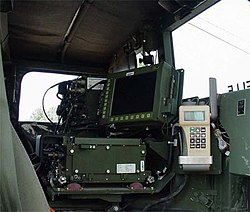
BC FBCB2 component in a Humvee

Battle command (BC) is the discipline of visualizing, describing, directing, and leading forces in operations against a hostile, thinking, and adaptive enemy. Battle command applies leadership to translate decision into actions, by synchronizing forces and warfighting functions in time, space, and purpose, to accomplish missions.[1][2][3] Battle command refers both to processes triggered by commanders and executed by soldiers and to the system of systems (SoS) that directly enables those processes.[1]

Alternate definition

[edit]
FM 100.5[further explanation needed]

BC is defined as the art of battle decision-making, leading, and motivating soldiers and their organizations into action to accomplish missions. BC includes visualizing the current state and future state, formulating concepts of operations to get from one to the other, and doing so at least cost. Assigning missions, prioritizing and allocating resources, selecting the critical time and place to act, and knowing how and when to make adjustments during the fight are also included.[4]

FM 7-30[further explanation needed]

BC is the art and science of battlefield decision making and leading soldiers and units to successfully accomplish the mission. The BC basic elements are decision making, leading, and controlling. The BC System of Systems at brigade level enables commanders to lead, prioritize, and allocate assets required to employ and sustain combat power. The brigade commander must see further, process information faster and strike more precisely and quicker. If information is the medium of the BC process, the BC system must provide the commander with timely and accurate information on which to base the commander's decision.[5]

Synonyms

[edit]

Battle management

[edit]

Battle management (BM) is the management of activities within the operational environment based on the commands, direction, and guidance given by appropriate authority. BM is considered to be a subset of BC.[nb 1][6]

Processes

[edit]

Business processes associated with command and control[7] of military forces are detailed in various publications of the United States Department of Defense.[2][8]

System of systems

[edit]

Modern BC software and hardware exhibit all of the traits and qualities of an SoS.[9] A BC SoS can be decomposed into systems such as maneuvers, logistics, fires and effects, air support, intelligence, surveillance, reconnaissance (alternatively recognizance) (these three sometimes grouped as ISR, or by adding target acquisition, ISTAR), terrain, and weather.[10][11][12] Among the many inputs of these systems is a plethora of sensors which undergo sensor fusion and are compiled into a common operational picture/local operational picture that enable commanders to achieve situational awareness (SA)/situational understanding (SU). SA/SU is paramount for commanders to command and control modern military forces.

Military acquisition in the United States

[edit]

The Department of the Army organization primarily responsible for the acquisition of the BC SoS is the PM BC, a subordinate organization within the PEO C3T.

Types

[edit]

Battle command on the move (BCOTM)

[edit]

One of the problems with BC SoS is that a commander has little communication while in the battlefield. Command and control planning occurs at a command post (CP) or tactical operations center (TOC). Once a battle begins, a commander leaves the CP/TOC and moves forward to stay engaged. A commander has limited communication possibilities while in the battlefield, making it difficult to follow and control all events as they happen. Battle command on the move (BCOTM) is a capability that provides commanders all of the information resident in their CP/TOC and the required communications necessary to command and control on the move, or at a short halt, from any vantage point on the battlefield.[13][14]

Airborne battle command

[edit]

Example airborne systems that contribute to BC:

See also

[edit]

Notes

[edit]

References

[edit]
[edit]
Revisions and contributorsEdit on WikipediaRead on Wikipedia
from Grokipedia
Battle command is the exercise of command in military operations against a hostile, thinking enemy, applying the leadership element of combat power through timely decisions, visualization, description, and direction of forces. It blends the art of intuitive judgment and leadership with the science of structured processes and information management to synchronize combat power across battlefield operating systems. Primarily a U.S. Army doctrinal concept, battle command emphasizes commander-centric decision-making in uncertain environments, enabling subordinates to exercise disciplined initiative within the commander's intent. Central to battle command are its core processes: visualizing the operational environment using factors like mission, , , troops, time, and civil considerations (METT-TC) to form a of the ; describing this vision through clear commander's intent and planning guidance to align subordinates; and directing forces via mission orders that focus on desired outcomes rather than prescriptive methods, allowing flexibility in execution. These processes rely on robust (C2) systems for real-time information sharing, while commanders assess risks and maintain personal presence to inspire trust and adaptability. Battle command principles stress decentralized execution, where subordinates operate with autonomy to exploit opportunities, balanced against the need for unity of effort through shared understanding and . Introduced in U.S. Army doctrine with the 1993 edition of Field Manual (FM) 100-5, Operations, battle command replaced elements of the broader "command and control" framework to highlight leadership in dynamic combat scenarios, particularly under the AirLand Battle concept that emphasized initiative and rapid maneuver. It was further detailed in FM 3-0, Operations (2001), as a warfighting function integrating the art of command with scientific tools like digital C2 networks to counter nonlinear battlefields. By 2009, amid lessons from counterinsurgency operations in Iraq and Afghanistan, the term evolved into "mission command" in Army Doctrine Publication (ADP) 6-0, retaining core tenets like trust and decentralized execution but formalizing it as both a philosophy and warfighting function to better address large-scale combat against peer threats. This shift reflected broader doctrinal adaptations to information-age warfare, where battle command's emphasis on commander visualization and subordinate empowerment continues to influence joint and multinational operations.

Definitions and Historical Context

Primary Definition

Battle command is the art and science of visualizing, describing, directing, and leading forces in operations against a hostile, thinking, and adaptive , under conditions of , surprise, and continuous change, made possible by the exercise of command and the effective application of control. According to U.S. Army in the 2001 edition of Field Manual (FM) 3-0, Operations, it encompasses battle decision-making, leading, and motivating soldiers and organizations into action to accomplish missions, including visualizing the current and future states of an operation, describing that visualization to subordinates and superiors, and directing actions to achieve the desired end state. Central to battle command are the leadership applications of combat power, which involve to synchronize warfighting functions, motivation to inspire troops amid chaos, and to minimize operational costs while maximizing mission success against an adaptive adversary. These elements emphasize the human dimension of command, relying on professional judgment, experience, and informed intuition to translate into effective battlefield action. Battle command differs from broader (C2) by focusing specifically on the tactical execution of combat operations in dynamic environments, whereas C2 encompasses the overarching systems, procedures, and technologies for planning, directing, and coordinating all military activities. This doctrinal concept later evolved into in subsequent Army publications to adapt to more decentralized operations.

Historical Evolution and Alternate Definitions

The concept of battle command originated in the U.S. Army's keystone doctrine, Field Manual (FM) 100-5, Operations (1993), where it was defined as the art of battle decision-making, leading, and motivating soldiers and their organizations to accomplish assigned missions effectively and efficiently while minimizing risk and cost. This definition emphasized the commander's visualization of the battlefield, rapid decision-making under uncertainty, and the integration of combat power to achieve decisive results in full-dimensional operations against a nonlinear, noncontiguous enemy. Subsequent refinements appeared in FM 3-0, Operations (2001), and FM 6-0, Mission Command: Command and Control of Army Forces (2003), which emphasized battle command's role in enabling timely information sharing, synchronized fires, and adaptive responses to an agile adversary through integrated command and control processes and emerging technologies. These updates highlighted the need for commanders to exercise authority through mission orders that fostered disciplined initiative, while leveraging emerging technologies for enhanced situational awareness without rigid centralization. FM 6-0 (2003) introduced mission command as the Army's preferred C2 concept, building on battle command by emphasizing decentralized execution and subordinate initiative. In FM 7-30, The Infantry Brigade (1995), battle command was further articulated as both the art and science of battlefield decision-making, encompassing the commander's role in prioritizing efforts, allocating resources, and sustaining operations across the depth of the battlefield. By 2012, Army doctrine shifted decisively from battle command to , as outlined in Army Doctrine Publication (ADP) 6-0, (2012), which redefined the approach as the exercise of authority through mission orders to enable disciplined initiative within the commander's intent, empowering subordinates to act decisively in dynamic environments. This transition, reinforced in the March 2025 update to FM 3-0, Operations, was driven by operational lessons from and —highlighting the limitations of prescriptive control in —and escalating peer threats requiring agility against near-peer adversaries. The original battle command concept's reliance on hierarchical structures for synchronization has become outdated, superseded by multidomain operations in FM 3-0 (2025), which emphasize convergence of capabilities across land, air, sea, space, and cyber domains to create multiple dilemmas for the enemy.

Core Concepts and Processes

Command and Leadership Processes

Battle command encompasses the human-centered processes through which commanders exercise authority and direction in combat operations, emphasizing visualization, decision-making, and synchronization to achieve mission success against adaptive adversaries. Central to these processes, as outlined in early 21st-century U.S. Army doctrine, are the core steps of receiving the mission, analyzing the situation, developing courses of action, making decisions, directing forces, and assessing operations. Upon receiving the mission, the commander issues initial guidance while the staff gathers essential data to define the operational problem. Situation analysis then employs tools like intelligence preparation of the battlefield to identify critical tasks, available assets, risks, and constraints, setting the foundation for subsequent planning. Developing courses of action involves the staff generating viable options that synchronize the battlefield operating systems—such as , movement and maneuver, fires, , sustainment, and —to apply combat power effectively. The commander then evaluates these through war-gaming and comparison to select or refine a course, incorporating key elements like commander's intent and critical information requirements to guide execution. Directing forces follows via orders, such as operation orders or fragmentary orders, which communicate decisions and ensure unity of effort among subordinates. Throughout, assessment provides continuous feedback by measuring progress against established criteria, enabling adjustments to maintain operational momentum. Leadership in battle command amplifies these processes through the commander's personal influence, fostering motivation, trust, and disciplined initiative among subordinates to execute missions with . By building cohesive teams via mutual trust and shared understanding, commanders empower subordinates to act decisively within the bounds of intent, even in uncertain conditions. These processes form the basis for the modern warfighting function. This integration of warfighting functions under the commander's vision ensures that movement and maneuver elements advance while fires and support neutralize threats, creating synergistic effects on the . Synchronization mechanisms rely heavily on the commander's intent—a clear, concise statement of the operation's purpose and key tasks—to align subordinate actions against an enemy's adaptive responses, allowing flexibility without loss of cohesion. Feedback loops, embedded in the assessment step, facilitate real-time evaluation through reports and observations, enabling commanders to refine plans and maintain tempo. Doctrinal updates in FM 3-0 (March 2025) incorporate convergence within multidomain operations, where these processes enable joint force integration across land, air, maritime, space, and cyberspace domains to overwhelm adversaries through synchronized effects. Supporting tools, such as the common operational picture, enhance shared situational awareness to inform these human-driven decisions.

Battle Management Practices

Battle management serves as a practical subset of battle command, focusing on the execution and coordination of activities in accordance with higher-level guidance. According to the Department of Defense Dictionary of Military and Associated Terms, it is defined as "the management of activities within the operational environment based on the commands, direction, and guidance given by appropriate authority," encompassing task assignment to subordinate units, continuous status monitoring of forces and resources, and real-time adjustments to ensure mission accomplishment. This process emphasizes in dynamic conditions, translating strategic intent into tactical actions without encompassing the full spectrum of decision-making. Key practices in battle management include the synchronization of critical battlefield functions such as , fires, and to maximize . Synchronization involves arranging these elements in time, space, and purpose, often through tools like the synchronization matrix and fires execution matrix, to support maneuver units and avoid or resource waste. Additionally, adherence to (ROE) and escalation protocols is integral, as ROE provide directives that limit the to achieve political and objectives while discouraging unintended conflict expansion; for instance, they specify conditions under which escalation—such as increasing force levels in response to enemy actions—may occur to maintain operational tempo without violating . In contrast to the broader battle command, which involves visualizing, describing, and leading forces against adaptive adversaries through visionary , battle management adopts a more operational and tactical orientation centered on efficiency and resource control. While battle command addresses strategic intent and motivation, battle management executes these by monitoring unit positions, allocating fires based on real-time intelligence, and adjusting flows to sustain momentum, thereby enabling commanders to focus on higher-level decisions. As of 2025 U.S. Army doctrine, battle management has adapted to incorporate (AI) for real-time oversight in contested environments, where degraded communications and high data volumes challenge human operators. AI tools integrate into the Military Decision-Making Process (MDMP) by automating from sensors and intelligence feeds, generating optimized courses of action, and simulating outcomes to predict enemy movements, thus reducing commanders' by handling routine tasks like and status updates. For example, enables AI-driven synchronization in electromagnetic-contested areas, allowing units to maintain fires and coordination without constant human intervention, while human oversight ensures alignment with principles. This integration enhances decision speed and accuracy, supporting multidomain operations without supplanting human judgment.

Technological Frameworks

System of Systems Integration

The (SoS) concept in battle command refers to an interconnected framework of hardware, software, networks, and processes designed to integrate diverse capabilities for enhanced and . Originating in U.S. doctrinal developments, this approach emphasizes the fusion of subsystems to support key operational functions, including maneuver planning, logistics coordination, fires management, intelligence, surveillance, and reconnaissance (ISR), terrain analysis, and weather integration. As outlined in TRADOC Pamphlet 525-3-3, the SoS integrates people, processes, the Army information network, and command posts as interdependent elements to synchronize power across domains, enabling commanders to visualize the and direct forces effectively. Core components of the include sensors that contribute to a (COP), providing real-time shared awareness of friendly, enemy, neutral, and environmental elements across the . processes aggregate inputs from these sensors—such as ISR platforms, , and weather —into actionable intelligence, allowing commanders to make timely decisions amid uncertainty. The architecture is scalable, supporting operations from tactical levels to operational echelons, with modular command posts and a common that spans domains like cloud-based centers, mounted platforms, and embedded sensors. This integration ensures resilient connectivity through converged transport for voice, , video, and , even in contested environments. Historically, the framework underpinned the Battle Command System (ABCS), a suite of interconnected applications fielded starting in the mid-1990s to enable digital battle command at the brigade level and below during the 1990s and 2000s. ABCS facilitated brigade-level operations by linking maneuver control systems, coordination, logistics automation, and ISR feeds, marking a shift from analog to networked warfare in exercises like those under the Force XXI initiative. However, challenges persisted, particularly in achieving full during operations, where disparate service systems often led to data silos, communication gaps, and delayed synchronization among , , and elements. ABCS served as a foundational system that paved the way for more modern architectures. By 2025, the concept remains foundational to multidomain operations, evolving to incorporate cyber and domains as integral layers for resilient command in contested environments, as updated in FM 3-0. This expansion enables synchronized effects across land, air, maritime, , and , countering threats through integrated fires, electronic warfare, and space-based navigation. For instance, modern implementations like the Integrated Battle Command System build on this architecture to fuse sensor data for air and , including successful intercepts demonstrated in flight tests at in October 2025.

Modern Command and Control Systems

Modern (C2) systems represent the evolution of battle command into networked, data-centric architectures that enable real-time , , and coordination across military forces. These systems integrate sensors, effectors, and communication networks to support multidomain operations, addressing the limitations of legacy platforms from the early by incorporating advanced computing and standards. Key U.S. implementations focus on the Army's digital , emphasizing plug-and-fight to link disparate assets without proprietary constraints. The Army Battle Command System (ABCS) served as a foundational digital C4I (command, control, communications, computers, and ) platform that integrated six primary functional systems to provide comprehensive oversight. These include the Maneuver Control System (MCS) for tracking ground forces and planning operations, the Advanced Field Artillery Tactical Data System (AFATDS) for coordinating , and the Air and Missile Defense Planning and Control System (AMDPCS) for aerial threat management, among others such as the All-Source Analysis System (ASAS) for fusion. By linking these components over a shared network, ABCS delivered automated , force tracking, and automated messaging to commanders at all echelons, facilitating synchronized maneuver and fires. Developed in the 1990s and fielded in the , ABCS has been succeeded by advanced systems. The Integrated Battle Command System (IBCS), a next-generation system-of-systems for air and , exemplifies plug-and-fight architecture by decoupling sensors from effectors to enable flexible threat engagement across domains. IBCS aggregates data from diverse radars and platforms—such as Patriot, THAAD, and emerging counter-unmanned aerial systems (C-UAS)—to generate a unified picture, allowing operators to assign any sensor to any shooter for optimized intercepts. In 2025, significant updates integrated ' Lattice software platform into IBCS-Maneuver (IBCS-M), enhancing C-UAS capabilities through automated fire control and real-time decision support for drone swarms. This selection, announced in November 2025 following Army and evaluations, allows a single operator to manage multiple counter-drone effectors, improving response times against low-cost threats. IBCS has demonstrated these features in live-fire tests, including successful intercepts of surrogate threats at . Joint All-Domain Command and Control (JADC2), also known as Combined Joint All-Domain Command and Control (CJADC2), extends battle command into a , multidomain framework that unifies from air, land, sea, space, and cyber assets for seamless operations. This evolving architecture employs AI-driven to share targeting information for , drones, and precision fires, enabling commanders to rapidly task assets across services. In 2025, JADC2 advanced through Global Information Dominance Experiments (GIDE), which tested AI algorithms for and coordination in simulated scenarios. These tests, conducted iteratively every 90 days, validated AI's role in creating a unified layer for real-time C2, including drone swarm coordination and cueing. JADC2 builds on existing networks to address gaps, prioritizing secure transport for forces. Recent advancements in these systems incorporate artificial intelligence (AI) for predictive analytics, enhancing battle command by forecasting enemy movements and optimizing resource allocation based on real-time data patterns. AI tools, such as those integrated into the Military Decision-Making Process (MDMP), automate scenario analysis to reduce planning timelines from hours to minutes, addressing the overload from modern multidomain threats. Cybersecurity enhancements, including AI-powered anomaly detection and self-healing networks, protect C2 platforms against advanced persistent threats, with 2025 implementations focusing on zero-trust architectures to secure data flows in contested environments. Additionally, Internet of Things (IoT) devices enable edge computing at the tactical level, processing sensor data locally on drones and vehicles to minimize latency and bandwidth demands, thereby supporting resilient operations in denied communications zones. These innovations collectively modernize outdated 2000s-era systems like early ABCS variants, improving overall decision dominance.

Specialized Applications

Battle Command on the Move (BCOTM)

Battle Command on the Move (BCOTM) is a mobile capability designed to enable tactical commanders to maintain and understanding while operating from vehicles or platforms during dynamic maneuvers, using portable command posts or tactical operations centers (TOCs). It integrates voice and data communications to deliver real-time battlefield information, supporting commander-centric decision-making in environments. The primary purpose is to allow commanders to issue orders and receive updates without halting movement, thereby accelerating operational tempo and reducing vulnerability to static positions. Key features of BCOTM include secure communications via terrestrial networks like the Near Term Data Radio (NTDR) and Enhanced Position Location Reporting System (EPLRS), as well as satellite links such as for continuous connectivity. GPS-enabled tracking through EPLRS and Force XXI Battle Command Brigade and Below (FBCB2) provides precise location data and , enhancing on-the-move . These systems reduce setup time significantly; for instance, during operations with the 4th Division in in 2003, BCOTM eliminated a nine-hour delay associated with traditional command post establishment. Developed under the U.S. Army's Force XXI initiatives in the 1990s and 2000s, BCOTM evolved from FBCB2 to incorporate ruggedized Army Battle Command System (ABCS) applications in vehicles like the M-7 Bradley Team, with initial deployments in five such vehicles by 2003. By 2025, BCOTM has seen enhancements through integration with the Integrated Battle Command System (IBCS), which provides a common operating picture accessible during mobile operations to shorten maneuver cycles by fusing sensor data for rapid targeting. Drone and AI feeds have been incorporated for contested mobility, enabling real-time reconnaissance and automated threat detection; for example, U.S. Army transformation tests at , , in 2025 demonstrated seamless linkage of AI-powered drones with Next Generation Command and Control (NGC2) platforms for enhanced decision-making in complex exercises. Despite these advances, BCOTM faces challenges from bandwidth limitations in denied environments, where jamming or interference can disrupt data flows critical for ABCS integration. Solutions include leveraging low-Earth orbit (LEO) satellites, such as SpaceX's , which the U.S. Army has adopted for resilient, high-throughput in tactical scenarios, providing low-latency alternatives to traditional SATCOM.

Airborne Battle Command Systems

Airborne battle command systems enable commanders to maintain control during the dynamic phases of parachute assaults and air assaults, where forces are rapidly inserted into contested environments. These systems prioritize enroute , allowing real-time coordination from like the C-17 Globemaster III, which serves as a flying command post. Core components include ruggedized radios, such as the AN/PRC-158 , which support push-to-talk voice communications for air-to-air and air-to-ground links, powered directly from aircraft electrical outlets via battery eliminators. communications further bridge isolated units post-insertion, using fixed installed satellite antennas (FISA) and emerging fuselage mount antennas (FMA) with Ka-band capabilities for high-bandwidth data transfer. The Enroute (EMC) suite integrates these elements, providing secure voice over IP, video teleconferencing, and chat functions to facilitate mission planning mid-flight. Additionally, the Joint Battle Command-Platform (JBC-P) equips HMMWVs for low-velocity airdrops, ensuring tools remain operational without removal during descent, thus accelerating assembly on the ground. The historical development of these systems in U.S. Army airborne units, particularly the 82nd and 101st Airborne Divisions, has emphasized decentralized control to counter the inherent uncertainties of airborne insertions, such as troop scatter across drop zones. Doctrine outlined in FM 3-99, Airborne and Air Assault Operations, guides planning for command during forcible entry, stressing robust pre-mission rehearsals and flexible execution post-landing to link fragmented elements. For the 82nd Airborne Division, early integrations focused on protecting command vehicles and radios during airdrops, evolving from manual assembly procedures to automated systems like JBC-P, tested in simulated impacts to verify post-landing functionality without errors in data transmission. The 101st Airborne Division, specializing in air assaults, adapted similar principles from FM 90-4, Air Assault Operations, incorporating aviation coordination for helicopter-based insertions while prioritizing ground-linkup after dispersal. These evolutions reflect a shift toward self-sustaining units capable of independent action until higher echelons reestablish centralized oversight, as demonstrated in joint forcible entry operations since the 1980s. By 2025, airborne battle command has incorporated unmanned aerial systems for , enhancing visibility during drops and rapid deployments. Drones, such as first-person view (FPV) models equipped with explosives, provide real-time reconnaissance and defensive strikes, as shown in the U.S. Army's inaugural drone-on-drone engagement by the during exercises. This capability supports paratroopers by monitoring drop zones and adjacent threats, integrating with traditional radios for low-latency updates. (JADC2) further advances synchronization between air and ground forces, enabling data sharing across domains for faster convergence in contested spaces. Multidomain exercises like Northern Strike 25 and Swift Response 2025 have tested these integrations, with airborne units practicing agile combat employment and networked fires over extended ranges; for example, during a 2024 Joint Readiness Training Center rotation, the conducted large-scale air assaults spanning 500 nautical miles using Integrated Tactical Networks on 31 . Mobile User Objective Systems (MUOS) on helicopters extend beyond-line-of-sight communications, allowing seamless handoff from enroute to ground phases. Unique to airborne operations, these systems must withstand extreme risks, including and physical impacts, demanding resilient, low-signature communications to evade detection in high-threat environments. High-frequency (HF) radios offer scalable, jam-resistant links for and command in denied areas, complementing systems with minimal electromagnetic footprint. The Command and Staff Palletized Airborne Node (CASPAN) within EMC exemplifies this resilience, featuring ruggedized laptops and multiple screens for 10 personnel to operate amid turbulence and potential enemy fire. Training for these capabilities occurs through the Training Program (MCTP), which delivers command post exercises tailored to airborne divisions, simulating decentralized decision-making and network recovery in scenarios like joint forcible entry. Units such as the 82nd Airborne participate in MCTP rotations to refine battle management, ensuring commanders can adapt to isolation and rapid linkups under simulated combat conditions.

Acquisition and Global Implementation

United States Acquisition Processes

The U.S. Army's acquisition of battle command capabilities is primarily managed through the Program Manager for Mission Command (PM MC), which succeeded the legacy Program Manager Battle Command (PM BC) and falls under the Program Executive Office for Command, Control, Communications, and Network (PEO C3N)—renamed from PEO C3T in October 2024 to reflect a unified network focus. This structure ensures integrated development of command and control systems, with overarching oversight provided by the U.S. Army Transformation and Training Command (T2COM), established in October 2025 through the merger of Army Futures Command and the Training and Doctrine Command (TRADOC). T2COM synchronizes requirements, training, and modernization to align battle command acquisitions with evolving operational needs. Key acquisition milestones include the spiral development model applied to the Battle Command System (ABCS) in the 1990s, which enabled incremental integration of command, control, and tools to accelerate fielding while addressing emerging requirements. More recently, the Integrated Battle Command System (IBCS) has advanced through contracts awarded to , starting with a $577 million development award in 2010 and extending to production and sustainment agreements valued at over $1.4 billion in 2025 for low-rate initial production and international adaptations. These efforts are funded in part by the Army Transformation Initiative (ATI), which in 2026 allocates resources—within a $197 billion base budget request—to divest legacy programs and invest in networked command capabilities. Acquisition processes begin with capability requirements defined by T2COM, formerly under TRADOC, to ensure alignment with multidomain operations , followed by rigorous testing that transitions from simulations to field evaluations. For instance, 2025 IBCS demonstrations at validated system performance by successfully detecting and engaging simulated cruise missiles in contested environments. A core emphasis is on modularity through the Modular Open Systems Approach (MOSA), allowing seamless integration of new technologies like sensors and effectors without overhauling entire platforms, thereby supporting rapid future upgrades. Challenges in these processes include persistent interoperability gaps among disparate command systems, which the March 2025 update to Field Manual (FM) 3-0 addresses by prioritizing unified multidomain integration and joint force synchronization. Additionally, cost overruns in legacy programs have driven ATI reforms, prompting a strategic pivot toward AI-driven to cut sustainment expenses and enhance speed. This shift underscores a broader commitment to agile, cost-effective acquisitions that leverage commercial AI technologies for scalable battle command enhancements.

International Perspectives and Adaptations

has integrated battle command concepts into its (ACO) framework to enable joint (C2) across multinational forces, emphasizing a three-tier structure that spans strategic, operational, and tactical levels for planning and executing operations. This integration supports rapid deployment and sustainment of combined forces, with a focus on shared through the Joint Intelligence, Surveillance, and Reconnaissance (JISR) initiative, which incorporates , , , and (ISTAR) capabilities to fuse data from multiple domains into a (COP). The JISR, achieving Initial Operating Capability in 2016, enhances by providing near real-time sharing among allies, as demonstrated in assets like the Alliance Ground Surveillance (AGS) system. In the United Kingdom, battle command adaptations build on the Bowman Communications and Information System (CIS), introduced in 2004 to provide secure digital tactical communications and real-time data sharing for enhanced C2 in operations such as those in Afghanistan. Evolving from Bowman, the Land Environment Tactical Communications and Information Systems (LE TacCIS) program, including the Morpheus initiative, aims to deliver cyber-resilient, modular networks, with upgrades like the Bowman Capability Improvement Programme (BCIP) extending service until at least 2035 due to delays. The UK has further aligned with NATO's Federated Mission Networking (FMN) framework, a key component of the Connected Forces Initiative, to standardize interoperability for mission networks among allies and partners, facilitating seamless coalition communications and joint operations. Russia's approach features the Reconnaissance-Strike Complex (RUK), a system-of-systems () that coordinates real-time intelligence with high-precision, long-range weapons to enable adaptive warfare, rooted in Soviet deep operations doctrine and applied in conflicts like . The RUK integrates assets, such as UAVs, with fire-direction centers and for near-real-time target destruction, though operational data from 2022-2025 shows a shift toward coercive, punitive strikes using drone swarms rather than seamless maneuver support, with correlations indicating increased intensity from UAVs (+13 personnel losses per UAV). This complex emphasizes algorithmic attrition and security zone enforcement, contrasting with Western networked models by prioritizing massed fires over full-spectrum integration. The (PLA) of China adapts battle command through network-centric structures in "informatized" operations, formalized post-1991 , with a focus on AI-driven multidomain convergence by 2025. The establishment of the Information Support Force (ISF) in April 2024 enhances networked C2 across theater commands, integrating cyber, , and systems for real-time and joint all-domain operations, aiming for a "strong, modernized information support force" by 2027. AI applications, such as generative tools for intelligence analysis and autonomous drone swarms (e.g., WZ-7 Soaring Dragon UAVs), support multidomain precision warfare, formalized in 2021 doctrine, with over 500 ISR-capable satellites as of May 2025 enabling -based ISR for dominance across air, land, sea, , and cyber domains. Key challenges in international battle command include achieving within s, where diverse national systems hinder seamless C2, as seen in NATO's need to integrate over 480 capabilities tested annually via the Coalition Warrior Interoperability Exercise (CWIX). Political and technological hurdles, such as safeguarding information among allies, exacerbate gaps in shared COP during multinational operations. U.S. influences via (FMS) address some issues, with exports of Integrated Battle Command System (IBCS) variants to allies like and planned or ongoing exports to the Republic of Korea enhancing coalition integration and multidomain fires. Historical analyses reveal gaps in non-U.S. doctrines, with much literature prioritizing American models and limited coverage of foreign adaptations in pre-2020 texts, leading to incomplete understandings of global C2 evolution. By 2025, trends emphasize adaptations, such as Russia's integration of irregular tactics into RUK for below-threshold competition, and NATO's focus on continuum-based conflict to bridge doctrine-practice divides in multinational settings.

References

Add your contribution
Related Hubs
User Avatar
No comments yet.