Recent from talks
Nothing was collected or created yet.
Bearded lady
View on Wikipedia
A bearded lady (or bearded woman) is a woman with a naturally occurring beard normally due to the condition known as hirsutism or hypertrichosis. Hypertrichosis causes people of either sex to develop excess hair over their entire body (including the face), while hirsutism is restricted to females and only causes excessive hair growth in the nine body areas mentioned by Ferriman and Gallwey.
Background
[edit]A relatively small number of women are able to grow enough facial hair to have a distinct beard. The condition is called hirsutism. It is usually the result of polycystic ovary syndrome which causes excess testosterone, thus (to a greater or lesser extent) results in male pattern hair growth, among other symptoms. In some cases, female beard growth is the result of a hormonal imbalance (usually androgen excess), or a rare genetic disorder known as hypertrichosis.[1] In some cases, a woman's ability to grow a beard can be due to hereditary reasons without anything medically being wrong.[2]
There are numerous references to bearded women throughout the centuries, and William Shakespeare also mentioned them in Macbeth:
you should be Women,
And yet your beards forbid me to interpret,
That you are so.
— 138–46; 1.3. 37–45
However, no known productions of Macbeth included bearded witches.[3]
Race
[edit]Charles Darwin's ideas on sexual selection that influenced the perception of women with excess facial hair were applied differently across race.[citation needed] Women of color who had excess facial hair were actually perceived as evidence of human's evolution from apes, whereas white women with excess facial hair were perceived as diseased. A beard on a white woman challenged her sex and medical condition, whereas a beard on a woman of color challenged her species.[2]
Some famous bearded women were Krao Farini[2] and Julia Pastrana.[4]
Entertainment
[edit]Notable examples were the famous bearded ladies of the circus sideshows of the 19th and early 20th centuries, such as Barnum's Josephine Clofullia and Ringling Bros.' Jane Barnell, whose anomalies were celebrated.[citation needed] Sometimes circus and carnival freak shows presented bearded ladies who were actually women with facial hairpieces or bearded men dressed as women, both practices being lampooned by comedian and former circus performer W.C. Fields in the 1939 film, You Can't Cheat an Honest Man.[5]
Notable women with beards
[edit]
8th century
[edit]- Iconography of the bearded Mary
12th century
[edit]- Topographia Hibernica written by Gerald of Wales
14th century
[edit]16th century
[edit]- Helena Antonia
- Brígida del Río, "the bearded woman of Peñaranda" (1590)
17th century
[edit]- Magdalena Ventura, portrait by Jusepe de Ribera (1631)
19th century
[edit]- Julia Pastrana
- Krao Farini
- Josephine Clofullia
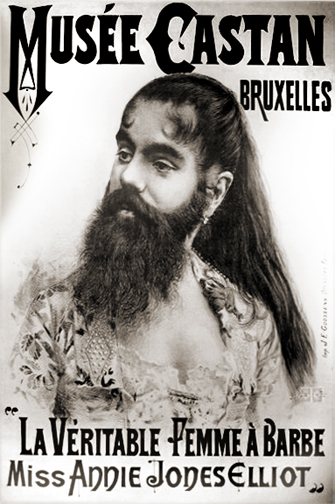
- Annie Jones
- Alice Elizabeth Doherty ("The Minnesota Woolly Girl", 1887–1933)
- Sidonia de Barcsy (1866–1925)[6]: 34–35
- Madame Jane Devere (b. 1842)[6]: 35–36
- Grace Gilbert (1876–1924)[6]: 40
20th century
[edit]- Clémentine Delait (late 19th century and early 20th century)
- Jane Barnell (late 19th century and early 20th century)
- Jennifer Miller
- Percilla Bejano
21st century
[edit]Popular culture
[edit]- Rosalie, Nadia Tereszkiewicz's character in Rosalie, loosely inspired by the life of Clémentine Delait.[7]
- Ethal Darling, Kathy Bates's character in American Horror Story.
- Lettie Lutz, Keala Settle's character in The Greatest Showman.
- A fascination with Wilgefortis grips the narrator of Fifth Business, the 40th-best novel of the 20th century according to the Modern Library's readers' list.[8]
- In the fictional country of Elbonia from the Dilbert comic strip, both men and women have beards and look identical.[9]
See also
[edit]References
[edit]- ^ Taylor, Sarah K (June 18, 2009). "Congenital Hypertrichosis Lanuginosa". Emedicine. Medscape. Retrieved December 4, 2009.
- ^ a b c Hamlin, Kimberly A. (2011). "The "Case of a Bearded Woman": Hypertrichosis and the Construction of Gender in the Age of Darwin". American Quarterly. 63 (4): 955–981. doi:10.1353/aq.2011.0051. ISSN 1080-6490. S2CID 144556475.
- ^ Shopland, Norena 'A wonder of nature' from Forbidden Lives: LGBT stories from Wales, Seren Books, 2017
- ^ Trainor, Sean (2014). "Fair Bosom/Black Beard: Facial Hair, Gender Determination, and the Strange Career of Madame Clofullia, "Bearded Lady"". Early American Studies. 12 (3): 548–575. doi:10.1353/eam.2014.0019. S2CID 144373934. ProQuest 1553324492.
- ^ Deschner, Donald (1966). The Films of W.C. Fields. New York: Cadillac Publishing by arrangement with The Citadel Press. p. 139. Introduction by Arthur Knight
- ^ a b c Hartzman, Marc (2006). American Sideshow. East Rutherford: Penguin Publishing Group. ISBN 1585425303.
- ^ "Rosalie - A new star is born in Stéphanie Di Giusto's period French drama inspired by a true story".
- ^ "Readers' List: 100 Best Novels", Random House Modern Library
- ^ Scott Adams (21 Oct 2008). Dilbert 2.0: 20 Years of Dilbert. Andrews McMeel Publishing. p. 89. ISBN 978-0740777356. Retrieved 1 July 2021.
.. I made all Elbonians look identical, even the women, with long black beards ...
External links
[edit]Bearded lady
View on GrokipediaBiological and Medical Foundations
Primary Causes and Mechanisms
Hirsutism, characterized by excessive terminal hair growth in a male-like pattern on the face and body, arises primarily from elevated androgen levels, which promote the transformation of vellus hairs into thicker, pigmented terminal hairs in androgen-dependent follicles. In women, physiological androgen concentrations—predominantly testosterone and its metabolites like dihydrotestosterone—remain low enough to favor vellus hair in facial regions, reflecting sexual dimorphism where higher male androgens drive denser terminal hair for evolutionary signaling of traits like maturity and dominance. Excess androgens, however, bind to follicle receptors, extending the anagen growth phase and increasing hair diameter, leading to visible beard-like growth that deviates markedly from normative female patterns.[2][9][10] Polycystic ovary syndrome (PCOS) accounts for 70-82% of hirsutism cases, involving ovarian hyperandrogenism from impaired follicular development, elevated luteinizing hormone, and insulin-mediated theca cell stimulation, which boosts androgen synthesis. Adrenal sources contribute in 3-5% of cases via conditions like non-classic congenital adrenal hyperplasia, where enzyme deficiencies (e.g., 21-hydroxylase) shunt precursors toward androgen production rather than cortisol. Rare etiologies include androgen-secreting tumors (ovarian or adrenal, <1% of cases) or iatrogenic factors such as phenytoin, cyclosporine, or anabolic steroids, which either amplify androgen activity or directly stimulate follicular proliferation independent of systemic hormone levels.[11][2][12] Distinct from androgenetic hirsutism, congenital hypertrichosis manifests as generalized excessive lanugo or vellus hair from birth, often including facial coverage, due to genetic mutations disrupting ectodermal-mesodermal signaling or hair cycle regulators like those in the Wnt pathway. Autosomal dominant inheritance predominates in forms such as congenital hypertrichosis lanuginosa, with chromosomal anomalies (e.g., 8q22 inversions) implicated in persistent lanugo retention, bypassing androgen mechanisms entirely. These rare variants—estimated at fewer than 1 in 1,000,000—affect hair growth uniformly rather than in sex-specific patterns, underscoring isolated defects in follicular differentiation over hormonal excess.[13][14][15]Distinctions Between Hirsutism and Hypertrichosis
Hirsutism is defined as the excessive growth of terminal (thick, pigmented) hair in women in androgen-dependent, male-pattern distribution areas, such as the upper lip, chin, chest, abdomen, and back, resulting from elevated androgen levels or increased sensitivity of hair follicles to androgens.[16] This condition affects 5% to 10% of reproductive-age women and is frequently associated with underlying endocrine disorders like polycystic ovary syndrome (PCOS).[2][17] Hypertrichosis, by contrast, involves excessive hair growth beyond normal ethnic, age-, and sex-related variations, distributed across any body region—including non-androgen-sensitive areas like the forehead, ears, or limbs—and is typically independent of androgen influence.[18] It encompasses both vellus (fine, unpigmented) and terminal hair types and can manifest as generalized or localized forms, with congenital variants often stemming from genetic mutations disrupting hair cycle regulation or follicle development.[13] Rare congenital generalized hypertrichosis universalis, for instance, arises from inherited genetic errors rather than hormonal dysregulation.[13] Distinguishing the two relies on clinical evaluation and targeted diagnostics: hirsutism is quantified via the Ferriman-Gallwey score, which grades hair density on a 0-4 scale across nine androgen-sensitive sites, with scores ≥8 confirming the diagnosis in most populations.[11] Hypertrichosis diagnosis emphasizes pattern and etiology, often requiring genetic sequencing for congenital cases to rule out syndromes, as opposed to serum androgen testing central to hirsutism workup.[13] Although co-occurrence is possible, conflating them overlooks distinct causal mechanisms—hormonal in hirsutism versus primarily genetic or non-endocrine in hypertrichosis—guiding precise etiological assessment.[19]Prevalence, Diagnosis, and Treatment Options
Hirsutism, characterized by excessive terminal hair growth in a male-pattern distribution, affects approximately 5-10% of women of reproductive age globally, with prevalence varying by ethnicity due to differences in hair follicle sensitivity and androgen levels rather than deterministic racial factors.[12][2][20] Rates are higher among women of Mediterranean, South Asian, Middle Eastern, and African descent, reaching 10% in community samples of African American women, while lower in East Asian populations at under 5%.[21][20] In contrast, hypertrichosis—diffuse excessive hair growth independent of androgens—is far rarer, with congenital forms like hypertrichosis lanuginosa estimated at 1 in a billion to 1 in 10 billion births, though acquired cases from medications or malnutrition occur sporadically without population-level prevalence data exceeding isolated reports.[14][22] Diagnosis begins with clinical assessment using the modified Ferriman-Gallwey (mFG) scoring system, which evaluates hair density in nine androgen-sensitive areas (upper lip, chin, chest, upper back, lower back, upper abdomen, lower abdomen, upper arms, thighs) on a 0-4 scale per site, with a total score ≥8 indicating hirsutism in Caucasian women (thresholds adjusted lower for Asian women at ≥2-6).[23] Laboratory evaluation follows for all women with elevated mFG scores, measuring total and free testosterone, dehydroepiandrosterone sulfate (DHEAS), and sex hormone-binding globulin to identify hyperandrogenemia; additional tests include 17-hydroxyprogesterone screening for nonclassic congenital adrenal hyperplasia (affecting 1-10% of hirsutism cases depending on ethnicity) and prolactin for hyperprolactinemia.[24][25] Transvaginal ultrasound detects polycystic ovarian morphology in up to 80-90% of cases linked to polycystic ovary syndrome (PCOS), while MRI or CT rules out rare androgen-secreting tumors (prevalence <0.1%).[23] For hypertrichosis, diagnosis relies on excluding hirsutism via normal androgen levels and identifying patterns (e.g., generalized vs. localized), with biopsy rarely confirming non-androgenetic vellus-to-terminal hair transformation.[13] Treatment targets underlying hyperandrogenism for hirsutism while employing mechanical or optical methods for hair reduction, with combined approaches yielding optimal outcomes over monotherapy. Oral contraceptives (e.g., ethinyl estradiol with progestins) suppress ovarian androgens, reducing Ferriman-Gallwey scores by 15-30% after 6-12 months, particularly effective in PCOS (70-80% of cases).[26][27] Anti-androgens like spironolactone (100-200 mg daily) block androgen receptors, achieving 20-40% hair reduction but requiring contraception due to teratogenicity; flutamide or finasteride offer similar efficacy (30-50% reduction) but carry hepatotoxicity risks.[28][27] Insulin sensitizers such as metformin (500-2000 mg daily) address PCOS-related insulin resistance, modestly lowering androgens and hirsutism scores by 10-20% in overweight patients.[27] Cosmetic interventions include electrolysis for permanent follicular destruction (effective in small areas) and laser therapy (alexandrite or diode lasers), which achieve 70-90% long-term hair reduction after 6-8 sessions in darkly pigmented hair, though less so in lighter follicles; paradoxical hypertrichosis occurs in <1% but up to 10% in Mediterranean or South Asian skin types.[28] Untreated PCOS-associated hirsutism elevates risks of endometrial hyperplasia, diabetes, and infertility due to ovulatory dysfunction.[21] Hypertrichosis management focuses on depilation (shaving, waxing, eflornithine cream for facial vellus), as congenital types lack curative hormonal therapies, with laser or electrolysis providing temporary to semi-permanent relief but recurrence common without addressing etiology like drug withdrawal.[13][28]Historical and Legendary Accounts
Ancient and Medieval References
In ancient Greek medical literature, the Hippocratic Corpus provides one of the earliest documented cases of a bearded woman in the text Diseases of Women. The case describes Phaethousa of Abdera, a married woman who ceased menstruating after her husband Pytheus departed for war, subsequently developing a beard and other masculinized traits due to grief and retention of bodily fluids, which ancient physicians attributed to an imbalance shifting her toward male humoral dominance.[29] [30] This account reflects proto-empirical observation linking hirsutism to reproductive disruptions, rather than supernatural causes, though empirical verification remains limited to textual report.[29] Roman sources offer scant specific records of bearded women, with natural historians like Pliny the Elder focusing more on general hypertrichosis in tribes or animals without detailing individual female facial cases, emphasizing instead environmental or innate factors for excessive hair growth.[31] In medieval Europe, Gerald of Wales documented an observed bearded woman circa 1180 at the court of Donald (Duvenaldus), king of Limerick, Ireland, in his Topographia Hibernica (completed 1188); she possessed a fully masculine beard yet bore children and exhibited otherwise female physiology, interpreted as a prodigy allowing her royal succession amid patrilineal norms.[32] [33] This eyewitness-like report blends empirical description with wonder, attributing rarity to divine anomaly rather than medical pathology.[32] The legend of Saint Wilgefortis (also Uncumber or Liberata), a pious Christian princess, emerged in devotion by the 12th century and crystallized in the 14th, recounting her miraculous beard growth—granted by God in response to prayers against a forced pagan marriage—repelling her suitor but provoking her father's crucifixion of her as punishment.[34] [35] Venerated for aiding escape from unhappy unions, her story fused hirsutism motifs with hagiographic miracle, possibly misattributing real conditions to interventionist causality, and inspired pilgrim offerings like coins for her depicted shoe.[34] Such accounts highlight medieval causal frameworks prioritizing divine will or curses over physiological mechanisms, contrasting later endocrinological understandings.[35]Early Modern to 18th Century Cases
One of the earliest well-documented cases of a bearded woman in early modern Europe was Barbara Urslerin, born on February 16, 1629, in Augsburg, Germany, who exhibited hypertrichosis covering her face and much of her body from infancy.[36] Her condition led to exhibition across Europe by her husband, Michael van Beck, including in London, where she was presented as the "Hairy Maid" or "Bearded Lady" for public novelty between the 1620s and her death around 1668.[37] Contemporary accounts described her beard cascading from her eyebrows to her chin, distinguishing her hypertrichosis—excessive hair growth not limited to androgen-influenced patterns—from later hirsutism cases, though both sparked curiosity blending superstition with emerging empirical observation.[36] In 1631, Spanish artist Jusepe de Ribera painted Magdalena Ventura with Her Husband and Son, depicting the 52-year-old Italian woman from Abruzzo who had developed a prominent beard at age 37, likely due to virilization from hirsutism.[38] The portrait, commissioned by the Viceroy of Naples, included an inscription detailing her condition's onset after 20 years of marriage and her ability to bear children, including a recently born son whom she breastfed, highlighting proto-medical interest in her fertility despite masculinized features.[39] This case marked a shift toward viewing such anomalies through a lens of natural philosophy rather than pure monstrosity, as Ribera's work emphasized her humanity and family life over mere spectacle.[40] Eighteenth-century records of bearded women remain sparse, with mentions primarily in medical compendia rather than public exhibitions, reflecting growing scientific scrutiny over sensationalism.[41] Women with facial hair often concealed it using rudimentary depilation or isolation to avoid social stigma, though isolated reports in English and French texts noted cases tied to endocrine disruptions, fostering early diagnostic efforts without widespread display.[42] This era's cases underscored a transition from viewing bearded women as divine portents or familial curses to subjects of anatomical inquiry, though empirical verification lagged behind morbid fascination.[43]Entertainment and Public Exhibition
Origins in Sideshows and Circuses
The institutionalization of bearded women in public exhibitions emerged prominently in the mid-19th century amid the expansion of dime museums and traveling circuses in the United States and Europe, where they served as staple attractions in sideshows attached to larger spectacles.[44][45] P.T. Barnum advanced this format through his American Museum in New York, established in 1841, which featured human curiosities including bearded women alongside animals and novelties, charging a standard 25-cent admission that appealed to broad audiences via tiered pricing for laborers.[46] By the 1870s, as Barnum integrated sideshows into circus operations like his Grand Traveling Museum, Menagerie, Caravan & Circus launched in 1871, these acts became fixtures, leveraging rail and steamship networks for seasonal tours across continents.[46] Promoters marketed bearded women as verifiable "natural wonders" to capitalize on Victorian-era interest in biological anomalies, distinguishing them from outright fabrications while employing publicity stunts to refute skepticism.[32] Barnum, for instance, orchestrated legal challenges alleging performers were men in disguise, which courts dismissed after examinations, thereby authenticating the exhibitions and amplifying media coverage to boost turnout.[32] Such tactics aligned with broader freak show strategies using pamphlets, photographs, and press endorsements—exemplified by Queen Victoria's 1844 audience with Barnum's General Tom Thumb—to frame displays as educational alongside entertaining, countering hoax perceptions without undermining the core draw of physiological rarity.[46] Attendance data for analogous curiosities underscore the revenue potential, with over 100,000 London viewers for conjoined twins Chang and Eng in 1829, and Barnum's museum routinely filling to capacity during peak seasons, reflecting sustained public curiosity rooted in the low prevalence of conditions like hypertrichosis rather than mere sensationalism.[46] Bearded women proved reliable earners in this ecosystem, often headlining lineups that sustained circus profitability into the late 19th century by offering repeatable, low-overhead spectacles amid competing urban entertainments.[44] International tours further evidenced this viability, as European fairs and American circuits exchanged acts to exploit transatlantic novelty.[45]Economic Realities and Performer Agency
Bearded ladies in 19th- and early 20th-century sideshows frequently secured earnings that surpassed average wages for women, fostering financial autonomy in an era of limited opportunities. For instance, Annie Jones' parents received $150 weekly from P.T. Barnum's exhibition upon her debut as an infant in 1865, a figure comparable to high executive compensation when adjusted for inflation and relative to contemporaneous labor rates, where annual factory worker earnings hovered around $400.[47] [48] As an adult, Jones maintained top billing, leveraging her prominence for sustained income and influence within the industry.[49] Performers demonstrated agency through deliberate career decisions, including contract renewals and tour selections tailored to maximize prosperity. Jones, for example, negotiated multi-year agreements and later advocated as a spokesperson for fellow attractions, rejecting exploitative labels like "freaks" to assert professional dignity.[48] Similarly, Vivian Wheeler began sideshow work at age five in the mid-20th century, channeling earnings to support her family and sustaining a decades-long career on her terms.[50] While managers occasionally imposed harsh terms, performers countered through collective actions like the 1930s "Revolt of the Freaks" strike, demanding fair pay and conditions, which underscores proactive self-advocacy rather than passive victimhood.[51] Long tenures and accumulated savings for many, including Jones who performed until her death in 1902, refute narratives of universal coercion, as viable alternatives like medical beard removal risked eliminating their primary revenue source.[49] By the 1930s, prominent sideshow acts could earn $400 daily—equivalent to about $9,000 in 2024—enabling retirement security amid economic hardship.[52]Notable Bearded Women
19th Century Figures
Josephine Clofullia (c. 1829–1870), born near Geneva, Switzerland, developed a prominent beard in childhood, reaching five inches by age 14, attributable to hypertrichosis.[53] Facing family financial hardship, she began exhibiting as a late adolescent and arrived in the United States in 1853 to perform at P. T. Barnum's American Museum in New York City.[53] Clofullia supplemented her display with demonstrations of embroidery and other domestic skills, underscoring her conventional feminine roles.[53] That year, rival showman William Chaar sued Barnum claiming she was male, but the case was dismissed following medical testimony affirming her female anatomy.[53] She toured internationally before dying in Bridgwater, England, in 1870 at about age 41.[54] Julia Pastrana (1834–1860), an indigenous woman born in the Sierra Madre mountains of western Mexico, exhibited generalized hypertrichosis lanuginosa—causing thick hair over her face and body—and gingival hyperplasia, which thickened her lips and gums.[55][56] Recruited for exhibition around 1854 by showman M. Rates during a tribal visit, she later partnered with and married manager Theodore Lent. Pastrana debuted in New York City in December 1854, toured eastern North America and Canada, appeared in London in 1857, and reached Moscow in 1859, performing songs in multiple languages.[56] In March 1860, shortly after giving birth there to a son who lived only 35 hours, she died from metro-peritonitis puerperalis, a postpartum uterine infection.[56] Her and her infant's bodies were embalmed by Professor Sokolov and exhibited across Europe for decades.[56]Annie Jones (1865–1902), born in Virginia, displayed hirsutism from birth, featuring coarse, male-pattern facial hair.[49] Her parents exhibited her to P. T. Barnum before age one as the "Infant Esau"; she later starred as his premier "Bearded Lady" under a three-year contract paying $150 annually and toured widely with his shows.[49] Jones publicly opposed the label "freak" for performers, positioning herself as a professional entertainer. She married Richard Elliot in 1880 (divorced 1895) and then William Donovan, who died after four years; childless, she continued performing until contracting tuberculosis. Jones died on October 22, 1902, at age 37 while visiting her mother.[49]
