


Community hub
Recent from talks
Contribute something
Nothing was collected or created yet.
Blaine, Minnesota
View on Wikipedia
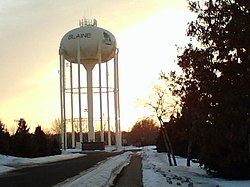
Blaine (/ˈbleɪn/ BLAYN) is a suburban city in Anoka and Ramsey counties in Minnesota, United States. Once a rural town, Blaine's population has increased significantly in the last 60 years.[when?] For several years, Blaine led the Twin Cities metro region in new home construction.[7][8] The population was 70,222 at the 2020 census.[5] The city is mainly in Anoka County, and is part of the Minneapolis–Saint Paul metropolitan area.
Key Information


Interstate 35W, U.S. Highway 10, and Minnesota State Highway 65 are three of the main routes in the city.
History
[edit]Phillip Leddy, a native of Ireland, was recorded in the 1857 census[9] as having settled in the township of Anoka until his death in 1872, on land that later became Blaine. In 1862, he moved near a lake that now bears his misspelled name, Laddie Lake. Another early settler was the Englishman George Townsend, who lived for a short time near what today is Lever St. and 103rd Ave.[10]
In 1865, Blaine's first permanent resident, Greenberry Chambers, settled on the old Townsend claim.[11] Chambers was a former slave who moved north from Barren County, Kentucky, after the American Civil War. Around 1884, Chambers and his family moved to St. Paul.[12]
In 1870, George Wall, Joseph Gagner, and others settled in the area and it began to grow.[citation needed]
In 1877, Blaine separated from Anoka and organized as a township.[13] That year the first election was held and Moses Ripley was elected the first Chairman of the Board of Supervisors. Ripley, who had come to Minnesota from Maine, persuaded his fellow board members to name the new township in honor of James G. Blaine, a U.S. Senator, statesman and three-time presidential candidate from Maine. By 1880, Blaine's population had reached 128.
While many other Anoka County communities experienced growth due to farming, Blaine's sandy soil and abundant wetlands discouraged farmers and it remained a prime hunting area. Blaine's growth remained slow until after World War II, when housing developments began in the southern part of town and the community became more suburban. Blaine's population grew from 1,694 in 1950 to 20,573 in 1970, 57,186 in 2010, and 70,222 in 2020. By 2023, the population was over 72,500.
The land development technique of sand mining opened thousands of acres of peat sod farms up for development. Beginning with the development of the Knoll Creek, Club West, Pleasure Creek and TPC Twin Cities, the existing land was modified through extensive grading efforts in the large open water areas. The sand from the excavation of those ponds was used to raise the level of the site. These site modifications are needed to accommodate the development of the homes and neighborhoods.[14] The success of mining sand allowed for further development. The centerpiece of those developments is the Lakes of Blaine.[15] Corporate residents include the Aveda Corporation, Infinite Campus, PTC Inc, MagnetStreet, the parking lot portion of a Medtronic Development, and Dayton Rogers Manufacturing.
Geography
[edit]According to the United States Census Bureau, the city has an area of 34.05 square miles (88.19 km2), of which 33.85 square miles (87.67 km2) is land and 0.20 square miles (0.52 km2) is water.[16] Blaine is 13 miles (21 kilometers) from Minneapolis and 20 mi (32 km) from St. Paul.
Blaine can be accessed from several major roadways in the Twin Cities, including Minnesota State Highway 65, Interstate 35W, University Avenue, Lexington Avenue, Hamline Avenue, U.S. Highway 10 and Minnesota State Highway 610.
Major landforms
[edit]The Blaine area was covered by a large glacier that shaped the landscape during the late Wisconsinan glaciation. The land used to be covered by river valleys 200 feet deep. The valleys filled with sediment. One valley ran northeast to southwest under Lino Lakes. As the glaciers retreated, the water gathered into a lake that covered much of Anoka County. Huge ice chunks were left in the glacier's wake. They melted and formed depressions that filled with water. This became the chain of lakes between Lino Lakes and Circle Pines.[17]
There are four major named water bodies partially or completely within the city limits. Sunrise Lake as part of The Lakes housing development is the largest body at 158 acres, with a depth near 40 feet in some places.[18] The next largest body is Laddie Lake, the only naturally occurring lake in Blaine, which is also partially in Spring Lake Park, at 77 acres, reaching a maximum depth of six feet.[19] The next largest body is Club West Lake at 39 acres and depths up to 25 feet, also man-made, in the Club West Housing development.[20] The last named body of water in the city is Loch Ness; 11 acres, it is managed by the city and has a fishing dock.[21] Several other large bodies of water found around the TPC of the Twin Cities, Pleasure Creek Neighborhood, Knoll Creek Development, and Crescent Ponds are not classified as lakes.
Blaine is also creating a 500-acre open space plan. It started acquiring portions of the property in the late 1990s, but most of it was acquired after Blaine voters approved a $3.5 million referendum in 2000.[22] A tentative long-range plan calls for the construction of a nature center by 2020. The 70-acre Kane Meadows Park next to The Lakes development has been the centerpiece of this program.[23]
Demographics
[edit]| Census | Pop. | Note | %± |
|---|---|---|---|
| 1880 | 128 | — | |
| 1890 | 205 | 60.2% | |
| 1900 | 374 | 82.4% | |
| 1910 | 413 | 10.4% | |
| 1920 | 550 | 33.2% | |
| 1930 | 506 | −8.0% | |
| 1940 | 921 | 82.0% | |
| 1950 | 3,604 | 291.3% | |
| 1960 | 7,570 | 110.0% | |
| 1970 | 20,573 | 171.8% | |
| 1980 | 28,558 | 38.8% | |
| 1990 | 38,975 | 36.5% | |
| 2000 | 44,942 | 15.3% | |
| 2010 | 57,186 | 27.2% | |
| 2020 | 70,222 | 22.8% | |
| 2022 (est.) | 71,739 | [6] | 2.2% |
| U.S. Decennial Census[9] 2020 Census[5] | |||
2010 census
[edit]As of the census of 2010, there were 57,186 people, 21,077 households, and 15,423 families living in the city. The population density was 1,689.4 inhabitants per square mile (652.3/km2). There were 21,921 housing units at an average density of 647.6 per square mile (250.0/km2). The racial makeup of the city was 84.0% White, 3.7% African American, 0.5% Native American, 7.8% Asian, 1.2% from other races, and 2.7% from two or more races. Hispanic or Latino people of any race were 3.2% of the population.
There were 21,077 households, of which 38.3% had children under the age of 18 living with them, 57.8% were married couples living together, 10.8% had a female householder with no husband present, 4.6% had a male householder with no wife present, and 26.8% were non-families. 20.7% of all households were made up of individuals, and 5.7% had someone living alone who was 65 years of age or older. The average household size was 2.71 and the average family size was 3.14.
The median age in the city was 35.6 years. 26.5% of residents were under the age of 18; 7.4% were between the ages of 18 and 24; 30.7% were from 25 to 44; 27% were from 45 to 64; and 8.5% were 65 years of age or older. The gender makeup of the city was 49.1% male and 50.9% female.
2000 census
[edit]As of the census of 2000, there were 44,942 people, 15,898 households, and 12,177 families living in the city. The population density was 1,330 inhabitants per square mile (510/km2). There were 16,169 housing units at an average density of 477.6 per square mile (184.4/km2). The racial makeup of the city was 93.46% White, 0.86% African American, 0.63% Native American, 2.54% Asian, 0.02% Pacific Islander, 0.75% from other races, and 1.75% from two or more races. 1.72% of the population were Hispanic or Latino people of any race.
There were 15,898 households, out of which 41.1% had children under the age of 18 living with them, 61.1% were married couples living together, 11.1% had a female householder with no husband present, and 23.4% were non-families. 17.0% of all households were made up of individuals, and 3.3% had someone living alone who was 65 years of age or older. The average household size was 2.82 and the average family size was 3.19.
In the city, the population was spread out, with 29.1% under the age of 18, 8.7% from 18 to 24, 34.8% from 25 to 44, 22.0% from 45 to 64, and 5.3% who were 65 years of age or older. The median age was 33 years. For every 100 females, there were 100.2 males. For every 100 females age 18 and over, there were 98.1 males.
The median income for a household in the city was $59,219, and the median income for a family was $63,831. Males had a median income of $40,620 versus $30,452 for females. The per capita income for the city was $22,777. 3.0% of the population and 2.1% of families were below the poverty line. Out of the total population, 3.0% of those under the age of 18 and 3.7% of those 65 and older were living below the poverty line.
Economy
[edit]Top employers
[edit]According to the city's 2022 Comprehensive Annual Financial Report,[24] the largest employers in the city are:
| # | Employer | Employees |
|---|---|---|
| 1 | Aveda Corporation | 700 |
| 2 | Cub Foods (four locations) | 435 |
| 3 | Infinite Campus | 650 |
| 4 | Carley Foundry, Inc. | 350 |
| 5 | National Sports Center | 325 |
| 6 | Walmart Stores, Inc. | 300 |
| 7 | Target Corporation | 270 |
| 8 | The Home Depot (two locations) | 230 |
| 9 | City of Blaine | 230 |
| 10 | Lowe's | 140 |
Sports
[edit]The 3M Open, a PGA Tour event, is held at TPC Twin Cities.[25]
The National Sports Center was the home of Minnesota's professional soccer teams for 23 years. From 1990 to 2003 and 2008–2009 the National Sports Center was home for the now defunct Minnesota Thunder. After the Thunder folded, the sports center quickly stepped in and created the NSC Minnesota Stars for the 2009 season. The United States Soccer Federation ruled the stadium could not own the team, due to an increase in financial standards the stadium did not have, and the team re-branded to become the Minnesota Stars FC for the 2010–2012 seasons. The Minnesota United FC, after being re-branded in early 2013 to represent the history of soccer in Minnesota, played at the National Sports Center until their promotion to Major League Soccer in 2017,[26] and they now play at Allianz Field in St. Paul but continue to use the National Sports Center as their training facility.[27]
The National Sports Center is also home to Victory Links Golf Course, a stadium with an artificial turf field, over 50 full-size soccer fields, an eight-sheet ice arena, the largest of its kind in the world, an expo center, and a meeting and convention facility.
Parks and recreation
[edit]Blaine has 66 parks and hundreds of miles of trails. Its parks include Aquartore Park, Happy Acres Park, Lexington Athletic Complex, the Blaine Baseball Complex, and Lakeside Commons Park. The Blaine Wetland Sanctuary is 500 acres of protected open space featuring a boardwalk and trails.[28]
Government
[edit]| Year | Republican | Democratic | Third party(ies) | |||
|---|---|---|---|---|---|---|
| No. | % | No. | % | No. | % | |
| 2000 | 9,808 | 44.67% | 10,783 | 49.11% | 1,368 | 6.23% |
| 2004 | 14,438 | 51.35% | 13,372 | 47.56% | 306 | 1.09% |
| 2008 | 14,738 | 47.73% | 15,493 | 50.18% | 646 | 2.09% |
| 2012 | 15,741 | 48.03% | 16,273 | 49.66% | 757 | 2.31% |
| 2016 | 15,995 | 47.06% | 14,849 | 43.69% | 3,141 | 9.24% |
| 2020 | 18,420 | 46.21% | 20,431 | 51.25% | 1,011 | 2.54% |
2021-2024 Blaine City Council:
- Mayor: Tim Sanders
- Ward One Councilmembers: Jason Smith and Wes Hovland
- Ward Two Councilmembers: Julie Jeppson and Jess Robertson
- Ward Three Councilmembers: Chris Massoglia and Richard Paul
Blaine is in Minnesota's 6th congressional district, represented by Tom Emmer, a Republican. Its U.S. senators are Amy Klobuchar and Tina Smith, both Democrats. Blaine is represented by Nolan West and Erin Koegel in the Minnesota House of Representatives and Jerry Newton in the Minnesota Senate.
Education
[edit]Three different school districts serve Blaine. The Anoka-Hennepin School District covers most of the city, from Highway 65 to University Avenue north of 99th Ave NE and the areas north of Cloud Drive, and zigzags through the Lakes neighborhood up to Main Street, where it covers everything north all the way across to Sunset, the city's eastern edge. The Spring Lake Park School District covers nearly everything south of 99th Ave NE, the east side of Highway 65 north to where it bumps into District 11 and east to Lexington, where it bumps into the Centennial School District. District 12—Centennial Schools—covers east of Lexington almost up to Main Street and everything south and east of Interstate 35W.
There are three high schools in the city: Blaine High School in the Anoka-Hennepin School District, Centennial High School in the Centennial School District, and Paladin Career and Technical High School, a public charter school. In addition, some Blaine students attend Spring Lake Park High School in the Spring Lake Park School District.
Rasmussen University, a private, for-profit school offering bachelor's and associate degrees, has a location in Blaine.
References
[edit]- ^ "Guide to Blaine Minnesota". www.lakesnwoods.com. Retrieved April 3, 2018.
- ^ Blaine Charter §2.01
- ^ "2020 U.S. Gazetteer Files". United States Census Bureau. Retrieved July 24, 2022.
- ^ a b U.S. Geological Survey Geographic Names Information System: Blaine, Minnesota
- ^ a b c "Explore Census Data". United States Census Bureau. Retrieved October 15, 2023.
- ^ a b "City and Town Population Totals: 2020-2022". United States Census Bureau. October 15, 2023. Retrieved October 15, 2023.
- ^ "Minnesota Population". Minnesota Department of Minnesota. 2005. Archived from the original on November 24, 2005. Retrieved December 11, 2006.
- ^ Barry, Dan; Ackerman, Jenn (August 4, 2024). "A Battle Over a Farm, a Mosque and the Moral High Ground". The New York Times. ISSN 0362-4331. Retrieved August 5, 2024.
- ^ a b United States Census Bureau. "Census of Population and Housing". Retrieved August 14, 2013.
- ^ "Blaine's History". Archived from the original on February 14, 2022.
- ^ "Greenberry Chambers - Blaine, MN". Archived from the original on February 14, 2022.
- ^ "Slavery to freedom: The Greenberry Chambers story - Anoka County Historical Society". July 23, 2020. Archived from the original on February 14, 2022.
- ^ "The Story of Blaine". Archived from the original on April 10, 2021.
- ^ "Archived copy" (PDF). Archived from the original (PDF) on January 23, 2004. Retrieved February 6, 2015.
{{cite web}}: CS1 maint: archived copy as title (link) - ^ "Travis Sabby - The Lakes". liveinthelakes.com. Retrieved April 3, 2018.
- ^ "US Gazetteer files 2010". United States Census Bureau. Archived from the original on January 25, 2012. Retrieved November 13, 2012.
- ^ Blaine History. Norhart. Blaine Apartments. https://www.norhart.com/blaine/history
- ^ "Sunrise Lake - the Lakes of Radisson". Archived from the original on February 18, 2015. Retrieved February 18, 2015.
- ^ "Fisheries Lake Surveys - Minnesota Department of Natural Resources". dnr.state.mn.us. Retrieved April 3, 2018.
- ^ "LakeFinder - Lake Page - Minnesota Department of Natural Resources". dnr.state.mn.us. Retrieved April 3, 2018.
- ^ "Fisheries Lake Surveys - Minnesota Department of Natural Resources". dnr.state.mn.us. Retrieved April 3, 2018.
- ^ Hagen, Eric (August 5, 2014). "Concept for 500-acre open space site in Blaine approved". abcnewspapers.com. Retrieved April 3, 2018.
- ^ "Blaine to create 500-acre nature preserve". startribune.com. Retrieved April 3, 2018.
- ^ "City of Blaine 2022 Comprehensive Annual Financial Report" (PDF). April 16, 2022. p. 141.
- ^ "3M Open". 3M Open.
- ^ "Minnesota United is joining Major League Soccer in 2017". Star Tribune. Retrieved July 22, 2017.
- ^ "Allianz Field".
- ^ "Home". blaineparks.com.
- ^ "Minnesota Election Results". Office of the Minnesota Secretary of State. Retrieved August 13, 2024.
External links
[edit]Municipalities and communities of Anoka County, Minnesota, United States | ||
|---|---|---|
| Cities |  | |
| Township | ||
| CDP | ||
| Unincorporated community | ||
| Ghost towns/Neighborhoods | ||
| Footnotes | ‡This populated place also has portions in an adjacent county or counties | |
Municipalities and communities of Ramsey County, Minnesota, United States | ||
|---|---|---|
| Cities |  | |
| Township | ||
| Unincorporated communities | ||
| Ghost towns/Neighborhoods | ||
| Footnotes | ‡This populated place also has portions in an adjacent county or counties | |
45°09′39″N 93°14′05″W / 45.16083°N 93.23472°W
| International | |
|---|---|
| National | |
| Geographic | |

Blaine, Minnesota
View on GrokipediaThe city, incorporated in 1964, originated as a rural township but underwent rapid post-World War II expansion, with its population increasing from 1,694 in 1950 to 20,640 by 1970 and reaching 70,222 as recorded in the 2020 United States Census, making it the tenth-largest city in Minnesota.[2][3]
Blaine is distinguished by the National Sports Center, a 600-acre complex established in 1990 that operates as the world's largest amateur sports facility, encompassing over 50 soccer fields, multiple ice arenas including the Schwan Super Rink, a championship golf course, and venues for hosting regional, national, and international competitions across various sports.[4][5][6]
The city's growth continues, with recent estimates projecting a population approaching 76,000 by 2025, supported by its proximity to major employment centers, residential developments, and amenities that have earned it recognition as one of America's top places to live.[7][8][3]
History
Founding and Early Development
The area now comprising Blaine, Minnesota, was originally inhabited by Dakota and Ojibwe peoples who utilized the region's wetlands and forests for hunting prior to European settlement.[9] Land surveys began in 1847 under Andrew Hewett, facilitating early speculation, though permanent settlement lagged due to challenging sandy soils and extensive marshes.[10] The first recorded settler was likely Andrew More in 1855, as noted in the 1857 census, but Phillip Leddy, an Irish immigrant, is widely recognized as the initial permanent resident after purchasing land in 1857 and 1859 and establishing a farm around 1862 near what became known as Laddie Lake.[10] Leddy's family continued farming until at least 1875, following his death in 1872.[10] Other early arrivals included Englishman George Townsend, who briefly resided near present-day Lever Street and 103rd Avenue, and Green Chambers, a former enslaved person from Kentucky, who settled permanently in 1865 on a prior claim.[2] Initially part of Anoka Township, the area saw sparse development focused on subsistence agriculture amid environmental constraints. In 1877, residents petitioned to separate from Anoka, leading to the organization of Blaine Township that June, with state and county approval.[11] The inaugural election occurred on July 7 at S.C. Tisdale's home, electing Moses Ripley—originally from Maine and an admirer of U.S. Senator James G. Blaine—as the first chairman of the Board of Supervisors; the township bore the politician's name in tribute.[2] By 1880, the population numbered 128, sustained primarily by dairy farming, which persisted as the dominant economic activity into the early 20th century despite limited growth from the terrain's unsuitability for large-scale crops.[10] The township remained largely rural, serving as a peripheral hunting and foraging zone for nearby communities.[2]Post-World War II Growth
Following World War II, Blaine experienced rapid population expansion driven by the national housing shortage and suburban migration from the Twin Cities core, as returning veterans and expanding families sought affordable single-family homes. The population increased from 921 residents in 1940 to 1,694 by 1950, then surged to 7,570 in 1960 and 20,573 in 1970, reflecting a transition from rural agrarian roots to suburban character.[11] This growth was facilitated by the conversion of former dairy farmlands into starter-home subdivisions, primarily in the southern and eastern areas of the township.[10] The influx prompted infrastructural and administrative changes to accommodate suburbanization, including the development of basic utilities and roads to support residential expansion. In response to mounting development pressures, Blaine incorporated as a village in 1954 to manage zoning and services more effectively, followed by adoption of a home rule charter and city status in 1964 amid a population nearing 15,000.[12] Developers like Vern Donnay advanced plans for complementary commercial nodes, such as early shopping centers, signaling the shift toward a mixed-use suburban economy tied to regional commuting patterns.[11] By the late 1960s, these changes had solidified Blaine's role as a burgeoning bedroom community, with over tenfold population growth in two decades underscoring the causal link between postwar demographic pressures and land-use transformation.[10]Late 20th and 21st Century Expansion
During the late 20th century, Blaine transitioned from a predominantly agricultural community to a burgeoning suburb, fueled by enhanced accessibility via the completion and expansion of Interstate 35W, U.S. Highway 10, and Minnesota Highway 65, which connected it more efficiently to the Minneapolis-St. Paul metropolitan area.[10] The population surged from 28,558 in 1980 to 38,975 in 1990 and 44,942 by 2000, driven by the conversion of farmland into residential subdivisions and commercial zones.[13] Key milestones included the 1978 Clover Leaf development and the 1990 opening of the National Sports Center (NSC), a state-funded facility on over 600 acres that became the world's largest amateur sports complex, attracting events and spurring ancillary economic activity.[11][4] In the 21st century, Blaine's expansion accelerated with sustained population growth, adding roughly 1,000 residents annually to reach 70,222 by 2020 and an estimated 75,978 by 2025, supported by ongoing housing projects such as Deacon's Walk, Club West, and The Lakes in the early 2000s.[3][7] Employment expanded by 18% from 2000 to 2010, exceeding regional averages, bolstered by a diversifying economy with nearly 1,400 businesses, including major employers in manufacturing and services.[14][15] Recent initiatives, such as the 105th Avenue redevelopment and the National Sports Village mixed-use project, alongside a $750 million sports and entertainment district breaking ground in 2025 adjacent to the NSC, aim to enhance tourism, retail, and tax revenues while addressing infrastructure needs.[16][17]Geography
Physical Features and Landforms
Blaine occupies a portion of the Anoka Sand Plain, a glacial outwash plain in Anoka County formed by sandy and gravelly deposits from meltwater of retreating glaciers during the late Wisconsinan stage of the Pleistocene epoch. These unconsolidated sediments, typically 20 to 80 feet thick, overlie older glacial till and bedrock, creating a permeable aquifer that influences local hydrology.[18][19] The terrain exhibits low relief, with flat to gently undulating surfaces averaging 907 feet (276 meters) above sea level and maximum elevation changes of 39 feet over short distances, consistent with outwash plain deposition rather than erosional carving. Local variations include subtle dunes, shallow depressions from kettle holes, and occasional tunnel valleys incised by subglacial meltwater streams.[20][21] Kettle lakes and wetlands, resulting from differential melting of stagnant ice blocks within the outwash, punctuate the landscape and account for approximately 3.3% of the city's 34-square-mile area as surface water. Drainage occurs primarily through the Rice Creek and Coon Creek watersheds, which channel surface and groundwater toward the Mississippi River, with numerous small streams and bogs enhancing the region's wetland density.[22][23]Climate and Environmental Factors
Blaine experiences a humid continental climate characterized by cold, snowy winters and warm, humid summers, classified under the Köppen system as Dfa (hot-summer humid continental).[24] [25] Annual temperatures typically range from an average low of 5°F in winter to a high of 82°F in summer, with extremes occasionally reaching below -20°F or above 100°F.[26]| Month | Avg. Max (°F) | Mean (°F) | Avg. Min (°F) | Precip. (in) | Snowfall (in) |
|---|---|---|---|---|---|
| January | 25 | 16 | 10 | 0.1 | 3.2 |
| February | 29 | 21 | 14 | 0.2 | 3.3 |
| March | 42 | 33 | 26 | 1.0 | 3.3 |
| April | 58 | 47 | 38 | 2.4 | 0.9 |
| May | 69 | 59 | 49 | 3.3 | 0.1 |
| June | 78 | 68 | 58 | 4.2 | 0.0 |
| July | 82 | 73 | 63 | 3.6 | 0.0 |
| August | 80 | 70 | 61 | 3.5 | 0.0 |
| September | 71 | 62 | 53 | 3.1 | 0.0 |
| October | 58 | 49 | 41 | 1.9 | 0.4 |
| November | 42 | 34 | 28 | 1.0 | 2.7 |
| December | 28 | 21 | 15 | 0.4 | 4.2 |
| Annual | 55 | 46 | 38 | 24.7 | 18.1 |
Demographics
Population Growth and Projections
Blaine's population has expanded rapidly since the post-World War II era, driven by suburban development and proximity to the Minneapolis–Saint Paul metropolitan area. The U.S. Census Bureau recorded 44,942 residents in 2000, rising to 57,186 by 2010—a 27.2% increase—and reaching 70,222 in the 2020 decennial census, reflecting sustained annual additions of roughly 1,000 residents over the prior two decades.[3] Recent estimates place the population at 73,774 as of 2023, continuing a trend of about 1.5–2.8% annual growth in recent years.[33] Projections from the Metropolitan Council anticipate further expansion, with the population forecasted to grow to 78,800 by 2030, 83,700 by 2040, and 90,200 by 2050—representing a 28.45% increase from the 2020 baseline.[34] These estimates account for ongoing housing development, employment opportunities in nearby commercial hubs, and regional migration patterns, though actual growth may vary based on economic conditions and infrastructure capacity. Independent analyses project similar near-term figures, such as 75,978 for 2025 at a 1.47% annual rate.[7]| Decade | Population | Percent Change |
|---|---|---|
| 2000 | 44,942 | — |
| 2010 | 57,186 | +27.2% |
| 2020 | 70,222 | +22.8% |
Racial, Ethnic, and Socioeconomic Composition
As of the 2020 United States Census, Blaine's population of 70,222 was composed of 77% White residents, reflecting a decline from 84% in 2010 amid broader suburban diversification trends in the Minneapolis-St. Paul metropolitan area.[3] Non-Hispanic Whites constituted approximately 71-72% in recent American Community Survey estimates, with Asian residents at 9.5%, Black or African American at 8.6%, and Hispanic or Latino (of any race) at around 5%.[35] [36] Smaller shares included individuals identifying as two or more races (about 6%) and American Indian or Alaska Native (under 1%).[37] This composition aligns with Minnesota's statewide patterns of increasing non-White populations driven by immigration and domestic migration, though Blaine remains less diverse than urban cores like Minneapolis.[38]| Racial/Ethnic Group | Percentage (2022 ACS Estimate) |
|---|---|
| White (Non-Hispanic) | 71% |
| Asian (Non-Hispanic) | 9.5% |
| Black or African American (Non-Hispanic) | 9% |
| Hispanic or Latino (any race) | 5% |
| Two or More Races | 4% |
| Other | <1% |