Hubbry Logo
BosaBosaMain
Open search
Bosa
Community hub
Bosa
logo
8 pages, 0 posts
0 subscribers
Be the first to start a discussion here.
Bosa
Bosa
from Wikipedia
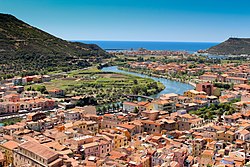
Bosa and its castle seen from the river Temo

Key Information

An aerial view of Bosa
Historical City Clock

Bosa is a town and comune in the province of Oristano (until May 2005 it was in the province of Nuoro), part of the Sardinia region of Italy. Bosa is situated about two-thirds of the way up the west coast of Sardinia, on a small hill, about 3 kilometres (2 miles) inland on the north bank of the Temo River. It is the only town on the island of Sardinia built on the banks of a river.[3] The town has maintained a population of around 8,000 people for a significant amount of time, but has an urban character that has differentiated it from other locations in Sardinia. It is one of I Borghi più belli d'Italia ("The most beautiful villages of Italy").[4] Agriculture and fishing play an important part in the city economy, thanks to the river valley near the coast surrounded by hills and highland plateaus.

History

[edit]

The area was inhabited since prehistorical times, as attested by the presence of several domus de janas and nuraghe. It was probably founded by the Phoenicians, although little is known about the original settlement. Under the Romans it was a municipium. The present town of Bosa was founded in 13th century by the Malaspina family, 2.5 km (1.5 miles) from the site of the ancient town.[5] In the early Middle Ages, as part of the Giudicato of Logudoro, it was a provincial capital. After the construction of the Malaspina Castle, the population gradually moved from the seaside to the hills.

It remained in the hands of the Malaspina until the 14th century, when it was taken over by the Crown of Aragon. Along with the rest of Sardinia, it was later ruled by Spain. For a short period in between, it was a part of the Giudicato of Arborea.

Bosa is known for a classical way of saying: you do like they do in Bosa: if it rains, they let it rains.

Museums

[edit]

While smaller than Sardinia's major cities, Bosa offers several museums and cultural attractions that provide insight into the town's unique heritage and traditions. These institutions count among the essential things to see in Bosa for visitors interested in a deeper understanding of local history and craftsmanship.

Casa Deriu Museum

[edit]

Housed in a beautifully preserved 19th-century bourgeois residence on the riverfront, Casa Deriu Museum (Museo Casa Deriu) offers visitors the chance to step into the world of Bosa's prosperous merchant class. The museum preserves the original furnishings, decorations, and domestic objects of a wealthy local family, providing a glimpse into daily life during Bosa's economic heyday.

Tanneries Museum

[edit]

One of the most distinctive chapters in the history of Bosa involved its tannery industry, which flourished along the riverbanks from the Middle Ages until the early 20th century. The Tanneries Museum (Museo delle Conce) preserves this industrial heritage in the actual buildings where leather was once processed. [6]

Sources and references

[edit]
[edit]
Revisions and contributorsEdit on WikipediaRead on Wikipedia
from Grokipedia
Bosa is a town and comune in the province of , in the region of , uniquely situated about three kilometers inland along the northern bank of the Temo River—the island's only navigable waterway—approximately two-thirds of the way up its western coast. With a population of around 7,400 residents (as of 2024), it is celebrated for its vibrant, multicolored historic center featuring cobbled streets and pastel-hued houses climbing the slopes of Serravalle Hill, crowned by the medieval Malaspina Castle, earning it inclusion among Italy's most beautiful villages as a member of the "I Borghi più Belli d’Italia" association. The town's geography is defined by the Temo River, which bisects Bosa into its historic core, known as Sa Costa with its steep, narrow lanes and former tanneries now preserved as a since 1989, and the more modern Bosa Marina district along the coast, renowned for its sandy beaches such as S'Abba Druche and Maladroxia. Bosa's economy historically revolved around tanning, , and , with the river facilitating , while today it thrives on , wine production—particularly the renowned di Bosa—and artisanal crafts like coral jewelry and asphodel reed baskets. Bosa's history traces back to Phoenician settlements around the 9th century BCE, leveraging its strategic coastal position for trade, followed by Roman influence that left archaeological traces in the surrounding area. During the , it endured invasions by Arab pirates until the construction of the Malaspina Castle between the 12th and 13th centuries provided defense under the , later passing to Aragonese control in the ; the castle's interior features 14th- and 15th-century frescoes, and the town also boasts Romanesque churches like the 11th-century San Pietro Extramuros and the 12th-century Cathedral of the Immaculate Conception. The 19th century saw the development of Corso Vittorio Emanuele, lined with elegant palazzos, reflecting Bosa's tannery boom that made it Sardinia's largest center for leather production. Culturally, Bosa preserves vibrant traditions, including the lively known as Sa Carrasegare with masked parades and satirical floats, and religious festivals honoring patron saints, alongside its architectural gems like the Church of Nostra Signora de Sos Regnos Altos with its 14th-century frescoes. The town's blend of natural beauty, from palm-lined riverbanks to nearby nuragic sites, and its commitment to sustainability positions it as a quintessential Sardinian gem attracting visitors for its authentic, unspoiled charm.

Geography

Location and topography

Bosa is an Italian in the province of , within the autonomous region of , situated at coordinates 40°18′N 8°30′E. The town occupies a position on 's west coast, roughly two-thirds of the way northward from the island's southern tip, approximately 3 km inland from the . Bosa lies at an elevation of 2 meters (6.6 ft) above . Bosa lies along the north bank of the Temo River, Sardinia's only navigable , which courses directly through the urban center and defines much of the town's elongated, riverside configuration. As the principal settlement in the historical Planargia region, Bosa's municipal territory encompasses 128 km² of diverse landscape, blending the fertile alluvial plains of the Temo valley with adjacent plateaus, rolling hills, and modest mountain ranges. The core settlement rises along the slopes of the modest Serravalle hill (81 m or 266 ft above ), which anchors the town amid this varied topography of riverine lowlands and elevated hinterlands. The shares borders with several adjacent municipalities, including Modolo to the south, Magomadas and to the north, Montresta to the east, and also Padria, Pozzomaggiore, and Villanova Monteleone to the northeast.

Climate

Bosa experiences a warm temperate , classified as Csa under the Köppen-Geiger system, featuring hot, dry summers and mild, rainy winters. The annual average temperature hovers around 16°C (61°F), with seasonal variations moderated by the town's coastal position. During summer months from June to August, average high temperatures range from 28°C to 32°C (82°F to 90°F), while lows remain above 18°C (64°F), creating warm nights. In contrast, winter months from to February bring average highs of 14°C to 16°C (57°F to 61°F), with lows typically between 6°C and 9°C (43°F to 48°F). Annual precipitation totals 600-800 mm (24-31 inches), concentrated primarily in the autumn and winter period from October to March, when monthly averages can reach 70-100 mm (2.8-3.9 inches). Summers are notably dry, with July and August often recording less than 10 mm (0.4 inches) per month. Bosa's location on the west coast helps moderate occasional intense rainstorms more common in eastern . Winters often feature frequent mistral winds, a strong northwesterly flow that enhances clear skies and ventilation. These winds, peaking in December at average speeds of 11 mph (18 km/h), contribute to drier conditions despite the rainy season. Spring brings comfortable humidity levels, typically 70-75%, alongside mild temperatures of 15-22°C (59-72°F). The proximity to the and the Temo River further tempers temperature extremes, preventing severe frosts or excessive heat, which supports vegetation like olive trees adapted to this regime.

History

Ancient and medieval periods

The area surrounding Bosa reveals evidence of prehistoric human habitation, including pre-Nuragic rock-cut tombs from the to periods (ca. 4000–2700 BCE) used for funerary purposes, found in nearby locales such as Villanova Monteleone. These sites indicate early settled communities engaged in and practices, with the Temo River valley providing fertile land. Evidence of the later , approximately 1800–2000 BCE, is characterized by tower structures, with sites like Nuraghe Appiu in Villanova Monteleone. Bosa's strategic position at the mouth of the Temo River, Sardinia's only navigable waterway, likely attracted Phoenician traders who established a settlement there around the 9th–8th century BCE as a coastal . Under Roman rule from the BCE onward, the town—known as Bosa Vetus—developed into a , benefiting from infrastructure such as stone bridges across the Temo and roads connecting it to inland areas for commerce in metals, grain, and olive oil. However, following the fall of the , Bosa experienced decline after invasions by Germanic tribes and in the 5th century CE, leading to economic disruption and depopulation. In the early medieval period, as part of , Bosa fell under the Byzantine from the 6th to 8th centuries, during which the island was reorganized under Eastern Roman administration to counter Vandal and later Arab threats, though local governance remained decentralized. By the 9th–11th centuries, it integrated into the Giudicato of Logudoro, one of Sardinia's four independent medieval kingdoms, serving as a provincial capital and center for Christian bishoprics amid efforts to consolidate power against external incursions. From the 12th to 14th centuries, the Tuscan constructed the Castello di Serravalle around 1112–1120 atop Serravalle Hill to fortify the town against pirate raids that plagued 's coasts, expanding it into a defensive complex with towers and walls. Bosa came under Pisan influence in the 13th century through commercial and military pacts with the Giudicati, fostering trade in leather and wine. In 1324, following the Aragonese conquest of from , rule passed to the Crown of , with Bosa assigned to the Giudicato of Arborea as an uneasy ally until its full incorporation into Aragonese domains by the mid-14th century, marked by further fortifications and feudal governance.

Modern era

Following the decline of medieval feudal structures, Bosa remained under Spanish rule as part of the Crown of until 1714, a period marked by administrative oversight from distant authorities and episodes of poverty exacerbated by epidemics and natural disasters, leading to economic stagnation despite the town's strategic coastal position. The Treaty of London in 1718 transferred , including Bosa, to the , and by 1720 it came under the Kingdom of ruled by the , ushering in greater administrative stability through centralized governance and the establishment of provincial structures, though widespread economic challenges persisted across the island. In the , Bosa underwent an industrial boom, particularly along the Temo River, where tanneries specializing in processing proliferated, supported by abundant and local raw materials, positioning the town as a key producer in . This era also saw growth in textiles, production, and , which attracted a and spurred modest increases to sustain these sectors, while infrastructure improvements like aqueducts and sewers reflected broader modernization efforts under Savoy administration. The 20th century brought limited direct impacts from the World Wars to Bosa, as Sardinia's role was more strategic for airfields and coastal defenses elsewhere on the island, sparing the town major destruction, though wartime disruptions affected trade and migration patterns. Post-World War II modernization accelerated with Italy's economic recovery, but Bosa's tanneries began a sharp decline in the second half of the due to the rise of synthetic materials and competition from industrialized production, leading to the closure of the last facilities in 1962. The town's integration into the Italian Republic following the constitutional aligned it with national development policies, fostering gradual shifts toward diversified activities. The legacy of the tanneries endures in dedicated museums that showcase their historical significance. Entering the , Bosa gained recognition in the 2010s as one of "," highlighting its preserved and riverside charm, which has bolstered cultural identity and visitor interest. funding has supported preservation initiatives across Sardinia's historic sites, including structural restorations in Bosa to combat degradation from environmental factors.

Demographics

As of 2025, the population of Bosa is estimated at 7,345 residents. This marks a continued decline from 8,026 inhabitants recorded in the and 7,539 in the 2021 census. Historical records indicate relative stability around 8,000–8,600 through the late , with a peak of 8,602 in 1981, before a gradual downward trend began in the 1990s. The commune covers 128 km² with a of 57.37 inhabitants per km². Most residents are concentrated in the urban core, where the town proper accounted for 7,180 of the commune's 7,539 total in , highlighting a pronounced urban-rural divide. Bosa's demographic patterns align with regional challenges, including to mainland and low fertility rates; Sardinia's stood at 0.91 children per woman in 2023 (stable at 0.91 in 2024). This has contributed to an aging population, evidenced by an average age of 48.7 years (as of 2024). Projections suggest ongoing decline if trends persist, with Bosa potentially following Sardinia's forecasted 21% population reduction by 2050 due to sustained low birth rates and net migration losses. The annual change rate of -0.86% from 2021 to 2025 underscores this trajectory.

Ethnic and linguistic groups

The residents of Bosa are predominantly ethnic Sardinians, who maintain a strong sense of regional identity alongside their Italian national affiliation. Known locally as Bosani in Italian and referred to in Sardinian contexts during traditional events like the Carrasegare ‘Osincu , they form a cohesive rooted in the island's indigenous heritage. Italian serves as the in Bosa, but Sardinian—specifically the Logudorese variant prevalent in the northwestern and central-western parts of the island—remains widely spoken in daily life and home settings. Approximately 68% of Sardinians overall report using one of the Sardinian languages, reflecting a similar pattern in Bosa where the dialect underscores local conversations, , and cultural expressions. Bosa's cultural groups are deeply tied to the broader Planargia sub-region, encompassing nearby villages like , Tinnura, and Flussio, where shared traditions in , craftsmanship, and festivals foster a unified regional identity. Historical influences from Phoenician traders, Roman settlers, and later Spanish migrations during the Aragonese period have left subtle traces in local and , but these have largely been assimilated into the dominant Sardinian ethnic fabric over centuries. The community exhibits high social cohesion, with limited ethnic diversity compared to Sardinia's larger urban centers like or . Foreign residents constitute about 2.2% of the population (as of 2023), primarily from (22%) and (18%), contributing minimally to the town's multicultural profile while integrating into its traditional social structures.

Economy

Agriculture and traditional industries

Bosa's agricultural sector is anchored in the cultivation of olives, particularly the Bosana variety, which thrives on the terraced hills surrounding the town and contributes to the production of high-quality extra virgin . This oil benefits from the (DOP) status under the Sardegna DOP label, ensuring standards of quality and traditional methods that highlight the region's mild climate and mineral-rich soils. Many small-scale producers in the area continue to employ traditional stone presses, some dating back to medieval operations, to extract the oil, preserving artisanal techniques that yield a fruity, slightly spicy profile. Viticulture forms another cornerstone, with vineyards perched on the hilly terrain producing wines under the Malvasia di Bosa DOC appellation, primarily from the di Sardegna grape. These wines, often sweet and aromatic with notes of , , and , reflect the coastal influence and origins of the variety, supporting local economies through small family estates. Livestock rearing, especially of Sarda sheep that graze on the coastal pastures near Bosa, underpins dairy production, notably for pecorino cheese, a semi-hard variety central to Sardinian traditions. Fishing remains a vital traditional activity, leveraging both the Temo River and the coastal waters at Bosa Marina, where small fleets employ time-honored methods such as netting and line fishing to harvest mullet and shellfish. Mullet, in particular, is prized for its roe, processed into bottarga—a salted, cured delicacy that sustains local markets and underscores the sector's role in the regional economy. These practices not only supply fresh seafood to Bosa's vendors but also maintain cultural ties to the town's maritime heritage. Historical industries, such as the 19th-century tanneries along the Temo River, once made Bosa a national hub for processing using vegetable from local plants, though they declined by the mid-20th century due to environmental and economic shifts; today, their ruins stand as iconic landmarks. Artisanal persists in workshops producing traditional Sardinian textiles, including intricate patterns on looms that echo medieval designs, while crafts involve carving wood into utensils and decorative items, drawing on the abundance of local timber. presses, integral to , have operated continuously since , blending production with heritage preservation. In recent decades, Bosa's primary sectors have embraced , with a notable shift toward practices for olives and vines, reducing chemical use and enhancing in the Planargia region. initiatives allow visitors to engage in farm activities, boosting income while preserving traditions. These efforts are supported by subsidies through Sardinia's Programme, which allocates funds for eco-friendly agriculture and rural innovation in areas like Planargia, promoting resilience against climate challenges.

Tourism and services

Bosa's tourism sector has emerged as a vital component of the local , drawing visitors to its picturesque riverside setting and vibrant , often described as a "colorful village" along the Temo River. The town appeals particularly to those seeking an authentic Sardinian experience away from mass hotspots, with seasonal peaks during the summer months, especially , when Italian and international travelers flock for its serene coastal charm and . While specific annual visitor figures for Bosa are not comprehensively tracked, the province contributes significantly to Sardinia's tourism, which saw 3.479 million arrivals and 14.2 million presences in 2023, with records broken in 2024 at nearly 4.5 million arrivals and 18.9 million presences island-wide, reflecting strong post-COVID recovery. Accommodation options in Bosa cater to a range of preferences, including hotels, bed-and-breakfasts, and agriturismi that emphasize experiences integrated with the surrounding landscape. Guided tours are a of the visitor , offering explorations of the Temo River by boat, visits to the medieval Malaspina Castle, and thematic walks highlighting the town's historic districts. Eco-tourism initiatives, such as the Bosa wine route, promote sustainable discovery of local vineyards and trails, linking visitors to the region's and traditional while minimizing environmental impact. The service sector supports through vibrant retail shops and restaurants clustered along the Temo River's banks, providing local crafts, , and Sardinian specialties. Transportation facilitates access, with Bosa located about 50 kilometers south of , reachable by a one-hour drive via regional roads, and connected to broader networks including ferries and Alghero's airport. Following the , Bosa has seen recovery aligned with 's push, including participation in the Network of Sardinia—established in 2019—which fosters low-impact travel through certified operators and eco-friendly accommodations. Tourism significantly bolsters Bosa's economy by generating seasonal employment in hospitality and services, helping to counterbalance the town's demographic challenges of a around 7,500 as of 2023. The sector drives income for related industries like and , positioning Bosa as a model for balanced, sustainable growth in Sardinia's landscape.

Culture

Festivals and traditions

Bosa's religious calendar is anchored by the feast of its patron saints, Saints Emilius and Priamus, celebrated on May 28 with solemn masses, processions carrying flower-adorned statues through the streets, and folkloristic elements that blend devotion and community participation. These events, beginning three days prior, highlight the town's deep Catholic heritage, drawing residents and visitors to honor the martyrs. Easter, known locally as Chida Santa, unfolds during with a series of evocative processions that reenact Christ's Passion, including the Tuesday Mysteries depicting key biblical scenes, Thursday's visit to the Sepolcri (elaborate altar displays), Good Friday's S’Iscravamentu (), and Sunday's joyful S’Incontru (Meeting) between the Risen Christ and Mary. These rites, accompanied by traditional polyphonic singing such as canto a traggiu, underscore Bosa's ties to Sardinian liturgical customs rooted in medieval influences. emphasize communal warmth amid the town's historic center, featuring nativity scenes (presepi), evening concerts by the Coro Polifonico SS. Pietro e Paolo, and markets with handmade crafts, culminating in vigils and gift drives on December 24 to support local families. Secular celebrations begin with the February Carnival, or Karrasegare Osinku, a vibrant three-day affair from the Thursday before to , characterized by quirky black-and-white masks, satirical parades, and groups singing parodic verses while dancing through the streets. Key figures include the mournful S’Attittidu (mourner) and playful Giolzi (chaser), symbolizing ancient Dionysian rites and agricultural renewal, with events like the Festa delle Cantine offering wine tastings in historic cellars. Summer brings BosaEstate, a July-August program of outdoor music, performances, and exhibitions that animate the riverside and plazas, including the Bosa Rock Fest with international bands and the August 1st Sunday's Festa di Santa Maria Stella Maris, a fishermen's procession along the Temo River ending in . Enduring customs reflect Bosa's adaptive spirit, exemplified by the local "Comenti fais? Comenti faint in Bosa: candu proiri, lassanta proi" ("How do you do? Like they do in Bosa: when it rains, let it rain"), which encourages resilience and acceptance of life's unpredictability. Artisanal fairs, often tied to feasts like the Bosa Wine Festival in late May, showcase local weaving and woodworking alongside Sardinian heritage music, including the haunting polyphonic strains of launeddas in folk performances. These gatherings play a vital role in sustaining community identity in a region facing low birth rates—Sardinia's fertility stood at 0.91 children per woman in 2023—by fostering intergenerational bonds and cultural continuity through shared rituals.

Cuisine and local products

Bosa's cuisine draws heavily from its Sardinian roots and coastal-riverine location, emphasizing fresh, locally sourced ingredients that highlight the town's agricultural heritage. Signature dishes often feature , a ridged pasta known as gnocchetti sardi, typically served with a rich infused with saffron and tomatoes, reflecting the Campidanese style prevalent across but adapted with Bosa's local pork. fish, such as caught from the Temo , are prepared simply grilled or stewed with , , and herbs to preserve their delicate flavor, complementing the town's traditions. Antipasti centered on extra virgin , produced from native bosana olives in the surrounding hills, include simple preparations like oil-drizzled cured meats, fresh cheeses, and seasonal , providing a peppery base that underscores the meal. Local sheep's milk cheeses, particularly made from the milk of the indigenous Sarda breed, form a staple, offering a semi-hard texture with nutty, grassy notes when young or sharper intensity when aged, often enjoyed plain or paired with . Wines from the region elevate these dishes, with , a sweet white varietal derived from Malvasia di Sardegna grapes grown in the Temo valley's alluvial soils, featuring aromas of , , and ; its oxidative aging yields amber hues and pairs ideally with seafood like or river mullet. Nearby reds from the Mandrolisai , blending Bovale Sardo, Monica, and Cannonau grapes from granitic hillside vineyards, provide robust, fruity profiles with savory structure, suiting heartier fare such as sausage . Artisanal products extend beyond the table, including handcrafted variants and wildflower honey gathered from the area's , both available at Bosa's Tuesday morning market alongside seasonal figs, , and other fruits that burst with Mediterranean sweetness. Historically, the town nods to its leather-working legacy through tanneries along the Temo, producing durable goods like bags and belts from vegetable-tanned hides, often sold at the same market stalls. These elements integrate with Sardinia's ethos, preserving biodiversity and traditional methods, while recipes like are transmitted through family lineages, ensuring generational continuity in home cooking.

Landmarks and attractions

Historic architecture and sites

Bosa's historic architecture reflects its layered past, from Roman engineering to medieval fortifications and ecclesiastical designs, creating a urban landscape along the Temo River. The town's built heritage, concentrated in the old quarter, features stone structures in local that blend defensive utility with aesthetic charm, drawing visitors to explore its hilltop vantage points and riverside crossings. Dominating the skyline is the Malaspina Castle, also known as the Castle of Serravalle, constructed between the 12th and 13th centuries by the Tuscan atop the Serravalle hill at an elevation of about 81 meters. This medieval fortress, with its imposing walls and towers, exemplifies defensive architecture of the era, offering panoramic views of Bosa's colorful rooftops, the Temo River valley, and the surrounding coastal plain. The castle complex includes remnants of a donjon and defensive perimeter, underscoring its role in safeguarding the town during the . The Sa Costa district forms the heart of Bosa's medieval old town, a of narrow cobblestone streets winding up the slopes toward the , where pastel-colored houses in shades of , , and cling to the hillside. Developed around the 12th-13th century fortifications, this quarter preserves an authentic urban layout with steep alleys, arched doorways, and terraced facades that evoke the town's feudal past, providing a vivid contrast to the modern riverfront. The present Cathedral of the dates to 19th-century restorations over a medieval origin, with a facade blending late and Neoclassical styles in red , including pilasters and cornices. The interior features elements, such as an 18th-century marble altar with polychrome sculptures and a wooden in the deep , alongside a single-nave layout with side chapels and barrel vaulting. Positioned near the Temo's right bank, it anchors the transition from the old town to the river. Spanning the Temo River are remnants of an ancient bridge, often referred to as the , highlighting early infrastructure in that connected settlements and facilitated trade, visible during boat tours amid the modern .

Museums and cultural institutions

Bosa's museums and cultural institutions preserve and interpret the town's historical layers, with a strong emphasis on its 19th- and 20th-century industrial legacy and domestic traditions, serving educational roles through guided tours and exhibits that illuminate local craftsmanship and . The Casa Deriu Museum occupies a 19th-century noble residence at Corso Vittorio Emanuele II, 59, originally formed by merging several houses and renovated in 1838, where it exhibits original furniture, decor, and elements of bourgeois life from Bosa's historic center. The piano nobile features an authentic stately apartment with parquet flooring, frescoed vaults, and period furnishings, while the third floor houses a permanent collection of 18 artworks from the Convento dei Cappuccini, including 16 oil paintings and two wooden statues from the 18th-century Sardinian-Naples school, alongside works by local artist Melchiorre Melis such as paintings, ceramics, and furniture inspired by African and Libyan motifs. The first floor hosts temporary exhibitions on Bosan , and the museum offers guided tours and didactic-educational laboratories to explore themes of local , artisanal crafts, and social history, fostering understanding of the town's elite past. As of 2023, admission to the Casa Deriu Museum costs €4.50 for full tickets (ages 13-64), €3 reduced (ages 6-12, over 64, groups of 10+), and free for children under 5, with the museum open year-round from to Sunday on a seasonal schedule: 10:00-13:00 and 15:00-17:00 from late September to May; 10:30-13:00 and 17:00-20:00 in June; and 10:00-13:00 and 18:00-23:30 from early July to mid-September. Visitors should check official sources for current details. The Tanneries Museum (Museo delle Concerie), located at via Sas Conzas, 62 along the left bank of the Temo River near , preserves 19th- and 20th-century workshops in a restored 1700s building, displaying tools, production processes, and the history of Bosa's tanning industry, which once supported up to 30 active sites during its peak. Exhibits include tanning wells, presses, vats for processes like coloring, washing, and finishing, as well as finished products such as soles and vacchetta , illustrating the tradition's revival in the from ancient Roman roots and its decline mid-20th century due to concerns and economic shifts toward . Guided tours emphasize the educational value of this proto-industrial heritage, connecting visitors to Bosa's economic past through demonstrations of craftsmanship and historical context. As of 2023, the Tanneries Museum operates year-round, typically Tuesday to Sunday from 10:00-13:00 and 15:00-18:00 (with seasonal adjustments similar to other local sites), and charges €4 for full admission (ages 13-64) and €3 reduced, bookable via the managing operator. Visitors should verify current schedules and fees. Both the Casa Deriu and Tanneries Museums, along with other sites like the Stara Ethnographic Collection—which displays Planargia artifacts across 26 sections in a 300-square-meter space, including household utensils and traditional items reflecting local customs—are managed by TACS Visits & Tours, offering combined tickets for year-round access to multiple institutions and underscoring Bosa's focus on industrial and cultural heritage. Archaeological displays in Bosa's feature local prehistoric and historical finds, including nuragic items from the Planargia region, complementing the museums' interpretive roles in educating about the area's ancient roots.

Beaches and natural areas

Bosa Marina, located approximately 3 kilometers from the historic town center, features a long stretch of fine golden sand and shallow, crystal-clear waters ideal for swimming and family-friendly recreation. Bosa Marina holds the Blue Flag certification for 2025, recognizing its high standards in , environmental management, and safety. Facilities include beach clubs, lifeguard services during summer months, equipment rentals for water sports such as , and nearby bars and restaurants along a pedestrian promenade. Access is straightforward by car or , with ample parking available, though peak summer seasons may require early arrival for spots. Cane Malu Beach offers a more secluded experience as a rocky cove framed by dramatic white cliffs and Mediterranean scrub, reachable only by a short but steep trail from Bosa's port area. The unserviced site features natural pools and clear waters suitable for , with no facilities to preserve its wild character. Nearby trails extend into the coastal landscape, providing opportunities for amid aromatic maquis vegetation typical of Sardinia's western shores. The Temo River estuary, Sardinia's only navigable river, forms a vital natural corridor at Bosa Marina, supporting diverse ecosystems and boat-based exploration. Kayaking tours along the allow visitors to observe local in calm waters, with rentals available for self-guided paddling. Surrounding hills and the nearby Monte Mannu offer eco-trails for , where species such as raptors and passerines thrive amid . remains excellent year-round due to regional monitoring, though access to trails and river activities is best from spring to autumn to avoid occasional winter flooding. These areas contribute significantly to Bosa's appeal as a destination for nature-focused .

References

Add your contribution
Related Hubs
User Avatar
No comments yet.