



Community hub
Recent from talks
Contribute something
Nothing was collected or created yet.
Bosonic string theory
View on Wikipedia| String theory |
|---|
 |
| Fundamental objects |
| Perturbative theory |
| Non-perturbative results |
| Phenomenology |
| Mathematics |
Bosonic string theory is the original version of string theory, developed in the late 1960s. It is so called because it contains only bosons in the spectrum.
In the 1980s, supersymmetry was discovered in the context of string theory, and a new version of string theory called superstring theory (supersymmetric string theory) became the real focus. Nevertheless, bosonic string theory remains a very useful model to understand many general features of perturbative string theory, and many theoretical difficulties of superstrings can actually already be found in the context of bosonic strings.
Problems
[edit]Although bosonic string theory has many attractive features, it falls short as a viable physical model in two significant areas.
First, it predicts only the existence of bosons whereas many physical particles are fermions.
Second, it predicts the existence of a mode of the string with imaginary mass, implying that the theory has an instability to a process known as "tachyon condensation".
In addition, bosonic string theory in a general spacetime dimension displays inconsistencies due to the conformal anomaly. But, as was first noticed by Claud Lovelace,[1] in a spacetime of 26 dimensions (25 dimensions of space and one of time), the critical dimension for the theory, the anomaly cancels. This high dimensionality is not necessarily a problem for string theory, because it can be formulated in such a way that along the 22 excess dimensions spacetime is folded up to form a small torus or other compact manifold. This would leave only the familiar four dimensions of spacetime visible to low energy experiments. The existence of a critical dimension where the anomaly cancels is a general feature of all string theories.
Types of bosonic strings
[edit]There are four possible bosonic string theories, depending on whether open strings are allowed and whether strings have a specified orientation. A theory of open strings must also include closed strings, because open strings can be thought of as having their endpoints fixed on a D25-brane that fills all of spacetime. A specific orientation of the string means that only interaction corresponding to an orientable worldsheet are allowed (e.g., two strings can only merge with equal orientation). A sketch of the spectra of the four possible theories is as follows:
| Bosonic string theory | Non-positive states |
|---|---|
| Open and closed, oriented | tachyon, graviton, dilaton, massless antisymmetric tensor |
| Open and closed, unoriented | tachyon, graviton, dilaton |
| Closed, oriented | tachyon, graviton, dilaton, antisymmetric tensor, U(1) vector boson |
| Closed, unoriented | tachyon, graviton, dilaton |

Note that all four theories have a negative energy tachyon () and a massless graviton.

The rest of this article applies to the closed, oriented theory, corresponding to borderless, orientable worldsheets.
Mathematics
[edit]Path integral perturbation theory
[edit]Bosonic string theory can be said[2] to be defined by the path integral quantization of the Polyakov action:
![{\displaystyle I_{0}[g,X]={\frac {T}{8\pi }}\int _{M}d^{2}\xi {\sqrt {g}}g^{mn}\partial _{m}x^{\mu }\partial _{n}x^{\nu }G_{\mu \nu }(x)}](https://wikimedia.org/api/rest_v1/media/math/render/svg/ec86e41babcae6c6ab47e0d5dd06f409a09f4df5)
is the field on the worldsheet describing the most embedding of the string in 25 +1 spacetime; in the Polyakov formulation, is not to be understood as the induced metric from the embedding, but as an independent dynamical field. is the metric on the target spacetime, which is usually taken to be the Minkowski metric in the perturbative theory. Under a Wick rotation, this is brought to a Euclidean metric . M is the worldsheet as a topological manifold parametrized by the coordinates. is the string tension and related to the Regge slope as .


has diffeomorphism and Weyl invariance. Weyl symmetry is broken upon quantization (Conformal anomaly) and therefore this action has to be supplemented with a counterterm, along with a hypothetical purely topological term, proportional to the Euler characteristic:


The explicit breaking of Weyl invariance by the counterterm can be cancelled away in the critical dimension 26.
Physical quantities are then constructed from the (Euclidean) partition function and N-point function:
![{\displaystyle Z=\sum _{h=0}^{\infty }\int {\frac {{\mathcal {D}}g_{mn}{\mathcal {D}}X^{\mu }}{\mathcal {N}}}\exp(-I[g,X])}](https://wikimedia.org/api/rest_v1/media/math/render/svg/408aee3735e2a27d069ca0a2dd646525769b0d0e)
![{\displaystyle \left\langle V_{i_{1}}(k_{1}^{\mu })\cdots V_{i_{p}}(k_{p}^{\mu })\right\rangle =\sum _{h=0}^{\infty }\int {\frac {{\mathcal {D}}g_{mn}{\mathcal {D}}X^{\mu }}{\mathcal {N}}}\exp(-I[g,X])V_{i_{1}}(k_{1}^{\mu })\cdots V_{i_{p}}(k_{p}^{\mu })}](https://wikimedia.org/api/rest_v1/media/math/render/svg/f3f4a8f6392cefd08b4a3e41e97b10207ece8003)

The discrete sum is a sum over possible topologies, which for euclidean bosonic orientable closed strings are compact orientable Riemannian surfaces and are thus identified by a genus . A normalization factor is introduced to compensate overcounting from symmetries. While the computation of the partition function corresponds to the cosmological constant, the N-point function, including vertex operators, describes the scattering amplitude of strings.


The symmetry group of the action actually reduces drastically the integration space to a finite dimensional manifold. The path-integral in the partition function is a priori a sum over possible Riemannian structures; however, quotienting with respect to Weyl transformations allows us to only consider conformal structures, that is, equivalence classes of metrics under the identifications of metrics related by
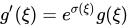
Since the world-sheet is two dimensional, there is a 1-1 correspondence between conformal structures and complex structures. One still has to quotient away diffeomorphisms. This leaves us with an integration over the space of all possible complex structures modulo diffeomorphisms, which is simply the moduli space of the given topological surface, and is in fact a finite-dimensional complex manifold. The fundamental problem of perturbative bosonic strings therefore becomes the parametrization of Moduli space, which is non-trivial for genus .

h = 0
[edit]At tree-level, corresponding to genus 0, the cosmological constant vanishes: .

The four-point function for the scattering of four tachyons is the Shapiro-Virasoro amplitude:

Where is the total momentum and , , are the Mandelstam variables.


h = 1
[edit]
Genus 1 is the torus, and corresponds to the one-loop level. The partition function amounts to:

is a complex number with positive imaginary part ; , holomorphic to the moduli space of the torus, is any fundamental domain for the modular group acting on the upper half-plane, for example . is the Dedekind eta function. The integrand is of course invariant under the modular group: the measure is simply the Poincaré metric which has PSL(2,R) as isometry group; the rest of the integrand is also invariant by virtue of and the fact that is a modular form of weight 1/2.





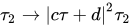
This integral diverges. This is due to the presence of the tachyon and is related to the instability of the perturbative vacuum.
See also
[edit]Notes
[edit]- ^ Lovelace, Claud (1971), "Pomeron form factors and dual Regge cuts", Physics Letters, B34 (6): 500–506, Bibcode:1971PhLB...34..500L, doi:10.1016/0370-2693(71)90665-4.
- ^ D'Hoker, Phong
References
[edit]D'Hoker, Eric & Phong, D. H. (Oct 1988). "The geometry of string perturbation theory". Rev. Mod. Phys. 60 (4). American Physical Society: 917–1065. Bibcode:1988RvMP...60..917D. doi:10.1103/RevModPhys.60.917.
Belavin, A.A. & Knizhnik, V.G. (Feb 1986). "Complex geometry and the theory of quantum strings". ZhETF. 91 (2): 364–390. Bibcode:1986ZhETF..91..364B. Archived from the original on 2021-02-26. Retrieved 2015-04-24.
External links
[edit]Bosonic string theory
View on GrokipediaOverview
Definition and fundamentals
Bosonic string theory posits fundamental constituents of matter as one-dimensional extended objects known as strings, rather than zero-dimensional point particles as in standard quantum field theory.[2] These strings possess a characteristic tension and propagate through spacetime, sweeping out a two-dimensional surface called the worldsheet.[4] Unlike point particles, which are localized at a single position, strings have an intrinsic length scale, allowing them to vibrate in various modes that correspond to different particle states.[2] The theory is termed "bosonic" because it incorporates only bosonic degrees of freedom, described by transverse coordinates that are scalar fields on the worldsheet, with no fermionic components or supersymmetry.[2] These coordinates embed the string in a -dimensional spacetime, where consistency requires the critical dimension to eliminate quantum anomalies.[4] A key parameter is the Regge slope , which sets the string tension and governs the relationship between string excitations and particle masses.[2] The worldsheet serves as the arena for the theory's dynamics, analogous to a (1+1)-dimensional quantum field theory, where parameterizes the string's spatial extent and its evolution in time.[4] This framework introduces a fundamental length scale , below which spacetime geometry breaks down, providing a natural ultraviolet cutoff for quantum gravity.[2] Originally motivated in the late 1960s as a model for strong interactions, bosonic string theory represents the simplest consistent quantum theory of strings.[4]Historical context
Bosonic string theory originated in the late 1960s as an attempt to model the strong nuclear force through dual resonance models. In 1968, Gabriele Veneziano introduced the Veneziano amplitude, a scattering amplitude for hadrons that exhibited both resonance behavior at low energies and Regge pole behavior at high energies, using the Euler beta function to satisfy crossing symmetry and duality requirements.[5] This breakthrough provided a starting point for dual models that interpolated between s-channel resonances and t-channel Regge trajectories, aligning with experimental data on hadron scattering.[6] By 1970, the underlying physical picture shifted toward relativistic strings as fundamental objects modeling hadrons. Yoichiro Nambu proposed the string interpretation in lectures, suggesting that hadron interactions could arise from the dynamics of open strings, while Tetsuo Goto independently developed a similar relativistic string action. Concurrently, Holger Bech Nielsen and Leonard Susskind advanced this view, interpreting the dual amplitudes as arising from quantized string vibrations, with the string tension parameter α' tied to the observed hadron mass scale of approximately 1 GeV². These developments, known as the Nambu–Goto string, provided a classical action for strings propagating in spacetime, motivated by analogies to quark confinement and linear Regge trajectories observed in pion-nucleon scattering data.[6] Early models faced significant challenges, including the prediction of a tachyon—a scalar particle with negative mass-squared—in the quantum spectrum, which violated causality and stability, despite successfully reproducing linear Regge trajectories (J = α' M² + constant) that matched hadron spectra.[7] In 1971, Claud Lovelace discovered that anomalies in the string theory amplitude vanish only in 26 spacetime dimensions, establishing D=26 as the critical dimension for consistency. This otherworldly dimensionality initially hindered the theory's acceptance as a hadron model, especially as quantum chromodynamics (QCD) gained favor. The perspective changed dramatically in 1974 when Tamiaki Yoneya identified a massless spin-2 particle in the string spectrum as the graviton, revealing unintended gravitational interactions. Shortly thereafter, Joel Scherk and John Schwarz proposed reinterpreting bosonic string theory as a candidate for quantum gravity, rescaling α' to the Planck length (∼10^{-33} cm) to suppress unwanted hadronic states and emphasizing its anomaly-free gravity sector in D=26, marking the transition from strong interaction alternative to unified theory contender. This shift addressed earlier gravitational anomalies but left the tachyon issue unresolved, spurring further developments through the 1970s.[7]Classical formulation
Worldsheet description
In bosonic string theory, the worldsheet is a two-dimensional surface that describes the trajectory of the string through spacetime. It is parametrized by coordinates , where represents the timelike evolution parameter along the string's worldline, and is the spacelike coordinate along the string's length. For closed strings, ranges from 0 to with periodic boundary conditions , forming a cylindrical topology. For open strings, typically spans from 0 to , with endpoints at and .[2] The embedding of the worldsheet into -dimensional Minkowski spacetime is specified by coordinates , where and is the flat spacetime metric. This mapping describes how the string's position varies along the worldsheet parameters. The theory exhibits reparametrization invariance, a diffeomorphism symmetry on the worldsheet that allows arbitrary smooth changes of coordinates without altering the physical configuration, reflecting the absence of a preferred metric on the worldsheet itself.[2][1] The metric on the worldsheet is induced from the embedding in spacetime, given by where . This induced metric determines the geometry of the surface. To simplify calculations while preserving the invariance, the conformal gauge is often chosen, where the worldsheet metric is proportional to the flat Minkowski metric, , with .[2][1] For open strings, boundary conditions are imposed at the endpoints. Neumann boundary conditions, , are standard and correspond to free endpoints where the string can move transversely without fixed positions. Dirichlet boundary conditions, constant, fix the endpoints in certain directions and are rarely used in the basic bosonic formulation but appear in contexts involving branes. Closed strings have no boundaries, relying solely on periodicity.[2][1]Action principles
The dynamics of the bosonic string in classical theory is governed by action principles that extremize the area of the string's worldsheet embedded in a flat D-dimensional spacetime with Minkowski metric η_{μν}. The simplest such action is the Nambu-Goto action, proposed independently by Nambu and Goto, which is proportional to the worldsheet area:where γ_{ab} = ∂_a X^μ ∂_b X_μ is the induced metric on the worldsheet parametrized by coordinates ξ^a (a=0,1), X^μ(ξ) are the embedding coordinates (μ=0,...,D-1), and T is the string tension with T = 1/(2π α'), where α' is the fundamental string length scale squared.[8] An alternative formulation, introduced by Polyakov, incorporates an auxiliary worldsheet metric h_{ab} to facilitate quantization and reveal additional symmetries:
This Polyakov action treats the embedding functions X^μ and the metric h_{ab} as independent dynamical variables, with the overall factor ensuring consistency with the Nambu-Goto tension.[9] Classically, the Nambu-Goto and Polyakov actions are equivalent, related by a Weyl rescaling of the auxiliary metric h_{ab} → e^{2ω(ξ)} h_{ab}, which allows one to solve for h_{ab} in terms of the induced metric γ_{ab}, recovering the Nambu-Goto form upon substitution. This equivalence holds provided the worldsheet is two-dimensional, where the Weyl transformation leaves the action invariant up to boundary terms.[9] (Polchinski, J., String Theory, Vol. 1, Cambridge Univ. Press, 1998, Sec. 2.6) Varying either action with respect to the embedding coordinates yields the equations of motion for the bosonic string: the wave equation
describing free propagation of transverse fluctuations on the worldsheet. Reparametrization invariance of the actions under diffeomorphisms ξ^a → ξ'^a(ξ) imposes constraints on the worldsheet stress-energy tensor, leading to the Virasoro conditions T_{ab} = 0, where T_{ab} \propto h^{ab} \partial_a X \cdot \partial_b X - \frac{1}{2} h_{ab} h^{cd} \partial_c X \cdot \partial_d X in the Polyakov formulation (and analogously for Nambu-Goto). These constraints eliminate unphysical longitudinal modes and generate the Virasoro algebra underlying string symmetries.[8][9][10]