


Community hub
Recent from talks
Contribute something
Nothing was collected or created yet.
Bulletproofing
View on Wikipedia
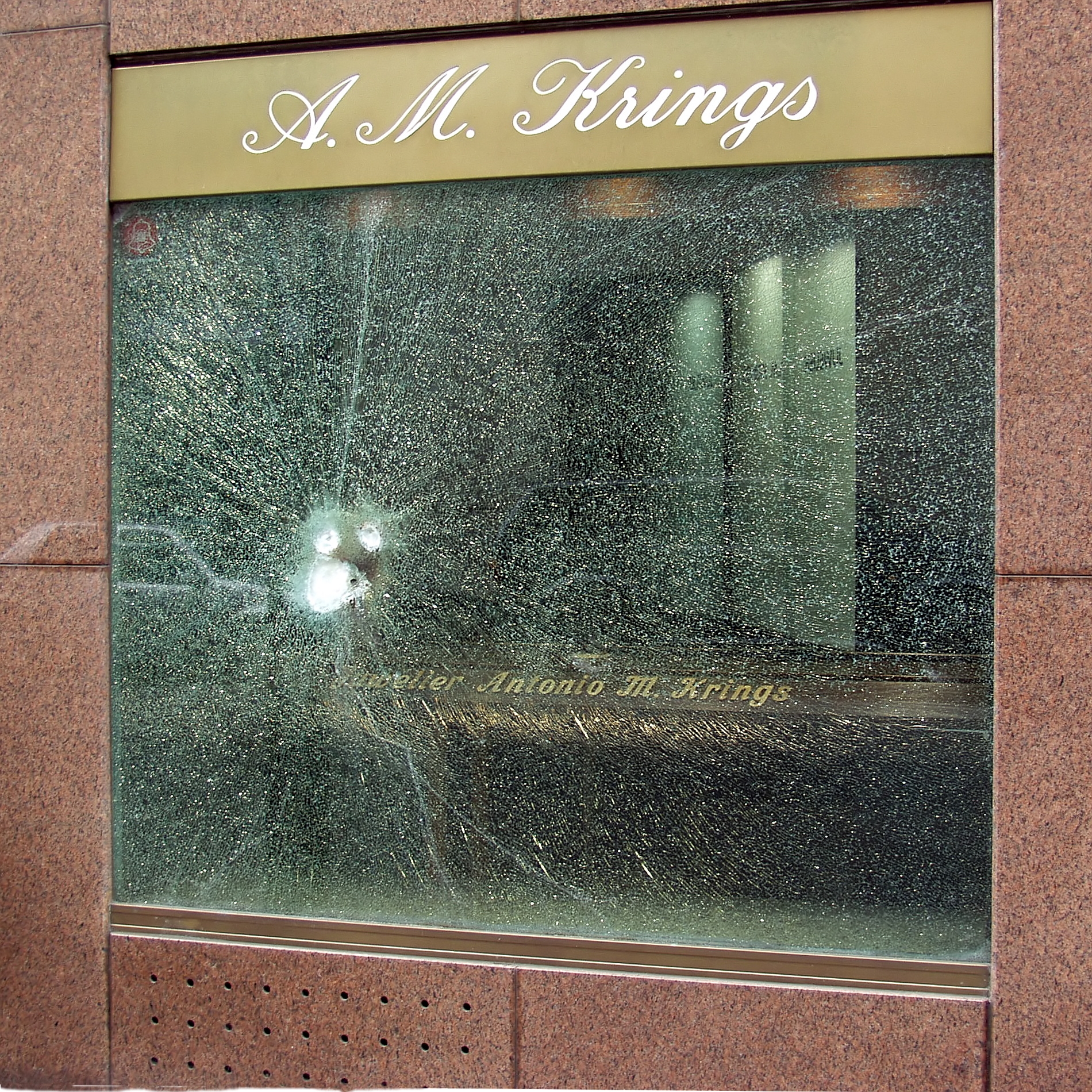
Bulletproofing is the process of making an object capable of stopping a bullet or similar high velocity projectiles (e.g. shrapnel). The term bullet resistance is often preferred because few, if any, practical materials provide complete protection against all types of bullets, or multiple hits in the same location, or simply sufficient kinetic (movement) energy to overcome it.
Origins
[edit]In 1887, George E. Goodfellow, of Tombstone, Arizona, documented three cases where bullets had failed to penetrate silk articles of clothing. He described the shooting death of Charlie Storms by gambler Luke Short. Although Storms was shot in the heart, "not a drop of blood" exited the wound. Goodfellow found that, though the bullet did indeed kill Storms, it failed to pass through a silk handkerchief. The handkerchief essentially caught the bullet, but not sufficiently to stop the bullet penetrating Storms.
Another example was the killing of Billy Grounds by Assistant City Marshal Billy Breakenridge. Goodfellow examined Grounds and found that two buckshot grains had penetrated his Mexican felt hat band, embroidered with silver wire, penetrating his head and flattening against the posterior wall of the skull. Another of the grains had passed through two heavy wool shirts and a blanket-lined canvas coat and vest before coming to rest deep in his chest. However, Goodfellow was fascinated to find two shotgun pellets in the folds of a Chinese silk neckerchief around Grounds' neck but no holes or wounds.[1][2]
He also described a wound to Curly Bill Brocius, who had been shot through the right side of the neck, narrowly missing his carotid artery. A portion of his silk neckerchief was carried into the wound by the bullet, preventing a more serious injury, but the scarf was undamaged.[1][2][3] The Tombstone Epitaph reported, "A silken armor may be the next invention."[4]
Invention and design
[edit]
In 1887, Goodfellow wrote an article for the Southern California Practitioner titled "Notes on the Impenetrability of Silk to Bullets".[2][5] In the process of doing so, he experimented with designs for bullet-resistant clothing made of multiple layers of silk.[6] By 1900, gangsters were wearing $800 silk vests to protect themselves.[7]
Bullet designs vary widely, not only according to the particular firearm used (e.g. a 9×19mm Parabellum caliber hollowpoint handgun cartridge will have inferior penetration power compared to a 7.62×39mm rifle cartridge), but also within individual cartridge designs. As a result, so-called "bullet-proof" panels may successfully prevent penetration by standard 7.62×39mm bullets containing lead cores, however the same panels may easily be defeated by 7.62×39mm armor-piercing bullets containing hardened steel penetrators.
Bullet-resistant materials (also called ballistic materials or, equivalently, anti-ballistic materials) are usually rigid, but may be supple. They may be complex, such as Kevlar, UHMWPE, Lexan, or carbon fiber composite materials, or basic and simple, such as steel or titanium. Bullet resistant materials are often used in law enforcement and military applications to protect personnel from death or serious injury. In 2018, the US military began conducting research into the feasibility of using artificial silk as body armor.[8]
Uses
[edit]
Bullet-resistant body armor has been in use since about 1984. When law enforcement began wearing body armor, there was a dramatic drop in officer deaths, saving over 3,000 lives.[citation needed]
The National Institute of Justice first developed standards for ballistic resistant body armor in the 1970s. The standards have been revised five times since 1984. The National Law Enforcement and Corrections Technology Center tests body armor to assess its compliance with the standards and publishes the results.[9] There are many applications for bulletproofing, some of which include:
Classification
[edit]There are various tests which items must pass before being classified as bullet-resistant. These tests specify the detailed characteristics of bullets which the material or object must be resistant to. For example, the U.S. National Institute of Justice standard 0104.04 for bullet-resistant vests specifies that a Type II vest must not deform clay representing the wearer's body when hit by an 8.0 g (124 gr) 9 mm caliber round nosed full-metal jacket bullet travelling at up to 358 m/s (1175 ft/s); but a Type IIIA vest is needed for protection against the same bullet traveling at up to 427 m/s (1400 ft/s). In both cases, the vest is not required to protect against a second hit within 51 mm (2 inches) of the first.[10]
References
[edit]- ^ a b Edwards, Josh (May 2, 1980). "George Goodfellow's Medical Treatment of Stomach Wounds Became Legendary". The Prescott Courier. pp. 3–5.
- ^ a b c "Dr. George Goodfellow". Archived from the original on 20 December 2014. Retrieved 8 March 2013.
- ^ Erwin, Richard E. (2000). The Truth about Wyatt Earp. San Jose, California: iUniverse. ISBN 978-0595001279.
- ^ "Silk as Bullet Proof". The Tombstone Epitaph. April 3, 1882. p. 2. Retrieved October 3, 2014.
- ^ G.E. Goodfellow (January 1887). J.P. Widney; Joseph Kurtz; Walter Lindley (eds.). "Notes on the Impenetrability of Silk to Bullets". Southern California Practitioner. 2 (1). Los Angeles: Stroll and Thayer.
- ^ Hollington, Kris. "Staying Alive". Archived from the original on 3 May 2007. Retrieved 4 March 2013.
- ^ Hollington, Kris (2008). Wolves, Jackals, and Foxes: The Assassins Who Changed History. St. Martin's Press. ISBN 9781429986809. Retrieved 2013-03-17.
- ^ Air Force scientists study artificial silk for body armor, parachutes
- ^ "Ballistic". JustNet. National Law Enforcement and Corrections Technology Center. Retrieved 26 March 2015.
- ^ National Institute of Justice (April 1987). "Ballistic Resistance of Personal Body Armorv" (PDF). U.S. Department of Justice. Archived from the original (PDF) on March 13, 2008. Retrieved March 26, 2015.
Bulletproofing
View on GrokipediaHistory
Early Concepts and Experiments
In the late 19th century, pioneering observations on bullet resistance emerged from the American Southwest, where physicians encountered frequent gunshot wounds amid frontier violence. Dr. George E. Goodfellow, a surgeon practicing in Tucson, Arizona, conducted early experiments with silk fabric after treating numerous shooting victims, recognizing its unexpected ability to resist penetration. In 1887, Goodfellow published "Notes on the Impenetrability of Silk to Bullets" in the Southern California Practitioner, documenting cases where silk items mitigated bullet damage without modern ballistic engineering.[5] One seminal case involved gambler Charlie Storms, shot in the chest at close range with a .45-caliber Colt revolver during a February 1881 altercation in Tombstone, Arizona. Goodfellow noted that a folded silk handkerchief in Storms' breast pocket had encapsulated the bullet, remaining intact and unworn despite the impact, though Storms succumbed to the heart wound. This observation prompted Goodfellow to test silk systematically, firing bullets from the same firearms and powder charges at layered samples; he found that four to six folds of thin silk often prevented penetration, attributing this to the material's tensile strength and energy dissipation through deformation. A similar incident occurred with a patient shot through the neck at close range, where a silk handkerchief drawn into the wound remained uncut, aiding survival by staunching blood flow from the carotid artery.[5][5] These findings highlighted the primitive concept of layered natural fabrics for ballistic protection, relying on silk's elasticity to absorb and distribute projectile energy rather than rigid deflection. Goodfellow's work extended to other instances, such as a shotgun victim whose silk neckerchief captured buckshot without perforating the skin, even after passing through clothing and bone. Goodfellow's tests in 1887 formalized silk's role in rudimentary body armor prototypes.[5] By the early 20th century, these ideas influenced commercial silk undergarments worn by urban gangsters in the United States, designed as concealable layers to counter low-velocity handgun threats common in Prohibition-era conflicts. Such vests, often comprising dozens of tightly woven silk sheets, cost approximately $800—equivalent to several months' wages for many—and were tested to stop rounds from pistols like the .32-caliber at short ranges. Gangsters, including figures in Chicago's underworld, adopted them for discreet protection, building on the layered fabric principle to blunt impacts without synthetics. These early efforts demonstrated silk's viability for personal armor but were limited to handgun calibers, paving a brief transition toward synthetic innovations in later decades.[5][7]20th-Century Developments
The advent of industrialized warfare in the 20th century significantly advanced bulletproofing technologies, driven primarily by the demands of World War I and World War II. During World War I, militaries experimented with steel plates integrated into uniforms to protect vital areas such as the torso, though these were limited by their weight and restricted to specialized units like trench raiders. Building on 19th-century silk experiments as precursors to layered protective fabrics, these steel reinforcements offered partial resistance to shrapnel and low-velocity projectiles but were not widely adopted due to mobility constraints.[5] World War II further accelerated innovations, with the U.S. military incorporating steel plates into flak jackets for aircrews to shield against fragmentation from anti-aircraft fire. These jackets, often featuring overlapping manganese steel segments sewn into fabric, weighed around 12 pounds and prioritized coverage over the chest and back. Concurrently, the U.S. military tested early fiberglass composites in the 1930s for potential armor applications, leading to the development of the Doron plate—a rigid, laminated fiberglass material named after Brigadier General Georges Doriot—during the war for use in experimental vests deployed in the Pacific theater, such as at the Battle of Okinawa in 1945.[8][9] Post-World War II, bulletproofing transitioned toward commercialization, particularly for law enforcement. In the 1950s, surplus military designs incorporating Doron plates were adapted into vests for police use, with companies like American Armor Corporation producing lightweight models that combined fiberglass panels with nylon fabric to stop handgun rounds and fragments. These vests marked the first widespread civilian application of composite armor, influencing urban policing amid rising crime rates.[8] The 1960s introduced synthetic aramid fibers, revolutionizing soft body armor. DuPont chemist Stephanie Kwolek developed Kevlar in 1965 through liquid crystalline polyamide solutions, yielding a material five times stronger than steel by weight. By the early 1970s, Kevlar fabric enabled the production of flexible, concealable vests capable of stopping most pistol bullets without rigid plates, leading to their adoption by U.S. police departments and marking the shift to high-performance polymer-based protection.[10]Post-2000 Advancements
Following the September 11, 2001 attacks and the subsequent Operations Enduring Freedom and Iraqi Freedom, the U.S. military experienced a significant surge in research and development for body armor to address emerging threats from improvised explosive devices and small arms fire, leading to rapid iterations on protective systems.[11] This post-9/11 emphasis prompted a 2003 U.S. Central Command directive mandating one Interceptor Body Armor suit per deployed soldier, which spurred further enhancements like enhanced small arms protective inserts by 2006.[11] From 2003 to 2010, the U.S. Army invested in the Objective Force Warrior program, later evolving into the Future Force Warrior initiative, to develop lighter integrated soldier systems that reduced overall combat loads to under 70 pounds while maintaining ballistic protection through advanced fabrics and modular designs.[12] Building on 20th-century aramid fiber foundations like Kevlar, these efforts incorporated nanotechnology and power-efficient components, with prototypes demonstrated by fiscal year 2006 that emphasized climate-adaptive suits for enhanced mobility.[12] In 2018, U.S. Air Force researchers at the Air Force Research Laboratory, in collaboration with Purdue University, advanced multifunctional armor by engineering artificial spider silk fibers that mimic natural silk's strength and flexibility for applications in body protection and parachutes.[13] Led by Dr. Augustine Urbas, the project focused on synthetic fibroin-based materials stronger than Kevlar yet capable of reducing wearer temperature by 10-15°F through improved breathability, aiming to create scalable fabrics for lighter vests and larger payload parachutes.[13] During the 2010s, nanotechnology integration transformed bulletproofing via shear-thickening fluids (STFs)—suspensions of nanoparticles like silica in polyethylene glycol—that remain flexible under normal conditions but harden upon impact to enhance fabric energy absorption.[14] DARPA supported STF research, including a 2016 $1 million grant to NIST and Georgetown University, which modeled frictional mechanisms to improve STF performance against projectiles and blasts, enabling fewer Kevlar layers (e.g., four instead of ten) while boosting ballistic limits by up to 10%.[15] By 2021, Army-funded work at MIT's Institute for Soldier Nanotechnologies produced lattice-structured polymers using nanoscale 3D printing, outperforming Kevlar and steel in penetration resistance and allowing multi-layered protection in lighter configurations.[16]Principles of Ballistic Protection
Mechanisms of Bullet Resistance
Bulletproof materials resist penetration by dissipating the kinetic energy of incoming projectiles through a combination of deformation, absorption, and dispersion mechanisms. Upon impact, the projectile's energy is initially absorbed by the deformation of the outer layers, where fibers or structures stretch and fracture to convert kinetic energy into heat and plastic deformation, thereby slowing the projectile. Subsequent layers then disperse this residual energy over a larger area, preventing localized penetration by distributing the force across multiple plies, which increases the effective stopping power without complete material failure.[17][18] The mechanisms differ notably between stopping intact bullets and high-velocity fragments like shrapnel. For bullets, resistance relies on catching and deforming the projectile's rigid shape through frictional engagement and tensile stretching of layered fibers, which progressively erodes the bullet's momentum until it stops. In contrast, fragmentation resistance focuses on withstanding multiple irregular, lower-mass impacts that lack a unified shape, emphasizing broad energy absorption to prevent any single fragment from breaching the material while handling distributed threats.[19][20][21] Blunt force trauma is mitigated by limiting backface deformation (BFD), the protrusion of the inner armor surface toward the body upon impact, which is controlled to under 44 mm per standards to reduce injury risk from energy transfer. Spacing between layers and strategic layering enhance this by allowing controlled bulging that absorbs shock without excessive deformation, particularly in multi-hit scenarios where prior impacts weaken the structure. This design ensures that subsequent projectiles encounter a still-functional energy-dissipating matrix, maintaining protection integrity across repeated strikes.[22][23][24]Key Physical Properties
The effectiveness of materials in ballistic protection hinges on several core physical properties, including tensile strength, modulus of elasticity, and density, which collectively determine their ability to absorb and dissipate impact energy while maintaining structural integrity. Tensile strength measures the maximum stress a material can withstand before breaking, with high-performance fibers like aramids (e.g., Kevlar® 29) exhibiting values around 2,920 MPa, far surpassing conventional materials such as steel on a weight-normalized basis.[25] The modulus of elasticity, indicating stiffness, is typically high at approximately 70 GPa for Kevlar® 29, enabling rapid deformation resistance without permanent yielding.[25] Density plays a critical role in achieving a high strength-to-weight ratio; for instance, aramid fibers have a density of 1.44 g/cm³, while ultra-high-molecular-weight polyethylene (UHMWPE) variants like Spectra® 1000 offer even lower values at 0.97 g/cm³, allowing for lightweight constructions that enhance user mobility in applications such as body armor.[26][26] Areal density, defined as mass per unit area (typically in kg/m²), and material thickness directly influence the balance between protective capability and practical usability, as higher values provide greater stopping power but increase bulk and fatigue on the wearer. Materials with optimized low areal densities, such as those below 5 kg/m² for soft armor panels, minimize encumbrance while still defeating threats, though exceeding certain thresholds can compromise comfort and long-term wear.[23] This trade-off is evident in designs where thinner, high-modulus composites reduce thickness to under 10 mm for equivalent protection, prioritizing ergonomics over maximal rigidity.[26] Environmental resilience is another vital attribute, encompassing heat resistance, flexibility under stress, and resistance to degradation from factors like ultraviolet (UV) radiation and moisture. Aramids maintain structural properties up to 177°C for extended periods but decompose above 427°C, ensuring performance in high-temperature scenarios without significant softening.[25] Prolonged UV exposure (300–450 nm wavelengths) can cause gradual chain scission and strength loss in aramid fibers, necessitating protective coatings for outdoor use, while moisture at neutral pH has minimal impact over months, though acidic or basic conditions accelerate hydrolysis.[25][27] UHMWPE materials similarly exhibit good flexibility under duress but are more susceptible to UV-induced embrittlement, highlighting the need for encapsulation to preserve ballistic efficacy over time.[26]Materials and Construction
Soft and Flexible Materials
Soft and flexible materials in bulletproofing primarily consist of high-performance fibers that provide ballistic resistance through energy absorption and deformation without rigidity, enabling applications in concealable personal protection. These materials are typically layered fabrics that rely on the tensile strength and ductility of synthetic or bio-based polymers to deform and capture projectiles, prioritizing lightweight design and mobility over hard armor.[28] Aramid fibers, such as Kevlar developed by DuPont and Twaron produced by Teijin Aramid, are para-aramid polymers renowned for their exceptional tensile strength and use in soft ballistic panels. Kevlar exhibits a tensile strength of approximately 3,600 MPa in resin-impregnated strands, enabling it to withstand high-impact forces through molecular alignment that resists stretching and breaking.[25] Twaron shares similar properties, with tensile strengths comparable to Kevlar at around 3,000-3,600 MPa, and is often woven into fabrics for equivalent ballistic performance.[29] These fibers are fabricated using plain or twill weaving techniques to create multi-layered textiles, where weave density influences energy dissipation by optimizing fiber orientation and inter-yarn friction during impact.[30] For handgun resistance meeting NIJ Level IIIA standards, 20 to 30 layers of aramid fabric are commonly stacked, allowing the panel to absorb and distribute kinetic energy from rounds like 9mm or .44 Magnum without penetration.[31] To enhance wearer comfort in personal vests, aramid layers are often hybridized with natural fibers such as cotton in outer coverings, improving breathability and reducing skin irritation while maintaining core ballistic integrity.[32] Notable past alternatives include polyparaphenylene benzobisoxazole (PBO, e.g., Zylon), which offered superior tensile strength of about 5,800 MPa but was discontinued in body armor applications around 2005 due to moisture-related degradation compromising reliability.[33] Ultra-high-molecular-weight polyethylene (UHMWPE) fibers, exemplified by Dyneema from DSM, offer an alternative to aramids with superior lightness and hydrophobicity for flexible ballistic applications. Dyneema is produced via a gel-spinning process, where UHMWPE polymer is dissolved in a solvent to form a gel, extruded into filaments, and drawn to align molecular chains, achieving high tenacity without the need for chemical cross-linking.[34] This results in fibers that are buoyant, floating on water due to their low density of 0.97 g/cm³, which aids in applications requiring water resistance or reduced weight.[35] Additionally, Dyneema provides enhanced cut resistance compared to aramids, owing to its smoother surface and higher abrasion tolerance, making it suitable for multi-threat protection in layered composites. As of 2025, advanced Dyneema variants feature improved crystallinity for better performance.[36][37] Natural alternatives like silkworm silk and synthetic options such as Innegra are used in hybrid configurations for sustainable or enhanced soft ballistic materials, though they generally exhibit lower tensile strengths than aramids but offer advantages in ductility and impact energy dissipation. Silkworm silk fibers possess tensile strengths of 300-600 MPa, enabling them to absorb energy through high elongation (up to 25%) in hybrid composites for lightweight armor.[38] Innegra, a polypropylene-based fiber, achieves tensile strengths around 667 MPa and is hybridized with aramids to improve impact energy dissipation and reduce back-face deformation in ballistic panels.[39] Compared to Kevlar's 3,600 MPa, these options prioritize toughness over absolute strength, with silk providing up to 319 MJ/m³ in engineered forms for potential integration into flexible vests. Emerging hybrids, such as carbon nanotube-aramid composites as of 2025, show promise for strengths exceeding Kevlar while remaining lightweight.[40][41]Rigid and Composite Materials
Rigid materials in bulletproofing primarily consist of ceramics, metals, and composites engineered to provide high hardness and deformation resistance against high-velocity impacts. Ceramics such as boron carbide (B₄C) and alumina (Al₂O₃) are favored for their ability to fracture and shatter incoming projectiles, dissipating kinetic energy through brittle failure mechanisms.[42] In boron carbide, the high compressive strength and low density enable the material to erode the projectile's nose upon impact, while internal tensile stresses propagate cracks that fragment the ceramic tile, preventing deep penetration.[43] Alumina ceramics, though denser than boron carbide, offer similar fracture mechanics but with greater weight, making them suitable for applications where cost is a priority over minimal mass.[44] For NIJ Level IV protection against armor-piercing rounds like .30-06 M2 AP, ceramic plates typically range from 10 to 20 mm in thickness, with alumina variants often around 23 mm to balance protection and mobility.[45] Metallic rigid materials, including steel and titanium alloys, provide robust alternatives through ductile deformation and high yield strength. Rolled homogeneous armor (RHA) steel serves as a benchmark for ballistic performance, with equivalents measured against its resistance to penetration; for instance, modern armor steels are designed to match or exceed RHA's ballistic limit velocity for given threats.[46] The ballistic coefficient of these steels, influenced by hardness (typically 300-500 Brinell) and thickness, determines energy absorption via plastic deformation rather than shattering.[47] Corrosion-resistant coatings, such as zinc phosphate or epoxy primers, are applied to steel plates to mitigate environmental degradation in prolonged exposure scenarios.[48] Titanium alloys like Ti-6Al-4V offer superior corrosion resistance inherently due to their passive oxide layer, while providing 15-35% weight savings over RHA steel for equivalent ballistic protection through high specific strength and shear resistance.[49] Composite rigid materials, particularly carbon fiber reinforced polymers (CFRP), integrate high-modulus fibers with epoxy matrices to achieve multi-threat resistance in layered configurations. These composites are constructed by stacking unidirectional or woven carbon fiber plies impregnated with epoxy resin, cured under pressure to form laminates that distribute impact loads across interfaces.[50] The interlaminar shear strength (ILSS), often exceeding 50 MPa in optimized epoxy systems, prevents delamination during repeated impacts, enabling sustained performance against multiple projectiles.[51] Such layering enhances overall ballistic efficiency by combining fiber tensile strength with matrix adhesion, offering resistance to both fragmentation and armor-piercing threats without the brittleness of pure ceramics.[52] These rigid components are often integrated with soft backers for complete armor systems.[53]Applications
Personal Body Armor
Personal body armor encompasses wearable protective gear designed to shield individuals from ballistic threats while prioritizing mobility and comfort for users such as law enforcement officers, military personnel, and security professionals. The primary component is the ballistic vest, which typically consists of soft armor panels made from materials like aramid fibers or ultra-high-molecular-weight polyethylene to absorb and disperse impact energy. These vests are configured in overt or covert carriers: overt carriers are external tactical platforms visible over clothing, often featuring MOLLE webbing for attachments, while covert carriers are concealed under garments for discreet operations. Both types provide torso coverage of approximately 0.35 m², focusing on vital organs like the heart and lungs, and incorporate modular trauma plates—hard inserts rated to NIJ standards—that can be added to enhance protection against higher-velocity rounds without significantly impeding movement.[23][54] The efficacy of personal body armor is evidenced by its life-saving impact, with ballistic-resistant vests credited for saving more than 3,100 U.S. law enforcement officers' lives since 1987, according to the IACP/DuPont Kevlar Survivors' Club as of 2025. This statistic underscores the gear's role in reducing fatalities from firearm assaults by up to 76%, as officers wearing compliant armor experience significantly lower penetration risks during real-world incidents. NIJ performance levels, such as IIIA for handgun threats, serve as benchmarks ensuring vests meet rigorous testing for ballistic resistance and backface deformation.[55][56][57] Beyond vests, personal body armor extends to specialized components like ballistic helmets and limb guards, which address vulnerabilities in uncovered areas. Ballistic helmets, often constructed from similar composite materials, provide head protection against fragments and low-velocity projectiles, with designs such as high-cut models allowing integration with communication systems and weighing under 1.5 kg for extended wear. Limb guards, including thigh and arm protectors, offer targeted coverage for extremities, typically using flexible soft armor panels to mitigate risks from shrapnel or stray rounds while maintaining joint flexibility. These elements form a modular system, enabling users to customize protection based on mission requirements.[58][59] Ergonomic adaptations in personal body armor account for gender-specific anatomical differences to improve fit, comfort, and effectiveness. Female-oriented designs feature contoured panels that accommodate wider hips, narrower shoulders, and bust curvature, reducing gaps in coverage and minimizing chafing compared to unisex models, which often lead to ill-fit and reduced mobility for women comprising up to 15% of law enforcement. Male adaptations emphasize broader torso framing and adjustable strapping for larger builds, ensuring even weight distribution across the shoulders and waist. These gender-specific configurations, informed by anthropometric studies, enhance overall wearability and compliance rates, as evidenced by NIJ-compliant vests tailored for diverse body types.[60][61][62]Vehicle and Equipment Protection
Bulletproofing for vehicles and equipment prioritizes mobility while addressing the unique challenges of integrating heavy protective layers without compromising handling, speed, or fuel efficiency. In armored vehicles, transparent armor for windshields typically employs multi-layered constructions of polycarbonate sandwiched between glass panes, achieving thicknesses up to 75 mm to withstand high-velocity impacts while maintaining visibility.[63] These systems absorb and distribute ballistic energy through controlled delamination, preventing penetration, though the added weight—often exceeding 100 kg per windshield—requires reinforced frames to avoid structural strain during high-speed maneuvers.[64] Complementing this, run-flat tire inserts, constructed from durable rubber composites, enable vehicles to travel approximately 50 miles at 50 mph even after complete tire deflation from gunfire, ensuring escape capability in hostile environments.[65] For VIP transportation and military applications, such as luxury sedans and High Mobility Multipurpose Wheeled Vehicles (HMMWVs), ballistic ratings like B6 and B7 provide critical resistance to 7.62 mm NATO full metal jacket rounds, allowing the vehicle to endure multiple hits without occupant injury. For example, BMW armored vehicles such as the X5 Protection utilize the VR6 protection level, which covers threats from assault rifles like the AK-47 or AKM using 7.62 x 39 mm FMJ/PB/SC ammunition at approximately 720 m/s velocity, as detailed in VPAM standards.[66][67][68] In military HMMWVs, spall liners—interior panels made from aramid fabrics like Kevlar—line the cabin walls and roof to capture and contain ricocheting fragments from armor breaches, significantly reducing secondary injuries from spalling effects during improvised explosive device blasts or direct fire.[69] Integration of these liners adds minimal weight (typically under 20 kg per vehicle section) but demands precise installation to preserve interior space and ventilation, as uneven distribution can exacerbate rollover risks in off-road operations.[70] Portable equipment for executive protection, including briefcases and vehicle door panels, utilizes lightweight ballistic inserts to offer on-demand shielding without hindering daily use. Ballistic briefcases feature foldable panels of ultra-high-molecular-weight polyethylene (UHMWPE) or Kevlar, weighing as little as 2-4 kg, that deploy into shields resisting handgun rounds up to NIJ Level IIIA while fitting seamlessly into professional attire.[71] Similarly, retrofit door panels for law enforcement or VIP vehicles employ thin Kevlar composites, each under 10 pounds and just 1/4 inch thick, bolting into existing frames to cover large areas without altering door functionality or increasing overall vehicle mass beyond 40 kg for a full set.[72] These solutions highlight the emphasis on modularity, as excessive rigidity could impede quick access or emergency egress, balancing protection with the operational demands of mobile assets.Architectural and Infrastructure Uses
Bullet-resistant glazing plays a crucial role in architectural bulletproofing, particularly for protecting high-value assets in public spaces while maintaining visual transparency and aesthetic integration. This glazing typically consists of layered polycarbonate and acrylic stacks, where polycarbonate sheets absorb and deform under impact to capture projectiles, while acrylic layers provide rigidity and clarity. These multi-layered composites, often bonded with interlayers like polyvinyl butyral, can achieve resistance to handgun and rifle rounds without excessive thickness that compromises design. For instance, the Louvre Museum's enclosure for the Mona Lisa, upgraded around 2005 with advanced bulletproof glass, exemplifies this application in cultural institutions, ensuring protection against both vandalism and ballistic threats while preserving the artwork's visibility.[73][74] In building envelopes, walls and doors incorporate bullet-resistant materials to fortify fixed structures like schools and banks, prioritizing permanence and seamless integration with architectural elements. Concrete-filled steel panels, where steel frames are infilled with high-density concrete or ballistic composites, offer robust protection against penetration by small arms fire, commonly used in educational facilities to create secure entryways and classrooms without altering aesthetics. These panels meet standards like UL 752 Level 3 or higher, balancing weight, cost, and fire resistance for institutional settings. For enhanced transparency in secure areas, one-way bulletproof mirrors—combining reflective coatings on layered ballistic glass—allow observation from inside while appearing opaque from outside, applied in bank transaction zones to deter threats while supporting operational visibility under controlled lighting.[75][76][77] High-profile implementations of architectural bulletproofing underscore its role in diplomatic and public venues, adapting to evolving security needs. U.S. embassy fortifications frequently feature bullet-resistant glazing in windows and facades, designed to UL 752 Level 8 standards to resist high-velocity rifle rounds, as seen in compounds like those in London and Baghdad, where thick laminated glass integrates with blast-mitigating structures for comprehensive perimeter defense. In stadiums, bulletproof barriers such as armored glass panels in luxury suites and entry vestibules protect against active shooter scenarios, with installations at major arenas using Level 4 to 8 rated materials to maintain sightlines while enhancing crowd safety. Amid 2020s urban security trends, there's a surge in retrofitting public infrastructure with modular bulletproof elements, driven by rising threats and significant market growth in the global bulletproof glass sector, which reached over $8 billion as of 2025.[78][79][80][81]Standards and Testing
Classification Levels
Bulletproofing classifications establish standardized performance tiers based on the caliber, type, and velocity of projectiles that protective materials must withstand, ensuring consistent threat calibration across applications like body armor, vehicles, and glazing. In the United States, the National Institute of Justice (NIJ) defines these levels for body armor under Standard 0101.07, which incorporates threat details from companion Standard 0123.00. These replace the prior 0101.06 designations (such as IIA, II, IIIA, III, and IV) with streamlined handgun (HG) and rifle (RF) categories to better reflect contemporary threats, with testing emphasizing backface deformation limits and multi-hit capabilities.[82][83] The HG levels address pistol and submachine gun threats, while RF levels target rifle ammunition. For example:| Level | Key Threats (Ammunition, Mass, Reference Velocity) |
|---|---|
| HG1 | 9 mm Luger FMJ RN (124 grain, 398 m/s); .357 Magnum JSP (158 grain, 436 m/s) – Suitable for standard law enforcement handguns. |
| HG2 | 9 mm Luger FMJ RN (124 grain, 448 m/s); .44 Magnum JHP (240 grain, 436 m/s) – Protects against higher-velocity pistols like .357 SIG equivalents. |
| RF1 | 7.62×51 mm M80 Ball (147 grain, 847 m/s); 7.62×39 mm MSC (123 grain, 732 m/s); 5.56 mm M193 (56 grain, 990 m/s) – Defeats common rifle rounds. |
| RF2 | All RF1 threats plus 5.56 mm M855 (62 grain, 950 m/s) – Includes penetrating "green tip" ammunition. |
| RF3 | .30-06 M2 AP (166 grain, 878 m/s) – Highest protection against armor-piercing rifle rounds. |