


Community hub
Recent from talks
Contribute something
Nothing was collected or created yet.
Cabrera, Balearic Islands
View on Wikipedia | This article needs additional citations for verification. (August 2024) |
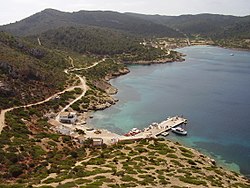
Cabrera (Balearic Catalan: [kəˈbɾeɾə], Spanish: [kaˈβɾeɾa], Latin: Capraria) is an island in the Balearic Islands, Spain located in the Mediterranean Sea off the southern coast of Mallorca. A National Park,[1] its highest point is Na Picamosques (172 m). Uninhabited, it is administratively part of the city of Palma in Mallorca.
Key Information


Cabrera is the largest island of the small archipelago that includes (from south to north) the islands of Estells de Fora, L'Imperial, Illa de ses Bledes, Na Redona, Conillera, L'Esponja, Na Plana, Illot Pla, Na Pobra and Na Foradada.
History
[edit].jpg)
In December 1530, Hayreddin Barbarossa, an Ottoman admiral of the fleet, captured the Castle of Cabrera, and started to use the island as a logistic base for his operations in the area. Barbarossa's naval victories secured Ottoman dominance over the Mediterranean during the mid-16th century, from 1530 until the Battle of Lepanto in 1571.
Cabrera was used to house French prisoners of war following the 1808 Battle of Bailén. Of the 9,000 sent to Cabrera during the war, only 3,600 remained to be repatriated at its end in 1814, though 876 officers and sergeants were taken off in July 1810 and sailed to England.[2] The island was to be supplied every two days with food and water but these ships often did not set sail. As well as dying of starvation, thirst and disease many were driven insane and some became cannibalistic. Inscriptions by the prisoners have been discovered in a cave at Cap Ventos, in the northwest of the island, an area still littered with buttons from their disintegrated uniforms.[3]
Late in 1916, a malfunctioning Austro-Hungarian Navy submarine remained at Cabrera for several hours, and the Spanish government subsequently decided to expropriate the island for defense. It is alleged that Juan March Ordinas, avoiding the blockade, had been selling supplies, including fuel, to submarine personnel, from the area of Cala Ganduf and S'Olla. There was strong international protest, particularly by the British Admiralty, as Spain was officially neutral during the First World War.
Cabrera remained a military zone until the 1980s, although from the 1920s some Mallorcan civilians rented out their Cabrera land for agriculture.
In 1936, during the Spanish Civil War, a Republican Air Force Dornier Wal D-1 airplane crashed near the island. The crew were captured by military nationalist forces, but two Republican submarines (a B2 and B3) sent by order of Pedro Marqués Barber (an old NCO and former military Menorca self-proclaimed governor) came immediately and the small Cabreran force surrendered. Facundo Flores Horrach (the chief military officer), Mariano Ferrer Bravo (a retired Spanish officer) and three civilians (males of the Suñer Mas family) were taken to Menorca and executed in a harbour place named S'Hort d'en Morillo (Mahón). After the failure of Captain Alberto Bayo Column landing in Mallorca, from 15 August to 4 September, the Republican troops left Cabrera. Bayo's plan was for the CNT column, stationed in Cabrera, to appear at Dragonera Island just southwest of Mallorca and simulate a false landing. But the anarchist CNT command refused this tactic and later went to Mallorca. A bloody battle destroyed them in Porto Cristo. The rest of this column failed before it arrived and was killed on Sa Cabana, just outside their point of entry at Manacor.
Cabrera, which had been a former Santa Catalina, Palma de Mallorca district, was declared a National Park in April 1991. The Cabrera National Park is now administratively grouped with the municipality of Palma de Mallorca.
See also
[edit]References
[edit]- ^ Parque Nacional del Archipiélago de Cabrera - Ministerio de Medio Ambiente de España
- ^ Smith, Denis (2001). The Prisoners of Cabrera. New York: Four Walls Eight Windows. pp. 129–141. ISBN 1568582129.
- ^ "Cavern reveals the inhuman fate of Napoleon's defeated troops". The Times.
External links
[edit]
- Cabrera Island with zoomable island map (by IslasBaleares)
- Cabrera (by MallorcaWeb)
- Cabrera environment (by Mar Cabrera)
| International | |
|---|---|
| Geographic | |
| Other | |

Cabrera, Balearic Islands
View on GrokipediaGeography
Location and Physical Features
The Cabrera archipelago lies in the western Mediterranean Sea, approximately 10 kilometers southeast of Mallorca's southern coast near Ses Salines, within the Balearic Islands autonomous community of Spain.[4] Its central coordinates are roughly 39°09′N 2°57′E.[7] Administratively, the islands fall under the municipality of Palma de Mallorca despite their separation from the main island.[3] Comprising the main island of Cabrera (also known as Cabrera Gran) and 18 smaller islets, including Conillera, the archipelago has a total land area of about 13 km².[8] The main island covers roughly 11.5 km², featuring a rugged limestone karst terrain with steep cliffs, narrow coves, and jagged coastlines that limit accessible beaches and arable land.[9] [10] The highest elevation is Na Picamosques at 172 meters.[11] This topography contributes to the archipelago's isolation, surrounded by waters up to 150 meters deep in the Cabrera Strait, emphasizing its compact scale and maritime context.[1]Geology and Climate
The archipelago of Cabrera consists primarily of Mesozoic-era sedimentary rocks, dominated by Jurassic limestones and dolomites that form the foundational structure of the islands. These carbonate formations, characteristic of the Balearic Promontory's tectonic extension from the Iberian mainland's fold mountains, result in thin, nutrient-poor soils due to intense dissolution processes. Karst topography prevails, featuring sinkholes, caves, and underground drainage systems that limit soil development and influence freshwater availability, shaping the islands' sparse vegetation and habitat distribution.[10] Seismic activity in the region remains minimal, with instrumental records indicating low-magnitude, shallow events (<10 km depth) tied to ongoing Plio-Quaternary strike-slip tectonics along faults in the central Balearic area.[12] Regional tectonics, including Miocene extensional phases, have contributed to the archipelago's uplift and exposure of these rocks, while erosion—primarily through karstic dissolution and wave action—drives coastal degradation, forming rugged cliffs and limited sediment accumulation.[13] Cabrera exhibits a typical Mediterranean climate, with mild winters averaging 12–15°C and hot, dry summers reaching 25–28°C, fostering seasonal contrasts that affect ecological productivity.[14] Annual precipitation totals approximately 400–500 mm, predominantly occurring in autumn storms, while low humidity and frequent strong northerly tramontana winds enhance aridity and influence marine nutrient upwelling.[14] These patterns, modulated by the islands' isolation and elevation, support drought-resistant scrubland but constrain agricultural potential and heighten erosion vulnerability during intense rainfall events.[14]History
Prehistoric and Ancient Settlement
The earliest confirmed human presence on Cabrera dates to the Talayotic period, spanning approximately 1300 to 123 BCE, a prehistoric culture endemic to the Balearic Islands characterized by dry-stone megalithic architecture including talayots (defensive or ceremonial towers) and navetas (collective burial chambers resembling upturned boats).[15] Archaeological evidence, though limited by the island's small area (1,836 hectares) and aridity, indicates sporadic settlements adapted to resource constraints, with no prior Neolithic occupation documented specifically for Cabrera despite such evidence on larger neighboring islands like Mallorca from around 5000 BCE.[16] The Talayotic inhabitants likely engaged in subsistence agriculture, pastoralism, and maritime activities, but freshwater scarcity restricted population density to small, temporary groups.[17] Following the Roman conquest of the Balearics in 123 BCE, which coincided with the decline of Talayotic society, Cabrera shows traces of intermittent ancient use primarily through maritime evidence rather than fixed settlements.[15] Punic and Roman shipwrecks off the island's coast, including a well-preserved 3rd- or 4th-century CE vessel at 70 meters depth laden with amphorae for wine or oil transport, point to its function as a navigational waypoint in Mediterranean trade networks.[18][19] Pottery fragments and imported marbles from sites like Pla de ses Figueres near the harbor suggest episodic activity, possibly for salting fish or resource extraction, but no substantial Phoenician, Greek, or Roman colonial infrastructure has been identified, consistent with the island's marginal habitability and vulnerability to abandonment during resource shortages or invasions.[20]Medieval Period to 19th Century
Following the Muslim conquest of the Balearic Islands in 902 CE, Cabrera came under Islamic rule, during which Arab settlers introduced sophisticated irrigation systems that enabled the cultivation of drought-resistant crops such as figs, olives, and almonds, transforming marginal arid lands into productive agricultural zones.[21] These techniques, adapted from North African practices, supported small-scale farming and pastoralism on the island's limited arable terrain, though Cabrera's sparse population—likely numbering in the dozens—remained focused on subsistence herding and seasonal fishing rather than large estates.[21] The island was reconquered in 1229 as part of James I of Aragon's campaign against Muslim-held Mallorca, with Cabrera integrated into the newly formed Kingdom of Mallorca under Aragonese control; James I's forces, comprising over 1,500 knights and 15,000 foot soldiers aboard 155 ships, secured the archipelago by 1231, redistributing lands to loyal nobles and the church.[22] Feudal lordships dominated governance thereafter, with Cabrera granted to Aragonese barons who exploited its resources through sheep herding—primarily for wool and cheese production—and coastal fishing, activities that sustained a semi-nomadic population of shepherds and fishermen vulnerable to the island's water scarcity and isolation.[15] Recurring pirate raids by Berber corsairs from North Africa intensified from the 14th century onward, prompting the construction of Castell de Cabrera around 1400 as a watchtower and fortress to safeguard the harbor and livestock; the structure, perched on a cliff overlooking Port de Cabrera, was repeatedly damaged and rebuilt—most notably in the 16th century amid heightened Mediterranean piracy—reflecting the precarious security that discouraged permanent settlement.[23] By the late medieval period, under the Kingdom of Mallorca's feudal system, Cabrera's economy remained rudimentary, with lordly oversight emphasizing transhumant grazing over innovation, contributing to chronic underpopulation as inhabitants sought stability on the mainland. The 19th century saw further depopulation trends, exacerbated by Cabrera's isolation and resource limitations, leading to emigration to Mallorca and beyond; historical records indicate the island supported only a handful of families by mid-century, reliant on intermittent herding and foraging amid declining feudal viability post-Enlightenment reforms.[24] Notably, from 1809 to 1814, Cabrera served as an open-air penal colony for over 9,000 French Napoleonic prisoners captured during the Peninsular War, with peak populations exceeding 5,000 under dire conditions—lacking barracks, fresh water, and adequate food—resulting in mortality rates approaching 40% from disease, starvation, and exposure, as documented in survivor accounts and Spanish military logs.[25] This episode underscored the island's marginal habitability, accelerating abandonment after repatriation and reinforcing emigration patterns into the late 19th century under Bourbon monarchy rule.[25]20th Century Military Use and Transition to Protection
During the Spanish Civil War (1936–1939), Cabrera saw limited but notable military activity, including a Republican Air Force Dornier Wal seaplane crash near the island in 1936. From 1916 onward, the archipelago fell under the control of the Spanish Ministry of War, serving as a military zone for maneuvers and training, though it avoided major World War II engagements.[3] This status persisted into the Franco regime (1939–1975), where strict restrictions on civilian access—enforced by the Ministry of Defence taking over existing barracks—prevented widespread development, agriculture beyond limited rentals, and tourism, inadvertently preserving the islands' isolation and ecological integrity amid broader Balearic urbanization pressures.[26][27] Post-Franco democratization in the late 1970s and 1980s marked a shift, as military use waned by around 1980, opening opportunities for environmental assessment.[10] Advocacy from conservation groups highlighted Cabrera's pristine state—attributable to decades of restricted human interference—prompting calls for formal protection to safeguard its endemic flora, seabird colonies, and Posidonia oceanica meadows from emerging threats like overfishing.[28] This culminated in the Spanish Congress passing Ley 14/1991 on April 29, 1991, declaring the Archipiélago de Cabrera a Parque Nacional Marítimo-Terrestre, initially encompassing approximately 10,021 hectares of land and surrounding waters to prioritize biodiversity over prior military priorities.[29] The transition from military oversight to civilian conservation involved transferring administrative control to the national parks authority, with initial regulations emphasizing regulated access and habitat restoration.[30] By the mid-1990s, reduced human disturbance post-declaration facilitated measurable ecosystem recovery, including stabilization of reptile populations and regrowth of maquis shrubland on abandoned military terrains, as isolation from development allowed natural succession processes to dominate.[31] This shift underscored causal links between access controls—first military, then protective—and the archipelago's retention of pre-20th-century biodiversity levels relative to developed Mediterranean islands.[27]Administration and Demographics
Governance and Legal Status
The Cabrera Archipelago Maritime-Terrestrial National Park is governed by Spain's Organismo Autónomo Parques Nacionales (OAPN), an autonomous entity subordinate to the Ministry for the Ecological Transition and the Demographic Challenge (MITECO).[32] This national-level authority oversees park management, including conservation planning and enforcement of protections, with a management plan initially established in 1995 and revised in 2003.[33] A Board of Trustees, comprising stakeholders such as environmental organizations, fishing representatives, and regional officials, provides advisory input on policy and expansion decisions, as evidenced by its role in supporting the 2019 maritime extension approved by the Council of Ministers.[34] [35] Legally designated as a national park under Law 14/1991 of April 29, the archipelago's status prioritizes ecological preservation over local development, overriding certain regional initiatives despite administrative affiliation with the Municipality of Palma de Mallorca.[36] It integrates into the European Union's Natura 2000 network as Site of Community Importance ES0000083, functioning as both a Special Area of Conservation under the Habitats Directive and a Special Protection Area for birds under the Birds Directive.[37] [38] Additionally, it qualifies as a Specially Protected Area of Mediterranean Importance (SPAMI) under the Barcelona Convention protocols.[33] Funding derives primarily from the central government's budget allocated to OAPN, limiting fiscal autonomy and emphasizing reliance on national resources for operations and conservation efforts.[33] While aligned with Balearic Islands regional environmental laws, national park authority prevails, though a 2020 Supreme Court ruling affirmed the Balearic Government's competence over external surrounding waters, delineating shared jurisdictional boundaries.[39] This framework ensures centralized control to maintain the park's integrity as Spain's largest maritime-terrestrial protected area, expanded to over 90,000 hectares in 2019.[40]Population and Settlement Patterns
The Cabrera archipelago supports a sparse human presence confined to the main island of Cabrera, where approximately 20 permanent residents, primarily national park rangers, researchers, and lighthouse keepers, were reported as of the early 2020s.[5][41] These individuals maintain essential park operations but do not constitute a civilian community, as private habitation ended with the archipelago's designation as a national park in 1991.[42] All surrounding islets and smaller islands remain entirely uninhabited, fostering undisturbed habitats for endemic species.[43] Settlement is limited to Es Port, a modest harbor village on the southeastern coast of Cabrera featuring staff quarters, a lighthouse, basic provisioning facilities, and administrative buildings, without expansion or private property development due to strict conservation regulations.[44] This configuration yields one of the lowest population densities in the Mediterranean, at under 2 inhabitants per square kilometer on the main island, prioritizing ecological preservation over human expansion and minimizing service sustainability challenges through reliance on mainland supply lines.[5] Historically, human numbers on Cabrera peaked during its military occupation from 1916 to the 1980s, when a garrison of up to several dozen personnel conducted training and surveillance, far exceeding current levels but still modest compared to earlier transient prisoner populations exceeding 9,000 in the early 19th century.[10][2] The post-1991 transition to park status reduced residency to rotational staff, with negligible seasonal fluctuations as non-essential personnel rotate out during off-peak periods, ensuring year-round low-impact occupancy.[45]National Park and Conservation
Establishment and Boundaries
The Parc Nacional Marítimo-Terrestre del Archipiélago de Cabrera was established by Ley 14/1991, de 29 de abril, which created the national park encompassing the Cabrera archipelago and an initial marine buffer zone south of Mallorca in the Balearic Islands.[46] This legislation designated approximately 10,021 hectares for protection, including the terrestrial areas of the main island and surrounding islets as well as adjacent coastal waters, aiming to preserve the area's ecological integrity following its prior use as a military zone.[40] The park's initial boundaries were delimited to safeguard unique habitats shaped by the archipelago's isolation, which had limited human development and urbanization compared to the nearby densely populated island of Mallorca.[47] In 2019, the Spanish government approved a significant expansion of the park's boundaries through a resolution dated February 7, increasing the total protected area to 90,800.52 hectares, with approximately 90% comprising marine zones.[36] This extension added over 80,000 hectares of surrounding seas, extending protections to deeper waters and encompassing critical ecosystems such as Posidonia oceanica seagrass meadows, which empirical studies have identified as vital for Mediterranean biodiversity and carbon sequestration.[48] The expansion, multiplying the park's size by nearly nine times, positioned it as the largest marine national park in the western Mediterranean and the second-largest overall in the Mediterranean Sea, justified by data highlighting threats to marine habitats from fishing and pollution absent in the isolated Cabrera region.[49][40]Management Practices and Regulations
Access to the Cabrera Archipelago National Park is tightly controlled through a permitting system for vessels departing primarily from Mallorca, limiting daily visitors to a maximum of 300 individuals to prevent overcrowding and ecological strain, as enforced by regional authorities.[50] Organized tours via authorized boats dominate, with private vessels requiring advance mooring permits for designated buoys, prohibiting free anchoring to protect seabeds.[51] Overnight accommodations are restricted to a single shelter with capacity for 12 persons, supplemented by limited park staff quarters, ensuring minimal human presence after dusk.[51] The park's zoning scheme divides the archipelago into categories including integral reserves comprising about 3.1% of the area, where public access and extractive activities are banned, permitting only authorized scientific research to preserve pristine habitats.[52] General use zones allow guided pedestrian access on marked trails and supervised landings at specific sites like Es Port, with prohibitions on off-trail wandering, collecting specimens, or disturbing wildlife to maintain biodiversity integrity.[53] Recreational fishing is entirely forbidden park-wide, while traditional artisanal fishing operates under strict no-take sub-zones and gear restrictions.[52] Scientific research necessitates prior permits from park management, facilitating studies on endemic species and ecosystems by institutions such as IMEDEA-CSIC, with activities confined to non-disruptive protocols.[33] Enforcement relies on maritime patrols, vessel inspections, and surveillance to deter poaching and infractions, supported by lists of approved operators.[54] Adaptive strategies incorporate ongoing fisheries data collection and stock assessments to refine quotas for sustainable artisanal harvests, exemplifying evidence-based adjustments amid Mediterranean pressures.[55] Annual monitoring reports track compliance and impacts, informing regulatory updates per the park's management plan.[56]Biodiversity
Terrestrial Ecosystems
The terrestrial vegetation of Cabrera primarily consists of Mediterranean maquis and garrigue shrublands, featuring species such as wild olive (Olea europaea var. sylvestris), mastic tree (Pistacia lentiscus), and junipers (Juniperus spp.). Aleppo pine (Pinus halepensis) occurs in forests, particularly in areas with softer soils, and has regenerated following the removal of grazing pressure from introduced herbivores. Approximately 500 species of vascular plants are recorded across the archipelago, encompassing a substantial share of the regional flora.[57][58][33] Endemism is notable, with around 30 taxa restricted to the Balearic Islands or Cabrera itself, including Silene cambessedesii and the subspecies Rubia angustifolia ssp. caespitosa (raspeta). Other endemics encompass Rhamnus ludovici-salvatoris (Balearic buckthorn) and Dracunculus muscivorus (dead horse arum). These species thrive in the archipelago's calcareous soils and Mediterranean climate, contributing to habitat diversity from coastal garigue to higher-elevation woodlands.[58][57][6] Avifauna includes breeding populations of all seabird and sea-cliff raptor species present in the Balearic Islands, such as Eleonora's falcon (Falco eleonorae), which formed 11 colonies totaling 72 individuals in 2023. The archipelago supports over 130 bird species overall, with key breeders like the Balearic warbler (Sylvia balearica) and peregrine falcon (Falco peregrinus). Reptilian fauna features the Balearic wall lizard (Podarcis lilfordi ssp.), maintaining significant populations adapted to insular conditions.[33][59][6] Mammals are depauperate, with rabbits (Oryctolagus cuniculus) and hedgehogs (Erinaceus europaeus) as the primary terrestrial species. Introduced goats (Capra hircus) have been eradicated to reduce habitat degradation, while control measures against black rats (Rattus rattus)—initiated in the late 20th century—continue to mitigate predation on native biota, particularly on smaller islets.[6][60]Marine Life and Habitats
The marine habitats surrounding the Cabrera Archipelago feature extensive Posidonia oceanica seagrass meadows, rocky seabeds, and sheltered coves, which collectively support high underwater biodiversity. These seagrass beds, forming submarine forests, act as critical nurseries for juvenile fish and carbon sinks, sequestering atmospheric CO₂ in their sediments while stabilizing coastal ecosystems.[61][62] Surveys indicate over 200 fish species inhabit these waters, including emblematic reef-associated species such as groupers (Epinephelus marginatus) and dentex (Dentex dentex), which thrive in the protected rocky habitats.[63][64][65] Invertebrate communities are abundant, particularly molluscs and crustaceans in the archipelago's coves, contributing to the overall trophic structure. Deeper waters host coral formations, enhancing habitat complexity for demersal species. Megafauna includes common bottlenose dolphins (Tursiops truncatus), striped dolphins (Stenella coeruleoalba), sperm whales (Physeter macrocephalus), and loggerhead turtles (Caretta caretta), which utilize the area for foraging and transit.[66][67][68] Marine productivity in the region benefits from episodic wind-driven upwelling events, which introduce nutrient-rich waters and support elevated biomass levels compared to surrounding Mediterranean areas. However, ichthyological assessments highlight vulnerability to overexploitation, with historical spearfishing and small-scale fisheries targeting high-value species like groupers and dentex, underscoring the need for sustained protection to prevent depletion.[69][70][65]Economy and Human Activities
Historical Economic Uses
The economy of Cabrera Island prior to the 20th century centered on subsistence activities adapted to its arid terrain and isolation. Residents engaged in small-scale fishing, targeting migratory species such as tuna and sardines using traditional methods evidenced by preserved tackle in local ethnographic collections.[71] Herding of goats and sheep provided meat, milk, and limited hides for trade, with goats tracing back to Roman introductions for provisioning shipwrecked sailors, sustaining semi-nomadic pastoralism amid sparse vegetation.[15] Dry farming supplemented these efforts, focusing on drought-resistant crops like figs and barley on arable patches such as Sa Platgeta, though yields remained low due to poor soil and water scarcity.[72] In the late 19th century, the Feliu family acquired the island in 1890 and initiated a repopulation project under the Vila Cristina initiative, promoting viticulture in areas like Pla de ses Figueres with vine plantings documented in 1892 engravings.[73] This aimed to export wine but collapsed post-1891 phylloxera outbreak, leading to vine uprooting and reversion to sheep stabling in former winery structures.[72] Minor extraction of resources like esparto grass for cordage and charcoal from scrub vegetation occurred sporadically for local fuel and trade with Mallorca, though records indicate these were marginal and unsustainable on the karst landscape. The Napoleonic Wars disrupted these patterns when Cabrera served as an open-air prison from 1809 to 1814, housing approximately 9,000 French prisoners-of-war transferred from Cádiz, of whom only about 3,600 survived due to famine and exposure rather than organized labor.[73][72] No systematic forced agricultural work is recorded during this period, effectively halting civilian economic uses. Subsequent 19th-century repopulation efforts failed, correlating with evident resource strain: overgrazing by unchecked goat herds degraded soils, while inconsistent fishing yields and failed cash crops like vines contributed to population attrition to mere dozens by century's end, as families abandoned the island for mainland opportunities.[73] A small military garrison established in 1916 further prioritized defense over extraction, marking the end of viable historical economic pursuits.[73]Modern Limited Activities
The economy of Cabrera Archipelago centers on national park operations, encompassing maintenance, monitoring, and scientific research, which constitute nearly all local employment and funding. The park's annual budget approximates €1.9 million, with €0.7 million allocated to staff costs supporting approximately 25 jobs primarily dedicated to conservation tasks such as habitat surveillance, trail upkeep, and biodiversity studies. These roles are filled by government-employed rangers and researchers, reflecting the archipelago's status as a protected area with no permanent civilian population beyond essential personnel. Commercial activities remain severely restricted to preserve ecological integrity, with no industrial operations, agriculture, or large-scale development permitted. Limited fishing occurs only under strict quotas in peripheral marine zones outside core protected boundaries, targeting sustainable catches like small pelagic species while prohibiting trawling or intensive methods within the park.[74] Residents and staff face self-sufficiency challenges due to the island's isolation and aridity, relying on state-subsidized supplies transported from Mallorca rather than local production. This model starkly contrasts with the broader Balearic Islands' economy, where tourism directly and indirectly accounts for over 40% of GDP through visitor-driven services and infrastructure.[75] Cabrera prioritizes long-term conservation over economic expansion, forgoing growth opportunities to maintain its role as a minimally disturbed reference site for Mediterranean ecosystems.Tourism
Access Methods and Restrictions
Access to the Cabrera Archipelago National Park is restricted to maritime entry, with all arrivals originating from Colònia de Sant Jordi on Mallorca's southern coast.[1] Organized ferry excursions provide the primary means of transport, covering the distance in approximately 40 to 60 minutes depending on vessel type and conditions.[76][77] These services are weather-dependent, with potential cancellations during adverse conditions such as strong winds or rough seas common in the Mediterranean.[78] Prior authorization is mandatory for all visitors, obtained through the Balearic Islands government's online portal for day visits via public boats, with bookings required to manage limited capacity.[51] Private vessels necessitate separate navigation permits, valid for 12 months, and mooring authorizations for designated buoys; free anchoring is prohibited park-wide to prevent damage to posidonia seagrass meadows and benthic ecosystems.[51][79][80] Applications for private boat access, including for yachts, must be submitted 3 to 20 days in advance to park authorities, with quotas limiting entries—such as up to 50 yachts permitted in certain areas—to control environmental impact.[81] The islands prohibit motorized vehicles, confining movement to marked footpaths for pedestrian exploration only.[82] Ferry operations and permit availability peak from April to October, corresponding to milder weather and higher demand, though year-round access may be feasible under select conditions.[78] Violations of mooring or access rules, including unauthorized anchoring, incur fines enforced by park rangers to uphold regulatory compliance.[79][80]Key Attractions and Visitor Experiences
Visitors to Cabrera primarily engage in snorkeling within the park's sheltered coves, such as those near Sa Platgeta and S'Empalmador beaches, where crystal-clear waters reveal diverse marine species including fish and crustaceans visible from shallow depths without extensive swimming.[66][83] Guided tours emphasize these areas for their protected status, allowing observation of underwater ecosystems while adhering to no-anchor zones.[84] Hiking trails offer access to key sites, including the Faro de n'Ensaiola lighthouse at 102 meters elevation, providing panoramic vistas of the archipelago's rugged cliffs and islets; the 6.6-mile route to the lighthouse is rated moderately challenging with opportunities to spot endemic flora.[4] Historic trails lead to the 14th-century Castell de Cabrera, a small fortress offering elevated views, and nearby prehistoric ruins reflecting Neolithic settlements.[85] Birdwatching at coastal vantage points highlights seabird colonies, with species such as Audouin's gulls, Cory's shearwaters, and Mediterranean shags nesting on cliffs; the park's remoteness supports sightings during migration periods.[86][87] Visitor limits of 200 to 300 daily permits preserve a serene, uncrowded environment, with accounts describing an "untouched" wilderness feel that enhances immersion in the natural setting.[87][77][68]Environmental Challenges
Identified Threats and Data
Surveys of the Cabrera National Park coastline in February, March, May, and July 2021 documented seasonal marine debris accumulation, with stranded items accounting for 77% of totals observed—predominantly plastic fragments sized 2.5 to 50 cm—exceeding floating debris at 23%.[88] Microplastics and floating macro litter have been quantified along sea surfaces within the protected area, revealing concentrations atypical for such zones due to persistent influx from surrounding waters.[89] Seafloor evaluations via remotely operated vehicles indicate litter densities diminish with increasing depth, primarily linked to discarded fishing gear like nets and lines, which entangle marine life and smother benthic habitats.[90] Sediments in the region harbor twofold higher microplastic levels than surface waters, dominated by fibers from textiles and ropes, signaling chronic deposition beyond expectations for a marine protected area.[91] Overfishing exerts ongoing pressure despite regulatory quotas, with documented illegal practices—such as destructive bottom trawling—devastating seagrass beds and reef structures around Cabrera, as evidenced by habitat scarring observed in recent patrols.[92] In the broader Mediterranean context, where 80% of fish stocks face overexploitation, Cabrera's proximity to high-pressure fishing grounds amplifies localized depletion of demersal species.[93] Invasive marine species represent a primary ecological risk, outcompeting natives and altering community structures in shallow coastal zones.[53] Climate-driven warming further threatens Posidonia oceanica meadows, with elevated sea temperatures correlating to reduced meadow extent and vitality through physiological stress and disease susceptibility.[94] Non-native introductions, potentially vectored by shipping or aquaculture, compound these shifts in Spanish protected areas including Cabrera.[95] Nutrient enrichment from wastewater outflows in the Balearic archipelago, including untreated or inadequately processed effluents from island facilities, elevates risks to Cabrera's waters via currents, prompting assessments in the 2020s for treatment plant modernizations to curb eutrophication impacts on seagrasses.[96] Heavy metal traces in Posidonia-associated foraminifera indicate localized pollution hotspots, attributable to episodic wastewater infiltration during high-tourism periods.Conservation Debates and Responses
Non-governmental organizations, including Oceana, have pressed for stricter fisheries management in Cabrera Archipelago Maritime-Terrestrial National Park following its 2019 expansion, contending that the absence of comprehensive prohibitions on industrial practices like trawling undermines habitat recovery in vulnerable areas such as coralligenous communities.[97] [98] Oceana's 2024 recommendations emphasize revamping regulations to align with the park's enlarged boundaries, which added over 80,000 hectares of marine territory, to bolster biodiversity restoration amid documented illegal fishing pressures.[99] Empirical evidence supports pro-protection stances, with research demonstrating that prior sport-fishing bans have enhanced population structures of key species, such as the dusky grouper (Epinephelus marginatus), by reducing exploitation in core zones.[100] Opposing views from small-scale fishing communities in the Balearic Islands highlight potential economic dislocations from intensified restrictions, with fishers attributing landing declines to protected area designations rather than overcapacity or external factors, while favoring quota systems and localized sustainable harvests over outright bans that could incentivize unregulated alternatives.[101] These stakeholders argue for balanced measures that preserve artisanal access, citing adherence to existing limits in lightly regulated zones as evidence of minimal localized harm when monitored effectively.[102] Governmental responses include the 2019 park extension, approved by Spain's Council of Ministers, which elevated Cabrera to the Mediterranean's largest national park by marine coverage and incorporated provisions for ongoing surveillance of benthic communities and fisheries compliance.[40] [103] Enhanced monitoring protocols, such as seasonal debris and habitat assessments initiated post-expansion, aim to quantify protection efficacy, though debates persist on capping tourism-derived activities—like boating, which contributes anchoring damage and species introductions—against their role in funding conservation without verified overexploitation thresholds.[88] [104]References
- https://www.coastalwiki.org/wiki/Mediterranean_seagrass_ecosystem