Hubbry Logo
Calcium iodideCalcium iodideMain
Open search
Calcium iodide
Community hub
Calcium iodide
logo
8 pages, 0 posts
0 subscribers
Be the first to start a discussion here.
Calcium iodide
Calcium iodide
from Wikipedia
Calcium iodide
Calcium iodide
Calcium iodide
Names
IUPAC name
calcium iodide
Identifiers
3D model (JSmol)
ChemSpider
ECHA InfoCard 100.030.238 Edit this at Wikidata
EC Number
  • 233-276-8
RTECS number
  • EV1300000
UNII
  • InChI=1S/Ca.2HI/h;2*1H/q+2;;/p-2 checkY
    Key: UNMYWSMUMWPJLR-UHFFFAOYSA-L checkY
  • InChI=1/Ca.2HI/h;2*1H/q+2;;/p-2
    Key: UNMYWSMUMWPJLR-NUQVWONBAC
  • I[Ca]I
  • [Ca+2].[I-].[I-]
Properties
CaI2
Molar mass 293.887 g/mol (anhydrous)
365.95 g/mol (tetrahydrate)
Appearance white solid
Density 3.956 g/cm3 (anhydrous)[1]
Melting point 779 °C (1,434 °F; 1,052 K) (anhydrous) [2]
Boiling point 1,100 °C (2,010 °F; 1,370 K)[2]
64.6 g/100 mL (0 °C)
66 g/100 mL (20 °C)
81 g/100 mL (100 °C)
Solubility soluble in acetone and alcohols
−109.0·10−6 cm3/mol
Structure
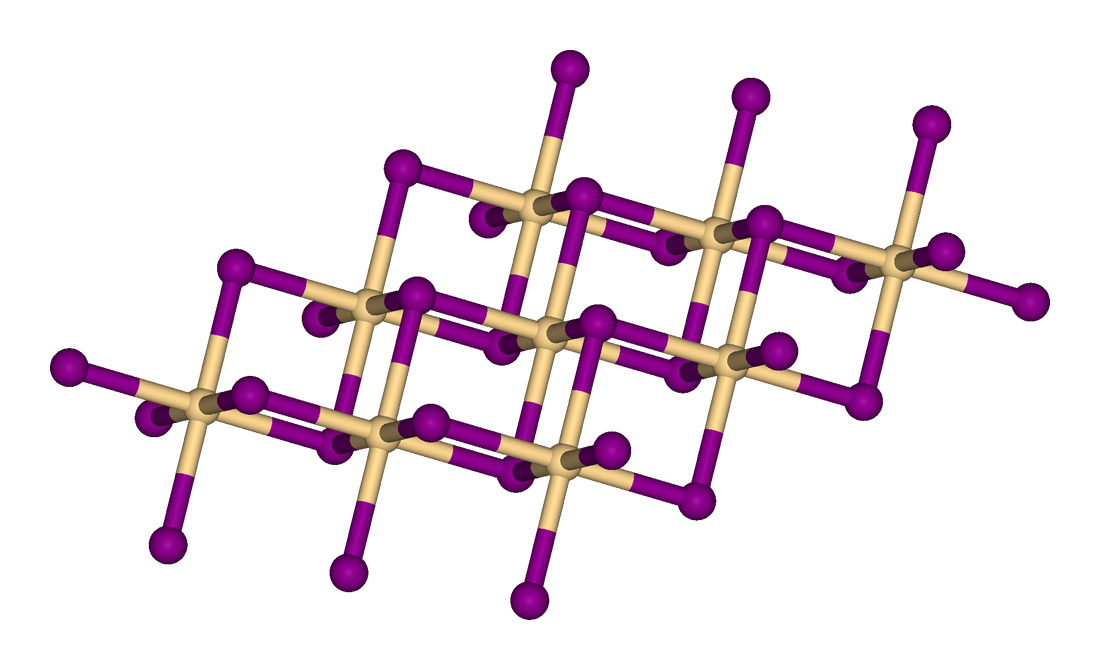
Rhombohedral, hP3
P-3m1, No. 164
octahedral
Hazards
NFPA 704 (fire diamond)
NFPA 704 four-colored diamondHealth 2: Intense or continued but not chronic exposure could cause temporary incapacitation or possible residual injury. E.g. chloroformFlammability 0: Will not burn. E.g. waterInstability 1: Normally stable, but can become unstable at elevated temperatures and pressures. E.g. calciumSpecial hazards (white): no code
2
0
1
Related compounds
Other anions
calcium fluoride
calcium chloride
calcium bromide
Other cations
beryllium iodide
magnesium iodide
strontium iodide
barium iodide
Except where otherwise noted, data are given for materials in their standard state (at 25 °C [77 °F], 100 kPa).
☒N verify (what is checkY☒N ?)

Calcium iodide (chemical formula CaI2) is the ionic compound of calcium and iodine. This colourless deliquescent solid is a salt that is highly soluble in water. Its properties are similar to those for related salts, such as calcium chloride. It is used in photography.[1] It is also used in cat food as a source of iodine.

Reactions

[edit]

Henri Moissan first isolated pure calcium in 1898 by reducing calcium iodide with pure sodium metal:[3]

CaI2 + 2 Na → 2 NaI + Ca

Calcium iodide can be formed by treating calcium carbonate, calcium oxide, or calcium hydroxide with hydroiodic acid:[4]

CaCO3 + 2 HI → CaI2 + H2O + CO2

Calcium iodide slowly reacts with oxygen and carbon dioxide in the air, liberating iodine, which is responsible for the faint yellow color of impure samples.[5]

2 CaI2 + 2 CO2 + O2 → 2 CaCO3 + 2 I2

References

[edit]
Revisions and contributorsEdit on WikipediaRead on Wikipedia
from Grokipedia
Calcium iodide (CaI₂) is an inorganic ionic compound composed of calcium and iodine, existing as a colorless to white deliquescent solid that is highly soluble in , , and . Its is 293.89 g/mol, with a of 3.956 g/cm³, a of 779 °C, and a of approximately 1100–1115 °C. The compound crystallizes in a rhombohedral structure and is unstable in air, reacting with to form and free iodine. Calcium iodide is typically prepared by the reaction of or with , or by direct combination of calcium metal with iodine vapor. It finds applications in as a component in light-sensitive emulsions, in animal nutrition as an iodine supplement to support function, and in pharmaceuticals for treating disorders such as goiter and . More recently, it has been employed in as a passivator for solar cells to enhance efficiency and stability. Due to its hygroscopic nature and reactivity, calcium iodide must be stored in sealed containers to prevent absorption and . It is often encountered as hydrates such as the tetrahydrate or hexahydrate. Safety considerations include potential for disruption (iodism) if ingested in excess.

Chemical and Physical Properties

Molecular Structure and

Calcium iodide is an ionic compound with the CaI2CaI_2, where the calcium cation exhibits a +2 (Ca2+Ca^{2+}) and is paired with two anions (II^-) to maintain charge neutrality. The compound forms through electrostatic attractions between the positively charged calcium ions and the negatively charged ions, characteristic of typical halides. In its anhydrous form, calcium iodide crystallizes in a trigonal structure (space group P3ˉm1P\bar{3}m1, No. 164) that corresponds to a hexagonal lattice, featuring layers of edge-sharing CaI6CaI_6 octahedra. The molar mass of CaI2CaI_2 is 293.89 g/mol. Standard preparations of calcium iodide employ stable isotopes, predominantly 40Ca^{40}Ca for calcium (natural abundance 96.94%) and 127I^{127}I as the sole stable isotope of iodine, without incorporation of radioactive variants.

Physical Characteristics

Calcium iodide is a white to off-white crystalline solid at , though it often appears pale yellow due to minor liberation of iodine upon exposure to air. The compound is odorless and exists in a solid state under standard conditions, typically in the form of powder, beads, or lumps. The form of calcium iodide has a of 3.96 g/cm³. It melts at 779 °C and boils at 1100 °C. Calcium iodide is highly hygroscopic, readily absorbing moisture from the atmosphere to form hydrates such as the hexahydrate (CaI₂·6H₂O). This property necessitates storage in dry conditions to prevent deliquescence.

Solubility and Stability

Calcium iodide exhibits high in , with reported values of approximately 66 g per 100 mL at 20 °C, increasing to 81 g per 100 mL at 100 °C, indicating endothermic dissolution behavior. It is also soluble in polar organic solvents such as , , and acetone, but insoluble in non-polar solvents like . In aqueous solutions, calcium iodide readily forms , including the stable hexahydrate (CaI₂·6H₂O), which appears as colorless to yellow-white, deliquescent crystals and maintains characteristics similar to the form, though specific data for the hydrate is less commonly quantified. The compound demonstrates good thermal stability up to its of 1100 °C. In the event of fire, it may decompose, potentially releasing and . Aqueous solutions of calcium iodide are generally neutral in pH, as it is derived from a strong base () and a strong acid (), with minimal effects. Due to its deliquescent nature, calcium iodide absorbs moisture from the air, necessitating storage in sealed, dry containers to maintain stability and prevent degradation.

Synthesis and Preparation

Laboratory Methods

Calcium iodide is commonly prepared in laboratory settings through small-scale reactions that utilize readily available and standard glassware, allowing for controlled synthesis in research or educational environments. One established method involves the reaction of with . is suspended in deionized , and concentrated is added dropwise while stirring, resulting in effervescence due to evolution. The balanced for this acid-base reaction is: \ceCaCO3+2HI>CaI2+H2O+CO2\ce{CaCO3 + 2 HI -> CaI2 + H2O + CO2} The mixture is heated gently to ensure complete dissolution, then filtered to remove any insoluble residues. The filtrate is evaporated under reduced pressure to yield calcium iodide dihydrate, which can be further processed for the anhydrous form. This approach is favored for its simplicity and use of inexpensive starting materials. A direct synthesis method employs the combination of elemental calcium and iodine. Finely powdered calcium metal is placed in a dry reaction vessel under an inert atmosphere to prevent oxidation, and iodine crystals are added in stoichiometric amounts. The mixture is initiated with mild heating, leading to a vigorous, exothermic reaction: \ceCa+I2>CaI2\ce{Ca + I2 -> CaI2} The white product forms rapidly, and excess heat is dissipated using a cooling bath. This method produces anhydrous calcium iodide directly but requires caution due to the intense reaction and potential for iodine vapors. An alternative route uses calcium hydroxide and iodine under basic conditions. Calcium hydroxide is dissolved in water to form a slurry, and iodine is introduced gradually while maintaining alkaline pH, promoting a redox disproportionation process that initially yields a mixture of calcium iodide and calcium iodate. The balanced equation for this reaction is: \ce6Ca(OH)2+6I2>5CaI2+Ca(IO3)2+6H2O\ce{6 Ca(OH)2 + 6 I2 -> 5 CaI2 + Ca(IO3)2 + 6 H2O} In practice, this requires subsequent separation steps, such as acidification and filtration to remove iodate, or reduction of the iodate byproduct (e.g., with carbon) followed by dissolution and recrystallization to isolate calcium iodide. The reaction is conducted at elevated temperatures to enhance efficiency. Following synthesis, purification is achieved via recrystallization. The crude product is dissolved in hot water or absolute ethanol—a solvent chosen based on the desired hydrate form, as calcium iodide exhibits high solubility in both (approximately 66 g/100 mL in water at 20°C and soluble in ethanol). The solution is filtered hot to remove impurities, then cooled slowly to promote crystal growth. For anhydrous isolation, ethanol recrystallization followed by vacuum drying at 100–150°C is employed to eliminate bound water. This step effectively removes contaminants like unreacted acids or metal residues. Laboratory yields for these methods typically range from 80% to 95%, influenced by reactant purity and procedural , with particular attention to isolating the product to avoid hydration during storage.

Industrial Production

Calcium iodide is manufactured on a commercial scale through the of with in large reactors, yielding calcium iodide and as the primary byproduct. The reaction proceeds as follows: \ceCa(OH)2+2HI>CaI2+2H2O\ce{Ca(OH)2 + 2HI -> CaI2 + 2H2O} This method ensures efficient production for industrial needs, with similar processes employing as an alternative calcium source, generating alongside . Production occurs primarily in chemical located in and , where major manufacturers such as those in (e.g., Jindian Chem, Tianjin Dasheng) and operate facilities tailored to regional demand. Global production is estimated at approximately 200–300 tons annually (as of 2024), supporting applications in pharmaceuticals, chemicals, and , though exact volumes vary by market fluctuations. The compound is produced in varying purity levels, including technical grade at 95-98% for general industrial use and pharmaceutical grade exceeding 99% for medical and high-precision applications. To optimize costs, byproduct management includes the recovery of iodine from process waste streams, often through oxidation and extraction techniques that recycle iodide back into hydroiodic acid production. Economic viability is closely tied to iodine prices, as hydroiodic acid derives from iodine sourced mainly as a byproduct of mining operations like caliche ore processing in Chile or brine extraction in Asia. Fluctuations in global iodine supply directly influence manufacturing expenses, with analyses as of November 2025 indicating stable to cautious pricing trends due to ongoing supply constraints.

Chemical Reactions

Reactivity with Air and Moisture

Calcium iodide exhibits limited reactivity with dry air but undergoes gradual decomposition when exposed to atmospheric oxygen and carbon dioxide. The oxidation by oxygen proceeds slowly according to the balanced equation: 2\ceCaI2+\ceO22\ceCaO+\ceI22 \ce{CaI2} + \ce{O2} \rightarrow 2 \ce{CaO} + \ce{I2} This reaction liberates iodine vapor, contributing to the compound's instability over time. In the presence of carbon dioxide and oxygen, calcium iodide reacts to form calcium carbonate and iodine, as shown in: 2\ceCaI2+2\ceCO2+\ceO22\ceCaCO3+2\ceI22 \ce{CaI2} + 2 \ce{CO2} + \ce{O2} \rightarrow 2 \ce{CaCO3} + 2 \ce{I2} This process leads to progressive decomposition. The compound is highly deliquescent, readily absorbing atmospheric moisture to form hydrates such as the tetrahydrate (\ceCaI24H2O\ce{CaI2 \cdot 4H2O}) or hexahydrate (\ceCaI26H2O\ce{CaI2 \cdot 6H2O}). This hydration accelerates the release of iodine by facilitating the dissolution and subsequent reaction of the iodide ions in the aqueous environment. Decomposition rates are notably faster in humid environments, where promotes both deliquescence and the CO₂-mediated reaction, whereas the form remains relatively more stable under dry, inert conditions. Visual indicators of these reactions include a gradual yellowing or browning of the initially white or colorless solid, attributable to the accumulation of free iodine.

Reactions with Acids and Bases

Calcium iodide exhibits stability in dilute acidic conditions, where it primarily undergoes double displacement reactions without significant oxidation of the iodide ions, such as with to form and . However, in the presence of strong oxidizing acids like concentrated , the iodide ions are oxidized to elemental iodine, accompanied by reduction of nitrate to . In aqueous solutions, calcium iodide solutions have a nearly neutral pH around 7, owing to the compound's high (approximately 208 g/100 mL at 20°C). When reacted with bases, calcium iodide forms a white precipitate of in the presence of excess base, as demonstrated with : CaI₂ + 2 NaOH → Ca(OH)₂ ↓ + 2 NaI. This precipitation occurs because has low (about 0.173 g/100 mL at 20°C). The iodide component of calcium iodide acts as a due to the of the I⁻/I₂ couple, with a standard oxidation potential of -0.54 V (corresponding to the of +0.54 V for I₂ + 2e⁻ → 2I⁻). This property facilitates its oxidation in oxidizing environments, as seen in reactions with . In qualitative analysis, calcium iodide solutions react with to form a bright precipitate of , which is insoluble and used to confirm the presence of ions: CaI₂ + 2 AgNO₃ → 2 ↓ + Ca(NO₃)₂.

Applications and Uses

Industrial and Analytical Applications

Calcium iodide has found niche applications in , particularly in historical processes where it serves as a sensitizing agent in the preparation of iodide-based emulsions. These emulsions enhance the sensitivity of photographic films to light, improving image quality and development efficiency in traditional wet-plate methods and related techniques. In optical analysis, calcium iodide is utilized to form oriented light-polarizing by reacting with iodine solutions, producing blue-colored crystals suitable for polarizing materials. This property stems from its ability to chelate with iodine, enabling the creation of suspensions for light-polarizing films and devices used in optical . As an industrial feed additive, calcium iodide acts as a stable source of iodine for nutrition, particularly in and feeds to prevent iodine deficiencies and support function. Its high iodine content, approximately 863 g/kg, makes it an effective supplement in premixes, providing both iodine and absorbable calcium for overall health. In , calcium iodide functions as a for detecting low-energy X-rays in scintillation detectors, leveraging its layered and high light output when doped with (CaI₂:Eu²⁺). This application is valuable in scientific instrumentation for precise radiation measurement, though its hygroscopic nature requires careful handling. Additionally, it serves as a source of ions in qualitative and quantitative analyses, such as iodometric titrations. In materials science, calcium iodide is used as a passivator for CH₃NH₃PbI₃ (MAPbI₃) perovskite films and as a dopant in 3D γ-CsPbI₃ perovskite solar cells to improve power conversion efficiency and stability.

Nutritional and Medical Uses

Calcium iodide serves as a source of supplemental iodine in dietary products, helping to provide essential iodine for thyroid hormone production and preventing iodine deficiency disorders such as goiter. Iodine from calcium iodide supports normal thyroid function by enabling the synthesis of thyroxine (T4) and triiodothyronine (T3), which regulate metabolism and growth. While less common than potassium iodide in human formulations, calcium iodide is incorporated into some nutritional supplements as an alternative for iodization, particularly where combined calcium and iodine delivery is desired. In , calcium iodide is used to treat and prevent in , such as and , where it is added to trace supplements or feed to maintain health and reproductive performance. Iodine supplementation levels for typically range from 0.5 to 2 mg per kg of feed , with maximum authorized concentrations up to 5 mg iodine/kg feed for most species, depending on regional guidelines such as those from the . This dosing helps mitigate symptoms like goiter and reduced fertility in affected animals. Historically, prior to the , iodide compounds were employed in practice as expectorants to alleviate respiratory conditions by promoting and thinning bronchial fluids. The recommended daily iodine for adults is 150 μg, and calcium iodide, containing approximately 86% iodine by weight, can supply this amount efficiently in supplemental form. Calcium iodide exhibits high , with iodide ions readily absorbed in the via mechanisms, achieving uptake rates comparable to other soluble iodides. The accompanying calcium component further supports by contributing to mineralization processes, enhancing the compound's dual .

Safety, Handling, and Environmental Impact

Health and Toxicity Hazards

Calcium iodide poses health risks primarily through its irritant properties and the potential for iodine overload upon exposure. Acute exposure to the compound can cause irritation to the skin, resulting in redness and discomfort, and severe to the eyes, potentially leading to redness, , and temporary vision impairment. of calcium iodide dust may irritate the respiratory tract, causing coughing and discomfort, particularly due to the release of iodine vapors in moist conditions. can lead to gastrointestinal upset, including , , and . Chronic exposure to calcium iodide, mainly through repeated ingestion or absorption, can result in iodine overload, leading to iodism—a condition characterized by symptoms such as a metallic in the , skin rash, headache, and irritation of mucous membranes. Excess iodine from such exposure may also disrupt function, potentially causing goiter, , or , especially in individuals with pre-existing conditions. The calcium component contributes minimally to toxicity due to the compound's high and the body's regulation of calcium levels. No significant has been noted for calcium iodide. Calcium iodide is not classified as carcinogenic by major regulatory bodies, including the International Agency for Research on Cancer (IARC), the National Toxicology Program (NTP), or the (OSHA). Overall, while acute effects are largely irritative, chronic risks stem from its content affecting iodine .

Storage, Handling, and Disposal

Calcium iodide is hygroscopic and light-sensitive, requiring storage in tightly sealed, airtight containers made of compatible materials such as or to prevent absorption and . It should be kept in a cool, dry, and dark location, away from incompatible substances like strong oxidizers, to maintain stability and avoid potential reactions. During handling, appropriate , including gloves, safety goggles, protective clothing, and a (such as NIOSH-approved type P1 filter), must be worn to minimize contact, eye exposure, and of . Operations should occur in well-ventilated areas or under a , with hands and contaminated clothing washed thoroughly after use to prevent inadvertent transfer. In the event of a spill, evacuate the area and avoid generating by using dry methods to collect the , such as sweeping or vacuuming with a HEPA-filtered unit, then place it in a sealed, labeled for disposal. The affected area should be ventilated, and any residues wiped with a damp cloth before final cleanup, ensuring into drains or waterways. Disposal of calcium iodide must comply with local, state, and federal regulations, typically as through licensed facilities involving controlled with scrubbing or secure burial to prevent environmental release. Small quantities may be neutralized if permitted and disposed via standard streams, but larger amounts require professional handling to avoid . Due to its high water solubility, calcium iodide exhibits low persistence in and aquatic environments, readily dissociating into calcium and ions that disperse quickly. However, ions may in aquatic organisms, such as (bioaccumulation factor of 40) and (factor of 5), potentially affecting marine ecosystems if released in significant quantities. Precautions should include preventing discharge into surface or to mitigate these risks.

References

Add your contribution
Related Hubs
User Avatar
No comments yet.