Hubbry Logo
HutiaHutiaMain
Open search
Hutia
Community hub
Hutia
logo
8 pages, 0 posts
0 subscribers
Be the first to start a discussion here.
Hutia
Hutia
from Wikipedia

Hutia
Temporal range: Early Miocene–Recent
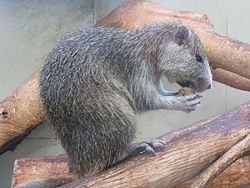
Desmarest's hutia (Capromys pilorides)
Scientific classification Edit this classification
Kingdom: Animalia
Phylum: Chordata
Class: Mammalia
Order: Rodentia
Family: Echimyidae
Subfamily: Capromyinae
Smith, 1842
Type genus
Capromys
Desmarest, 1822
Genera

Tribe Capromyini

Tribe Plagiodontini

†Tribe Hexolobodontini

†Tribe Isolobodontini

Hutias (known in Spanish as jutía[1]) are moderately large cavy-like rodents of the subfamily Capromyinae that inhabit the Caribbean islands. Most species are restricted to Cuba, but species are known from all of the Greater Antilles, as well as The Bahamas and (formerly) Little Swan Island off of Honduras.

Twenty species of hutia have been identified, but at least half are extinct. Only Desmarest's hutia and the prehensile-tailed hutia remain common and widespread; all other extant species are considered threatened by the IUCN.

The extinct giant hutias of the family Heptaxodontidae also inhabited the Caribbean, but are not thought to be closely related, with the giant hutias belonging in the superfamily Chinchilloidea.[2]

Description

[edit]

Most species have a head-and-body length that ranges from 21 to 46 cm (8.3 to 18.1 in) and weigh less than 2 kg (4.4 lb), but Desmarest's hutia has a head-and-body length of 31 to 60 cm (12 to 24 in) and weighs 2.8–8.5 kg (6.2–18.7 lb).[3] They resemble the coypu in some respects. Tails are present, varying from vestiges to prehensile. They have stout bodies and large heads. Most species are herbivorous, though some consume small animals. Instead of burrowing underground, they nest in trees or rock crevices.

They are hunted for food in Cuba, where they are often cooked in a large pot with wild nuts and honey. At the Guantanamo Bay Naval Base however, there is an over population due to an abundant food source and the lack of natural predators. Desmarest's hutias are referred to by those stationed at the Guantanamo Bay Naval Base as banana rats.[4] Banana rats are not named for their dietary preference, but because their feces look like small versions of the fruit. They are known to come out at night.

Phylogeny

[edit]

Molecular studies of phylogeny indicate that hutias nest within the Neotropical spiny rats (Echimyidae).[5] Indeed, the hutia subfamily, Capromyinae, is the sister group to Owl's spiny rat Carterodon.[6] In turn, this clade shares phylogenetic affinities with a subfamily of spiny rats, the Euryzygomatomyinae.[6]

Within Capromyidae, the deepest split involves Plagiodontia with respect to other genera, followed by the divergence of Geocapromys. The latter genus is the sister group to a clade in which Capromys branches off before the Mesocapromys and Mysateles split.

Genus-level cladogram of the Capromyidae
with their relationship to Carterodon and Euryzygomatomyinae.
  Octodontoidea  
Euryzygomatomyinae
         

  Trinomys (Atlantic spiny rats)


  Clyomys

  Euryzygomatomys (guiaras)

  Carterodon (Owl's spiny rat)

Capromyidae
  Plagiodontini  

  Plagiodontia

  Capromyini  

  Geocapromys


  Capromys (Desmarest's hutia)


  Mesocapromys

  Mysateles

The cladogram has been reconstructed from mitochondrial and nuclear DNA characters.[7][8][9][5][10][6]

Hutias colonized the islands of the Caribbean as far as the Bahamas by oceanic dispersal from South America,[11][12] reaching the Greater Antilles by the early Oligocene.[13] This was facilitated by the direction of prevailing currents.

Systematics

[edit]
Prehensile-tailed hutia (Mysateles prehensilis)

The systematics of the 10 extant and 11 extinct recognized species of Capromyidae is as follows.[14][15][16] Taxa known to be extinct are marked with a dagger (†).

Subfamily Capromyinae
Tribe Capromyini
Capromys
Garrido's hutia (Capromys garridoi) (possibly extinct)
Desmarest's hutia (Capromys pilorides)
Geocapromys
Jamaican hutia (Geocapromys brownii)
Bahamian hutia (Geocapromys ingrahami)
Cayman hutia (Geocapromys caymanensis)
Cuban coney (Geocapromys columbianus)
Little Swan Island hutia (Geocapromys thoracatus)
Mesocapromys
Cabrera's hutia (Mesocapromys angelcabrerai)
Eared hutia (Mesocapromys auritus)
Black-tailed hutia (Mesocapromys melanurus)
Dwarf hutia (Mesocapromys nana) (possibly extinct)
San Felipe hutia (Mesocapromys sanfelipensis) (possibly extinct)
Mysateles
Prehensile-tailed hutia (Mysateles prehensilis)
Tribe †Hexolobodontini
Hexolobodon
Imposter hutia (Hexolobodon phenax)
Tribe Isolobodontini
Isolobodon
Montane hutia (Isolobodon montanus)
Puerto Rican hutia (Isolobodon portoricensis)
Tribe Plagiodontini
Plagiodontia
Hispaniolan hutia (Plagiodontia aedium)
Samaná hutia (Plagiodontia ipnaeum)
Small Haitian hutia (Plagiodonta spelaeum)
Hyperplagiodontia
Wide-toothed hutia (Hyperplagiodontia araeum)
Rhizoplagiodontia
Lemke's hutia (Rhizoplagiodontia lemkei)

Religious significance

[edit]

In Santería, hutia powder (Spanish: jutía ahumada) is used as a ritual offering, especially to Elegua.[17]

References

[edit]
[edit]
Revisions and contributorsEdit on WikipediaRead on Wikipedia
from Grokipedia
Hutias are moderately large, cavy-like rodents belonging to the family Capromyidae (also classified as the subfamily Capromyinae within Echimyidae), endemic to the Caribbean islands where they represent a classic example of island radiation following a single colonization event from South America during the Early Miocene. These herbivores typically measure 20–60 cm in length and weigh 1–7 kg, featuring robust bodies, short legs, coarse fur, and tails that vary from short and thick to prehensile in some species, adapted for climbing and foraging in diverse habitats ranging from montane cloud forests to arid coastal semideserts. With 10 extant species distributed across five genera—Capromys, Geocapromys, Mesocapromys, Mysateles, and Plagiodontia—hutias exhibit high endemism, often restricted to single islands or small archipelagos in the Greater Antilles (Cuba, Jamaica, Hispaniola) and the Bahamas, though many of the approximately 26 described species have gone extinct due to human activities, habitat loss, and introduced predators like cats and mongooses. A 2024 study proposed splitting Desmarest's hutia into two species, potentially increasing the extant count to 11. Primarily vegetarian, they consume leaves, fruits, bark, and twigs, with some opportunistic predation on small invertebrates; breeding occurs year-round, producing 1–4 offspring after a 16–20 week gestation, and they display behaviors from diurnal activity in Cuba to nocturnal habits elsewhere, often sheltering in rock crevices or burrows. Conservation efforts are critical, as most surviving species are threatened or endangered, highlighting the need for protected reserves, captive breeding programs, and control of invasive species to preserve this unique caviomorph lineage.

Physical Characteristics

Morphology and Size

Hutias (family Capromyidae) exhibit a sturdy, cavy-like build characterized by robust bodies, short limbs, large heads with blunt snouts, and small, rounded ears. Their feet bear five toes equipped with strong, curved claws adapted for and . Body size varies significantly across , ranging from rat-like forms under 2 kg to larger individuals up to approximately 7 kg, with head-and-body lengths typically spanning 20–60 cm. For instance, (Capromys pilorides), the largest extant , reaches an average length of 61 cm and weighs around 7 kg, though individuals can exceed 9 kg. Tail morphology differs notably between species, reflecting ecological niches; terrestrial forms like Capromys have shorter, fully furred tails measuring 14–29 cm, while arboreal species such as the prehensile-tailed hutia (Mysateles prehensilis) possess longer, partially prehensile tails that can comprise up to 80% of body length (total length 55–75 cm) and aid in locomotion among branches. Weights for arboreal hutias are generally lighter, as seen in M. prehensilis at 1.4–1.9 kg. Fur is typically thick and coarse, consisting of long guard hairs over denser underfur, with colors ranging from grizzled brown or gray dorsally—often darker than the lighter underparts—to variations like reddish-brown or yellowish shades in some populations. Skeletally, hutias feature a robust suited to their herbivorous diet, displaying hystricognathous structure—marked by a medially inflected mandibular —characteristic of the Hystricognathi suborder. The cranium is strongly built with heavy ridges, a short rostrum, prominent , broad zygomatic arches, and a large infraorbital canal lacking an accessory groove; auditory bullae are not enlarged, and paroccipital processes are intermediate to long. The lower shows variable angular and prominent coronoid processes, supporting powerful mastication.

Adaptations

Hutias exhibit a range of anatomical adaptations suited to their diverse lifestyles within ecosystems, particularly emphasizing arboreal, terrestrial, and behaviors. Arboreal species, such as the prehensile-tailed hutia (Mysateles prehensilis), possess a semi-prehensile that can reach up to 80% of body length and functions to grasp branches during climbing, facilitating navigation through tree canopies. In contrast, terrestrial forms like (Capromys pilorides) lack this prehensile capability, with s instead serving primarily for balance during ground movement. These variations reflect evolutionary divergence tied to preferences, enhancing stability and maneuverability in respective environments. Dental structures in hutias are specialized for processing fibrous material, featuring high-crowned () molars that enable efficient grinding of tough vegetation such as leaves, bark, and roots. The cheek teeth exhibit a occlusal pattern, supporting continuous wear and replacement through diet-induced abrasion. Complementing this, their ever-growing incisors, typical of , allow for gnawing on woody stems and aid in foraging. The dental formula, consistently 1/1, 0/0, 1/1, 3/3 across genera, underscores this uniformity in herbivorous adaptation. Sensory adaptations compensate for limitations in vision, with hutias generally possessing small eyes indicative of reduced , relying instead on acute olfaction and hearing for predator detection and . Their strong facilitates chemical communication through scent marking with and glandular secretions, essential for territorial and social interactions. Hearing is enhanced by relatively large, rounded ears in some species, such as Geocapromys thoracatus, which support nocturnal or crepuscular activity patterns by detecting subtle environmental cues. Long vibrissae () provide tactile feedback, further aiding low-light orientation. Limb and claw morphology supports versatile nesting and locomotion strategies, with prominent claws on all digits enabling both and burrowing. In species like Capromys pilorides, large claws on short, stocky limbs allow proficient scaling of rocks and trees for refuge construction in crevices or hollows. Terrestrial hutias, including the Jamaican hutia (Geocapromys brownii), use these adaptations to dig shallow burrows or scrape shelters under rocks, protecting against environmental stressors.

Ecology and Behavior

Habitat and Distribution

Hutias are endemic to the islands, where they exhibit their greatest species diversity in , home to 11 of the 14 extant species. Other significant areas of distribution include , (shared by and the ), and , with most species confined to single islands or small archipelagos. These rodents inhabit a variety of environments, ranging from dry and montane forests to mangroves, rocky karst formations, and caves. For instance, the eastern Desmarest's hutia (Capromys pilorides)—one of two species recently recognized from the former broader Desmarest's hutia group—is commonly found in Cuban lowland semi-deciduous and coastal forests, as well as at agricultural edges and mangrove thickets. Jamaican hutia (Geocapromys brownii), meanwhile, prefers exposed limestone areas with natural crevices and tunnels in hilly or mountainous regions. Historically, hutias occupied a broader pre-Columbian range across the , , and portions of the , as evidenced by archaeological remains in indigenous kitchen middens. Contemporary distributions are more fragmented due to habitat loss, with surviving populations often restricted to isolated locales such as East Plana in , where the Bahamian hutia (Geocapromys ingrahami) persists. Altitudinally, hutias occur from sea level up to approximately 2,000 m in Cuba's mountains, adapting to diverse elevations within forested and rocky terrains.

Diet and Foraging

Hutias are primarily herbivorous , consuming a diet dominated by materials such as leaves, fruits, bark, seeds, shoots, stems, , and tubers. Species like the eastern Desmarest's hutia (Capromys pilorides) primarily browse on tender leaves while also incorporating fruits, flowers, seeds, shoots, and bark, with occasional opportunistic intake of small invertebrates or vertebrates such as and . Similarly, Jamaican hutia (Geocapromys brownii) feeds on a variety of exposed , bark, shoots, fruits, and foliage from numerous , including C4 grasses and (Saccharum officinarum), which can lead to conflicts with agriculture in human-modified landscapes. This herbivorous focus supports their role as folivores and frugivores, though some exhibit limited omnivory. Foraging behaviors vary by and , but most hutias are nocturnal, emerging at night to browse on the ground or in trees over wide areas. Ground-dwelling like Jamaican hutia actively search expansive terrains for accessible plant parts, while arboreal forms such as the prehensile-tailed hutia (Mysateles prehensilis) climb and navigate tree canopies, using their prehensile tails for balance and food manipulation, such as making semicircular cuts in leaves or stripping bark with their strong, continuously growing incisors. These incisors, adapted for gnawing tough vegetation, enable efficient bark removal, as observed in Cuban hutia populations where severe damage to tree bark and stems has been documented across diverse s. Hutias often sit upright like squirrels, holding food with their forepaws, and their tails assist in posture and handling during feeding. To maximize nutrient extraction from fibrous, low-quality diets, hutias practice coprophagy, re-ingesting soft feces produced during fermentation, a trait common among hystricognath . This behavior, observed in species like the eastern , enhances digestion of cellulose-rich s through microbial breakdown in the enlarged and colon. Their digestive system features a simple followed by fermentation, allowing adaptation to variable availability, though specific seasonal shifts—such as increased fruit consumption during wet periods—remain understudied but inferred from broader patterns in tropical herbivores.

Reproduction and Social Structure

Hutias are polyestrous, with females capable of breeding year-round across many species, often exhibiting postpartum estrus that allows for multiple litters annually. In the eastern (Capromys pilorides), breeding peaks from April to July but occurs throughout the year, enabling 1–2 litters under typical conditions, though up to three may occur if resources are abundant. lasts 120–150 days, resulting in litters of 1–4 young, with an average of 2–3 for ; larger litters of four or more are rare and observed primarily in . Offspring are precocial, born fully furred with open eyes and mobile shortly after birth, allowing them to soon thereafter. Social organization in hutias varies but centers on small groups or pairs, with some individuals appearing solitary, possibly due to displacement or small units. like the eastern Desmarest's hutia form polygynous groups comprising a dominant territorial male, several females, and offspring, often sheltering communally in rock crevices, tree hollows, or caves. Males defend territories using scent marking via , while both sexes employ vocalizations—such as soft grunts and squeaks—for communication and group cohesion during or social interactions. These behaviors support a where dominant males pair with multiple females, and agonistic encounters are infrequent, indicating low territorial aggression within groups. Parental care is primarily provided by females, who nurse young for 3–6 months (90–180 days), though the precocial nature of offspring means they begin independent foraging within weeks. is reached at 6–12 months, with males maturing at 7–10 months and females around 10 months in . In the wild, hutias typically live 4–8 years, as evidenced by up to 12 years for the Bahamian hutia (Geocapromys ingrahami), while extends lifespan to 8–14 years across species.

Evolutionary History

Phylogeny

Hutias belong to the subfamily Capromyinae within the family , part of the hystricognathous rodents (), which originated in through transatlantic dispersal from African ancestors during the late Eocene to early , approximately 40–30 million years ago. The Capromyinae themselves diverged from their closest South American relatives around 16.5 million years ago in the early , likely arriving in the via oceanic rafting on vegetation mats, a mechanism inferred from analyses and the absence of land bridges during that period. Phylogenetically, Capromyinae is nested within as a monophyletic group, supported by analyses of (mtDNA) and multiple nuclear genes, which place it as the sister taxon to the heteropsomyines, including genera like Carterodon (Owl's spiny-rat). This positioning highlights hutias' close affinity to spiny rats and underscores their evolutionary ties to the octodontoid of caviomorph , with comprehensive capture data from over 200 nuclear loci confirming the monophyly and resolving internal relationships among capromyine genera. The diversification of hutias began in the early following their initial colonization of the , with the oldest known fossils, such as Zazamys veronicae from , dating to approximately 16 million years ago and aligning with molecular estimates of . This radiation accelerated during the middle to , driven by adaptive processes on isolated islands, resulting in over 30 endemic species across multiple genera adapted to diverse insular environments. Key evolutionary events included repeated colonizations of different islands, fostering through allopatric isolation, and the influence of Pleistocene glacial cycles, where fluctuating sea levels periodically connected and fragmented habitats, further promoting among populations.

Systematics

Hutias are classified within the family , a diverse group of Neotropical spiny rats, as the Capromyinae. This classification reflects their hystricognathous status, characterized by unique jaw and dental adaptations. The Capromyinae is further divided into tribes that highlight ecological and morphological distinctions, including the Capromyini (encompassing more terrestrial or mainland-like forms), the arboreal Plagiodontini, and the extinct Hexolobodontini and Isolobodontini. There are five extant genera in Capromyinae, comprising approximately 13 living species, all endemic to the islands. As of 2024, molecular analyses suggest that (Capromys pilorides) comprises at least two distinct species, potentially raising the number of extant hutias. The genus Capromys includes two species restricted to : C. pilorides () and C. garridoi (Garrido's hutia, possibly extinct). The genus Mysateles has four species, also Cuban endemics: M. prehensilis (prehensile-tailed hutia), M. meridionalis ( tree hutia), M. gundlachi (Gundlach's hutia), and M. melanurus (bushy-tailed hutia). Geocapromys contains three species across and : G. brownii (Jamaican hutia), G. ingrahami (Bahamian hutia), and G. thoracatus (Little Swan Island hutia, extinct). The genus Mesocapromys features four Cuban species: M. auritus (eared hutia), M. angelcabrerai (Cabrera's hutia), M. sanfelipensis (San Felipe hutia), and M. nanus (dwarf hutia, extinct). Finally, Plagiodontia has one extant species, P. aedium (Hispaniolan hutia), on . Extinct species in Capromyinae number 11 to 15, based on fossil records primarily from cave deposits, representing a significant portion of the original of about 32 described across eight genera. These include giant forms like Elasmodontomys obliquus (plate-toothed giant hutia), known from type locality Cueva de las Golondrinas, , with an estimated body mass of up to 14 kg and specialized plate-like molars for tough vegetation. Other notable extinct are Hexolobodon phenax (imposter hutia; type locality: , ; synonym: H. haiticus), Isolobodon portoricensis (Puerto Rican hutia; type locality: Cueva de las Golondrinas, ; synonym: I. montanus), Plagiodontia ipnaeum (Samana hutia; type locality: , ), Plagiodontia velozi (now synonymized with P. ipnaeum; type locality: , ), Geocapromys columbianus (Cuban coney; type locality: Cueva de Paredones, ), and Mesocapromys beatrizae (Beatriz hutia; type locality: Cueva del Indio, ). Additional extinct taxa include Hyperplagiodontia from and Rhizoplagiodontia (type locality: Trou de l'Hermite, ), often debated in synonymy with Plagiodontia. Taxonomic revisions since the 2000s, driven by molecular phylogenetic analyses, have shifted hutias from the independent family Capromyidae to the subfamily Capromyinae within , supported by mitochondrial and nuclear DNA sequences showing close affinity to South American spiny rats. These studies, including mitogenomic assemblies and exon capture approaches, resolved previously ambiguous relationships and confirmed the of Capromyinae. Unresolved debates continue regarding certain genera, such as Plagiodon, an early name sometimes considered a of Plagiodontia but potentially representing distinct taxa based on dental morphology from Hispaniolan deposits.

Conservation

Extinct Species

Several hutia species became extinct in the , primarily due to human activities following the colonization of the islands. The Isolobodon, including I. montanus and I. portoricensis, was endemic to and , with evidence indicating that I. portoricensis was introduced to from by pre-Columbian Amerindians around 5,500–5,200 years (BP). These species persisted until at least the 13th century AD but vanished shortly after European contact in 1492, driven by overhunting, from agricultural clearance, and competition or predation from such as black rats (Rattus rattus) and dogs. In contrast, some larger extinct hutias predate significant human influence. The giant hutia Amblyrhiza inundata, from the Bank (including and nearby islands), represents an extreme case of insular , with body mass estimates ranging from 50 kg to over 200 kg based on femoral and humeral bone analyses—far exceeding the sizes of living hutias, which typically weigh 1–7 kg. This Pleistocene species, part of the family , exhibited unique adaptations such as gracile forelimbs for digging and massive hind limbs, along with blunt, multi-cusped teeth suited for grinding tough vegetation; its extinction occurred during the , likely around 125,000 years ago during the Sangamonian interglacial, attributed to climate-driven sea-level changes causing and population bottlenecks rather than human actions, as no fossils have been found. Other notable extinct taxa include members of the genus Hexolobodon, such as H. phenax from , which featured distinctive even-toothed with multiple cusps adapted for processing fibrous plants, differing from the simpler teeth of extant hutias. Fossils of these species have been recovered from key sites like Cuban caves (e.g., Las Obas) and Bahamian sinkholes, preserving subfossil remains that reveal their broader historical distributions across the and . Recent subfossil analyses in the 2020s have expanded understanding of these extinct hutias' ranges without leading to any confirmed revivals or rediscoveries. For instance, studies from 2020 extracted genetic material from subfossils of related extinct genera like Boromys and Elasmodontomys, demonstrating wider archipelago-wide distributions and monophyletic origins, which highlight the anthropogenic drivers behind the loss of at least 20 hutia species since human arrival.

Living Species Status

Most extant hutia species (family Capromyidae) are classified as threatened on the IUCN Red List, with statuses ranging from Least Concern to Critically Endangered, reflecting ongoing population declines driven by anthropogenic pressures. Desmarest's hutia (Capromys pilorides), the most widespread species endemic to Cuba and nearby islands, is assessed as Least Concern as of 2025, with stable or locally increasing populations due to effective management in protected areas; a 2024 taxonomic revision recognizes two distinct species within the former C. pilorides complex, with ongoing assessments for separate IUCN statuses. In contrast, the Bahamian hutia (Geocapromys ingrahami) was upgraded to Critically Endangered in 2024, with fewer than 250 mature individuals remaining on East Plana Cays and possibly small groups on other islands, marking a severe decline from historical distributions. The Jamaican hutia (Geocapromys brownii) is Endangered, with populations under 1,000 individuals confined to three fragmented remote areas in Jamaica's Blue and John Crow Mountains. Key threats to living hutia species include habitat destruction through deforestation for agriculture and mining, unregulated hunting for bushmeat, and predation by invasive species such as cats, mongooses, and rats. In Cuba, agricultural expansion and mining have led to the loss of over 400,000 hectares of tree cover between 2001 and 2023, directly impacting Cuban hutia populations. Invasive rats exacerbate vegetation degradation, as demonstrated by 2025 genetic studies on the Bahamian hutia, which linked rat-induced seed predation and soil disturbance to reduced native plant cover essential for hutia foraging and shelter. Hunting remains a significant pressure on Jamaican and Hispaniolan species, while invasive predators have decimated populations on smaller islands. Conservation efforts focus on , monitoring, and species reintroductions to mitigate these threats. In , national protected areas cover much of the range, supported by hunting regulations that have maintained stable populations since the 1990s; ongoing surveys in southeastern regions like provide abundance indices for . For the Bahamian hutia, translocations to predator-free cays have been implemented since the , with recent genetic monitoring confirming viability despite challenges from invasions. Jamaican hutia conservation involves community-based in national parks and anti-poaching patrols, though funding limitations hinder broader reintroductions. These initiatives, coordinated by organizations like the IUCN Small Mammals Specialist Group, emphasize control and restoration to support long-term survival.

Cultural and Human Significance

Hunting and Economic Use

Hutias have been exploited by humans for food since pre-Columbian times, serving as a key protein source for indigenous groups like the Lucayans in and in , where they were hunted, translocated to new islands, and possibly managed through provisioning with crops such as to enhance availability. Archaeological evidence from sites like Palmetto Junction in the reveals that hutia remains were abundant in middens dating to AD 700–1450, indicating sustained harvesting without immediate population collapse in some areas. In , indigenous peoples roasted or stewed hutias, integrating them into daily diets alongside agricultural products. Post-colonial intensification of occurred in , where enslaved people in cane fields pursued hutias as a supplementary food source amid habitat changes from . By the , indiscriminate for home consumption and commercial sale threatened several species, prompting protective measures, such as the 1909 Law on (amended until 1956) and subsequent regulations, which protect hutias and require permits for capture or killing. Today, (Capromys pilorides) is legally hunted in parts of under regulated permits, serving as that provides an affordable alternative to in rural areas facing food shortages. In 2019, Cuban authorities announced plans to establish hutia farms alongside and operations to address protein deficits, leveraging the rodent's high yield—up to 8.5 kg per individual—and ease of rearing in controlled environments. Illegal poaching persists in , where the critically endangered Jamaican hutia (Geocapromys brownii) faces threats from human disturbance on remote Jamaican cays, exacerbating declines through unauthorized and . Economic value remains tied primarily to subsistence, though past commercial trade in highlighted hutias' role in local markets before bans were imposed in scarce regions to promote recovery. Beyond , hutias have limited non-consumptive uses, such as for occasional crafts, though this is rare due to their coarse pelage and conservation priorities. In overpopulated locales like the U.S. Naval Base at Guantanamo Bay, , programs manage densities exceeding 5 hutia per in some areas, employing live traps baited with melons for relocation or to mitigate vegetation damage and risks. Current methods include nighttime with pellet guns and multi-capture traps, aiming to reduce populations by 60–75% for ecological balance. Hunting contributes to localized declines, particularly for , but regulated practices in demonstrate potential for , as 2020 studies indicate variable abundances allowing management of overabundant groups without broader risks.

Religious and Symbolic Role

In Afro-Cuban religious traditions, particularly (also known as Regla de Ocha or ), hutia holds a significant ritual role as an offering to the orishas, the deities central to the faith. Smoked or powdered hutia, often prepared as jutía ahumada, is used in ceremonies for spiritual protection, cleansing, and invocation, symbolizing abundance and connection to ancestral forces. These offerings are commonly directed to orishas such as Eleguá, the guardian of crossroads and opportunities, where hutia is combined with other elements like to enhance the ritual's potency for healing and warding off negative energies. Among indigenous communities in the pre-Columbian , hutia was an important part of daily life and sustenance, hunted using fire drives and dogs, but historical records do not document specific mythological or spiritual symbolism, such as depictions as forest spirits or emblems. In contrast, modern occasionally portrays hutia as a resourceful survivor in rural tales, reflecting its adaptability in and forest habitats, though such narratives are more anecdotal than deeply embedded in broader cultural lore. References to hutia in variants remain undocumented in available ethnographic sources, suggesting its symbolic presence is limited primarily to contexts. The ritual use of hutia has sparked controversies related to animal rights and conservation in contemporary , where the species is classified as vulnerable due to habitat loss and . In October 2025, a young Cuban , Ibraín Venereo Jiménez, intervened to rescue a hutia advertised for sale at 5,000 pesos specifically for religious sacrifice, highlighting tensions between traditional practices and emerging concerns under Cuba's Decree-Law 31/2021 on Animal Welfare. Activists argue that such sacrifices, often conducted in public or semi-public settings, exacerbate population declines and conflict with ethical standards, prompting calls for alternatives like symbolic offerings while respecting cultural freedoms.

References

Add your contribution
Related Hubs
User Avatar
No comments yet.