


Community hub
Recent from talks
Contribute something
Nothing was collected or created yet.
Cardellina
View on Wikipedia
| Cardellina | |
|---|---|

| |
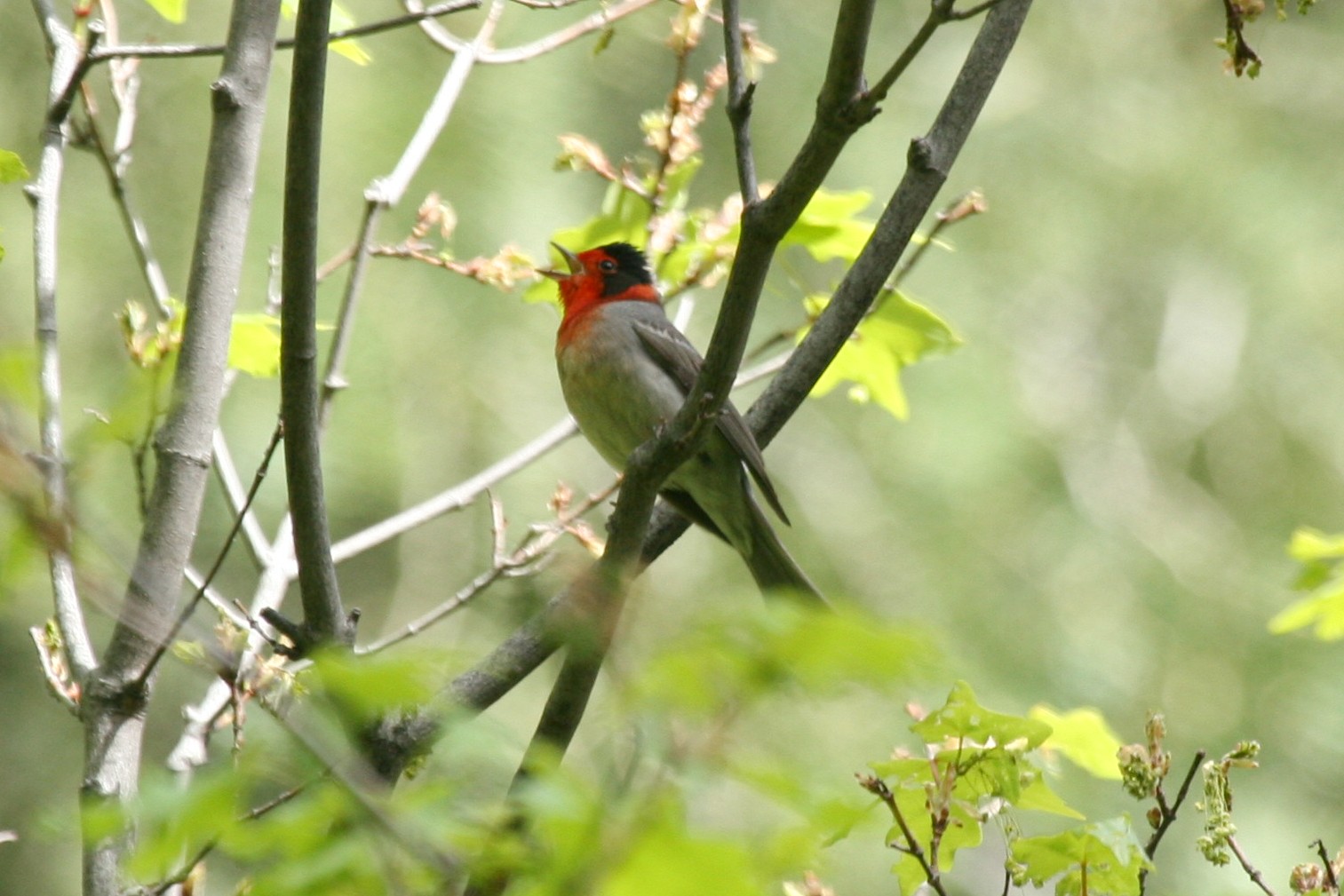
| Red-faced warbler (Cardellina rubifrons) | |
Scientific classification 
| |
| Kingdom: | Animalia |
| Phylum: | Chordata |
| Class: | Aves |
| Order: | Passeriformes |
| Family: | Parulidae |
| Genus: | Cardellina Du Bus de Gisignies, 1849 |
| Type species | |
| Cardinella amicta[1] = Muscicapa rubrifrons Du Bus
| |
| Species | |
|
See text | |
| Synonyms | |
|
Ergaticus Baird (1865) | |
Cardellina is a genus of passerine birds in the New World warbler family Parulidae. The genus name Cardellina is a diminutive of the Italian dialect word Cardella for the European goldfinch.[2]
Taxonomy
[edit]
The genus was introduced by the French naturalist Charles Lucien Bonaparte in 1850.[3] The type species was subsequently designated as the red-faced warbler.[4][5] The genus originally contained one species, the red-faced warbler. A comprehensive study of the wood-warblers published in 2010 that analysed mitochondrial and nuclear DNA sequences found that the five species formed a discrete clade, with the Wilson's and Canada warblers as early offshoots, followed by a lineage that gave rise to two branches – one leading to the red-faced and another that diverged to the red and pink-headed warblers.[6]
Spencer Fullerton Baird described the genus Ergaticus in 1865, using it to separate several species from what he felt was the closely related genus Cardellina,[7] and eventually subsumed into Cardellina in 2011. Prior to the creation and widespread acceptance of this genus, the red warbler and pink-headed warbler were placed in various other warbler genera, including Setophaga (with the American redstart), Cardellina (with the red-faced warbler), and Basileuterus (a widespread genus of tropical warblers) — as well as the Old World warbler genus Sylvia and the Old World tit genus Parus.[8] Recent DNA analysis shows that Ergaticus falls comfortably within the New World warbler clade, along with 18 other genera. It is closest to the genus Cardellina, with which it shares a common ancestor, and slightly more distantly related to the genus Wilsonia.[9]
There are two sister species, separated by the low-lying Isthmus of Tehuantepec, in the genus. The red warbler, C. ruber, is found in the Mexican highlands north of the isthmus. Its three subspecies, which differ slightly in appearance, are found in three disjunct populations. The pink-headed warbler, C. versicolor, is found south of the isthmus, in the highlands of Chiapas, Mexico and western Guatemala. It is monotypic across its limited range.[10] Though they are separated by geography and differ considerably in plumage, the two have sometimes been considered to be conspecific.[11]
Ergaticus is the Latinized version of the Ancient Greek ergatikos, meaning "willing or able to work".[12]
List of species
[edit]The following five species are currently recognized.[13]
| Image | Scientific name | Common name | Distribution |
|---|---|---|---|
 |
Cardellina canadensis | Canada warbler | Summers in Canada and northeastern United States and winters in northern South America. |
 |
Cardellina pusilla | Wilson's warbler | Across Canada and south through the western United States, and winters from Mexico south through much of Central America. |
.jpg) |
Cardellina rubrifrons | Red-faced warbler | Mexico and the US states of Arizona and New Mexico, and the Central American nations of El Salvador, Guatemala, and Honduras. |
.jpg) |
Cardellina rubra | Red warbler | Mexican highlands north of the Isthmus of Tehuantepec |
 |
Cardellina versicolor | Pink-headed warbler | Southwestern Highlands of Guatemala and the central and southeastern Highlands of the Mexican state of Chiapas. |
Description
[edit]These are medium-sized warblers, measuring 12.5–13.5 cm (4.9–5.3 in) in length,[nb 1][10] and weighing 7.6–10 g (0.27–0.35 oz); the pink-headed warbler is, on average, slightly the heavier of the two.[11] As adults, their overall color is red, with duller wings and tails; juveniles are tawny-brown, with slightly paler underparts. The red warbler has white or silvery-gray ear patches (the color depends on the subspecies), while the pink-headed warbler's head and chest are silvery-pink. The sexes are similar in both species.[11] They have long, rounded wings and fairly long, rounded tails. They have small, narrow bills, with rictal bristles that extend more than halfway down their length.[8]
Habitat and range
[edit]Both the pink-headed and red warblers are birds of highland forest.[10] The red warbler is found from 2,000 to 3,500 m (6,600 to 11,500 ft) above sea level, and the pink-headed warbler from 2,000 to 3,800 m (6,600 to 12,500 ft).[11]
Notes
[edit]References
[edit]- ^ "Parulidae". aviansystematics.org. The Trust for Avian Systematics. Retrieved 16 July 2023.
- ^ Jobling, James A. (2010). The Helm Dictionary of Scientific Bird Names. London, United Kingdom: Christopher Helm. p. 91. ISBN 978-1-4081-2501-4.
- ^ Bonaparte, Charles Lucien (1850). Conspectus generum avium (in Latin). Vol. 1. Lugduni Batavorum [Leiden]: E.J. Brill. p. 312.
- ^ Paynter, Raymond A. Jr, ed. (1968). Check-list of birds of the world. Vol. 14. Cambridge, Massachusetts: Museum of Comparative Zoology. p. 51.
- ^ Dickinson, E.C.; Christidis, L., eds. (2014). The Howard & Moore Complete Checklist of the Birds of the World. Vol. 2: Passerines (4th ed.). Eastbourne, UK: Aves Press. p. 368. ISBN 978-0-9568611-2-2.
- ^ Lovette, Irby J.; Pérez-Emán, Jorge L.; Sullivan, John P.; Banks, Richard C.; Fiorentino, Isabella; Córdoba-Córdoba, Sergio; Echeverry-Galvis, María; Barker, F. Keith; Burns, Kevin J.; Klicka, John; Lanyon, Scott M.; Bermingham, Eldredge (2010). "A comprehensive multilocus phylogeny for the wood-warblers and a revised classification of the Parulidae (Aves )" (PDF). Molecular Phylogenetics and Evolution. 57 (2): 753–770. Bibcode:2010MolPE..57..753L. doi:10.1016/j.ympev.2010.07.018. PMID 20696258. Archived from the original on 10 August 2017. Retrieved 25 April 2018.
- ^ Baird, Spencer Fullerton (1865). Review of American Birds in the Museum of the Smithsonian Institution. Washington, D.C.: Smithsonian Institution. p. 264.
- ^ a b Ridgway, Robert; Friedmann, Herbert (1901). The birds of North and Middle America. Washington, D.C.: Government Publishing Office. pp. 758–761. ISBN 1-112-57414-X.
{{cite book}}: ISBN / Date incompatibility (help) - ^ Lovett, I. J.; Bermingham, E. (July 2002). "What is a Wood Warbler? Molecular Categorization of a Monophyletic Parulidae" (PDF). The Auk. 119 (3): 695–714. doi:10.1642/0004-8038(2002)119[0695:WIAWWM]2.0.CO;2. S2CID 86287753. Archived from the original (PDF) on 29 June 2011.
- ^ a b c Howell, Steve N. G.; Webb, Sophie (1995). A Guide to the Birds of Mexico and Northern Central America. Oxford University Press. pp. 654–655. ISBN 0-19-854012-4.
- ^ a b c d Curson, John; Quinn, David; Beadle, David (1994). New World Warblers. London: Christopher Helm. pp. 191–193. ISBN 0-7136-3932-6.
- ^ Jaeger, Edmund C. (1978). A Source-Book of Biological Names and Terms. Springfield, IL: Charles C. Thomas. p. 95. ISBN 0-398-00916-3.
- ^ Gill, Frank; Donsker, David, eds. (2018). "New World warblers, mitrospingid tanagers". World Bird List Version 8.1. International Ornithologists' Union. Retrieved 1 May 2018.
- ^ Cramp, Stanley, ed. (1977). Handbook of the Birds of Europe, the Middle East and North Africa: Birds of the Western Palearctic. Vol. 1, Ostrich to Ducks. Oxford University Press. p. 3. ISBN 0-19-857358-8.
 | This Parulidae-related article is a stub. You can help Wikipedia by expanding it. |