Hubbry Logo
CardinalisCardinalisMain
Open search
Cardinalis
Community hub
Cardinalis
logo
8 pages, 0 posts
0 subscribers
Be the first to start a discussion here.
Cardinalis
Cardinalis
from Wikipedia

Cardinalis
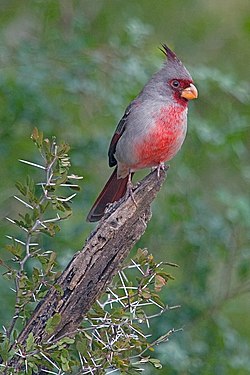
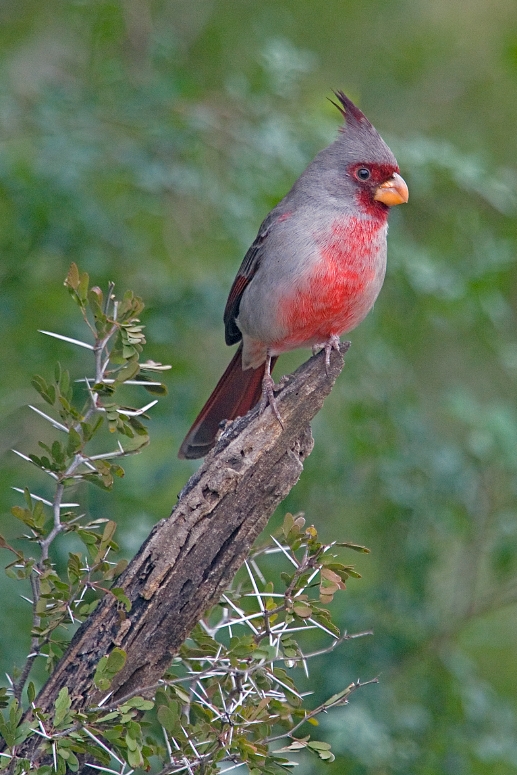
Male pyrrhuloxia
Female pyrrhuloxia
Scientific classification Edit this classification
Kingdom: Animalia
Phylum: Chordata
Class: Aves
Order: Passeriformes
Family: Cardinalidae
Genus: Cardinalis
Bonaparte, 1838
Type species
Cardinalis virginianus = Loxia cardinalis
Bonaparte, 1838

Cardinalis is a genus of birds in the family Cardinalidae.[1][2] There are three species ranging across North America to northern South America.

Description

[edit]

They are birds between 19 and 22 cm in length. Its most distinctive characteristics are the presence of a conspicuous crest and a thick and strong conical bill. There is sexual dimorphism;[3] males have a greater amount of red in their plumage, and females have only some tints, with a predominance of gray. Its striking red plumage is likened to a Catholic senior priest's garments, and their genus is named after the Latin word for them, cardinalis.[4] Immature individuals are similar to females.

Species

[edit]
Genus Cardinalis Bonaparte, 1838 – three species
Common name Scientific name and subspecies Range Size and ecology IUCN status and estimated population
Northern cardinal


Male
{{{image2-alt}}}
Female

Cardinalis cardinalis
(Linnaeus, 1758)

Nineteen subspecies[5]
  • C. c. cardinalis (Linnaeus, 1758)
  • C. c. affinis Nelson, 1899
  • C. c. canicaudus Chapman, 1891
  • C. c. carneus (Lesson, 1842)
  • C. c. clintoni (Banks, 1963)
  • C. c. coccineus Ridgway, 1873
  • C. c. flammiger J.L. Peters, 1913
  • C. c. floridanus Ridgway, 1896
  • C. c. igneus S.F. Baird, 1860
  • C. c. littoralis Nelson, 1897
  • C. c. magnirostris Bangs, 1903
  • C. c. mariae Nelson, 1898
  • C. c. phillipsi Parkes, 1997
  • C. c. saturatus Ridgway, 1885
  • C. c. seftoni (Huey, 1940)
  • C. c. sinaloensis Nelson, 1899
  • C. c. superbus Ridgway, 1885
  • C. c. townsendi (van Rossem, 1932)
  • C. c. yucatanicus Ridgway, 1887
United States from Maine to Texas and in Canada in the provinces of Ontario, Quebec, New Brunswick and Nova Scotia. Its range extends west to the U.S.–Mexico border and south through Mexico to the Isthmus of Tehuantepec, northern Guatemala, and northern Belize
Map of range
Size:

Habitat:

Diet:
 LC 


Pyrrhuloxia (a.k.a. Desert cardinal)


Male
{{{image2-alt}}}
Female

Cardinalis sinuatus
Bonaparte, 1838
U.S. states of Arizona, New Mexico, and Texas and woodland edges in Mexico
Map of range
Size:

Habitat:

Diet:
 LC 


Vermilion cardinal


Male
{{{image2-alt}}}
Female

Cardinalis phoeniceus
Bonaparte, 1838
Colombia and Venezuela
Map of range
Size:

Habitat:

Diet:
 LC 


Phylogeny

[edit]

Cladogram based on analysis by Tilston Smith and Klicka published in 2013.[6]

Cardinalis

References

[edit]
[edit]
Revisions and contributorsEdit on WikipediaRead on Wikipedia
from Grokipedia
Cardinalis is a of New World passerine birds in the family , consisting of three known for their striking , prominent , and robust conical bills adapted for seed-cracking. These birds, often referred to as "true cardinals," are distributed across diverse habitats from southern to northern , including arid scrublands, woodlands, and semi-arid regions. The genus is characterized by sexual dichromatism in most , with males typically displaying vibrant red or gray-red coloration to attract mates and defend territories, while females are more subdued in tone for during nesting. The three species in Cardinalis are the northern cardinal (C. cardinalis), pyrrhuloxia (C. sinuatus), and vermilion cardinal (C. phoeniceus). The , the most widespread, ranges from southern through the central and to northern , with introduced populations in , southern , and ; it inhabits forest edges, thickets, and suburban gardens. The pyrrhuloxia is restricted to open desert scrub in the and northern , where it overlaps with the northern cardinal but prefers drier environments, and its populations have declined due to habitat loss. In contrast, the vermilion cardinal is endemic to the coast of and , favoring semi-arid scrub and often perching conspicuously on shrubs or cacti. Members of Cardinalis are omnivorous, primarily consuming seeds, fruits, and , and exhibit complex vocalizations including songs from both sexes in some . They are generally non-migratory, socially monogamous, and territorial, with breeding seasons varying by and ; for instance, s may raise multiple broods per year. Conservation status varies, with the being common and stable, while the faces localized threats from habitat degradation. These birds play important ecological roles as seed dispersers and insect predators in their ecosystems.

Taxonomy

Etymology

The genus name Cardinalis derives from the Latin cardinalis, meaning "principal" or "chief," a reference to the bright red plumage of its type species, the (Cardinalis cardinalis), which evokes the scarlet robes worn by officials of the . The ecclesiastical term "cardinal" itself originates from Latin cardo, denoting a "" or pivot, symbolizing something essential upon which others depend. French naturalist established the genus Cardinalis in 1838, designating Cardinalis cardinalis—originally described as Loxia cardinalis by in 1758—as the . This classification occurred amid the 19th-century expansion of ornithological taxonomy, where Linnaean became the standard for systematically naming birds as European naturalists documented American avifauna.

Phylogenetic position

The genus Cardinalis belongs to the family , a of New World songbirds within the order Passeriformes and the parvorder Oscines. The family comprises approximately 14 genera, including cardinals, grosbeaks, and buntings, and is distinguished by molecular and morphological traits such as nine primary remiges in the wing. Historically, taxa now assigned to were included in the broader family Emberizidae ( and allies), but phylogenetic analyses have established as a distinct monophyletic family by excluding genera with affinities to Thraupidae () and Parulidae (New World warblers). This reclassification was driven by evidence that traditional groupings based on morphology, such as crest presence and bill shape, did not reflect evolutionary relationships. Molecular evidence from (mtDNA) sequences, including cytochrome b and ND2 genes, supports the of and its internal structure, with high bootstrap support (>95%) for key nodes. Multilocus approaches combining mtDNA with nuclear genes (e.g., intron-2 and GAPDH) have reinforced this, providing denser sampling and resolving relationships within , the superfamily containing . For instance, Klicka et al. (2007) analyzed mtDNA from 34 species across genera, recovering five major s: a "masked" including Cardinalis, a "blue" (Passerina and allies), the Habia-Chlorothraupis group, Granatellus, and Pheucticus. In this phylogeny, Cardinalis emerges as a monophyletic genus within the masked , to Piranga and Rhodothraupis, with the entire masked basal to the remaining cardinalids; Granatellus forms a successive lineage to the and Pheucticus. Barker et al. (2015) corroborated this topology using multilocus data from over 300 species in , positioning as to Thraupidae within a larger nine-primaried oscine radiation. Divergence time estimates, calibrated with fossil constraints and models, indicate that the Cardinalis originated approximately 5–7 million years ago in the , coinciding with aridification events that expanded suitable habitats across the .

Description

Morphology

Species in the Cardinalis are medium-sized passerines, typically measuring 19–22 cm in total length, with wingspans ranging from 25–30 cm and body masses between 25–50 g. These dimensions provide a compact yet robust build suited to their arboreal and terrestrial lifestyles. A prominent feature across the is the crested head, consisting of elongated feathers that form a forward-pointing tuft capable of being erected or flattened. The bill is stout and conical, with a sharply angled lower designed for exerting force to crack open hard seeds and husks, reflecting an to a granivorous diet. Their legs and feet are strong and anisodactyl, facilitating secure perching on branches as well as ground-based . Skeletally, Cardinalis species exhibit typical avian adaptations for flight, including pneumatized that reduce overall mass while maintaining structural integrity, and a pronounced on the that anchors large for powered flapping. The , located at the tracheobronchial junction, features a complex arrangement of cartilaginous rings, membranes, and intrinsic muscles that enable the production of varied, melodious songs characteristic of oscine passerines. Sexual size dimorphism is present in all , with males averaging slightly larger than females in length, mass, and bill dimensions, though the difference is modest and does not exceed 10%.

Plumage and sexual dimorphism

The genus Cardinalis is renowned for its vibrant , particularly in males, where carotenoid-based pigmentation dominates the body, derived from dietary sources and deposited during molt to produce brilliant tones across the head, underparts, wings, and tail. A characteristic black face encircles the robust, conical bill, extending rearward to the eye and covering the chin and , while a prominent, erectile crest of feathers tops the head in both sexes. This coloration, absent or subdued in females, underscores the genus's visual appeal and adaptive significance. Females exhibit more subdued plumage adapted for camouflage, featuring buffy gray or warm tan tones overall, with faint red washes limited to the wings, tail, crest, and occasionally the face or . Sexual dimorphism is highly pronounced in C. cardinalis and C. phoeniceus, where males display uniform, intense plumage contrasting sharply with the brownish-gray or tan hues of females, which include accents around the bill in the latter species. In C. sinuatus, dimorphism is subtler, as males are primarily gray with targeted highlights on the face, crest, wings, and tail, while females are paler buffy gray lacking significant . Members of Cardinalis undergo a complete annual prebasic molt in late summer, post-breeding, replacing body feathers and while incorporating dietary to intensify red hues in males. Juveniles emerge resembling adult females in their dull, buffy but transition to definitive patterns by the second basic plumage, with males developing brighter reds. The vivid male functions as an honest signal in mate attraction, where brighter intensity correlates with superior body condition, territory quality, and , allowing females to assess potential partners. differences also facilitate species recognition among congeners, evolving under dual pressures of —favoring male brightness—and , which shapes female dullness for concealment in varied habitats.

Species

Northern cardinal

The Northern cardinal (Cardinalis cardinalis) is a mid-sized distinguished by its vibrant and prominent crest. Adult males exhibit brilliant red coloration across the face, crest, breast, body, wings, and tail, accented by a face mask and throat. Females are warm buff-brown overall, with red tinges on the crest, wings, tail, and occasionally the face and breast, along with a similar mask. Both sexes possess a short, thick, conical bill adapted for seed-cracking and a long tail. The species measures 21–23 cm (8.3–9.1 in) in length, with a of 25–31 cm (9.8–12.2 in) and weight of 42–48 g (1.5–1.7 oz). It was first described by in 1758. There are 19 recognized , grouped by geographic variation in bill shape, crest form, and intensity; the nominate C. c. cardinalis inhabits the , featuring vivid red males with dark bills, while southern populations in the carneus group exhibit pale bills. Northern cardinals are noted for their loud, clear whistled songs, typically lasting 2–3 seconds and phrased as "cheer-cheer-cheer," "birdie-birdie-birdie," or similar repetitive motifs, which males deliver year-round from elevated perches. These vocalizations, along with aggressive displays, support strongly territorial behavior, where pairs defend year-round territories and may confront intruders or even window reflections. The species holds cultural significance as the state bird of seven U.S. states: , , , , , , and .

Pyrrhuloxia

The (Cardinalis sinuatus), also known as the desert cardinal, is a medium-sized measuring 21-22 cm in length, characterized by its stocky build and distinctive patterns shared within the Cardinalis. Males exhibit a predominantly gray body with vivid red accents on the face, crest, wings, and undertail coverts, while females are duller, appearing gray-brown or buff with subtle red tinges on the face, crest, wings, and tail. A key morphological feature is its short, stout, parrot-like bill, which is yellow to yellow-orange and features a sharply curved upper adapted for cracking seeds in harsh environments. Adapted to arid landscapes, the inhabits desert scrub, mesquite thickets, and thorn-brush areas in the and , thriving in drier conditions that contrast with the more ubiquitous woodland preferences of its close relative, the . Its vocalizations include clear, whistled songs that closely resemble those of the , such as variations on the "what-cheer" phrase, though Pyrrhuloxia notes are typically thinner and shorter, enabling that may aid in territory defense. The species recognizes three : C. s. sinuatus in the core range, C. s. fulvescens in , and C. s. peninsulae on the , reflecting minor variations in intensity and size. In the field, the is frequently mistaken for a female due to overlapping grayish tones and crested silhouette, but it can be reliably distinguished by its thicker, curved yellow bill compared to the thinner, black conical bill of the female. This less vividly colored species occupies a specialized in North American deserts, setting it apart from the brighter, more tropical found in South American thorn-scrub habitats.

Vermilion cardinal

The (Cardinalis phoeniceus) is the only in its endemic to tropical , characterized by its vivid coloration and restricted distribution along the coasts of and . This monotypic , with no recognized , measures approximately 19–20 cm in length, making it slightly smaller than its northern congener. Males exhibit brilliant scarlet overall, accented by a black chin and a prominent spiky red crest, while females are more subdued with tawny-brown underparts, grayish heads, and retaining a red crest and tail tips. Both sexes possess a stout, conical gray bill adapted for seed-cracking. Described by in 1838 in the same publication where he established the Cardinalis, the Vermilion cardinal's scientific name reflects its fiery red hue, evoking the scarlet robes of cardinals in the —a theme echoed in the . In terms of morphology, it features a relatively shorter tail compared to the , contributing to a more compact appearance. Behaviorally, it tends to be more secretive than its North American relatives, often in pairs or small groups within low rather than boldly perching in open view, though it may occasionally adopt conspicuous postures atop shrubs. Its vocalizations include melodious, whistled songs delivered as series of clear notes, such as variations on "cheer-cheer-to-weet-to-weet," resembling those of the but typically softer and less emphatic. These songs, sung by both sexes, serve primarily for territory defense and mate attraction within its limited tropical range.

Distribution and habitat

Geographic range

The Cardinalis encompasses three species distributed across , , and northern , with the core range spanning from southern southward to northern and . The Northern Cardinal (Cardinalis cardinalis) occupies the broadest range within the genus, breeding from southeastern Canada (including Nova Scotia and New Brunswick) and the northeastern United States westward across the northern U.S. to southeastern South Dakota, then south through the eastern and central U.S. to the Gulf Coast, southern Mexico, and Baja California Sur. This species has been introduced and established in Hawaii, southern California, and Bermuda. The Pyrrhuloxia (Cardinalis sinuatus) is more restricted, residing year-round in the southwestern United States—including southeastern Arizona, southern New Mexico, and southwestern Texas (east to the southern Gulf Coast)—and extending into northern and central Mexico. In contrast, the Vermilion Cardinal (Cardinalis phoeniceus) is endemic to the northern coastal regions of South America, with disjunct populations in northeastern Colombia (from the Guajira Peninsula) and northern Venezuela (from Lara state eastward to Anzoátegui and the Araya Peninsula). Members of the genus are predominantly non-migratory residents throughout their ranges, with most individuals maintaining year-round territories near their natal sites. However, some northern populations of the exhibit partial migration, with individuals dispersing southward during harsh winters, though evidence for true migratory behavior remains limited. The Northern Cardinal has undergone significant historical range expansion since the mid-19th century, particularly northward into previously unoccupied areas of the northeastern and midwestern United States and Canada, driven by habitat alterations from agricultural development and suburban growth. This expansion has continued into the 21st century, with breeding records now established farther north than in the early 1900s.

Preferred habitats

Species of the genus Cardinalis generally prefer habitats that provide dense vegetative cover for nesting, foraging, and protection from predators, such as edges, shrublands, and gardens. These environments typically feature a mix of shrubs, small trees, and vegetation that offer concealment and proximity to food sources. The (Cardinalis cardinalis) thrives in deciduous forests, forest edges, overgrown fields, hedgerows, and suburban areas, including backyards and city parks where dense bushes are present. It favors semi-open, brushy habitats from swamps to clearings, showing a strong affinity for areas with thick undergrowth. In contrast, the (Cardinalis sinuatus) inhabits thorny desert scrub, upland deserts, mesquite savannas, dry grasslands, and open mesquite woodlands, often utilizing riparian streamside areas and farm fields with hedgerows for nesting in mesquite trees or shrubs. The (Cardinalis phoeniceus) is adapted to semi-arid scrublands, dry savannas, and subtropical/tropical dry shrublands along coastal regions, perching in cacti or upper branches of thorny bushes from up to 300 meters elevation. These species exhibit notable adaptations to human-modified landscapes, particularly the , which readily occupies urban and suburban environments like gardens and parks, tolerating proximity to human activity while relying on artificial plantings for cover. The and show similar flexibility in altered arid habitats, such as agricultural edges and scrub degraded by grazing. Across the , climate preferences span temperate to tropical zones, with all species requiring access to sources near their dry or semi-arid habitats to support survival in varying seasonal conditions.

Behavior and ecology

Foraging and diet

Cardinals of the genus are opportunistic omnivores, with diets dominated by matter including seeds and fruits, supplemented by animal prey such as and other . The (C. cardinalis) consumes approximately 71% material and 29% animal matter annually, though this varies seasonally with higher consumption during breeding periods in warmer months. Fruits, berries, and grains provide additional sources, enabling adaptability to diverse environments. Foraging typically occurs on the ground or in low shrubs, where individuals hop to scratch through leaf litter or vegetation in search of food. They employ their strong, conical bills to crack open seeds and husks, a method well-suited to their primary food sources. Cardinals also glean from foliage or snatch them mid-air, and they readily exploit human-provided feeders, especially in winter when natural seeds are scarce. The (C. cardinalis) shows marked seasonal shifts, consuming more like beetles, grasshoppers, caterpillars, and spiders (50 to 60% of diet in summer) alongside seeds from weeds and grasses, while winter intake leans heavily toward seeds and berries. In contrast, the (C. sinuatus) favors desert-adapted items such as fruits, mesquite seeds, and ground including grasshoppers and beetles, often foraging in mixed flocks during non-breeding seasons to exploit abundant seed crops. The (C. phoeniceus) includes arthropods and in its diet, alongside fleshy fruits and seeds, typically searching through dense scrub vegetation in small groups or pairs.

Reproduction and breeding

Cardinals in the genus Cardinalis are generally monogamous, forming pairs that often remain together for a breeding season or longer, with males performing displays such as singing and feeding the female to strengthen pair bonds. Breeding seasons vary by and : in northern populations like the (C. cardinalis), it occurs from March to July or August, aligning with spring and summer availability of resources, while tropical such as the (C. phoeniceus) may breed year-round or in extended periods influenced by local conditions. Pairs defend territories vigorously during breeding, with males using to deter intruders and maintain pair cohesion. Nesting behavior is consistent across the genus, featuring open cup-shaped nests constructed primarily by the female using twigs, grass, bark, and leaves, often lined with finer materials like hair or rootlets; these are typically placed in dense shrubs, vines, or low trees for concealment, 1-3 meters above ground. Clutch sizes range from 2-5 eggs, most commonly 3-4, which are pale with brown or gray markings; the female alone incubates the eggs for 11-14 days, during which the male supplies food to her on the nest. Nestlings are altricial, fed by both parents with insects and seeds, and fledge after 9-13 days, remaining dependent on adults for several weeks post-fledging. Parental roles emphasize biparental care, with males guarding the and to advertise and defend it, while both sexes provision the young; this division allows females to initiate subsequent broods. The Northern Cardinal often raises 2-4 broods per year in its range, contributing to high reproductive output in suitable habitats. Species differences include the (C. sinuatus), which nests higher in thorny vegetation like cholla cacti or mesquite (up to 5 meters) in arid deserts, with incubation lasting about 14 days, and breeds from mid-March to mid-August. The Vermilion Cardinal constructs nests in cacti or bushes in coastal scrub, laying 3-4 eggs with a breeding peak from June to August, and the female solely handles incubation and brooding, though exact duration is similar to congeners at around 12-13 days.

Conservation

Status and threats

All three species in the genus Cardinalis are currently classified as Least Concern on the IUCN Red List, with assessments conducted in 2018 for the Northern cardinal and in 2025 for the Pyrrhuloxia and Vermilion cardinal. However, local declines have been noted in some populations, particularly for the Pyrrhuloxia and Vermilion cardinal, due to ongoing environmental pressures. The primary threats to Cardinalis species include habitat fragmentation resulting from agricultural expansion and urbanization, which disrupts scrub and riparian ecosystems essential for their survival. Predation by domestic and cats poses a significant , particularly in human-modified landscapes where these predators are abundant. further exacerbates these issues by altering temperature regimes and patterns, potentially shifting suitable ranges and intensifying habitat stress in arid and coastal regions. For the , populations remain stable to expanding, benefiting from adaptability to suburban environments despite localized habitat pressures. The faces heightened vulnerability from desert habitat loss, driven by agricultural conversion and urban development in the and . The is particularly threatened by coastal development, including and land conversion for agriculture and ranching along the Caribbean shores of and . In the United States, the and receive federal protection under the Migratory Bird Treaty Act of 1918, which prohibits their take, including killing or capture, without authorization to ensure population sustainability. The , occurring outside U.S. , lacks this specific protection but benefits from regional conservation measures in its range countries. The genus Cardinalis encompasses three species with varying population sizes and trajectories across their respective ranges. The Northern Cardinal (C. cardinalis) is estimated to number over 100 million individuals continent-wide, reflecting its widespread abundance in . In contrast, the Pyrrhuloxia (C. sinuatus) has a global population of approximately 3 million birds, primarily in the and . The Vermilion Cardinal (C. phoeniceus) lacks a precise quantified estimate but is described as fairly common within its restricted range in northern . Population trends for Cardinalis species are tracked primarily through long-term monitoring efforts, revealing distinct patterns. Data from the North American Breeding Bird Survey (BBS), initiated in 1966, indicate a roughly 20% overall increase in abundance since the , attributed to expanded availability and widespread supplementary feeding via backyard bird feeders. Pyrrhuloxia populations have shown a slight decline, with an estimated 1% annual decrease from 1967 to 2023, resulting in a cumulative reduction of about 37% over that period, linked to regional pressures. For the Vermilion Cardinal, trends suggest stability in core areas but an overall gradual decline, influenced by localized factors such as capture for the pet trade. Ongoing monitoring programs provide essential data for assessing these dynamics. The BBS conducts standardized roadside surveys during the breeding season to estimate annual changes in bird abundance across , covering routes where C. cardinalis and C. sinuatus are frequently detected. Complementing this, eBird—a citizen-science platform managed by the Cornell Lab of —aggregates millions of global observations to model relative abundance and detect short-term fluctuations for all three . The Audubon Christmas Count (CBC), an annual winter since 1900, further tracks non-breeding populations, with s consistently ranking among the most reported , often exceeding 100,000 individuals across counts, underscoring the role of urban feeders in sustaining numbers. Supplementary feeding has notably boosted populations by enhancing winter survival and breeding success in human-modified landscapes. Overall genus-level monitoring will be crucial to adapt conservation strategies amid variability.

References

Add your contribution
Related Hubs
User Avatar
No comments yet.