


Community hub
Recent from talks
Contribute something
Nothing was collected or created yet.
Gouldian finch
View on Wikipedia
| Gouldian finch | |
|---|---|

| |
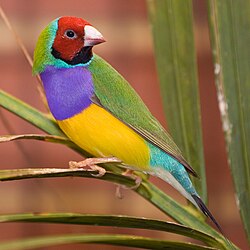
| Adult red-headed male | |
Scientific classification 
| |
| Kingdom: | Animalia |
| Phylum: | Chordata |
| Class: | Aves |
| Order: | Passeriformes |
| Family: | Estrildidae |
| Genus: | Chloebia Reichenbach, 1862 |
| Species: | C. gouldiae
|
| Binomial name | |
| Chloebia gouldiae (Gould, 1844)
| |

| |
| Distribution | |
| Synonyms[3] | |
| |


The Gouldian finch (Chloebia gouldiae), also known as the Gould's finch or the rainbow finch, is a colourful passerine bird that is native to Australia.
Taxonomy
[edit]The Gouldian finch was described by British ornithologist John Gould in 1844 as Amadina gouldiae,[3] in honour of his deceased wife Elizabeth.[4][5] Specimens of the bird were sent to him by British naturalist Benjamin Bynoe, although they had been described some years before by French naturalists Jacques Bernard Hombron and Honoré Jacquinot.[6] It is also known as the rainbow finch, Gould's finch, or sometimes just Gould.[7] The Gouldian finch is sister to the parrotfinches in the genus Erythrura.[8]
Description
[edit]Both sexes are brightly coloured with black, green, yellow, and red markings. The females tend to be less brightly coloured. One major difference between the sexes is that the male's chest is purple, while the female's is a lighter mauve.[9]
Gouldian finches are about 125–140 mm (4.9–5.5 in) long.[10] Their heads may be red, black, or yellow. Formerly considered three different kinds of finches, it is now known that these are colour variants of one species that exist in the wild.[11] Selective breeding has also developed mutations (blue, yellow and silver instead of a green back) in both body and breast colour.[12]
There are several "prominent rounded tubercles" with an "opalescent lustre" at the back of the gape. These tubercles are commonly (and incorrectly) described as phosphorescent in spite of much scientific evidence to the contrary.[13] It is believed that these tubercles simply reflect light and are not luminescent.[13]
Distribution and habitat
[edit]
Gouldian finches are native to northern Australia,[14] in particular the Kimberley and Northern Territory.[15]
Prior to the Australian government's ban on the export of Australian fauna,[16] Gouldian finches were exported worldwide, which has resulted in viable captive breeding populations being held in many countries.[citation needed]
Conservation status
[edit]This species has been considered an Endangered species by the Australian Government in the last two "Endangered Species Act"s - the Australian Endangered Species Protection Act (ESPA) of 1992[17] and the Environment Protection and Biodiversity Conservation (EPBC) Act, 1999.[2] Its status on the IUCN Red List is currently Least concern, but it was considered to be endangered previously: Threatened in 1988, EN in six assessments between 1994 and 2008, and Near threatened in three assessments between 2012 and 2016.[1]
The number of Gouldian finches in the wild decreased dramatically in the 20th century due to human-caused habitat loss.[18][15] The population went from hundreds of thousands in the early 20th century to 2,500 or fewer by the 1980s.[18] The current estimated population continues to be 2,500 or fewer birds.[15] Early research suggested that a parasite called the air sac mite was responsible for the species' decline, but the mite is no longer considered a major factor.[citation needed] The primary threat to wild Gouldian finch populations is an increase in extensive wildfires in the late dry season of its native habitat, which negatively impacts the availability of both tree hollows for breeding, and the seeds that comprise the bulk of the Gouldian finch's diet.[15][19] Cyclones and climate change have also negatively impacted tree hollow availability in the Northern Territory.[20]
Behaviour
[edit]Outside the breeding season, Gouldian finches often join mixed flocks consisting of long-tailed finches and masked finches. Flocks can consist of up to 1,000–2,000 individuals.[21] During the breeding season, they are normally found on rough scree slopes where vegetation is sparse. In the dry season, they are much more nomadic and will move to wherever their food and water can be found.[21]
Feeding
[edit]Like other finches, the Gouldian finch is a seed eater. They eat up to 30% of their bodyweight each day.[22] During the breeding season, Gouldian finches mainly feed on ripe and half-ripe grass seeds of sorghum. During the dry season, they mainly forage on the ground for seeds. During the wet season, spinifex grass seed (Triodia sp.) is an important part of their diet. So far Gouldians have been recorded eating six different species of grass seed, but researchers have yet to find evidence of insect consumption.[23]
Breeding
[edit]

Gouldian finches will usually make their nests in tree hollows. They usually breed in the early part of the dry season, when there is plenty of food available.[24] When a male is courting a female, he bobs about and ruffles his feathers in an attempt to show off his bright colours. He will expand his chest and fluff out the feathers on his forehead. After mating, the female will lay a clutch of about 4–8 eggs. Both parents help brood the eggs during the daytime, and it is the female who stays on the eggs at night. When the eggs hatch, both parents care for the young. Gouldian finches leave the nest after between 19 and 25 days and are completely independent at 40 days old.[24]
Gouldian finches have brightly coloured gapes and call loudly when the parent birds return so that they are able to find and feed their mouths in the dark nest.[25]
It has been shown that female Gouldian finches from Northern Australia can control the sex of their offspring by choosing mates according to their head colour. A certain amount of genetic incompatibility between black and red-headed birds can result in high mortality (up to 80%) in female offspring when birds of different head colours mate. If the female mates with a finch of different head colour, this genetic incompatibility can be addressed by over-producing sons, up to a ratio of four males to one female. This is one of the first proven instances of birds biasing the sex of their offspring to overcome genetic weaknesses.[26][27]
Aviculture
[edit]Gouldian finches are a popular species in aviculture because of their striking colours and low care requirements.[24] Gouldian finches get along well with other species of grass finch and some other docile species of bird, such as waxbills and parrot finches.[28]
Trapping for aviculture
[edit]In the Kimberley District of Western Australia, where most wild Gouldian finch were trapped for aviculture, it was often reported as one of the more common of the eleven finch species. Until 1977, it was trapped in greater numbers than any other finch. From 1897, when finch trapping started in the Kimberley, it was the most sought after finch by trappers and the most desired by fanciers. Between 1934 and 1939, the Gouldian finch was the most exported single finch species. The Perth Zoo exported 22,064 finches of which 12,509 were Gouldian. Private dealers exported 35,315 finches, of which 14,504 were Gouldian. The number of finches taken in the 1958 finch trapping season was the largest for one year, of the 38,649 finches taken, 11,286 were Gouldian. The last licensed trapping of Gouldian finch in Western Australia was on 15 November 1981. In that year's finch trapping season, of the 23,450 finches taken 1,054 were Gouldian.[29] However, it is now illegal to export these birds from Australia.[30]
In popular culture
[edit]Gallery
[edit]-
 Black-headed female Gouldian finch
 -
 Red headed male Gouldian finch at Artis Zoo, Netherlands
 -
 A juvenile at Cincinnati Zoo
 -
 A young Gouldian finch with the beginnings of bright adult plumage
 -
 Two Gouldian finches eating birdseed


.jpg)
Gouldian finch mutations
[edit]-
 White Gouldian finch and yellow Gouldian finch mutation
 -
 White-breasted yellow-headed Gouldian finch (left) and black-headed male Gouldian finches
 -
 Adult male double factor yellow back Gouldian finch


References
[edit]- ^ a b BirdLife International. (2022). "Chloebia gouldiae". IUCN Red List of Threatened Species. 2022 e.T22719744A211561819. doi:10.2305/IUCN.UK.2022-1.RLTS.T22719744A211561819.en. Retrieved 17 August 2024.
- ^ a b "Chloebia gouldiae — Gouldian Finch | SPRAT Profile". Australian Government.
- ^ a b Australian Biological Resources Study (6 May 2016). "Species Erythrura (Chloebia) gouldiae (Gould, 1844)". Australian Faunal Directory. Canberra, Australian Capital Territory: Department of the Environment, Water, Heritage and the Arts, Australian Government. Retrieved 28 August 2018.
- ^ "The Goulds, John Gould (1804–1881)". Avicultural Review. 15 (1). The Avicultural Society of New South Wales (ASNSW). January 1998.
- ^ "Part 1: An introduction to the Gouldian finch – Planet Aviary". planetaviary.com. 17 February 2016. Retrieved 25 August 2018.
- ^ "Gouldian Finch discovery". GouldianFinches.eu.
- ^ "The Gouldian Finch – Chloebia gouldiae". www.efinch.com. Retrieved 27 August 2018.
- ^ Olsson, Urban; Alström, Per (2020). "A comprehensive phylogeny and taxonomic evaluation of the waxbills (Aves: Estrildidae)". Molecular Phylogenetics and Evolution. 146 106757. Bibcode:2020MolPE.14606757O. doi:10.1016/j.ympev.2020.106757. PMID 32028027. S2CID 211048731.
- ^ "Gouldian finch - Erythrura gouldiae - ARKive". 29 January 2009. Archived from the original on 29 January 2009.
- ^ "Gouldian Finch Identification – Gouldian Finch". www.diamante-de-gould.com. Archived from the original on 7 December 2019. Retrieved 26 August 2018.
- ^ Southern H.N. (1945). "Polymorphism in Poephila gouldiae" (PDF). J. Genet. 47: 51–157. doi:10.1007/BF02989037. S2CID 38518147.
- ^ "Gouldian Finch colour mutations".
- ^ a b McAtee W.L. (July 1947). "Luminosity in Birds". American Midland Naturalist. 38 (1): 207–213. doi:10.2307/2421636. JSTOR 2421636.
- ^ Cox, Lisa (4 September 2022). "Tanya Plibersek urged to save Gouldian finches from NT defence development". The Guardian. ISSN 0261-3077. Retrieved 13 August 2023.
- ^ a b c d "Gouldian finch – WWF-Australia". Retrieved 25 August 2018.
- ^ "Department of the Environment and Energy". Department of the Environment and Energy. Retrieved 25 August 2018.
- ^ "Endangered Species Protection Act 1992". Australian Government. 5 December 1999.
- ^ a b Tidemann, Sonia C. (March 1996). "Causes of the decline of the Gouldian Finch Erythrura gouldiae". Bird Conservation International. 6 (1): 49–61. doi:10.1017/S0959270900001301.
- ^ "Australian Wildlife Conservancy". www.australianwildlife.org. Retrieved 25 August 2018.
- ^ Abbatangelo, Ben (11 July 2023). "Binybara is not just home to the Gouldian finch. It's part of the Larrakia nation. And it deserves protection". The Guardian. ISSN 0261-3077. Retrieved 13 August 2023.
- ^ a b "Gouldian Finches or Rainbow Finches | Beauty of Birds". www.beautyofbirds.com. Retrieved 30 August 2018.
- ^ "Lady Gouldian Finch Diet Feeding Guide". Archived from the original on 22 December 2019. Retrieved 22 December 2019.
- ^ "Gouldian Finches or Rainbow Finches | Beauty of Birds". www.beautyofbirds.com. Retrieved 28 August 2018.
- ^ a b c "8 Top Low-Maintenance Pet Bird Species".
- ^ Attenbourgh, David. The Life of Birds, Episode 9, 3 mins, 55 s.
- ^ Pryke, S.R.; Griffith, S.C. (2009). "Genetic incompatibility drives sex allocation and maternal investment in a polymorphic finch". Science. 323 (5921): 1605–1607. Bibcode:2009Sci...323.1605P. doi:10.1126/science.1168928. PMID 19299618. S2CID 9348692.
- ^ "Bird Controls Offspring's Gender". Scientific American.
- ^ "Gouldian Finch Personality, Food & Care – Pet Birds by Lafeber Co". Archived from the original on 28 August 2018. Retrieved 28 August 2018.
- ^ Finch Trapping in the Kimberley, K H Coate and L H Merritt (2015) ISBN 978-0-85905-621-2 – ref Fisheries Department, table, trapped birds export statistics 1935–1939 22 August 1939, SROWA CONS 477, ITEM 1934-0059; and Department of Conservation and Land Management, table, Annual Finch Trapping Since 1968 1986. SROWA CONS 6437, ITEM 014832F3528
- ^ "Department of the Environment and Energy". Department of the Environment and Energy. Retrieved 31 August 2018.
- ^ "Our Vision". ViewSonic. Retrieved 21 July 2023.
External links
[edit]

Gouldian finch
View on GrokipediaTaxonomy and Systematics
Classification and Etymology
The Gouldian finch (Chloebia gouldiae) belongs to the class Aves within the phylum Chordata and is classified in the order Passeriformes and family Estrildidae, a group of small seed-eating birds primarily distributed in the Old World tropics.[7][4] The genus Chloebia is monotypic, encompassing only this species, which distinguishes it from related parrotfinches in the genus Erythrura.[1] This placement reflects phylogenetic analyses separating it as a distinct lineage within Estrildidae, based on morphological and molecular evidence.[10] The species was first described scientifically by British ornithologist John Gould in 1844 under the name Amadina gouldiae, originally placed in a genus now recognized for other African finches.[10] Subsequent taxonomic revisions transferred it to genera such as Poephila and Erythrura, with the latter used in some earlier classifications like Christidis and Boles (2008), but recent authorities, including del Hoyo and Collar (2016), favor Chloebia to reflect its unique evolutionary position as sister to Erythrura parrotfinches.[1][10] The common name "Gouldian finch" and specific epithet gouldiae honor Elizabeth Gould, the wife and accomplished illustrator of John Gould, who died in 1841 shortly before the description; the feminine Latin suffix underscores this dedication, leading to alternative names like "Lady Gouldian finch."[11] The genus name Chloebia derives from the Greek chloē, meaning "green grass" or "verdant," alluding to the bird's predominant green plumage.[10]Subspecies and Genetic Lineages
The Gouldian finch (Erythrura gouldiae) is recognized as a monotypic species, lacking formally designated subspecies across its range in northern Australia.[1][12] Genetic variation within the species is primarily manifested through a sex-linked polymorphism in adult head coloration, resulting in three distinct morphs: black-headed, red-headed, and orange-headed. This polymorphism is maintained by balancing selection, despite fitness costs associated with certain genotypes, such as reduced viability in red/black heterozygotes.[13][14] The black-headed morph predominates in wild populations, accounting for 60–80% of individuals depending on locality, while the red-headed morph comprises 20–40%. The orange-headed morph is exceptionally rare, with frequencies below 0.1% in surveyed flocks.[13] The underlying genetics involve a supergene on the Z chromosome (the bird equivalent of the X in mammals), where the red allele is dominant to black but incurs a 10–15% viability penalty in heterozygous males, promoting coexistence of morphs through negative frequency-dependent selection.[13][14] Orange heads arise from an independent autosomal recessive mutation that disrupts melanin synthesis via altered tyrosinase activity, effectively depigmenting the Z-linked red or black pattern to yellow-orange.[15]| Head Morph | Approximate Wild Frequency | Genetic Mechanism |
|---|---|---|
| Black-headed | 60–80% | Z-linked recessive allele |
| Red-headed | 20–40% | Z-linked dominant allele (with heterozygote disadvantage) |
| Orange-headed | <0.1% | Autosomal recessive depigmentation modifier |
Physical Characteristics
Morphology and Size
The Gouldian finch (Erythrura gouldiae) is a small estrildid finch measuring 12 to 15 cm in total length from bill to tail tip, with adults weighing 14 to 15 grams.[17][18] Its body is compact and relatively small, comprising a stocky granivorous form typical of grassfinches, but the disproportionately long, wispy tail contributes to the overall medium finch size.[19][20] There is no pronounced sexual dimorphism in body size or mass between males and females.[3] The head is rounded with a strong, wedge-shaped bill suited for seed-cracking, featuring a pale ivory or pinkish base, darker upper mandible, and reddish tip; pale nodules are present at the gape.[19][21] The legs and feet are slender and light brown, supporting agile perching and ground foraging.[18] Wings are short and rounded, aiding maneuverability in grassy habitats rather than sustained flight. Juveniles exhibit similar proportions but are smaller at fledging, with underdeveloped tails and overall lengths approaching adult size by 4-6 weeks post-hatching.[18] Body mass can vary slightly with nutritional status and season, as these nomadic birds adapt to fluctuating food availability in savanna environments.[22]Plumage and Color Morphs in the Wild
The adult Gouldian finch exhibits plumage characterized by bright green upperparts, including the back and wings, a violet-purple breast, yellow underparts, and turquoise-blue rump and upper tail-coverts. The tail feathers are black with transverse white bars. The beak is straw-yellow with a black tip, and the legs and feet are yellow.[2][4] Males possess more intensely saturated colors than females, particularly in the breast plumage, which is duller purple in females. Both sexes display the head color polymorphism, featuring a facial mask of black, red, or rarely orange, encircled by a turquoise band at the nape.[3][2] In wild populations, black-headed individuals comprise about 70% of adults, red-headed approximately 30%, and orange-headed fewer than 1%. This polymorphism is absent in body coloration, with wild birds uniformly exhibiting the standard green-backed, purple-breasted pattern, unlike diluted variants prevalent in captivity.[14][23] The head color variation is genetically determined by a single sex-linked locus on the Z chromosome, with the red allele dominant over black; orange represents a homozygous recessive form at low frequency.[24][14]Distribution and Habitat
Geographic Range
The Gouldian finch (Erythrura gouldiae) is endemic to northern Australia, with no established populations outside this continent.[2][7] Its native range encompasses tropical savanna woodlands, but populations have contracted significantly from historical extents.[25] Current distribution is patchy and fragmented, concentrated in the Kimberley region of northwestern Western Australia, the Top End of the Northern Territory (including areas around Darwin and Katherine), and isolated sites in northwestern Queensland extending thinly toward the Gulf of Carpentaria.[1][2] Scattered records persist on Cape York Peninsula and the Einasleigh Uplands in far northeastern Queensland, though these are infrequent and represent marginal habitat use.[1][7] The species favors sub-coastal zones below 400 meters elevation, avoiding denser rainforests or arid interiors.[25] Historically, prior to the mid-20th century, Gouldian finches occupied a broader expanse of open eucalypt savannas across northern Australia, from near Derby in Western Australia eastward to northeastern Queensland, supported by anecdotal reports and early collector records.[2] Decline has isolated remnants to fewer than 20 known localities, primarily on Aboriginal-managed lands in the Northern Territory and Western Australia, with Queensland populations nearing extirpation.[1][9] No feral or introduced populations exist elsewhere, despite occasional escapes from aviculture.[7]Habitat Requirements and Preferences
The Gouldian finch (Erythrura gouldiae) primarily inhabits open tropical savanna woodlands in northern Australia, favoring areas with a grassy understorey dominated by tall annual grasses such as Sorghum and Heteropogon species, which provide essential seeding grounds for foraging.[1][2] These habitats typically feature scattered eucalypt trees, including smooth-barked species like Eucalyptus and Corymbia, offering hollows for nesting at heights of 6–13 meters above ground.[26][27] Breeding sites are selected in regions with high densities of suitable tree cavities, often in hilly or rocky terrain that supports hollow-bearing trees such as Eucalyptus brevifolia and E. tintinnans.[28][29] While tree hollows are the predominant nesting substrate, occasional use of cavities in termite mounds has been documented, though this is rare and secondary to arboreal sites.[29] Proximity to water sources is a consistent preference, enabling access to drinking sites amid the dry-season conditions of these fire-prone ecosystems.[2] Non-breeding habitat overlaps with breeding areas but emphasizes open plains and grasslands with abundant ripe grass seeds, where flocks congregate post-breeding.[28] The species shows specificity for relatively undisturbed savannas, avoiding dense forest edges or heavily modified landscapes, as evidenced by habitat selection studies indicating preference for patches with minimal competitive interference from other finches.[30] Climate-wise, Gouldian finches require warm, humid conditions with distinct wet and dry seasons, thriving in temperatures above 20°C and showing aversion to cold, which limits their adaptability outside native ranges.[1]Ecology and Behavior
Foraging and Diet
The Gouldian finch (Erythrura gouldiae) is an obligate granivore, with its diet consisting almost exclusively of grass seeds from both annual and perennial species native to northern Australian savannas.[31] Primary food sources include Sorghum spp. (such as S. stipoideum), Triodia spp. (spinifex), Themeda triandra, Alloteropsis semialata, Chrysopogon fallax, and Heteropogon triticeus.[32] Unlike many other estrildid finches, Gouldian finches do not regularly supplement their diet or that of their nestlings with insects, relying instead on a succession of available seed resources throughout the year.[31] Although occasional insect consumption has been noted in some accounts, empirical studies, including crop analyses, provide no substantial evidence of significant arthropod intake in the wild.[31] Foraging occurs primarily on the ground, where birds search for fallen ripe seeds among grasses and litter, often in small flocks that move between patches based on seed availability.[3] During the wet season (November to April), they target seeds from perennial grasses, while the dry season (May to October) shifts focus to shed seeds from annual species, particularly in recently burnt areas that enhance seed accessibility by reducing grass cover.[32] Gouldian finches exhibit dietary wariness, showing repeatable neophobia toward novel foods in experimental settings, which may reflect adaptations to their specialized, unpredictable seed-based foraging niche.[33] Individuals can consume up to 35% of their body weight in seeds daily, underscoring the high energetic demands of this foraging strategy in a fire-prone, seasonally variable habitat.[11]