Hubbry Logo
Prothonotary warblerProthonotary warblerMain
Open search
Prothonotary warbler
Community hub
Prothonotary warbler
logo
8 pages, 0 posts
0 subscribers
Be the first to start a discussion here.
Prothonotary warbler
from Wikipedia

Prothonotary warbler
Female
Scientific classification Edit this classification
Kingdom: Animalia
Phylum: Chordata
Class: Aves
Order: Passeriformes
Family: Parulidae
Genus: Protonotaria
Baird, 1858
Species:
P. citrea
Binomial name
Protonotaria citrea
(Boddaert, 1783)
Range of P. citrea
  Breeding range
  Wintering range

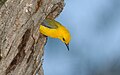
The prothonotary warbler (Protonotaria citrea) is a small songbird of the New World warbler family. It is named for its plumage, which resembles the yellow robes once worn by papal clerks (named prothonotaries) in the Roman Catholic Church.

The prothonotary warbler is the only member of the genus Protonotaria and the only eastern warbler that nests in natural or artificial cavities.

These warblers often move with quick, jerky, movements and will even crawl upside down on sticks or trees. During the spring they are often seen in wetlands gathering nesting material, or food, for their mate.

Taxonomy

[edit]

The prothonotary warbler was described by the French polymath Georges-Louis Leclerc, Comte de Buffon in 1779 in his Histoire Naturelle des Oiseaux from a specimen collected in Louisiana. Buffon coined the French name Le figuier protonotaire.[2] The bird was also illustrated in a hand-coloured plate engraved by François-Nicolas Martinet in the Planches Enluminées D'Histoire Naturelle, which was produced under the supervision of Edme-Louis Daubenton to accompany Buffon's text.[3] Neither the plate caption nor Buffon's description included a scientific name but in 1783 the Dutch naturalist Pieter Boddaert coined the binomial name Motacilla citrea in his catalogue of the Planches Enluminées.[4] The prothonotary warbler is now the only species placed in the genus Protonotaria that was introduced in 1858 by the American naturalist Spencer Baird.[5][6][7] The species is monotypic, no subspecies are recognised.[7]

The genus name is from Late Latin protonotarius, meaning "prothonotary", a notary attached to the Byzantine court who wore golden-yellow robes. The specific citrea is from Latin citreus meaning the colour "citrine".[8] It was once known as the golden swamp warbler.[9]

A molecular phylogenetic study of the family Parulidae published in 2010 found that the prothonotary warbler was a sister species to Swainson's warbler (Limnothlypis swainsonii).[10]

Description

[edit]

The prothonotary warbler is 13 cm (5.1 in) long, weighs a mean 14.3 g (0.50 oz),[11] and has a wingspan of 22 cm (8.75 in).[12] It has an olive-coloured back with blue-grey wings and tail, yellow underparts, a relatively long pointed bill, and black legs. The adult male has a bright orange-yellow head. Females and immature birds are duller and have a yellow head. In flight from below, the short, wide tail has a distinctive two-toned pattern, white at the base and dark at the tip.[13]

Distribution and habitat

[edit]

The prothonotary warbler mostly breeds in hardwood swamps in extreme southeastern Ontario and the eastern United States. However, it may nest near other bodies of water such as creeks, streams, ponds, and swimming pools.

The habitat of the warblers during migration is not well known. However, they are particularly prominent in Belize during spring migration.[14]

The warblers winter in the West Indies, Central America and northern South America, primarily in mangrove swamps.[15][14]

It is a rare vagrant to parts of the western United States,[16] most notably California.

Behavior and ecology

[edit]

The prothonotary warbler is the only eastern warbler that nests in natural or artificial cavities, sometimes using old downy woodpecker holes. The male often builds several incomplete, unused nests in his territory; the female builds the real nest and lays 3–7 eggs.[17]

The preferred foraging habitat is dense, woody streams, where the prothonotary warbler forages actively in low foliage, mainly for insects and snails.[17]

The song of this bird is a simple, loud, ringing sweet-sweet-sweet-sweet-sweet. The call is a loud, dry chip, like that of a hooded warbler. Its flight call is a loud seeep.[18]

Status

[edit]

Prothonotary warblers are declining in numbers due to loss of habitat. They also experience parasitism by the brown-headed cowbird (Molothrus ater), and are outcompeted for nest sites by the house wren (Troglodytes aedon).[19] The warblers are listed as endangered in Canada, with approximately 30 individuals estimated to breed in Ontario as of 2008.[20] The species persists in protected environments such as South Carolina's Francis Beidler Forest, which is currently home to more than 2,000 pairs, the densest known population.[21]

In culture

[edit]

Art and literature

[edit]

John James Audubon's painting of a prothonotary warbler is the third plate in The Birds of America.[22]

The warbler has also been mentioned several times in literature. First, the warbler is mentioned in A Sand County Almanac by Aldo Leopold as the "jewel of my disease-ridden woodlot", "as proof that dead trees are transmuted into living animals, and vice versa. When you doubt the wisdom of this arrangement, take a look at the prothonotary."[23] Second, Kurt Vonnegut described the warbler as "the only birds that are housebroken in captivity" in his novel, Jailbird.[citation needed]

The Hiss-Chambers Hearing

[edit]

The prothonotary warbler became known to a wider audience in the 1940s as the bird that established a connection between Whittaker Chambers and Alger Hiss in front of the House Un-American Activities Committee.

On August 3, 1948, in a hearing before the committee, Chambers accused Hiss of being a communist spy who sought to infiltrate the U.S. government. Two days later, Hiss testified before the committee and claimed, among other things, that Chambers' allegations were false and that he did not know Chambers.

However, future U.S. president, Richard Nixon, who was then a freshman congressman on the committee, became convinced that Hiss had committed perjury at the hearing.[24] To verify this suspicion, the committee had Chambers appear before it again on August 7, 1948, to testify about his relationship with Hiss. At that hearing, Chambers testified that Hiss enjoyed bird-watching, and once bragged to Chambers about seeing a prothonotary warbler along the Potomac River. When Hiss appeared before the committee again, he haphazardly confirmed spotting a prothonotary warbler on the Potomac, causing many members of the committee to become convinced of the pair's acquaintance.[25][26][27] Ultimately, the Hiss-Chambers hearing led, in part, to Nixon's political rise.[14]

[edit]

References

[edit]
[edit]
Revisions and contributorsEdit on WikipediaRead on Wikipedia
from Grokipedia
The prothonotary warbler (Protonotaria citrea) is a small, vividly golden-yellow in the family Parulidae, unique among eastern North American warblers for its habit of nesting in natural or woodpecker-excavated tree cavities rather than open cups. Males exhibit bright yellow underparts and heads contrasting with blue-gray wings and tails, while females are slightly duller; both forage actively for , snails, and spiders in low foliage along wooded and swamps. Breeding occurs in mature deciduous floodplain forests and wetlands from southeastern and the south to and , with birds migrating to winter in and northern . Although populations have declined by approximately 34% since 1970 due to habitat loss from wetland drainage and development, the species is assessed as Least Concern globally by the IUCN, though it faces greater threats in northern portions of its range. Conservation efforts, including nest box programs in suitable habitats, have supported local recoveries in areas with fragmented bottomland forests.

Taxonomy

Classification and etymology

The prothonotary warbler (Protonotaria citrea) is classified in the kingdom Animalia, phylum Chordata, class Aves, order Passeriformes, family Parulidae (New World warblers), genus Protonotaria, and species P. citrea. The species was formally described by Pieter Boddaert in 1783. It comprises the only member of its genus, which is distinguished from other parulids by morphological and genetic traits, including cavity-nesting behavior atypical for most wood warblers. The genus name Protonotaria originates from the protonotarius, denoting a —a high-ranking cleric or in the Byzantine and later Roman Catholic courts who wore bright golden-yellow robes, evoking the bird's vivid . The specific epithet citrea derives from Latin citreus, meaning "of " or lemon-yellow, directly referencing the ' characteristic yellow coloration. This naming convention, established in the 18th century, aligns with Linnaean practices emphasizing diagnostic physical features for taxonomic distinction.

Description

Physical characteristics

The prothonotary warbler (Protonotaria citrea) is a medium-sized measuring 13–14 cm in total length, with a of approximately 22 cm and an average body mass of 12.5–14 g. It possesses a robust, heavy-bodied build relative to other warblers, characterized by a large head, a thick, pointed bill, relatively short legs, and a short . Adult males display vivid orange-yellow plumage on the head, neck, breast, and belly, transitioning to olive-green on the back and bluish-gray on the wings and tail, with conspicuous white undertail coverts and two white wing bars. The bill is long, slender, and pointed, appearing black during the breeding season but paling to a horn color in winter; legs are dark gray to black, and eyes are dark and prominent. Females exhibit similar plumage patterns but are duller overall, with reduced yellow intensity and a greenish wash on the crown and ; they possess shorter wings and culmen lengths than males, though breeding females tend to be heavier. s remain largely consistent across seasons, with no major molt-induced changes beyond bill coloration, distinguishing the from many other warblers that undergo more pronounced seasonal shifts. Juveniles resemble adults but feature browner upperparts, yellower underparts, and buffy wing bars, molting into adult-like by the first fall. Brighter male coloration correlates with superior nesting success, as evidenced by field studies linking plumage intensity to quality.

Vocalizations

The primary song of the Prothonotary Warbler (Protonotaria citrea), primarily produced by males, is a series of loud, ringing notes often rendered phonetically as "sweet-sweet-sweet-sweet-sweet" or "zweet-zweet-zweet," typically repeated 4–14 times with single syllables that may initially decrease or increase in frequency. This song functions in establishment and defense against intruding males, with countersinging common between adjacent holders; it is often muted near the nest cavity or when close to females or conspecifics. Males also deliver a canary-like flight song during aerial displays. Both sexes produce songs, though females sing less frequently, including during mate acquisition periods with structurally similar but potentially distinct modes. Males may vocalize with songs upon arriving at the nest with food. Call notes consist of a loud, metallic "chip," "tsiip," or dry "tschip," used for contact, alarm, or during where soft, rapid variants occur between sexes. These calls exhibit falling, flat, or rising patterns and can include chirp-like or whistle elements.

Distribution and migration

Breeding range and habitat

The prothonotary warbler (Protonotaria citrea) breeds across the , extending from the and southeastern southward to and eastern , primarily along major river valleys and corridors. Its northern breeding limit reaches and , while the core range lies in the southeastern states where suitable habitats are more abundant. Breeding occurs in wooded wetland environments, including flooded bottomland hardwood forests, swamps, and riparian zones adjacent to slow-moving rivers, streams, ponds, and lakes. These habitats feature standing water or periodic flooding, which promotes the decay of snags and creation of natural cavities essential for nesting. Preferred species include black , red , sweetgum, bald , , and buttonbush, providing both opportunities and nest sites. Nesting sites are typically low in flooded or semi-flooded areas, with cavities often 1–3 meters above in dead or live trees; the readily uses artificial nest boxes in degraded habitats to supplement natural availability. Habitat quality depends on the presence of large snags and minimal disturbance, as dense or canopy closure can reduce suitability.

Winter range

The prothonotary warbler (Protonotaria citrea) spends its non-breeding season primarily in the mangrove forests and coastal wetlands of and northern . Its winter range extends from the of southern Mexico southward along the Atlantic and Pacific coasts through to and , with records also from and other islands, though less commonly. Tracking studies using geolocators have revealed that a significant portion of the population—91% of 34 individuals monitored from U.S. breeding sites—winters in northern , highlighting a concentration in this region despite the broader distribution. Winter selection favors low-elevation coastal mangroves and wet lowland forests, where the birds in similar flooded or swampy conditions to their breeding grounds but adapted to tropical environments. These areas provide essential resources during the stationary non-breeding period, typically from late fall to early spring, with departure from wintering sites often occurring in March.

Migration patterns

The Prothonotary warbler (Protonotaria citrea) undertakes medium- to long-distance migrations between breeding grounds in the and wintering areas in southern and northern , primarily crossing the . Western breeding populations typically migrate directly across the Gulf to the in both spring and fall, while eastern populations may incorporate detours via the before reaching wintering sites in northern or . Spring migration is characteristically swift, with individuals departing wintering grounds as early as the first week of and arriving at breeding territories by late or early . Geolocator data from a tracked in revealed departure from or on March 4 and arrival at the breeding site on March 23, covering the route in approximately 19 days. Peak spring passage through many North American sites occurs in , positioning the among the earliest arriving warblers from Neotropical wintering areas. Fall migration commences notably early compared to other warblers, with birds vacating northern breeding areas from late onward and most having departed by early . A geolocator-equipped individual left its breeding territory on July 26, staged along the Gulf Coast until August 12 for presumed refueling, then crossed southward to on August 13, detoured eastward to the from October to November, and reached or by November 15. Passage peaks in August across much of the breeding range. En route, Prothonotary warblers rely on stopover habitats including coastal zones, marshes, citrus groves, and scrublands to and replenish fat reserves, often low in vegetation near water. Total migration distances can exceed 7,900 km, spanning multiple countries and highlighting the species' dependence on intact coastal and corridors.

Behavior

Foraging and diet

The prothonotary warbler (Protonotaria citrea) primarily in the lower strata of forested wetlands, including flooded bottomlands and swamps, by from foliage, branches, and the ground while hopping deliberately along twigs and vines. It also engages in aerial pursuits to capture flying and probes into shallow water or mud for submerged prey, behaviors that exploit the high density in its riparian . Foraging efficiency varies by ; individuals in cypress-tupelo swamps encounter prey at higher rates than in upland forests, reflecting greater invertebrate abundance in flooded environments. Its diet consists mainly of arthropods year-round, with lepidopterans ( and moths), dipterans (flies), coleopterans (beetles), and hymenopterans () comprising the bulk during breeding, supplemented by spiders, odonates (dragonflies and damselflies), ephemeropterans (mayflies), trichopterans (), and gastropods (snails). Nestlings receive a substantial proportion of , such as mayflies and midges, provisioned by parents across the breeding range, with regional variations in composition linked to local prey availability. Terrestrial items like caterpillars dominate adult diets, but opportunistic consumption of small vertebrates (e.g., tadpoles, ) occurs rarely. In wintering grounds, the diet broadens to include seeds, small fruits, and when availability declines, enabling persistence in and coastal habitats. This flexibility underscores the species' adaptation to seasonal prey fluctuations, though breeding-season reliance on wetland ties foraging success to integrity.

Breeding biology

The prothonotary warbler is socially monogamous, with pair bonds typically formed shortly after females arrive on breeding territories a few days following males. Males establish territories in wooded wetlands and advertise availability through singing, while females select mates and initiate nest building. Extra-pair copulations occur, as documented in studies from in the mid-1980s, though the species remains primarily monogamous during the breeding season. Nests are constructed by the female in natural cavities or artificial boxes, often 2–33 feet above ground near . The male may contribute initial , but the female completes the cup-shaped structure with grasses, sedges, rootlets, leaves, and tendrils in 3–8 days. Clutch size ranges from 3–7 eggs, averaging 5–6 in first attempts, laid daily until complete; eggs are white with rust-brown to lavender spots, measuring approximately 18–20 mm by 14–15 mm. Only the female incubates, beginning with the penultimate or last egg, for 12–14 days on average, though periods vary from 10–16 days influenced by ambient , female age, and clutch size. Hatching typically occurs synchronously within 12 hours, often in midmorning, producing altricial young with sparse down and closed eyes. Nestlings remain in the cavity for 9–11 days, fed by both parents, with fledging occurring at this age; young may remain dependent on parents briefly post-fledging. Pairs often attempt second broods, enabling higher annual reproductive output.

Ecology

Interspecific interactions

The Prothonotary Warbler (Protonotaria citrea) primarily engages in competitive interactions with other secondary cavity-nesting birds for limited nest sites, particularly in forested wetlands where natural cavities are scarce. House Wrens (Troglodytes aedon) represent the most significant competitor, exhibiting aggressive behaviors such as nest usurpation, eviction of adults, and destruction of eggs or nestlings, which can lead to direct adult mortality and reduced breeding success for Prothonotary Warblers. In northern portions of the breeding range, such as eastern Iowa, House Wren interference accounts for approximately 33% of Prothonotary Warbler nest failures or adult losses. This competition is exacerbated in artificial nest box programs, where placement in marginal habitats may favor more aggressive species like House Wrens, potentially hindering Prothonotary Warbler population recovery by increasing interspecific conflict without proportional benefits. Prothonotary Warblers display intolerance toward intruders of various species near their breeding territories but do not maintain formal interspecific territorial boundaries, relying instead on site-specific defense of cavities. Other cavity-nesters, including Tree Swallows (Tachycineta bicolor) and black-capped chickadees (Poecile atricapillus), may compete for sites, though less frequently than House Wrens, with overlaps noted in studies of nest box occupancy where early-arriving species preempt cavities. Foraging overlaps occur with coexisting insectivores like the common yellowthroat (Geothlypis trichas), but these rarely escalate to antagonism due to niche partitioning in microhabitats, such as Prothonotary Warblers' preference for hovering over water versus ground gleaning by others. Rare instances of interspecific have been documented, including a case where a Prothonotary Warbler laid eggs in a House nest, though such events are exceptional and not indicative of regular behavior. Overall, nest site competition dominates interspecific dynamics, influencing local distribution and prompting conservation strategies like targeted designs to minimize conflicts with aggressive competitors.

Predators and parasitism

The primary predators of Prothonotary Warbler (Protonotaria citrea) eggs and nestlings include rat snakes (Elaphe spp.), raccoons (Procyon lotor), and, in the northern portion of the breeding range, House Wrens (Troglodytes aedon), which puncture eggs and destroy nests. Snakes and raccoons access cavity nests, with predation rates varying by habitat; for instance, among 2,726 monitored nesting attempts, water depth around nests influenced predation risk, as deeper water deterred mammalian predators but snakes could still reach low-elevation cavities. Adult warblers may mob potential threats, such as Eastern Screech-Owls (Megascops asio), to defend nests or territories. Brood parasitism by the (Molothrus ater) significantly impacts reproductive success, with parasitized nests exhibiting reduced host fledgling production due to competition from larger nestlings, which elicit higher provisioning rates from warbler parents but result in smaller warbler offspring sizes and lower survival. Parasitism often occurs early in the nesting cycle, imposing severe costs through or brood size reductions, and can decrease adult return rates and fledgling ; for example, studies show parasitized broods yield fewer viable warbler young compared to unparasitized ones. Cowbirds exploit host compensatory behaviors, such as increased feeding, but overall effects favor parasite fitness at the host's expense, with some double-brooded warblers avoiding parasitism in second nests due to reduced activity. Nest placement over may offer partial mitigation against access, though parasitism remains prevalent in fragmented habitats.

Conservation

The North American population of the prothonotary warbler (Protonotaria citrea) has experienced a long-term decline, with the North American Breeding Bird Survey (BBS) documenting an average annual decrease of 0.7% from 1966 to 2019, resulting in an approximately 31% cumulative loss over that period. This aligns with broader estimates of a 38–40% range-wide decline since the or 1970, attributed primarily to habitat loss in breeding and wintering grounds. Recent trends show greater stability, with short-term BBS data (post-1990s) indicating relative stability or nonsignificant changes in some regions, potentially influenced by conservation measures such as provisioning, which has supported local increases by mitigating competition for natural cavities. Partners in Flight estimates the continental breeding at approximately 2.1 million individuals, placing the on the Yellow Watch List for moderate-to-high threats despite its Least Concern status under IUCN criteria. Regional variations exist, with steeper declines in northern portions of the range (e.g., and , where populations remain small and fragmented) contrasting with more stable or slowly recovering numbers in core southern breeding areas like the and southeastern U.S. In , for instance, state populations are stable amid a broader 38% global decline from 1970 to 2014. These patterns underscore the role of habitat restoration in halting further erosion, though ongoing monitoring via BBS and eBird highlights persistent vulnerabilities to environmental stochasticity.

Threats

The primary threats to the Prothonotary warbler stem from loss and degradation on both breeding and wintering grounds. Breeding in bottomland forests and forested wetlands has been extensively altered through , conversion to , and draining for development, reducing availability of suitable cavity-nesting sites in standing dead trees. Wintering in Central and South American forests faces similar pressures from and coastal development, compounding the ' vulnerability as a specialist. Brood parasitism by the (Molothrus ater) imposes significant reproductive costs, including reduced host clutch and brood sizes, particularly during early nesting stages, with parasitized nests often fledging fewer warbler young. Cowbirds preferentially target active prothonotary nests, and host acceptance of parasitic eggs can lead to lower overall fledging success, though warblers exhibit some adaptive responses like ejection attempts. Nest predation by mammals such as raccoons and reptiles like snakes further endangers eggs and nestlings, exacerbated by that increases predator access to isolated wetlands. Competition for limited natural and artificial nest cavities from other cavity-nesting species adds pressure, particularly in degraded areas where dead tree removal eliminates potential sites. and associated factors, including spring heat waves that elevate nestling mortality, pose localized risks in expanding human-modified landscapes.

Conservation efforts

Conservation efforts for the Prothonotary warbler primarily involve nest box programs to supplement cavity availability in breeding habitats, habitat restoration targeting forested wetlands and bottomland hardwoods, and research initiatives to track migration and population dynamics. In the United States, organizations such as the Barataria-Terrebonne National Estuary Program initiated nest box trails in 2016 to monitor and support breeding pairs in Louisiana's estuarine wetlands. Similarly, Project Prothonotary, launched in South Carolina in 2019, deploys nest boxes across public and private lands to counteract habitat loss from development and logging, with volunteers monitoring occupancy and productivity. Habitat restoration efforts emphasize reconnecting forests and preserving mature bald cypress-tupelo swamps, as these provide essential nesting and foraging sites. The American Bird Conservancy advocates for restoration on breeding grounds in the southeastern U.S. and conservation on wintering areas in and to address pressures. Society programs include geolocator deployments by the Prothonotary Warbler Working Group to map stopover sites and winter ranges, informing targeted protections along migration routes in and the Costa Rica-Panama border. In Canada, where the species is listed as endangered, a federal recovery strategy outlines actions such as maintaining large tracts of Carolinian wetland forests and expanding nest box programs, which peaked at approximately 300 boxes in southwestern Ontario by the early 2000s. Regional initiatives, like those by the Alachua Society in , focus on southern breeding range support through nest boxes to enhance local densities at the periphery of the species' distribution. Partners in Flight coordinates multi-site monitoring to assess annual cycle threats, prioritizing data-driven interventions amid a documented 34% since 1970. These efforts collectively aim to stabilize numbers by mitigating , though long-term efficacy depends on addressing underlying drivers like drainage and climate-induced shifts in extent.

Cultural significance

Art and literature

The prothonotary warbler has been depicted in ornithological illustrations, most notably by in plate 3 of Havell edition, which portrays the bird perched amid foliage and was painted circa 1821 during Audubon's observations in . This early representation highlights the species' bright golden-yellow against natural swamp , contributing to its recognition in American bird art. Ornithologist Robert Ridgway illustrated the prothonotary warbler in his 1878 publication Our Native Birds of Song and Beauty, emphasizing its vibrant coloration and cavity-nesting behavior in a detailed color plate. In literature, conservationist referenced the bird in (1949), calling it "the real jewel of my disease-ridden woodlot" for its striking gold-and-blue flash amid decaying hardwood forests, underscoring its ecological role in disturbed habitats.

Historical associations

The common name of the Prothonotary warbler (Protonotaria citrea) derives from the bright yellow plumage of the bird, which early observers likened to the golden-yellow robes worn by prothonotaries—high-ranking notaries or clerks in the , particularly those attached to the papal court or Byzantine administration. The genus name Protonotaria stems from the protonotarius, directly referencing these officials. This nomenclature likely originated among 18th-century Creoles, who applied the term to the species based on its vivid coloration, marking one of the earliest European-influenced associations in North American . The bird gained broader historical notoriety during the 1948 U.S. congressional investigations into alleged communist infiltration, specifically in the testimony of against . Chambers, a former communist operative turned informant, claimed under oath that Hiss, a State Department official, had accompanied him on outings in the mid-1930s, during which Hiss identified a prothonotary warbler by sight and name near their residence. Hiss denied any such association with Chambers or familiarity with the bird, stating he had "never seen a prothonotary warbler." To test credibility, members, including , presented Chambers with an image of the warbler, which he accurately identified and described in detail—its head, blue-gray wings, and preferences—contrasting with Hiss's professed ignorance of a native to the region's wetlands. This exchange, detailed in trial records and Chambers's memoirs, bolstered Chambers's testimony and contributed to Hiss's perjury conviction in 1950, rendering the prothonotary warbler a symbol of scrutiny despite ongoing debates over the case's veracity.

References

Add your contribution
Related Hubs
User Avatar
No comments yet.