Hubbry Logo
Old World sparrowOld World sparrowMain
Open search
Old World sparrow
Community hub
Old World sparrow
logo
8 pages, 0 posts
0 subscribers
Be the first to start a discussion here.
Old World sparrow
Old World sparrow
from Wikipedia

Old World sparrow
Male house sparrow (Passer domesticus)
Scientific classification Edit this classification
Kingdom: Animalia
Phylum: Chordata
Class: Aves
Order: Passeriformes
Suborder: Passeri
Infraorder: Passerides
Parvorder: Passerida
Family: Passeridae
Rafinesque, 1815
Type genus
Passer
Brisson, 1760
Genera

Old World sparrows are a group of small passerine birds forming the family Passeridae. They are also known as true sparrows, a name also used for a particular genus of the family, Passer.[1] They are distinct from both the New World sparrows, in the family Passerellidae, and from a few other birds sharing their name, such as the Java sparrow of the family Estrildidae. Many species nest on buildings and the house and Eurasian tree sparrows, in particular, inhabit cities in large numbers. They are primarily seed-eaters, though they also consume small insects. Some species scavenge for food around cities and, like pigeons or gulls, will eat small quantities of a diversity of items.

Description

[edit]
Male house sparrow in Germany
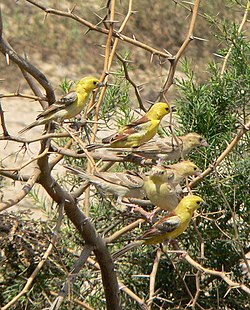
Yellow-throated sparrow at Keoladeo National Park, India
Sparrow in Tharparkar, Sindh

Generally, Old World sparrows are small, plump, brown and grey birds with short tails and stubby, powerful beaks. The differences between sparrow species can be subtle. Members of this family range in size from the chestnut sparrow (Passer eminibey), at 11.4 centimetres (4.5 in) and 13.4 grams (0.47 oz), to the parrot-billed sparrow (Passer gongonensis), at 18 centimetres (7.1 in) and 42 grams (1.5 oz). Sparrows are physically similar to other seed-eating birds, such as finches, but have a vestigial dorsal outer primary wing feather and an extra bone in the tongue.[2][3] This bone, the preglossale, helps stiffen the tongue when holding seeds. Other adaptations for eating seeds are specialised bills and elongated and specialised alimentary canals.[4]

Taxonomy and systematics

[edit]
A sparrow chick

The family Passeridae was introduced (as Passernia) by the French polymath Constantine Samuel Rafinesque in 1815.[5][6] Under the classification used in the Handbook of the Birds of the World (HBW) main groupings of the sparrows are the true sparrows (genus Passer), the snowfinches (typically one genus, Montifringilla), and the rock sparrows (Petronia and the pale rockfinch). These groups are similar to each other, and are each fairly homogeneous, especially Passer.[4] Some classifications also include the sparrow-weavers (Plocepasser) and several other African genera (otherwise classified among the weavers, Ploceidae)[4] which are morphologically similar to Passer.[7] According to a study of molecular and skeletal evidence by Jon Fjeldså and colleagues, the cinnamon ibon of the Philippines, previously considered to be a white-eye, is a sister taxon to the sparrows as defined by the HBW. They therefore classify it as its own subfamily within Passeridae.[7]

Many early classifications of the Old World sparrows placed them as close relatives of the weavers among the various families of small seed-eating birds, based on the similarity of their breeding behaviour, bill structure, and moult, among other characters. Some, starting with P. P. Suskin in the 1920s, placed the sparrows in the weaver family as the subfamily Passerinae, and tied them to Plocepasser. Another family sparrows were classed with was the finches (Fringillidae).[4]

Some authorities previously classified the related estrildid finches of the Old World tropics and Australasia as members of the Passeridae. Like sparrows, the estrildid finches are small, gregarious and often colonial seed-eaters with short, thick, but pointed bills. They are broadly similar in structure and habits, but tend to be very colourful and vary greatly in their plumage. The 2008 Christidis and Boles taxonomic scheme lists the estrildid finches as the separate family Estrildidae, leaving just the true sparrows[clarification needed] in Passeridae.[8]

Despite some resemblance such as the seed-eater's bill and frequently well-marked heads, New World sparrows are members of a different family, Passerellidae, with 29 genera recognised.[9] Several species in this family are notable singers. New World sparrows are related to Old World buntings, and until 2017, were included in the Old World bunting family Emberizidae.[10][11] [4] The hedge sparrow or dunnock (Prunella modularis) is similarly unrelated. It is a sparrow in name only, a relict of the old practice of calling more types of small birds "sparrows".[12] A few further bird species are also called sparrows, such as the Java sparrow, an estrildid finch.

Passeridae

Gymnoris – 4 species

Passer – 28 species

Phylogeny based on a study by Martin Päckert and colleagues published in 2021. The monotypic genera Carpospiza and Hypocryptadius were not sampled.[13]

Species

[edit]

The family contains 43 species divided into eight genera:[14]

Image Genus Living species
Hypocryptadius
Carpospiza
Petronia
Onychostruthus
Montifringilla
Pyrgilauda
Gymnoris
Passer, the true sparrows

Distribution and habitat

[edit]
A male Dead Sea sparrow in southeastern Turkey

The Old World sparrows are indigenous to Europe, Africa and Asia. In the Americas, Australia, and other parts of the world, settlers imported some species which quickly naturalised, particularly in urban and degraded areas. House sparrows, for example, are now found throughout North America, Australia (every state except Western Australia), parts of southern and eastern Africa, and over much of the heavily populated parts of South America.[4]

The Old World sparrows are generally birds of open habitats, including grasslands, deserts, and scrubland. The snowfinches and ground-sparrows are all species of high latitudes. A few species, like the Eurasian tree sparrow, inhabit open woodland.[4] The aberrant cinnamon ibon has the most unusual habitat of the family, inhabiting the canopy of cloud forest in the Philippines.[7]

Behaviour and ecology

[edit]

Old World sparrows are generally social birds, with many species breeding in loose colonies and most species occurring in flocks during the non-breeding season. The great sparrow is an exception, breeding in solitary pairs and remaining only in small family groups in the non-breeding season. They form large roosting aggregations in the non-breeding seasons that contain only a single species (in contrast to multi-species flocks that might gather for foraging). Sites are chosen for cover and include trees, thick bushes and reed beds. The assemblages can be quite large with up to 10,000 house sparrows counted in one roost in Egypt.[4]

The Old World sparrows are some of the few passerine birds that engage in dust bathing. They will first scratch a hole in the ground with their feet, then lie in it and fling dirt or sand over their bodies with flicks of their wings. They will also bathe in water, or in dry or melting snow. Water bathing is similar to dust bathing, with the sparrow standing in shallow water and flicking water over its back with its wings, also ducking its head under the water. Both activities are social, with up to a hundred birds participating at once, and is followed by preening and sometimes group singing.[4]

Eggs

[edit]

The house sparrow typically lays 3–6 eggs, but has been known to lay as few as 1 and as many as 8 greenish-white eggs. The incubation period is typically 10–14 days.[15]

Relationships with humans

[edit]
House sparrows being fed brioche in front of Notre-Dame Cathedral in Paris.

Old World sparrows may be the most familiar of all wild birds worldwide.[16] Many species commonly live in agricultural areas, and for several, human settlements are a primary habitat. The Eurasian tree and house sparrows are particularly specialised in living around humans and inhabit cities in large numbers. 17 of the 26 species recognised by the Handbook of the Birds of the World are known to nest on and feed around buildings.[4]

Grain-eating species, in particular the house and Sudan golden sparrows, can be significant agricultural pests. They can be beneficial to humans as well, especially by eating insect pests. Attempts at large-scale control have failed to affect populations significantly, or have been accompanied by major increases in insect attacks probably resulting from a reduction of numbers, as in the Great Sparrow Campaign in 1950s China.[4]

Because of their familiarity, the house sparrow and other species of the family are frequently used to represent the common and vulgar, or the lewd.[17] Birds usually described later as Old World sparrows are referred to in many works of ancient literature and religious texts in Europe and western Asia. These references may not always refer specifically to Old World sparrows, or even to small, seed-eating birds, but later writers who were inspired by these texts often had the house sparrow and other members of the family in mind. In particular, Old World sparrows were associated by the ancient Greeks with Aphrodite, the goddess of love, due to their perceived lustfulness, an association echoed by later writers such as Chaucer and Shakespeare.[4][17][18] Jesus's use of "sparrows" as an example of divine providence in the Gospel of Matthew also inspired later references, such as that in the final scene of Shakespeare's Hamlet[17] and the hymn "His Eye Is on the Sparrow".[19]

Sparrows are represented in ancient Egyptian art very rarely, but an Egyptian hieroglyph
G37
is based on the house sparrow. The symbol had no phonetic value and was used as a determinative in words to indicate small, narrow, or bad.[20]

Old World sparrows have been kept as pets at many times in history, even though most are not particularly colourful and their songs are unremarkable.[citation needed] The earliest mentions of pet sparrows are from the Romans. Not all the passeri mentioned, often as pets, in Roman literature were necessarily sparrows.[21] John Skelton's The Boke of Phyllyp Sparowe is a lament for a pet house sparrow belonging to a Jane Scrope, narrated by Scrope.[4][17][21][22] Sparrows are difficult to keep, as pet sparrows must be raised by hand and a considerable amount of insects are required to feed them. Nevertheless, many people succeed at hand-raising orphaned or abandoned baby sparrows.[23]

References

[edit]
[edit]
Revisions and contributorsEdit on WikipediaRead on Wikipedia
from Grokipedia
Old World sparrows are small to medium-sized passerine birds in the family Passeridae, consisting of approximately 42 species distributed primarily across Europe, Africa, and Asia. These birds are characterized by their compact, plump bodies, short tails, stout conical bills adapted for cracking seeds, and plumage typically in shades of brown, gray, and buff with subtle streaking or markings for camouflage in open habitats. Predominantly granivorous, they supplement their diet with insects, particularly during breeding seasons to feed nestlings, and many species exhibit gregarious behavior outside the breeding period. The family Passeridae encompasses genera such as , Montifringilla (snowfinches), and Petronia (rock sparrows), with the house sparrow (Passer domesticus) being the most widespread and ecologically significant due to its commensal relationship with humans, thriving in urban and agricultural environments worldwide following introductions beyond its native range. Native to open grasslands, savannas, and semi-arid regions, sparrows have adapted to diverse ecological niches, from high-altitude montane areas for snowfinches to coastal and desert fringes for others, often forming large flocks that aid in foraging efficiency and predator avoidance. Their reproductive strategy involves multiple broods per year in temperate species, with nests built from grasses and feathers in cavities or shrubs, contributing to their resilience and abundance in human-modified landscapes.

Physical Description


Old World sparrows, members of the family Passeridae, are small to medium-sized passerine birds typically ranging from 10 to 20 cm in length and weighing between 10 and 40 grams, though sizes vary by species such as the smaller tree sparrows at around 12-14 cm and larger rock sparrows up to 18 cm. They feature stout, conical bills with a strong, decurved culmen ridge adapted for seed-cracking, short rounded wings for agile flight, and relatively short tails that are often squared or slightly notched.
Plumage is predominantly dull and cryptic, consisting of streaked browns, grays, and buffs on the upperparts for , with paler underparts; bright colors are rare, though some species like golden sparrows exhibit yellow tones. is common, with males often larger and more boldly patterned—featuring black throat bibs, brighter crowns, or contrasting patches—while females and juveniles display more uniform, subdued tones to blend into surroundings. Legs are short and sturdy, supporting ground-based , and overall body form is plump and full-breasted.

Taxonomy and Systematics

Phylogenetic Relationships and Evolution

The family Passeridae occupies a derived position within the oscine passerines (Passeriformes: Passeri), as part of the , and is sister to a group encompassing the weaver finches (), estrildid finches (), comb ducks (), and the peculiar white-headed shrike-babbler (Urocynchramus pylzowi). Multilocus analyses using nuclear introns, mitochondrial genes, and osteological data confirm the of Passeridae, with internal resolution revealing a basal split approximately 17.5 million years ago (mya) that isolates the cinnamon ibon (Hypocryptadius cinnamomeus) from all other members. This early divergence underscores the family's deep evolutionary roots in Southeast Asian montane habitats, potentially reflecting vicariance driven by tectonic and climatic upheavals. The remaining Passeridae diversify into two principal clades around 10 mya. One clade unites the rock sparrows (Petronia) as sister to the snowfinches, including Montifringilla, Pyrgilauda, and Onychostruthus, with the snowfinch radiation commencing ~6.9 mya amid Pleistocene glacial cycles that promoted high-altitude adaptations in Central Asia. The second, more species-rich clade positions the true sparrows (Passer, ~27 species) as sister to the African sparrow-weavers (Gymnoris), rejecting prior suggestions of closer affinity to Petronia. Within Passer, monophyletic Afrotropical lineages (e.g., grey-headed sparrows) diverged ~6 mya, while Palearctic and Oriental forms (including the house sparrow, P. domesticus) split ~5.5 mya, aligning with savanna expansions and human agricultural origins that facilitated commensalism. These phylogenies highlight of seed-cracking bills across clades, independent of emberizids, and challenge taxonomic lumping (e.g., no support for genera Sorella or Auripasser). The sparse record, with potential -like remains from Pleistocene Palestine (~350,000 years ago), lags behind molecular estimates, suggesting taphonomic biases in preserving small passerines; earlier Eocene- passeriform s provide only indirect context for the family's stem lineage. Overall, Passeridae's origin and Pliocene radiation reflect adaptation to aridifying environments, with recent human-mediated dispersal amplifying distributions.

Species Diversity

The family Passeridae exhibits moderate species-level diversity, comprising over 40 across approximately 8–11 genera depending on taxonomic authority. The core diversity centers on the genus Passer, which includes 28 of true sparrows, many of which are small, seed-eating birds adapted to grasslands, urban areas, and agricultural landscapes across , , and introduced regions. These , such as the (P. domesticus) and (P. hispaniolensis), often form large flocks and show varying degrees of with humans. Adjacent clades include Gymnoris (4 species of bush sparrows restricted to , inhabiting savannas and woodlands) and Petronia (rock sparrows, with at least 4–5 species in arid and rocky terrains of , , and ). Monotypic genera such as Carpospiza (pale rock sparrow) and Hypocryptadius (cinnamon ibon, a Philippine endemic) represent specialized lineages. The snowfinch assemblage, comprising genera like Montifringilla (around 6 species), Pyrgilauda, Onychostruthus, and others (totaling about 10–12 species), occupies high-altitude, cold environments in central and eastern , featuring adaptations like thickened and gregarious behavior for . Phylogenetic studies using multilocus data have affirmed the of the snowfinch while revealing deep divergences that support a revised genus-level , potentially elevating or consolidating snowfinch taxa based on molecular evidence rather than morphology alone. This classification underscores Passeridae's into niche-specific forms, from human-associated generalists to montane specialists, with limited hybridization across . Overall, while not highly diverse compared to larger families, the group's species richness reflects ecological specialization driven by habitat variation in the .

Distribution and Habitat

Old World sparrows of the family Passeridae are native to the continents of , , and , encompassing the Palearctic, Ethiopian, and Oriental biogeographic realms where species diversity is highest. While most species remain restricted to these native ranges, several, notably the (Passer domesticus), have been intentionally introduced to regions outside their natural distribution, including , , , and , establishing populations since the . These introductions often succeeded due to the birds' adaptability to human-altered landscapes, though some populations face ongoing management as in non-native areas. The family occupies diverse open habitats, from arid deserts and semi-deserts to grasslands, savannas, scrublands, and agricultural fields, with many species favoring edge habitats near woodlands or human settlements. Synanthropic genera like Passer thrive in urban, suburban, and rural environments, exploiting structures for nesting and foraging amid buildings, farms, and towns, while avoiding dense forests. Specialized taxa exhibit narrower preferences: snowfinches (Montifringilla) inhabit high-elevation alpine meadows and rocky slopes up to montane zones, and petronias (Petronia) occupy rocky cliffs and arid terrains. This ecological versatility spans elevations from sea level to alpine heights and climates from tropical to temperate, underscoring the family's broad tolerance for varied conditions proximate to ground-level vegetation and seeds.

Behavioral Ecology

Foraging and Diet

Old World sparrows primarily consume from cereals, grasses, weeds, and other plants, supplemented by , spiders, berries, buds, and sprouts. In urban and commensal settings, they opportunistically scavenge waste, including and scraps. Dietary composition varies seasonally; grains and seeds dominate outside breeding periods, while arthropods increase during to meet nutritional demands for nestling growth. Nestlings receive an insect-heavy diet initially, with house sparrow (Passer domesticus) parents providing arthropods for the first three post-hatching days before transitioning to seeds. Similarly, Eurasian tree sparrow (Passer montanus) nestlings depend on invertebrates, reflecting a broader family pattern where adults maintain a granivorous baseline but shift to support offspring protein needs. Adults of species like the favor millet, , and native grasses, consuming up to 53.5% millet in experimental settings over native seeds. Foraging occurs mainly on the ground via hopping and scratching in leaf litter or to uncover seeds and , often in flocks that enhance detection but may reduce intake at high densities. They also glean from vegetation, bark, or perches, adapting techniques to ; rural populations exploit crop fields, while urban ones target pavement edges and feeders. Flock sizes influence efficiency, with solitary preferred when resources yield in groups. Across the , this opportunistic strategy supports wide distribution, though specialization varies, as in rock sparrows favoring alpine seeds.

Reproduction and Breeding

Old World sparrows typically exhibit seasonal breeding, with timing influenced by photoperiod, temperature, and rainfall; temperate species breed from spring through summer, producing up to four clutches annually, while tropical populations may breed continuously or during wet seasons. Pairs are primarily monogamous, though extra-pair paternity occurs in up to 26% of offspring, with males selecting nest sites and performing displays to attract females, who assess both male traits and site quality. Breeding success correlates with food availability, with multiple broods enabling higher lifetime reproductive output in favorable conditions. Clutch sizes generally range from 3 to 6 eggs, averaging 4–5 in many species like the (Passer domesticus), with larger clutches in higher latitudes due to extended daylight and resources; eggs are typically white or pale blue with brown speckles. Incubation lasts 10–14 days, primarily by the female, though males may assist, and hatching is often asynchronous over 1–2 days. Nestlings are altricial, brooded by the female and fed invertebrates and seeds by both parents; fledging occurs at 14–17 days, after which young remain dependent for several weeks while learning foraging skills. Nests are constructed from grass, straw, feathers, and debris in cavities, shrubs, or human structures, with males often initiating construction to advertise territories. Parental investment varies by sex and age, with older males providing more sperm and provisions, potentially enhancing fertilization and nestling growth. Across the family Passeridae, these traits support adaptability, though urban populations show reduced clutch sizes linked to anthropogenic stressors.

Eggs and Nesting Habits

Old World sparrows exhibit diverse nesting strategies adapted to their habitats, with many species in the genus Passer constructing bulky, cup-shaped or domed nests in cavities such as tree holes, rock fissures, building crevices, or abandoned nests of other birds. High-altitude snowfinches (Montifringilla) typically nest in rock crevices, while groundsparrows (Gymnoris) and petronias (Petronia) often build in grass tussocks or shallow scrapes on the ground lined with plant material. Nests are generally composed of coarse grasses, twigs, and , stuffed into the chosen site and lined with softer feathers, , or for insulation. Eggs of sparrows are small, oval, and typically white with dark spots, streaks, or blotches, though coloration varies slightly by species—ranging from plain white in some to pale greenish-white in others like the house sparrow. Clutch sizes generally range from 1 to 8 eggs, averaging 4 to 5 per brood, with multiple broods possible per breeding season in temperate regions. Incubation lasts 9 to 16 days and is primarily undertaken by the female, though both parents may share duties in certain species, leading to synchronous hatching of the altricial young. Nestlings remain dependent on both parents for brooding and feeding insects and seeds for 10 to 21 days before fledging.

Social Behavior and Vocalizations

Old World sparrows in the family Passeridae typically exhibit gregarious behavior, forming flocks during and non-breeding periods to enhance food resource exploitation and predator detection. Flock sizes vary by species; for instance, house sparrows (Passer domesticus) commonly aggregate in groups of 10–30 or more individuals, while Eurasian tree sparrows (Passer montanus) form flocks of 15–20, occasionally exceeding 150. Dominance hierarchies often structure interactions within these flocks, influencing access to resources. plays a role in social preferences, as evidenced by house sparrows favoring siblings in flock associations even post-fledging, potentially aiding . Many species breed in loose colonies or communally, with pairs defending small territories around nests but tolerating nearby conspecifics. For example, Spanish sparrows (Passer hispaniolensis) nest and flock in groups, showing nomadic wandering in winter. Gregariousness extends to mixed-species flocks during feeding, reducing and buffering stress responses in urban or novel environments. However, not all are equally social; species like the Sind sparrow (Passer pyrrhonotus) form smaller bands of 5–6, up to 30. Vocalizations in Passeridae are relatively simple compared to other oscines, consisting primarily of chirps, chips, and cheeps used for contact, alarm, and mating. Males typically produce songs as rhythmic series of notes, such as the cheep-chirrup phrases in house sparrows or prolonged chirp-chips in Eurasian tree sparrows, primarily during and territory defense near nests. Both sexes emit short contact calls, like high-pitched chips, to maintain flock cohesion. Alarm calls vary, including nasal quer-like notes in house sparrows for general threats and shrill chree sounds in high distress. Females often produce chattering variants for communication within groups. These vocal patterns facilitate social coordination but show limited complexity, aligning with the family's opportunistic ecology.

Population Dynamics and Conservation

The (Passer domesticus), a representative within Passeridae, maintains a global population of approximately 896 million to 1.31 billion mature individuals, with densities reaching 1,200–1,300 birds per km² near human settlements associated with livestock in . However, populations have declined in regions such as , where the European estimate stands at 134–196 million breeding individuals, and in the , where numbers fell by 11% from 1995 to 2023, leading to its inclusion on the UK Red List since 2002. Similar trends affect the (Passer montanus), with decreasing populations in alongside increasing urban presence. Declines are attributed to multiple interacting factors, including agricultural intensification reducing spilled grain availability, from , diminished insect populations impacting nestling diets, and effects on breeding success. Genetic studies indicate reduced diversity in declining urban populations, potentially exacerbating vulnerability, though rural areas sometimes show stability. Across the , dynamics vary: many in native Asian and African ranges remain stable or abundant due to broader tolerance, while commensal face pressures from changes. Despite regional declines, no Passeridae species meets IUCN criteria for threatened status globally, with the classified as Least Concern owing to its vast overall numbers and adaptability. Conservation measures emphasize localized actions such as installing nest boxes, planting insect-supporting vegetation, and minimizing use in urban and agricultural areas to bolster recruitment rates, though systematic monitoring via programs like breeding bird surveys continues to track trends.

Interactions with Humans

Commensal Relationships and Urban Adaptation

Several species of sparrows, particularly in the genus , maintain commensal relationships with s, deriving benefits from proximity to settlements such as access to food scraps, grains from , and artificial nesting cavities in buildings, while imposing negligible costs on human hosts. The (Passer domesticus) exemplifies this association, with genomic analyses revealing signatures of selection for traits enabling exploitation of human-modified environments, including enhanced digestion of human-associated starches. This originated once in the during the around 10,000 years ago, coinciding with early and sedentary human communities, and subsequently spread globally via human transport. Unlike commensals, house sparrows persist in non-urban habitats but achieve highest densities near human . Urban adaptation in commensal sparrows involves behavioral, physiological, and morphological shifts that facilitate survival amid high human density and altered resources. House sparrows in cities exhibit reduced , evidenced by shorter flight initiation distances—averaging 2-3 meters closer to approaching humans than in rural conspecifics—reflecting to frequent anthropogenic disturbances. Nesting occurs preferentially in crevices of buildings and under roofs, leveraging and protection from predators, while targets diverse urban edibles like bakery waste and spilled seeds. in urban populations has darkened and dulled over decades, potentially as against soot-polluted surfaces or for in heat islands, contrasting with brighter rural variants. Vocalizations also vary, with urban males producing songs of higher pitch and repetition, possibly to counter ambient . Despite these adaptations, extreme correlates with population declines due to reduced insect prey for nestlings and , underscoring limits to plasticity. Species like the (Passer montanus) show parallel urban tolerances but prefer less dense settings, highlighting genus-wide but variable commensal propensities.

Ecological and Agricultural Impacts

Old World sparrows, particularly the introduced Passer domesticus (house sparrow), exert competitive pressures on native avian communities in non-native regions such as and , where they aggressively usurp nesting cavities and eliminate eggs or nestlings of cavity-nesting species like bluebirds (Sialia spp.) and tree swallows (Tachycineta bicolor). This behavior reduces nesting success and local among native songbirds by limiting access to breeding sites and resources. In their native Eurasian and African ranges, such integrates into balanced ecosystems without the same disruptive scale, though population dynamics can still influence local and insect predation patterns. Agriculturally, house sparrows consume significant quantities of cereal grains, seeds, and spilled feed in fields, leading to sporadic but notable crop losses; for instance, they target , , and paddies in regions like , where dual cultivation practices exacerbate vulnerability to flocks. They also buds, , and flowers intermittently, contributing to their classification as pests in areas. Counterbalancing this, their diet includes pest deleterious to crops, providing incidental biocontrol benefits, though net economic assessments historically emphasize over these positives in high-density agricultural zones. Agricultural intensification, including reduced winter stubble and use, has indirectly affected sparrow populations by curtailing food availability, potentially altering their pest dynamics.

Cultural and Historical Significance

In tradition, Old World sparrows, particularly the (Passer domesticus), symbolize and the care extended to even the most insignificant creatures. Biblical passages in the illustrate this, stating that "not one [sparrow] will fall to the ground outside your Father’s care" (Matthew 10:29, NIV) and that "five [sparrows are] sold for two pennies" yet none are forgotten by (Luke 12:6). These references, drawn from the common market value and ubiquity of sparrows in the , emphasize themes of humility, trust in providence, and human worth surpassing that of birds. Archaeological evidence links sparrows to human history from the period, with jawbone fossils from Levantine sites indicating their adaptation to early agricultural settlements around 10,000 years ago, predating widespread of other species. This commensal bond fostered their portrayal in ancient cultures; in (Gardiner sign G37), the sparrow denoted smallness, narrowness, or negativity, often as a phonetic complement (sw) or determinative for birds, reflecting perceptions of their unremarkable status rather than reverence. In European literature and , sparrows evoked the mundane and resilient, appearing in Shakespearean works such as (Act 4, Scene 3), where they are likened to voracious feeders amid famine, symbolizing survival amid hardship. Their historical role as quarry in , documented in Frederick II's 13th-century De Arte Venandi cum Avibus, underscores their accessibility as prey for training raptors, embedding them in traditions across . Their persistent presence in urban settings has also inspired modern conservation reflections, though primarily as symbols of anthropogenic change rather than .

References

Add your contribution
Related Hubs
User Avatar
No comments yet.