


Community hub
Recent from talks
Contribute something
Nothing was collected or created yet.
Charles IV of Spain
View on Wikipedia
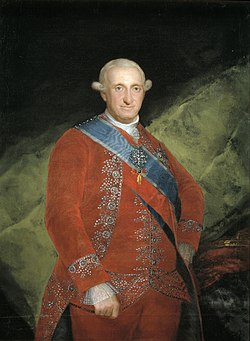
Charles IV (Spanish: Carlos Antonio Pascual Francisco Javier Juan Nepomuceno José Januario Serafín Diego de Borbón y Sajonia; 11 November 1748 – 20 January 1819) was King of Spain and ruler of the Spanish Empire from 1788 to 1808.
Key Information


The Spain inherited by Charles IV gave few indications of instability,[1] but during his reign, Spain entered a series of disadvantageous alliances and his regime constantly sought cash to deal with the exigencies of war. He detested his son and heir Ferdinand, who led the unsuccessful El Escorial Conspiracy and later forced Charles's abdication after the Tumult of Aranjuez in March 1808, along with ousting Charles's widely hated first minister Manuel Godoy. Summoned to Bayonne by Napoleon Bonaparte, who forced Ferdinand VII to abdicate, Charles IV also abdicated, paving the way for Napoleon to place his elder brother Joseph Bonaparte on the throne of Spain. The reign of Charles IV turned out to be a major negative turning point in Spanish history.[2][3]
Early life
[edit]Charles was the second son of Charles III and his wife, Maria Amalia of Saxony. He was born in Naples (11 November 1748), while his father was King of Naples and Sicily. His elder brother Don Felipe was passed over for both thrones, due to his learning disabilities and epilepsy. In Naples and Sicily, Charles was referred to as the Prince of Taranto.[4] He was called El Cazador (meaning "the Hunter"), due to his preference for sport and hunting, rather than dealing with affairs of state. Charles is considered by historian Stanley G. Payne as "good-hearted but weak and simple-minded".[5]
Reign
[edit]

In 1788, Charles III died; Charles IV succeeded to the throne and ruled for the next two decades. Even though he had a profound belief in the sanctity of the monarchy and kept up the appearance of an absolute, powerful king, Charles never took more than a passive part in his own government. The affairs of government were left to his wife, Maria Luisa, and the man he appointed first minister, Manuel de Godoy. Charles occupied himself with hunting in the period that saw the outbreak of the French Revolution, the executions of his Bourbon relative Louis XVI of France and his queen, Marie Antoinette, and the rise of Napoleon Bonaparte. Ideas of the Age of Enlightenment had come to Spain with the accession of the first Spanish Bourbon, Philip V. Charles' father, Charles III, had pursued an active policy of reform that sought to reinvigorate Spain politically and economically and make the Spanish Empire more closely an appendage of the metropole. Charles III was an active, working monarch with experienced first ministers to help reach decisions. Charles IV, by contrast, was a do-nothing king, with a domineering wife and an inexperienced but ambitious first minister, Godoy. The combination of a king not up to the task of governance, the queen widely perceived to take lovers (including Godoy) and the first minister with an agenda of his own earned the monarchy increased alienation from its subjects.[6]
Upon ascending to the throne, Charles IV intended to maintain the policies of his father and, accordingly, retained his prime minister, the Count of Floridablanca.[5] Floridablanca avoided war with Great Britain in the Nootka Sound crisis, where a minor trade and navigation dispute off the west coast of Vancouver Island in 1789 could have blown up into a major conflict. Spain could have drawn on its French ally in support against Britain but they refused. In a humiliating move, Floridablanca had no choice but to capitulate to British terms and thereby negotiated with them. In 1792, political and personal enemies ousted Floridablanca from office, replacing him with the Count of Aranda. However, in the wake of the war against Republican France, the liberal-leaning Count of Aranda was himself replaced by Manuel de Godoy, a favorite of the Queen and widely believed to be her lover, who enjoyed the lasting favor of the King.[7]
Under Charles IV, scientific expeditions continued to be sent by the crown, some of which were initially authorized by Charles III. The Royal Botanical Expedition to New Granada (1783–1816),[8] and the Royal Botanical Expedition to New Spain (1787–1803),[9] were funded by the crown. The Malaspina Expedition (1789–94) was an important scientific expedition headed by Spanish naval commander Alejandro Malaspina, with naturalists and botanical illustrators gathering information for the Spanish crown.[10][11][12][13][14][15] In 1803, he authorized the Balmis Expedition, aimed at vaccinating Spain's overseas territories against smallpox.[16] In 1799, Charles IV authorized Prussian aristocrat and scientist Alexander von Humboldt to travel freely in Spanish America, with royal officials encouraged to aid him in his investigation of key areas of Spain's empire. Humboldt's Political Essay on the Kingdom of New Spain was a key publication from his five-year travels.[citation needed]

Spain's economic problems were of long standing, but deteriorated further when Spain was ensnared in wars that its ally France pursued. Financial needs drove his domestic and foreign policy. Godoy's economic policies increased discontent with Charles's regime.[17] In an attempt to implement major economic changes, Gaspar Melchor de Jovellanos, a reformist, Jansenist conservative proposed major structural reform of land tenure to promote the revival of agriculture. His 1795 work Informe en el expediente de ley agraria argued that Spain needed thriving agriculture to allow its population to grow and prosper. In his analysis, the concentration of land ownership and traditions and institutional barriers were at the heart of agriculture's problems. He called for division and sale of public lands, which were held by villages, as well as the swaths of Spanish territory controlled by the Mesta, the organization of livestock owners who had kept grazing lands as an asset for their use. Jovellanos also argued for the abolition of entailed properties (mayorazgos), which allowed landed estates to pass undivided through generations of aristocrats, as well as sale of lands held by the Catholic Church. The aim of these policies was to create in Spain yeoman farmers, who would pursue their self-interest and make agricultural land more productive. The cost would be to undermine the power of the Church and the aristocracy.[18]
As the situation with immediate revenue became more fraught, the crown in 1804 imposed measures in its overseas empire forcing the church to call in immediately the mortgages it had extended on a long-term by the Catholic Church. Although aimed at undermining the wealth and power of the church, the wealthy landowning elites were faced with financial ruin, since they had no way to make full payment on their mortgaged properties.[19] This ill-considered royal decree has been seen as a major factor in the independence movement in New Spain (Mexico).[20] The decree was in abeyance once Charles and Ferdinand abdicated, but it undermined elite support while in force.
In foreign policy Godoy continued Abarca de Bolea's policy of neutrality toward as France, but after Spain protested the execution of Louis XVI of France in 1793, France declared war on Spain. After the declaration, Portugal and Spain signed a treaty of mutual protection against France.[21] In 1796 France forced Godoy to enter into an alliance, and declare war on the Kingdom of Great Britain. As a consequence, Spain became one of the maritime empires to have been allied with Republican France in the French Revolutionary War, and for a considerable duration.[22]
Spain remained an ally of France for a while, lost against the British in the battle of Trafalgar, and supported the Continental Blockade. After Napoleon's victory over Prussia in 1807, Godoy kept Spain with the French side.
But the switching of alliances devalued Charles's position as a trustworthy ally, increasing Godoy's unpopularity, and strengthening the fernandistas (supporters of Crown Prince Ferdinand), who favoured an alliance with the United Kingdom.[citation needed]
Economic troubles, rumors about a sexual relationship between the Queen and Godoy, and the King's ineptitude, caused the monarchy to decline in prestige among the population. Anxious to take over from his father, and jealous of the prime minister, Crown Prince Ferdinand attempted to overthrow the King in an aborted coup in 1807.[23] He was successful in 1808, forcing his father's abdication following the Tumult of Aranjuez.
-
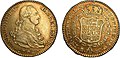 Coins with image of Charles IV of Spain, 1798
 -
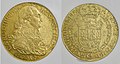 Coin of Charles IV of Spain Colombia 8 Escudos, 1794
 -
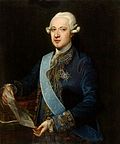 Count de Floridablanca, painting by Goya ca. 1782-83
 -
 Count of Aranda
 -
 Manuel de Godoy, as general. Painting by Goya 1801
 -
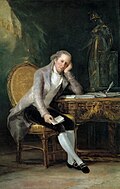 Gaspar Melchor de Jovellanos. Painting by Goya 1798
 -
 Crown Prince Ferdinand, Painting by Goya 1800


,_When_Prince_of_Asturias_MET_DT236256.jpg)
Abdications of Bayonne
[edit]Riots, and a popular revolt at the winter palace Aranjuez, in 1808 forced the king to abdicate on 19 March, in favor of his son.[23] Ferdinand took the throne as Ferdinand VII, but was mistrusted by Napoleon, who had 100,000 soldiers stationed in Spain by that time due to the ongoing War of the Third Coalition.
The ousted king, having appealed to Napoleon for help in regaining his throne, was summoned before Napoleon in Bayonne, along with his son, in April 1808. Napoleon forced both Charles and his son to abdicate, declared the Bourbon dynasty of Spain deposed, and installed his brother, Joseph Bonaparte, as King Joseph I of Spain, which began the Peninsular War.[24]
Later life and death
[edit]
Following Napoleon's deposing of the Bourbon dynasty, the ex-King, his wife, and former prime minister Godoy were held captive in France first at the château de Compiègne[25] and three years in Marseille (where a neighborhood was named after him).[26] After the collapse of the regime installed by Napoleon, Ferdinand VII was restored to the throne. The former Charles IV drifted about Europe[27] until 1812, when he finally settled in Rome, in the Palazzo Barberini.[28][29][30][31] His wife died on 2 January 1819, followed shortly by Charles, who died on 19 January of the same year. At the time of his death Charles was visiting his brother Ferdinand I of the Two Sicilies in Naples.[32] Sir Francis Ronalds included a detailed description of the funeral in his travel journal.[33][34]
Character
[edit]Well-meaning and pious, Charles IV floundered in a series of international crises beyond his capacity to handle.[27] He was said to be 'despotic, sluggish and stupid'. He was also noted as a former wrestler who spent many a time hunting.[35] He was painted by Francisco Goya in a number of official court portraits, which numerous art critics have seen as satires on the King's stout vacuity.[36]
Marriage and children
[edit]Charles IV married his first cousin Maria Louisa, the daughter of Philip, Duke of Parma, in 1765. The couple had fourteen children, seven of whom survived into adulthood:
| Children of King Charles IV | |||
|---|---|---|---|
| Name | Portrait | Lifespan | Notes |
| Carlos Clemente Infante of Spain |

|
19 September 1771 – 7 March 1774 | Born and died at El Escorial; baptized on the same day he was born, with Charles III representing "the Holy Father" at the christening. Pope Clement XIV celebrated Carlos' birth and sent the infant consecrated swaddling clothes. Died young however.[37] |
| Carlota Joaquina Queen of Portugal and the Algarves |

|
25 April 1775 – 7 January 1830 | Born at the Royal Palace of Aranjuez, she married her first cousin John VI of Portugal in 1785 and became Queen consort of Portugal in 1816. Had issue, including the future Pedro I of Brazil. She died at Queluz National Palace. |
| Maria Luisa Infanta of Spain |
_Version_with_Golden_Fleece_and_Order_of_Charles_III_Collars.svg)
|
11 September 1777 – 2 July 1782 | Born and died at the Royal Palace of La Granja de San Ildefonso died young.[38] |
| María Amalia Infanta of Spain |
.jpg)
|
9 January 1779 – 22 July 1798 | Born at the Royal Palace of Aranjuez, she married her uncle Infante Antonio Pascual of Spain in 1795. She gave birth to a stillborn son in 1798 and died shortly thereafter. |
| Carlos Domingo Infante of Spain |

|
5 March 1780 – 11 June 1783 | Born at the Royal Palace of El Pardo and died at the Royal Palace of Aranjuez.[38] After his birth, his father pardoned all of the convicts from Puerto San Julián as a sign of celebration. Died in childhood.[39] |
| Maria Luisa Queen of Etruria Duchess of Lucca |

|
6 July 1782 – 13 March 1824 | Born at the Royal Palace of La Granja de San Ildefonso, she married her first cousin Louis, King of Etruria in 1795[40] and had issue, including Charles II, Duke of Parma. Became Duchess of Lucca in her own right in 1817 and died in Rome in 1824 of cancer. |
| Carlos Francisco de Paula Infante of Spain |

|
5 September 1783 – 11 November 1784 | Twins, born and died at the Royal Palace of La Granja de San Ildefonso.[41] Their birth was an important event for the people of Spain and provided security for the succession, a security which was truncated with the early deaths of Carlos and Felipe. Both died in childhood.[42] |
| Felipe Francisco de Paula Infante of Spain |
5 September 1783 – 18 October 1784 | ||
| Fernando (VII) King of Spain |

|
14 October 1784 – 29 September 1833 | Born and died at El Escorial, he succeeded his father as King in 1808, but was deposed by Joseph Bonaparte one month later. Married his first cousin Princess Maria Antonia of Naples and Sicily in 1802, no issue. Re-instated as King in 1813. Married his niece Maria Isabel of Portugal in 1816, had issue. Married Maria Josepha Amalia of Saxony in 1819, no issue. Married his niece Maria Christina of the Two Sicilies in 1829 and had issue, including the future Isabella II of Spain. Died in 1833. |
| Carlos María Isidro Benito Count of Molina |
.JPG)
|
29 March 1788 – 10 March 1855 | Born at the Royal Palace of Aranjuez. Married his niece Infanta Maria Francisca of Portugal in 1816 and had issue. Married his niece Maria Teresa, Princess of Beira in 1838, no issue. First Carlist pretender to the throne of Spain as "Carlos V". Used the title "Count of Molina" between 1845 and his death in 1855. |
| María Isabel Queen of the Two Sicilies |
_by_Giuseppe_Cammarano_(Palace_of_Caserta).jpg)
|
6 July 1789 – 13 September 1848 | Born at the Royal Palace of Madrid, she married her first cousin Francis I of the Two Sicilies in 1802 and had issue, including the future Ferdinand II of the Two Sicilies. Queen consort between 1825 and 1830, her husband's death. Died at the Palace of Portici in 1848. |
| Maria Teresa Infanta of Spain |
|
16 February 1791 – 2 November 1794 | Born at the Royal Palace of Aranjuez and died at El Escorial. Died in Childhood[43] of smallpox.[44] |
| Felipe Maria Infante of Spain |

|
28 March 1792 – 1 March 1794 | Born at the Royal Palace of Aranjuez and died at the Royal Palace of Madrid. Died in childhood.[43] |
| Francisco de Paula | 
|
10 March 1794 – 13 August 1865 | Born at the Royal Palace of Aranjuez, he married his niece Princess Luisa Carlotta of Naples and Sicily in 1819 and had issue. Died in Madrid in 1865. |
Ancestors
[edit]| Ancestors of Charles IV of Spain[45] |
|---|
See also
[edit]References
[edit]- ^ Lynch, John. Bourbon Spain, 1700–1808. Basil Blackwell, 1989, p. 375
- ^ Lynch, "Charles IV and the Crisis of Bourbon Spain", Chapter 10, Bourbon Spain.
- ^ "Charles IV of Spain and His Family hides a rulers caricature". Hypercritic. Retrieved 19 March 2023.
- ^ Almanach royal, p 34
- ^ a b Stanley G. Payne, History of Spain of Portugal, vol. 2, University of Wisconsin Press, 1973, ISBN 978-0-299-06284-2, page 415
- ^ Lynch, Bourbon Spain, 376-77
- ^ Hilt, The Troubled Trinity: Godoy and the Spanish Monarchs
- ^ Pérez Arbeláez, Enrique (1983) [1967]. José Celestino Mutis y la real expedición botánica del Nuevo Reyno de Granada (in Spanish) (second ed.). Bogotá: Instituto Colombiano de Cultura Hispánica.
- ^ Rickett, Harold W. (1947). "The Royal Botanical Expedition to New Spain". Chronica Botanica. 11 (1): 1–81.
- ^ Bleichmar, Visible Empire, pp. 16–18.
- ^ La expedición Malaspina 1789–1794. 9 vols. Madrid: Lunwerg Editores 1987–96.
- ^ Andrés Galera Gómez, La ilustración española y el conocimiento del nuevo mundo. La ciencias naturales en la expedición Malaspina (1789–1994): La labor científica de Antonio Pineda. Madrid: CSIC 1988.
- ^ Dolores Higueras Rodríguez (ed.) La Botánica en la Expedición Malaspina 1789–1794. Madrid: Turner Libros 1989.
- ^ Juan Pimentel, La física de la monarquía. Ciencia y política en el pensamiento colonial de Alejandro Malaspina (1754–1810). Madrid: Doce Calles 1998.
- ^ María Pilar de San Pío Aladrén and María Dolores Higueras Rodríguez (eds.) La armonía natural. La naturaleza en la expedición marítima de Malaspina y Bustamante (1789–1794). Madrid: Lunverg Editores 2001.
- ^ Carlos Franco-Paredes; Lorena Lammoglia; José Ignacio Santos-Preciado (2005). "The Spanish Royal Philanthropic Expedition to bring Smallpox vaccination to the New World and Asia in the 19th Century". Clinical Infectious Diseases. 41 (9). Oxford Journals: 1285–1289. doi:10.1086/496930. PMID 16206103.
- ^ Burkholder, Suzanne Hiles. "Charles IV of Spain" in Encyclopedia of Latin American History and Culture. Vol. 2, p. 82. New York: Charles Scribner's Sons 1996.
- ^ Brading, D.A. The First America: The Spanish monarchy, Creole patriots, and the Liberal state, 1492-1867. Cambridge: Cambridge University Press 1991, pp. 510-11.
- ^ Hamnett, Brian R. "The Appropriation of Mexican Church Wealth by the Spanish Bourbon Government--The Consolidación de Vales Reales', 1805-1809." Journal of Latin American Studies 1.2 (1969): 85-113.
- ^ Von Wobeser, Gisela. "La consolidación de vales reales como factor determinante de la lucha de independencia en México, 1804-1808." Historia mexicana (2006): 373-425.
- ^ Portugal; de), José Ferreira Borges de Castro (Visconde; Biker, Julio Firmino Judice; Estrangeiros, Portugal Ministério dos Negócios (19 June 2018). "Supplemeto á Collecção dos tratados, convenções, contratos e actos publicos celebrados entre a corôa de Portugal e as mais potencias desde 1640". Imprensa nacional.
- ^ Ollie Bye (3 February 2016). "The French Revolutionary Wars: Every Other Day". Archived from the original on 13 November 2021 – via YouTube.
- ^ a b Payne, page 420
- ^ Griffin, Julia Ortiz; Griffin, William D. (2007). Spain and Portugal:A Reference Guide from the Renaissance to the Present. Facts on File. p. 151. ISBN 978-0-8160-4592-1.
- ^ Alain Raisonnier, Claudie Ressort (2009) Le séjour de Charles IV et de la Cour d'Espagne au Palais de Compiègne en 1808-1809, Annales Historiques compiégnoises, n° 113-114, pp. 14-24
- ^ Paul Gaffarel (1919) Le séjour de Charles IV d'Espagne à Marseille, Revue des Etudes Napoléoniennes, t. XVI, pp. 40-57
- ^ a b Griffin, page 152
- ^ fr:Charles IV d'Espagne
- ^ Manuel de Godoy#Exile
- ^ Worldroots.com Archived 11 May 2004 at archive.today
- ^ "The Royal Favorite: Manuel Francisco Domingo de Godoy, Prince of the Peace". napoleon-series.org.
- ^ Seco Serrano, Carlos. "Historia Hispánica - Carlos IV". Real Academia de la Historia (in Spanish). Retrieved 4 May 2025.
- ^ Ronalds, B.F. (2016). Sir Francis Ronalds: Father of the Electric Telegraph. London: Imperial College Press. p. 188. ISBN 978-1-78326-917-4.
- ^ "Sir Francis Ronalds' Travel Journal: Naples and Pompeii". Sir Francis Ronalds and his Family. Retrieved 23 February 2018.
- ^ Davies, Norman (2011). Vanished Kingdoms: The History of Half-Forgotten Europe. Penguin Books Limited. p. 522. ISBN 978-0-14-196048-7.
- ^ Edward J. Olszewski (1999). "Exorcising Goya's "The Family of Charles IV"". Artibus et Historiae. 20 (40): 169–185. doi:10.2307/1483673. JSTOR 1483673.
- ^ von Pastor, Ludwig Freiherr (1952). The History of the Popes, from the Close of the Middle Ages. Michigan: Kegan Paul. p. 201.
- ^ a b Real Academia Matritense de Heráldica y Genealogía (2007). Anales de la Real Academia Matritense de Heráldica y Genealogía. Vol. X. (in Spanish). Madrid: RAMHG. p. 330.
- ^ Senatore, Mar'a Ximena (2007). Arqueolog'a e historia en la colonia espa–ola de Floridablanca, Patagonia, siglo XVIII (in Spanish). Madrid: Teseo. p. 149. ISBN 978-987-1354-08-5.
- ^ Simpson, William; Jones, Martin Desmond (2000). Europe, 1783-1914. Routledge. p. 127. ISBN 9780415226608.
- ^ Real Academia Matritense de Heráldica y Genealogía (2007). Anales de la Real Academia Matritense de Heráldica y Genealogía. Vol. X. (in Spanish). Madrid: RAMHG. p. 332.
- ^ Palazón, Juan Manuel Abascal (2010). José Vargas Ponce (1760–1821) en la Real Academia de la Historia (in Spanish). Madrid: Real Academia de la Historia. p. 54. ISBN 978-84-15069-00-3.
- ^ a b Hilt, Douglas (1987). The Troubled Trinity: Godoy and the Spanish Monarchs. Alabama: University of Alabama Press. p. 292. ISBN 978-0-8173-0320-4.
- ^ Zavala, José María (2013). La maldición de los Borbones (in Spanish). Mexico: Random House Mondadori. p. 16. ISBN 978-84-01-34667-5.
- ^ Genealogie ascendante jusqu'au quatrieme degre inclusivement de tous les Rois et Princes de maisons souveraines de l'Europe actuellement vivans [Genealogy up to the fourth degree inclusive of all the Kings and Princes of sovereign houses of Europe currently living] (in French). Bourdeaux: Frederic Guillaume Birnstiel. 1768. p. 9.
Further reading
[edit]- Barbier, Jacques A. "Peninsular finance and colonial trade: The dilemma of Charles IV's Spain." Journal of Latin American Studies 12.1 (1980): 21–37.
- Gómez de Arteche. Historia del Reinado de Carlos IV, (5 vols.), in the Historia General de España de la Real Academia de la Historia (Madrid, 1892).
- Hamilton, Earl J. "Monetary problems in Spain and Spanish America 1751–1800." The Journal of Economic History 4.1 (1944): 21–48.
- Hilt, Douglas. The Troubled Trinity: Godoy and the Spanish Monarchs. Alabama: University of Alabama Press, 1987, ISBN 978-0-8173-0320-4.
- Paquette, Gabriel B. Enlightenment, governance, and reform in Spain and its empire, 1759–1808. New York: Palgrave Macmillan, 2008.
- Russell, Craig H. "Spain in the Enlightenment." The Classical Era. Palgrave Macmillan, London, 1989. 350–367.
External links
[edit]
- . Encyclopædia Britannica (11th ed.). 1911.
- . The American Cyclopædia. 1879.
- Historiaantiqua. Isabel II; (Spanish) (2008)
|  | |

.svg)

Charles IV of Spain
View on GrokipediaEarly Life
Birth and Family Background
Charles IV, originally named Carlos Antonio Pascual Francisco Javier Juan Nepomuceno José Januario Servando Diego, was born on 11 November 1748 at the Palazzo Reale in Portici, near Naples, in the Kingdom of the Two Sicilies.[1] His father, Charles III, ruled the Two Sicilies at the time as Charles VII (later ascending to the Spanish throne in 1759), while his mother, Maria Amalia of Saxony (1724–1760), was the daughter of Augustus III, Elector of Saxony and King of Poland, and Maria Josepha of Austria.[1][5] As the second surviving son of Charles III—following his elder brother Felipe (born 1747, who suffered from intellectual disabilities and never married)—Charles was positioned as the primary heir to the Bourbon crowns despite the family's extensive progeny.[5] Charles III and Maria Amalia had thirteen children in total, though only seven, including Charles, survived to adulthood; these included siblings such as Infanta Carlota Joaquina (born 1775, future queen consort of Portugal), Infante Gabriel (1752–1788), and Infante Antonio Pascual (1755–1827).[5] The high infant mortality among the royal offspring reflected broader patterns in 18th-century European aristocracy, where multiple heirs were produced to secure dynastic continuity amid health risks like smallpox and genetic conditions.[5] The House of Bourbon, to which Charles belonged, represented the Spanish branch of the French Bourbon dynasty, established by Philip V (grandfather of Charles III) following the War of the Spanish Succession in 1700, which transferred the Spanish crown from the Habsburgs to the Capetian-descended Bourbons via the Treaty of Utrecht.[1] This lineage emphasized absolute monarchy and centralized reform, influences that Charles III actively pursued in Naples, Sicily, and later Spain, setting the administrative context for his son's upbringing.[1]Upbringing and Education
Charles IV was born on 12 November 1748 at the Palace of Portici in the Kingdom of Naples as Carlos Antonio Pascual Francisco Javier Juan Nepomuceno José Januario Serafín Diego de Borbón y Sajonia, the second surviving son of then-King Charles VII of Naples (later Charles III of Spain) and Maria Amalia of Saxony.[6][7] His elder brother, Felipe, was afflicted with epilepsy and developmental impairments that rendered him unfit for succession, thus designating the infant Carlos as the presumptive heir from birth.[8][9] His initial upbringing occurred amid the opulent yet disciplined environment of the Neapolitan court, where the Bourbon family emphasized military discipline, courtly etiquette, and basic humanistic studies typical for royal offspring.[10] In 1759, following his father's accession to the Spanish throne upon the death of Ferdinand VI, Carlos—then aged 10—remained in Naples under the administrative oversight of Prime Minister Bernardo Tanucci, serving as nominal regent alongside his younger brother Fernando until rejoining the family in Madrid in 1760.[10] This transitional period exposed him to provisional governance responsibilities, though actual authority rested with Tanucci's council, fostering early familiarity with administrative routines rather than deep scholarly immersion.[10] Upon arrival in Spain as Prince of Asturias, Charles's education shifted to preparation for monarchical duties under his father's direct supervision at the Royal Palace of Madrid and El Escorial, incorporating tutelage in history, governance principles, riding, fencing, and hunting—activities in which he excelled and later pursued avidly.[2] At age 16 in 1764, Charles III granted him permission to attend Council of State meetings, providing observational exposure to policy deliberations and diplomacy without formal participation.[2] Contemporary accounts portray his overall instruction as routine and pragmatic, prioritizing physical vigor and practical kingship skills over intensive intellectual or philosophical training, aligning with Bourbon emphases on absolutist rule; however, he displayed limited aptitude for abstract studies, preferring mechanical interests like carriage construction.[11][12] This regimen culminated in his marriage to Maria Luisa of Parma on 6 September 1765 at age 16, marking the transition from princely tutelage to adult court life.[13]Reign (1788–1808)
Ascension to the Throne and Initial Governance
Charles III died on 14 December 1788 in Madrid after two days of high fever.[14] His eldest surviving son, Charles IV, succeeded him immediately as King of Spain, with proclamation occurring the same day in Madrid.[2] At age 40, Charles IV ascended amid a relatively stable Spain bolstered by his father's administrative reforms, though the empire faced underlying fiscal strains from prior wars.[2] In the initial phase of his reign, Charles IV retained key ministers from his father's administration to ensure policy continuity, notably appointing José Moñino, Count of Floridablanca, as chief minister—a role Floridablanca had effectively held under Charles III since 1777.[15] [2] Floridablanca, a reformist statesman, focused on internal stability and cautious diplomacy, including suppressing early signs of French revolutionary influence through censorship and border controls starting in 1789.[15] Charles IV himself engaged minimally in day-to-day governance, delegating authority while pursuing personal interests in hunting and religious observance.[15] This period of initial governance maintained the enlightened absolutism of Charles III, with efforts to modernize administration and economy, though Floridablanca's conservative approach to external threats like the French Revolution—prioritizing absolutist monarchy preservation—shaped early decisions until his dismissal in 1792.[15] The retention of experienced figures like Floridablanca and later brief service under Pedro Pablo Abarca y Bolea, Count of Aranda, reflected Charles IV's reliance on paternal legacies rather than assertive personal rule.[2]
Domestic Policies and Reforms
Upon ascending the throne on December 14, 1788, Charles IV retained José Moñino y Redondo, Count of Floridablanca, as chief minister, whose policies emphasized internal stability and suppression of influences from the French Revolution beginning in 1789. Floridablanca imposed censorship on the press, monitored intellectual circles, and curtailed liberal publications to prevent the spread of revolutionary ideas, effectively halting the progressive reforms of Charles III's reign.[16] These measures prioritized absolute monarchical control over innovation, abandoning initiatives like expanded economic societies and administrative rationalization in favor of restoring traditional authority.[16] In February 1792, Floridablanca was dismissed and replaced by Pedro Pablo Abarca y Bolea, Count of Aranda, who briefly pursued a more moderate approach, restoring some press freedoms and easing restrictions on intellectual discourse. However, Aranda's tenure lasted only until November 1792, after which Manuel Godoy assumed de facto control, shifting focus toward fiscal exigencies amid impending wars. Administrative structures, such as the intendancy system for provincial governance established under Charles III, were maintained without significant alteration, though coordination via the Junta de Estado continued to address peninsular and colonial overlaps.[16] [17] Under Godoy's influence, efforts at economic reform intensified in response to agrarian stagnation and revenue shortfalls. In 1795, Gaspar Melchor de Jovellanos, commissioned by the crown, published his Informe sobre la ley agraria, advocating the abolition of mayorazgos (heritable entails) and mortmain restrictions on church lands to enable land subdivision, private ownership, and agricultural modernization through incentives for cultivation and enclosure.[18] These proposals drew on Enlightenment principles of utility and productivity, aiming to reverse depopulation and low yields in rural areas by broadening land access beyond noble and clerical monopolies. Appointed minister of grace and justice in 1797, Jovellanos pushed for partial implementation, including taxes on certain land acquisitions, but faced vehement opposition from entrenched interests, leading to his dismissal in 1798 and minimal enactment before conservative reaction prevailed.[19] [20] Fiscal policies dominated the era, with repeated loans, tax impositions, and sales of royal domains to fund military commitments, yet these yielded short-term gains at the cost of inflation and public resentment without addressing underlying structural inefficiencies like guild restrictions or outdated taxation.[21] By the early 1800s, wartime demands overshadowed domestic initiatives, resulting in stalled modernization and heightened aristocratic discontent that culminated in the 1808 Mutiny of Aranjuez.[21]Economic and Colonial Management
Charles IV inherited an economy shaped by his father's Bourbon reforms, which emphasized mercantilist policies to bolster Spanish manufacturing and agriculture while extracting resources from the colonies. Early in his reign (1788–1792), these efforts continued with institutional changes, such as the 1790 ministerial reorganization separating the Almadén mercury mine administration from the Cuban tobacco monopoly, aiming to streamline colonial revenue flows to the Peninsular treasury.[22] However, persistent deficits—potentially reaching 31% in 1801–1802—and rising expenditures, averaging 1.075 billion reales de vellón annually from 1796 to 1802, strained finances amid wars with Britain and France.[22] Attempts at domestic reform, including Gaspar Melchor de Jovellanos's 1795 Informe sobre la ley agraria, proposed abolishing mayorazgos (entailed estates) and mortmain to free land markets and boost agriculture, but political resistance and Jovellanos's dismissal in 1798 limited implementation.[19] Under Manuel Godoy's dominance from 1797, economic management shifted toward war financing, including the 1798 consolidación de vales reales, which forced creditors to exchange high-interest short-term bonds for lower-yield long-term ones or land, alienating elites and deepening fiscal woes.[23] By 1808, unpaid interest on vales alone exceeded 60 million reales, reflecting cumulative debt from military defeats like Trafalgar (1805) that disrupted trade and remittances.[23] These policies prioritized short-term liquidity over structural growth, exacerbating inflation and discontent without resolving underlying issues like smuggling and agricultural stagnation. Colonial administration maintained the centralized intendancy system from Charles III, enforcing trade monopolies via Cádiz but adapting to wartime pressures through limited liberalization. Between 1787 and 1792, additional ports in Spain and the Americas were opened to transatlantic commerce, easing machinery imports and expanding legal trade volumes.[17] In 1797, decrees permitted neutral foreign vessels to supply colonies like Venezuela and Mexico, reserving national ships post-peace via the March 24, 1798, royal order, while restraining local factories to protect Peninsular interests.[22] Silver remittances from the Americas remained crucial, tracked by the Cádiz treasury, but British seizures—such as 10 merchantmen off Cádiz in May 1800—curtailed flows.[22] The 1800 Treaty of San Ildefonso retroceded Louisiana to France without compensation, signaling strategic concessions that undermined colonial cohesion and fueled Creole grievances over taxation for European conflicts.[16] These measures sustained short-term imperial revenue but heightened tensions, contributing to autonomy demands by 1808.[24]Foreign Policy and Military Engagements
Charles IV's foreign policy initially opposed the French Revolution, leading to the War of the Pyrenees against France from March 7, 1793, to 1795, triggered by the execution of Louis XVI and a military demonstration on the Franco-Spanish border.[1] Spanish forces suffered defeats, culminating in the Treaty of Basel on July 22, 1795, which ended hostilities and ceded territories in the Caribbean and Santo Domingo to France.[3] This conflict reflected Spain's alignment with European monarchies against revolutionary upheaval, though financial strains from ongoing wars with Britain limited resources.[1] Following the peace, Spain reversed course under pressure from France, signing the second Treaty of San Ildefonso on August 18, 1796, which formalized an alliance committing Spain to support France against Britain in exchange for territorial adjustments.[2] This pact drew Spain into the Anglo-French naval wars, with Spanish fleets joining French operations, resulting in significant losses including the capture of merchant shipping and colonial vulnerabilities.[25] The alliance strained relations with Portugal, prompting the War of the Oranges in 1801, a brief Franco-Spanish invasion of Portugal to enforce the blockade of British trade; Spanish forces under Manuel Godoy advanced to Elvas, securing the Treaty of Badajoz on June 6, 1801, which ceded Olivenza to Spain and established a demarcation line.[25][2] Naval engagements escalated with Britain's Royal Navy, culminating in the Battle of Trafalgar on October 21, 1805, where a combined Franco-Spanish fleet of 33 ships, including 15 Spanish vessels under Admiral Federico Gravina, was decisively defeated by 27 British ships led by Horatio Nelson off Cape Trafalgar. Spain lost nine ships captured and one destroyed, with over 1,000 sailors killed and Admiral Gravina mortally wounded, effectively crippling the Spanish navy and exposing colonial trade routes to British predation.[26] Despite this catastrophe, the alliance persisted, reinforced by the secret Third Treaty of San Ildefonso on October 1, 1800, in which Spain retroceded Louisiana to France for the Duchy of Parma, aiming to bolster Bourbon interests but ultimately facilitating French expansion.[27] By 1807, French demands under Napoleon for Spain to aid in enforcing the Continental System against Britain led to French troop transit through Spain to invade Portugal, sowing distrust and setting the stage for the Peninsular War.[1] Spain's military commitments, totaling over 100,000 troops deployed across European fronts and naval losses exceeding 20 capital ships since 1796, exacerbated fiscal collapse and domestic unrest without commensurate gains.[3] These engagements underscored a policy reactive to French dominance, prioritizing Bourbon familial ties over strategic independence, which eroded Spain's great power status.[4]Influence of Manuel Godoy
Manuel Godoy, a guardsman who rose rapidly in the Spanish court after Charles IV's accession in 1788, became the king's principal advisor and de facto ruler by 1792, when he was appointed prime minister at age 25.[28] His influence stemmed from close personal ties to both Charles IV and Queen Maria Luisa, enabling him to dominate decision-making despite lacking formal education or administrative experience.[29] Godoy's control extended to foreign policy, where he prioritized alliances with France to counter British naval power, signing the second Treaty of San Ildefonso on August 19, 1796, which bound Spain to defensive and offensive support for the French Republic.[30] Under Godoy's sway, Charles IV pursued pro-French policies that entangled Spain in costly conflicts, including the Third Treaty of San Ildefonso on October 1, 1800, which secretly ceded Louisiana to France in exchange for vague territorial promises in Italy and Portugal.[31] This alignment culminated in the War of the Oranges in 1801, a brief invasion of Portugal—Britain's ally—led personally by Godoy, resulting in the Treaty of Badajoz on June 6, 1801, whereby Spain gained Olivenza and other border enclaves but incurred heavy financial burdens and naval commitments that weakened Spain's fleet.[32] Godoy's deference to French demands, including subsidies and military aid, contributed to Spain's decisive defeat at the Battle of Trafalgar on October 21, 1805, where combined Franco-Spanish forces lost 22 ships, eroding Spain's maritime empire.[33] Domestically, Godoy influenced moderate reforms, such as promoting vaccination against smallpox and curtailing the Inquisition's power, yet his extravagance, corruption, and favoritism alienated the nobility and military, fostering widespread resentment.[33] Charles IV's reliance on Godoy blinded him to these criticisms, as evidenced by the king's reinstatement of Godoy as prime minister in 1801 after a brief dismissal, prioritizing personal loyalty over competent governance.[34] This unchecked influence exacerbated Spain's economic strain from war debts and colonial losses, setting the stage for the 1808 Tumult of Aranjuez, where popular fury targeted Godoy as the symbol of royal misrule.[29]Abdication Crisis
Prelude to the Bayonne Meetings
The prelude to the Bayonne meetings was marked by the progressive French military occupation of Spain, facilitated by the secret Treaty of Fontainebleau signed on October 27, 1807, which permitted French forces transit through Spanish territory to invade Portugal but enabled broader incursions.[35] Beginning in November 1807, General Junot's 25,000 troops crossed into Spain, followed by General Dupont's 30,000 men on November 22, who did not proceed directly to Portugal, and further contingents under Marshals Moncey and Duhesme entering in January and February 1808, totaling over 100,000 soldiers.[33] These movements culminated in the seizure of key fortresses, including Pamplona on February 16, Barcelona on February 29, and Figueras on March 18, heightening Spanish anxieties amid rumors of Prime Minister Manuel Godoy's plans to evacuate the royal family to the American colonies.[33][36] Internal court rivalries exacerbated the crisis, with Crown Prince Ferdinand VII and his supporters, known as Fernandinos, opposing Godoy's perceived pro-French policies and personal influence over Charles IV.[36] The Tumult of Aranjuez erupted on March 17, 1808, as a mob, mobilized by Ferdinand's partisans, attacked Godoy's residence in Aranjuez, forcing him into hiding after assaulting his properties; Godoy was later captured but spared execution through Ferdinand's intervention.[1] On March 19, amid the unrest, Charles IV abdicated the throne in favor of Ferdinand VII, who was proclaimed king and entered Madrid on March 24, where he encountered Joachim Murat, who had arrived with 20,000 French troops on March 23.[1][33] Ferdinand VII, lacking firm control and seeking legitimacy, appealed to Napoleon for recognition and support against French encroachments.[36] On April 10, he departed Madrid for Burgos, arriving April 12, before proceeding to Bayonne, France, where he met Napoleon on April 20.[33] Charles IV, regretting his abdication and claiming coercion, petitioned Napoleon for restoration, arriving in Bayonne on May 1, 1808, accompanied by his wife Maria Luisa; Napoleon, who had reached Bayonne on April 14, hosted them, setting the stage for coerced negotiations.[36] This convergence of the rival royals under French dominance, amid rising Spanish resistance like the Dos de Mayo uprising in Madrid on May 2, directly precipitated the abdications.[36]The Abdications of Bayonne
Ferdinand VII arrived in Bayonne on 20 April 1808, ostensibly to secure Napoleon's recognition of his recent ascension but effectively entering French custody as French troops occupied key Spanish positions.[36] Charles IV and Queen Maria Luisa followed under Napoleon's invitation, reaching Bayonne on 1 May 1808, where the family was detained at the Château de Marracq amid escalating French control over Spain.[36] Napoleon exploited the existing dynastic tensions, including Ferdinand's prior intrigues against his parents and the ousted Godoy, to coerce the Bourbon rulers into relinquishing the throne, aiming to install a French-aligned regime and neutralize Spanish resistance to his continental blockade.[33] On 6 May 1808, under direct pressure from Napoleon—including threats to the family's safety and promises of pensions and estates—Ferdinand VII formally renounced his rights to the Spanish crown in favor of his father, Charles IV, restoring the latter's nominal sovereignty.[33] Four days later, on 10 May 1808, Charles IV abdicated the throne to Napoleon himself, citing his inability to govern amid turmoil and accepting Napoleon's assurances of compensation, such as the title of Count of Chinchón and residence in France.[33] These acts, conducted without broader Spanish consent and amid military occupation, effectively ended Bourbon rule in Spain temporarily, paving the way for Napoleon to designate his brother Joseph as king on 10 June 1808 after extracting similar renunciations from other Spanish royals.[36] The abdications were not voluntary but enforced through isolation, intimidation, and the presence of French forces, as evidenced by Ferdinand's initial refusal to yield until his parents' arrival and subsequent family captivity.[33] Napoleon provided the ex-monarchs with annual pensions—300,000 francs for Charles IV and 400,000 for Ferdinand—along with properties like the Château de Chambord, though these were contingent on non-interference.[37] Charles IV briefly attempted to retract his abdication in July 1808, protesting Napoleon's maneuvers, but was ignored, underscoring the coercive nature of the proceedings that ignited widespread Spanish revolts and the Peninsular War.[38]Later Life and Exile
Residence in France
Following the abdications at Bayonne on May 6, 1808, Charles IV, his wife Maria Luisa of Parma, and their favored minister Manuel Godoy were transported to various residences in France under French imperial oversight.[1] Initially detained at Fontainebleau and then the Château de Compiègne, they were relocated southward to Marseille by late 1808, where Charles IV established a primary residence for approximately three years.[5] [1] In Marseille, the former king and his entourage occupied comfortable quarters, supported by an annual pension of 8 million francs granted by Napoleon Bonaparte, reflecting the emperor's strategy to maintain loyalty among deposed monarchs.[1] Though nominally free, their movements were restricted as state prisoners, with French authorities monitoring activities to prevent intrigue against the Bonaparte regime in Spain.[5] A local neighborhood in Marseille became known as the Quartier Carlos IV in recognition of his presence, underscoring the visibility of his exile despite the circumstances.[1] Charles IV's daily life centered on domestic pursuits, including hunting and religious devotion, alongside continued deference to Godoy's influence and his wife's companionship; occasional visits from family members, such as their daughter Carlota Joaquina, occurred under supervision.[5] He expressed no public opposition to Napoleon during this period, accepting the pension and imperial protection even as Spanish resistance grew.[1] By 1811–1812, amid shifting European fortunes, the group departed France for Rome, ending their French residence.[1] [5]Final Years and Death
Following the abdications at Bayonne on 6 May 1808, Charles IV, Queen Maria Luisa, and Manuel Godoy were escorted to France under Napoleon's control, initially residing at the Château de Compiègne before relocating to Marseille in 1809, where they lived under surveillance for approximately three years.[1][2] In Marseille, the former king received a pension from Napoleon and maintained a household including loyal retainers, though restricted in movement and correspondence.[1] In 1812, amid shifting wartime fortunes, Napoleon authorized their transfer to Rome, where Pope Pius VII provided hospitality at the Palazzo Barberini as guests of the Papal States.[39][2] Charles IV spent his remaining years in relative seclusion, pursuing personal interests such as mechanical tinkering and religious devotion, while Godoy resided nearby under papal protection.[34] Despite Ferdinand VII's restoration to the Spanish throne in 1814, Charles IV made no successful bid to return, remaining in Italy amid familial estrangement and political irrelevance.[1] Maria Luisa succumbed to pneumonia on 2 January 1819 at the Palazzo Barberini.[40] Charles IV died there eighteen days later, on 20 January 1819, at age 70, from natural causes associated with advanced age.[34][1] His body was repatriated and interred in the Pantheon of Kings at El Escorial.[1]Personal Life
Marriage and Family Dynamics
Charles IV, then Prince of Asturias, married his first cousin Maria Luisa of Parma on 23 September 1765 at the Royal Palace of La Granja de San Ildefonso.[41] Maria Luisa, born on 9 December 1751 as the daughter of Philip, Duke of Parma, and granddaughter of Louis XV of France, entered the marriage at age 13, while Charles was 16; the union aimed to reinforce Bourbon alliances across European courts.[42] The royal couple's relationship was characterized by Charles's unwavering devotion to Maria Luisa, despite her assertive temperament and later political meddling. Maria Luisa dominated household and court decisions, often overshadowing her husband's more passive disposition, as depicted in Francisco de Goya's 1800 family portrait where she positions herself centrally amid the group.[43] This dynamic extended to family life, with Maria Luisa favoring certain favorites that sowed discord, particularly with their eldest surviving son, Ferdinand, who resented her influence and allies.[44] Over 24 pregnancies, Maria Luisa bore 14 children, though infant mortality claimed seven early, leaving seven to reach adulthood; notable offspring included Carlota Joaquina (born 1775, later Queen of Portugal), María Luisa (born 1782, Queen of Etruria), and Ferdinand VII (born 1784).[2] Charles, a pious Catholic, emphasized religious upbringing for the family, yet the queen's extramarital rumors and favoritism toward figures like Manuel Godoy strained internal harmony without fracturing the king's loyalty to her.[45]Children and Succession Issues
Charles IV and his wife, Maria Luisa of Parma, had fourteen children between 1771 and 1795, of whom eight survived to adulthood.[5] The high infant mortality reflected common patterns in royal families of the era, with early deaths including Infante Carlos Clemente in 1774 at age three and several others in infancy.[2] The surviving children included daughters who formed key dynastic alliances: Infanta Carlota Joaquina (1775–1830), who married John VI of Portugal in 1790; Infanta María Luisa (1782–1824), who wed Louis, Duke of Parma and Piacenza (later King of Etruria), in 1795; and Infanta María Isabel (1789–1848), who became Queen of the Two Sicilies through marriage to Francis I in 1802.[5] Infanta María Amalia (1779–1798) died unmarried at age 19 from tuberculosis.[5] The sons were Ferdinand (1784–1833), who succeeded as Ferdinand VII; Infante Antonio Pascual (1792–1875); Infante Francisco de Paula (1794–1865); and Infante Carlos María Isidro (1788–1855), later claimant to the throne as Carlos V.[5]
| Name | Birth–Death | Notes |
|---|---|---|
| Carlota Joaquina | 1775–1830 | Queen consort of Portugal (1790 marriage) |
| María Amalia | 1779–1798 | Died unmarried |
| María Luisa | 1782–1824 | Queen of Etruria (1795 marriage) |
| Ferdinand | 1784–1833 | Succeeded as Ferdinand VII |
| María Isabel | 1789–1848 | Queen of the Two Sicilies (1802 marriage) |
| Antonio Pascual | 1792–1875 | Infante, served as regent briefly |
| Francisco de Paula | 1794–1865 | Infante, married sister-in-law |
| Carlos María Isidro | 1788–1855 | Infante, Carlist pretender as Carlos V |
| [5] |