Hubbry Logo
CarolandsCarolandsMain
Open search
Carolands
Community hub
Carolands
logo
8 pages, 0 posts
0 subscribers
Be the first to start a discussion here.
Carolands
Carolands
from Wikipedia

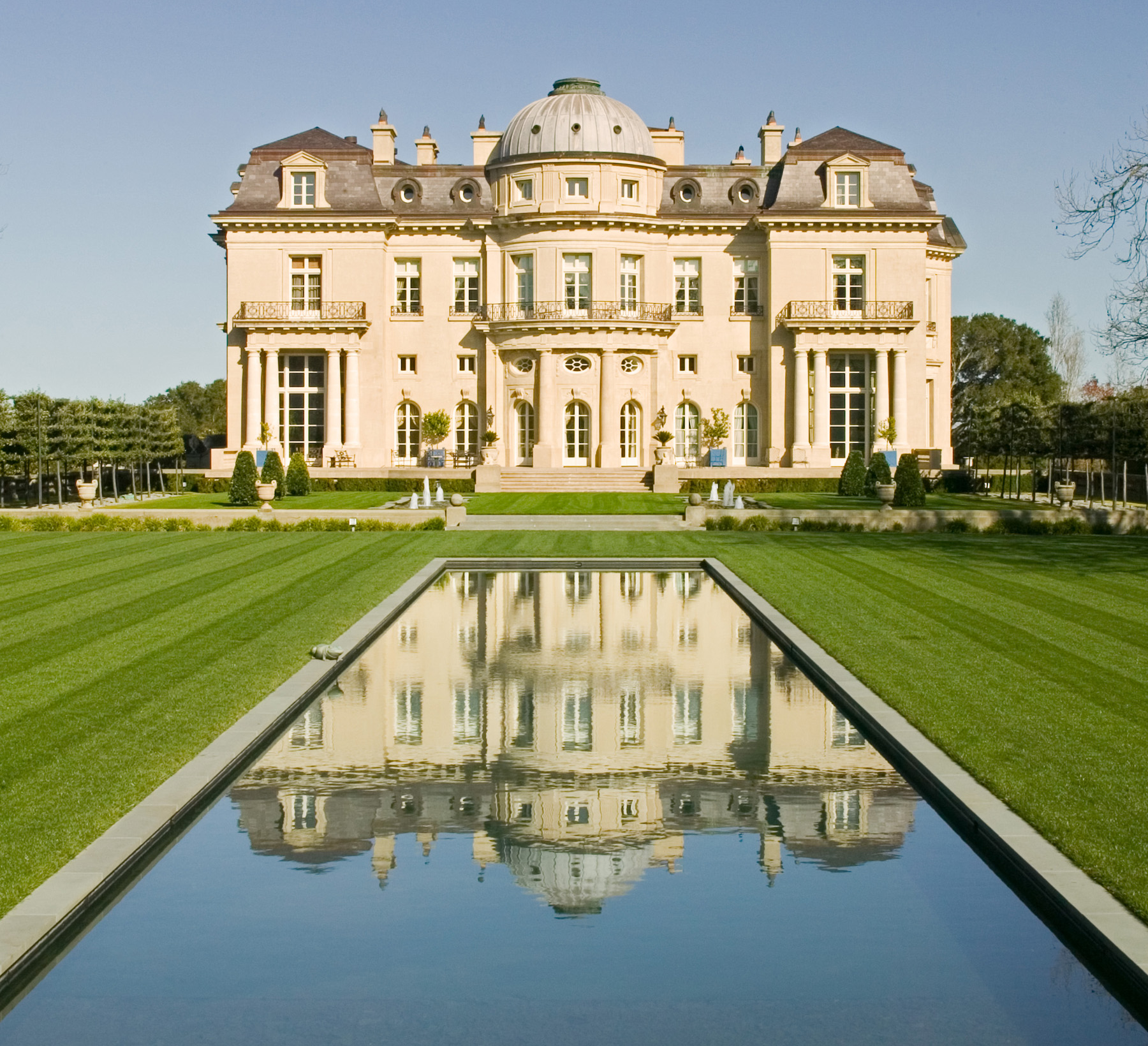
Carolands Chateau is a 46,050-square-foot (4,278 m2),[20] 4.5 floor, 98 room mansion on 5.83 acres (2.36 ha) in Hillsborough, California, United States. An example of American Renaissance and Beaux-Arts design, the building is a California Historical Landmark and is listed on the National Register of Historic Places. Carolands is one of the last of the houses built during the Gilded Age, a period of great mansion-building that included famous houses of the Vanderbilt family, such as Marble House, Biltmore Estate and The Breakers, and stately California houses such as Filoli and the Huntington family's mansions.

Key Information

History

[edit]

Harriett Pullman Carolan

[edit]

The woman who built Carolands, Harriett Pullman Carolan (1869–1956), was the daughter of George Pullman, a 19th-century industrialist, one of Chicago's wealthiest men, and founder of the Pullman Company, famous for its Palace railway cars. In Chicago in 1892, Harriett Pullman married Francis Carolan of San Francisco and moved with him to California. In 1912, she acquired 554 acres (224 ha) of land in Hillsborough,[21] on which she intended to build a house and garden that would excite "the wonder and admiration of America" and reflect her many refined and cultivated interests.[22] The result was a masterpiece of Beaux-Arts architecture, inspired by the court architecture of Louis XIV. Carolan chose the site, the highest in the neighborhood, for its commanding views of the San Francisco Bay and the surrounding hills.

Architects

[edit]

Harriett Carolan commissioned plans for the chateau from the Parisian architect Ernest Sanson, at the time France's foremost designer of prestigious private houses. Sanson was a classicist, and his design for the chateau's exterior was inspired by the 17th-century designs of François Mansart. He was seventy-six years old, near the end of a long and distinguished career, and never visited the California site. Carolan engaged the San Francisco-based Willis Polk, a distinguished architect in his own right, to be the structural designer and construction manager, instructing him to faithfully execute Sanson's designs.[23]

France's leading landscape architect, Achille Duchêne, designed Carolands' gardens. Duchêne's work was inspired by the works of the great 17th-century landscape designer André Le Nôtre, whose most famous creations included the gardens at the Palace of Versailles, Vaux-le-Vicomte and the Jardins des Tuileries. In his original, ambitious design for Carolands, Duchêne planned miles of roadways leading across extensive grounds, landscaped with thousands of shrubs and trees, accented by fountains and statuary. Only a small portion of the scheme was ever built.

Construction

[edit]

Soon after Harriett Carolan secured the land in 1912, Duchêne arrived in San Francisco to lay out the grand parterre gardens. In late 1913, Ernest Sanson began to design the house. His plans included a dry moat around two sides of the house, discreetly located to provide light and air, and access, to the service spaces in the basement, while not blocking views of the gardens from the principal rooms on the main floor. In his design, Sanson incorporated three 18th-century period rooms that Carolan had purchased in Paris with the advice of the famous antique dealer Boni de Castellane.

In 1914, Willis Polk began grading the great terraces planned by Duchêne, sending progress photographs to the owner and her architects. Polk began to build the reinforced concrete superstructure he had designed, creating the infill walls with brick, finishing them with concrete stucco, sanded and scored to resemble natural limestone.[24]

The Dining Room, photographed by Jack E. Boucher for HABS in August 1974

In mid-1916, the elaborate interior elements began arriving on the site. The house as completed had ninety-eight rooms, including nine bedrooms and baths for the owners and their guests, each with an antechamber to guarantee quiet and privacy. The service spaces were equally elaborate: a kitchen with walls and ceiling made of white glass tiles; a service elevator connecting all floors; and a butler's pantry and mezzanine with walls of Delftware tile.[24] In the fall of 1916, Harriett and Frank Carolan moved in with their staff.

First decline

[edit]

Harriett Carolan did not use her house for long: she separated from Frank Carolan in 1917 and closed the chateau the following year. After the separation, she moved to New York City, while Frank remained in California where he died in 1923. Two years later, Harriett married Col. Arthur Schermerhorn, and while the couple occasionally occupied Carolands, in 1928 Harriett removed her furniture and put the property up for sale.

The U.S. Government considered buying Carolands to use as a Western White House in 1939,[25] and again during the Kennedy administration, but both times declined to purchase.

In 1945, Tomlinson Moseley bought the house and surrounding 550 acres (2.2 km2) from the Schermerhorns and began to sub-divide the land and build additional houses.[3] In 1947, Life Magazine published an article about a charity event held at the house,[26] the first opportunity for San Francisco-area residents to see its interior. According to the article, the house had been abandoned for twenty-five years, so that plumbing for the event had to be provided by a fire hose, and lighting required the use of portable generators and flood lights.

Grand Staircase (from first level), by Boucher for HABS in Aug 1974

In 1948, Moseley sold the property, by then reduced to 25 acres (10 ha), to Mrs. S. Coe Robinson.[3] By 1950, she had carved off much of the remaining land into smaller parcels and begun to contemplate demolishing the house.[4]

Countess Lillian Remillard Dandini

[edit]

Countess Lillian Remillard Dandini purchased Carolands Chateau in 1950,[8] saving it from demolition by speculators interested in developing the land, and uninterested in the house's architectural significance. Prior to her marriage in 1932 to Mexican-born Count Alessandro Dandini di Cesena, Lillian Remillard was an heir to the Remillard Brothers fortune, which derived from a brick manufacturing business dating back to California's gold rush, a business that benefitted greatly from the construction boom following the 1906 earthquake. During the twenty-three years (until her death) that she lived at Carolands, the countess entertained often and made the house available for numerous charity benefits. She frequently invited San Francisco's French community to the house and opened it annually to the San Francisco Bay area's French students. Her generosity in sharing the house inspired the Town of Burlingame to give her the town's "Woman of the Year" award.

In her later years the Countess Dandini lacked the necessary funds to maintain the house, and after she died in 1973 it was once again at risk of demolition.[27] The countess willed the house and the remaining 5.83 acres (23,600 m2) to the Town of Hillsborough to be used as a French and Italian musical, artistic and literary center,[28] but was unable to include an endowment. The Town of Hillsborough declined the gift, ruling the proposed use inconsistent with the town's charter while noting it could not afford to pay the cost to maintain the property.

Years of decline

[edit]

In 1975, the house was added to the list of California Historical Landmarks (CHL #886),[19] and to the National Register of Historic Places (NRHP #75000478).[3] Nevertheless, Carolands suffered from frequent changes in ownership after Countess Dandini's death.

In 1976, Dr. Selwyn McCabe won the house in a probate auction,[5] but declined to purchase, deferring to the next bidder, Rose 'Roz' Franks.[6][7] In 1979, Franks lost the house to George I. Benny,[8] who in turn lost it to foreclosure in 1982, after conviction for conspiring to defraud institutional lenders.[9] At the time, adult filmmakers gained access to the site where they produced the 1982 film All American Girls.[28][citation needed]

During these years, Carolands was often vacant, and curious local high school students often entered the house.[29] In 1985, David Allen Raley, a security guard, lured two high school students onto the property where he sexually assaulted and stabbed them, leaving them for dead in a ravine near San Jose.[30] They managed to climb out of the ravine and flag down a passing motorist for help, but one later died of wounds received during the ordeal.[31] Raley had bragged earlier that day that he often received bribes from curious students interested in the mansion's interior, but that "he only let girls in."[32] He was convicted, and received the death penalty in 1988.[33]

Bordeaux Salon. Photograph by Boucher for HABS in Aug 1974
After 2013 restoration

In 1986, Michael DeDomenico, an heir to the family controlling Rice-A-Roni and Ghirardelli, bought Carolands,[12] and that year developers commissioned an Environmental Impact Report in support of a proposal to further subdivide the land and build additional houses. In 1989, the house suffered superficial damage in the Loma Prieta earthquake leading its owners to consider demolishing it. In 1997, a new owner proposed carving the house into fifteen condominiums,[34] but the Hillsborough town charter banned multi-family residences.

Restoration

[edit]

In 1991, the Hillsborough Designer Showhouse was held at Carolands, attracting 68,000 visitors, each paying $20 admission, netting more than $1 million for the sponsoring charity and reviving interest in the house.[11][35][28][27] Among the visitors were Dr. Ann Johnson, who would later buy Carolands, and her interior decorator, Mario Buatta, who would help her to restore it.

In 1998, Johnson and her husband, mutual fund billionaire Charles Bartlett Johnson, bought the house and the remaining land for under $6 million.[28] The Johnsons undertook extensive renovations and restorations of the house, often hosting events there.[36]

Current status

[edit]

Billionaire businessman Charles B. Johnson and his wife bought the Carolands Chateau in 2009 for $26 million.[37] By 2023, it was appraised at $130 million.[37] In 2012, Johnson and his wife donated the Carolands Chateau to his private foundation, "Carolands Foundation".[37] The couple filed for tax-exempt status for the mansion, as they said that the mansion would be open to self-guided public tours every weekday from 9–5.[37] By valuing the mansion so highly and by obtaining tax-exempt status, the Johnsons collected more than $38 million in tax savings from the estate over five years.[37] However, the mansion was not open to the public 40 hours per week or subject to self-guided tours.[37] Rather, it was only open to a few dozen lottery winners who could access the mansion on a guided tour for two hours from 1PM on most Wednesdays.[37] Tax and legal experts questioned the validity of the high appraisal for the mansion and the tax-exempt status of the estate.[37]

[edit]

Exteriors

[edit]

Gardens

[edit]

Interiors

[edit]
[edit]

In 2006 a feature-length documentary, Three Women and a Chateau, which tells the nearly 100-year history of Carolands, premiered at the Santa Barbara International Film Festival and was featured in seven other film festivals, winning Best Documentary (Grand Jury Award) at the Rhode Island International Film Festival.[citation needed][38]

The Heiress and Her Chateau: Carolands of California, a one-hour documentary about the chateau, first premiered January 19, 2014 on KQED-TV, and the following year was broadcast nationally on PBS. It was nominated for two Emmy Awards: Outstanding Achievement – Cultural/Historical Documentary and Outstanding Achievement - Writer. Both documentaries were made by Luna Productions.

References

[edit]
[edit]
Revisions and contributorsEdit on WikipediaRead on Wikipedia
from Grokipedia
Carolands Chateau is a Beaux-Arts style mansion in , completed in 1916 for Harriett Pullman Carolan, to the Pullman fortune, and her Francis Carolan. Designed by French architect Ernest Sanson, with construction supervised by San Francisco architect Willis Polk and gardens laid out by Achille Duchêne, the estate originally spanned 554 acres and incorporated authentic 17th- and 18th-century French interiors purchased in Europe. The 98-room chateau, constructed at a cost of about $3 million, stands as one of the largest private homes west of the Mississippi River and exemplifies the opulent architecture of America's Gilded Age, drawing inspiration from chateaux like Vaux-le-Vicomte. Its features include a 75-foot-high atrium—the tallest in any American residence—and an imperial grand staircase, though planned expansions like a full ballroom were curtailed due to financial constraints during World War I. After Harriett Carolan's in , the changed hands multiple times, and subdivision that reduced its grounds to under 6 acres, with threats of in the mid-20th century prompting preservation efforts. Restored extensively from to by philanthropists and Ann Johnson at a cost exceeding $20 million, Carolands was designated California Historic Landmark No. 886 in 1975 and added to the National Register of Historic Places in 1975. In 2012, it was donated to the Carolands Foundation, which maintains it for educational tours and charitable initiatives focused on architectural heritage.

Origins and Construction

Harriett Pullman Carolan and Family Background

Harriett Sanger Pullman was born on , 1869, in , , as the youngest of four children born to George Pullman (1831–1897) and Harriet Amelia "Hattie" Sanger (1842–1921). Her father founded the Pullman Palace Car Company in 1867, revolutionizing long-distance rail travel through the invention of the luxury sleeping car and building a fortune estimated at over $10 million by the 1890s, though marred by labor unrest including the violent 1894 Pullman Strike. Her mother, daughter of New York merchant George H. Sanger, managed the family's social and philanthropic affairs from their Prairie Avenue mansion in Chicago, a hub of Gilded Age opulence. Harriett's siblings included older sister Florence Sanger Pullman (1868–1937), who married Illinois governor Frank Orren Lowden, and twin brothers George Mortimer Pullman Jr. (1875–1901) and Walter Sanger Pullman (1875–1905), both of whom died young without issue. The family enjoyed elite status, with Harriett often described as the prettier and favored daughter, receiving a cosmopolitan education that included private tutoring in Chicago and extended stays in , where she achieved fluency in French. On June 7, 1892, at age 22, Harriett married Francis James "Frank" Carolan (1861–1923), a 31-year-old polo player and sportsman from a wealthy banking , in a ceremony at the Pullman family chapel in Chicago. The childless couple relocated to Burlingame, California, where they maintained a social presence among West Coast elites; Carolan's death on November 12, 1923, from complications following surgery left Harriett widowed and in control of inherited Pullman assets, enabling major projects like the construction of Carolands.

Architectural Design and Influences

Carolands Chateau exemplifies Beaux-Arts Classicism, a style characterized by grandeur, symmetry, and classical French elements, designed by Parisian architect Ernest-Paul Sanson in 1913–1915. Sanson, trained at the École des Beaux-Arts and renowned for commissions among French aristocracy—including restorations like Château Chaumont and the opulent Hôtel de Castellane (Palais Rose)—crafted preliminary plans after meeting owner Harriett Pullman Carolan in Paris. His design for Carolands adapts 17th-century French chateau precedents, particularly the Château de Vaux-le-Vicomte (built 1658–1661 by Louis Le Vau) and Château de Maisons, emphasizing balanced facades, pilasters, entablatures, and garlands. The exterior draws directly from François Mansart's 17th-century classicism, featuring a , hipped ends, and dormers, while the rectangular (130 ft by 120 ft, rising 100 ft over 4.5 stories) prioritizes and hierarchical spatial progression typical of estates. , scored to imitate , marked an innovative for seismic-prone under supervising Willis Polk, yet preserved Sanson's vision of stone-like without compromising authenticity. Interiors incorporate salvaged French elements, including three period salons shipped from Europe: two from 1784 Bordeaux chateaus with ornate plaster ceilings and parquet floors, and one Louis XIII-era room, blending historical revival with new fabrication in oak, rosewood, and marble. This synthesis reflects the Gilded Age American elite's emulation of European aristocracy, positioning Carolands as among the purest realizations of French Classical architecture stateside, distinct from contemporaneous American interpretations that often diluted such rigor with eclectic additions. The central atrium, soaring 75 ft under a skylight with layered colonnades and an imperial staircase, further evokes Versailles-scale formality adapted for private residential use.

Construction Timeline and Key Contributors

Harriett Pullman Carolan, to the Pullman railroad fortune, acquired 554 acres in , in to establish the estate, marking the of the . That year, she purchased three antique French salons in Paris for incorporation into the interiors, at a cost of $50,000, and engaged landscape architect Achille Duchêne to design the grounds. In 1913, Carolan commissioned French Beaux-Arts Sanson to create the chateau's plans, approving preliminary designs during a visit to ; Sanson, aged 81 at the time, provided his final major American commission. Construction commenced in 1914, with contracts awarded and San Francisco Willis Polk appointed as on-site construction manager to supervise implementation of Sanson's blueprints, adapting them to local conditions while ensuring fidelity to the French classical style. The 98-room reached substantial completion by , allowing Carolan, her Francis J. Carolan, and staff to occupy the residence that year. Duchêne oversaw concurrently, from 17th-century French precedents to layout formal parterres and terraces integrated with the . Polk's role extended to early site preparation, including grading for the expansive grounds, underscoring his coordination of the transatlantic design vision amid logistical challenges of importing materials and artisans pre-World War I.

Architectural Features and Specifications

Exterior and Structural Elements

The Carolands Chateau employs a reinforced concrete frame, one of the earliest such applications in a residential structure, forming a rectangular plan approximately 130 feet long by 120 feet wide and rising 100 feet across five stories including a basement. The concrete is finished with scoring to imitate ashlar masonry and clad in limestone veneer, providing durability and a classical appearance inspired by French Renaissance chateaux of the Loire Valley. The principal south facade centers on a rusticated base supporting an arched floored in and gated with , flanked by a half-octagonal tower featuring pedimented windows and pilasters. Ornamentation includes classical elements such as columns, entablatures, and garlands, executed in a Beaux-Arts style. The west elevation incorporates two rectilinear towers bookending a circular tower capped by a distinctive copper dome, with the piano nobile opening onto a raised terrace overlooking the gardens. North and east facades present orderly rows of articulated windows, with the basement level illuminated by an artificial moat. The entire structure is crowned by a copper mansard roof pierced by oeil-de-boeuf dormers and pedimented attic windows, enhancing the French chateau aesthetic. These elements, designed by French architect Ernest Sanson in collaboration with Willis Polk, emphasize symmetry, grandeur, and seismic resilience through the innovative concrete construction.

Interior Layout and Decorative Elements

The interior of Carolands Chateau encompasses approximately to 110 rooms spanning 46,050 square feet across four and a half stories, with a rectangular plan centered around a four-story hall topped by a skylight. The basement level contains service facilities, including a 600-square-foot kitchen with 12-foot ceilings, a wine cellar capable of holding 2,000 bottles on parquet floors, and specialized preparation rooms such as a salad room and baker's room. The main floor, or piano nobile, features principal reception areas like the library (40 by 60 feet with 25-foot ceilings and a balcony), state dining room, large salon (drawing room), small salon, ballroom (30 feet wide with a stage), solarium, round room, square room, Chinese room, and breakfast room, accessed via an entrance foyer with marble flooring leading to a columned court and double staircase with Doric columns and wrought-iron balustrades. The second floor houses nine principal bedroom suites and sitting rooms along galleries, including the largest suite for Harriett Carolan with a marble bathtub and dual dressing rooms connected by a circular staircase, while the third floor accommodates up to 40 servant quarters. A concealed mezzanine between the main and second floors provides storage for wardrobes, valuables, and oeil-de-boeuf windows. Decorative elements reflect French Classical and Beaux-Arts influences, drawing from , with many components fabricated in and shipped to the site starting in mid-1916 under the guidance of architect Sanson. Key imports include three 18th-century paneled rooms from a mansion designed by Victor Louis, purchased for about $50,000 and incorporating boiseries (carved paneling), original marble mantels, and fireplaces. Specific features encompass Louis XV-style paneling in the , marbleized plaster walls and gilt-trimmed woodwork in the dining room with two champagne fountains, a painted ceiling with cherubs in the drawing room, rosewood panels circa 1780 and a marble fireplace in the round room, lacquered panels in the Chinese room, brocade wall coverings in the ballroom, and an intricate ceiling roundel depicting Apollo the Sun God in the large salon. Additional opulent details include Carrara marble tubs, golden bathroom fixtures, silver door handles and sinks, 17 steel safes, parquet flooring, and skylights over the elliptical grand and garderobe staircases, complemented by decorative cartouches, niches, buffets, and grisailles in rooms like the Salon and antechamber. The reinforced concrete structure supports brick interior walls, scored to mimic ashlar, enabling expansive, high-ceilinged spaces finished in materials such as , rosewood, marble, and wrought iron.

Gardens, Grounds, and Outbuildings

The gardens of Carolands were designed by French landscape architect Achille Duchêne, renowned for restorations of historic French estates and inspired by the formal layouts of 17th-century designers like . Duchêne's plans for the estate incorporated extensive formal elements, including , fountains, statues, and roadways amid thousands of trees and shrubs. The west , a key feature, exemplifies his geometric precision, with intricate concealing a high-capacity underground garage beneath. Original garden structures encompassed a , , orangerie for cultivation, and a tempietto , enhancing the estate's self-contained luxury. These elements complemented the chateau's Beaux-Arts style, integrating indoor and outdoor spaces through terraced views and axial alignments. The initial grounds spanned 554 acres of rolling in Hillsborough, affording panoramic vistas of the , though subsequent subdivisions reduced the estate's . Outbuildings included the Carolands , constructed in 1929 as a 1,000-square-foot French-style lodge with garage facilities, featuring hand-painted beams and a for attendant . Additional service structures supported estate operations, such as stables and storage ancillary to the s, though many fell into disuse by the mid-20th century amid changes. Restoration efforts in the early by owners Ann and Johnson revived select features, preserving Duchêne's vision for architectural study and public appreciation.

Ownership History

Initial Ownership and Use

Carolands was commissioned by Harriett Pullman Carolan (1869–1956), daughter and heiress of railroad magnate , who acquired 554 acres of land in , in 1912 for the purpose of constructing a palatial French-inspired chateau and gardens. The estate, designed to evoke the grandeur of Versailles, was intended as a luxurious retreat for social entertaining and family residence, reflecting Harriett's status as a Gilded Age heiress with a penchant for European opulence. Construction began in 1914 under the supervision of French Sanson and Willis Polk, with the 98-room chateau completed in 1916 at a of about $3 million—equivalent to roughly $80 million in contemporary terms, largely depleting Harriett's . Harriett, her husband Francis J. Carolan (to whom she had been married since 1892), and household staff moved into the property that year, using it initially as a primary residence with its expansive interiors, including imported 18th-century French salons, and grounds featuring formal parterres. The couple hosted events there during this brief period, though specific gatherings are sparsely documented amid the estate's emphasis on privacy and architectural splendor. The Carolans' separation in 1917, exacerbated by disputes over the estate's escalating expenses, led to Carolands being closed indefinitely by 1918; Francis returned to his prior residence at Crossways , while Harriett relocated primarily to New York. Thereafter, the saw only occasional visits from Harriett, who remarried in 1925 but maintained nominal without resuming full-time habitation or extensive use, as financial and personal constraints further development of the incomplete and gardens. Francis's death in 1923 did not alter this pattern, and Harriett retained the estate until selling it in 1950 to Countess Lillian Remillard Dandini, who acquired the chateau amid threats of demolition following earlier land subdivisions.

Countess Lillian Remillard Dandini Period

Countess Lillian Remillard Dandini, born in 1880 in , as the of Pierre-Nicolas Remillard, founder of the Remillard Brick established in 1879, assumed of the alongside her following her father's death in 1904. In 1932, at age 52, she married Count Alessandro Dandini di , an Italian noble 20 years her junior; the union ended in divorce by 1938, after which she retained the title of Countess. In 1950, facing imminent demolition by developers seeking to subdivide the land, Dandini acquired Carolands Chateau and approximately six acres from Mrs. S. Coe Robinson through an arrangement that included building supplies from the Remillard Company. She relocated to the estate, establishing it as her primary residence and furnishing it with personal art objects and amenities, thereby stabilizing its occupancy during a period of prior transience. During her 23-year tenure until her death in 1973, Dandini hosted musical performances, charitable fundraisers, and community gatherings in the and , including supporting the League of Oakland as a noted patron. In 1958, she repurchased and reinstalled the two Bordeaux salons—ornate paneled rooms originally from the estate's —into their designated spaces after nearly three decades in storage. She also utilized the light chamber above the Great Court for cultivating houseplants, integrating personal horticultural interests into the property's use. Upon her passing at age 93, Dandini's service occurred in the chateau's , and she sought to bequeath the to the town of Hillsborough for conversion into a , an offer ultimately declined by authorities. Her ownership marked a phase of relative preservation and active social utilization, averting further decline in the immediate postwar era.

Mid-20th Century Transitions

Following the death of Countess Lillian Remillard Dandini on , , at age 93, Carolands faced immediate legal contention over her will, which bequeathed the estate to the Town of Hillsborough for use as a and . Relatives contested the bequest, leading to prolonged proceedings that delayed resolution for several years. In , the was sold at a probate court auction for $250,000 to Dr. Selwyn McCabe, a New Zealand-born cardiologist and inventor, though his ownership lasted only briefly before transferring to subsequent buyers. The auction winner's short tenure initiated a pattern of rapid turnover, with the estate passing to Rose "Roz" Franks, a San Francisco socialite, who held it from 1976 until approximately 1979. Franks' ownership emphasized social events but did little to address structural maintenance, exacerbating underlying deterioration from deferred upkeep during Dandini's later years. Subsequent acquisitions in the late 1970s and 1980s, including by developer George Benny around 1979, involved proposals for subdivision or commercial repurposing, reflecting speculative interest amid the property's shrinking viability as a private residence on its reduced 5.4-acre lot. These handoffs, often marred by financial disputes and unfulfilled restoration pledges, marked Carolands' shift from aristocratic stewardship to precarious speculation, setting the stage for intensified neglect.

Period of Decline and Challenges

Post-1950s Neglect and Vandalism

Following the death of Countess Lillian Remillard Dandini in , after her ownership since 1950, Carolands entered a phase of pronounced instability with a succession of short-term owners unable to manage the estate's escalating upkeep expenses, which strained even the countess's resources during her tenure. This led to deferred across the 98-room and remaining grounds, resulting in widespread deterioration including water damage, crumbling interiors, and overgrown landscapes. The period was characterized by repeated threats of as developers sought to subdivide the prime Hillsborough , coupled with legal battles and owner bankruptcies that halted any sustained repairs. Break-ins and acts of compounded the physical decay, with unsecured access allowing intruders to fixtures, artwork remnants, and architectural elements, further eroding the chateau's condition amid inadequate measures. By the 1980s, the estate's neglected state had rendered it a target for illicit activities, including unauthorized filming of content on the premises, highlighting profound vulnerabilities in oversight and . These challenges persisted until the late , when the property's hung in balance against ongoing financial and structural pressures.

The 1985 Murders and Security Failures

On , 1985, two 19-year-old women, Jeanine Grinsell and Laurie McKenna, visited the derelict Carolands estate in , after spotting it while driving through affluent neighborhoods seeking . The property, then owned by a trust and minimally maintained amid ongoing financial disputes, had been opened sporadically for informal tours to generate , despite its to trespassers due to years of . David Allen , a 23-year-old security guard employed by the estate's management to deter vandalism and unauthorized entry, encountered the women and escorted them inside under the pretense of a guided tour. Raley led Grinsell and McKenna to an upper , where he suddenly assaulted them with a and , beating and both in a prolonged attack involving , attempted , and . Grinsell suffered fatal wounds, including multiple stab injuries to her neck and chest, and was left to die in a bathroom; McKenna, severely injured but conscious, feigned death until Raley departed, then sought help from a passerby. Police arrested Raley shortly thereafter based on McKenna's description and evidence recovered from the scene, including bloodied weapons and the victims' belongings. In 1987, Raley's trial in Santa Clara County Superior Court proceeded with testimony detailing the two-hour ordeal, including McKenna's account of Raley's threats and physical restraint of the victims. A jury convicted him in 1988 of first-degree murder with special circumstances (torture, kidnapping, and rape), attempted murder, and related charges, sentencing him to death; his appeals, including a 1992 California Supreme Court review, were denied, leaving him on death row at San Quentin as of 2007. The incident exposed profound security lapses at Carolands, which by the mid-1980s had deteriorated into a target for and curiosity-seekers following decades of absentee and deferred . With no robust perimeter , , or background vetting for its lone guard—Raley, a San Jose resident hired without evident rigorous screening—the estate relied on minimal amid financial strain from inheritance disputes. Allowing unsupervised public access to such an isolated, unsecured 65,000-square-foot structure amplified risks, as the guard's position enabled unchecked isolation of visitors; subsequent investigations highlighted the absence of protocols like paired patrols or visitor logs, contributing to the unchecked escalation of violence. These failures underscored broader vulnerabilities in managing historic properties in decline, prompting no immediate structural reforms but influencing later restoration efforts to prioritize fortification.

Restoration and Modern Preservation

Acquisition and Initial Restoration by the Johnsons

In 1998, and his , Ann Lutes Johnson, acquired Carolands Chateau and its remaining 5.8 acres for under $6 million from prior owners amid the property's prolonged decline. The purchase was motivated by a commitment to preserve the Gilded Age landmark, which Charles Johnson described as akin to "a beautiful lady who's never had a decent dress to wear," reflecting its need for structural and aesthetic revival after years of vandalism, deferred maintenance, and failed development proposals. The Johnsons immediately launched an extensive restoration, investing approximately $20 million over four years to reconstruct deteriorated elements while adhering to original 1916 designs by architects Bliss & Faville and landscape architect Bruce Porter. Efforts included repairing the 65,000-square-foot mansion's limestone facade, restoring 98 rooms with period-appropriate materials like imported French oak paneling and marble, and reinstalling salvaged features such as crystal chandeliers and frescoes previously removed or damaged. Interior decorator Mario Buatta contributed to redecorating salons and bedrooms, emphasizing authentic French chateau aesthetics over modern alterations. Gardens and grounds received parallel attention, with the Johnsons recreating formal parterres, fountains, and the Duchêne border based on historical photographs and original plans, reversing overgrowth and erosion from neglect. By 2002, the family occupied the restored chateau as their primary residence, hosting charitable events while maintaining it as a private home for a decade. This initial phase stabilized the structure against further decay, preventing demolition threats and setting the foundation for ongoing preservation.

Comprehensive Renovation Efforts

Following the acquisition of Carolands by and Ann Johnson in , a comprehensive multi-year commenced, aimed at preserving the chateau's architectural and restoring its original grandeur. The effort, which spanned approximately four years and concluded around 2002 when the family occupied the residence, involved extensive structural and mechanical upgrades. Key components included repairing outdated mechanical systems, removing hazardous asbestos throughout the 98-room mansion, and replacing the entire roof at a cost of $3 million. Interior restoration emphasized authenticity, with meticulous attention to historical details under the guidance of decorator Mario Buatta, who oversaw the revival of opulent spaces like the grand staircase and salons. The overall project exceeded $20 million in expenditures, reflecting a commitment to halting decades of neglect and vandalism. Gardens and grounds also underwent parallel restoration, drawing on original designs inspired by French chateaux such as , to reinstate formal parterres, fountains, and terraces. This holistic approach ensured compliance with preservation standards, transforming the estate from a dilapidated structure into a functional historic landmark by the early 2000s. The Johnsons' dedication, documented in local reporting, prioritized empirical fidelity to the 1915-1916 construction era over modern alterations.

Formation of the Carolands Foundation

In 2012, , a financier and CEO of Franklin Resources, and his Ann established the Carolands Foundation by donating the fully restored Carolands Chateau to it following their purchase of the property in 1998 and a multi-year reconstruction completed by 2002. The foundation, structured as a private nonprofit entity, received the 65,000-square-foot estate—including its Beaux-Arts architecture, formal gardens, and ancillary structures—to ensure long-term preservation and prevent future commercial exploitation or neglect. This transfer aligned with the Johnsons' intent to dedicate the site to charitable, educational, and cultural missions, such as hosting guided tours and supporting programs that highlight the estate's historical significance in American architecture and landscape design. The foundation promptly pursued and obtained federal tax-exempt status under Section 501(c)(3) of the , enabling it to operate without income tax liability and facilitating deductible contributions for maintenance and operations. By 2013, it began offering limited public access through small-group tours, emphasizing the chateau's original 1916 design by architects Willis Polk and Sanson, while generating revenue via events to fund ongoing upkeep costs estimated in the millions annually. The Johnsons retained no personal ownership post-donation, shifting control to a board focused on stewardship, though the foundation has faced local property tax disputes asserting its exempt status based on educational use rather than private benefit. This formation model reflects a broader trend among wealthy philanthropists using private foundations to safeguard Gilded Age-era properties against urban development pressures in affluent enclaves like Hillsborough, California.

Current Status and Operations

Ownership and Management Structure

Carolands Chateau is owned by the Carolands Foundation, a private nonprofit foundation established by and his , Ann Lutes Johnson, who acquired the in 1998 and undertook extensive restoration before donating it to the foundation in 2012. The foundation's primary mission is the preservation and of the estate, funding operations through its endowment, which includes significant holdings such as shares in Franklin Resources, Inc., valued at over $284,000 as of recent filings. The is led by co-presidents , a and CEO of Franklin Resources, and Ann L. Johnson, a physician, both serving without compensation. Johnson, of and also affiliated with Franklin Resources, serves as a trustee, ensuring family oversight of the foundation's activities focused on the chateau's upkeep. This reflects a private family foundation model, prioritizing long-term stewardship over public or commercial use, with annual expenses directed toward property maintenance rather than broader charitable distributions.

Public Access, Tours, and Events

Public access to Carolands Chateau is strictly limited to guided tours and select events managed by the Carolands Foundation, with no general admission or self-guided visits permitted. Tours are offered exclusively on Wednesdays at 1:00 p.m., requiring advance reservations through a lottery system on the foundation's website. Participants must be at least 16 years old, arrive by 12:45 p.m. with printed confirmation, and prepare for approximately 2.5 hours of touring, including up to 100 steps and extended standing. These complimentary docent-led tours cover the mansion's interiors, such as the grand staircase and salons, as well as portions of the grounds, emphasizing the estate's architectural and historical features. As of 2024, includes the third floor, previously restricted, available to the via reservations, allowing visitors to explore additional and upper levels alongside main floors and gardens. exceeds capacity, often requiring multiple lottery attempts for selection, reflecting the estate's status as a preserved rather than a routine tourist venue. Events at Carolands are hosted for charitable, educational, or cultural purposes, accommodating up to 175 guests for receptions, dinners, concerts, seminars, and lectures, but not for private corporate or personal functions. Examples include fundraisers like the "Brunch for " event on October 8, 2024, featuring plated meals, auctions, speakers, and guided tours. These gatherings support the foundation's mission to educate on the chateau's legacy while generating funds for preservation, maintaining the property's exclusivity and operational .

Ongoing Maintenance and Challenges

The Carolands Chateau, with its 46,050 square feet, rooms, and expansive grounds, demands significant resources for upkeep, including structural repairs, restoration, and climate control to prevent deterioration of original materials like plasterwork and wood paneling. The Carolands Foundation, which manages the property, reported expenses of approximately $1.42 million in recent fiscal years, covering preservation activities amid the inherent challenges of maintaining a century-old Beaux-Arts structure in a seismically . Key challenges include balancing preservation with limited public access to minimize wear; tours are restricted to select 2-hour sessions via lottery on most Wednesdays, constrained by a shortage of volunteer docents and concerns over potential damage to fragile interiors. This approach has drawn scrutiny, as the foundation's 2013 IRS application promised broader weekday access from 9 a.m. to 5 p.m., leading to questions about fulfilling its charitable educational mission versus serving primarily as a private holding. Tax status remains a persistent issue, exemplified by a dispute with San Mateo County over the foundation's exemption eligibility, which hinged on demonstrating sufficient public benefit; while resolved in favor of the foundation, such challenges underscore the tension between historic preservation incentives and fiscal oversight of nonprofit estates. Ongoing funding relies heavily on endowment assets derived from donor Johnson's contributions, with over $38 million in tax savings realized from the donation valued at $130 million, amid broader critiques that such arrangements yield limited societal returns relative to public subsidies.

Historical and Cultural Significance

Role in Gilded Age Architecture


Carolands exemplifies the opulent mansion-building of the Gilded Age's extension into the early 20th century, where industrial magnates commissioned palatial estates to rival European nobility. Constructed from 1914 to 1916 on a 554-acre site in Hillsborough, California, the chateau was funded by Harriet Pullman Carolan, whose inheritance from the Pullman railroad sleeping car fortune enabled this display of wealth. The design by French architect Ernest Sanson, with construction supervision by San Francisco architect Willis Polk, adapted Beaux-Arts principles and 17th-century French chateau motifs, such as those of Vaux-le-Vicomte, into a 46,050-square-foot, 98-room structure featuring reinforced concrete framing, brick interior walls, and imported 18th-century Parisian salons purchased in 1912 for $50,000.
This collaboration highlights Gilded Age architecture's reliance on transatlantic expertise to achieve grandeur, with Polk ensuring structural integrity suited to California's terrain while preserving Sanson's classical symmetry, grand atrium, and imperial staircase. The estate's scale and features, including Achille Duchêne's formal gardens, positioned it as the largest private home west of the Mississippi, symbolizing the era's economic excess driven by railroad tycoons and their emulation of aristocratic lifestyles amid rapid urbanization and wealth concentration from 1870 to 1914. Carolands thus served as a capstone to the period's residential extravagance, preceding the decline of such projects due to World War I, higher taxes, and shifting social norms. Recognized for its architectural merit, the property's designation as No. 886 in 1975 and listing affirm its role as a rare surviving testament to aspirations in American , distinct from East Coast Vanderbilt-era by its West Coast and French .

Economic and Social Context of Builders

The principal builders and architects of Carolands, including San Francisco-based Willis Polk as on-site construction manager and French designers Ernest Sanson and Achille Duchêne, worked amid California's post-1906 earthquake economic resurgence, which accelerated suburban development for affluent residents fleeing urban vulnerabilities in San Francisco. Polk, who had directed Daniel Burnham's reconstruction efforts in the city from 1903 to 1913, capitalized on this boom by overseeing contracts for grand residences that symbolized rebuilt prosperity and exclusivity in enclaves like Hillsborough. Harriet Pullman Carolan, the whose inherited fortune from the Pullman —approximately $1,000,000 upon her father's in —financed the , reflected the era's concentration of industrial such endeavors. , spanning 1914 to 1916 on 554 acres acquired in , incorporated high-cost elements like three antique Parisian salons purchased for $50,000, underscoring how railroad-era tycoons' heirs deployed capital for architectural statements amid broader regional growth tied to transportation infrastructure. Socially, the builders navigated a stratified where American elites emulated European through Beaux-Arts chateaus, with Polk's firm executing commissions for San Francisco's Georgian Revival mansions and commercial towers like the Building (1914), the city's tallest at the time. This period's "" among the wealthy, post-disaster, contrasted with impending challenges like the 1907 financial and onset in 1914, yet sustained for opulent as markers of status amid rising urban and labor exploitation in California's extension.

Legacy and Comparisons to Other Estates

Carolands exemplifies the pinnacle of Gilded Age architectural ambition on the West Coast, embodying the era's fusion of American industrial fortune with European grandeur. As one of the final such estates completed before World War I halted lavish construction, it holds designations as California State Historical Landmark No. 886 and was listed on the National Register of Historic Places in 1975 (Reference No. 75000478). Its preservation through private restoration, including a comprehensive overhaul initiated after the 1998 acquisition by Charles B. and Ann Johnson, has safeguarded original features such as the 75-foot-high atrium—the largest enclosed space in any California private residence—and two surviving 17th- to 18th-century Bordeaux salons imported from France. Relocated antique interiors now enhance public collections at the California Palace of the Legion of Honor, extending the estate's cultural influence beyond its site. The 2012 donation to the Carolands Foundation perpetuates this legacy via charitable operations, limited tours, and events that generate funds for upkeep, raising over $1 million in one decorators' show house iteration alone. The estate's historical prominence is further evidenced by its 1939 consideration as a presidential "Western White House" and a 1945 proposal for United Nations headquarters, reflecting its scale and symbolic stature amid mid-20th-century national planning. For decades, Carolands ranked as the largest private home west of the Mississippi River, with approximately 65,000 square feet across 98 rooms and 4.5 stories rising 100 feet high, underscoring its role in showcasing railroad heiress Harriett Pullman Carolan's vision of transatlantic elegance. Comparatively, Carolands outscaled regional peers, such as the 67-room Crocker mansion, establishing it as the preeminent estate in San Mateo during its heyday. Its Beaux-Arts by French Sanson, drawing inspiration from the 17th-century de Vaux-le-Vicomte, prioritizes symmetrical classical formalism over the eclectic Mediterranean Revival of contemporaries like , while paralleling the imported opulence of East Coast commissions such as the Sanson-designed Belmont in . Unlike larger Eastern exemplars like the Vanderbilt (178,926 square feet), which emphasized Revival on acreage, Carolands adapts Loire Valley chateau motifs to a compact 5.65-acre modern parcel, prioritizing vertical drama and interior volume in a post-frontier California context. This synthesis of French pedigree with American excess positions it as a bridge between Old World aristocracy and New World tycoonery, though its anachronistic timing—completed in 1916 amid rising global tensions—rendered it a swan song for unchecked -building.

References

Add your contribution
Related Hubs
User Avatar
No comments yet.