


Community hub
Recent from talks
Contribute something
Nothing was collected or created yet.
Common bream
View on Wikipedia | This article needs additional citations for verification. (March 2014) |
| Common bream | |
|---|---|

| |
Scientific classification 
| |
| Kingdom: | Animalia |
| Phylum: | Chordata |
| Class: | Actinopterygii |
| Order: | Cypriniformes |
| Family: | Leuciscidae |
| Subfamily: | Leuciscinae |
| Genus: | Abramis Cuvier, 1816 |
| Species: | A. brama
|
| Binomial name | |
| Abramis brama | |
| Synonyms[2][3] | |
|
Genus
Species List
| |

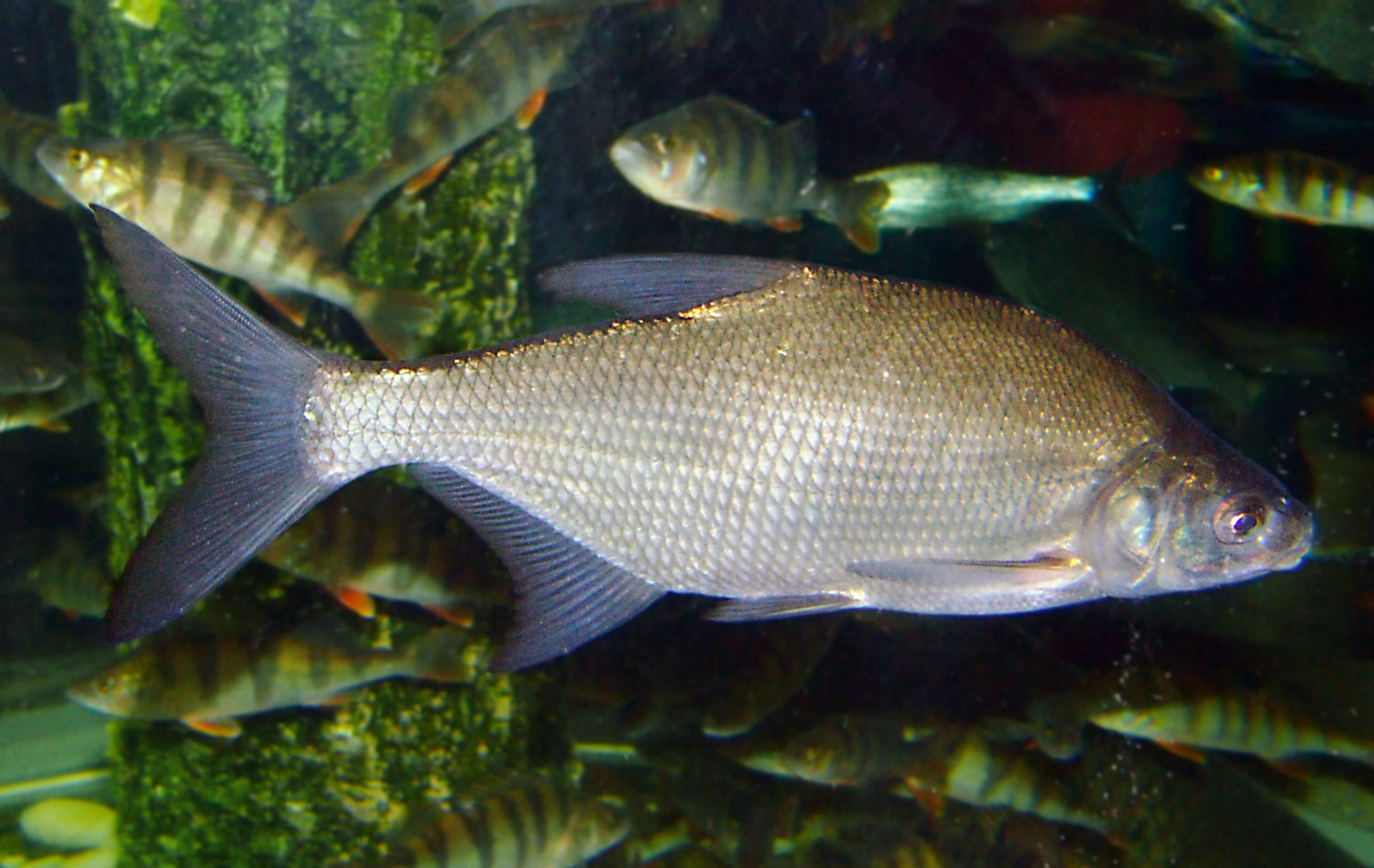
The common bream (Abramis brama), also known as the freshwater bream, bream, bronze bream,[4] carp bream[5] or sweaty bream, is a European species of freshwater fish in the family Leuciscidae. It is now considered to be the only species in the genus Abramis.
Taxonomy
[edit]The common bream was first formally described as Cyprinus brama in the 10th edition of Systema Naturae published in 1758 by Carl Linnaeus with its type locality given as European lakes.[3] In 1816 Georges Cuvier proposed the genus Abramis, designating Cyprinus brama as its type species. This taxon is classified within the subfamily Leuciscinae of the family Leuciscidae.[2]
Etymology
[edit]The common bream is the only species in the genus Abramis, this name is an Ancient Greek name for a bream or mullet. The specific name is derived from Abramis.[6]
Range and habitat
[edit]The common bream's home range is Europe north of the Alps and Pyrenees, as well as the Balkans. They are found as far east as the Caspian Sea, the Black Sea, and the Aral Sea. The common bream lives in ponds, lakes, canals, and slow-flowing rivers.[citation needed]
The common bream generally lives in rivers (especially in the lower reaches) and in nutrient-rich lakes and ponds with muddy bottoms and plenty of algae. It can also be found in brackish sea waters.[1]
Description
[edit]The bream is usually 30 to 55 cm (12 to 22 in) long, though some specimens of 75 cm (30 in) have been recorded; it usually weighs 2 to 4 kg (4.4 to 8.8 lb). Its maximum length is 90 cm (35 in), the record weight exceeds 9 kg (20 lb).[7]
The common bream has a laterally flattened and high-backed body and a slightly undershot mouth. It has a bright silver colouration, though older fish can be bronze-coloured, especially in clear waters. The fins are greyish to black, but never reddish.
Similar-looking fish
[edit]The common bream can easily be confused with the silver or white bream (Blicca bjoerkna), in particular at the younger stages (see picture). The most reliable method of distinguishing these species is by counting the scales in a straight line downwards from the first ray of the dorsal fin to the lateral line. Silver bream have fewer than 10 rows of scales, while common bream have 11 or more. At the adult stage the reddish tint of the fin of the silver bream is diagnostic. Like other Cyprinidae, common bream can easily hybridise with other species, and hybrids with roach (Rutilus rutilus) can be very difficult to distinguish from pure-bred bream.[4]
Immature specimens could also be confused with other European breams, such as the two Ballerus species or Vimba vimba.
- Silver bream (Blicca bjoerkna) and common bream (Abramis brama) comparison
-
 B. bjoerkna (top), immature A. brama (bottom)
 -
 B. bjoerkna (left), immature A. bramis (right).
 -
 Immature A. brama (top). Mature B. bjoerkna (bottom)


Biology
[edit]Feeding habits
[edit]
The common bream lives in schools near the bottom. At night, common bream can feed close to the shore, and in clear waters with sandy bottoms, feeding pits can be seen during daytime. The fish's protractile mouth helps it dig for chironomid larvae, Tubifex worms, bivalves, and gastropods. The bream eats water plants and plankton, as well.
In very turbid waters, common bream can occur in large numbers, which may result in a shortage of bottom-living prey such as chironomids. The bream are then forced to live by filter feeding with their gill rakers, Daphnia water fleas being the main prey. As the fish grows, the gill rakers become too far apart to catch small prey and the bream will not then grow bigger than 40 cm (16 in).[citation needed] If a common bream is malnourished, it can develop a so-called "knife back", a sharp edge along its back.
Spawning
[edit]


The common bream spawns from April to June, when water temperatures are around 12–20 °C (54–68 °F). At this time, the males develop white tubercles on head and upper body and form territories which they defend. The females lay 90,000 to 300,000 eggs per kilogram of body weight over large areas of weed or within reed beds over 7-14 days. The eggs are then fertilised by the male. The fry hatch after 3-12 days and attach themselves to water plants with special adhesive glands, until their yolk is used up. The fry will stay in the warmer water around the weed beds and margins initially and then form large shoals, gradually moving into deeper water. The fry feed on zooplankton during the day initially, growing quickly during the warmer months and then becoming bottom feeders that filter the substrate for invertebrates and molluscs.
Because of their high fertility and adaptability, breams are known to overpopulate. This causes the fish to grow at a slow pace and become stunted.[8]
Because of their slender shape, the young fish are often not recognised as bream, but they can be identified by their flat bodies and silvery colour. At this stage, the fish are still pelagic, but after a few months, they acquire their typical body shape and become bottom-dwellers. By three to four years old, the fish are sexually mature.
Fishing
[edit] | This article contains instructions or advice. (May 2017) |
The freshwater bream is not generally caught for consumption[citation needed]. Common bream are popular with sport and match fishermen. However, bream are not as hard fighting as most other fish native to the UK, as due to their flat, disc-shaped profile they are relatively easy to bring to the bank. Bream will eat most baits, especially:
- Sweetcorn – two or three grains hooked or hair-rigged.
- Maggots/worms – two or three straight on the hook.
- Boilies – the large mouths of Bream will devour most boilies
Bream can be caught in rivers or lakes, with generous use of groundbait to attract the shoals. They are not shy fish. Another technique is float fishing on the bottom. Ledgering (using just a lead weight to hold the bait down) with a cage feeder full of bait often works better on larger rivers and lakes.
As of 2022[update] the current European record common bream caught with rod and reel is 10.32 kilograms (22.8 lb), caught in the United Kingdom.[9][10]
See also
[edit]References
[edit]- ^ a b Freyhof, J. & Kottelat, M. (2008). "Abramis brama". IUCN Red List of Threatened Species. 2008 e.T135696A4184980. doi:10.2305/IUCN.UK.2008.RLTS.T135696A4184980.en. Retrieved 11 January 2018.
- ^ a b Fricke, Ron; Eschmeyer, William N. & van der Laan, Richard (eds.). "Genera in the family Leuciscinae". Catalog of Fishes. California Academy of Sciences. Retrieved 1 May 2025.
- ^ a b Fricke, Ron; Eschmeyer, William N. & van der Laan, Richard (eds.). "Species in the genus Abramis". Catalog of Fishes. California Academy of Sciences. Retrieved 1 May 2025.
- ^ a b Giles, Nick (1994). Freshwater Fish of the British Isles: A Guide for Anglers and Naturalists. Swan Hill Press. pp. 140–144. ISBN 1-85310-317-9.
- ^ FishBase, Common names of Abramis brama. Retrieved 2010-11-13.
- ^ Christopher Scharpf (8 April 2024). "Family LEUCISCIDAE: Subfamily LEUCISCINAE Bonaparte 1835 (European Minnows)". The ETYFish Project Fish Name Etymology Database. Christopher Scharpf. Retrieved 1 May 2025.
- ^ British Record (Rod Caught) Fish Committee (July 2020). "Top 50 Bream" (PDF). anglingtrust.net.
- ^ Dobruka, Luděk; Podhajská, Zdenka; Bauer, Jaroslav (1987). Pestrá príroda [Varied nature] (in Slovak) (Slovak translation ed.). Slovakia: Mladé Letá. p. 71.
- ^ "Abramis brama". Fishing-Worldrecords.com. Retrieved 10 November 2022.
- ^ British Record (Rod Caught) Fish Committee (19 July 2021). "Coarse Fish Records as at July 2021" (PDF). anglingtrust.net.
External links
[edit]
- Froese, Rainer; Pauly, Daniel (eds.). "Abramis brama". FishBase. August 2011 version.
- ITIS 163666
| Authority control databases: National |
|---|

Common bream
View on GrokipediaTaxonomy and nomenclature
Taxonomy
The common bream (Abramis brama) belongs to the kingdom Animalia, phylum Chordata, class Actinopterygii, order Cypriniformes, family Leuciscidae, genus Abramis, and species A. brama.[4] It was first described by Carl Linnaeus in 1758 under the basionym Cyprinus brama, with the type locality in European lakes.[4] In 1816, Georges Cuvier established the genus Abramis, designating Cyprinus brama as the type species. Other historical synonyms include Abramis microlepidotus and Abramis vulgaris, though none are currently accepted.[5] No subspecies of A. brama are recognized. Historically, the species was classified within the family Cyprinidae, where the genus Abramis formed the sole member of the subfamily Abraminae.[6] Phylogenetic analyses in the mid-2010s prompted revisions to the Cypriniformes classification; specifically, a 2017 study using molecular and genomic data elevated the former Cyprinidae subfamilies, including those encompassing Abramis, to the distinct family Leuciscidae based on monophyletic groupings supported by bootstrap values exceeding 95%.[7] This reclassification reflects the deep divergence between Eurasian leuciscids like Abramis and core Cyprinidae taxa such as carps.Etymology
The scientific name of the common bream, Abramis brama, originates from Linnaeus's 1758 classification, where it was initially described as Cyprinus brama before being reassigned to the genus Abramis by Cuvier in 1816. The genus name Abramis derives from the Ancient Greek word abramis (ἀβραμὶς), which referred to a type of perch-like or mullet-like fish in classical texts. The specific epithet brama stems from the vernacular European names for the species, traceable to Proto-Germanic brahsmǭ or Frankish brahsima, ultimately linked to Old High German brahsema, denoting a fish with prominent or biting characteristics, or possibly Swedish brämma, alluding to its deep-bodied shape.[8][9] The common English name "bream" evolved from Middle English breme, borrowed from Old French bresme or braisme around the 14th century, reflecting the fish's glistening scales that evoke shining or glossiness, as in the Old English sense of brēme meaning "famous" or "bright."[8][9] This term specifically applies to the freshwater species Abramis brama in European contexts, distinguishing it from marine varieties. Regional variants of the common name highlight physical traits: "bronze bream" refers to the metallic sheen on mature specimens' flanks, while "carp bream" emphasizes its cyprinid relation to carps; "sweaty bream" arises from the abundant slimy mucus coating its skin, which can feel moist or perspiration-like when handled.[10] In various languages, such as French (brème) or German (Barsch), the name overlaps with those for sea breams of the family Sparidae, causing historical misnomers where the freshwater bream is conflated with unrelated marine species due to superficial resemblances in body shape and scalation.[8][11]Distribution and habitat
Geographic distribution
The common bream (Abramis brama) is native to a broad expanse across Europe and western Asia. In Europe, its range spans from the drainages of the British Isles (native in England and Wales, but absent from Scotland) and central France eastward to the Pechora River basin in western Siberia, encompassing most major river systems north of the Pyrenees and Alps. The northern limit reaches approximately 67–68°N in southern Scandinavia and Finland, while the southern boundary extends through the Balkans to northern Italy, though it is naturally absent from the Iberian Peninsula, the Adriatic basin, most of Italy, and Mediterranean islands such as Sicily and Crete.[1][12] In Asia, the species occurs naturally from the Marmara Sea basin in Turkey eastward through the Caspian and Aral Sea drainages to western Siberia, including the Volga and Ural River systems. This distribution reflects post-glacial recolonization patterns, where ancestral populations expanded northward from southern refugia following the retreat of ice sheets around 10,000–15,000 years ago.[1] Human-mediated introductions have occurred within and beyond this native range, primarily for aquaculture and fisheries enhancement. Within Europe, the species has been locally established in Ireland, Spain, and northeastern Italy, where it was absent naturally. In Asia, introductions include Lake Baikal and the upper drainages of the Ob and Yenisei rivers. In eastern Europe, including some Baltic states, intentional stockings have led to naturalized populations supporting local fisheries.[1][13] The species' range has undergone historical changes, including post-glacial northward expansion into previously glaciated northern European waters. More recently, local contractions have occurred in areas affected by pollution and wetland drainage, reducing suitable habitats in parts of central and eastern Europe, though the overall distribution remains extensive.[12][1]Habitat requirements
The common bream (Abramis brama) primarily inhabits slow-flowing lowland rivers, large lakes, reservoirs, ponds, and backwaters, where it prefers muddy or sandy bottoms at depths typically ranging from 1 to 5 meters.[14] These environments provide suitable conditions for its bottom-dwelling lifestyle, with the species often forming large shoals in areas of low current velocity.[14] It avoids fast-flowing waters and cold oligotrophic lakes, favoring instead warmer, more productive systems that support its ecological niche.[14] As a eurythermal species, the common bream tolerates a wide temperature range, enabling it to occupy diverse freshwater habitats across its distribution.[14] It demonstrates resilience to low dissolved oxygen levels, with critical concentrations for oxygen consumption around 2 mg/L at temperatures between 15–25°C, allowing persistence in eutrophic waters prone to hypoxia.[15] The species also withstands high turbidity, which aligns with its prevalence in sediment-laden, shallow systems, and can endure slight brackish conditions up to approximately 10 ppt in estuarine areas.[16] In terms of microhabitats, common bream aggregate in vegetated shallows during warmer periods and migrate to deeper channels for overwintering, with shoaling behavior strongly influencing overall habitat utilization and resource partitioning. Adaptations such as elongated gill rakers facilitate filter-feeding in murky, low-visibility waters, while a protective mucus layer aids in particle retention and general environmental resilience.[17]Physical characteristics
Morphology
The common bream (Abramis brama) possesses a deep-bodied form, with body height reaching 35-40% of standard length, resulting in a laterally compressed, diamond-shaped outline that tapers toward the head and caudal peduncle.[2] This robust structure supports its typical adult length of 30-50 cm, though individuals can attain a maximum total length of 82 cm and a maximum weight of approximately 6 kg.[14] The body is covered in large cycloid scales, numbering 51-60 along the lateral line, which contribute to its sleek, streamlined appearance.[14] In terms of coloration, the back is dark green-grey, transitioning to silvery-bronze sides with a subtle golden sheen, while the belly is yellowish-white; juveniles exhibit a paler, more silvery overall tone.[18] The fins darken with age, appearing grey to dark brown, with the paired fins showing hyaline or grey bases.[14][18] The head is relatively small, featuring eyes with a diameter of about 18% of head length and an inferior, protrusible mouth adapted for substrate interaction.[14] The dorsal fin originates opposite the pelvic fins and contains 3 spines and 9-10 branched soft rays, while the anal fin is notably long, with 3 spines and 23-30 soft rays, its base roughly twice the length of the dorsal fin base; the caudal fin is deeply forked with 19 rays.[14] Sexual dimorphism is evident during the spawning season, when males develop small tubercles on the head and sides, contrasting with the rounder body shape of females.[19]Similar species
The common bream (Abramis brama) is often confused with other cyprinid fishes due to overlapping habitats and juvenile similarities, but distinct morphological traits aid identification. The silver bream (Blicca bjoerkna), also known as white bream, is a frequent look-alike, particularly for juveniles of the common bream; it is smaller, reaching a maximum length of about 30 cm compared to the common bream's up to 82 cm, and exhibits a more arched body profile with a golden iris and orange-tinged anal fin.[20] Key differences include fewer anal fin rays (20-23 versus 23-30 in common bream) and a higher gill raker count (40-50 versus 20-30), with silver bream having 9–11 transverse scale rows compared to 13 or more in common bream.[21] The roach (Rutilus rutilus) shares sluggish water preferences but has a shallower, more streamlined body than the deep-bodied common bream, along with redder eyes and fins, and a dorsal fin with 9–12 soft rays (compared to 9–10 in the common bream).[22] Hybrids between common bream and roach are common and fertile, displaying intermediate traits such as variable fin ray counts and body depth, often complicating field identification.[22] The rudd (Scardinius erythrophthalmus) can resemble larger common bream in body depth but is distinguished by its bright red fins and eyes, more streamlined form, and upturned upper mouth position, contrasting with the common bream's subterminal mouth and greyish, hyaline fins.[23] Rudd also tend to have fewer scales above the lateral line (6-8 versus 8-10 in common bream). Hybrids with rudd show blended characteristics like partial red fin coloration and intermediate mouth orientation.[24]Biology and ecology
Feeding habits
The common bream (Abramis brama) is an omnivorous species with a diet dominated by benthic invertebrates, including chironomid larvae, mollusks such as zebra mussels (Dreissena polymorpha), and crustaceans like amphipods and isopods, which can constitute up to 40% of the diet in adults from certain populations.[14][25] Plant matter, including algae (e.g., Chlorophyta and Bacillariophyta), detritus, and aquatic vegetation, forms a significant portion of the adult diet, often exceeding 50% in some reservoirs, while larger individuals occasionally consume small fish.[26] Juveniles primarily feed on zooplankton such as Cladocera, transitioning to benthic prey as they grow.[14][27] As a bottom-feeder, the common bream employs a protrusible mouth and elongated gill rakers to sift through sediment and mud, capturing particulate food via pump-filtering or direct bottom-grasping techniques that disturb the substrate and increase water turbidity during shoal foraging.[14] This foraging often occurs nocturnally or at crepuscular periods in shallow waters, where shoals of bream can collectively resuspend bottom particles to access buried prey like chironomid larvae.[28][29] Feeding habits exhibit seasonal variations, with a shift toward more herbivorous consumption of algae and vegetation in summer, when these items dominate the diet in biomanipulated reservoirs, and greater reliance on insects and benthic invertebrates in spring.[30] Feeding intensity declines in winter, with reduced activity below 4°C, leading to lower stomach volumes and minimal intake across all prey types.[27] Positioned as an omnivore at trophic level 3.1 in freshwater food webs, the common bream influences ecosystem dynamics by preying on zebra mussels, potentially controlling their populations in European lakes where dreissenid densities are high.[14][31]Reproduction
The common bream (Abramis brama) reaches sexual maturity at 3-4 years of age, when individuals typically measure 20-25 cm in length, though this can vary by population and environmental conditions, with males often maturing slightly earlier than females.[2] The species is iteroparous and spawns annually, exhibiting a sex ratio close to 1:1 in mature populations.[2][32] Spawning occurs from April to June in temperate regions, triggered primarily by increasing water temperatures of 12-18°C and lengthening photoperiod, with females releasing eggs in multiple batches over 2-3 weeks to maximize reproductive success.[2][33] This process is influenced by environmental cues such as rising water levels during spring floods, which facilitate migration to suitable sites.[2] Spawning takes place in shallow waters, typically 20-100 cm deep, in vegetated floodplains, weedy bays, or lake shores with dense aquatic plants that provide cover and attachment surfaces for eggs.[1][2] Males establish and defend small territories, often chasing and courting females in promiscuous group spawning events characterized by vigorous splashing and agitation; once fertilized, the adhesive eggs are scattered over the substrate, and no parental care is provided post-spawning.[2] Females produce 45,000 to 941,000 adhesive eggs per spawning season, with diameters of 1-2 mm and typical values around 200,000 depending on body size and age; males simultaneously release milt to fertilize the eggs externally.[2][1] Fecundity increases with female length, reflecting the species' strategy to compensate for high egg mortality in open-water scattering.[2]Growth and lifespan
The common bream (Abramis brama) hatches as larvae measuring approximately 4.5–5.2 mm in total length, with juveniles rapidly growing to 10–15 cm by the end of their first year through intensive feeding on plankton in shallow, still waters where they form shoals.[34][2] Early growth is particularly sensitive to temperature and food availability, with optimal development occurring at 20–25°C and adequate zooplankton supply, leading to higher survival and faster size attainment in mesotrophic environments.[35] In the juvenile and early adult phases, growth is rapid, averaging 5–7 cm per year for the first three years as individuals transition from backwaters to more open riverine or lacustrine habitats, but it slows to 1–2 cm annually thereafter as fish approach asymptotic sizes.[36][37] This pattern is often modeled using the von Bertalanffy growth function, with representative parameters including an asymptotic length (L∞) of approximately 60 cm and growth coefficient (K) of 0.15 year−1, though values vary by population (e.g., L∞ = 71.6 cm, K = 0.076 in brackish lagoons).[37][38] The average lifespan of common bream is 8–10 years, though individuals in favorable conditions can reach 20–23 years, with maximum recorded age of 23 years in wild populations.[39][40] Growth and longevity exhibit latitudinal variation, with slower rates and potentially longer lifespans in northern populations due to cooler temperatures.[41] Growth is density-dependent, particularly in shoaling juveniles where high population densities in eutrophic waters reduce individual rates due to competition for benthic invertebrates and detritus.[42] Environmental factors such as food abundance and water temperature further modulate growth, with warmer conditions accelerating early phases but potentially stressing adults in oversaturated habitats.[35][43]Human interactions
Fishing and angling
The common bream is a popular target for coarse anglers in the United Kingdom and Europe, where it is caught using specialized rigs suited to its bottom-feeding and shoaling habits. Float fishing with a sliding or stick float on a 12- to 13-foot rod allows precise depth control in stillwaters or slow rivers, while legering or feeder methods employ groundbait to attract shoals over distances up to 100 meters using 9- to 11.5-foot rods with sensitive quivertip indicators.[44][20] Effective baits include sweetcorn, bread flake, maggots, casters, and worms, often presented in cocktails or as hookbaits over beds of groundbait mixed with breadcrumbs, maize meal, or pellets to build fish confidence.[45][46] Commercial fishing for common bream occurs primarily through netting in Eastern Europe and Russia, where it ranks as a key species in inland catches, contributing up to 15% of yields in some regions like the Danube basin and averaging around 200 tons annually in Russian river systems such as the Ob.[47][48] These operations supply bream for human consumption and as bait fish, reflecting its economic value in local markets. The species is also cultured in aquaculture, particularly in Eastern Europe, though production remains minor compared to common carp, with global output under 1,000 tons annually as of recent FAO data; farmed bream is marketed fresh, frozen, smoked, or canned.[49] Historically, the common bream held significant importance in medieval Europe, serving as the most favored freshwater fish on royal tables during the 13th century, often reared in ponds for elite diets alongside species like pike and carp.[50] Angling records highlight the species' potential size, with the British rod-caught record standing at 22 pounds 11 ounces (10.29 kg), captured from a gravel pit in Cambridgeshire in 2012.[46] The common bream is a staple in UK match fishing competitions, where anglers target shoals in canals and lakes to accumulate weight, favoring pellet or maggot feeders for consistent catches during events on venues like the Grand Union Canal.[51][52] Seasonal strategies emphasize summer evenings, when warmer waters from June to August activate feeding, particularly post-spawning in late spring when shoals regroup in deeper margins. Night fishing with hair rigs and luminous baits targets larger specimens avoiding daytime pressure, enhancing success on lakes and slow rivers.[44][20]Conservation status
The common bream (Abramis brama) is classified as Least Concern on the IUCN Red List, with this global assessment dating to 2023 and no substantive updates indicating a change in status as of 2025. This designation reflects its wide distribution across Europe and stable overall populations, though regional variations exist.[14] Despite the global stability, populations have experienced local declines in Western Europe, such as in metropolitan France, where occurrence and abundance decreased between 1980 and 2009 due to habitat alterations and environmental pressures. Key threats include habitat loss from river regulation, drainage, and fragmentation, which disrupt spawning and nursery areas essential for the species. Eutrophication exacerbates risks through oxygen depletion in stratified waters, particularly during summer, affecting juvenile survival in affected lakes and rivers. Overfishing contributes to growth overfishing in some intensively exploited lakes, reducing average body sizes and biomass. Additionally, invasive species, such as introduced cyprinids in altered ecosystems, can intensify competition for resources, while climate change drives northward range shifts by altering temperature regimes and favoring expansion in cooler northern waters at the expense of southern margins. Management efforts focus on stocking programs to bolster depleted populations in reservoirs and rivers, often using hatchery-reared juveniles to enhance recruitment. Population monitoring commonly employs electrofishing surveys to assess abundance and age structure, enabling adaptive fisheries regulations. These measures, combined with habitat restoration, have led to population increases in rehabilitated wetlands, where enhanced shoreline complexity supported higher bream densities post-restoration. However, isolated peripheral populations, including those near Arctic fringes, remain vulnerable to cumulative stressors like warming and limited connectivity.References
- https://en.wiktionary.org/wiki/bream