Hubbry Logo
search
logo
2325415

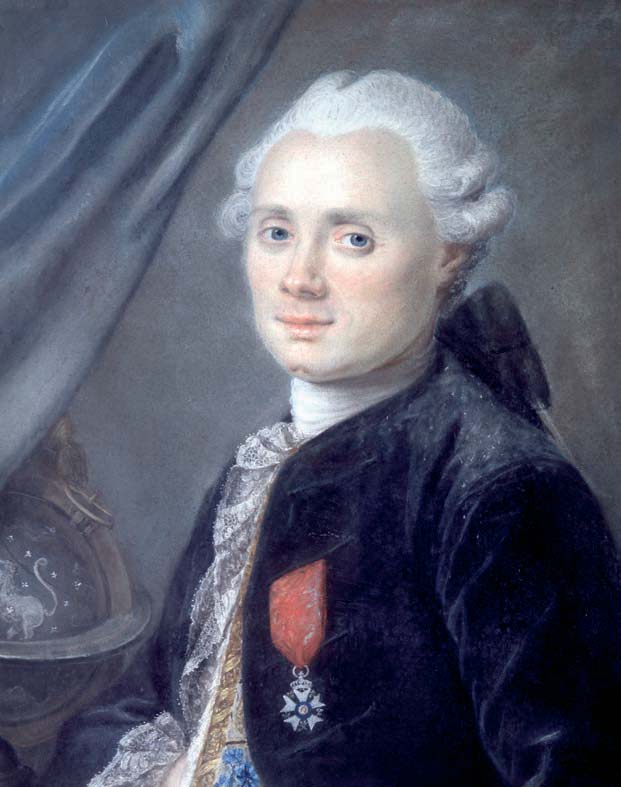
Charles Messier

logo
Community Hub0 Subscribers
Read side by side
from Wikipedia

Charles Messier (French: [ʃaʁl me.sje]; 26 June 1730 – 12 April 1817) was a French astronomer. He published an astronomical catalogue consisting of 110 nebulae and star clusters, which came to be known as the Messier objects, referred to with the letter M and their number between 1 and 110. Messier's purpose for the catalogue was to help astronomical observers distinguish between permanent and transient visually diffuse objects in the sky.

Key Information

Early life

[edit]

Messier was born in Badonviller in the Lorraine region of France, in 1730, the tenth of twelve children of Françoise B. Grandblaise and Nicolas Messier, a Court usher. Six of his brothers and sisters died while young, and his father died in 1741. Charles' interest in astronomy was stimulated by the appearance of the great six-tailed comet in 1744 and by an annular solar eclipse visible from his hometown on 25 July 1748.[1]

Career

[edit]

In 1751, Messier entered the employ of Joseph Nicolas Delisle, the astronomer of the French Navy, who instructed him to keep careful records of his observations. Messier's first documented observation was that of the Mercury transit of 6 May 1753, followed by his observations journals at Cluny Hotel and at the French Navy observatories.[citation needed]

In 1764, Messier was made a fellow of the Royal Society; in 1769, he was elected a foreign member of the Royal Swedish Academy of Sciences; and on 30 June 1770, he was elected to the French Academy of Sciences. He was given the nickname "Ferret of Comets" by King Louis XV.[2]

Messier's grave in Père Lachaise

Near the end of his life, Messier self-published a booklet connecting the great comet of 1769 to the birth of Napoleon, who was in power at the time of publishing. According to Maik Meyer:[3]

As hard as it may seem to accept, the memoir is an ingratiation to Napoleon in order to receive attention and monetary support. It is full of servility and opportunism. Messier did not even refrain from utilizing astrology to reach his goal. Messier comes quickly to the point on the first page of the memoir, by stating that the beginning of the epoch of Napoleon the Great ... coincides with the discovery of one of the greatest comets ever observed.

Messier is buried in Père Lachaise Cemetery in the 20th arrondissement of Paris.[citation needed]

Messier catalogue

[edit]
The Orion Nebula as drawn by Messier, and which he gave the designation M 42 in his catalogue

Messier's occupation as a comet hunter led him to continually come across fixed diffuse objects in the night sky which could be mistaken for comets. He compiled a list of them,[4] in collaboration with his friend and assistant Pierre Méchain (who may have found at least 20 of the objects[5]), to avoid wasting time sorting them out from the comets for which they were looking. The entries are now known to be 39 galaxies, 4 planetary nebulae, 7 other types of nebulae, 26 open star clusters and 29 globular star clusters.[citation needed]

Messier did his observing with a 100 mm (four-inch) refracting telescope from Hôtel de Cluny (now the Musée national du Moyen Âge), in downtown Paris, France. The list he compiled only contains objects found in the area of the sky Messier could observe, from the north celestial pole to a declination of about −35.7° . They are not organised scientifically by object type, or by location. The first version of Messier's catalogue contained 45 objects and was published in 1774 in the journal of the French Academy of Sciences in Paris. In addition to his own discoveries, this version included objects previously observed by other astronomers, with only 17 of the 45 objects being discovered by Messier himself.[6] By 1780 the catalogue had increased to 80 objects.[citation needed]

The final version of the catalogue was published in 1781, in the 1784 issue of Connaissance des Temps.[7][8][9] The final list of Messier objects had grown to 103. On several occasions between 1921 and 1966, astronomers and historians discovered evidence of another seven objects that were observed either by Messier or by Méchain, shortly after the final version was published. These seven objects, M 104 through M 110, are accepted by astronomers as "official" Messier objects.[citation needed]

The objects' Messier designations, from M 1 to M 110, are still used by professional and amateur astronomers today and their relative brightness makes them popular objects in the amateur astronomical community.[10]


Legacy

[edit]
Commemorative plaque in Messier's hometown of Badonviller

The lunar crater Messier and the asteroid 7359 Messier were named in his honour.[11]

Comets discovered

[edit]

Messier discovered 13 comets:[12]

  • C/1760 B1 (Messier)
  • C/1763 S1 (Messier)
  • C/1764 A1 (Messier)
  • C/1766 E1 (Messier)
  • C/1769 P1 (Messier)
  • D/1770 L1 (Lexell)
  • C/1771 G1 (Messier)
  • C/1773 T1 (Messier)
  • C/1780 U2 (Messier)
  • C/1785 A1 (Messier–Méchain)
  • C/1788 W1 (Messier)
  • C/1793 S2 (Messier)
  • C/1798 G1 (Messier)

He also co-discovered comet C/1801 N1 (Pons), a discovery shared with several other observers including Pons, Méchain, and Bouvard.[13]

See also

[edit]

References

[edit]
[edit]
Revisions and contributorsEdit on WikipediaRead on Wikipedia
from Grokipedia
Charles Messier (26 June 1730 – 12 April 1817) was a French astronomer best known for his avid pursuit of comets and for compiling the Messier catalog, a foundational list of 110 deep-sky objects including nebulae, star clusters, and galaxies that he documented to distinguish them from comets during his observations.[1][2][3] Born in the village of Badonviller in Lorraine, France, Messier was the third of six children in a modest family; his formal education ended abruptly at age 11 following his father's death, after which he developed an early interest in astronomy inspired by sightings of the Great Comet of 1744 and a solar eclipse in 1748.[1] At age 21 in 1751, he moved to Paris and secured employment as a draftsman for the French Navy at the Hôtel de Cluny, where he honed his skills in astronomical observation under the guidance of astronomers like Joseph-Nicolas Delisle.[1] Messier's career at the Naval Observatory in Paris, where he rose to become chief astronomer, centered on comet hunting; he independently discovered 13 comets between 1758 and 1793, earning the moniker "Comet Ferret" from King Louis XV, and his most notable find was the Great Comet of 1769, which was visible worldwide and even observed during Captain James Cook's voyage to observe a transit of Venus.[1][4] While systematically scanning the night sky with a small refracting telescope for these elusive objects, Messier frequently encountered fixed "nebulae" that could be mistaken for comets, prompting him to begin cataloging them starting in 1758 after noting the Crab Nebula (M1).[2] His initial catalog, published in 1774 with 45 entries and expanded to 103 by 1781 through collaborations with assistant Pierre Méchain, was later supplemented to 110 objects; this compilation remains a cornerstone for amateur and professional astronomers, serving as a benchmark for observing faint celestial phenomena visible from the Northern Hemisphere.[2] Despite suffering a severe injury from a fall in 1781 that impaired his mobility, Messier continued his work until his death in Paris at age 86, leaving a legacy that has inspired generations of stargazers and modern space telescopes like Hubble, which has imaged nearly all of the catalog's objects.[1][2]

Early Life

Birth and Family Background

Charles Messier was born on June 26, 1730, in the village of Badonviller, located in the Lorraine region of what is now northeastern France. At the time, Badonviller served as the capital of the Principality of Salm-Salm, a small territory within the Holy Roman Empire.[5] He was the tenth of twelve children born to Nicolas Messier, a local commissioner who later became the village's mayor, and his wife, Françoise B. Grandblaise. The Messier family enjoyed considerable wealth due to Nicolas's position in the administration of the principality, which involved duties such as tax collection and local governance. However, the family faced significant hardships, as six of Charles's siblings died in infancy or childhood, a common occurrence in 18th-century rural Europe.[5][6] Tragedy struck the family when Nicolas Messier died in 1741, leaving eleven-year-old Charles without a father. His mother, Françoise, survived until 1765 but was unable to care for all the remaining children alone. Charles and his surviving siblings were effectively orphaned in terms of parental guidance, with the family dynamics shifting to reliance on elder siblings for support and upbringing. In particular, Charles was raised by his older brother Hyacinthe Messier, who assumed a paternal role and provided basic education during this period.[5] At the age of 21, in 1751, Messier left Badonviller for Paris, seeking employment opportunities beyond the rural confines of Lorraine. The move was facilitated by family connections and the changing political landscape of the region, which prompted several siblings, including Hyacinthe, to relocate as well. This transition marked the end of Messier's early family-centered life and his entry into the urban world of 18th-century France.[5]

Education and Initial Influences

Charles Messier developed an early interest in astronomy at age 14 through the observation of the Great Comet of 1744 (C/1743 X1), a bright comet visible worldwide that profoundly inspired him. This interest was further stimulated four years later by his observation of a partial annular solar eclipse on July 25, 1748, visible from his hometown of Badonviller in northeastern France.[5][7] This event, which obscured about 74% of the Sun in his location, prompted him to immerse himself in available astronomical literature.[7] Lacking formal schooling beyond basic education from his brother after his father's death, Messier taught himself the fundamentals of the night sky by studying star charts and texts, including Jean-Dominique Fortin's edition of John Flamsteed's Atlas Coelestis, which provided detailed celestial maps essential for identifying constellations and positions.[5] In 1751, at the age of 21, Messier relocated to Paris and secured an apprenticeship as a scribe and assistant to the astronomer Joseph-Nicolas Delisle, who served as the official Astronomer of the Navy and operated an observatory at the Hôtel de Cluny.[8] Under Delisle's guidance, Messier transitioned from solitary learning to hands-on involvement in astronomical work, assisting with record-keeping and basic computations that honed his skills in precise measurement and documentation.[7] Delisle's observatory exposed Messier to professional-grade instruments, including refracting telescopes and quadrants, allowing him to practice observational techniques such as aligning sights on stars and recording positional data under controlled conditions.[8] This practical training built on his self-study, familiarizing him with the tools and methods of contemporary astronomy. A pivotal influence came in 1757–1758, when Messier, inspired by Edmond Halley's prediction of the comet's return, undertook his first independent observations using a 4.5-foot Newtonian reflector telescope borrowed from Delisle's collection.[7] Although he did not spot Halley's Comet first, his successful detection of another comet (C/1758 K1) on August 14, 1758, validated his growing expertise and fueled his lifelong dedication to comet hunting.[7]

Astronomical Career

Entry into Astronomy and Mentorship

In 1751, Charles Messier relocated to Paris and began his formal entry into astronomy as an assistant to Joseph-Nicolas Delisle, the Astronomer of the French Navy, at the Observatoire de la Marine housed in the Hôtel de Cluny. This role, secured due to Messier's skilled handwriting and basic observational interest, placed him under the royal patronage of the Navy, where he supported nautical astronomy essential for maritime navigation. Delisle, a veteran observer who had traveled to Asia for eclipse expeditions, provided Messier with structured training in recording celestial positions and maintaining observational logs, marking the start of his professional development in a prestigious institution.[5][9] Messier's mentorship under Delisle evolved into more independent responsibilities after Delisle's retirement in 1757, allowing him to continue at the observatory while benefiting from guidance by established astronomers such as Pierre Charles Le Monnier, a fellow Navy-affiliated scholar and Academy member whose work on planetary positions influenced Messier's techniques. Through Le Monnier's connections, Messier gained access to royal telescopes, including refractors up to 100 mm aperture, enabling higher-precision observations from the Cluny tower. Early duties focused on practical applications: Messier drew detailed lunar maps to assist in selenography for navigation and tracked marine chronometers during sea trials, such as his 1767 voyage aboard the frigate L'Aurore to test timepieces for longitude determination, a critical Navy priority amid advances in horology by makers like Ferdinand Berthoud. These tasks honed his skills in positional astronomy, bridging theoretical computation with fieldwork under institutional support.[5][10] A pivotal moment came in 1759 when Messier calculated and independently recovered Halley's Comet on January 21, using orbital predictions adjusted from Edmond Halley's 1705 tables despite errors in Delisle's ephemerides; this achievement, as the first confirmed sighting in France following its December 1758 rediscovery by Johann Palitzsch, earned him widespread recognition among European astronomers for his diligence and computational accuracy. Although his announcement was delayed by Delisle until April, the observation solidified Messier's reputation as a reliable comet hunter and directly contributed to his election as a corresponding member of the French Academy of Sciences in 1770, affirming his transition from assistant to esteemed professional.[5][9]

Professional Roles and Comet Discoveries

Messier held the position of Astronomer to the Navy, a role he assumed officially in 1771 after years of service with the French Navy's Marine Observatory in Paris, where he conducted systematic astronomical observations.[5] King Louis XV bestowed upon him the nickname "Comet Ferret" in recognition of his dedicated pursuit of comets, a moniker reflecting his lifelong commitment to this work under naval auspices.[1] From 1765, he employed a 5-foot focal length refractor telescope crafted by John Dollond, which proved instrumental in his nocturnal sweeps of the sky.[11] Between 1760 and 1798, Messier independently discovered 13 comets, with additional co-discoveries bringing his total involvement to 20, establishing him as the preeminent comet hunter of the 18th century.[7] Notable among these were the Great Comet of 1760 (C/1760 A1), which he co-discovered on January 8 near Orion's sword, and the comet C/1785 A1 (Messier-Méchain), spotted on January 7, 1785, at magnitude 6.5 in the constellation Cetus.[7][5] These findings underscored his skill in identifying transient objects amid the fixed celestial backdrop. Messier's techniques involved rigorous nightly patrols, often conducted from the rooftops of Paris, including the Hôtel de Cluny observatory, where he scanned the heavens for hours to detect moving points of light.[7] He distinguished comets from fixed stars and nebulae by noting their proper motion over successive observations and plotting precise positions against star charts, a method honed through persistent practice.[7] However, he faced significant challenges, including fierce competition from contemporaries like Johann Elert Bode, who claimed several comet discoveries in the 1770s, and the inherent limitations of his era's equipment, such as small-aperture telescopes that restricted faint object detection and required clear skies for success.[7][5]

The Messier Catalog

Origins and Motivational Context

Charles Messier's motivation to compile a catalog of deep-sky objects stemmed from a pivotal observational error in 1758, when he mistook the Crab Nebula for the anticipated return of Halley's Comet during his systematic sweeps of the sky.[12] This incident underscored the risks of confusion between transient comets and fixed nebulae or clusters, prompting Messier to document such "deceptive" objects to aid future astronomers in distinguishing true comets.[13] As a dedicated comet hunter, he recognized that these nebulous appearances could waste valuable time and obscure genuine discoveries in an era when comet observation was a prestigious pursuit.[7] This drive was deeply influenced by the legacy of comet hunting within the French astronomical community, particularly through his early exposure to the Cassini family at the Paris Observatory. Jean-Dominique Cassini, part of the renowned dynasty that directed the observatory, exemplified the rigorous, methodical approach to comet searches that Messier emulated after joining the institution in 1751 under astronomer Joseph Nicolas Delisle.[5] The Cassinis' emphasis on precise mapping and observation instilled in Messier a commitment to cataloging celestial phenomena that mimicked comets, ensuring that such fixed objects would not derail the hunt for periodic visitors like Halley's.[7] In 1771, Messier formalized his efforts by presenting an initial list of 45 such objects to the French Academy of Sciences, inspired in part by Edmond Halley's earlier star catalog, which had set a precedent for systematic enumeration of celestial bodies to facilitate accurate identification.[11] This submission marked the catalog's public inception, driven by Messier's desire to equip the astronomical community with a reference tool amid the limitations of contemporary telescopes, which increasingly revealed faint, comet-like nebulosities.[14] The initial version, published in the Mémoires de l'Académie Royale des Sciences in 1774 (presented to the Academy in 1771), listed 45 objects without numbering, presented in a table format with right ascension, declination, apparent diameter, and terse textual descriptions of appearance and constellation placement.[15] At its core, Messier's personal motivation was to safeguard the efficiency of comet hunting, his lifelong passion, by preemptively identifying and listing these persistent deep-sky impostors, thereby allowing observers to focus on the dynamic phenomena that defined his career.[1]

Compilation Process and Key Objects

Charles Messier conducted his observations for the catalog over a 24-year period from 1758 to 1782, primarily from the Paris Observatory using small refracting telescopes, including his preferred 3.5-inch (90 mm) achromatic instruments with focal lengths around 3.5 feet and magnifications up to 120 times. These modest tools, typical of 18th-century astronomy, allowed him to systematically scan the night sky for diffuse objects that could be mistaken for comets during his hunts. Messier recorded positions and brief descriptions in personal notebooks before formalizing them into publications, often collaborating with Pierre Méchain, who contributed discoveries of 26 objects included in the list. The process involved meticulous nightly sweeps, cross-referencing with prior astronomical records, and verifying non-transient nature through repeated observations. By 1781, Messier expanded it to 103 entries in a revised edition, incorporating additional finds and numbering them sequentially as M1 through M103 for easier reference; this version maintained the structured format, classifying objects implicitly by type—such as nebulae ("nébuleuse"), star clusters ("amas d'étoiles"), or milky patches—while providing concise notes on visibility and structure. Seven more objects (M104 through M110), discovered by Messier and Méchain but not published in his lifetime, were added posthumously in the 20th century by astronomers like Camille Flammarion (M104 in 1921) and Helen Sawyer Hogg (M105–M107 in 1947), bringing the total to 110 based on historical verification of their notes. Among the catalog's entries, several stand out for their prominence and Messier's succinct observations, highlighting the diversity of deep-sky phenomena visible from northern latitudes. M1, the Crab Nebula in Taurus, was the first object cataloged on August 28, 1758 (published later), described as a "nebula without star" resembling a comet's core but confirmed stationary—a supernova remnant from 1054. M31, the Andromeda Galaxy, noted in 1764 as a "beautiful nebula" with a bright nucleus and faint extensions, represents one of the nearest major galaxies. M45, the Pleiades open cluster in Taurus, entered in 1769 with a simple remark on its hazy appearance enclosing several stars, exemplifies a well-known stellar grouping observable even to the naked eye. These examples, drawn from Messier's brief, observational prose, underscore the catalog's mix of 40 galaxies, 29 globular clusters, 27 open clusters, six diffuse nebulae, and four planetary nebulae, aiding comet hunters while cataloging cosmic variety. Despite its thoroughness, the compilation faced limitations inherent to Messier's location and era. Observations from Paris at 48.9° north latitude restricted visibility to objects above about -35° declination, excluding prominent southern sky features like the Large Magellanic Cloud due to horizon obstruction. Additionally, some entries contained errors, such as misidentifications of non-nebulous objects; for instance, M40 was logged as a nebula around two stars but is actually a double star system (Winnecke 4), and M73 an asterism rather than a true cluster—issues later corrected through refined positional data and modern telescopes in the 19th and 20th centuries.

Later Contributions and Personal Life

Additional Astronomical Work

Messier published the initial version of his catalog, containing 45 objects, in the Connaissance des Temps for the year 1771, which appeared in 1774, marking the first widespread dissemination of his work on nebulae and clusters.[15] Subsequent editions expanded the list: the 1780 issue (for 1783) included a supplement adding 23 new objects, bringing the total to 68, while the 1784 issue (published in 1781) featured the final version with 103 entries, incorporating additional discoveries and refined descriptions, often accompanied by engravings of select objects for illustrative purposes.[16] These publications not only updated the catalog with Messier's ongoing observations but also integrated contributions from collaborators like Pierre Méchain, ensuring broader accessibility to astronomers across Europe.[17] Beyond the catalog, Messier contributed detailed memoirs on comet trajectories, including a 1773 account analyzing the path of the comet he discovered in 1766 (C/1766 E1), complete with positional data and orbital insights derived from his nightly observations at the Hôtel de Cluny observatory.[18] He also documented the 1761 transit of Venus, collaborating with Jérôme Lalande to record timings and atmospheric effects from Paris, contributing valuable data to international efforts aimed at measuring the solar parallax.[5] These works underscored Messier's precision in positional astronomy, blending empirical records with geometric analysis to aid contemporary calculations of celestial distances. Complementing such efforts, he maintained meticulous records of lunar eclipses, such as the partial eclipse of October 1767, noting the Moon's penumbral shading and reappearance timings to refine lunar theory and eclipse prediction models.[19] As an elected member of the Académie Royale des Sciences since 1770, Messier actively participated in institutional committees, particularly those evaluating astronomical instruments like telescopes and quadrants, where he assessed their accuracy for meridian observations and comet tracking, influencing standards for equipment used in French observatories.[5] His roles extended to reviewing proposals for observational campaigns, ensuring the integration of reliable tools into national astronomical endeavors.

Family and Health Challenges

In 1770, at the age of 40, Charles Messier married Marie-Françoise de Vermauchampt, a 37-year-old woman he had known for fifteen years through connections at the Collège de France.[5] Their union was brief and marked by tragedy; in March 1772, she gave birth to their son, Antoine-Charles, but both died shortly thereafter, leaving Messier childless and without a surviving immediate family.[5] Despite the short duration of the marriage, de Vermauchampt provided emotional support during Messier's intense observational work in the early 1770s, a period when he was actively compiling his catalog of nebulae and clusters amid frequent comet hunts.[7] Messier's health began to decline in the late 1770s, likely due to the physical demands of his nocturnal observations and exposure to harsh conditions at the Hôtel de Cluny observatory. By the early 1780s, mobility issues emerged, exacerbated by a severe accident on November 6, 1781, when he fell into an ice cellar, sustaining injuries including a broken thigh that confined him to bed for months.[5] Although he recovered sufficiently by late 1782 to resume some activities, these problems limited his ability to conduct extended observing sessions, forcing greater reliance on collaborators for fieldwork.[5] The French Revolution, beginning in 1789, profoundly disrupted Messier's personal stability and finances, as his positions tied to royal institutions came under threat. During the Reign of Terror (1793–1794), he lost his naval salary and Academy pension when the French Academy of Sciences was disbanded and observatory funding was slashed, plunging him into financial strain that required loans from colleagues like Joseph Jérôme Lalande to sustain his household.[5][7] Amid the era's widespread arrests and executions—including the guillotining of his friend Jean-Sylvain de Saron in 1794—Messier faced fears of imprisonment due to his associations with the ancien régime, though he avoided direct persecution.[5] In the absence of close family, Messier found crucial support in his longtime assistant and collaborator, Pierre Méchain, whom he met in 1774 at the Depôt de la Marine. Méchain, acting almost as an adopted family member, assisted in observations and discoveries, identifying at least seven nebulae (M104 through M110) that were incorporated into the expanded Messier Catalog in the 1780s, compensating for Messier's health limitations.[5][20] Their partnership extended through the revolutionary turmoil, with Méchain's contributions ensuring the catalog's completion despite Messier's personal hardships.[20]

Death and Legacy

Final Years and Passing

In his later years, Charles Messier scaled back his astronomical activities due to declining eyesight, effectively retiring from routine observations and ceasing calculations of comet positions by 1806. Despite these limitations, he remained engaged with the field, incorporating the nebula discoveries of his longtime collaborator Pierre Méchain into the Messier catalog until Méchain's death in 1804. Messier's final contribution to the catalog came in the form of a detailed 1801 note on M110, the companion galaxy to M31 (the Andromeda Galaxy), which he had first observed in 1773 but described more fully later in his career.[5][21] By 1815, ongoing health issues culminated in a stroke that partially paralyzed Messier, though he achieved some recovery and attended a few additional meetings of the French Academy of Sciences. These mobility challenges, building on earlier personal hardships, marked the close of his active involvement in astronomy.[5] Messier died on the night of April 11–12, 1817, at his home in Paris, at the age of 86. He was buried two days later, on April 14, in Père Lachaise Cemetery in the 20th arrondissement of Paris.[5][22]

Enduring Impact and Honors

Charles Messier's catalog has served as a foundational resource for modern deep-sky observing, providing astronomers with a standardized list of prominent nebulae, star clusters, and galaxies that facilitated systematic exploration of the night sky.[2] Its influence extended to subsequent catalogs, such as the New General Catalogue (NGC), which built upon Messier's work by expanding the inventory of deep-sky objects while incorporating many of his entries as cross-references in modern astronomical databases.[15] In amateur astronomy, the catalog remains central to activities like the Messier Marathon, an annual challenge where observers attempt to view all 110 objects in a single night, typically during late March under optimal conditions.[23] The catalog's practical utility in protecting comet searches by distinguishing fixed deep-sky objects from transient comets enabled later astronomers, including William Herschel, to focus on new discoveries without redundant observations of known features.[2] Recent efforts, such as the Frosty Drew Observatory's 2020 project to re-image the entire catalog using contemporary telescopes, underscore its ongoing relevance through digitization and high-resolution updates that enhance accessibility for both professionals and enthusiasts.[24] Messier received the Cross of the Legion of Honor from Napoleon Bonaparte in 1806 for his contributions to astronomy.[5] Posthumously, honors include the naming of the lunar crater Messier in the Mare Fecunditatis, an elongated feature approximately 15 km long formed by a low-angle impact, and asteroid 7359 Messier, discovered in 1996 at Kleť Observatory.[25][8] Despite its enduring status as the first modern deep-sky catalog, the Messier list has faced critiques for its northern hemisphere bias, limiting visibility of southern objects for global observers, and its relative brevity of only 110 entries compared to more comprehensive later compilations.[26]
User Avatar
No comments yet.