


Community hub
Recent from talks
Contribute something
Nothing was collected or created yet.
Silvermont
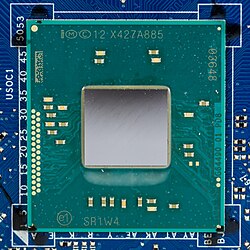
View on Wikipedia Intel Mobile Celeron N2830 | |
| General information | |
|---|---|
| Launched | From 2013 |
| Common manufacturer | |
| Architecture and classification | |
| Technology node | 22 nm |
| Instructions | x86-16, IA-32, x86-64 |
| Extensions | |
| Physical specifications | |
| Cores |
|
| Products, models, variants | |
| Brand names | |
| History | |
| Predecessors | Bonnell Saltwell |
| Successors | Airmont (die shrink), Goldmont (new microarchitecture) |
Silvermont is a microarchitecture for low-power Atom, Celeron and Pentium branded processors used in systems on a chip (SoCs) made by Intel. Silvermont forms the basis for a total of four SoC families:[1]
- Merrifield and Moorefield – consumer SoCs intended for smartphones
- Bay Trail – consumer SoCs aimed at tablets, hybrid devices, netbooks, nettops, and embedded/automotive systems
- Avoton – SoCs for micro-servers and storage devices
- Rangeley – SoCs targeting network and communication infrastructure.
Silvermont is the successor of the Bonnell, using a newer 22 nm process (previously introduced with Ivy Bridge) and a new microarchitecture, replacing Hyper Threading with out-of-order execution.[2]
Silvermont was announced to news media on May 6, 2013, at Intel's headquarters at Santa Clara, California.[3] Intel had repeatedly said the first Bay Trail devices would be available during the Holiday 2013 timeframe, while leaked slides showed that the release window for Bay Trail-T as August 28 – September 13, 2013.[4] Both Avoton and Rangeley were announced as being available in the second half of 2013. The first Merrifield devices were announced in 1H14.[5]
According to the Tick–tock model Airmont is the 14 nm die shrink of Silvermont, launched in early 2015 and first seen in the Atom x7-Z8700 as used in the Microsoft Surface 3.[6] Airmont microarchitecture includes the following SoC families:[7]
- Braswell – consumer SoCs aimed at PCs
- Cherry Trail – consumer SoCs aimed at tablets.
Silvermont based cores have also been used, modified, in the Knight's Landing iteration of Intel's Xeon Phi HPC chips.
Design
[edit]Silvermont was the first Atom processor to feature an out-of-order architecture.[8]
Technology
[edit]- A 22 nm manufacturing process based on 3D tri-gate transistors
- System on chip architecture
- Consumer chips up to quad-core, business-class chips up to eight cores
- Supports SSE4.2 instruction set
- Gen 7 Intel HD Graphics with DirectX 11, OpenGL 4.0, and OpenCL 1.1 support. OpenGL 4.0 is supported with 10.18.10.5161 WHQL[9][10] and later drivers. On Android, Silvermont graphics is OpenGL ES 3.1 certified.[11]
- 10 W TDP desktop processors
- 4.5 and 7.5 W TDP mobile processors
- 20 W TDP Server and Communications processors
Errata
[edit]Intel revealed in its Q4 2016 quarterly report that there were quality issues in the C2000 product family, which had an effect on the financial performance of the company's Data Center Group that quarter.[12] An erratum named AVR54 published by Intel; state there is a defect in the chip's LPC clock, and affected systems "may experience inability to boot or may cease operation".[13][14][15] A workaround is available requiring platform hardware changes. The SoC failures are thought to have led to failures in Cisco and Synology products,[16] though discussion of the C2000 as the root cause of failure has been reported to be under a non-disclosure agreement for many vendors.[17]
Intel released a new C0 stepping of the C2000 series in April 2017 which corrected the bug.[18]
In July 2017 Intel published that a similar quality issue affects also Atom E3800 series embedded processors. The erratum named VLI89 published by Intel state, similar to issue with Atom C2000, that there is a defect in the chip's LPC clock and affected systems "may experience inability to boot or may cease operation".[19] Issues extend also to USB bus and SD card circuitry and should happen "under certain conditions where activity is high for several years". In April 2018 Intel announced it is releasing a new D1 stepping to fix the issue.[20]
The LPC, USB and SD Card buses circuitry degradation issues also apply to other Bay Trail processors such as Intel Celeron J1900 and N2800/N2900 series;[21] also to Pentium N3500, J2850, J2900 series; and Celeron J1800 and J1750 series—as those are based on the same affected silicon.
Cisco stated failures of Atom C2000 processors can occur as early as 18 months of use with higher failure rates occurring after 36 months.[22]
Mitigations were found to limit impact on systems. Firmware update for the LPC bus called LPC_CLKRUN# reduces the utilization of the LPC interface what in turn decreases (but not eliminates) LPC bus degradation - some systems are however not compatible with this new firmware. USB should have a maximum of 10% active time and there is a 50TB transmit traffic life expectancy over the lifetime of the port. It is recommended not to use SD card as a boot device and to remove the card from the system when not in use.
Bay Trail issues on Linux
[edit]It has been widely reported that Bay Trail CPUs (and possibly their derivatives including Airmont/Braswell/Cherry Trail) experience random freezes / lock-ups on various Linux kernels. Reference Linux bug report 109051 on Kernel.org Bugzilla, first reported Dec-2015. Workaround seems to be setting the Linux kernel flag intel_idle.max_cstate=1, which while eliminating the system freezes/lock-ups, results in increased CPU power/battery usage by preventing the CPU from entering higher power-saving C-states. Systems running Windows-OSes apparently do not experience these lockup/freeze issues. The issue had been addressed in the commit "drm/i915: Disable preemption and sleeping while using the punit sideband".
Bay Trail issues on FreeBSD
[edit]A potential fix is to set hw.acpi.cpu.cx_lowest=C1 and dev.cpu.<n>.lowest via /etc/sysctl.conf.
Airmont issues
[edit]14 nm Airmont architecture processors are also affected by the design flaws as noted in the Braswell Specification Update under CHP49 errata.[23] In addition to LPC and SD Card circuitry degradation issues those 14 nm designs also have issues with Real Time Clock (RTC) circuitry degradation, their USB buses are however not affected. Unspecified firmware changes are required to mitigate RTC circuitry degradation. Intel does not plan to release a new stepping for Braswell. Intel admitted the issue stating the impact on consumers depends on use condition.[24]
List of Silvermont processors
[edit]Desktop processors (Bay Trail-D)
[edit]List of desktop processors as follows:
| Target segment |
Cores (threads) |
Processor branding and model |
GPU model | TDP | Turbo (GHz) |
GPU freq. (MHz) |
L2 cache (MB) |
Release date |
Price (USD) | ||
|---|---|---|---|---|---|---|---|---|---|---|---|
| 1-core | Base | Turbo | |||||||||
| Value | 4 (4) | Pentium | J2900 | HD Graphics (4 EU) |
10 W / 2.41 GHz | 2.67 | 688 | 896 | 2 | Q4 2013 | $94 |
| J2850 | — | 792 | Q3 2013 | ||||||||
| Celeron | J1900 | 10 W / 2.0 GHz | 2.42 | 854 | Q4 2013 | $82 | |||||
| J1850 | — | 792 | Q3 2013 | ||||||||
| 2 (2) | J1800 | 10 W / 2.41 GHz | 2.58 | 1 | Q4 2013 | $72 | |||||
| J1750 | — | 750 | Q3 2013 | ||||||||
Server processors (Avoton)
[edit]It has been found that a bug in the blueprint of the C2000 CPUs family may cause failure of its embedded Ethernet ports.[citation needed]
List of server processors as follows:[25]
| Target segment |
Cores (threads) |
Processor branding and model |
GPU model | TDP | CPU Turbo (GHz) |
Graphics clock rate | L2 cache (MB) |
Release date |
Price (USD) | ||
|---|---|---|---|---|---|---|---|---|---|---|---|
| 1-core | Normal | Turbo | |||||||||
| Server | 8 (8) | Atom | C2750 | — | 20 W / 2.4 GHz | 2.6 | — | — | 4 | Q3 2013 | $171 |
| C2730 | 12 W / 1.7 GHz | 2.0 | $150 | ||||||||
| 4 (4) | C2550 | 14 W / 2.4 GHz | 2.6 | 2 | $86 | ||||||
| C2530 | 9 W / 1.7 GHz | 2.0 | $70 | ||||||||
| 2 (2) | C2350 | 6 W / 1.7 GHz | 1 | $43 | |||||||
Communications processors (Rangeley)
[edit]List of communications processors as follows:[26]
| Target segment |
Cores (threads) |
Processor branding and model |
GPU model | TDP | CPU Turbo (GHz) |
GPU freq. | Intel QuickAssist |
L2 cache (MB) |
Release date |
Price (USD) | ||
|---|---|---|---|---|---|---|---|---|---|---|---|---|
| 1-core | Normal | Turbo | ||||||||||
| Communications | 8 (8) | Atom | C2758 | — | 20 W / 2.4 GHz | — | — | — | Yes | 4 | Q3 2013 | $208 |
| C2738 | No | |||||||||||
| C2718 | 18 W / 2.0 GHz | Yes | $182 | |||||||||
| 4 (4) | C2558 | 15 W / 2.4 GHz | 2 | $104 | ||||||||
| C2538 | No | |||||||||||
| C2518 | 13 W / 1.7 GHz | Yes | $91 | |||||||||
| C2508 | 9.5 W / 1.25 GHz | Q2 2014 | $98 | |||||||||
| 2 (2) | C2358 | 7 W / 1.7 GHz | 2.0 | 1 | Q3 2013 | $60 | ||||||
| C2338 | No | |||||||||||
| C2308 | 6 W / 1.25 GHz | — | Yes | Q2 2014 | ||||||||
Embedded/automotive processors (Bay Trail-I)
[edit]List of embedded processors as follows:[27]
| Target segment |
Cores (threads) |
Processor branding and model |
GPU model | TDP | CPU Turbo | GPU freq. (MHz) |
L2 cache |
Release date |
Price (USD) | ||
|---|---|---|---|---|---|---|---|---|---|---|---|
| 1-core | Base | Turbo | |||||||||
| Embedded | 4 (4) | Atom | E3845 | HD Graphics (4 EU) |
10 W / 1.91 GHz | — | 542 | 792 | 2 MB | Q4 2013 | $52 |
| 2 (2) | E3827 | 8 W / 1.75 GHz | 1 MB | $41 | |||||||
| E3826 | 7 W / 1.46 GHz | 533 | 677 | $37 | |||||||
| E3825 | 6 W / 1.33 GHz | — | $34 | ||||||||
| 1 (1) | E3815 | 5 W / 1.46 GHz | 400 | 512 KB | $31 | ||||||
| 2 (2) | E3805 | — | 3 W / 1.33 GHz | — | 1 MB | Q4 2014 | |||||
Mobile processors (Bay Trail-M)
[edit]List of mobile processors as follows:
| Target segment |
Cores (threads) |
Processor branding & model |
GPU model | TDP | CPU turbo (GHz) |
GPU freq. (MHz) |
L2 cache (MB) |
Release date |
Price (USD) | ||
|---|---|---|---|---|---|---|---|---|---|---|---|
| Base | Turbo | ||||||||||
| Value | 4 (4) | Pentium | N3540 | Intel HD Graphics (4 EU) |
7.5 W / 2.16 GHz | 2.66 | 313 | 896 | 2 | 2014-07-20 | $161 |
| N3530 | 2.58 | 2014-02-23 | |||||||||
| N3520 | 7.5 W / 2.166 GHz | 2.42 | 854 | 2013-11-03 | |||||||
| N3510 | 7.5 W / 2.0 GHz | — | 750 | 2013-09-11 | |||||||
| Celeron | N2940 | 7.5 W / 1.83 GHz | 2.25 | 854 | Q3 2014 | $107 | |||||
| N2930 | 2.16 | 2014-02-23 | |||||||||
| N2920 | 7.5 W / 1.86 GHz | 2.0 | 844 | 2013-11-03 | |||||||
| N2910 | 7.5 W / 1.6 GHz | — | 756 | 2013-09-11 | |||||||
| 2 (2) | N2840 | 7.5 W / 2.16 GHz | 2.58 | 311 | 792 | 1 | Q3 2014 | ||||
| N2830 | 2.41 | 313 | 750 | 2014-02-23 | |||||||
| N2820 | 7.5 W / 2.13 GHz | 2.39 | 756 | 2013-11-03 | |||||||
| N2815 | 7.5 W / 1.86 GHz | 2.13 | |||||||||
| N2810 | 7.5 W / 2.0 GHz | — | 2013-09-11 | ||||||||
| N2808 | 4.5 W / 1.58 GHz | 2.25 | 311 | 792 | Q3 2014 | ||||||
| N2807 | 4.3 W / 1.58 GHz | 2.16 | 313 | 750 | 2014-02-23 | ||||||
| N2806 | 4.5 W / 1.6 GHz | 2.0 | 756 | 2013-11-03 | |||||||
| N2805 | 4.3 W / 1.46 GHz | — | 667 | 2013-09-11 | |||||||
Tablet processors (Bay Trail-T)
[edit]List of tablet and hybrid processors as follows:
| Target segment |
Cores (threads) |
Processor branding & model |
SDP[28](W) | CPU freq. (GHz) |
L2 cache (MB) |
GPU model | GPU freq. (MHz) |
Memory | Max display resolution | Socket | Release date |
Price (USD) | |||||||
|---|---|---|---|---|---|---|---|---|---|---|---|---|---|---|---|---|---|---|---|
| Base | Turbo | Base | Burst | Type | # channels | Max speed | Max bandwidth | Max supported | |||||||||||
| Value | 4 (4) | Atom | Z3795 | 2 | 1.66 | 2.39 | 2 | HD Graphics (4 EU) | 311 | 778 | LPDDR3 | 2x64b | 1067MT/s | 17.1 GB/s | 4 GB | FCBGA1380 | Q1 2014 | $40.00 | |
| Z3785 | 2.2 | 1.49 | 2.41 | 313 | 833 | 1333MT/s | 21.3 GB/s | Q2 2014 | |||||||||||
| Z3775 | 2 | 1.46 | 2.39 | 311 | 778 | 1067MT/s | 17.1 GB/s | Q1 2014 | $35.00 | ||||||||||
| Z3775D | 2.2 | 1.49 | 2.41 | 792 | DDR3L-RS | 1x64b | 1333MT/s | 10.6 GB/s | Q1 2014 | $35.00 | |||||||||
| Z3770 | 2 | 1.46 | 2.39 | 667 | LPDDR3 | 2x64b | 1067MT/s | 17.1 GB/s | 2560×1600 | 11 September 2013 | $37.00 | ||||||||
| Z3770D | 2.2 | 1.5 | 2.41 | 313 | 688 | DDR3L-RS | 1x64b | 1333MT/s | 10.6 GB/s | 2 GB | 1920×1280 | ||||||||
| Z3740 | 2 | 1.33 | 1.86 | 311 | 667 | LPDDR3 | 2x64b | 1067MT/s | 17.1 GB/s | 4 GB | 2560×1600 | $32.00 | |||||||
| Z3740D | 2.2 | 1.83 | 313 | 688 | DDR3L-RS | 1x64b | 1333MT/s | 10.6 GB/s | 2 GB | 1920×1280 | |||||||||
| Z3735F | 311 | 646 | 10.6 GB/s | 1920×1200 | FCBGA592 | Q1 2014 | $17.00 | ||||||||||||
| Z3735G | 1x32b | 5.3 GB/s | 1 GB | 1200×800 | |||||||||||||||
| 2 (2) | Z3680 | 2.0 | 1 | 667 | LPDDR3 | 1x64b | 1067MT/s | 8.5 GB/s | 1280×800 | 11 September 2013 | — | ||||||||
| Z3680D | 688 | DDR3L-RS | 1x64b | 1333MT/s | 10.6 GB/s | 2 GB | 1920×1280 | ||||||||||||
Smartphone processors (Merrifield)
[edit]List of smartphone processors as follows:
| Model | sSpec number |
Cores | Clock rate | GPU frequency |
L2 cache |
I/O bus | Memory | Voltage | TDP | Socket | Release date | Part number(s) |
Release price (USD) |
|---|---|---|---|---|---|---|---|---|---|---|---|---|---|
| Atom Z3460 |
|
2 | 1.6 GHz | 400–457 MHz | 1 MB | 2 × LPDDR3-1066 | March 2014 |
|
|||||
| Atom Z3480 |
|
2 | 2.13 GHz | 457–533 MHz | 1 MB | 2 × LPDDR3-1066 | March 2014 |
|
Smartphone processors (Moorefield)
[edit]List of smartphone processors as follows:
| Model | sSpec number |
Cores | Clock rate | GPU frequency |
L2 cache |
I/O bus | Memory | Voltage | TDP | Socket | Release date | Part number(s) |
Release price (USD) |
|---|---|---|---|---|---|---|---|---|---|---|---|---|---|
| Atom Z3530 |
|
4 | 1.33 GHz | 457 MHz | 2 × 1 MB | 2 × LPDDR3-1600 | H2 2014 |
|
|||||
| Atom Z3560 |
|
4 | 1.83 GHz | 457–533 MHz | 2 × 1 MB | 2 × LPDDR3-1600 | H2 2014 |
|
|||||
| Atom Z3570 | 4 | 2.00 GHz | 457–640 MHz | 2 × 1 MB | 2 × LPDDR3-1600 | Q4 2014 | |||||||
| Atom Z3580 |
|
4 | 2.33 GHz | 457–533 MHz | 2 × 1 MB | 2 × LPDDR3-1600 | H2 2014 |
|
|||||
| Atom Z3590 | 4 | 2.50 GHz | 457–640 MHz | 2 × 1 MB | 2 × LPDDR3-1600 | H2 2015 |
List of Airmont processors
[edit]Desktop processors (Braswell)
[edit]List of desktop processors as follows:
| Target segment |
Cores (threads) |
Processor branding and model |
GPU model | TDP | Turbo (GHz) |
GPU freq. (MHz) |
L2 cache (MB) |
Release date |
Price (USD) | |||
|---|---|---|---|---|---|---|---|---|---|---|---|---|
| Brand name & model number |
EU | 1-core | Base | Turbo | ||||||||
| Desktop | 4 (4) | Pentium | J3710 | HD Graphics 405 | 18 | 6.5 W / 1.6 GHz |
2.64 | 400 | 740 | 2 | January 2016 |
N/A |
| Celeron | J3160 | HD Graphics 400 | 12 | 6 W / 1.6 GHz |
2.24 | 320 | 700 | |||||
| 2 (2) | J3060 | 2.48 | 2 [note 1] | |||||||||
Mobile processors (Braswell)
[edit]List of mobile processors as follows:
| Target segment |
Cores (threads) |
Processor branding and model |
GPU Model | TDP | Turbo (GHz) |
GPU freq. (MHz) |
L2 cache (MB) |
Release date |
Price (USD) | |||
|---|---|---|---|---|---|---|---|---|---|---|---|---|
| Brand name & model number |
EU | 1-core | Base | Turbo | ||||||||
| Mobile | 4 (4) | Pentium | N3710 | HD Graphics 405 | 16 | 6W / 1.6 GHz |
2.56 | 400 | 700 | 2 | Q1 2016 | $161 |
| N3700 | HD Graphics (Braswell)[note 2] | 2.4 | Q1 2015 | |||||||||
| Celeron | N3160 | HD Graphics 400 | 12 | 2.24 | 320 | 640 | Q1 2016 | $107 | ||||
| N3150 | HD Graphics (Braswell) [note 2] |
2.08 | Q1 2015 | |||||||||
| 2 (2) | N3060 | HD Graphics 400 | 2.48 | 600 | 2[note 1] | Q1 2016 | ||||||
| N3050 | HD Graphics (Braswell) [note 2] |
2.16 | Q1 2015 | |||||||||
| N3010 | HD Graphics 400 | 4W / 1.04 GHz | 2.24 | Q1 2016 | ||||||||
| N3000 | HD Graphics (Braswell) [note 2] |
2.08 | Q1 2015 | |||||||||
- ^ a b Some initial reports stated that the processor has 1 MB L2 cache; see Anthony Shvets. "Notes below Specifications". CPU World.
- ^ a b c d Klaus Hinum (January 26, 2016). "Intel HD Graphics (Braswell)". Notebookcheck Publishing GmbH.
Tablet processors (Cherry Trail)
[edit]List of smartphone and tablet processors as follows:
| Target segment |
Cores (threads) |
Processor branding and model |
SDP (W) |
L2 cache (MB) |
CPU freq. (GHz) |
GPU | Socket | Release date |
Price (USD) | |||||
|---|---|---|---|---|---|---|---|---|---|---|---|---|---|---|
| Brand name | EU | Freq. (MHz) | ||||||||||||
| Base | Turbo 1-core | Base | Turbo | |||||||||||
| Tablet | 4 (4) | Atom x7 | Z8750 | 2 | 2 | 1.6 | 2.56 | HD Graphics | 16 | 200 | 600 | FCBGA1380 | Q1 2016 | $37 |
| Z8700 | 2.4 | Q1 2015 | ||||||||||||
| Atom x5 | Z8550 | 1.44 | 12 | $27 | ||||||||||
| Z8500 | 2.24 | |||||||||||||
| Z8350 | 1.92 | 500 | FCBGA594 | Q1 2016 | $21 | |||||||||
| Z8330 | ||||||||||||||
| Z8300 | 1.84 | Q2 2015 | $21 | |||||||||||
Other uses
[edit]Silvermont based processor cores have been used in Knights Landing versions of Intel's Xeon Phi multiprocessor HPC chips, with changes for HPC including AVX-512 vector units.[29][30]
Intel also licensed Airmont CPU cores to Spreadtrum (now UNISOC) for use with two of its SoCs launched in 2017: SC9861G-IA[31] and SC9853l.[32]
See also
[edit]References
[edit]- ^ "Intel Launches Low-Power, High-Performance Silvermont Microarchitecture". Intel.com. Retrieved 2013-05-06.
- ^ "Deep inside Intel's new ARM killer: Silvermont". The Register. 2013-05-08. Retrieved 2014-04-08.
- ^ "Intel Launches Low-Power, High-Performance Silvermont Microarchitecture". Newsroom.intel.com. 2013-05-06. Retrieved 2014-04-08.
- ^ "Intel Bay Trial-T launches August 28 – September 13". guru3d.com. Retrieved 2013-07-04.
- ^ "Intel reveals Merrifield processor". engadget.com. Retrieved 2013-06-04.
- ^ Joel Hruska (March 31, 2015). "Intel quietly launches 14nm Braswell, Bay Trail's successor". ExtremeTech.
- ^ Michael Kan. "Intel plans new 'Braswell' chip for PCs, over 20 Chromebooks". PCWorld. Retrieved 2014-04-08.
- ^ Anand Lal Shimpi. "Intel's Silvermont Architecture Revealed: Getting Serious About Mobile". Archived from the original on May 8, 2013.
- ^ "Download Intel® Graphics Driver for Windows 7* and 8.1*, and Windows® 10 [15.33]". Drivers & Software.
- ^ "Intel HD Graphics Drivers v10.18.10.3621 with one new OpenGL Extension". Geeks3D. Retrieved 2014-06-05.
- ^ "OpenGL ES Conformant product list". Khronos Group. 11 January 2014. Retrieved 11 January 2014.
- ^ Alcorn, Paul (31 January 2017). "CPU Failures Hurt Intel's Bottom Line". Tom's Hardware. Retrieved 7 February 2017.
- ^ Hellstrom, Jeremy (7 February 2017). "Intel's Atom C2xxx processors may just make like a banana and split". PC Perspective. Retrieved 7 February 2017.
- ^ Calburn, Thomas (6 February 2017). "Atom C2000 chips are bricking products – and it's not just Cisco hit". The Register. Retrieved 7 February 2017.
- ^ "Intel Atom Processor C2000 Product Family Specification Update" (PDF). Intel Atom Processor C2000 Product Family Specification Update. Intel. Retrieved 7 February 2017.
- ^ Kampman, Jeff (7 February 2017). "Report: Some embedded Atom CPUs can brick their host systems". Tech Report. Retrieved 7 February 2017.
- ^ Kennedy, Patrick (7 February 2017). "The Intel Atom C2000 Series Bug – Why It is So Quiet". ServeTheHome. Retrieved 28 February 2017.
- ^ Robinson, Cliff (23 April 2017). "Intel Atom C2000 C0 Stepping Fixing the AVR54 Bug". Serve the Home. Retrieved 25 April 2017.
- ^ "Intel Atom® Processor E3800 Specification Update" (PDF). Retrieved 2018-04-13.
- ^ "Product Change Notification 116196 - 00" (PDF). 2018-04-09.
- ^ "Intel® Celeron® Processor J1900, N2807 & N2930 for Internet of Things Platforms Specification Update Addendum" (PDF). Retrieved 2018-04-14.
- ^ "Clock Signal Component Issue". Cisco. Retrieved 2018-04-14.
- ^ "N-series Intel® Pentium® Processors and Intel® Celeron® Processors Specification Update" (PDF). Retrieved 2018-04-15.
- ^ "Another Atom Bomb Intel Atom E3800 Bay Trail VLI89 Bug". ServeTheHome. 2018-04-13.
- ^ "Intel® Atom™ Processor for Server". Ark.intel.com. Retrieved 2014-04-08.
- ^ "Intel® Atom™ Processor for Communications". Ark.intel.com. Retrieved 2014-04-08.
- ^ "Products (Formerly Bay Trail)". Ark.intel.com. Retrieved 2014-04-08.
- ^ "Intel® Atom™ Processor Z36xxx and Z37xxx Series: Datasheet, V.1". Intel.com. Retrieved 2014-04-08.
- ^ Sodani, Avinash, Knights Landing (KNL): 2nd Generation Intel® Xeon Phi™ Processor (PDF), Intel, p. 5
- ^ Smith, Ryan (26 June 2014), "Intel's "Knights Landing" Xeon Phi Coprocessor Detailed", www.anadtech.com, archived from the original on June 26, 2014
- ^ "Spreadtrum launches 14nm 8-core 64-bit mid- and high-end LTE SoC platform (press release)". Spreadtrum Communications Inc. 2017-02-27. Archived from the original on 2017-03-01. Retrieved 2025-08-30.
- ^ "Spreadtrum Launches Complete Lines of High-Performance LTE SoC Platforms for the Global Mainstream Consumer Market (press release)". 2017-08-15. Retrieved 2025-08-30 – via PR Newswire.
Silvermont
View on GrokipediaBackground
Overview
Silvermont is a low-power x86 microarchitecture developed by Intel, introduced as the first in the Atom lineup to incorporate out-of-order execution, targeting systems-on-chip (SoCs) for mobile, embedded, and low-power computing applications.[1] It powers Atom, Celeron, and Pentium branded processors fabricated on a 22 nm Tri-Gate process node, marking a significant evolution from the in-order designs of previous generations.[2] The architecture employs a modular design with dual-core units, enabling scalable configurations up to eight cores across multi-module setups.[2] Announced on May 6, 2013, Silvermont succeeded the Saltwell microarchitecture (part of the Bonnell/Saltwell lineage) and launched later that year in products like Bay Trail and Merrifield SoCs.[1] Its primary goals were to enhance performance-per-watt efficiency by approximately 3x in peak performance or deliver equivalent performance at about 5x lower power consumption relative to prior Atom cores, addressing limitations in instruction-level parallelism and energy use from predecessors like Saltwell.[1] Basic specifications include support for 2 threads per dual-core module (one per core), clock speeds typically ranging from 1.3 to 2.4 GHz, and thermal design power (TDP) ratings of 2 to 10 W.[2] As part of Intel's broader strategy to reinvent the Atom brand for the post-PC era, Silvermont aimed to expand into competitive segments including tablets, smartphones, microservers, and automotive systems, challenging ARM dominance in low-power markets.[5] This microarchitecture was later succeeded by the 14 nm Airmont shrink in 2015.[6]Development history
Development of the Silvermont microarchitecture began around 2010-2011 as part of Intel's strategic response to intensifying competition from ARM-based processors in the mobile and low-power computing markets.[7][8] Intel recognized the need to overhaul its Atom lineup, which had struggled with power efficiency and performance in emerging segments like smartphones and tablets, prompting a roadmap revision to prioritize sub-10W designs.[7] Internally code-named Silvermont, the architecture was first publicly revealed in Intel's 2012 product roadmap, emphasizing a ground-up redesign to deliver substantial improvements in instructions per cycle (IPC) while incorporating out-of-order execution to improve performance while controlling power consumption.[8] The design targeted a 50% IPC uplift over the prior Saltwell microarchitecture, addressing the latter's limitations in single-threaded performance and efficiency, where Saltwell typically achieved around 0.6 IPC compared to Silvermont's goal of approximately 1.0 IPC.[9][10] This focus, including the adoption of out-of-order execution optimized for low power, aimed to enable competitive SoCs for tablets and embedded systems.[9] Key milestones included tape-out in late 2012, followed by first silicon validation in mid-2013, culminating in the launch of Silvermont-based products like the Bay Trail SoC platform in the fourth quarter of 2013.[3][11] Intel officially unveiled Silvermont on May 6, 2013, highlighting its integration into quad-core configurations for consumer devices and its projected 3x performance-per-watt gains over predecessors. Challenges during development centered on balancing die size reductions with enhanced branch prediction and wider execution units, all while fabricating in-house on Intel's 22 nm process to meet aggressive power envelopes under 3W for mobile applications.[9][10] Following its debut, Silvermont evolved into the Airmont microarchitecture, a 14 nm shrink introduced in 2015 for broader adoption in tablets and 2-in-1 devices, which refined power management and graphics integration while retaining core design principles.[6] This led to the Goldmont architecture in 2016, marking a further iteration with enhanced vector processing and security features for IoT and entry-level computing.Microarchitecture
Core design
The Silvermont microarchitecture features an out-of-order execution engine for integer operations, marking a significant departure from the in-order designs of prior Atom generations like Saltwell, while maintaining in-order execution for floating-point and memory operations to balance performance and power efficiency in low-power SoCs.[1][12] This design enables better single-threaded performance without excessive power draw, with cores organized in a modular cluster configuration where pairs of cores share key resources. Each cluster includes two physical cores that share a 1 MB L2 cache with 16-way set associativity, a common bus interface, and unified power domains, allowing for efficient scaling up to eight cores in multi-cluster SoCs while minimizing overhead from independent core operation.[13][1] Silvermont cores fully support the x86-64 instruction set architecture, including SSE4.2 for 128-bit SIMD vector processing, but lack native AVX support in standard implementations to prioritize area and power constraints in mobile and embedded applications; optional Hyper-Threading (simultaneous multithreading) is available in select configurations, such as server-oriented variants, enabling up to four threads per dual-core cluster by doubling logical processors per core.[1][14] Integer execution per core includes two arithmetic logic units (ALUs) for basic operations like add and shift, paired with dedicated address generation units (AGUs) in a separate memory execution cluster for load/store address calculations; the floating-point unit is a 128-bit wide vector processor optimized for SSE instructions, capable of handling both scalar and packed floating-point data types with latencies of 3 cycles for add and 3-5 cycles for multiply operations.[15][16] The front-end employs a 2-wide decoder that can process up to two x86 instructions per cycle, emitting up to two micro-operations (uops), and incorporates macro-op fusion to combine common instruction pairs—such as compare-and-branch—into a single uop for reduced decode bandwidth and improved efficiency on control-heavy code.[12] Branch prediction is handled by a dual-scheme mechanism: a primary fetch-directed predictor for early direction and target speculation, augmented by a secondary decode-stage predictor that can override the initial guess for higher accuracy, representing a substantial upgrade over Saltwell's simpler predictor with lower misprediction penalties (around 10-12 cycles) and better handling of indirect branches through global history tracking.[17] The overall integer pipeline spans 14 stages for simple operations, integrating these elements into a cohesive flow that emphasizes responsiveness in power-sensitive environments.[18]Pipeline and execution units
Silvermont employs a 14-stage out-of-order pipeline to enhance instruction throughput while maintaining low power consumption. The front-end, comprising fetch and decode stages, spans approximately four stages overall, enabling efficient handling of instruction streams. The execution phase includes six stages that integrate integer and floating-point processing, followed by a four-stage back-end for retirement and writeback. This structure reduces latency compared to prior Atom designs by decoupling memory access from the core integer pipeline.[19][20] The fetch unit processes 16 bytes of instructions per cycle, supported by a branch target buffer and predictor to minimize disruptions. A loop stream detector identifies small loops and buffers up to 32 decoded instructions in an instruction queue, allowing the front-end to be clock-gated for power savings during repetitive execution. Decode follows with a width of two macroinstructions per cycle, fusing common operations where possible to optimize queue entry.[14][19] Dispatch occurs at two instructions per cycle into the out-of-order engine, accompanied by a register rename stage that allocates from 32 physical registers each for integer and floating-point/SSE operations. Execution throughput reaches two integer operations per cycle across two arithmetic logic units, one 128-bit floating-point vector operation per cycle, and one load plus one store per core, leveraging distributed reservation stations for scheduling.[12][19] The back-end retires up to two instructions per cycle in program order via a 32-entry reorder buffer. Branch misprediction incurs a penalty of 10 cycles, three cycles lower than in Saltwell, due to streamlined recovery mechanisms. Overall, these enhancements yield about 50% higher instructions per cycle (IPC) than Saltwell, driven by wider decoding, out-of-order capabilities, and superior branch prediction, with typical workloads achieving 0.6 to 0.8 IPC.[3][9]Cache and memory subsystem
Silvermont employs a two-level on-chip cache hierarchy designed for low-power efficiency, with no dedicated L3 cache; instead, it relies directly on system memory for higher-level caching needs. Each core features a private L1 instruction cache of 32 KB, organized as 8-way set associative with 64-byte cache lines, alongside a 24 KB L1 data cache that is 6-way set associative using the same line size. These L1 caches are non-inclusive, allowing for optimized power and area usage without requiring the L2 to duplicate all L1 contents. The load/store units in the execution pipeline interface directly with these caches, achieving a typical L1 hit latency of 3 cycles to support timely data access.[21][22][19] The L2 cache is unified and shared within a dual-core cluster, providing 1 MB per pair (totaling 2 MB in quad-core configurations), implemented as 16-way set associative with 64-byte lines, inclusive of the L1 instruction cache but non-inclusive and non-exclusive of the L1 data cache, to balance coherence management and efficiency. This design balances capacity and latency, with load-to-use times around 14-17 cycles, while delivering up to 32 bytes per cycle bandwidth shared between the cores in the cluster. The absence of an L3 cache underscores Silvermont's focus on embedded and mobile applications, where system memory serves as the next level in the hierarchy.[13][19][22] Translation lookaside buffers (TLBs) in Silvermont support efficient virtual-to-physical address translation, with a 48-entry fully associative L1 instruction TLB and data TLB, covering 4 KB pages. A unified L2 TLB backs these with 512 entries, also 4-way set associative, to handle misses and larger page sizes including 2 MB and 4 MB. Hardware prefetchers enhance memory access patterns: the data prefetcher implements stride detection for regular accesses and adjacent-line prefetching to anticipate sequential loads, while the instruction prefetcher uses a 128-entry buffer to fetch ahead in code streams.[19][21] The integrated memory controller supports dual-channel DDR3L-1600 memory, delivering up to 25.6 GB/s aggregate bandwidth, with mobile variants also accommodating LPDDR3 for lower power consumption. It operates within a 64-bit address space, enabling access to large memory configurations suitable for embedded systems. This subsystem prioritizes bandwidth efficiency over raw capacity, aligning with Silvermont's power-constrained environments.[23][19]Key technologies
Manufacturing process
Silvermont processors are fabricated using Intel's 22 nm process technology, which incorporates 3-D tri-gate transistors—Intel's implementation of FinFETs—to achieve superior gate control and significantly reduced leakage current compared to planar transistors.[1][24] This structure enables up to 37% higher performance at low voltages or 50% lower power consumption at equivalent performance levels relative to the prior 32 nm planar process used in the Saltwell microarchitecture.[24] The 22 nm node delivers approximately double the transistor density of the 32 nm process, facilitating more compact system-on-chip (SoC) designs suitable for mobile and embedded applications.[25] The manufacturing process supports dynamic frequency and voltage scaling, with core voltages ranging from 0.8 V to 1.1 V to balance performance and power efficiency across varying workloads. For the Bay Trail implementation, the dual-core die contains approximately 1.9 billion transistors and measures about 102 mm², reflecting the density advantages of the FinFET technology. High-volume production of Silvermont-based SoCs commenced in the third quarter of 2013, primarily at Intel's fabrication facilities in the United States (Oregon and Arizona) and Ireland, ensuring scalable output for platforms like Bay Trail and Avoton.[24] These sites benefited from process optimizations that improved yields for the complex tri-gate structures, enabling TDP ranges as low as 2 W for ultra-low-power devices.[1]Integrated graphics and I/O
The integrated graphics in Silvermont-based systems vary by platform to suit different form factors and power envelopes. In consumer and embedded implementations such as Bay Trail, the SoC incorporates Intel HD Graphics (Generation 7), derived from the Ivy Bridge architecture, featuring 4 execution units with base clocks around 313 MHz and boosts up to 896 MHz depending on thermal and power conditions. This GPU supports DirectX 11 feature level 11_0, OpenGL 4.0, and OpenCL 1.2, enabling hardware-accelerated video decode for formats like H.264 and basic 3D rendering for embedded applications.[26][27] Mobile-oriented Merrifield platforms, however, utilize a licensed Imagination Technologies PowerVR G6400 GPU with 4 shader cores operating at 457 MHz base and up to 533 MHz boost, tailored for smartphone workloads with support for OpenGL ES 3.0 and efficient power gating for battery life. Server variants like Avoton and Rangeley exclude integrated graphics entirely, focusing instead on dense I/O for networked environments without display requirements. The graphics bandwidth in these SoCs relies on the integrated DDR3L/LPDDR3 memory controller, which provides up to 12.8 GB/s in dual-channel configurations for Bay Trail.[28][29] Display capabilities in Silvermont SoCs with graphics integration support up to two independent outputs, including HDMI 1.4a (up to 1920x1080 at 60 Hz), DisplayPort 1.2 (up to 2560x1600 at 60 Hz), and LVDS/eDP interfaces for panel integration at similar resolutions. These features facilitate multi-monitor setups in tablets and thin clients, with hardware support for overlay planes and color space conversions.[26] The I/O complement emphasizes connectivity for low-power embedded systems, including PCIe 2.0 with up to 4 lanes (x1 or x4 configurations) for peripherals and storage expansion. USB support comprises one USB 3.0 port (5 Gb/s) and up to five USB 2.0 ports (480 Mb/s), alongside two SATA 3.0 (6 Gb/s) ports for HDD/SSD attachment and an SD 3.0 card controller in mobile variants for removable media. Networking integration appears in server models like Avoton, which includes up to four 10/100/1000 Ethernet MACs with IEEE 1588 precision timing, while mobile platforms offload Wi-Fi (802.11ac) and Bluetooth 4.0 via PCIe or USB interfaces to external modules.[30][31]Power management features
Silvermont incorporates Enhanced Intel SpeedStep Technology (EIST) for dynamic frequency and voltage scaling, allowing the processor to adjust operating points based on workload demands to balance performance and power efficiency. Additionally, Intel Turbo Boost Technology enables short bursts of higher performance, up to 2.4 GHz in select implementations, when thermal and power headroom is available. The architecture supports C-states ranging from C0 (active state) to C6 (deep sleep), where the C6 state reduces core voltage to near zero volts, minimizing leakage and enabling low-power idle modes.[9][32][23] Per-cluster power gating permits independent shutdown of dual-core clusters sharing a 1 MB L2 cache, reducing static power when inactive cores or entire clusters are not needed. Fine-grained clock gating is applied at various pipeline stages and functional units to eliminate unnecessary switching activity, thereby lowering dynamic power dissipation. The design features separate voltage and frequency domains for the CPU cores, integrated graphics, and I/O subsystems, with adaptive voltage scaling (AVS) compensating for process variations to optimize margins and efficiency.[9][1] Thermal power design is configurable across implementations, with thermal design power (TDP) ratings as low as 2.2 W for mobile tablet platforms and up to 10 W for embedded desktop variants; idle power consumption approaches 0.5 W per core in optimized systems. The 22 nm tri-gate manufacturing process contributes to these efficiencies by reducing leakage currents compared to prior planar transistors.[23][33][23]Implementations
Bay Trail platforms
The Bay Trail family of system-on-chips (SoCs), introduced in the fourth quarter of 2013, marked Intel's initial implementation of the Silvermont microarchitecture for consumer and embedded applications. These SoCs targeted low-power devices such as netbooks, all-in-one PCs, and automotive infotainment systems, offering improved efficiency and performance over prior Atom generations. Configurations support up to four cores organized as two dual-core clusters, with each cluster sharing a 1 MB L2 cache to optimize power and area in multi-core setups.[1][34][35][23] Bay Trail-D variants focus on desktop and entry-level computing, branded under the Pentium and Celeron lines in the J and N series for fanless, compact systems. The Celeron J1900, for example, provides four cores and four threads at a base frequency of 2.0 GHz (burst up to 2.42 GHz) with a 10 W TDP, and is frequently deployed in small-form-factor devices like Intel's Next Unit of Computing (NUC) kits.[36] The Bay Trail-M series extends similar capabilities to mobile platforms but with reduced thermal design power (TDP) levels of 2.5–7.5 W for better battery life in portable devices. Representing this lineup, the Celeron N2815 offers two cores and two threads, operating at a 1.86 GHz base (burst to 2.13 GHz), and suits ultrathin laptops and netbooks.[37][38] Optimized for tablets, Bay Trail-T emphasizes ultra-low power consumption at 2–4 W to enable all-day battery life in slim designs. The Atom Z3735F exemplifies this with four cores and four threads, a 1.33 GHz base frequency (burst to 1.83 GHz), and integrated support for Windows 8 tablets.[39][40] Bay Trail-I delivers hardened options for embedded and automotive environments, supporting extended temperature ranges for industrial and in-vehicle applications. The Atom E3825, a dual-core model at 1.33 GHz with a 6 W TDP and two threads, powers rugged systems like in-vehicle infotainment (IVI) units.[41][23][42] In terms of performance, Bay Trail SoCs achieve roughly twice the multi-threaded throughput of Saltwell-based predecessors while delivering up to three times the graphics performance through an Ivy Bridge-derived GPU.[40][38]Avoton and Rangeley
Avoton, launched in the second half of 2013, comprises Intel's server-grade system-on-chips (SoCs) based on the Silvermont microarchitecture, optimized for microserver and storage deployments. These processors emphasize energy efficiency and integration, supporting up to 8 cores configured in clustered modules with out-of-order execution and frequencies reaching 2.4 GHz. Representative models include the C2538, a quad-core/quad-thread configuration at 2.4 GHz with a 15 W thermal design power (TDP), and the C2750, an octa-core/octa-thread variant operating at base frequencies of 2.40 GHz with turbo up to 2.60 GHz and a 20 W TDP.[43] The series features the Avoton S and D variants, where S models target single-SoC setups and D models enable dual-SoC configurations for enhanced scalability in compact form factors.[44][45][46] Rangeley, a communications-oriented derivative released in 2014, extends the C2000 family to infrastructure applications such as gateways, routers, and security appliances. It shares the Silvermont core design but includes optimizations for network processing, exemplified by the C2550 model with 4 cores/4 threads at 2.4 GHz and a 12 W TDP.[47][48] Rangeley prioritizes single-SoC implementations tailored for universal customer premises equipment (uCPE), facilitating virtualized network functions at the edge. Both Avoton and Rangeley incorporate shared enterprise features, including support for up to 8 cores across quad-core clusters, an integrated 2.5 GbE media access controller (MAC) for high-speed networking, and Intelligent Platform Management Interface (IPMI) for out-of-band system management and reliability monitoring.[43][49] These SoCs also provide enhanced error-correcting code (ECC) support for DDR3 memory, enabling up to 64 GB at 1600 MT/s to ensure data integrity in demanding environments. Their low-power profile and integrated I/O, including PCIe Gen2 lanes and SATA ports, enable dense deployments in cloud edge computing and network-attached storage (NAS) systems, delivering significant performance-per-watt gains over prior Atom generations for scalable infrastructure.[43][50][51]Merrifield and Moorefield
Merrifield, introduced in 2013 as part of Intel's Atom Z3000 series, represented the company's push into smartphone processors with a focus on low-power x86 architecture for Android devices. The platform featured dual-core configurations, exemplified by the Atom Z3460 operating at a base frequency of 1.6 GHz with burst capabilities up to 2.13 GHz, all within a power envelope of approximately 3W to optimize battery life in mobile handsets. A key innovation was Intel's first integrated LTE modem, the XMM 7160, supporting multimode 2G/3G/4G connectivity with up to 15 LTE bands and download speeds of 150 Mbps, enabling seamless global roaming without relying on external baseband chips. This integration marked a shift toward fully unified SoCs for telephony, reducing size and power draw compared to prior Clover Trail+ designs. Moorefield served as a 2014 refresh under the Atom Z3700 series, expanding to quad-core setups for mid-range smartphones while maintaining the 22 nm Silvermont core and a similar 3W thermal design power target to balance performance and efficiency. The flagship Atom Z3590 delivered base clocks from 1.66 GHz to 2.0 GHz, with bursts reaching 2.39 GHz, paired with an upgraded GPU in the form of Imagination Technologies PowerVR Series 6 G6430, which offered improved rendering over the prior generation's PowerVR SGX544MP2 implementation. Early Merrifield variants utilized the PowerVR SGX544MP2 GPU clocked at up to 533 MHz, and Moorefield continued with PowerVR for graphics. Merrifield supported dual-channel (2x32-bit) LPDDR3-1066 up to 4 GB; Moorefield supported dual-channel (2x32-bit) LPDDR3-1600 up to 4 GB to prioritize cost and power savings in slim phone designs. These SoCs emphasized mobile adaptations like MIPI CSI for camera interfaces up to 20 MP and MIPI DSI for displays up to 1080p, alongside power management techniques such as dynamic voltage scaling and S0ix low-power states to extend battery life within the constrained 3W envelope. Intel partnered with Lenovo and Asus under the "Intel Inside" initiative to develop reference phones, including devices like the Asus ZenFone 5 and Lenovo K900, aiming to challenge ARM-based competitors in the Android ecosystem. However, adoption remained limited due to the entrenched dominance of ARM architectures in power-sensitive mobile markets, resulting in fewer than a dozen commercial smartphone models by 2015. The Merrifield lineup included the Z3460 and Z3480, both dual-core at 1.6 GHz base with minor variations in burst speeds and I/O tuning. Moorefield models comprised the Z3560 (1.8 GHz quad-core base), Z3580 (2.0 GHz quad-core base), and Z3590 (2.0 GHz quad-core base), offering progressive performance tiers for mid-range handsets.Airmont derivative
Architectural modifications
Airmont is a 14 nm die-shrink of the Silvermont microarchitecture, transitioning from Intel's 22 nm Tri-Gate process to the more efficient 14 nm Tri-Gate process while retaining the fundamental out-of-order dual-core design.[52] This process optimization yielded a substantial reduction in die size, with the dual-core module approximately 64% smaller than Silvermont's equivalent, enabling higher transistor density and improved power efficiency without a major redesign.[52] The architecture was released in 2014–2015 to prolong the viability of the Silvermont family in low-power applications ahead of the subsequent Goldmont redesign.[6] The pipeline structure remains consistent with Silvermont's 14-stage out-of-order execution flow as a baseline, incorporating targeted enhancements for modest performance gains.[2] Notable tweaks include a larger reorder buffer (48 entries versus 32 in Silvermont), deeper reservation stations and store buffers, support for more outstanding load misses, and doubled data TLB size, collectively delivering a 5–10% instructions-per-clock (IPC) uplift primarily through refined decoder efficiency and better handling of instruction streams.[52] Branch prediction accuracy was bolstered by doubling the sizes of branch predictor arrays, which also enlarged the branch target buffer (BTB) to 20,000 entries from Silvermont's smaller capacity, reducing the branch misprediction penalty to 13 cycles compared to 15 cycles in the prior design.[52][53] Cache hierarchy sizes stayed unchanged at 24 KB L1 instruction cache, 16 KB L1 data cache per core, and 512 KB L2 per core, but access latencies are consistent with Silvermont, with L1 data cache hits achievable in 3 cycles.[2] Power management saw refinements in gating mechanisms, facilitating operation at sub-2 W thermal design power (TDP) levels suitable for ultra-low-power devices, further leveraging the 14 nm process for density gains estimated at around 1.3× over Silvermont in effective logic utilization. The resulting dual-core die area measured approximately 37 mm², underscoring the shrink's focus on compactness.[54]Braswell and Cherry Trail platforms
The Braswell platform, launched in 2015, consisted of low-power system-on-chips (SoCs) designed for entry-level desktop and mobile computing, primarily under the Intel Celeron N3000 series branding. These processors featured dual- or quad-core configurations based on the Airmont microarchitecture, with base clock speeds ranging from 1.04 GHz to 1.60 GHz and burst speeds up to 2.24 GHz, all while maintaining a 6 W thermal design power (TDP) envelope. They integrated 2 MB of L2 cache and supported dual-channel DDR3L-1600 or LPDDR3-1600 memory, enabling efficient operation in compact form factors.[52] Braswell SoCs powered budget-oriented devices such as Chromebooks and convertible 2-in-1 laptops, where their balanced CPU and graphics capabilities suited web browsing, light productivity, and media consumption tasks. The integrated Intel HD Graphics, derived from the Gen8 architecture, provided up to 12 execution units (EUs) clocked at 320–640 MHz, supporting hardware-accelerated video decode for 4K content and multiple display outputs via eDP, DP, or HDMI. Additional platform features included USB 3.0 ports for faster data transfer and compatibility with 802.11ac Wi-Fi modules for improved wireless connectivity, all optimized for Windows 10 ecosystems.[52][55]| Model | Cores/Threads | Base Frequency | Burst Frequency | Cache | TDP |
|---|---|---|---|---|---|
| Celeron N3000 | 2/2 | 1.04 GHz | 2.08 GHz | 2 MB L2 | 6 W |
| Celeron N3050 | 2/2 | 1.60 GHz | 2.16 GHz | 2 MB L2 | 6 W |
| Celeron N3160 | 4/4 | 1.60 GHz | 2.24 GHz | 2 MB L2 | 6 W |
| Model | Cores/Threads | Base Frequency | Burst Frequency | Cache | SDP |
|---|---|---|---|---|---|
| Atom x5-Z8300 | 4/4 | 1.44 GHz | 1.84 GHz | 2 MB L2 | 2 W |
| Atom x5-Z8350 | 4/4 | 1.44 GHz | 1.92 GHz | 2 MB L2 | 2 W |
| Atom x5-Z8500 | 4/4 | 1.44 GHz | 2.24 GHz | 2 MB L2 | 2 W |
Known issues
Bay Trail errata
Bay Trail implementations encountered several notable software and hardware issues, primarily related to power management and peripheral controllers, which impacted compatibility with non-proprietary operating systems. Early versions of the Linux kernel in the 3.x series experienced kernel panics during power state transitions, particularly when attempting to enter the C6 idle state, due to incomplete ACPI handling tailored to the Silvermont microarchitecture's low-power features. These panics often resulted in system freezes or crashes, especially under idle conditions or during suspend-resume cycles. Support was improved starting with kernel 3.14 through targeted ACPI patches that enabled better recognition and management of Bay Trail's C-states and P-states, reducing the frequency of such failures. Additionally, graphics driver hangs were reported in Mesa implementations using the i915 DRM driver, leading to random X11 session freezes on Bay Trail hardware, often exacerbated by interactions between the kernel's power management and the integrated Intel HD Graphics. A common workaround involved booting with the kernel parameterintel_idle.max_cstate=1 to limit deeper idle states and prevent crashes.[58]
FreeBSD faced analogous power management challenges on Bay Trail platforms, including difficulties with C-state transitions that mirrored Linux issues, alongside USB 3.0 controller resets that could cause device detachments or system instability during high-load scenarios. These USB resets stemmed from xHCI host controller behavior, where resets occasionally failed to complete properly, triggering corrected errors or hangs. Resolutions were incorporated in FreeBSD 10.1 via driver enhancements and ACPI refinements, stabilizing power handling and USB operations for affected systems.[59]
On the hardware side, the Intel Atom E3800 series (the automotive-oriented Bay Trail variant) included documented errata affecting reliability. For instance, erratum VLI91 described scenarios where an xHCI host controller reset could lead to a system hang, as the controller might not respond, asserting CATERR# and requiring mitigation through a 1 ms post-reset delay in firmware. Similarly, erratum VLI63 noted that reset sequences might not complete under certain conditions during G3 (mechanical off) to S0 transitions, potentially hanging the SoC and necessitating a full power cycle; no silicon fix was available, but BIOS workarounds were recommended. Thermal throttling exhibited inconsistencies in automotive deployments, where environmental stressors could trigger uneven frequency scaling due to interactions with these power-related errata, though no dedicated erratum addressed this directly.
These errata collectively delayed adoption of Bay Trail in Linux-based embedded applications, as developers relied on workarounds that increased power consumption or limited functionality, while Windows environments saw minimal disruption thanks to Intel's optimized drivers and firmware. Intel issued microcode updates in 2014, such as revisions targeting idle state handling, alongside BIOS patches to mitigate power and USB issues without full hardware fixes.[60]
Airmont errata
Airmont-based processors, implemented in platforms such as Braswell and Cherry Trail, encountered a range of errata primarily affecting graphics stability and system-level operations, though these were generally less prevalent than in the preceding Silvermont generation due to refinements from the 14 nm process shrink. These issues often required firmware updates, driver revisions, or hardware stepping changes for mitigation, impacting the reliability of low-power tablets and embedded systems. Graphics functionality presented notable challenges, particularly with the integrated Gen8 GPU. In Cherry Trail devices, the GPU had limited DirectX 12 compatibility, which could lead to instability in applications attempting to use it. Braswell variants experienced HDMI audio output issues in some environments, affecting multimedia playback and requiring driver adjustments.[61] Operating system interactions revealed additional limitations. Early Braswell silicon had power management challenges, patched via BIOS firmware updates from OEMs. Under Linux, thermal management in custom distributions could be complicated by sensor interpretations. Overall, while Airmont's errata count was reduced compared to Bay Trail—owing to greater manufacturing maturity—these bugs nonetheless compromised tablet reliability, particularly in graphics-intensive or power-cycling use cases, underscoring the challenges of scaling low-power architectures.[62]References
- https://en.wikichip.org/wiki/intel/microarchitectures/silvermont
- https://en.wikichip.org/wiki/intel/microarchitectures/airmont