


Community hub
Recent from talks
Contribute something
Nothing was collected or created yet.
Chevrolet Bolt
View on Wikipedia | It has been suggested that Chevrolet Bolt EUV be merged into this article. (Discuss) Proposed since October 2025. |
| Chevrolet Bolt EV | |
|---|---|
 2022 Chevrolet Bolt EV | |
| Overview | |
| Manufacturer | General Motors |
| Production | 2016–2023[1] |
| Model years | 2017–2023 |
| Body and chassis | |
| Class | Subcompact car |
| Body style | 5-door hatchback |
| Layout | Front-motor, front-wheel drive |
| Chronology | |
| Predecessor | Chevrolet Spark EV |
The Chevrolet Bolt EV (marketed in Europe as Opel Ampera-e[Note 1]) is a battery electric subcompact hatchback manufactured and marketed by General Motors under its Chevrolet brand from late 2016 until late 2023, with a brief hiatus between mid-2021 and early 2022.
The first-generation Bolt was developed and manufactured with LG Corporation.[2] Sales of the 2017 Bolt began in California in December 2016; it was released nationwide and international markets release in 2017. A rebadged European variant was marketed as the Opel Ampera-e in mainland Europe.[3][4] In 2017, the Bolt was the second-best-selling plug-in car in the United States. It was named the 2017 Motor Trend Car of the Year, the 2017 North American Car of the Year,[5] an Automobile magazine 2017 All Star, and was listed in Time magazine's Best 25 Inventions of 2016.[6] The Ampera-e was discontinued after 2018. By the end of 2020, GM had sold 112,000 Bolt and Ampera-e cars worldwide. The first-generation Bolt had been subject to at least three recalls due to battery fire risks.[7][8]
In mid-2023, GM officials said they would discontinue the Bolt; after outcry, they announced plans for a next-generation model.[9] The second-generation Bolt, based on the Chevrolet Bolt EUV, was unveiled on October 9, 2025 and will go on sale in 2026 as a 2027 model.[10]
First generation (2016)
[edit]| First generation | |
|---|---|
 2017 Chevrolet Bolt EV | |
| Overview | |
| Also called | Opel Ampera-e (Europe; 2016–2021) |
| Production |
|
| Model years | 2017–2023 |
| Assembly | Battery/drivetrain, HVAC and instrument/infotainment systems at LG, Incheon, South Korea, with final assembly: GM Orion Assembly, Lake Orion, Michigan |
| Designer | Sangyeon Cho[12] |
| Body and chassis | |
| Platform | BEV II |
| Related | |
| Powertrain | |
| Electric motor | 200 hp (149 kW) permanent magnet motor/generator, 266 lb⋅ft (361 N⋅m) torque |
| Transmission | 1-speed Electronic Precision Shift, final drive gear ratio 7.05:1 |
| Battery |
|
| Electric range | |
| Plug-in charging | 120 V, 240 V AC, J1772, SAE Combo DC (CCS) Fast Charge |
| Dimensions | |
| Wheelbase | 102.4 in (2,601 mm) |
| Length | 164.0 in (4,166 mm) |
| Width | 69.5 in (1,765 mm) |
| Height | 62.8 in (1,595 mm) |
| Curb weight | 3,563 lb (1,616 kg) |
History
[edit]Development
[edit]GM Korea began developing the Bolt in 2012 with a team of 180 people with the project code G2KCZ (G2 for Gamma 2nd-generation platform, K for hatchback, C for Chevrolet, and Z for electric car).[16][17] Its initial concept debuted at the 2015 North American International Auto Show.[18]

As of June 2015[update], General Motors had tested more than 50 hand-built Bolt prototypes at the General Motors Proving Grounds in Milford, Michigan. The cars were tested at Proving Grounds and overseas for ride and handling dynamics, cabin comfort, quietness, charging capability, and energy efficiency.[19]
Alan Batey, head of General Motors North America, announced in February 2015 that the Bolt EV was headed for production, and would be available in all 50 states.[20] GM also has plans to sell the Bolt in select global markets.[21]
In January 2016, at the Consumer Electronics Show in Las Vegas, the production version of the Chevrolet Bolt was unveiled. During GM CEO Mary Barra's keynote at the show, Chevrolet confirmed an estimated range of 200 miles (320 km) or more, an approximate US$30,000 price tag (after government incentives), and stated it would be available in late 2016.[22] Barra projected in February 2016 that the European version, marketed as the Opel Ampera-e (or Vauxhall Ampera-e in the United Kingdom), would enter production in 2017.[23]
In March 2016, GM released photos and a short pre-production video of the Bolt at the company's Orion Assembly plant outside Detroit, testing manufacturing and tooling.[24] The car's user interface was developed in Israel.[25]
Profitability
[edit]An unnamed source cited by Bloomberg News estimated that General Motors is expected to take a loss of US$8,000 to US$9,000 per Bolt sold. A GM spokesman declined to comment about expected profitability.[26] Opel refuted that in December 2016 and stated that GM has battery cell costs of $130/kWh, and industry is not yet optimized for mass production.[27] A UBS tear-down in 2017 suggested slightly smaller losses per vehicle, of $7418 on a base spec, or $5520 on a higher spec vehicle.[28] They estimate that by 2025 the Bolt will make a profit of about $6000 per vehicle.
Production
[edit]Final assembly took place at GM's Orion Assembly plant in Orion Township, Michigan,[29] which received a US$160 million upgrade for Bolt production.[21] Manufacture of the battery, motor, and drive unit started in August 2016 at LG, Incheon, South Korea.[30]
The car is designed for flexible production by having some of the battery in the same position as the fuel tank in internal combustion engine-powered cars, and is made on the same assembly line as the Chevrolet Sonic[31][32] at a combined rate of 90,000 per year.[33] Although the car is assembled near Detroit, it has only 20% domestic-parts content.[34]
Analysts expected Bolt production at 22,000 per year, and Ampera-e at a few thousand.[35] Production may increase to 30,000 to 50,000 per year according to demand.[36] Regular production was expected to begin in October 2016 at 25,000-30,000 the first year.[37][38] Initial regular production had begun by early November 2016[39] at a rate of 9 per hour, gradually increasing to 30 per hour.[40] Retail deliveries began in California in December 2016.[3][needs update]
Bolt production was halted on August 23, 2021, while battery production was redirected to replacements under a recall affecting the 140,000 Bolt EVs that had been produced up to that time.[41] Production was not restarted until April 4, 2022.[42]
Recalls
[edit]In November 2020, 50,932 Chevrolet Bolt vehicles of model year 2017–2019 were recalled due to potential fire risk.[43] According to GM, these vehicles contained high voltage batteries produced at LG Chem's Ochang plant that may pose a risk of fire "when charged to full, or very close to full, capacity".[44]
As a precautionary measure, Chevrolet issued software updates that allow dealers to install a battery charge limit of 90% to their existing inventory while urging current 2017–2019 Chevy Bolt owners to enable the "Hill Top Reserve" option (2017-2018MY) or to set vehicle "Target Charge Level" (2019-2022MY) to 90%. A final software update was expected to remedy the charging capacity to 100% sometime in April 2021.[45] As of November 2020[update], the National Highway Traffic Safety Administration has confirmed five known fires with two injuries and recommends parking recalled vehicles outside, away from homes, until they have been repaired.[43]
On August 20, 2021, Chevrolet extended the recall to include all Bolt models (both EV and EUV) and model years (2017-2022) totaling the number of recalled Chevy Bolt cars to nearly 142,000.[46] GM will replace the recalled vehicles' batteries, citing manufacturing defects by its partner LG, which could be responsible for the shorting of deficient battery cells. Amid further investigation, GM says it will ramp up production of replacement battery cells with LG Chem, while seeking reimbursement for the recall from the manufacturer,[47] as GM expects the expense to be $1.8 billion.[48] LG Chem had to pay $1.9 billion to GM. Some of the recalled battery packs were repurposed in grid batteries.[49]
Cars which have had the battery-replacement recall done have the 259-mile (417-kilometre) range of the 2020-up Bolt, and the new batteries are warrantied for 8 years from the date of installation.[50]
Discontinuation and planned revival
[edit]In January 2022, GM announced that the Orion Township factory would be retooled at a cost of $4 billion to produce Chevrolet Silverado EV and GMC Sierra EV pickup trucks, starting in 2024.[51]
The affordable segment targeted by the Bolt was expected to be filled by the Chevrolet Equinox EV as GM shifts its EVs to Ultium third-generation battery technology.[52] On April 25, 2023, GM CEO Mary Barra said that the Bolt and Bolt EUV would be discontinued at the end of 2023 to make room for GM's "new generation of electric vehicles."[53]
The announcement drew public outcry.[54] On July 25, 2023, Barra said there were plans for a second-generation Bolt[55] using Ultium hardware[56] and Ultifi software.[57] Plans for this new Bolt only include the Bolt EUV body style.[58]
GM ended Bolt production on December 20, 2023.[59]
Design
[edit].jpg)


.jpg)
The Bolt was designed from 2012 by a team of 180 people at GM Korea[17] as a B-segment entry[60] on its own platform, the GM BEV2.[61] It does not share elements with the GM Gamma platform cars like the Chevrolet Sonic/Spark.[62][63]
The EPA classifies the Bolt as "small station wagon", with less than 130 cu ft (3,681.2 L) of interior volume.[13][64] GM refers to the Bolt as a crossover and puts it under the category of SUV on its website.[65][66] The passenger volume is 94 cu ft (2,700 L), and cargo space is 17 cu ft (480 L)[67] (381 liter).[68]
The Bolt's doors, tailgate, and hood are aluminum.[60] The driver can adjust the level of regenerative braking as the accelerator pedal is lifted.[69] The front seats are asymmetrical to maximize cabin volume while accommodating airbags.[70]
GM planned for over-the-air software updates during 2017[71] but the feature was finally released to the Bolt in April 2018.[72]
Pre-production name confusion
[edit]
In 2015, Chevrolet officials said they were considering changing the name Bolt because it was being confused with the five-year-old Volt, another electric car sold by the company.[73] Chevrolet's marketing chief, Tim Mahoney, subsequently announced GM would keep the Bolt name.[74]
Autoblog projected similar confusion among customers in Europe, where the Opel Ampera-e (the Bolt variant) was just one letter off from the Opel Ampera, the previous-generation Volt sold in Europe.[75]
Tata Motors has sold a car named Bolt since 2014, and has registered the trademark in India and other countries.[76]
Cruise AV (autonomous vehicle)
[edit],_Point_Lobos_Avenue,_Autonomes_Auto_--_2022_--_3049.jpg)

The Cruise AV is a Bolt EV-based autonomous vehicle developed and tested by Cruise Automation, whose majority owner is General Motors; GM acquired Cruise in March 2016.[77]
Pre-production versions of the Bolt EV were built at Orion Assembly in March 2016 and sent to Cruise, which modified the cars by adding sensors in San Francisco.[78] The modified pre-production vehicles were photographed in San Francisco in May.[79] Fifty of these first-generation (G1) Bolt EV-based Cruise AVs were tested from June 2016 in the San Francisco Bay Area and Scottsdale, Arizona.[77]
After its acquisition by GM in March 2016, Cruise began working with GM engineers to develop the 2nd-generation (G2) Cruise AV, which would be assembled alongside regular production Bolt EVs at Orion Assembly.[80] The G1 Cruise AV has two roof-mounted LIDAR sensors, four small round headlights, and the Chevrolet "bowtie" logo on the front grille,[79][80] while the G2 has five LIDARs and the same styling as the regular production Bolt.[81]: 7 A fleet of 130 G2 Cruise AVs were completed by June 2017, with an expanded, better-integrated sensor suite.[77] The G2 (and G3) Cruise AVs are equipped with five roof-mounted LIDARs, 16 cameras, and 21 radars (both long- and short-range as well as articulating).[81]: 7 The first G1 Cruise AV was retired and sent to the Henry Ford Museum in March 2019.[78]
A prototype 3rd-generation (G3) Cruise AV was shown in September 2017; Cruise CEO Kyle Vogt said the G3 AV was designed to incorporate redundant systems and was ready to be scaled up for mass production at the Orion Township factory.[82] In addition, the G3 AV uses fault-tolerant electrical, communication, and actuation systems unique to the automated vehicle and not shared with the Bolt EV.[80][81]: 11 With the completion of 50 G3 Cruise AVs in fall 2017, GM now considers the vehicle a separate model from the Bolt.[83] Externally, the G3 Cruise AV may be distinguished from the G2 by the color of the rooftop sensor package (black on the G2, white on the G3) and the two articulating radars: on the G2, these are black and replace the side rear-view mirrors on the G2; on the G3, these are white and are mounted just above the front wheels.[81]: 4, 13
Members of the press were invited to ride in a G2 Cruise AV in November 2017; they reported the choices made by the car's programming were conservative, but the self-driving system had minimal disengagements over the short 2.4 to 3 mi (3.9 to 4.8 km) trips.[84][85] In January 2018, Cruise showed renderings and a prototype of its planned 4th-generation (G4) AV, which removed the traditional driver's controls such as the steering wheel and pedals[86] and largely retained the external features of the G2,[87] but further development of the G4 Cruise AV was canceled to concentrate on their next generation autonomous vehicle, the Origin, which was unveiled in January 2020 and lacks driver controls entirely.[88] The Origin is scheduled to be introduced in January 2023.[89] Cruise received approval to test cars without safety drivers on public roads in October 2020;[90] the first SAE level 4 vehicles tested by Cruise were G3 AVs.[91] The safety driver was relegated to the passenger's (right-hand) front seat and did not have access to the traditional controls.[92]
Later in 2021, a G2 Cruise AV nicknamed "Poppy" was filmed for a short promotional video while undergoing testing in San Francisco.[93] The California Public Utilities Commission approved Cruise's application in June 2022; with the permit, Cruise plans to start offering driverless revenue taxi services in San Francisco with Cruise AVs.[94]
Refresh (2022-2023)
[edit]

For the 2022 model year, the Bolt received front and rear styling revisions, along with a revised interior. The front end carries new headlights, along with a new faux-grille and trim. The tail lights and the tailgate hatch also differ slightly from the previous model. Inside, the shifter was replaced with gear shifter buttons and the seats were upgraded and now are slightly larger, with more padding. The interior received a larger info screen.[95] In addition, the electronics were updated with new software, and the L2 charging system was increased to allow charging at 48 amps, up from 32 amps. Dimensions of the vehicle remain unchanged.[96]
GM also began selling a Bolt EUV crossover SUV alongside the existing Bolt EV hatchback that year. The EUV and EV share the same BEV2 platform; however, the EUV has an extended wheelbase and some improved features.[97]
Specifications
[edit]Battery
[edit]The Bolt's battery uses "nickel-rich lithium-ion" chemistry, allowing the cells to run at higher temperatures than those in GM's previous electric vehicles, allowing a simpler[98] and cheaper[98] liquid cooling system for the 60 kWh (220 MJ) battery pack. The battery pack is a stressed member and weighs 960 lb (440 kg).[99] It accounts for 23% of the car's value,[67] and is composed of 288 flat "landscape" format cells. Cells are bundled into groups of three connected in parallel, and 96 groups connected in series compose the pack, which is rated at 160 kW peak power.[100] GM offers a battery warranty of 8 years / 100,000 miles (160,000 km), and has no plans for other battery sizes.[27]

In October 2015, General Motors said they would purchase the Bolt's battery cells at a price of $145 per kilowatt hour from LG Chem, representing a minimum of $8,700 in revenue per car.[101] The cost is reportedly about $100 cheaper per kWh than the price LG was giving other customers at the time.[102][103] GM estimated a cell price of $130/kWh in December 2016.[27]
While initially expected to share its lithium-ion battery technology with the second-generation Chevrolet Volt,[20][104] the production version of the Bolt uses batteries with a different chemistry more suited to the charge cycles of a long-range electric vehicle, compared to the more frequent charging/discharging of hybrids and short-range EVs.[105]
The 2020 model year's battery capacity increased to 66 kWh because of a small change made to the battery chemistry that increased the EPA-rated range by 21 miles (34 km).[15] Physically, the battery is 50.2 in (1,280 mm) wide, 71.1 in (1,810 mm) long, and 7.3 to 13.7 in (190 to 350 mm) high, weighing 947 lb (430 kg).[106]
Drivetrain
[edit]Other specifications include a 200 hp (149 kW) and 266 lb⋅ft (361 N⋅m) interior permanent magnet electric motor, acceleration from 0–30 mph (0–48 km/h) in 2.9 seconds and 0–60 mph (0–97 km/h) in less than 7 seconds, and a top speed of 91 mph (146 km/h). The 72-slot/8-pole electric motor is integrated with a single-speed transmission and differential, to form a single modular drive unit that connects directly to the front axles. The single-speed transmission has a final drive ratio of 7.05:1.[107][108][109][110][111]
Body and chassis
[edit]The Bolt EV is tall hatchback design, with a curb weight of 3,580 pounds (1,620 kg).[112] Despite its height of nearly 63 inches (1.6 meters), the center of gravity is less than 21 inches (53 cm) above the ground, thanks to the under-floor mounting of the battery pack. This yields surprisingly stable handling during cornering.
Bolt uses the now-common kammback/hatchback low-drag body design, with sweeping curves leading to an abrupt back end. It was initially reported to have a drag coefficient of Cd=0.32[60] but GM says the final production vehicle has Cd=0.308.[113]
Range and efficiency
[edit]Under the U.S. Environmental Protection Agency (EPA) five-cycle test methodology, the Bolt fuel economy is rated at 119 miles per gallon gasoline equivalent (mpg-e) (17.6 kWh/100 km) for combined driving, 128 mpg‑e (16.4 kWh/100 km) in city and 110 mpg‑e (19 kWh/100 km) in highway.[13][114]
The Bolt EV has a combined EPA-rated range of 238 miles (383 km).[13] For city driving, the EPA rated the Bolt range at 255 miles (410 km), and due to its relatively high drag coefficient, its range for highway driving is 217 miles (349 km).[115]
The Ampera-e has a certified range of 320 miles (520 km) under the New European Driving Cycle (NEDC) test cycle with a full battery, and achieved a range of 240 miles (380 km) under the more strict Worldwide harmonized Light vehicles Test Procedures (WLTP).[14] Opel expected the Ampera-e to achieve a NEDC range of about 500 km (310 mi).[116]
Before the Tesla Model 3 was introduced in July 2017, the Bolt was the only plug-in electric car with a manufacturer's suggested retail price (MSRP) of less than US$50,000 capable of delivering an EPA-rated range of over 200 miles (320 km).[117]
As of the 2020 model year, the Bolt has an EPA all-electric range of 259 miles (417 km),[118][15] up from 238 miles (383 km) for the 2017–2019 model years, and EPA fuel economy rating of 119 mpg‑e (17.6 kWh/100 km) for combined city/highway driving.[13]
Charging
[edit].jpg)
All models of Bolt support standard SAE J1772 EV charging plugs, at Level 1 or Level 2 (AC). DC fast charging via the CCS1 connector can be added as a factory option. For 2021 model year, the upper trim level ("Premier") was equipped with the CCS1 connector as standard.[119] A portable Level 1 EVSE is supplied with each Bolt, stowed in a special compartment under the hatchback floor. It is UL Listed to operate at 120 VAC in the US market but is capable of operating at 240 VAC.[120]
Level 1 (120 VAC) charging supplies roughly 1 kW[68] and adds 3–5 miles (4.8–8.0 km) of range per hour of charging. Level 2 (240 VAC) charging supplies up to 7.2 kW[68] and adds 20–30 miles (32–48 km) of range per hour of charging. The factory-option 55 kW SAE Combo DC fast charging system[121] can add 150 miles (240 km) of range per hour. The Bolt user manual suggests fast-charging to only 80% charge to ensure consistent 50 kW charging.[32][122] The fast charge rate steps down to 38 kW at 56% charge and again to 24 kW at 68% charge. Above 85%, the charge rate varies from 16 kW to 0 kW.[123]
With the 2022 refresh, the on-board AC charger was upgraded to a maximum rate of 11.5 kW and the CCS1 connector was made standard, although DC fast charging remained limited to a maximum rate of 55 kW.[124]
Tires
[edit]The Bolt EV is delivered with self-sealing tires whose interior surfaces are coated with a sticky compound to automatically seal small leaks and punctures in the tread area.[125] There is no spare tire, nor is there a built-in place to store one.[126] The car is equipped with a digital tire-pressure monitoring system to warn the driver if a tire is leaking, and a portable air compressor kit is supplied as an optional part.[127] Under the rear hatchback cargo deck, there is a space that can be used to store an undersized spare, and some owners carry a compatible Chevrolet Cruze spare tire there.[128]
Test drives
[edit]
The EPA-rated range of 238 miles (383 km) was confirmed by automotive reporters driving a preproduction Bolt with a 60-kWh battery. Driven under different driving modes with the air conditioning on, the trip between Monterey and Santa Barbara was completed with an energy consumption of 50.1 kWh, representing an average efficiency of 21.1 kWh/100 mi (160 mpg‑e; 13.1 kWh/100 km). A total of 237.8 miles (382.7 km) were driven, with the Bolt's display showing 34 miles (55 km) of range remaining.[129] Several other journalists conducted a preproduction Bolt test drive on the same route, and all reported similar results regarding the Bolt EPA-estimated range.[130][131][132][133][134]
As part of its debut at the 2016 Paris Motor Show, Opel reported driving an Ampera-e without recharging from Piccadilly Circus in London to Porte de Versailles in Paris, the venue of the exhibition. The rebadged Bolt traveled 259 miles (417 km) with 50 miles (80 km) of range remaining.[116][135]
Markets and sales
[edit]| Calendar year | US | Canada | South Korea | Brazil | Mexico | Europe |
|---|---|---|---|---|---|---|
| 2017 | 23,876[Note 2] | 2,122 | 570 | 0 | 10 | 1,918 |
| 2018 | 18,019 | 2,628 | 4,722 | 0 | 20 | 2,731 |
| 2019 | 16,418 | 4,050 | 4,037 | 7 | 27 | 2,510 |
| 2020 | 20,754 | 4,025 | 1,579 | 108 | 38 | 2,775 |
| 2021 | 22,073 | 4,668 | 1,016 | 132 | 18 | 115 |
| 2022 | 11,029 | 6,372 | 2,606 | 10 | 42 | 1 |
| 2023 | 23,164 | 14,075 | 1,876 | 60 | 146 | |
| 2024 | 8,414 | 1,152 | 13 | 14 | 18 | - |
United States
[edit]
Pre-production versions of the Bolt EV were built in March 2016 and sent to Cruise Automation, which modified them as test vehicles for autonomous driving.[139] The modified pre-production vehicles were photographed in San Francisco in May.[79]
Ordering began in California and Oregon in mid-October 2016.[140] Production for the model year 2017 began in November 2016.[141][39] The first three Bolts were delivered in the San Francisco Bay Area on December 13, 2016,[3] and a total of 579 units were delivered in 2016.[142] Availability was rolled out gradually across the United States, and by August 2017 the car was available nationwide.[3]
To align production with demand, GM slowed production in July 2017.[143] Subsequently, in the last months of 2017 Bolt demand rose rapidly; by October, it outsold any other model of electric car, including those from Tesla.[144] Sales totaled 23,297 units in 2017, making the Bolt the U.S. second best selling plug-in car in 2017 after the Tesla Model S (≈26,500).[142][145] In California, the Bolt listed as the top selling plug-in car with 13,487 units delivered, ahead of the much more expensive Tesla Model S, listed second with 11,813.[146] The Bolt also led the state's subcompact segment in 2017, with a market share of 14.7% of all new cars sold in this category.[147] As of February 2018[update], cumulative sales in the American market totaled 26,477 units.[142]
In January 2019, GM reported that 2018 US sales for the Bolt totaled 18,019, down 22% from the previous year. (US sales of the Tesla Model 3, on the other hand, jumped from 1,764 in 2017 to 139,782 in 2018.[148]) The combined sales of the Bolt and Volt also triggered the start of the full $7,500 tax credit phase out in Q4 2018, prompting the tax credit to reduce to $3,750 in April 2019 and $1,875 in October 2019 before disappearing entirely April 2020.[149]
Canada
[edit]The Bolt has been available in Canada since the beginning of 2017. A total of 4,025 Bolt EVs were sold in Canada in 2020.[142]
South Korea
[edit]In South Korea, General Motors opened the order books on March 18, 2017, and all 400 units of the first allotment were sold out in 2 hours.[150]
European countries
[edit]The European version began production in February 2017.[23][151]
The Ampera-e launch in the Norwegian market was scheduled for April 2017, when 13 were registered.[152][153] Deliveries to retail customers[32] began on May 17, 2017.[154] Over 4,000 cars were ordered in Norway, with some to be delivered in 2018.[151] Registrations totaled 1,121 units in 2017.[155]
-
 Opel Ampera-e (Germany)
 -
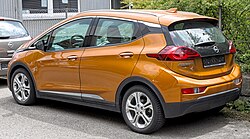 Rear view


European discontinuation controversy
[edit]The Ampera-e was first offered for sale in Norway, the first country in Europe where it was marketed, at a starting price of 299 900 kr (€33 500) in December 2016, higher than that of the Nissan Leaf and BMW i3. Availability was limited, as the Ampera-e and Bolt both were assembled at the same Orion Township factory.[156] Three months later in March 2017, Groupe PSA agreed to acquire Opel, the English twin sister brand Vauxhall and the European auto lending business from General Motors as GM exited the European market;[157] the acquisition was completed in November.[158]
By October 2017, European sales had expanded into Switzerland, the Netherlands, and Germany; there were 4,000-5,000 orders for the Ampera-e in Norway alone, which has a population of 5.2 million.[159] However, dealers in Europe were asked to completely stop accepting orders for the Opel Ampera-e at the same time, as the entire annual allotment for Europe had been sold and the earliest possible delivery date was pushed to 2019.[160][161] The starting price was raised to €46 699 in November.[162] The fact that Opel was limiting orders of the Ampera-e in Norway, its most promising market, led to speculation that GM was planning to discontinue the model in Europe.[163] GM previously has been accused of purposefully sabotaging its EV1 programme,[164] most notably in the 2006 documentary film Who Killed the Electric Car?.[165]
In February 2018, it was reported that 1,971 Opel Ampera-e had been sold in Europe to date.[166] Deliveries in Norway trickled at fewer than 100 units per month in 2018.[167] For comparison, in 2018, the Hyundai Kona Electric, equipped with a 64 kWh battery and offering comparable range to the Ampera-e, was offered for sale in Norway. The entire yearly allotment, 2,500 vehicles, was sold out almost instantly.[168]
In 2018, it was virtually impossible to order the car in Europe[citation needed] although in November 2018, it was reported to be on sale in the Netherlands for €46 699, possibly as a way to reduce overall emissions of the cars sold by Opel/Vauxhall.[169] Sales records show that, as of February 2019, fewer than 5,000 Ampera-e vehicles were ever delivered in the entirety of Europe.[170] Even though the Ampera-e could be ordered and bought in the Netherlands in 2019, its steep price was still an issue. In early 2020, the importer lowered the price to €34,149.[171] This was enough to put the car in the top 10 of bestselling cars in the country (regardless of the powertrain), and make it #1 among electric cars.[172][173][174] However, the 2020 price reduction was an incentive to sell the remaining stock;[171] as of 2020, Opel refuses to import any more Bolt/Ampera-e into the Netherlands and Germany.
Opel/Vauxhall offered the Opel Crossland X, a gasoline- or diesel-powered crossover utility vehicle with styling mildly reminiscent of the Bolt, using a platform developed by Groupe PSA under a partnership with GM predating the acquisition.[175] Under PSA, Opel/Vauxhall announced plans to offer EVs based on the Opel Corsa and the Peugeot 208, both being smaller cars than the Bolt.[162][176] The Corsa-e went on sale in March 2020.[177]
Awards and recognition
[edit]The Bolt won the 2017 Motor Trend Car of the Year award,[178] the 2017 North American Car of the Year,[5][179] the 2017 AutoGuide.com Reader's Choice Green Car of the Year,[180] 2017 Popular Mechanics Automotive Excellence Awards Car of the Year[181] and the Green Car Reports Best Car To Buy 2017.[182] The Bolt also ended up Car & Driver's '10 Best Cars' list for 2017.[183] The Chevy Bolt also won the 2017 Green Car of the Year awarded by the Green Car Journal.[184] It was also named by Time among its list of 25 Best Inventions of 2016,[185] and among Popular Science's 10 Greatest Automotive Innovations of 2016.[186] The Bolt EV beat out the Cadillac CT6 and Jaguar XE to win the Detroit Free Press award for Car of the Year.[187] Automobile included the Bolt in its 2017 All Star list.[188]
Second generation (2026)
[edit]| Second generation | |
|---|---|
| Overview | |
| Production | January 2026 (to commence) |
| Model years | 2027 (to commence) |
| Assembly | United States: Kansas City, Kansas (Fairfax Assembly) |
| Body and chassis | |
| Platform | BEV II |
| Dimensions | |
| Wheelbase | 105.3 in (2,675 mm) |
| Length | 169.6 in (4,308 mm) |
| Width | 69.7 in (1,770 mm) |
| Height | 63.9 in (1,623 mm) |
| Chronology | |
| Predecessor | Chevrolet Bolt EUV |
Chevrolet plans to begin production of the second generation Bolt in late 2025, and sales in early 2026 for the 2027 model.[189] Unlike the first generation, it will be sold exclusively in the crossover body style of the Bolt EUV, and as a result the previously used "EV" and "EUV" suffixes will be dropped.[190][191] It will be built on the GM Ultium platform.
The second generation Bolt was teased on July 30, 2025,[192] and unveiled on October 9, 2025.
The maximum charging speed on the second-generation Bolt has been increased to 150 kW, and GM claims a 10-80% charge time of 26 minutes. The 65 kWh battery pack now uses lithium-iron phosphate chemistry, and GM claims 255 miles (410 km) of range. The charging port was switched from CCS to NACS. Several parts are shared with the Equinox EV, including the sensor suite and the X76 permanent-magnet motor, which is slightly more powerful at 210 hp (157 kW), but has less torque than the 2023 models, at 169 lb⋅ft (229 N⋅m). A higher final drive reduction provides more torque at the wheels however. The car's weight increased by roughly 100 lb (45 kg) compared to the prior Bolt EUV. Like other Chevrolet EVs, Android Auto and Apple CarPlay were removed from the infotainment system. When used with a specific GM Home Energy charging station, the car has Vehicle-To-Home (V2H) capability and can supply power during a blackout.[193]
The cars are manufactured at GM's Fairfax plant in Kansas, and will be shipping to dealers in January 2026.[10][194] The battery cells will initially be supplied by a Chinese supplier, but GM intends to replace them with US-made cells from its Spring Hill, Tennessee plant in late 2027.[193]
See also
[edit]Notes and references
[edit]Note
[edit]References
[edit]- ^ Welch, David (February 15, 2022). "GM to Resume Bolt Production as Fix Found for Battery Fires". Bloomberg News. Retrieved February 15, 2022.
GM stopped production of the Bolt in August and recalled nearly 143,000 of them, which includes every one the company ever made, because a manufacturing defect at LG's battery plant resulted in at least 13 fires.
- ^ "Chevrolet Develops Bolt EV Using Strategic Partnership" (Press release). Warren, Michigan: Chevrolet Pressroom. October 20, 2015. Retrieved September 21, 2016.
- ^ a b c d Cobb, Jeff (December 13, 2016). "First Chevy Bolt EVs Delivered Today". HybridCars.com. Retrieved January 10, 2017.
- ^ Cole, Jay (September 20, 2016). "Chevrolet Bolt EV In Canada Priced At $42,795 – Includes Fast Charging, Arrives Early 2017". Inside EVs. US. Retrieved September 21, 2016.
- ^ a b "Chevrolet Bolt, Honda Ridgeline, Chrysler Pacifica Named 2017 North American Car, Truck and Utility Vehicle of the Year". Archived from the original on January 10, 2017. Retrieved January 9, 2017.
- ^ Cobb, Jeff (November 23, 2016). "2017 Chevy Bolt's Trophy Case Is Filling Up". HybridCars.com. Retrieved November 23, 2016.
- ^ "Battery Experts Provide Explanations for Chevy Bolt Fires". Autoweek. November 15, 2021. Retrieved August 8, 2023.
- ^ "GM tells Bolt EV owners park away from vehicles in decks". www.msn.com. Retrieved September 16, 2021.
- ^ Hawkins, Andrew J. (October 8, 2024). "GM teases next-gen Chevy Bolt EV: faster charging, multiple models". The Verge. Retrieved March 20, 2025.
- ^ a b Miller, Caleb (October 9, 2025). "The Chevy Bolt Returns with a Sub-$30K Price and 255-Mile Range". Car and Driver. Retrieved October 9, 2025.
- ^ Welch, David (February 15, 2022). "GM to Resume Bolt Production as Fix Found for Battery Fires". Bloomberg News. Retrieved February 15, 2022.
GM stopped production of the Bolt in August and recalled nearly 143,000 of them, which includes every one the company ever made, because a manufacturing defect at LG's battery plant resulted in at least 13 fires.
- ^ US D804356, Cho, Sangyeon, "Whole body of car", issued December 5, 2017, assigned to GM Global Technology Operations LLC
- ^ a b c d e Energy Efficiency & Renewable Energy, U.S. Department of Energy and U. S. Environmental Protection Agency (September 20, 2016). "Compare Side-by-Syde – 2017 Chevrolet Bolt". fueleconomy.gov. Retrieved September 20, 2016.
- ^ a b c "'Das Elektroauto': Opel Ampera-e Impresses with Electrifying High-tech" (Press release). Rüsselsheim: Opel Pressroom Europe. February 13, 2017. Retrieved February 19, 2017.
- ^ a b c Energy Efficiency & Renewable Energy, U.S. Department of Energy and U. S. Environmental Protection Agency (2019). "Compare Side-by-Syde – 2020 Chevrolet Bolt". fueleconomy.gov. Retrieved October 26, 2020.
- ^ Panait, Mircea (September 19, 2016). "2017 Chevrolet Bolt Platform Is So Unique GM Doesn't Even Want to Talk About It". autoevolution. Retrieved November 27, 2020.
- ^ a b Courtenay, Vince (April 26, 2017). "Bolt's Lead Designer Describes Clean-Sheet Creation". wardsauto.com. Archived from the original on April 26, 2017. Retrieved May 18, 2017.
Stuart Norris .. arrived in Korea in the fall of 2012 to start laying the groundwork for the Bolt's design
- ^ Turkus, Brandon (January 12, 2015). "Chevrolet Bolt EV Concept foreshadows an affordable, 200-mile EV future [w/videos]". Autoblog.com. Retrieved January 12, 2015.
- ^ Migliore, Greg (June 24, 2015). "Chevy ramps up development of Bolt EV". Autoblog.com. Retrieved June 24, 2015.
- ^ a b Thevenot, Brian; Hirsch, Jerry (January 12, 2015). "Chevy Bolt electric car targets Tesla with low price, long range". Los Angeles Times. Retrieved January 12, 2015.
- ^ a b Payne, Henry (November 19, 2015). "Chevy Bolt EV to be revealed in January at CES". The Detroit News. Retrieved November 20, 2015.
- ^ Szostech, Mike (January 6, 2016). "Chevrolet Bolt unveiled at CES Today". Archived from the original on December 14, 2016. Retrieved January 15, 2016.
- ^ a b Korosec, Kirsten (February 11, 2016). "GM Unveils an All-Electric Car for Europe". Fortune. Retrieved February 12, 2016.
- ^ Baldwin, Roberto (March 22, 2016). "Chevy is getting the Bolt EV ready for production". Engadget. Retrieved March 23, 2016.
- ^ "From Renault to Skoda, big carmakers are flocking to Israel". Haaretz.
- ^ Welch, David; Lippert, John (November 30, 2016). "GM's Ready to Lose $9,000 a Pop and Chase the Electric Car Boom". Bloomberg News. Retrieved December 9, 2016.
- ^ a b c Dalløkken, Per Erlien (December 23, 2016). "Her produseres elbilen og bensinbilen på samme linje". Teknisk Ukeblad. Retrieved December 25, 2016.
koster battericellene dem nå cirka 130 dollar per kilowattime.. .. fnyser av påstanden om at de på sikt, når produksjonen er skrudd opp, skal tape penger på elbilen
- ^ "Q-Series UBS Evidence Lab Electric Car Teardown – Disruption Ahead?". Union Bank of Switzerland. May 18, 2017. p. 45. Retrieved December 31, 2018.
- ^ White, Joseph (November 5, 2016). "GM cautiously ramps up Bolt electric car production". Reuters.
- ^ "LG gears up for new era in auto parts industry". The Korea Times. August 17, 2016. Archived from the original on October 5, 2016.
- ^ "Tesla's Next Broken Promise". MIT Technology Review. September 21, 2016. Retrieved October 14, 2016.
- ^ a b c "Opel Ampera-e". Teknisk Ukeblad. December 14, 2016. Retrieved December 14, 2016.
- ^ White, Joseph (November 7, 2016). "RPT-GM cautiously ramps up Bolt electric car production". Reuters UK. Archived from the original on November 8, 2016. Retrieved November 12, 2016.
GM redesigned the Orion assembly operation to allow workers to build either Bolts or Sonics and can shift production depending on demand
- ^ Mays, Kelsey (June 21, 2018). "2018 American-Made Index: What About the Least American Cars?". Cars.com. US. Retrieved September 29, 2019.
- ^ Burden, Melissa (September 13, 2016). "GM Orion readies for Chevy Bolt EV production". The Detroit News. Retrieved November 5, 2016.
- ^ "'Not a compliance car,' GM says 2017 Chevy Bolt can meet demand of over 50,000 per year". HybridCars.com. January 14, 2016.
- ^ "Chevy, GMC plan new and improved crossovers". July 15, 2016.
- ^ "Chevrolet Bolt To Be Built In Michigan In October 2016, Opel "Companion" EV Coming Too (Updates)". InsideEVs.
- ^ a b Krisher, Tom (November 5, 2016). "GM starts producing 200-mile electric Chevrolet Bolt". Retrieved November 5, 2016."General Motors starts producing 200-mile electric Chevrolet Bolt". The Economic Times. Archived from the original on November 5, 2016.
- ^ "Production Begins On 2017 Chevrolet Bolt". Retrieved November 12, 2016.
- ^ LaReau, Jamie L. (October 13, 2021). "GM prioritizes fixing Chevy Bolts before restarting production". Detroit Free Press. Retrieved March 6, 2023.
- ^ LaReau, Jamie L. (February 15, 2022). "GM keeps Orion Assembly idle until spring, leaving no new Bolts to buy". Detroit Free Press. Retrieved March 6, 2023.
- ^ a b brandon.gobel@dot.gov (November 13, 2020). "NHTSA Consumer Alert: Important Chevrolet Bolt Recall for Fire Risk". NHTSA. Archived from the original on August 15, 2021. Retrieved December 5, 2020.
- ^ "Part 573 Safety Recall Report" (PDF). National Highway Traffic and Safety Administration. Archived (PDF) from the original on November 14, 2020.
- ^ "Bolt EV Recall". My Chevrolet. November 17, 2020. Archived from the original on November 13, 2020. Retrieved January 4, 2021.
- ^ "Learn About". my.chevrolet.com. Retrieved August 20, 2021.
- ^ De Chant, Tim (August 23, 2021). "GM recalls every Chevy Bolt ever made, blames LG for faulty batteries". ARS Technica. Archived from the original on August 23, 2021.
- ^ LaReau, Jamie L. (August 26, 2021). "GM temporarily halts Orion Assembly amid massive Chevy Bolt recall". Detroit Free Press. Archived from the original on August 26, 2021.
- ^ Murray, Cameron (May 2, 2023). "Second life firm Element Energy using recalled LG batteries, says source". Energy Storage News. UK. Retrieved May 7, 2023.
- ^ Moloughney, Tom (April 4, 2022). "The Chevy Bolt EV Battery Recall Bonus That Nobody's Talking About". InsideEVs. US. Retrieved December 25, 2022.
- ^ Szymkowski, Sean (January 25, 2022). "Dim future for Chevy Bolt EV, EUV as evidence mounts GM plans to end production". Road/Show. CNet. Retrieved March 6, 2023.
- ^ LaReau, Jamie L. (July 12, 2022). "Chevrolet Bolt EV to disappear from lineup as new technology rolls out". Detroit Free Press. Retrieved March 6, 2023.
- ^ "GM to stop making Chevy Bolt EV in late 2023". April 25, 2023.
- ^ "GM announces new EV feature that will help drivers power their homes during storms and outages: 'It makes so much sense'". Yahoo News. September 7, 2023. Retrieved January 31, 2024.
- ^ "Chevrolet Announces Next-Gen Bolt" (Press release). Detroit. July 25, 2023. Retrieved July 25, 2023.
- ^ O’Neil, Kirk (July 30, 2023). "Tesla Dominance Pushes Major Carmaker to Exit Electric Vehicles". TheStreet. Retrieved July 31, 2023.
- ^ Gitlin, Jonathan M. (July 25, 2023). "GM announces a new Ultium-based Chevrolet Bolt during Q2 report". Ars Technica. Retrieved July 25, 2023.
- ^ George, Patrick (December 7, 2023). "The Next Chevrolet Bolt Will Be EUV-Only, GM Confirms". Inside EVs. US. Retrieved May 10, 2024.
- ^ Hawkins, Trey (August 11, 2023). "2023 Chevy Bolt EV, Bolt EUV Production Extended Into December". GM Authority. Retrieved January 4, 2023.
- ^ a b c "GM's Korea studio 'broke the mold' with Bolt". Automotive News. August 3, 2016. Retrieved August 11, 2016.
- ^ "GM BEV2 Vehicle Platform". GM Authority. May 25, 2017. Archived from the original on June 30, 2017. Retrieved August 27, 2021.
- ^ "2017 Chevrolet Bolt EV Photos and Info". Car and driver. January 6, 2016. Retrieved September 20, 2016.
all-new chassis called BEV II, which isn't related to the Gamma platform on the Sonic hatchback. .. and has a 3.0-inch-longer wheelbase.
- ^ "Chevy Bolt EV not on shared architecture, but platform name secret, GM says". Green Car Reports. September 16, 2016. Retrieved September 20, 2016.
There are no Bolt EV parts tied to the G2 architecture .. The Bolt EV program originated on the Gamma architecture, but then grew into its own architecture – even as it maintained the G2 code.
- ^ Energy Efficiency & Renewable Energy, U.S. Department of Energy and U. S. Environmental Protection Agency (September 27, 2016). "Frequently Asked Questions – How are vehicle size classes defined?". fueleconomy.gov. Retrieved September 27, 2016. Click on the link: "How are vehicle size classes defined?"
- ^ "And Now, the Preliminary Specs of the 2017 Chevrolet Bolt EV". GMAuthority.com. January 12, 2016. Retrieved September 27, 2016.
we find it interesting that Chevrolet is categorizing the Bolt EV as a crossover, specifically a 'five-passenger, five-door all-electric CUV.
- ^ "Chevrolet SUVs and Crossovers Lineup: 5-9 Passenger". Chevrolet. Retrieved January 26, 2023.
- ^ a b "2017 Chevrolet Bolt". Car and driver. August 17, 2016. Retrieved August 25, 2016.
- ^ a b c "Dette er bilen som snur opp ned på bilindustrien". Teknisk Ukeblad. November 23, 2016. Retrieved November 23, 2016.
- ^ "GM announces Bolt EV's 'one pedal' driving with regenerative braking". Electrek. September 6, 2016. Retrieved September 6, 2016.
- ^ Greimel, Hans (August 7, 2016). "GM's Korea studio 'broke the mold' with Bolt". Automotive News. Archived from the original on December 14, 2016. Retrieved January 15, 2017.
the Bolt's squat, wedge shape. .. 'It's a disaster for aero'. The seats look off-balance but allow for a wider armrest.
- ^ "Chevy Bolt To Feature Over-The-Air Software Updates". CleanTechnica. September 9, 2016. Retrieved September 9, 2016.
- ^ Loveday, Steven. "UPDATE: Chevy Bolt Finally Gets Its Over-The-Air (OTA) Updates". insideevs.com. Retrieved June 1, 2018.
- ^ Priddle, Alisa. "Will Bolt name stay on GM's new electric car?". Detroit Free Press. Retrieved November 5, 2025.
- ^ Healey, James R. (April 16, 2015). "'Bolt' name is a keeper, says Chevy marketing boss". USA Today. Retrieved April 17, 2015.
- ^ Bruce, Chris (February 12, 2016). "Opel Ampera-e brings a Bolt of EV driving to Europe". Autoblog.com. Retrieved February 12, 2016.
- ^ Meiners, Jens (January 20, 2015), "Two Bolts: Chevy Concept Shares Name with Tata Subcompact", Car and Driver
- ^ a b c Voelcker, John (June 14, 2017). "Self-driving Chevy Bolt EV electric test cars to be deployed". Green Car Reports. Retrieved June 30, 2022.
- ^ a b Phelan, Mark (March 12, 2019). "GM's first autonomous car heads to Henry Ford Museum". Detroit Free Press. Retrieved July 9, 2022.
- ^ a b c Ziegler, Chris (May 18, 2016). "Self-driving Chevy Bolts are on the streets of San Francisco". The Verge. Retrieved July 9, 2022.
- ^ a b c Vogt, Kyle (September 11, 2017). "How we built the first real self-driving car (really)". medium. Retrieved June 30, 2022.
- ^ a b c d 2018 Self-Driving Safety Report (PDF) (Report). General Motors. Archived from the original (PDF) on January 14, 2018.
- ^ Marshall, Aarian (September 11, 2017). "GM and Cruise's Self-Driving Car: Just Add Software". wired. Retrieved June 30, 2022.
- ^ LaReau, Jamie L. (July 19, 2018). "How General Motors is leading the race for self-driving cars". Detroit Free Press. Retrieved June 30, 2022.
Then, last fall [2017], it added another 50 of the cars. GM no longer calls them Bolts, but rather the Cruise AV, said [Patrick Sullivan, a GM spokesman].
- ^ Etherington, Darrell (November 29, 2017). "Taking a ride through SF in Cruise's self-driving Bolt EV". TechCrunch. Retrieved June 30, 2022.
- ^ Marshall, Aarian (November 29, 2017). "My Herky-Jerky Ride in General Motors' Ultra-Cautious Self Driving Car". wired. Retrieved June 30, 2022.
- ^ Voelcker, John (January 12, 2018). "Cruise AV, GM's autonomous electric Bolt EV, to go into production in 2019". Green Car Reports. Retrieved June 30, 2022.
- ^ Stevens, Tim (January 11, 2018). "General Motors Cruise AV is more than a Bolt without a steering wheel". Road/show. CNet. Retrieved July 9, 2022.
- ^ Hawkins, Andrew J. (January 21, 2020). "Exclusive look at Cruise's first driverless car without a steering wheel or pedals". The Verge. Retrieved June 30, 2022.
- ^ Strong, Michael (April 6, 2022). "GM CEO Barra Says Cruise Origin Ready in 2023". The Detroit Bureau. Retrieved June 30, 2022.
- ^ Hawkins, Andrew J. (October 15, 2020). "Cruise gets the green light to test fully driverless cars in California". The Verge. Retrieved June 30, 2022.
- ^ Hawkins, Andrew J. (December 9, 2020). "Cruise is now testing fully driverless cars in San Francisco". The Verge. Retrieved June 30, 2022.
- ^ Siddiqui, Faiz (December 9, 2020). "Cruise putting driverless cars on San Francisco streets for first time". The Washington Post. Retrieved June 30, 2022.
- ^ Lutz, Hannah (August 21, 2021). "Cruise film stars self-driving car to build trust". Automotive News. Retrieved June 29, 2022.
- ^ Dave, Paresh (June 2, 2022). "GM's Cruise wins first California permit to carry paying riders in driverless cars". Reuters. Retrieved June 30, 2022.
- ^ Lin, Kelly (November 10, 2020). "Chevy Teases 2022 Bolt EUV's High-Tech Interior". Motortrend.
- ^ Rogers, Cameron (February 14, 2021). "2022 Chevrolet Bolt EV Review". Edmunds. Archived from the original on December 3, 2020.
- ^ Rogers, Cameron (February 14, 2021). "2022 Chevrolet Bolt EUV Review". Edmunds. Archived from the original on March 7, 2020. Retrieved August 27, 2021.
- ^ a b "Drive Unit and Battery at the Heart of Chevrolet Bolt EV". media.gm.com. January 11, 2016. Retrieved September 1, 2021.
- ^ "Trickle Charged: GM Releases More Chevrolet Bolt EV Details". Archived from the original on September 14, 2016. Retrieved September 13, 2016.
- ^ Cobb, Jeff (January 11, 2016). "Chevy Bolt EV's Battery Is As Big As A Tesla's". HybridCars.com. Retrieved January 11, 2016.
- ^ "Chevy Bolt EV: LG gearing up to 'mass-produce parts' for the car this month". Electrek. August 18, 2016. Retrieved August 21, 2016.
- ^ Cole, Jay (October 23, 2015). "LG Chem "Ticked Off" With GM For Disclosing $145/kWh Battery Cell Pricing – Video". Inside EVs. Retrieved January 11, 2016.
- ^ Gitlin, Jonathan M. (January 6, 2016). "Chevrolet's Bolt is an electric vehicle for the masses – and we've driven it". Ars Technica. Retrieved January 11, 2016.
- ^ Levin, Doron (January 12, 2015). "Lightning in a sedan? GM reveals the Chevrolet Bolt". Fortune. Retrieved January 13, 2015.
- ^ Blanco, Sebastian (January 11, 2016). "Chevy Bolt EV's battery shows big improvements over Spark's". Autoblog. Retrieved January 11, 2016.
- ^ Ackley, J.A. (December 21, 2022). "Go EV with the Chevrolet Performance Ultium eCrate Package". Grassroots Motorsports. Retrieved January 16, 2023.
- ^ "2017 Chevrolet Bolt EV Specifications". Retrieved May 4, 2018.
- ^ "2017 Chevrolet Bolt EV Drivetrain First Look (w/Video)". Motor Trend. April 6, 2016. Retrieved March 25, 2017.
- ^ Szostech, Mike (January 11, 2016). "Chevrolet Bolt EV Full Specs Released at NAIAS this morning". Retrieved January 11, 2015.
- ^ Blanco, Sebastian (January 11, 2016). "More 2017 Chevy Bolt powertrain details revealed". Autoblog. Retrieved January 11, 2016.
- ^ Momen, Faizul; Rahman, Khwaja; Son, Yochan (2019). "Electrical Propulsion System Design of Chevrolet Bolt Battery Electric Vehicle". IEEE Transactions on Industry Applications. 55 (1): 376–384. Bibcode:2019IOJIA..55..376M. doi:10.1109/TIA.2018.2868280.
- ^ "2017 Chevrolet Bolt EV". media.gm.com.
- ^ "2017 Chevy Bolt EV Is Less of a Drag Than Originally Believed". HybridCars.com. January 29, 2017. Retrieved March 25, 2017.
- ^ Fleming, Charles (September 12, 2016). "Chevy Bolt EV range is 238 miles: Prime time for the electric car?". Los Angeles Times. Retrieved September 13, 2016.
- ^ Loveday, Eric (September 21, 2016). "Detailed Range Ratings For Chevrolet Bolt EV – 255 Miles City". InsideEVs.com. Retrieved September 21, 2016.
- ^ a b Accardi, Michael (September 29, 2016). "Opel Drove the Ampera-e 260 Miles to Its Paris Debut". HybridCars.com. Retrieved October 3, 2016.
- ^ Krok, Andrew (July 29, 2017). "By the numbers: Tesla Model 3 vs. Chevrolet Bolt EV". CNET. Retrieved July 29, 2017.
- ^ Lambert, Fred (August 22, 2019). "Chevy Bolt EV 2020 gets a range increase to 259 miles, EPA says". Electrek. US. Retrieved January 6, 2023.
- ^ Lopez, Jonathan (October 5, 2020). "2021 Chevy Bolt EV Premier Gains Fast Charging As Standard". GM Authority. Retrieved August 4, 2023.
- ^ "Stock 2016 Chevy Volt EVSE running on 240VAC". Imgur. January 8, 2016. Retrieved July 13, 2019.
- ^ "3 Reasons the Chevy Bolt EV is Already Outdated (and What GM Can Do to Fix It)". TorqueNews. US. June 13, 2019. Retrieved September 5, 2019.
- ^ Owner's manual 2017.
- ^ "Bolt EV ≈150A/≈55 kW max charging rate confirmed". Chevrolet Bolt EV Owners Forums. US. August 19, 2017. Retrieved July 13, 2019.
- ^ Goodwin, Antuan (July 27, 2021). "2022 Chevrolet Bolt EV review: A little bit better, a lot more affordable". Road/Show. CNet. Retrieved August 4, 2023.
- ^ Owner's manual 2017, p. 271.
- ^ Owner's manual 2017, p. 272.
- ^ "Bolt EV for Sale: 2020 Bolt EV Pricing". US: Chevrolet. Retrieved May 10, 2020.
- ^ "Bolt spare tire options". Chevy Bolt EV Forum. January 24, 2023.
- ^ Capparella, Joseph (September 13, 2016). "How I Drove 238 Miles in the Chevy Bolt EV". Car & Driver. Archived from the original on September 14, 2016. Retrieved September 13, 2016.
- ^ Davies, Alex (September 13, 2016). "We Drive the $30K Chevy Bolt, GM's Tesla-Walloping Electric Car". Wired. Retrieved September 22, 2016.
- ^ "2017 Chevrolet Bolt EV first drive: 240 miles in an electric car". Green Car Reports. September 13, 2016.
- ^ "Chevy Bolt EV range is 238 miles: Prime time for the electric car?". Los Angeles Times. September 13, 2016.
- ^ "Chevrolet Bolt First Drive Reports: Up To 290 Miles Of Range Within Reach". InsideEVs.
- ^ Kobza, Nathaniel (September 14, 2016). "Chevy Bolt EV first impressions roundup: 238 miles down the California Coast is remarkably nice [videos]". Electrek. Retrieved September 27, 2016.
- ^ Maumon, Emmanuel (October 3, 2016). "Mondial de l'Automobile : l'Opel Ampera-e casse les barrières de l'autonomie" [Paris Motor Show: Opel Ampera-e breaks the barriers of autonomy] (in French). Association pour l'Avenir du Véhicule Electrique Méditerranéen (AVEM). Retrieved October 3, 2016.
- ^ "Chevrolet Bolt EV Sales Numbers". August 3, 2016.
- ^ "Opel Ampera-e EV European sales figures". carsalesbase.com. May 6, 2017. Retrieved May 3, 2021.
- ^ "Chevrolet Bolt EV Sales Numbers". GM Authority. August 3, 2016. Retrieved February 20, 2022.
- ^ Phelan, Mark (March 12, 2019). "GM's first autonomous car heads to Henry Ford Museum". Detroit Free Press. Retrieved July 9, 2022.
- ^ Cobb, Jeff (October 12, 2016). "017 Chevy Bolt EV Ordering Has Begin In California and Oregon". HybridCars.com. Retrieved October 12, 2016.
- ^ "Chevrolet Commits to Bolt EV Production" (Press release). Chicago: General Motor. February 12, 2015. Retrieved February 17, 2015.
- ^ a b c d "GM Authority summary page". GM Authority. August 3, 2016. Retrieved June 4, 2022.
- ^ Carey, Nick (July 17, 2017). "GM extends shutdown at Chevy Bolt plant as inventories swell". reuters.com.
- ^ Gitlin, Jonathan. "Chevy's Bolt EV outsells Tesla for the first time in October". arstechnica.com.
- ^ Cobb, Jeff (January 4, 2018). "December 2017 Dashboard". HybridCars.com and Baum & Associates. Retrieved March 4, 2018.
- ^ Baker, David R. (February 28, 2018). "Top-selling electric car in California is not a Tesla". San Francisco Chronicle. Retrieved March 4, 2018.
- ^ California New Car Dealers Association (CNCDA) (February 2018). "New Vehicle Registrations in State Predicted to Exceed 2 Million Units Again in 2018" (PDF). CNCDA. Archived from the original (PDF) on February 17, 2018. Retrieved February 17, 2018. Registrations through December 2017 since 2013.
- ^ "Monthly Plug-In EV Sales Scorecard: Historical Charts". InsideEVs.com. Archived from the original on February 18, 2019. Retrieved February 17, 2019.
- ^ Lambert, Fred (January 3, 2019). "GM hits electric vehicle tax credit threshold, phase-out to start in April". Electrek. US. Retrieved July 13, 2019.
- ^ Szostech, Michael (September 6, 2016). "Chevrolet Bolt Availability". Retrieved April 20, 2017.
- ^ a b Dalløkken, Per Erlien (May 3, 2017). "Opel varsler forsinkelser i leveranser av Ampera-e til Norge". Teknisk Ukeblad. Retrieved May 3, 2017.
- ^ "Registreringer av nye elbiler i Norge". April 10, 2017. Retrieved April 10, 2017.
Apr 2017 .. 13 cars
- ^ "First batch of Opel Ampera-e cars arrive in Norway". April 6, 2017. Archived from the original on January 22, 2022. Retrieved April 10, 2017.
- ^ "Norway Lands World's First 3 Opel Ampera-e Deliveries On Constitution Day". CleanTechnica. May 22, 2017. Retrieved May 23, 2017.
- ^ Frydenlund, Ståle (January 3, 2018). "Nye elbilrekorder i 2017, og prognosen vår slo til" [New electric car orders in 2017, and our forecast struck]. Norsk Elbilforening (Norwegian Electric Vehicle Association) (in Norwegian). Retrieved March 4, 2018.
- ^ "Opel prices Amera-e above BMW i3, Nissan Leaf in its first European market". Automotive News Europe. December 14, 2016. Retrieved March 7, 2023.
- ^ "PSA targets Opel turnaround as GM exits Europe". Reuters. March 6, 2017.
- ^ Kable, Greg (November 1, 2017). "PSA Group purchase of Opel and Vauxhall completed with new financial company". Autocar. Retrieved March 7, 2023.
- ^ Kane, Mark (October 21, 2017). "Opel To Dealers: Stop Selling The Ampera-E, We Have Too Many Orders". Inside EVs. US. Retrieved July 13, 2019.
- ^ Olsen, Stein Jarle (October 20, 2017). "Opel stanser salget av Ampera-e" [Opel stops sales of the Ampera-e]. tek.no (in Norwegian). Retrieved March 7, 2023.
- ^ Mitrache, Vlad (October 22, 2017). "GM Stops Taking Bolt EV Orders in Europe as It Can't Match Demand". AutoEvolution. Retrieved March 7, 2023.
- ^ a b Panait, Mircea (November 9, 2017). "2018 Opel Ampera-e Priced EUR 5,700 Higher, General Motors is To Blame". AutoEvolution. Retrieved March 7, 2023.
- ^ Gordon-Bloomfield, Nikki (November 8, 2017). "Is GM Trying To Kill The Opel Ampera-E Electric Car in Europe? The Signs Aren't Good". Transport Evolved. Archived from the original on December 1, 2018.
- ^ Edwards, Owen (June 2006). "The Death of the EV-1". Smithsonian. Retrieved March 7, 2023.
- ^ St. John, Alexa (April 18, 2021). "Filmmaker Chris Paine on who killed the EV1". Automotive News. Retrieved March 7, 2023.
- ^ "Opel to swap Ampera-e (aka Bolt EV) for all-electric Corsa model in 2020". Green Car Reports. February 19, 2018. Retrieved April 18, 2021.
- ^ Monthly registrations of the Opel Ampera-e in Norway, 2018: January: [1] February: [2] March: [3] April: [4] May: [5] June: [6] July: [7] August: [8] September: [9] October: [10] November: [11] December: [12]
- ^ Kane, Mark (June 2, 2018). "Hyundai Kona Electric Priced In Norway – Sold Out For 2018". InsideEVs.
- ^ "Opel Ampera-e w Holandii znowu w sprzedaży. Cena? Od równowartości 201 tysięcy złotych • SAMOCHODY ELEKTRYCZNE" [Opel Ampera-e for sale again in the Netherlands. Price? From the equivalent of 201 thousand zlotys]. elektrowoz (in Polish). Poland. November 6, 2018. Retrieved July 13, 2019.
- ^ "Opel Ampera-e EV European sales figures". carsalesbase. The Netherlands. May 6, 2017. Retrieved July 13, 2019.
- ^ a b Kane, Mark (February 11, 2020). "Opel Lowers Ampera-e Prices As Electric Car Nears Retirement". InsideEVs. Retrieved March 7, 2023.
- ^ Pontes, José (February 13, 2020). "Opel Ampera-e (Opel Who?!?) Wins January In The Netherlands – EV Sales Report". CleanTechnica.
- ^ Pontes, José (March 12, 2020). "Netherlands EV Sales Report – Opel Ampera-e #8 in Overall Auto Market in February". CleanTechnica.
- ^ "Opel Ampera-e op kenteken". Kentekenradar.
- ^ Gibbs, Nick (February 2, 2017). "Opel expects Crossland X to win more women buyers". Automotive News Europe. Retrieved March 7, 2023.
- ^ Brodie, James (September 11, 2019). "New all-electric Vauxhall Corsa-e to start from just over £26k". AutoExpress. Retrieved March 7, 2023.
- ^ Saunders, Matt (October 4, 2021). "Vauxhall Corsa-e review". Autocar. UK. Retrieved June 10, 2022.
- ^ "Chevrolet Bolt EV is the 2017 Motor Trend Car of the Year". Motor Trend. November 14, 2016. Retrieved November 15, 2016.
- ^ "North American Car of the Year". January 9, 2017. Archived from the original on September 23, 2017. Retrieved September 23, 2017.
- ^ "Chevrolet Bolt Wins 2017 AutoGuide.com Reader's Choice Green Car of the Year Award". AutoGuide.com News. November 15, 2016. Retrieved November 15, 2016.
- ^ Dyer, Ezra (April 13, 2017). "The 2017 Popular Mechanics Automotive Excellence Awards". Popular Mechanics. Retrieved September 8, 2018.
- ^ Voelcker, John (November 14, 2016). "Chevrolet Bolt EV: Green Car Reports' Best Car To Buy 2017". Green Car Reports. Retrieved November 15, 2016.
- ^ Duff, Mike (November 16, 2016). "2017 10Best Cars: Chevrolet Bolt". Car and Driver. Retrieved November 18, 2016.
- ^ Blanco, Sebastian (November 17, 2016). "Chevy Bolt wins 2017 Green Car of the Year". Autoblog.com. Retrieved November 21, 2016.
- ^ "The 25 Best Inventions of 2016". Time. November 17, 2016. Retrieved November 21, 2016.
- ^ Atiyeh, Clifford (October 18, 2016). "The 10 Greatest Automotive Innovations of 2016". Popular Science. Retrieved November 24, 2016.
- ^ Phelan, Mark (December 28, 2016). "Chevrolet Bolt is the 2017 Free Press Car of the Year". Detroit Free Press. Retrieved December 29, 2016.
- ^ Trahan, Andrew (March 11, 2017). "2017 Automobile All-Stars: The Winners". Automobile. Retrieved March 25, 2017.
- ^ Priddle, Alisa (December 5, 2023). "Next-Generation Chevrolet Bolt EV Coming in 2025". Motor Trend. US. Retrieved February 3, 2025.
- ^ George, Patrick (December 7, 2023). "The Next Chevrolet Bolt Will be EUV-Only, GM Confirms". Inside EVs. US. Retrieved February 3, 2025.
- ^ Palmer, Zac (October 9, 2025). "2027 Chevy Bolt Boasts 250 Miles of Range and 210 Horsepower, Starts Under $30,000". Road & Track. US. Retrieved October 9, 2025.
- ^ Barta, George (July 30, 2025). "GM Teases First Images Of 2027 Chevy Bolt EV". Retrieved August 14, 2025.
- ^ a b Voelcker, John (October 28, 2025) [October 16, 2025]. "Rebooting the 2027 Chevy Bolt Was More Complex Than You'd Think". Car And Driver. Retrieved October 31, 2025.
- ^ "It's back: Introducing the 2027 Chevrolet Bolt" (Press release). GM News. October 9, 2025. Retrieved October 9, 2025.
Bibliography
[edit]- Chevrolet Bolt 2017 Owners' Manual (PDF). US: GM. 2016.
- Howie, Tim (July 2024). The Chevrolet Bolt: The World's First Mass-Market Electric Vehicle. Amazon Digital Services LLC - Kdp. ISBN 979-8329897470.

| External media | |
|---|---|
| Images | |
 US sales diagram US sales diagram | |
| Video | |
 Collection of GM videos Collection of GM videos |
Established in 1911, a division of General Motors since 1918 | |||||||||||||||||||||||||
| Current models |
| ||||||||||||||||||||||||
| Former models (by date of introduction)1 |
| ||||||||||||||||||||||||
| Concept cars |
| ||||||||||||||||||||||||
| Related topics | |||||||||||||||||||||||||


| Predecessor | |||||||||||||||
|---|---|---|---|---|---|---|---|---|---|---|---|---|---|---|---|
| Brands |
| ||||||||||||||
| Vehicles |
| ||||||||||||||
| Concept cars | |||||||||||||||
| Former subsidiaries | |||||||||||||||
Chevrolet Bolt
View on GrokipediaHistory
Concept and Initial Development
General Motors initiated the Chevrolet Bolt EV project to deliver a compact battery electric vehicle with over 200 miles of range at a target price under $30,000, positioning it as an affordable alternative to premium electric cars like those from Tesla.[7] Development leveraged lessons from the Chevrolet Volt plug-in hybrid, with engineering primarily handled by GM's team in South Korea, focusing on optimizing battery integration and electric drivetrain efficiency.[8] Initially considered for adaptation of the existing Gamma II platform, the project evolved to utilize a dedicated BEV2 (Battery Electric Vehicle 2) architecture, which allowed for better floorpan design to accommodate a large battery pack while maintaining interior space and handling dynamics.[9] The Bolt EV concept was unveiled on January 12, 2015, at the North American International Auto Show in Detroit, featuring a aerodynamic two-box hatchback body style with a low drag coefficient, regenerative braking, and a front-mounted electric motor.[10] This reveal highlighted the vehicle's emphasis on practicality, including seating for five and cargo versatility, contrasting with more performance-oriented EVs. GM CEO Mary Barra championed the initiative as part of a broader commitment to electrification, aiming to accelerate adoption through cost-effective engineering rather than luxury features.[7] Production approval followed swiftly, within about a month of the concept debut, enabling rapid progression to prototype validation.[11] Around 100 prototypes were built and tested across diverse U.S. conditions in late 2014 and 2015 to refine range estimates, thermal management, and durability under real-world stresses like varying temperatures and terrains.[7] Parallel efforts included partnering with LG for the powertrain, with LG establishing facilities in South Korea for battery module production to support the 60 kWh pouch-cell pack design.[8]Production and Launch
The Chevrolet Bolt EV production version was publicly revealed at the Consumer Electronics Show on January 6, 2016.[12] General Motors committed to manufacturing the vehicle at its Orion Assembly plant in Lake Orion, Michigan, in February 2015, citing the facility's capacity for high-volume electric vehicle output.[13] Assembly began in October 2016 at this plant, which had been retooled to accommodate the Bolt's dedicated electric platform.[14] Initial customer deliveries commenced on December 14, 2016, with the first three units handed over in Fremont, California, a market selected due to its alignment with zero-emission vehicle regulations and proximity to competitors like Tesla.[15] Sales rollout prioritized states under California's Zero-Emission Vehicle program mandates, such as Massachusetts, New York, Maryland, and Virginia, starting in early 2017, before expanding nationwide later that year.[16] The 2017 model year Bolt EV launched with a base MSRP of $37,495, qualifying for a $7,500 federal tax credit that reduced effective pricing for eligible buyers.[17] In Europe, the Bolt was rebadged as the Opel Ampera-e and entered production at the same Orion facility for export, with market launches beginning in France and Germany in mid-2017.[7] Early production emphasized the vehicle's 238-mile EPA-estimated range and front-wheel-drive electric powertrain, positioning it as General Motors' response to demands for accessible long-range battery electric vehicles.[1]Battery Recalls and Fire Risks
In November 2020, General Motors issued a recall for approximately 68,000 Chevrolet Bolt EV vehicles from model years 2017 to 2020 due to a risk of fire originating in the high-voltage battery pack.[18] The defect involved lithium-ion battery cells manufactured by LG Energy Solution, where pouch separators were improperly folded during production, potentially leading to tearing, internal short circuits, and thermal runaway.[19] At the time, NHTSA had confirmed five fire incidents, all occurring when batteries were fully or nearly fully charged, with two injuries reported but no fatalities; at least one fire spread to a nearby structure.[20] The recall expanded in June 2021 to include additional 2019 model year vehicles, followed by a comprehensive action in August 2021 affecting nearly all remaining Bolt EVs (2017–2022) and Bolt EUVs (2022), totaling about 142,000 vehicles worldwide.[5] By late 2021, GM reported at least 19 confirmed battery fire incidents across the affected fleet, primarily linked to the same manufacturing anomaly in specific battery modules containing Korean-sourced cells.[21] No crashes were associated with the fires, and the failure rate remained low relative to total production (estimated at under 0.02% for early models), but the severity prompted immediate production halts starting November 2020, with intermittent pauses extending through 2022.[22] Owners were advised to limit charging to 90% capacity, avoid full charges, park outdoors away from structures, and not leave vehicles unattended while charging.[23] Remediation efforts initially focused on inspecting and replacing defective battery modules, but supply chain constraints from LG delayed full repairs. In response, GM launched a voluntary repurchase and buyback program in September 2021 for all unsold and owner-retained affected vehicles, offering fair market value plus incentives, with most transactions completed by mid-2022.[24] Production resumed briefly in spring 2022 with redesigned batteries from LG, incorporating improved separators and diagnostic software to detect anomalies, allowing limited output until the model's discontinuation later that year.[4] A smaller recall in November 2024 addressed 107 remaining 2020–2022 Bolts for a software diagnostic flaw that could mask early fire risks, underscoring ongoing vigilance despite the primary defect's resolution.[25] These events highlighted vulnerabilities in early EV battery scaling, where manufacturing precision directly influenced safety, independent of broader vehicle design factors.Discontinuation Decision
General Motors announced on April 25, 2023, that production of the Chevrolet Bolt EV and Bolt EUV would cease by the end of December 2023, ending the first-generation models after seven years of manufacturing at the Orion Assembly plant in Michigan.[26] This decision followed the resolution of extensive battery recalls but aligned with GM's broader strategy to reallocate manufacturing capacity.[27] The primary operational rationale cited by GM was the need to retool the Orion facility for production of larger electric vehicles, specifically the Chevrolet Silverado EV and GMC Sierra EV, which require the plant's capacity for higher-volume output and align with the company's focus on profitable truck-based platforms.[27][28] The Bolt's older Delta platform, introduced in 2016, was incompatible with GM's newer Ultium battery architecture, making a transition costly without significant redesign investment.[26] Additionally, the Bolt's slower Level 2 charging speeds—peaking at around 55 kW DC fast charging—were seen as outdated compared to emerging competitors, limiting its long-term competitiveness despite post-recall improvements.[28] Contributing factors included the legacy of battery fire risks from LG Energy Solution cells, which prompted recalls of nearly 142,000 vehicles between 2020 and 2021 due to manufacturing defects causing short circuits and thermal runaway.[26][29] Although GM replaced affected batteries at a cost exceeding $2 billion and resumed production in late 2022 with enhanced Korean-sourced cells, the incidents eroded consumer trust and elevated warranty liabilities, influencing the discontinuation despite 2023 sales reaching record highs of over 39,000 units in the U.S. through March.[26][30] GM executives emphasized that the move supported capital efficiency by avoiding new plant investments and prioritizing Ultium-based vehicles with higher margins, even as the Bolt served as an affordable entry-level EV under $30,000 after incentives.[26][31]2025 Revival Announcement
On October 8, 2025, General Motors unveiled plans to revive the Chevrolet Bolt EV as a second-generation model for the 2027 model year, following its discontinuation in late 2022 due to battery fire risks and production shifts to Ultium-based platforms.[32][6] The announcement emphasized the Bolt's return to address demand for an affordable electric vehicle under $30,000, positioning it as GM's entry-level EV with updated battery technology and enhanced charging capabilities.[33][34] The revived Bolt retains a similar body package to the first-generation hatchback but incorporates a new lithium-iron-phosphate (LFP) battery pack, offering an EPA-estimated range of 255 miles and support for over 150 kW DC fast charging, a more than 2.5-fold improvement over prior models.[32][35] Production is slated to commence in late 2025 at the Fairfax Assembly plant in Kansas City, Kansas, with initial deliveries targeted for early 2026 and a limited production run planned.[36][37] GM described the vehicle as benefiting from the advanced X76 battery variant, rigorously tested for reliability, amid competitive pressures in the sub-$30,000 EV market where rivals like the Nissan Leaf offer comparable pricing and range.[6][32] The decision reflects ongoing consumer interest in the Bolt, which sold over 300,000 units cumulatively before discontinuation, despite earlier production halts and buyback programs costing GM approximately $2 billion.[33] CEO Mary Barra had signaled the model's potential return as early as 2023, citing its volume-selling appeal, though the 2025 reveal confirmed a non-Ultium architecture to prioritize cost efficiency over the more expensive platform used in higher-end GM EVs.[32] No immediate plans for a Bolt EUV variant were detailed, with focus on the core EV hatchback starting at $28,995 before incentives.[34][38]First-Generation Models (2017–2022)
Design and Body Styles
The first-generation Chevrolet Bolt EV (2017–2022) utilized a single body style: a front-wheel-drive, five-door subcompact hatchback optimized for urban driving and energy efficiency.[39][40] This configuration provided seating for five passengers and emphasized practicality with a tall, upright stance rather than a low-slung profile.[41] Exterior dimensions measured approximately 163.2 inches in length, 69.5 inches in width (excluding mirrors), 63.4 inches in height, and a 102.4-inch wheelbase, contributing to its compact footprint suitable for city environments.[42][43] The design prioritized aerodynamic efficiency to maximize electric range, incorporating features such as vented rear fenders and a streamlined hatchback silhouette derived from the 2015 Bolt EV concept unveiled at the North American International Auto Show.[40] The body structure employed an advanced high-strength steel frame with aluminum components on the hood, fenders, doors, and liftgate to reduce weight while maintaining rigidity.[44] Styling was functional and understated, resembling a conventional small hatchback without aggressive sportiness, which supported its role as an affordable, everyday electric vehicle.[41] No alternative body styles, such as sedans or SUVs, were offered for the Bolt EV during this generation; a related but distinct Bolt EUV crossover variant was introduced later as a separate model.[40]Powertrain and Battery Technology
The first-generation Chevrolet Bolt EV employs a front-wheel-drive electric powertrain centered on a single permanent-magnet synchronous AC motor producing 200 horsepower (150 kW) and 266 lb-ft (361 N⋅m) of torque.[45][2][46] This motor, designed with asymmetric magnet placement between poles to minimize torque ripple, integrates with a single-speed planetary gear reduction unit for efficient power delivery.[47] Regenerative braking captures kinetic energy during deceleration, feeding it back to the battery to extend range.[48] The battery system utilizes lithium-ion pouch cells manufactured by LG Chem, mounted in a floor-integrated pack with liquid thermal management for cooling and heating.[49] Early models from 2017 to 2019 featured a 60 kWh usable capacity, while 2020-2022 variants increased to 65 kWh through refined cell chemistry that enhanced energy density without enlarging the pack size.[45][46][49] The pack weighs approximately 947 pounds (430 kg) and supports DC fast charging up to 55 kW, though certain modules produced at LG's South Korean plant exhibited manufacturing defects prone to internal short circuits, prompting widespread recalls between 2020 and 2022.[48]Range, Efficiency, and Charging Capabilities
The first-generation Chevrolet Bolt EV featured a 60 kWh lithium-ion battery pack in model years 2017 through 2019, delivering an EPA-estimated range of 238 miles on a full charge.[50][51] Starting in 2020, General Motors increased the battery capacity to 65 kWh, extending the EPA-estimated range to 259 miles while maintaining the same front-wheel-drive electric powertrain.[52][53] These figures represented competitive performance for compact electric hatchbacks during the period, though real-world range varied with factors such as temperature, driving style, and load, often achieving 3.45 to 3.57 miles per kWh in mixed conditions.[53] Auxiliary electrical loads, such as heated seats, also contribute to overall energy consumption, particularly in cold weather. For the 2022 Chevrolet Bolt EV, owner measurements conducted with an ammeter on the 12V system indicate that each heated seat consumes approximately 35 W on high, 28 W on medium, and 20 W on low. The power cycles on and off after initial heating to maintain temperature. When both front seats are set to high, the combined average draw is around 65 W. No official Chevrolet specifications are available for these values.[54] Efficiency ratings for the Bolt EV were rated by the EPA at 119 MPGe combined for early models, improving slightly to 120 MPGe combined (131 city/109 highway) by 2022, reflecting optimizations in aerodynamics and regenerative braking.[50][52][53] The vehicle's energy consumption averaged 28 kWh per 100 miles in EPA testing for later models, positioning it efficiently among contemporaries but sensitive to highway speeds where aerodynamic drag reduced effectiveness.[52] Charging capabilities included a standard 7.2 kW onboard AC charger for Level 2 (240-volt) setups, enabling a full charge from empty in approximately 9.3 to 10 hours, or adding about 25 miles of range per hour of charging.[55][53] Level 1 charging via a 120-volt household outlet was supported but slower, typically adding 4 miles per hour and requiring over 40 hours for a full charge.[56] For public DC fast charging, the Bolt EV utilized a CCS connector with a maximum rate of 55 kW, allowing recovery from low battery states—such as 10% to 80%—in around one hour under optimal conditions, though rates tapered at higher states of charge.[57] This DC capability added roughly 100 miles of range in 30 to 45 minutes at peak power, limited by the battery's thermal management and charger availability.[58]| Model Year | Battery Capacity | EPA Range (miles) | EPA Combined MPGe |
|---|---|---|---|
| 2017–2019 | 60 kWh | 238 | 119 |
| 2020–2022 | 65 kWh | 259 | 120 |
2022 Facelift Updates
The 2022 Chevrolet Bolt EV received a mid-cycle refresh unveiled by General Motors on February 14, 2021, featuring updated exterior styling and interior enhancements while retaining the core powertrain.[59] Exterior modifications included a redesigned front fascia with integrated LED headlights and daytime running lights, a new rear fascia with LED taillights, a revised hood, and updated 17-inch aluminum wheels—standard silver-painted on the 1LT trim and machined-face with carbon flash accents on the 2LT. The Chevrolet bowtie emblem shifted to black from the previous gold coloring, accompanied by revised fog light housings.[60][61] Inside, the cabin saw a redesigned dashboard incorporating higher-quality materials, new front seats with cloth upholstery on the base model and perforated leather on higher trims, and a flat-bottom steering wheel. A pushbutton gear selector replaced the traditional shifter, and a digital instrument cluster was introduced alongside an optional Bose seven-speaker audio system.[60][61] The infotainment system upgraded to the Chevrolet Infotainment 3 platform with a standard 10.2-inch touchscreen, supporting wireless Apple CarPlay and Android Auto connectivity. Chevrolet Safety Assist features, including automatic emergency braking, forward collision alert, lane keep assist, and following distance indicator, became standard across trims. An optional one-pedal driving mode button facilitated regenerative braking adjustments.[61][60] Charging capabilities improved with an available 11.5-kW onboard module, adding up to 37 miles of range per hour on a 240-volt Level 2 charger, alongside standard DC fast charging capable of delivering 100 miles in 30 minutes. The powertrain specifications remained unchanged, with the 65-kWh lithium-ion battery pack powering a 200-horsepower front-mounted electric motor and delivering an EPA-estimated 259-mile range.[60][61]Second-Generation Model (2027–)
Platform and Design Refresh
The second-generation Chevrolet Bolt, introduced for the 2027 model year, retains the core BEV2 platform from the first-generation model to expedite production and maintain affordability, rather than adopting GM's newer BEV3 architecture.[62][63] This decision allows for a rapid refresh using existing tooling while incorporating targeted engineering updates, including the in-house X76 electric drive unit—a permanent-magnet motor with segmented magnets, minimal rare-earth materials, and a silicon carbide inverter for improved efficiency.[6] The platform also integrates GM's Global B electronic architecture, serving as the vehicle's central computing system with up to 4.5 terabytes of hourly processing power—five times that of prior systems—enabling over-the-air software updates, enhanced cybersecurity, and compatibility with advanced driver assistance features like Super Cruise.[64] Exterior design updates are evolutionary, preserving the compact hatchback silhouette for familiarity and cost control, with subtle revisions to the front bumper, grille, and rear taillights to modernize the appearance.[65][66] The lineup expands to include a sporty RS trim featuring unique grille badging, high-gloss black 17-inch wheels, roof rails, and an exclusive Atomic Yellow paint option paired with red interior stitching, alongside seven total exterior colors and three wheel finishes.[6] These changes aim to refresh the visual appeal without overhauling the body structure, reflecting GM's strategy to leverage proven aerodynamics and packaging from the prior generation.[64] Interior refinements focus on usability and technology integration, introducing an 11.3-inch infotainment touchscreen, an 11-inch driver information center, a new column-mounted shifter, and optional panoramic sunroof, alongside improved storage solutions and blended regenerative braking for smoother one-pedal driving.[6] The Global B architecture supports this by eliminating reliance on external smartphone mirroring, forgoing Apple CarPlay and Android Auto in favor of native GM software ecosystems.[67][64] Overall, the refresh prioritizes incremental enhancements to the established platform over radical redesign, enabling a sub-$30,000 starting price while addressing prior limitations in connectivity and efficiency.[68]Updated Specifications and Battery System
The second-generation Chevrolet Bolt EV, slated for production starting in late 2026 ahead of 2027 model year availability, incorporates a redesigned battery system centered on a 65 kWh lithium iron phosphate (LFP) pack, marking a shift from the nickel-manganese-cobalt (NMC) chemistry used in first-generation models.[69][70] This LFP configuration, sourced from suppliers like those integrated into General Motors' broader Ultium platform adaptations, prioritizes thermal stability and cycle life over energy density, enabling reduced fire risks compared to NMC cells while supporting cost efficiencies through simpler manufacturing and avoidance of scarce cobalt materials.[32][6] The battery employs a cell-to-pack architecture, which eliminates module-level intermediaries to enhance packaging efficiency and structural integration, contributing to an overall vehicle range of 255 miles under GM's EPA-equivalent testing estimates.[33][71] Paired with a single front-mounted electric motor delivering 210 horsepower, the system maintains the Bolt's subcompact footprint while optimizing for everyday commuting, with the average U.S. daily drive of approximately 42 miles covered on less than 20% of the pack's capacity.[70][6] Charging capabilities see substantial upgrades, with support for up to 150 kW DC fast charging—over three times the peak rate of prior Bolts—allowing a 10% to 80% state-of-charge replenishment in about 25 to 26 minutes under optimal conditions.[35][32] This improvement stems from higher-voltage architecture and advanced thermal management in the LFP pack, which sustains higher currents without excessive degradation, though real-world performance varies with ambient temperature and charger compatibility.[72] Level 2 AC charging remains at 11.5 kW, achieving a full charge in under seven hours.[35]| Specification | Details |
|---|---|
| Battery Capacity | 65 kWh (LFP)[33][70] |
| Estimated Range | 255 miles (city/highway combined)[6][35] |
| DC Fast Charging Peak | 150 kW (10-80% in ~25 minutes)[32] |
| Motor Power | 210 hp, front-wheel drive[70] |
Charging and Performance Enhancements
The second-generation Chevrolet Bolt EV incorporates a 65 kWh lithium iron phosphate (LFP) battery pack, which supports enhanced charging capabilities compared to the lithium-ion nickel manganese cobalt (NMC) batteries in the first-generation models.[32][73] This battery chemistry allows for a peak DC fast charging rate of 150 kW, over 2.5 times faster than the previous model's maximum of approximately 55 kW, enabling a 10% to 80% state-of-charge in about 26 minutes under optimal conditions.[6][74] The vehicle features a native North American Charging Standard (NACS) port for compatibility with Tesla Superchargers, supplemented by a J1772 port for Level 2 AC charging, facilitating broader access to public infrastructure without adapters.[58][75] Performance updates include an updated front-mounted permanent magnet electric motor derived from the Chevrolet Equinox EV, producing 210 horsepower—a 10 horsepower increase over the first-generation's 200 horsepower output—and 169 lb-ft of torque, a reduction from the prior 266 lb-ft.[75][74] This configuration, paired with the lighter LFP battery and retained front-wheel-drive layout on the BEV2 platform, yields a GM-estimated EPA range of 255 miles, prioritizing efficiency over low-end torque for urban and highway driving.[6][76] The torque reduction may result in slightly slower initial acceleration compared to the first generation, though overall power delivery supports responsive performance suitable for its compact hatchback segment.[77]Production and Pricing Plans
General Motors plans to produce the second-generation Chevrolet Bolt at its Fairfax Assembly plant in Kansas City, Kansas, utilizing domestically and globally sourced parts.[6][75] Production is scheduled to commence in late 2025, with vehicles shipping to customers and becoming available at dealerships in the first quarter of 2026 for the 2027 model year.[6][78] The production run is described as limited, operating on a single assembly line rather than two, which contrasts with higher-volume EV programs at the facility.[37] This approach positions the Bolt to capture a significant portion of Chevrolet's 2026 electric vehicle sales volume, alongside models like the Equinox EV, but without commitments to extended manufacturing.[6] Pricing for the 2027 Bolt emphasizes affordability, with the LT trim launching at a manufacturer's suggested retail price (MSRP) of $29,990, including the $1,395 destination freight charge (DFC); subsequent LT models are priced at $28,995 including DFC.[6] The sportier RS trim starts around $32,000, also incorporating the DFC, positioning the Bolt as one of the lowest-priced new electric vehicles available in the U.S. market upon launch.[75] These figures reflect General Motors' strategy to revive the Bolt as a limited-time, entry-level offering amid competitive pressures in the affordable EV segment.[37]Markets and Sales
North American Performance
The Chevrolet Bolt, encompassing both EV and EUV variants, recorded cumulative U.S. sales exceeding 250,000 units from its 2017 launch through 2023, establishing it as a leader among non-Tesla electric vehicles during that period.[3] Initial deliveries began in December 2016 in California, expanding nationwide in 2017, with annual U.S. sales peaking at approximately 23,000 units that year amid strong demand for its class-leading 238-mile EPA range and sub-$30,000 effective pricing after federal tax credits.[79] Sales fluctuated in subsequent years due to production constraints and supply chain issues, dipping to 16,000 units in 2019 before rebounding to over 20,000 in 2020.[79] A major setback occurred in 2021 when battery fire risks prompted General Motors to halt production in August, recall over 140,000 units, and offer buybacks costing the company more than $2 billion; U.S. sales that year totaled around 22,000 for the EV alone, with minimal EUV contributions as its late-2021 debut was curtailed.[80] Production resumed in spring 2022 with upgraded LG Energy Solution batteries incorporating stricter quality controls, enabling a recovery to combined Bolt family sales of approximately 62,000 units in 2023—the model's best year and top non-Tesla EV performance in the U.S.[3] This rebound reflected pent-up demand for the vehicle's affordability (MSRP starting at $26,500 post-incentives) and efficiency, though competition intensified from Tesla's price reductions and emerging rivals like the Hyundai Ioniq 5.[81] Production ceased in December 2023 as GM transitioned to its Ultium platform for higher-margin vehicles, leading to sharply declining U.S. sales: 12,367 Bolt EV units in 2024 and just 13 in Q1 2025 from remaining inventory.[82][80] The Bolt captured up to 10-15% of non-Tesla U.S. EV market share in peak years, outperforming models like the Nissan Leaf, but overall EV adoption remained below 8% of new vehicle sales in 2023, constrained by charging infrastructure limitations and consumer range anxiety.[83] In Canada, sales were modest, totaling around 5,000-6,000 units annually at peak (e.g., 5,963 combined in 2022), representing a fraction of U.S. volume and lagging behind Tesla and domestic brands amid similar market dynamics.[84] GM's decision to discontinue the first-generation Bolt, despite its profitability in 2023, prioritized platform unification over continued low-cost production, influencing its North American trajectory.[3]| Year | U.S. Bolt Family Sales (EV + EUV) | Notes |
|---|---|---|
| 2017 | ~23,000 | Launch year, EV only[79] |
| 2018 | ~18,000 | EV only[79] |
| 2019 | ~16,000 | EV only[79] |
| 2020 | ~21,000 | EV only[79] |
| 2021 | ~22,000 | EV dominant; production halt late year[79] |
| 2022 | ~21,000 (est. combined) | Post-recall restart; EUV introduction[3] |
| 2023 | 62,000 | Record year; inventory clearance[3] |
| 2024 | ~12,000 (EV only) | Wind-down[82] |
International Markets and Challenges
The Chevrolet Bolt EV was marketed internationally primarily in Europe under the Opel Ampera-e badge, following General Motors' ownership of Opel until its sale to PSA Groupe in 2017.[85] Sales commenced in select European countries including Norway, Germany, the Netherlands, and France starting in 2017, driven by strong initial demand in Norway where thousands of orders prompted an accelerated launch.[86] Limited exports occurred to Mexico, Brazil, and Middle Eastern markets, though these represented a small fraction of total global volume exceeding 100,000 units by early 2021.[85] Supply constraints hampered international penetration from the outset, as production at GM's Orion Assembly plant in Michigan prioritized North American demand, allocating insufficient units to Europe despite high interest.[87] Opel sold the Ampera-e at a reported loss of approximately $12,000 per vehicle, leading to sales freezes in markets like Norway to mitigate financial damage.[88] Following the 2017 divestiture to PSA, production ceased after depleting existing GM-supplied inventory by 2020, with PSA opting against continued manufacturing due to unprofitability and shifting focus to its own electric vehicle lineup.[89] The 2020-2021 battery fire recall, stemming from manufacturing defects in LG-supplied modules, exacerbated challenges by halting global production and affecting nearly all Bolt variants sold worldwide, including Ampera-e units.[90] This recall, expanded in August 2021 to encompass over 140,000 vehicles internationally, required battery module replacements and eroded consumer confidence in export markets already limited by low volumes and competition from European rivals like the Renault Zoe and Volkswagen ID.3.[91] Resumed production in late 2022 focused on North America, leaving international availability minimal and contributing to the model's phase-out ahead of the second-generation Bolt's anticipated North American-centric relaunch.[33]Sales Data and Competitive Context
In the United States, the Chevrolet Bolt EV recorded its peak annual sales in 2023 with 62,045 units delivered, driven by aggressive discounting to clear inventory ahead of first-generation production ending in December of that year.[3] This followed a production restart in April 2022 after a prolonged halt due to battery fire recalls affecting 2017–2022 models, with combined Bolt EV and EUV sales reaching 38,120 units in 2022.[92][93] Sales declined sharply thereafter, totaling 12,367 Bolt EV units in 2024 and just 13 units in the first quarter of 2025 as remaining stock was depleted.[82][80]| Year | U.S. Bolt EV Sales (Units) |
|---|---|
| 2022 | ~25,000 (est. EV portion of combined EV/EUV)[93] |
| 2023 | 62,045[3] |
| 2024 | 12,367[82] |
| Q1 2025 | 13[80] |