Hubbry Logo
City-building gameCity-building gameMain
Open search
City-building game
Community hub
City-building game
logo
8 pages, 0 posts
0 subscribers
Be the first to start a discussion here.
City-building game
City-building game
from Wikipedia
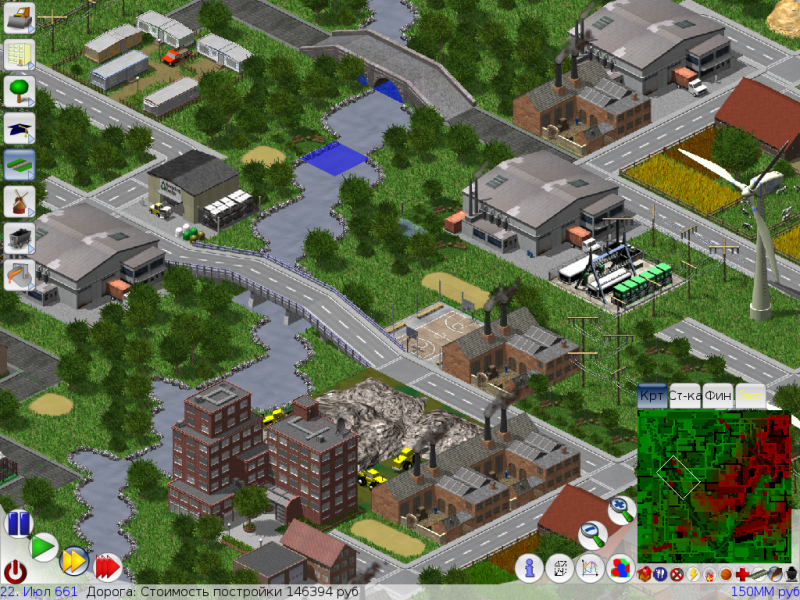
Lincity is a city-building game.

A city-building game, citybuilder or town-building game, is a genre of simulation video game where players act as the overall planner and leader of a city or town, looking down on it from above, and being responsible for its growth and management strategy. Players choose building placement and city management features such as salaries and work priorities, and the city develops accordingly.

City-building games such as SimCity, Cities XXL or Cities: Skylines are considered a type of construction and management simulation.[1]

History

[edit]

Early examples

[edit]

The earliest city-building game was The Sumerian Game (1964), a text-based mainframe game written by Mabel Addis, based on the ancient Sumerian city of Lagash. It was subsequently adapted into The Sumer Game (1968), later known as Hamurabi.[2] The first sim game, Utopia (1982) developed for the Mattel Intellivision console system, covered many of these same elements, but was limited by the primitive screen resolutions of its era. Unlike the thousands of individual spaces possible a few years later in SimCity, each island in Utopia held only 29 "buildable" spaces for schools, factories and other constructions. The player's score was based on the well-being of his people.

Beginnings of a genre

[edit]

The city-building game genre was established in 1989 with SimCity, which emphasized continuous building rather than a set victory condition.[3] Players followed personal preferences in design and growth. Indicators of success were maintaining positive budget balance and citizen satisfaction. While "SimCity" was independently developed by Will Wright, beginning in 1985; the game was not released until 1989.[4][5] Because the game lacked any arcade or action elements that dominated the video game market in the 1980s, video game publishers declined to release the title for fear of its commercial failure until Broderbund eventually agreed to distribute it. SimCity was a financial success, selling one million copies by late 1992, including 500,000 for home computers and another 500,000 for the SNES.[6] In the United States, it was the ninth best-selling computer game from 1993 to 1999, with another 830,000 units sold.[7] The SNES version sold 1.98 million units worldwide,[8] including 900,000 units in Japan.[9] Subsequent SimCity titles such as SimCity 4 soon followed when high sales of the game demonstrated its popularity. SimCity inspired a new genre of video games. "Software toys" that were open-ended with no set objective were developed trying to duplicate SimCity's success. The most successful was Wright's own The Sims, which went on to be the best selling computer game of all time. The ideas pioneered in SimCity have been incorporated into real-world applications as well, as urban developers have recognized that the game's design was "gamification" of city planning by integrating numerous real-world systems for a city or region interacted to project growth or change. Several real-world city improvement projects started with models inspired by SimCity prior to implementation, particularly with the onset of more connected smart cities.[10][11]

Second boost in the popularity

[edit]

1992 and 1993 saw the release of various games. Impressions Games was a British video game developer which created a series of historical city-building games starting from a blockbuster game which modeled cities in ancient Rome: Caesar. These games swapped radius-based “coverage” for agents (“walkers”; market ladies, priests, barbers, who physically deliver services along streets. The focus was now on street topology (loops, gates, choke points) and housing evolution (meeting tiered needs). Those games followed the style of Sim City over historical accuracy, such as including schools and hospitals, but not slavery.[12]

In 1993, The Settlers, which is set in medieval times and simulates a complex settlement and commerce system, which was revolutionary at the time. The Settlers turns the commerce into a watchable machine: woodcutter → sawmill → planks → building. Later entries add territory control and quality-of-life dashboards, but the core feature was observing supply lines.

The PC game Stronghold developed by Stormfront Studios, also appeared in 1993, and was advertised as "SimCity meets Dungeons & Dragons in 3D". Elves, humans and dwarves each built neighborhoods with unique architecture within the player's town. The title also had elements of real-time strategy games when enemies attacked the city, and the line between city-building and RTS games has often been blurred with this kind of hybrid title. True 3D graphics were not yet possible at that time, so the advertised 3D was actually a clever use of 2D graphics (an isometric projection) with mathematically generated terrain and overlaid bitmaps and sprites.[citation needed]

The Anno series started in 1998 with the release of Anno 1602 and established a high level of detail in graphics as well as an intense commerce simulation and a distinct gameplay. Players juggle multi-island networks, shipping lanes, population classes with escalating needs, and specialization pressures (expeditions, influence, diplomacy). It blends resource micro-management with macro-level logistics, evolving over time to incorporate futuristic and industrial-age settings.

Diversification

[edit]

In 2001, 3 games with different ideas were released. Tropico wrapped elections, factions, foreign meddling, edicts, coups in a Caribbean satire. The win condition is often just staying in office by designing a system that pleases enough people sufficiently. In Startopia, players build a space station on stacked decks (Engineering, Pleasure, Bio) with alien needs, commerce, and research. Stronghold (unrelated to the previous game) developed by Firefly Studios fused commerce with siege warfare. Food rations, fear factor, and wall geometry matter as much as troop numbers. Layout and supply lines are now military decisions too.

SimCity 4, released in 2003, was praised as a standard-setter among city-builders and is still regarded by Matt Smith of Makeuseof.com as one of the best games in the genre,[13] despite its complexity and steep learning curve.[3] Subsequent games in the series attempted to remedy this, such as SimCity Societies (2007), which did not further deepen the gameplay along the line of city simulation but incorporates different gameplay elements such as social management.[3] The changes to the formula polarized critics and its fan base alike. The reboot, SimCity, released in 2013, attempted to bring the franchise back to its roots but was panned by critics and traditional fans for its forced online requirements, consistent server issues at launch, bugs in the simulation, failure to add promised features and restrictions on city sizes, all of which ultimately led to the discontinuation of SimCity as a franchise. The waning dominance of the SimCity franchise in the genre caused several other companies to release similarly themed games, like Cities XL (2009).

Children of the Nile from ex-Impressions games employees pivoted from random walkers to household AI: named citizens with routines whose daily errands are essential for commerce .

Starting with Anno 2070 in 2011, continued by Anno 2205 in 2015, and emphasized by Surviving Mars and Frostpunk in 2018, futurist settings became again widely popular with the audience of the genre.[14]

With the rise of social gaming, mobile gaming, freemium and micropayment model in the 2010s, there has been a surge of casual city-building games with different mechanisms like time-based "produce and upgrade" feature, including CityVille, SimCity Buildit, and City Island. Although most traditional followers of the genre dislike these games due to factors like simple, dumbed-down mechanics and microtransactions,[15] they have gained greater commercial success around the world than most prior city building games.[16]

Banished released in 2014, kick-started the survival-citybuilder trend with harsh seasons, demographics, and food security issues.

2015 onwards

[edit]

The game Cities: Skylines published in 2015 and was very successful with the audience of the genre.[3] It revived the SimCity style with big maps, traffic fidelity, districts & policies, and day-one modding that turned the game into a platform (Traffic Manager: PE, 81 Tiles, thousands of assets). Cities: Skylines was followed up by a sequel, Cities: Skylines II, which released in October 2023.[17]

Planetbase, Aven Colony, Frostpunk, RimWorld, Surviving Mars, Endzone: A World Apart, Against the Storm, Workers & Resources: Soviet Republic, Foundation, and The Wandering Village are some of the notable games which came out in this period.

See also

[edit]

References

[edit]
Revisions and contributorsEdit on WikipediaRead on Wikipedia
from Grokipedia
A city-building game, also known as a town-building game, is a subgenre of simulation video games in which players act as the planner, mayor, or leader of a developing settlement, constructing infrastructure, zoning land for residential, commercial, and industrial use, managing resources and budgets, and responding to citizen needs to promote economic growth and urban expansion. These games typically feature open-ended "sandbox" gameplay without predefined win conditions, emphasizing creative freedom and long-term strategy over linear narratives. The genre's modern foundations were laid by early text-based simulations such as Hamurabi (1968), which introduced mechanics, but it exploded in popularity with Will Wright's in 1989, a groundbreaking title from that sold over a million copies and established core elements like grid-based , taxation, and disaster events. Subsequent entries in the series, including (1993) with enhanced visuals and utilities, (2003) introducing 3D graphics and regional play, and Cities: Skylines (2015) from , which emphasized and , propelled the genre's evolution toward more intricate societal and environmental modeling. Beyond the SimCity lineage, notable titles have diversified the genre with unique themes and mechanics, such as Caesar series (1992 onward) focusing on ancient Roman cities, Tropico (2001) incorporating in a setting, and Anno series emphasizing trade and historical progression. Recent developments from 2023 to 2026 highlight the genre's vitality, with over 20 new releases in 2024 alone, including Manor Lords ( 2024) blending medieval city-building with RTS elements and selling over 3 million copies as of February 2025, Workers & Resources: Soviet Republic (full release 2024) delving into planned-economy logistics, (2024) integrating survival and moral decision-making in a frozen , and Heartopia (free-to-play, released January 2026). As of February 13, 2026, the most popular city-building games on Steam, measured by concurrent players via SteamDB charts for the City Builder tag, are Heartopia (~36,876 current concurrent players, 50,947 24-hour peak), Sid Meier's Civilization VI (~31,584 current concurrent players), RimWorld (~26,611 current concurrent players), and others including Age of Empires II: Definitive Edition. These figures reflect the genre's ongoing popularity and success on digital platforms like Steam. These advancements reflect growing emphasis on niche settings, deeper of citizen behaviors, and accessibility through platforms like , while maintaining the core appeal of strategic creativity and emergent storytelling.

Definition and Characteristics

Core Elements

City-building games constitute a subgenre of and video games in which players assume the role of urban planners or mayors, tasked with constructing, expanding, and managing fictional cities from rudimentary settlements into thriving metropolises. These games emphasize open-ended, without rigid win conditions, allowing players to experiment with urban development decisions that influence the city's long-term viability. At their foundation, city-building games simulate complex urban systems, drawing inspiration from real-world planning principles to create emergent narratives of growth and challenge. Central to the genre are for land into distinct categories—typically residential for , commercial for businesses, and industrial for —to organize spatial layouts and balance interdependent urban functions. This system often enforces separation of uses, akin to Euclidean models, to manage factors such as diffusion from industrial sites or land value fluctuations near commercial hubs. drive progression, as simulated residents migrate in response to available amenities, opportunities, and quality-of-life factors like taxation rates and public services, thereby unlocking new development tiers and escalating the scale of management. construction forms another pillar, involving the placement of essential networks such as roads for connectivity, utilities like , , and for basic needs, and public facilities including schools, hospitals, and to sustain expansion and mitigate inefficiencies. Core objectives revolve around fostering through balanced budgets and revenue generation, while prioritizing via access to , healthcare, and to prevent decline or unrest. Players must also address , responding to simulated events like calamities or infrastructural failures—such as or flooding—through proactive policies and adaptive builds to maintain overall city resilience. These goals create a feedback loop where mismanagement leads to cascading issues, reinforcing the genre's emphasis on . Common interfaces facilitate oversight via isometric or top-down perspectives, providing a god's-eye view of the for and monitoring, often enhanced by and overlaid panels for budgets, demographics, and alerts. This visual approach enables intuitive interaction with the simulated environment, allowing players to zoom and rotate for detailed urban navigation.

Genre Distinctions

City-building games are primarily distinguished from (RTS) games by their emphasis on long-term of urban growth and resource balance, rather than direct, fast-paced unit control and combat engagements. In RTS titles, revolves around real-time tactical maneuvers to outmaneuver opponents in battles, with base-building serving as a means to support military objectives. City-builders, by contrast, treat and as the core loop, where any conflict elements—if present—are integrated as defensive or secondary features to protect the developing settlement, without demanding of individual units. Unlike tycoon games or broader management simulations, city-builders center on the interconnected simulation of an entire urban ecosystem, including zoning for residential, commercial, and industrial districts, alongside infrastructure like transportation and utilities, to foster a self-sustaining society. Tycoon games typically narrow the scope to optimizing a single enterprise, such as a transport network or amusement park, where the focus is on profit maximization through targeted operations rather than holistic civic planning. This broader systemic interplay in city-builders creates emergent challenges like traffic congestion or social needs, setting them apart from the more isolated business mechanics of tycoons. City-building games overlap with in the player's role as an all-seeing overseer who shapes and nurtures a from afar, wielding broad influence over development without direct intervention in daily affairs. However, incorporate mythological or themes, allowing players to invoke divine powers, miracles, or fantastical events to guide whimsical creatures or worlds. City-builders maintain a more realistic or grounded tone, simulating human-scale urban dynamics without such otherworldly elements, though the omnipotent perspective remains a shared trait. The encompasses various subgenres defined by temporal and thematic settings, notably historical city-builders that immerse players in recreating ancient civilizations through era-specific , routes, and societal hierarchies. These contrast with futuristic subgenres, which explore advanced space colonies or dystopian megacities, incorporating sci-fi mechanics like orbital habitats, alien resources, or technological to address interstellar expansion challenges. Such variations highlight the genre's flexibility in blending depth with diverse historical or speculative contexts.

History

Origins and Early Games

The roots of city-building games trace back to pre-digital simulations that emphasized resource management and urban development through board games and pen-and-paper exercises. In the 1970s, educational pen-and-paper urban planning simulations, such as adaptations of ancient economy models, introduced players to decision-making in resource allocation and population growth, laying conceptual groundwork for later digital titles. The 1980 board game Civilization, designed by Francis Tresham and published by Hartland Trefoil, further influenced the genre by simulating empire expansion from settlements, focusing on trading resources like iron and gold while advancing through a technology tree to develop regions over millennia. The transition to digital formats began with Hamurabi in 1973, a text-based originally derived from the 1968 and ported to for wider accessibility on early computers like the PDP-8. In Hamurabi, players act as a Babylonian ruler managing grain, land, and population over ten turns, balancing planting, feeding citizens, and mitigating risks like plagues or rats to foster economic stability, marking it as an early antecedent to city management mechanics. This game's influence extended to subsequent strategy simulations by demonstrating how simple inputs could simulate complex societal outcomes. The 1980s saw key milestones in graphical and interactive city-building. (1982), developed by for the console and published by Mattel Electronics, introduced real-time multiplayer elements where up to two players built island nations by constructing farms, schools, hospitals, and factories to grow population and manage disasters, establishing it as one of the first console-based city-builders with shared-screen competition. The genre's defining moment arrived with (1989), created by Will Wright and published by , which featured pixelated city grids for residential, commercial, and industrial areas, allowing players to experiment with without predefined win conditions. Core elements like were first prototyped in these early digital works, enabling dynamic city growth. A pivotal innovation in these origins was , particularly in , where player decisions—such as road placement or power distribution—unpredictably led to events like or spikes, simulating real-world urban complexities through interconnected systems rather than scripted narratives. This approach encouraged creative problem-solving and highlighted the consequences of planning choices, setting a foundation for the genre's emphasis on simulation depth.

Evolution in the Digital Age

The 1990s witnessed a significant expansion in the city-building genre, driven by sequels and technological improvements that added depth to simulation mechanics. , released in 1993 by , introduced an isometric perspective, underground utility layers, and a broader array of natural disasters, allowing players to manage more intricate urban infrastructures and respond to dynamic events. This title set a benchmark for the decade, inspiring a wave of sequels and variants that emphasized strategic layering and environmental interaction. The period also featured advanced isometric graphics, exemplified by in 1998 from (later Sierra Studios), which integrated historical Roman architecture with rotatable views to enhance visual immersion and tactical city placement. Entering the 2000s, city-building games diversified beyond pure simulation, incorporating narrative and social elements while adapting to emerging platforms like mobile devices and online networks. Tropico, developed by and published by in 2001, blended city management with RPG-style decision-making, where players assumed the role of a dictator, balancing political intrigue, economy, and citizen happiness in a satirical tropical setting. This innovation expanded the genre's appeal by adding personal agency and storytelling. Concurrently, online features gained traction, as seen in (2002) from and , which extended life-simulation building into persistent multiplayer worlds, enabling shared neighborhood development and social interactions. From the 2010s onward, the genre experienced an indie resurgence, fueled by accessible development tools and community-driven enhancements, alongside explorations into new mediums and themes. Cities: Skylines, launched in 2015 by and , revitalized interest through its open architecture and modding support via the , where user-created assets and expansions addressed limitations in scale and customization, contributing to over 12 million units sold by 2022. Post-2020, virtual and experiments emerged, such as Cities: VR (2022) on Meta Quest platforms, which allowed players to physically navigate and construct cities in immersive 3D environments. Sustainability motifs also proliferated in indie titles like (2023) and Timberborn (2021 onward), emphasizing eco-conscious planning, resource conservation, and to reflect real-world urban challenges. In 2025, the genre continued to thrive with releases such as Beyond These Stars, focusing on building cities on cosmic entities and exploring interstellar themes, alongside full releases and updates to ongoing titles like Manor Lords, highlighting persistent innovation in niche settings and advanced simulations. Broader industry trends have shifted the genre toward collaborative play and computational sophistication. Multiplayer co-op modes became standard in series like (2019) and (2019), enabling joint decision-making on trade routes, expansions, and defenses across shared maps. Hardware advancements, particularly in GPUs, have supported these evolutions by powering real-time simulations of large-scale populations, flows, and environmental systems, as demonstrated in titles leveraging technologies for enhanced rendering and physics.

Gameplay Mechanics

Resource and Economy Management

In city-building games, and management forms the backbone of sustainable urban expansion, requiring players to oversee financial inflows and outflows while ensuring resource availability supports and infrastructure demands. These systems simulate real-world economic principles by modeling how decisions in taxation, production, and influence city viability, often emphasizing balance to avoid collapse from deficits or overreliance on finite supplies. Taxation mechanics allow players to set rates that generate revenue for public services, with adjustments varying by game: from 0% to 20% in early titles like (1989), or negative values (subsidies) up to 30% in more recent ones like Cities: Skylines II (2023) to incentivize or discourage certain activities. Higher tax rates increase income but risk reducing citizen happiness and prompting migration, while lower rates may lead to budget shortfalls necessitating loans with interest. Budgeting involves allocating funds across services like utilities and transportation, adjustable from 0% to 200% in titles like (2003), or 50% to 150% in Cities: Skylines II, where underfunding raises costs through inefficiencies and overfunding strains surpluses. Managing deficits or surpluses requires prioritizing essentials over luxuries, as unchecked can accumulate and halt development. Resource chains simulate production from raw materials to , creating interdependent networks where farms yield for markets, or mines supply for factories producing tools. Players must balance extraction, , and distribution, as bottlenecks in one stage (e.g., insufficient labor for refining) can cascade into shortages, prompting with external entities to deficits or export surpluses at varying costs based on distance and volume. These chains often incorporate , with finite resources like requiring to prevent depletion. Economic indicators provide feedback on system health, including analogs to GDP such as overall value derived from and output, unemployment rates reflecting job availability versus , and modeled through rising resource prices that curb citizen . High unemployment may lower base and , while from overproduction or external factors increases expenses, forcing adjustments in or subsidies to stabilize . Basic economy formulas underpin these mechanics, such as revenue calculation, which follows the structure: Revenue=Tax Rate×Taxable Income\text{Revenue} = \text{Tax Rate} \times \text{Taxable Income} where taxable income aggregates from population size, land value, and happiness modifiers. Balancing inputs (e.g., resource production) and outputs (e.g., service consumption) ensures equilibrium, as excess outputs drain reserves while insufficient inputs trigger indicators like rising unemployment.

Urban Development and Simulation

In city-building games, simulation often revolves around metrics that reflect citizens' , influenced by access to such as schools, healthcare facilities, and recreational parks. These metrics are typically represented as numerical scores, where low due to inadequate services can lead to decreased , increased health issues, and outward migration, simulating real-world demographic shifts based on livability factors. For instance, in Cities: Skylines, uneducated or unhappy citizens contribute to higher waste production and lower , prompting players to prioritize for educational and to attract and retain residents. Infrastructure development in these games incorporates models to handle challenges like and , often using algorithms to model citizen and vehicle movement across transportation networks. Players must design road systems, public transit options such as buses and subways, and zoning layouts to mitigate , where inefficient paths can exacerbate delays and reduce overall city efficiency; for example, Cities: Skylines uses algorithms, such as variants of A*, to calculate routes, allowing vehicles to adapt dynamically to traffic volumes and road capacities. from industrial zones, highways, and power plants is simulated through spreading effects that degrade residential areas, necessitating separation of land uses or green buffers to maintain air and noise quality. Disaster and event systems introduce randomness to urban simulation, featuring events like earthquakes, fires, floods, and meteor strikes that can devastate and populations unless mitigated through proactive and measures. In Cities: Skylines, players deploy early warning systems such as radar dishes and radio towers, alongside emergency shelters and response centers, to minimize casualties and accelerate recovery, emphasizing strategic land allocation away from high-risk zones. These mechanics highlight the interplay between planning and unpredictability, where poor amplifies economic and social fallout from such events. Environmental mechanics in later city-building titles increasingly incorporate sustainability features, such as green spaces, sources, and controls, to simulate long-term ecological impacts like or . Games like Cities: Skylines reward interconnected parks and plazas with happiness boosts while penalizing overdevelopment through mechanics like sewage contamination or from unchecked expansion; centers and solar farms enable mitigation, though growth often competes with these eco-friendly options. Pre-industrial titles such as Banished further stress and balanced resource use to prevent environmental collapse, underscoring a shift toward holistic in modern simulations.

Notable Examples

Pioneering Titles

The pioneering city-building game that defined the genre was , released in 1989 by and designed by Will Wright. This title introduced players to an open-ended simulation where they could construct and manage virtual cities from scratch, focusing on residential, commercial, and industrial areas while balancing infrastructure needs like power plants, roads, and police stations. Its emphasis on experimentation without predefined goals or win conditions encouraged creative , allowing players to observe emergent consequences such as or based on their decisions. Key innovations included budget sliders for adjusting tax rates and funding allocations across city services, as well as an advisor system that provided feedback on departmental performance and suggested improvements, making complex economic management accessible yet strategic. SimCity received widespread critical acclaim for its addictive depth and innovative blend of simulation and strategy, earning praise as an educational tool that demystified urban dynamics despite some simplifications in realism. By late 1990, it had sold one million copies and generated over $5 million in revenue, marking an unexpected commercial triumph for and establishing open-ended city-building as a viable . Its legacy endures in shaping player expectations for sandbox-style simulations, influencing how subsequent games handle mechanics and long-term city evolution. Another foundational title from 1989 was Populous, developed by under , which blended city-building elements with god-game mechanics. Players acted as deities indirectly guiding followers by manipulating terrain—raising land, casting floods, or summoning earthquakes—to expand settlements and outmaneuver rival tribes across procedurally generated worlds. This hybrid approach innovated large-scale environmental control and , where building was tied to divine intervention rather than direct construction, fostering strategic depth in and territorial growth. Populous was a massive hit, selling hundreds of thousands to millions of copies worldwide and solidifying 's reputation, while its god-game framework laid groundwork for indirect management in later simulations. In 1990, , designed by and published by , expanded city-building into transport-focused empire management. Players built rail networks by laying tracks, erecting stations, and scheduling trains to haul goods like and between cities, optimizing routes for profit amid economic fluctuations and competition. Innovations included a macro-scale time system compressing years into gameplay hours for , combined with real-time train operations that integrated with broader economic simulation. The game earned "Game of the Year" honors from Computer Gaming World for its engaging blend of history and , and it pioneered the "Tycoon" sub-genre, inspiring transport and management titles that emphasized interconnected infrastructure.

Modern and Influential Series

As of February 13, 2026, the city-building genre continues to attract significant player engagement on Steam, as evidenced by concurrent player counts on the City Builder tag. The free-to-play Heartopia, released on January 16, 2026, leads with approximately 36,876 concurrent players and a 24-hour peak of 50,947. It is followed by Sid Meier's Civilization VI (~31,584 concurrent players), RimWorld (~26,611), and others such as Age of Empires II: Definitive Edition. Steam's City Builder tag page also prominently features Heartopia alongside titles like Sid Meier's Civilization VII, Jurassic World Evolution 3, Cities: Skylines II, and Two Point Museum, based on visibility, reviews, and sales indicators. This distribution of popularity highlights the genre's diversity, encompassing new free-to-play releases, long-standing strategy titles, and simulation-focused games. The Cities: Skylines series, developed by and published by , stands as a cornerstone of modern city-building games, beginning with the 2015 release that emphasized player freedom through robust support integrated directly into the game via tools like the Paradox Mods platform. This feature enabled communities to create custom assets, maps, and mechanics, extending the game's longevity and replayability far beyond its base content. The original title introduced sophisticated traffic AI, simulating individual citizen paths, vehicle lane changes, and congestion avoidance to create emergent urban challenges. By 2022, Cities: Skylines had sold over 12 million copies across platforms, underscoring its commercial and cultural impact. Its sequel, Cities: Skylines II (2023), advances these elements with enhanced simulation of economic policies, , and environmental factors, while maintaining the series' commitment to for deeper customization. Although official multiplayer is not supported—developers have noted it could compromise the core single-player experience—community mods have emerged to enable collaborative building, reflecting ongoing trends toward social gameplay in the genre. The Anno series, particularly (2019) from , exemplifies economic complexity in city-building by integrating intricate production chains with global trade routes that span multiple islands and player sessions. Players must balance resource extraction, workforce needs, and international to sustain expanding metropolises during the era, blending strategic depth with visual spectacle. This installment highlights the genre's evolution toward interconnected economies, where trade efficiency directly influences urban growth and technological progress. Frostpunk (2018), developed and published by , innovates by fusing city-building with survival mechanics in a post-apocalyptic frozen world, where players construct around a central generator while managing citizen through a book of laws. Unique systems track hope and discontent, forcing moral trade-offs like child labor or automaton use that impact societal stability and long-term viability. This approach shifts focus from pure expansion to ethical in harsh environments, influencing subsequent titles to incorporate narrative-driven tension. Recent trends in city-building emphasize sustainability and environmental integration, as seen in games like Eco (ongoing updates since 2018), where players construct civilizations while simulating ecosystem balance to avert ecological collapse. Titles such as Synergy (early access 2024, full release 2025) further this by requiring analysis of biomes and resource optimization for eco-conscious settlements, promoting themes of harmony between urban development and nature. These developments build on series like Cities: Skylines and Anno, prioritizing green infrastructure and multiplayer cooperation for resilient world-building.

Cultural and Educational Impact

Influence on Gaming Culture

City-building games have significantly shaped gaming communities through robust modding scenes that extend game lifespans and create vibrant ecosystems of player-generated content. In SimCity 4, a dedicated modding community has sustained the 2003 title for over two decades by developing tools to access its database and repurpose unused assets, such as transforming dirt roads into customizable highways via the Real Highway mod. The Network Addon Mod (NAM), now in its 49th iteration as of 2025, exemplifies this effort by introducing advanced transportation features like multilevel rail networks and traffic simulators, supported by a global team of contributors collaborating on forums like Simtropolis. Similarly, Cities: Skylines benefits from a thriving modding culture where creators like Bryan Shannon have transitioned to full-time work funded by community patronage on platforms like Patreon, producing thousands of custom assets that enhance urban customization and foster a "fan economy" of shared, monetized content. These communities not only preserve classic titles but also democratize game development, encouraging collaborative innovation that influences broader simulation genres. The genre's cross-media impact manifests in documentary representations that draw on its mechanics to explore urban themes, bridging virtual with real-world narratives. For instance, the 2021 documentary The Story of examines how the series' design philosophy—rooted in and —has permeated cultural discussions of city management, inspiring filmmakers to reference its and growth models in explorations of urban evolution. This influence extends to media portrayals of city navigation, where city-building elements inform expansive, interactive environments in other formats, though direct TV adaptations remain rare. Such integrations highlight the genre's role in popularizing complex urban dynamics beyond gaming, embedding tropes into broader discourse. City-building games have contributed to genre hybridization by infusing open-world titles with detailed urban simulation and navigation mechanics, creating more immersive cityscapes. In Watch Dogs 2 (2016), players navigate a simulated with hacking mechanics that echo the resource management and infrastructure interplay of titles like , blending action with strategic to enhance . This fusion has popularized "living cities" in open-world design, where procedural elements from city-builders enable reactive, scalable worlds that respond to player actions. Cultural critiques within city-building games often interrogate themes of and urban inequality, using to expose power dynamics. The Tropico series portrays a under player control as "El Presidente," where balancing foreign investments, domestic policies, and citizen demands reveals the exploitative undercurrents of capitalist development, such as resource extraction that widens social divides. By concealing inequalities behind an idyllic tropical facade, Tropico interpellates players into a colonizing framework tied to U.S. imperialist ideologies, critiquing how masks exploitation and perpetuates uneven urban development. These narratives encourage reflection on real-world , positioning the genre as a lens for examining neoliberal without overt .

Applications in Education and Simulation

City-building games have been adapted as educational tools in schools to teach subjects such as , , and by simulating real-world urban decision-making processes. SimCityEDU, released in 2013 by GlassLab, serves as a prime example, providing a classroom-oriented version of the classic game that integrates formative assessments aligned with standards to evaluate student understanding of environmental impacts, , and civic responsibilities. In geography lessons, players construct cities to explore themes like human-environment interaction and , fostering about urban layouts and challenges. For economics and civics, the game models budgeting, taxation, and policy trade-offs, allowing students to see consequences of decisions like or investment in an engaging, interactive format. Beyond classrooms, city-building games support professional simulations for urban planners, particularly through customizable modifications that enable realistic modeling of complex systems like . Cities: Skylines, developed by , has been employed by planning professionals to prototype city designs, test transportation networks, and visualize policy outcomes before real-world implementation. Custom mods in the game allow for advanced traffic simulations, incorporating variables such as vehicle density, public transit efficiency, and intersection designs to analyze congestion patterns and propose optimizations. Researchers at institutions like have modified the game to integrate real geographic data, enabling planners to simulate urban growth scenarios and evaluate measures in a low-cost, iterative environment. In research contexts, analyses of player behavior in city-building games have informed , especially regarding and . Studies utilizing games like demonstrate how players' strategic choices in handling crises—such as allocating resources during simulated floods or earthquakes—reveal insights into human decision-making under , which policymakers apply to enhance community preparedness frameworks. Frostpunk-inspired scenarios, explored in academic work on , highlight player responses to survival dilemmas in frozen wastelands, providing data on ethical trade-offs in resource that parallel real challenges. These investigations, often through mixed-methods approaches tracking in-game actions and post-play surveys, underscore how such simulations can predict societal behaviors during events like , guiding policies for resilient urban infrastructure. Accessibility initiatives in the 2020s have expanded city-building games' role in by offering free versions and integrations to reach diverse learners. Open-source adaptations like Micropolis, a browser-based evolution of early , provide no-cost access for classroom use, enabling teachers to incorporate exercises without licensing barriers. Programs such as Education's Schools Reinventing Cities challenge, launched in the early 2020s, integrate city-building mechanics into global curricula to teach solutions and equitable development, with free tools for students worldwide. These efforts emphasize , such as simplified interfaces and multilingual support, to accommodate varying skill levels and promote broader participation in STEM-related learning.

References

Add your contribution
Related Hubs
User Avatar
No comments yet.