


Community hub
Recent from talks
Contribute something
Nothing was collected or created yet.
University of Hertfordshire
View on Wikipedia
The University of Hertfordshire (UH) is a university in Hertfordshire, United Kingdom. The university is based largely in Hatfield, Hertfordshire. Its antecedent institution, Hatfield Technical College, was founded in 1948 and was identified as one of 25 Colleges of Technology in the United Kingdom in 1959.[5] In 1992, Hatfield Polytechnic was granted university status by the British government and subsequently renamed University of Hertfordshire. It is one of the post-1992 universities.
Key Information


Hertfordshire is mainly based at two campuses – College Lane and de Havilland. The university has 9 schools: Hertfordshire Business School, Computer Science, Creative Arts, Education, Health and Social Work, Humanities (which oversees its computer-assisted training system, or CATS programme), Hertfordshire Law School, Life and Medical Sciences, Physics, Engineering and Computer Science and Hertfordshire Higher Education Consortium.
As of 2022, it has around 32,000 students, including more than 13,000 international students that together represent 100 countries, making the university host the highest proportion of international students (outside of London) in England.[6] The university is one of Hertfordshire's largest employers with over 3,400 staff, 2,045 of whom are academic members of staff.[7] The annual income of the institution for 2021–22 was £317.5 million of which £9 million was from research grants and contracts, with an expenditure of £305.3 million.[1] Hertfordshire is a member of University Alliance, Universities UK and European University Association.
History
[edit]Origins
[edit]
The original campus for the university was at Roe Green in Hatfield, where it was founded as a technical college with a particular focus on training aerospace engineers for the aerospace industry that was then prevalent in Hatfield. The Gape family of St Michael's Manor in St Albans owned the land at Roe Green from the late 17th century. In the 1920s they sold it to Hill, a farmer, who then sold it to Alan Butler, chairman of the de Havilland Aircraft Company who lived at Beech Farm nearby. In 1944 he donated 90 acres (36 hectares) of land at Roe Green to be used for educational purposes.[8] In 1948 building commenced. The first principal W.A.J Chapman started on 1 January 1949, and in spring 1952 the 33 full-time and 66 part-time teachers were appointed. Hatfield Technical College opened with 1,738 students in September 1952, and in December it was formally opened by Prince Philip, Duke of Edinburgh. It was the first large technical college to be established in England after the war.[9] Students attended the college on part-time or full-time courses.[8]

In 1958 it was renamed Hatfield College of Technology, and by 1960 it offered four-year sandwich diplomas in technology. In 1961 it was designated a regional college in England and Wales by the Ministry of Education. The governors purchased a digital computer at a cost of £29,201 in 1962 so that a computer science degree could be established. The Council for National Academic Awards was formed in 1965 and Hatfield College was recognised for 13 honours degree courses.[8]
Sir Norman Lindop became the Principal of the College of Technology in 1966. A year later L.E. Haines was made Chair of Governors, but he died shortly afterwards and was replaced by F. Bramston Austin. A year later, Bayfordbury was acquired for the college.[10]
20th century
[edit]
In 1969 Hatfield College of Technology became Hatfield Polytechnic, offering honours degree courses in engineering and technology. In 1970 an observatory was built on the Bayfordbury Campus. Wall Hall and Balls Park Teacher Training Colleges merged in 1976 to become Hertfordshire College of Higher Education. In the same year Hatfield Polytechnic took over Balls Park. By 1977 more than ten per cent of the 4000 students came from more than forty different countries.[clarification needed] The Students' Union Social Centre opened in 1977.[8]
In 1982 John Illston succeeded Sir Norman Lindop as the director. A sports hall was built on the Hatfield Campus in 1984 and the number of students in that year was more than 5000. The number of staff, in the same year, had increased to 824.[8]
Neil Buxton became its director in 1987. The following year, Sir Ron Dearing and Buxton signed an agreement that gave the polytechnic accreditation from the Council for National Academic Awards. Hatfield was one of only 21 polytechnics, colleges and Scottish Central institutions to be accredited at the time. Hatfield was also, in that year, one of eight polytechnics accredited for research degrees. In 1989 it was given corporate status.[8]
After John Major announced in 1991 that polytechnics were to be abolished, Hatfield Polytechnic announced its intention to apply for university status. In 1992 it became the University of Hertfordshire and Sir Brian Corby became the first Chancellor.[11] It was the first university to run a bus company by making Uno bus public. The Hertfordshire College of Health Care and Nursing Studies and the Barnet College of Nursing and Midwifery merged with the university in 1993.[8]
In 1992, Hatfield Polytechnic was granted university status by the British government and subsequently renamed University of Hertfordshire. Its antecedent institution, Hatfield Technical College, was founded in 1948 and was identified as one of 25 Colleges of Technology in the United Kingdom in 1959.[5]
In 1994 the St Albans Cathedral was chosen to hold the university's graduation ceremonies. The same year saw the first publication of league tables and Hertfordshire was named as the top new university. In 1995 its law school moved to St Albans. Sir Ian MacLaurin was appointed chancellor in 1996 and in 1997 the Learning Resource Centre opened.[8]
21st century
[edit]In 2000, Olivia de Havilland, cousin of Geoffrey de Havilland, visited the university to mark the inauguration of a project to build a new campus named after her cousin. The university's 50th anniversary was celebrated in 2002, by which time it had 21,695 students. In 2003 Tim Wilson succeeded Neil Buxton as vice-chancellor and the de Havilland campus opened.[8]
Hertfordshire Sports Village also opened in 2003.[12] In 2005 the university launched the Bedfordshire and Hertfordshire Postgraduate Medical School and School of Pharmacy to enhance medical education, training and research in the region.[13] In 2006 the university opened its School of Film, Music and Media. The university opened the MacLaurin building in 2007, named in honour of its former chancellor Lord MacLaurin followed by a new law building in 2011.[14] During this period, Hertfordshire became a lead academic sponsor of Elstree University Technical College, a university technical college which opened in September 2013.[15] Hertfordshire is also the academic sponsor of Watford University Technical College[16]

In 2010, Tim Wilson announced his intention to retire as vice-chancellor after more than 19 years at the university.[8]
In 2011, Quintin McKellar replaced Tim Wilson as vice-chancellor of the university. Also on the same year, the Hatfield Beacon was restored and repositioned at the new Law School site. In the following year, the Kaspar project received a £180,000 donation from an international grant making foundation, which was used to further the university's research into the use of robotics to support the social development of children with autism.[17]
In 2015, Hertfordshire adopted a policy of naming its buildings after people or organisations with a significant local or regional impact. These include Kate Bellingham, British engineer and television presenter and Alistair Spalding, chief executive and artistic director of Sadler's Wells Theatre. All of the halls are named after influential alumni who the university feels represent the attributes of Hertfordshire graduates. In these two cases, the halls were named in recognition of Bellingham and Spalding's attributes of intellectual depth and adaptability and professionalism, employability and enterprise.[18] In the same year, the University of Hertfordshire was announced as one of the first recipients of the Race Equality Charter which is an initiative that recognises excellence in advancing racial equality in higher education. The charter was launched by the Equality Challenge Unit at the start of the 2015 academic year.[19]
In 2020, the University of Hertfordshire Observatory celebrated its 50th anniversary, and revealed an eight-year-long exposure photograph, breaking the record of longest exposure. The artist, Regina Valkenborgh, was a Master's student in August 2012, when she set the pinhole camera attached to one of the telescope domes in the Observatory. The camera was then forgotten, and rediscovered in September 2020 by the Observatory's Principal Technical officer. The photograph registered the path of the sun over the sky during the 2,953 days it was exposed to it.[20][21][22]
In 2024, the University of Hertfordshire hosted the European Maccabi Youth Games from 28 July to 6 August. This marked the first time the event was held in the United Kingdom, bringing together 900 young Jewish athletes from 14 countries, including Great Britain, United States, Netherlands, Germany, Denmark, Switzerland, South Africa, Hungary, Austria, Slovakia, France, Italy, Argentina, and Israel.[23][24]
Organisation and administration
[edit]
The University of Hertfordshire was established as an independent Higher Education Corporation in 1989 under the terms of the Education Reform Act (1989). The institution is an exempt charity.[25] The board of governors has responsibility for running the university, while the academic board is responsible for academic quality and standards, academic policies, research and scholarship. The vice-chancellor oversees its day-to-day running. The current chancellor is Robert Gascoyne-Cecil and the current vice-chancellor is Quintin McKellar.[26]
The following people have been vice-chancellors of the university.
- Neil Buxton (1987-2003)
- Tim Wilson (2003–2010)
- Quintin McKellar (2011–present)
The university runs on a three-term calendar in which the academic year is divided into three terms: Autumn (September–December), Spring (January–April), and Summer(April–May).[27] Full-time undergraduate students take three to four courses every year for approximately eleven weeks before their quarterly academic breaks. The school year typically begins in late September and ends in mid-May.[27]
Schools
[edit]The university offers over 800 undergraduate, postgraduate, CPD, online distance learning and short courses[28] in its 7 schools of study, within which there are around 50 academic departments and 24 research centres.[29]
- Hertfordshire Business School
- Creative Arts
- Health and Social Work
- Hertfordshire Law School
- Life and Medical Sciences
- Physics, Engineering and Computer Science[a]
- Social Sciences, Humanities and Education
Charity
[edit]Being a Higher Education Corporation created by the 1988 Education Reform Act as amended by the 1992 Act, the University of Hertfordshire is an exempt charity as defined under the various Charities Acts.[30]
The University of Hertfordshire has due regard to the Charity Commission's guidance on the reporting of public benefit, and particularly its supplementary guidance on the advancement of education, in accordance with the requirements of HEFCE, the Higher Education Funding Council for England, as the principal regulator of English higher education institutions under the Charities Act 2006.[30]
The university has entered an agreement with the Office of Fair Access (OFFA) to demonstrate that access to programmes of full-time undergraduate education should not be limited on grounds of individual financial circumstances.[30]
Affiliations and memberships
[edit]Hertfordshire is a member of Association of Commonwealth Universities which is the representative body of 535 universities from 37 Commonwealth countries.[31] It is the world's first and oldest international university network, established in 1913. It is also a member of University Alliance, a network of British universities which was formed in 2006, adopting the name in 2007. University Alliance is a group of 'business engaged' universities that claim to drive innovation and enterprise growth[32] through research[33] and teaching.[34] Its MBA programme is affiliated with Association of MBAs, the only global MBA-specific Accreditation and Membership Organisation.
Campus
[edit]The university is primarily based on two campuses, College Lane and de Havilland. It owns a BioPark facility, which is a science park managed by Exemplas on behalf of the university. It also provides 6,000 square metres of laboratory and office space to life science and health technology businesses. As of 2014, there are currently 27 permanent and virtual tenants.[35]
Additionally, a pool and climbing wall are among its sports facilities. It has also the Weston auditorium, for arts events, two art galleries and owns one of the highly recognised teaching observatories in the United Kingdom.[36]
With over 25,130 students, including more than 5,200 international students that together represent 100 countries, Hertfordshire has a global alumni of over 165,000.[37][38]
College Lane Campus
[edit]The main site of the university remains the College Lane campus, which houses the original Hatfield Technical College building. Notable among the buildings in this campus is the university's Learning Resource Centre, a combined library and computer centre.[39] There is also a substantial collection of halls of residence and student houses, and the University of Hertfordshire Students' Union is headquartered at College Lane campus. The College Lane campus is also the location of Hertfordshire International College, which is part of the Navitas group, providing a direct pathway for international students to the university.[40] The Hertfordshire Intensive Care & Emergency Simulation Centre is also located at College Lane. In 2016, the designed for purpose Science Building was opened, primarily offering teaching laboratories, a range of research laboratories and other specialist facilities.[41] This was renamed to 'Nexus' in September 2024 to accompany the grand opening of the Spectra building opposite. Spectra, which cost £100m to construct,[42] is a five-storey facility for the School of Physics, Engineering and Computer Science and contains several computer rooms and research areas, a robotics lab, racing simulator, and large electronics CDIO workshop.[42]
de Havilland Campus
[edit]The £120-million de Havilland campus, which was built by Carillion, opened in September 2003 and is situated within 15 minutes walk of College Lane, and is built on a former British Aerospace site.[43] This campus also houses its own Learning Resource Centre, a combined library and computer centre.[12] Hertfordshire Sports Village which includes a gym, swimming pool, squash courts is also on this site. The large Weston Auditiorium is present on the de Havilland campus, adjacent to the Learn Resource Centre. The auditorium has a capacity of 450 and can host talks both by university lectures for students and for guest lecturers for guests and students, music and films events and dance events.[44] The campus also contains 11 halls of residence;[45] named after local towns and villages. Ashwell and Welwyn are examples of the buildings with the towns being present in Hertfordshire. The campus is mostly themed around law and business, having its business school located on the campus as well as its law school. A full scale, mocked up court room is present, being available for use for students studying a law degree. Along with publicly Northampton University it provides the 2 years accelerated law degree.[citation needed]
Bayfordbury Campus
[edit]A third 50-hectare site in Bayfordbury houses the university's astronomical and atmospheric physics remote sensing observatory,[46] Regional Science Learning Centre,[47] and field stations for biology and geography programmes.[48]
Situated approximately 6 miles (10 kilometres) from the main campus, it houses one of the largest astronomical teaching observatories in the United Kingdom. The observatory has formed part of the astronomy-related degree programmes since it opened in 1970.[49]
The seven optical telescopes at Bayfordbury campus to observe detailed images of objects in space. Moreover, the five newest telescopes are also able to be operated remotely. The 4.5-metre radio telescope and 3-dish 115-metre baseline interferometer allow a completely different view of the universe. These are connected to 21 cm line receivers, to detect the neutral hydrogen in the galaxy and extragalactic radio sources.[49]
Meridian House
[edit]Home to some Schools within the Health and Human Faculty, this building is located on the edge of Hatfield town centre, off College Lane campus.[50] Meridian House is the location of eight clinical skills laboratories for nursing and midwifery programmes of the university. Skills facilities and ambulances for paramedic training are also situated at Meridian House, aside from counselling programme and staff offices.[51]
Gallery
[edit]-
 de Havilland Campus
 -
 Learning Resource Centre at de Havilland
 -
 Law Court Building
 -
 Halls of Residence at de Havilland
 -
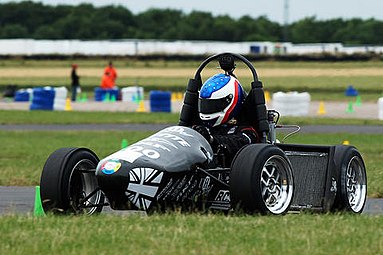 University of Hertfordshire Racing
 -
 Weston Auditorium
 -
 Sandwich Bar
 -


University symbols
[edit]
Academic dress
[edit]The University of Hertfordshire prescribes academic dress for its members. In accordance with tradition, Hertfordshire's academic dress consists of a gown, a cap and a hood. The black gown and square cap familiar to all readers of the Beano had evolved into their present form in England by the end of the Reformation. The hood, which is now the distinctive mark of a university-level qualification, is medieval in origin, and was originally functional.[52]
Ceremonial mace
[edit]The ceremonial mace was produced in 1999 by craftsman Martyn Pugh, a Freeman of the Worshipful Company of Goldsmiths, member of the British Jewellers Association and a Founder Member of the Association of British Designer Silversmiths.[53] Its design symbolises the university's origins, expertise and associations. Its shape is inspired by the shape of an aeroplane wing symbolising the university's origin in the aviation industry. The head of the mace is engraved with zodiac symbols representing the university's contribution to astronomy and also contains the DNA double helix representing the biological sciences and microprocessor chips representing information and communications technology.[54]
Coat of arms
[edit]The university's coat of arms was granted in 1992. The shield is charged with an oak tree taken from the coat of arms of the former Hatfield Rural District, the constellation Perseus (containing the binary star Algol) and a representation of the letter "H" recalling the emblem of the former Hatfield Polytechnic. The crest, a Phoenix rising from an astral crown, represents the university's evolution from a technical college training apprentices for the aviation industry. The two harts supporting the shield represent the county of Hertfordshire, with the covered cups referring to A.S. Butler, who donated the land upon which the original campus was built. A scroll bears the motto Seek Knowledge Throughout Life.[55]
University logo
[edit]The standard university logo comprises the university name and the UH symbol in a horizontal panel.[56] There is an exclusion zone equivalent to the height of the H in the logo above, below and to the right of the logo. The university has created an endorsed version of the logo to be used where legibility is an issue with the standard logo. It comprises just the university name in a horizontal panel.[57] Although the university brands its logo in various colours, the standard colours are black and white.[56]
Academic profile
[edit]Reputation
[edit]The university's School of Pharmacy has been awarded full Royal Pharmaceutical Society of Great Britain accreditation.[citation needed] The University of Hertfordshire is recognised as one of the top twenty universities in the world to study animation.[58]
According to Destination of Leavers from Higher Education 2012–13 93.2 per cent of its full-time, first degree UK graduates are in work or further study within six months of graduating.[41] Four of the university's schools achieved scores of 98 per cent: physics; astronomy and mathematics; health and social work; law and education. The survey, conducted by the UK's Higher Education Statistics Agency (HESA), revealed in its UK Performance Indicators for Employment 2013/14 that the University of Hertfordshire has climbed 30 places in the past year and is now ranked 35th out of 152 universities in the UK.
In September 2015, the Complete University Guide showed that the university has the lowest recorded 'student-relevant' crimes in the East of England. It is the fourth year the university has had the lowest rate of recorded crime in the East of England.[59] For university's commitment to gender equality, it was regranted Athena Swan's Bronze institutional status.[60]
The University of Hertfordshire won the Guardian University Award for Student Experience in 2015.[61]
Rankings
[edit]| National rankings | |
|---|---|
| Complete (2026)[62] | 82 |
| Guardian (2026)[63] | 49 |
| Times / Sunday Times (2026)[64] | 67 |
| Global rankings | |
| ARWU (2025)[65] | 801–900 |
| QS (2026)[66] | 901–950 |
| THE (2026)[67] | 601–800 |
University of Hertfordshire ranked 601–800 among world universities in Times Higher Education World University Rankings in 2019.[68] It comes under the ranking of 101-150 under Young University Rankings 2018. In subject specific rankings, it has an overall world ranking between 301 and 400 in Arts and Humanities in 2019. It had a subject specific world ranking between 150 and 200 in European Teaching in 2018.[69]
The 2029 Complete University Guide ranked UH courses in Food Science, Social Work, Optometry Ophthalmology & Orthoptics and Medical Technology as the top 20 in the UK.[70]
In the THE 100 Under 50 universities 2015, a global ranking of the top 100 world universities under 50 years old, University of Hertfordshire was placed 71st.[71]
It was awarded the Entrepreneurial University of the Year by Times Higher Education in 2010.[72] In 2011, it was ranked 41st by The Complete University Guide among UK universities, its highest regional ranking in recent years.[73]
In the Times Higher Education ranking of most international universities in January 2015, Hertfordshire ranked 84th in the top 100 in the world.[74] In 2016, it was placed at 122nd in the top 200 international universities in the world, by Times Higher Education. The rankings are based on excellence across teaching, research, citations, industry income and international outlook.[75][76]
In the US News Best Global Universities Ranking in 2018, Hertfordshire ranked 698th among universities in the world.[77]
According to the Times Higher Education Student Experience Survey 2018, the University of Hertfordshire has a ranking of 69, with a score of 75.5 for overall student satisfaction.[78]
QAA and OIA
[edit]The last Quality Assurance Agency institutional audit for the university was in March 2009. The outcome was that 'confidence can reasonably be placed in the soundness of the institution's present and likely future management of the academic standards of the awards that it offers'.[5]
According to the complaint statistics, from the Office of the Independent Adjudicator, the university issued 69 completion of procedures letters in relation to student complaints, in 2013. This is below the band medium of 81, possibly suggesting greater student satisfaction when compared to universities of a similar size.[79] The OIA received 22 complaints in 2013. This is above the band medium of 18.5, possibly suggesting that more students are dissatisfied with the outcome of internal complaints procedure's, compared to universities of a similar size.[79]
The university has also never been named in an OIA annual report for a shortfall in practice, or a failure to comply with a recommendation set by the Adjudicator.
Research
[edit]The university has three research institutes: Health and Human Sciences Research Institute; Science and Technology Research Institute; Social Sciences, Arts and Humanities Research Institute. Also an expanding research profile with key strengths in areas of nursing, psychology, history, philosophy, physics and computer science.[80]
HR Excellence in Research
[edit]In recognition of development activities related to research careers and the position of researchers at the university, the European Commission awarded University of Hertfordshire the right to use the HR Excellence in Research logo in spring 2010.[80][81]
Research Excellence Framework
[edit]Over 55 per cent of the university's research was rated 'world leading' and 'internationally excellent' in the UK Government's 2014 Research Excellence Framework (REF) announced 18 December 2014. Fifty-seven per cent of the university's research submissions achieved a 4 or 3-star rating. This was an increase of 11% when compared to the results of the assessment in 2008.[82] In 2014, it claimed the top impact for History for the results of REF, indicating that all of its submission in History is deemed 'outstanding'.[83]
Kaspar
[edit].jpg)

Kaspar, a social robot, has been designed by the University of Hertfordshire's Adaptive Systems Research Group (ASRG). The Kaspar project began in 2005, drawing upon previous researches to develop a social robot for engaging autistic children in a variety of play scenarios. The aim was to research whether interacting and communicating with Kaspar would help children with autism interact and communicate more easily with people. This is important because there is mounting evidence that early intervention for children with autism may change the child's development trajectory. Kaspar is a research tool with programmed responses adapted to be used by an autistic child in a safe, non-judgemental environment.[84] The Kaspar research has shown that robots may provide a safe and predictable tool for children with autism, that enables the children to learn social interaction and communication skills, addressing specific therapeutic and educational objectives (for example, being able to engage in direct eye-contact or shared eye-gaze), in an enjoyable play context.[85]
Rocket powered car
[edit]As part of the final year Aerospace Project, students and staffs from the University of Hertfordshire designed, built and tested a full sized rocket powered car under the mentorship of Ray Wilkinson, a senior professor from Department of Aerospace and Mechanical Engineering.With support from BBC - Bang Goes the Theory and Host Dallas Campbell, the Vauxhall VX220 sports car, was fitted with a large hybrid rocket motor that is designed to produce over half a tonne of thrust was tested in the Duxford Aerodrome.[86][87] The project got lot of attention for its unprecedented success story and was showcased in local places to build interest in STEM.[88]
Facilities
[edit]In 1992, it established University of Hertfordshire Press, whose first publication was a book celebrating the institution's change in status from polytechnic to university.[citation needed]

Art collection
[edit]The University of Hertfordshire holds over 500 artworks in its art collection. The ethos of the UH Art Collection is to present modern and contemporary art in places where people study, work and visit. This reflects the University of Hertfordshire's determination to provide not only an attractive education setting but also one which will inform, enlighten and enhance the life of its students, staff and the local community.[89] The UH Art Collection was established in 1952, as part of Hertfordshire Country Council's commitment to the post-war programme. The collection has a diverse portfolio including photography, textile, ceramics, sculpture, mixed media and works by Ben Nicholson, Barbara Hepworth, Andy Goldsworthy, Alan Davie, and Diane MacLean.[89]
Transportation
[edit]Hertfordshire operates a regular shuttle bus service, Park and Ride, which connects 800 parking spaces at Angerland Common with its College Lane and de Havilland Campus facilities. The scheme started in 2006, when it is initially provided with the 700-car facility at Angerland Common, off South Way, Hatfield, in a bid to get cars off surrounding roads.
Since 2006, the university has planned on opening a second venue, with 150 spaces, at the south side car park at Stanborough Lakes in Welwyn Garden City. This second park and ride site was used for a brief time in 2009 served by bus service 692. It was withdrawn due to lack of use.[90]
Uno (formerly UniversityBus) is a bus service operated by the University of Hertfordshire,[91] serving members of the general public, and also its own students and staff, at a discounted rate. In 1992, the University of Hertfordshire wanted to create and provide bus service to and from the university. Uno, previously known as UniversityBus, was created to provide student transport to the university from local areas; improve east-west travel across the county of Hertfordshire;[92] and, to create new links between Hertfordshire and North London.
Student life
[edit]
The main source of nightlife is the Forum, which houses three entertainment spaces, a restaurant, a café, multiple bars and onsite parking.[93] Hertfordshire Students' Union (HSU) is the Students' Union of the University of Hertfordshire.[94] The Students' Union Social Centre was opened in 1977.[8] The Hatfield Technical College's management encouraged the establishment of a Student Representative Council (SRC) in 1982, to create a sense of unity and expand the social activities of its day students. The SRC was affiliated to the National Union of Students but initially restricted itself largely to social activities. After 1988 it began to campaign on issues such as improvements to the canteen, lifting the ban on religious or political activity within the then Hatfield Polytechnic, and for a formal students' union. The sectarian ban was finally lifted in 1992 and a Union granted in 1995. However, the canteen continued to be an issue throughout the 2000s. The Students' Union at the University of Hertfordshire represents all students in the university by organising campus activities and running different clubs and societies, from sports to entertainment.[41]
Trident Media Radio
[edit]Trident Media Radio (formerly known as Crush Radio, Campus Radio Hatfield, CRUSH and Crush 1278) is the student radio station. TMR is run by students of the university.[95] Crush is run by students of the university along with amateurs from around the surrounding areas.
Crush was the first campus radio, founded in 1960 under the name of CRH (Campus Radio Hatfield). After starting as a pirate radio station, CRH was turned into a University Society of the University of Hertfordshire and was renamed Crush 1278 for it broadcast on 1278AM frequency. As Crush became more accessible, via the internet, the name was changed again to Crush Radio. In 2009 Crush as a society merged with the other media societies of the Students union and the University of Hertfordshire as one media society, though Crush still uses its own website and broadcasts over 1278AM frequency, however it stopped broadcasting on 1278AM after the move in September 2009, but restarted commencing February 2011. Crush Radio has been broadcasting since 1960. It broadcasts online via the Tunein platform.
Sport
[edit]Rowing
[edit]The University of Hertfordshire Rowing Club is affiliated to British Rowing (boat code UHE)[96] and Dave Bell became a British champion after winning the men's double sculls title at the 2010 British Rowing Championships.[97]
American Football
[edit]The University of Hertfordshire American Football team, The Hurricanes, is affiliated to British Universities American Football League (BUAFL) Premier League South[98]
Partner institutions
[edit]The university holds a number of formal links with top-ranking institutions from around the world to share teaching and research and facilitate staff and student exchanges.[99]
- Chulalongkorn University, Thailand
- James Cook University, Australia
- McGill University, Canada
- Nanyang Technological University, Singapore
- Stony Brook University, US
- University of Oklahoma, US
- Yonsei University, Korea
Aside from its international partners, the university has also strong regional agenda and a number of partner institutions in the region: Elstree Screen Arts Academy a university technical college located in Borehamwood; The Watford UTC, a University Technical College for the Watford area.[100] The UTC specialises in Event Management and Computer Sciences.
Notable alumni
[edit] | This article's list of alumni may not follow Wikipedia's verifiability policy. (March 2025) |
Arts, science and academia
[edit]- Whitney Adebayo – Television personality and businessowner[101]
- Jean Bacon – Professor of Distributed Systems, Computer Laboratory, University of Cambridge
- Tony Banham – Founder of the Hong Kong War Diary project
- Nick Hector - British Canadian documentary filmmaker
- Sean Hedges-Quinn – British sculptor and animator
- Diane Maclean – Sculptor and environmental artist
- David Mba - Vice Chancellor, Birmingham City University
- Ben Mosley - Expressive artist
- Ciarán O'Keeffe – Psychologist specialising in parapsychology and forensic psychology
Government, politics and society
[edit]
- Abdulaziz bin Abdullah – Deputy minister of foreign affairs in Saudi Arabia
- John Cryer – English Labour Party politician
- Onn Hafiz Ghazi – 19th Menteri Besar of Johor in Malaysia
- Richard Howitt – Member of the European Parliament for the Labour Party for the East of England
- Akif Çağatay Kılıç – Current Minister of Youth and Sports of Turkey
- Darell Leiking – Former minister of the international trade & industry of Malaysia (MITI) and current MP in Malaysian Parliament
- Gwen O'Mahony – Former MLA in the 39th Parliament of British Columbia
- Mark Oaten – British former politician who was a senior member of the Liberal Democrat Party
- Fiona Onasanya – Labour Member of Parliament
- Mohamad Sarif Pudin – Acting Commander of the Royal Brunei Navy (RBN) since 2023
- Lawrie Quinn – Labour politician in England
- Prince Raj – Member of Indian Parliament
- Claire Ward – British Labour Party politician
- Sarah West – First woman to be appointed to command a major warship in the Royal Navy
Business and finance
[edit]- Chris Gubbey – Auto executive for General Motors (Hatfield Polytechnic)[102]
- Luke Scheybeler – British designer and entrepreneur
Media and entertainment
[edit]
- Kate Bellingham – British engineer and BBC presenter
- Yulia Brodskaya – Artist and illustrator known for her handmade elegant and detailed paper illustrations
- Sanjeev Bhaskar – British comedian, actor and broadcaster
- Matthew Buckley – British actor
- Stevyn Colgan – British writer, artist and speaker
- Sonia Deol – British radio and television presenter, currently at GlobalBC in Vancouver, Canada (previously BBC Asian Network)
- Des de Moor – member of The Irresistible Force with Morris Gould aka Mixmaster Morris; co-organiser of Ambient techno industrial techno evening, Madhouse, at The Fridge (nightclub), Brixton in 1988[103]
- Guvna B – Urban contemporary gospel rap artist and composer
- Bob Johnson – British guitarist formerly in the electric folk band Steeleye Span
- Chris Knowles, member of anarchist punk rock collective Hagar the Womb, also known as industrial techno DJ Chris Liberator
- Lisa Lazarus – British model and actress
- Helen Lederer, Comedian, writer and actress who emerged as part of the alternative comedy boom at the beginning of the 1980s
- Upen Patel – British male model and film actor
- Flux Pavilion – British dubstep musician (real name Josh Steele)
Sports and athletics
[edit]
- Ajaz Akhtar – Former British cricketer
- Steve Borthwick – Former English rugby union footballer who played lock for Saracens and Bath
- Noah Cato – Rugby union player
- Iain Dowie – Football manager
- Owen Farrell – England, Saracens rugby union player
- Gavin Fisher – Former chief designer of the Williams Formula One team.
- Alex Goode – Professional British rugby union player
- Aaron Liffchak – Rugby union footballer
- Michael Owen – Rugby union player: former Wales and British & Irish Lions captain
- Sachin Patel – Former British cricketer
- Tom Ryder – Rugby union player
- Alex Skeel – English football coach, domestic violence survivor
See also
[edit]Notes
[edit]- ^ Formerly three separate schools (Physics, Astronomy and Mathematics (PAM), Engineering and Technology, and Computer Science), SPECS was formed through a series of mergers during 2019/2020
References
[edit]- ^ a b c "Strategic Report and Financial Statements 2021–22" (PDF). University of Hertfordshire.
- ^ "Key People". University of Hertfordshire website. Hatfield, Herts. Retrieved 1 September 2025.
- ^ a b "Where do HE students study?". Higher Education Statistics Agency. Students by HE provider: HE student enrolments by HE provider. Retrieved 3 April 2025.
- ^ Estates Vision University of Hertfordshire
- ^ a b c "University of Hertfordshire – Institutional audit" (PDF). qaa.ac.uk. Archived from the original (PDF) on 5 March 2016. Retrieved 13 December 2015.
- ^ "Where do HE students study?: Students by HE provider". HESA. HE student enrolments by HE provider. Retrieved 8 February 2023.
- ^ "HE staff by HE provider and activity standard occupational classification". hesa.ac.uk. Higher Education Statistics Agency. Retrieved 25 February 2023.
- ^ a b c d e f g h i j k Tyler, Helen (5 March 2011). "History of the University of Hertfordshire". Our Hatfield. Hertfordshire County Council. Archived from the original on 12 March 2024. Retrieved 12 March 2024. Includes comments: 14 December 2011 - 27 January 2024
{{cite web}}: CS1 maint: postscript (link) - ^ Lytton, Charlotte (17 April 2013). "University of Hertfordshire guide". London: Telegraph Media Group Limited. Archived from the original on 12 January 2022. Retrieved 9 August 2015.
- ^ "1961–1980". University of Hertfordshire. Retrieved 10 August 2015.
- ^ "Appreciation: Sir Brian Corby". The Actuary. Retrieved 1 October 2014.
- ^ a b Brave Herts The Guardian, 23 September 2003
- ^ Corporate Plan HertsDirect
- ^ Case Study – University of Hertfordshire Law Court Building[permanent dead link] Breathing buildings
- ^ Elstree University Technical College Archived 4 November 2012 at the Wayback Machine HertsDirect
- ^ "The Watford University Technical College opened its doors today". Watford Observer. Newsquest (London) Ltd. 15 September 2014. Retrieved 17 September 2014.
- ^ "2011 – present". University of Hertfordshire. Retrieved 8 August 2015.
- ^ "Bellingham and Spalding open new University halls". University of Hertfordshire. Retrieved 14 July 2015.[permanent dead link]
- ^ "Winners of new university race equality charter mark named". Times Higher Education. 13 August 2015. Retrieved 16 August 2015.
- ^ "Longest known exposure photograph ever captured using a beer can". www.herts.ac.uk. 10 December 2020. Retrieved 17 December 2020.
- ^ @NatGeoUK (10 December 2020). "'Longest known exposure' recovered from makeshift camera forgotten on UK telescope". National Geographic. Retrieved 17 December 2020.
- ^ Ferdowsi, Samir (14 December 2020). "A Photograph With an Eight-Year Exposure Was Taken With a Beer Can". Vice.com. Retrieved 17 December 2020.
- ^ "First taste of Olympic glory: European Maccabi Youth Games held in UK". Jewish News. 6 August 2024.
- ^ "What I Learned Inside The Maccabi Bubble". Times of Israel. 8 August 2024.
- ^ "Corporate Governance". University of Hertfordshire.
- ^ Whitaker's (18 October 2011). Whitaker's Almanack 2012. Bloomsbury. ISBN 9781408130124. Retrieved 15 July 2015.
- ^ a b "Term and semester dates". University of Hertfordshire. Retrieved 16 September 2014.
- ^ "Courses". University of Hertfordshire. Retrieved 16 September 2014.
- ^ "Schools of study". University of Hertfordshire. Retrieved 14 September 2014.
- ^ a b c "The University as a Charity". University of Hertfordshire. Retrieved 8 August 2015.
- ^ Association of Commonwealth Universities (ACU) | UNESCO NGO – db Archived 13 April 2014 at the Wayback Machine. Ngo-db.unesco.org. Retrieved 12 April 2014.
- ^ "What is University Alliance?". Archived from the original on 16 July 2015. Retrieved 15 July 2015.
- ^ "Alliance universities see big increase in share of world class research – University Alliance". 18 December 2014. Retrieved 15 July 2015.
- ^ "Job Ready: universities, employers and students creating success – University Alliance". Archived from the original on 1 July 2017. Retrieved 15 July 2015.
- ^ "Reasons to choose the University of Hertfordshire". University of Hertfordshire. Retrieved 13 September 2014.
- ^ "University guide 2016: University of Hertfordshire". TheGuardian.com. Retrieved 13 August 2015.
- ^ "University of Hertfordshire". ncub.co.uk. National Centre for Universities and Business. Archived from the original on 24 February 2017. Retrieved 17 July 2016.
- ^ "Student information". University of Hertfordshire. Retrieved 22 September 2014.
- ^ "SCONUL library design award for College Lane LRC – SCONUL" (PDF). Archived from the original (PDF) on 30 September 2006.
- ^ "HIBT". Archived from the original on 4 July 2008. Retrieved 11 July 2008.
- ^ a b c "University of Hertfordshire". The Complete University Guide. Retrieved 15 September 2015.
- ^ a b "University of Hertfordshire opens new £100 million building". Welwyn Hatfield Times. Retrieved 7 May 2025.
- ^ "Hertfordshire university opens £120m PFI campus". Public Finance. 25 September 2003. Retrieved 3 March 2018.
- ^ "Page Contents | University of Hertfordshire". www.herts.ac.uk. Archived from the original on 24 August 2016. Retrieved 20 April 2016.
- ^ "Accommodation on de Havilland campus | University of Hertfordshire". www.herts.ac.uk. Archived from the original on 27 March 2018. Retrieved 20 April 2016.
- ^ "Bayfordbury Observatory". Retrieved 15 July 2015.
- ^ "Science Learning Centre Bayfordbury | Science CPD for Science Educators". Archived from the original on 10 July 2014. Retrieved 15 October 2013.
- ^ "Bayfordbury Field Station". Retrieved 15 July 2015.
- ^ a b "About the Observatory". University of Hertfordshire. Retrieved 14 September 2014.
- ^ "UH 2020 Estates Vision" (PDF). University of Hertfordshire. Retrieved 1 October 2014.
- ^ "Meridian House". University of Hertfordshire. Retrieved 1 October 2014.
- ^ Christianson and Piggott, Academic Dress in the University of Hertfordshire, ISBN 978-1-898543-01-5; 2ed ISBN 1-905313-39-X
- ^ "The University of Hertfordshire Ceremonial Mace" (PDF). commissionacraftsman.com/. Commission a Craftsman. Archived from the original (PDF) on 23 September 2015. Retrieved 15 August 2015.
- ^ "Martyn Pugh". commissionacraftsman.com. Archived from the original on 13 April 2015. Retrieved 12 July 2017.
- ^ "Myth, Mystery and Materiality, Futures, Winter 2010, p. 9" (PDF). herts.ac.uk. Archived from the original (PDF) on 1 August 2018. Retrieved 12 November 2023.
- ^ a b "Standard University Logo" (PDF). University of Hertfordshire. Archived from the original (PDF) on 4 March 2016. Retrieved 16 September 2014.
- ^ "The University of Hertfordshire logo". herts.ac.uk/. University of Hertfordshire. Retrieved 16 September 2014.
- ^ "Top 20 Schools to Study VFX/Animation and Next-Gen Gaming for 2015". CG Student. Archived from the original on 28 December 2019. Retrieved 15 September 2015.
- ^ "Crime in student cities and towns". The Complete University Guide. Retrieved 12 September 2015.
- ^ We've been re-awarded bronze Athena Swan award for our commitment to gender equality https://www.herts.ac.uk/about-us/news/2018/november/weve-been-re-awarded-bronze-athena-swan-award-for-our-commitment-for-gender-equality
- ^ "Guardian university awards 2015: winners and runners up". the Guardian. 18 March 2015. Retrieved 1 December 2022.
- ^ "Complete University Guide 2026". The Complete University Guide. 10 June 2025.
- ^ "Guardian University Guide 2026". The Guardian. 13 September 2025.
- ^ "Good University Guide 2026". The Times. 19 September 2025.
- ^ "Academic Ranking of World Universities 2025". Shanghai Ranking Consultancy. 15 August 2025.
- ^ "QS World University Rankings 2026". Quacquarelli Symonds Ltd. 19 June 2025.
- ^ "THE World University Rankings 2026". Times Higher Education. 9 October 2025.
- ^ "University of Hertfordshire". Times Higher Education (THE). 25 March 2019.
- ^ "University of Hertfordshire". Times Higher Education (THE). 19 October 2021. Retrieved 1 December 2022.
- ^ University of Hertfordshire named as ‘notable climber’ in The Complete University Guide 2020 rankings https://www.herts.ac.uk/about-us/news/2019/may/university-of-hertfordshire-named-as-notable-climber-in-the-complete-university-guide-2020-rankings. The Complete University Guide. Retrieved 1 May 2019
- ^ "100 Under 50 Rankings 2015 results". TES Global Ltd. Retrieved 10 May 2015.
- ^ "Times Higher Education Awards 2010 winners". Times Higher Education (THE). 1 January 1994.
- ^ https://www.thecompleteuniversityguide.co.uk/league-tables/rankings?y=2011 . The Complete University Guide. Retrieved April 26, 2019.
- ^ "The 100 most international universities in the world 2015". TES Global Ltd. 23 January 2015. Retrieved 4 February 2015.
- ^ "University of Hertfordshire". Graduate Prospects. Retrieved 12 September 2015.
- ^ "The world's most international universities 2016". Times Higher Education (THE). 14 January 2016.
- ^ "University of Hertfordshire". US News. U.S. News & World Report LP. Retrieved 5 November 2018.
- ^ "THE Student Experience Survey 2018 results". Times Higher Education (THE). 22 March 2018.
- ^ a b "Page not found - OIAHE" (PDF). beta.oiahe.org.uk. 9 July 2018. Archived from the original (PDF) on 24 September 2015. Retrieved 12 August 2019.
{{cite web}}: Cite uses generic title (help) - ^ a b "University of Hertfordshire". The Complete University Guide. Retrieved 14 August 2015.
- ^ "University of Hertfordshire leading Europe in research staff career development". Watford Observer. Archived from the original on 1 February 2016. Retrieved 14 August 2015.
- ^ "Hertfordshire rated as internationally excellent and world leading for research". University of Hertfordshire. Archived from the original on 8 February 2018. Retrieved 25 May 2015.
- ^ "REF 2014: results by subject". Times Higher Education. 18 December 2014. Retrieved 9 June 2015.
- ^ "Robot at Hertfordshire University aids autistic children". BBC. 25 December 2011. Retrieved 26 September 2014.
- ^ "Developing KASPAR". University of Hertfordshire. Retrieved 14 September 2014.
- ^ "First Student Built Rocket Car Goes Off with a 'Bang'". News Powered by Cision. 18 April 2012. Retrieved 14 July 2019.
- ^ "Rocket-powered car". www.herts.ac.uk. Retrieved 14 July 2019.
- ^ "Students to wow shoppers with rocket powered car". St Albans & Harpenden Review. 4 May 2012. Retrieved 14 July 2019.
- ^ a b "University of Hertfordshire". Art UK. Retrieved 13 August 2015.
- ^ "University of Hertfordshire to charge for park and ride". Archant Community Media Ltd. 30 October 2009. Archived from the original on 1 February 2016. Retrieved 10 August 2015.
- ^ "Uno Buses". University of Hertfordshire. Retrieved 16 September 2014.
- ^ "University of Hertfordshire". The Complete University Guide. Retrieved 13 August 2015.
- ^ "University of Hertfordshire". The Complete University Guide. Retrieved 12 September 2015.
- ^ "Hertfordshire Students' Union". Hertfordshire Students' Union. Retrieved 13 September 2014.
- ^ "Crush – University of Hertfordshire". The Student Radio Association Ltd. Retrieved 16 September 2014.
- ^ "Club details". British Rowing.
- ^ "2010 Championships - Results of Sunday Racing". British Rowing Championships. Archived from the original on 6 December 2016.
- ^ https://www.facebook.com/UHAUAmericanFootball [user-generated source]
- ^ "Partner universities". University of Hertfordshire. Retrieved 30 June 2015.
- ^ Watford Observer, http://www.watfordobserver.co.uk/news/11396051.parking_concerns_could_put_the_breaks_on_watford_university_technical_college/
- ^ Soen, Hayley (8 June 2023). "This is where all the cast of Love Island 2023 went to university and what they studied". The Tab. Archived from the original on 30 July 2023. Retrieved 31 July 2023.
- ^ "Holden names its new boss". wheelsmag.com.au. 6 July 2011. Archived from the original on 9 September 2007. Retrieved 27 March 2025.
- ^ Colin Larkin, ed. (1998). The Virgin Encyclopedia of Dance Music (First ed.). Virgin Books. p. 224. ISBN 0-7535-0252-6.
External links
[edit]| People |
|
|---|---|
| Campus and Affiliates | |
| Affiliations | |
| Athletics | |
| Student life | |


51°45′12″N 0°14′38″W / 51.75333°N 0.24389°W
| International | |
|---|---|
| National | |
| Geographic | |
| People |
|
| Other | |

University of Hertfordshire
View on GrokipediaHistory
Origins
The University of Hertfordshire traces its origins to the establishment of Hatfield Technical College in 1948, founded to address the growing demand for skilled technical personnel in post-World War II Britain.[2] The college was initiated on land donated by A.S. Butler, chairman of the de Havilland Aircraft Company, reflecting the area's industrial needs, particularly in aviation and engineering.[2] From its inception, the institution operated under the University of London's external degrees system, enabling students to pursue recognized qualifications without full-time attendance at the central university.[2] The college's early curriculum emphasized technical and vocational education tailored to local industries, with a primary focus on engineering, building trades, and related fields such as business management, science, and mathematics.[2] This orientation was shaped by broader post-WWII educational reforms in the UK, particularly the Education Act of 1944, which expanded access to secondary and further education while prioritizing technical training to support economic reconstruction and the growth of new towns like Hatfield under the New Towns Act of 1946.[6][2] The first buildings opened in 1952, officiated by HRH Prince Philip, Duke of Edinburgh, accommodating an initial intake of 1,738 students, including full-time, part-time, and evening learners pursuing Higher National Certificates.[2] By 1958, the college's success was evident when its inaugural cohort received BSc (Engineering) degrees as external University of London students.[2] During the 1960s, Hatfield Technical College underwent significant expansion, diversifying beyond its engineering roots to incorporate art and design programs, which broadened its appeal and prepared it for further institutional growth.[2] Renamed Hatfield College of Technology in 1960, the institution continued to serve as a vital hub for vocational training amid the UK's push for advanced technical education. In 1969, under national reforms to expand higher education, Hatfield College of Technology was designated as Hatfield Polytechnic, enabling it to award its own degrees in engineering and technology.[2] These developments underscored the college's role in fostering skilled labor for regional industries, including the de Havilland works, which relied on its graduates for aeronautical expertise.[7]20th century development
In 1987, Hatfield Polytechnic merged with the Hertfordshire College of Higher Education, which had been formed in 1976 from the merger of Wall Hall and Balls Park Teacher Training Colleges, creating a comprehensive institution offering a broader range of higher education programs in engineering, arts, education, and vocational training.[2] This merger consolidated resources and expanded the institution's scope beyond its initial technical focus, aligning with national efforts to develop polytechnics as centers for applied education.[2] During the 1980s and 1990s, Hatfield Polytechnic underwent significant program expansions in response to UK higher education reforms, including the introduction of courses in business studies, health professions such as nursing and radiography, and advanced sciences, which attracted growing student numbers reaching 6,500 by 1989.[2] The Education Reform Act 1988 granted polytechnics greater autonomy by allowing them to incorporate as independent corporations, freeing Hatfield Polytechnic from local authority control and enabling more flexible academic and financial management. These changes supported a rapid increase in enrollment and curriculum diversification amid the government's push for expanded access to higher education.[8] On 29 June 1992, Hatfield Polytechnic attained full university status under the provisions of the Further and Higher Education Act 1992, which abolished the binary divide between universities and polytechnics and granted degree-awarding powers to eligible institutions, renaming it the University of Hertfordshire with over 9,000 students.[2][9] This transition marked the culmination of the polytechnic model's evolution into a modern university framework, emphasizing research alongside teaching.[8] Early campus consolidations in the late 20th century centered on the College Lane site, originally developed in the 1950s for the technical college, where infrastructure builds facilitated the integration of merged institutions' facilities and supported growing academic demands through centralized resources.[2][10]21st century expansion
In the early 2000s, the University of Hertfordshire expanded its infrastructure with the opening of the de Havilland Campus in 2003, a £120 million project funded through a public-private partnership and developed on the site of the former de Havilland aircraft factory.[2] This new campus, inaugurated by HRH Prince Philip, Duke of Edinburgh, accommodated 5,500 students and 900 staff, featuring academic facilities, residential accommodations, and the £15 million Hertfordshire Sports Village.[2] Subsequent investments enhanced these facilities, including the £10 million Law Court building in 2011, which earned sustainability awards for its design; the £12 million Enterprise Hub in 2020, supporting business incubation and student collaboration; and the £7.5 million Institute of Sport in 2021, advancing health and performance research.[2] Marking a milestone in 2020, the university celebrated the 50th anniversary of its Bayfordbury Observatory, established in 1970 as a key site for astronomical teaching and research.[11] During this anniversary year, a special project uncovered what is believed to be the longest exposure photograph ever taken, captured inadvertently over eight years (2012–2020) using a pinhole camera made from a beer can at the observatory.[12] The image, revealing 2,953 arcs of the sun's daily path across the sky, highlighted the site's enduring role in innovative astronomical observation.[13] In 2024, the university hosted the European Maccabi Youth Games from July 30 to August 6, bringing together over 800 young athletes from across Europe for competitions in sports such as football, basketball, and tennis at its Hatfield facilities.[14] This event, the first of its kind in Great Britain, emphasized Jewish education, social programming, and high-level athletics while fostering community engagement.[15] Later that year, on September 24, the university opened the £100 million Spectra building, its largest structure on the College Lane Campus, integrating physics, engineering, and computer science with advanced facilities like wind tunnels, robotics labs, flight simulators, and cyber systems rooms to address STEM skills shortages.[16] The university's growth continued with strategic planning initiatives. In December 2024, Welwyn Hatfield Borough Council endorsed an expansion masterplan, including new schools of medicine and business, additional health and social work buildings, and green spaces, aiming to increase student numbers by 2,000 to support regional economic and healthcare needs.[17] Building on this, the Strategy 2025–2030 was launched on January 28, 2025, outlining ambitions to elevate the university into the UK top 50, enhance graduate outcomes, boost research excellence, and achieve net zero emissions by 2050 through investments in staff, digital infrastructure, and global partnerships.[18] A pivotal leadership transition occurred on November 7, 2025, with the historic investiture of Professor Grace Ononiwu CBE as the university's first female and alumna Chancellor, alongside Professor Anthony Woodman as the fourth Vice-Chancellor and Chief Executive, signaling a commitment to inclusive innovation and strategic advancement.[19]Governance and administration
Organisational structure
The University of Hertfordshire operates under a governance framework established by the Education Reform Act 1988, with the Board of Governors serving as the primary governing body responsible for the strategic direction, oversight, and management of the institution.[20] The Board, comprising members from diverse sectors including business, local government, and higher education, ensures compliance with legal and regulatory requirements while approving major policies and financial plans.[21] Complementing the Board, the Academic Board advises on all academic matters, including the development, implementation, and monitoring of academic policies, quality assurance, research strategies, and scholarships.[22] Leadership at the executive level is provided by the Vice-Chancellor, who acts as the chief executive officer, overseeing daily operations, leading the University Executive Team, and representing the institution externally.[23] Professor Anthony Woodman assumed the role of Vice-Chancellor on 1 September 2025, succeeding previous leadership to drive the university's strategic priorities.[24] The Chancellor holds a ceremonial and ambassadorial position, presiding over key events such as degree congregations and symbolizing the university's values; Professor Grace Ononiwu CBE was appointed to this role on 1 October 2025, with a formal investiture ceremony held on 7 November 2025.[25][19] As a higher education corporation, the University of Hertfordshire is designated an exempt charity under the Charities Act 2011, exempt from direct registration with the Charity Commission but required to adhere to its guidance on public benefit, governance, and trustee duties.[26] This status imposes obligations to promote the advancement of education while maintaining transparency in operations and decision-making.[27] Key administrative functions are managed through specialized divisions that support the university's operations. The Finance and Procurement division handles financial management, budgeting, statutory reporting, and procurement to ensure value for money across the institution.[28] Human Resources oversees recruitment, employee relations, training, and compliance for over 3,000 staff members, fostering a supportive work environment.[29] Student Services provides comprehensive support to approximately 35,000 students, including administration, welfare, financial aid, and academic guidance to enhance the student experience. These divisions operate within nine non-academic Strategic Business Units, ensuring efficient alignment with the university's overall objectives.[30]Academic schools and departments
The University of Hertfordshire organizes its teaching and research activities across six academic schools, each focusing on distinct disciplinary areas while fostering interdisciplinary collaboration. These schools encompass a broad spectrum of subjects, from business and law to sciences and humanities, and are supported by numerous departments that deliver specialized programs. This structure enables the university to offer career-oriented education with strong industry ties, including placements and real-world projects.[31] The schools cover areas such as business, creative arts, health and medicine, law and education, and science, technology, engineering, and mathematics (STEM). They provide a range of undergraduate degrees, postgraduate options, and apprenticeships tailored for professional development, with many programs incorporating hands-on projects, laboratory-based learning, clinical placements, and industry-standard facilities.[31] Across these schools, the university enrolls approximately 35,000 students, including over 13,000 international students from more than 100 countries, reflecting a diverse and global academic community. Program offerings include over 700 undergraduate, postgraduate, research, and professional degrees, with a strong emphasis on flexibility; for example, many schools provide online distance learning options like BSc (Hons) Business Administration (Online) and MSc Computer Science (Online), alongside traditional on-campus and apprenticeship routes to accommodate varied learner needs.[32][33] In response to regional healthcare demands and economic growth, the university announced expansions in 2024, including the establishment of a new School of Medicine set to open in September 2026, initially admitting international students for an MBBS program aligned with the School of Health and Social Work. Additionally, plans for a new business school facility were approved in 2025 to enhance capacity in management and enterprise education, supporting the university's strategy to address skills gaps in key sectors.[34][35]Affiliations and memberships
The University of Hertfordshire is a member of the University Alliance, a collective of 12 UK universities focused on professional and technical education, research innovation, and industry collaboration.[36][37] It also holds membership in Universities UK, the representative body for higher education institutions across the country, which advocates for policy improvements and sector-wide standards.[26] The university participates in the Erasmus+ programme, enabling student and staff exchanges, joint projects, and mobility opportunities with European partners; prior to Brexit, this involved full programme funding, while post-Brexit involvement continues through bilateral agreements and UK-wide initiatives.[38] Additionally, it maintains strong regional ties with the Hertfordshire Local Enterprise Partnership (now known as Hertfordshire Futures), collaborating on economic growth, skills development, and infrastructure projects to support local businesses and innovation.[39] As a registered charity, the University of Hertfordshire extends its affiliations beyond exempt status through dedicated community outreach efforts, including the Community Partnership Office, which connects the institution with local charities, support groups, and residents to address social needs and foster volunteering opportunities.[40] These engagements emphasize knowledge exchange and societal impact in the Hertfordshire region.Campuses
College Lane Campus
The College Lane Campus, located in Hatfield, Hertfordshire, serves as the primary site of the University of Hertfordshire, situated just off Junction 3 of the A1(M) motorway for convenient access to London and the surrounding region.[41] Established in 1952 as Hatfield Technical College on land donated by local benefactor A.S. Butler, the campus opened with initial facilities to support technical education, enrolling 1,738 students in its first year.[2] It has functioned as the institution's central hub since the 1950s, with significant expansions in the 1960s—including a rename to Hatfield College of Technology in 1960—and 1970s, when it was designated Hatfield Polytechnic in 1969, introduced a modular course structure in 1973, and reorganized into five academic schools by 1975.[2] The campus hosts several key academic schools, including the Hertfordshire Business School, School of Humanities, Hertfordshire Law School, School of Education, and School of Health and Social Work, providing teaching spaces for a diverse range of undergraduate and postgraduate programs.[42] Central facilities include the Learning Resources Centre, a comprehensive library opened in 1997 that supports research and study with extensive collections and 24/7 access, as well as the Students' Union, headquartered in the Hutton Building since 1974 and featuring venues like The Forum for events and social activities.[2][43] These amenities contribute to a vibrant student life on a site that accommodates over 20,000 students as part of the university's total enrollment exceeding 30,000.[2] In 2024, the campus welcomed the opening of the £100 million Spectra building, a five-storey state-of-the-art facility spanning 15,000 square meters and designed as a net-zero carbon structure to house the School of Physics, Engineering, and Computer Science, fostering innovation through collaborative labs and teaching spaces.[16] The campus blends modern architecture—exemplified by Spectra's sustainable design—with open green spaces that enhance the learning environment and support outdoor activities.[41]de Havilland Campus
The de Havilland Campus of the University of Hertfordshire opened in 2003 on the site of the former de Havilland aircraft factory in Hatfield, Hertfordshire, a location with deep roots in the local aviation industry that dates back to the early 20th century when the de Havilland Aircraft Company pioneered aircraft design and production there.[2][44] The campus is named after Sir Geoffrey de Havilland, the aviation pioneer who founded the company in 1920 and whose innovations, including the innovative Moth series of aircraft, established Hatfield as a hub for aeronautical engineering.[45] This historical connection underscores the campus's focus on fostering engineering excellence in a region synonymous with flight innovation. Specializing in engineering, aerospace, and automotive programs, the de Havilland Campus houses dedicated facilities such as low-speed wind tunnels for aerodynamic testing and advanced flight simulators that provide hands-on training for students in aircraft design and operation.[46][47] These resources support practical learning in areas like aerodynamics, propulsion systems, and vehicle dynamics, enabling students to engage with industry-standard equipment from the outset of their studies.[48] In 2025, the university invested £2 million to upgrade these capabilities, adding state-of-the-art wind tunnels, enhanced flight simulators equipped with engineering packs, and a high-speed impact tester to position the campus at the forefront of aerospace and automotive education in the UK.[49][50] The campus has undergone expansions throughout the 2010s and into the 2020s to bolster research infrastructure, including the development of specialized laboratories for materials testing and simulation that integrate with broader university research in engineering technologies.[51] To ensure seamless connectivity, the de Havilland Campus is linked to the main College Lane Campus via a free shuttle bus service operating every 30 minutes during term time, facilitating shared resources and interdisciplinary opportunities for students and staff.[52][53]Bayfordbury Campus and other sites
The Bayfordbury Campus, located approximately six miles from the university's main Hatfield sites near Hertford, serves as a specialized facility for scientific teaching and research, particularly in physics, astronomy, and life sciences. Established on the 372-acre Bayfordbury estate, the campus was selected in 1969 for its dark skies and rural setting, with the Bayfordbury Observatory officially opened in 1970 by Hatfield Polytechnic, the university's predecessor institution.[54] Covering over 40 hectares of diverse habitats including woodlands, grasslands, ponds, and a lake, the site supports environmental studies through its Life and Medical Sciences Field Centre and the Clinton-Baker Pinetum, which houses more than 150 species of conifers.[55] In 2020, the observatory marked its 50th anniversary, highlighting its enduring role in astronomical education.[11] The Bayfordbury Observatory is recognized as one of the premier teaching observatories in the United Kingdom, equipped with advanced instrumentation for hands-on learning and research. It features seven optical telescopes with apertures up to 60 cm, four radio telescopes including a 3-element interferometer and a 4.5 m dish, and dedicated solar telescopes in a specialized dome.[54] Additional facilities include an atmospheric remote-sensing platform with LiDAR and all-sky cameras, research buildings for instrumentation development, a high-definition indoor planetarium, and two mobile planetariums for outreach.[54] These resources enable undergraduate students to engage in observational astronomy from their first year through to final-year projects, including remote and robotic telescope operations, while supporting staff and postgraduate research in astrophysics.[54] Meridian House, situated in Hatfield town centre at 32-36 The Common, functions as an off-campus hub for health sciences training, distinct from the main academic sites. Opened to support specialized programs, it houses eight clinical skills laboratories simulating hospital wards, maternity units, and emergency settings, along with paramedic training facilities featuring mock ambulances.[56] The building also accommodates classrooms and offices for the university's counselling programs, facilitating practical education in nursing, midwifery, and allied health professions.[56] The university maintains additional sites for creative and cultural activities, including facilities in St Albans that host visual arts, live performances, music, film, design, and media events through UH Arts + Culture.[57] These complement the main campuses by providing community-engaged spaces for the School of Creative Arts, building on the historical integration of the former St Albans School of Art in 1992.[58] Across its auxiliary sites and broader estate, which spans over 200 hectares including the main Hatfield campuses and Bayfordbury, the university emphasizes sustainability through biodiversity enhancement and renewable energy integration. Bayfordbury's natural habitats align with the Campus Biodiversity Strategy, while on-site solar panels and combined heat and power systems generate 38% of the university's electricity as of 2021, contributing to a 27% reduction in carbon emissions since 2018-19 as of 2022-23.[59][60][61]Academic profile
Rankings and reputation
The University of Hertfordshire has demonstrated steady progress in national university rankings, reflecting improvements in teaching quality, student outcomes, and research influence. In the 2026 Complete University Guide, it ranks 82nd out of 130 UK institutions, rising two places from the previous year. The Guardian University Guide 2026 positions it at 49th out of 123, a notable advancement of 26 places, driven by strong performance in student satisfaction and value-added metrics. Similarly, The Times and Sunday Times Good University Guide 2026 places the university at 67th, marking an increase of 16 positions and highlighting enhancements in graduate prospects and academic reputation.[62][3][63] On the international stage, the university maintains a solid presence among global institutions. The QS World University Rankings 2026 bands it in the 901-950 range, evaluating factors such as academic reputation, employer reputation, and international faculty ratios. The Times Higher Education (THE) World University Rankings 2026 situates it within the 601-800 group, with particular strengths in international outlook (92.1 score) and research quality (76.5 score). Additionally, the QS Stars 2025 rating awards the university an overall 5-star designation, excelling in facilities (5 stars, 99/100 score) and employability (5 stars), which underscore its practical-oriented education and career preparation.[32][5][64] The university's reputation is bolstered by its research impact and subject-specific excellence. In the 2021 Research Excellence Framework (REF), it ranks in the top 25% of UK universities for research impact, with 75% of its impact case studies rated as world-leading or internationally excellent. It also garners recognition for high employability rates and student satisfaction, as evidenced by its Guardian ranking and QS Stars scores, positioning it as a strong choice for career-focused higher education. In subject rankings from the 2026 Complete University Guide, the university secures top 10 national positions in Social Work (8th), Information Technology and Systems (10th), and Food Science (10th), demonstrating specialized strengths in applied and professional disciplines.[65][66][64][62]Quality assurance mechanisms
The University of Hertfordshire's educational quality is overseen by the Quality Assurance Agency for Higher Education (QAA), which conducted a Higher Education Review in December 2015 and judged that the institution meets UK expectations for academic standards, the quality of the learning experience, and the quality of information about learning opportunities.[67] The review commended the university's inclusive and developmental approach to managing collaborative partner institutions and its strong support for research degree students, fostering cohort identity and a positive environment.[67] Notably, the QAA made no recommendations for improvement, a remarkable achievement, as no other UK university has received no recommendations in a Higher Education Review.[67] The university also holds a Silver rating in the 2023 Teaching Excellence Framework (TEF), recognizing the quality of its teaching and student outcomes.[1] Internally, the university maintains quality through its Academic Quality Assurance and Enhancement Framework, which aligns with the 2025-2030 Strategic Plan and emphasizes clear responsibilities, risk-proportional processes, and enhancement-led monitoring to safeguard standards and enrich student learning.[68] Key processes include supported programme development with external validation events, data-driven annual monitoring and enhancement reviews, and audits of quality components, all governed by University Policy and Regulation (UPR) AS17.[69] UPR AS17 outlines validation for new programmes via panels with external experts, periodic reviews every six years for existing ones, and external examining by appointed specialists who provide annual reports to ensure alignment with UK benchmarks and academic integrity.[69] This framework is supported by the Centre for Education and Student Success, which offers staff development and involves students through surveys and feedback mechanisms.[70] Programme accreditation by professional bodies forms a core element of the internal quality framework, ensuring alignment with industry standards across disciplines. For instance, engineering programmes are accredited by the Institution of Engineering and Technology (IET), Institution of Mechanical Engineers (IMechE), and Royal Aeronautical Society (RAeS), while business courses hold recognition from the Chartered Management Institute (CMI) and professional accountancy bodies.[71][72] Other examples include accreditation by the Royal Town Planning Institute (RTPI) for planning programmes and the British Psychological Society (BPS) for psychology degrees, demonstrating the university's commitment to professional relevance.[73] Student complaints are addressed through an internal procedure under UPR SA16, with escalation to the Office of the Independent Adjudicator (OIA) if unresolved, providing an independent review scheme for higher education providers in England and Wales.[74] The OIA's role ensures fair resolution, and recent university records indicate a decrease in OIA complaints, reflecting effective internal handling.[75] Post-2020 reforms, the university complies with UK higher education standards as regulated by the Office for Students (OfS), holding Approved (fee cap) registration status and meeting ongoing conditions for quality and standards, including those for student outcomes and academic experience.[76] This includes adherence to OfS conditions B1 (positive student experience), B2 (reliable information), and B3 (continuation and completion rates above regulatory baselines), integrated into the university's enhancement framework.[68]Research
Research Excellence Framework outcomes
In the 2021 Research Excellence Framework (REF), the UK's system for assessing the quality and impact of higher education research, the University of Hertfordshire demonstrated strong performance, particularly in research impact where it ranked in the top 25% of all UK universities.[65] The assessment evaluated research outputs, societal and economic impacts, and the research environment across 13 units of assessment, with the university submitting work from a diverse range of disciplines. This marked a significant improvement from the 2014 REF, with the university rising 21 places in overall rankings to 62nd position nationally.[77] Key strengths emerged in areas such as business and management studies (Unit of Assessment 17), where 100% of the impact profile was rated as world-leading (4*) or internationally excellent (3*), physics (Unit of Assessment 9), with 86% of the overall profile at 4* or 3* including 54% internationally excellent, and allied health professions (Unit of Assessment 3), where 87% of the overall profile reached 4* or 3* and 75% of impacts were world-leading.[78] These results highlight the university's contributions in applied research with real-world applications, building on interdisciplinary approaches in these fields. The submission included 346 staff members, representing a 58% increase from 2014, with a notable rise in early-career researchers, reflecting broader staff involvement in research activities.[65] The university's alignment with the European Charter for Researchers is evidenced by its retention of the HR Excellence in Research award, first granted in 2010 and renewed for the 12th consecutive year in 2023, recognizing commitments to fair recruitment, professional development, and working conditions for researchers.[79] These REF outcomes have funding implications through the allocation of Quality-related (QR) research funding by UK Research and Innovation (UKRI), where higher impact scores contribute to increased block grants supporting future research infrastructure and activities; the university's top-quartile impact ranking positions it favorably for such allocations.Notable research initiatives
The University of Hertfordshire has been at the forefront of developing the Kaspar humanoid robot since 2005, primarily designed to support children with autism spectrum disorder (ASD) through therapeutic interactions. Kaspar facilitates activities such as emotion recognition, turn-taking, joint attention, and collaborative play, helping to improve social and communication skills in a non-threatening manner. A long-term study in a specialist nursery demonstrated that children engaged more effectively with Kaspar, showing increased entertainment and collaborative behaviors during sessions. International collaborations, including trials in the UK, Italy, and beyond, have validated its efficacy, with 98% of 54 experienced ASD practitioners affirming its role in enhancing communication based on structured interviews. The robot's impact extends to parental reports of first-time interactions and teacher observations of emotional progress in educational settings.[80][81][82][83] In engineering, students at the University of Hertfordshire led the design and construction of a rocket-powered car project in 2012, modifying a Vauxhall VX220 sports car with a rocket motor delivering approximately 600 kg of thrust to achieve 0-60 mph in 3 seconds—faster than many production sports cars like the Ferrari 360 Modena. This initiative, demonstrated publicly in St Albans, showcased practical applications of aerospace and propulsion engineering and inspired STEM engagement among participants. The project aligned with broader educational efforts inspired by the Bloodhound SSC program, though it focused on hands-on student innovation rather than direct record attempts, contributing to skill development in high-speed vehicle dynamics.[84][85] The Bayfordbury Observatory, operational since 1970, has made significant contributions to astronomical research and education, housing eight domed telescopes up to 0.5 meters in aperture for observations in astrophysics and atmospheric science. Key efforts include surveys of variable young stars using small telescopes, resulting in the identification of properties for 1,687 Gaia-selected members in star-forming regions, and statistical analyses of data to detect exoplanets and characterize high-redshift galaxies at long wavelengths. In 2020, the observatory marked its 50th anniversary with celebrations highlighting its role in hosting astronomy courses and public outreach, including video astronomy setups and remote sensing stations for polarimetry. These activities have supported over 50 years of peer-reviewed publications, advancing understanding of stellar evolution and cosmic structures through accessible instrumentation.[86][87][88][11] Recent initiatives in 2024-2025, centered around the newly opened Spectra building, emphasize advancements in artificial intelligence, health, and sustainability within the School of Physics, Engineering and Computer Science. The £100 million facility integrates AI applications through the University of Hertfordshire Integrated Care System Partnership, enabling predictive modeling for healthcare resource planning and resilient system design to address demands like patient flow and epidemic response. Sustainability features, such as exceeding UK Part L energy efficiency standards, support research in renewable technologies and low-carbon engineering, including robotics labs and flight simulators for eco-friendly simulations. These efforts align with the university's 2025-2030 strategy to foster interdisciplinary collaborations, positioning Spectra as a hub for innovative solutions in AI-driven health interventions and sustainable practices. In 2025, the university became a major partner in the UK's second Dementia Centre of Excellence, enhancing its world-class expertise in dementia research, and formed a strategic alliance with Jacobs to drive research, innovation, and talent development in engineering and related fields.[89][90][91][92][93][94]Facilities and resources
Learning and teaching facilities
The University of Hertfordshire's Learning Resources Centres (LRCs), located on the College Lane and de Havilland campuses, serve as central hubs for academic support, housing over 900,000 books—including 490,000 e-books—and more than 40,000 journal titles in print and online formats.[95] These facilities provide 24/7 access to students and staff, featuring diverse study spaces, advanced technology, and support services such as helpdesks to facilitate independent and collaborative learning.[96] Specialist laboratories enhance hands-on teaching across disciplines; for instance, the de Havilland campus includes advanced flight simulators, such as the three recently installed ALSIM AL250 models in 2025, which support aerospace engineering programs with realistic pilot training and engineering simulations.[97] At the College Lane campus, media studios equipped with broadcast-quality cameras, lighting rigs, and production floors enable practical instruction in film, television, and creative media courses.[98] In 2025, the university introduced a new digital student record system in partnership with TechnologyOne, designed to streamline administrative processes, improve data consistency, and enhance personalized learning management for students.[99] This system integrates with broader digital tools to support student success and aligns with the university's 2025–2030 strategy for expanded digital engagement.[100] Lecture theatres accommodating up to 250 students, alongside IT suites equipped with industry-standard software, form the backbone of classroom-based instruction, with many spaces upgraded for hybrid learning following the COVID-19 pandemic.[101] These hybrid setups, including AV-over-IP systems and immersive displays in venues like the Forum Theatre, allow seamless integration of in-person and remote participation to promote flexible teaching.[102] The recently opened Spectra building on the College Lane campus further bolsters these resources with modern teaching spaces for STEM disciplines.[89]Cultural and artistic resources
The University of Hertfordshire maintains an art collection comprising over 500 artworks, displayed across its campuses including the de Havilland and College Lane sites. This eclectic assortment emphasizes British sculpture from the 1950s onward and 20th-century art, featuring works by prominent artists such as Barbara Hepworth, Ben Nicholson, and Reg Butler, alongside contemporary pieces by creators like Andy Goldsworthy and Alan Davie.[103] The collection, which has developed over more than 60 years since the institution's origins as Hatfield Technical College, includes 13 external sculptures accessible via a self-guided Sculpture Walk at the College Lane Campus, promoting public engagement through downloadable maps and narrated video tours.[103] Within the School of Creative Arts, the Art + Design Gallery serves as a central venue for exhibitions, constructed in 1998 as a large atrium space that hosts annual displays of fine art, creative media, and postgraduate student works. UH Arts + Culture, the university's on-campus arts center, curates a program of three exhibitions per year in collaboration with emerging and established artists across various media, including residencies and public workshops that extend access to surrounding communities.[104][105] These initiatives foster creative interaction, with events like immersive theater and visual arts projects integrated into campus life. The university supports film and media production through specialized facilities in the School of Creative Arts, including the Mike Newell Soundstage equipped with broadcast-quality cameras, lighting rigs, and control suites for live production. Complementing this are the Walter Murch Post-production Suite with 45 Apple workstations running software like Avid Media Composer and DaVinci Resolve, as well as editing and 5.1 surround sound dubbing suites. In 2024, the university announced Propeller Stage One, a £500,000 film studio set to open in 2025 within a repurposed architecture space, designed for student training and commercial hires to bridge education with industry standards.[98][106] The university engages with local cultural events, notably hosting the 2024 European Maccabi Youth Games from July 28 to August 6, which drew over 800 young athletes from 14 countries to its Hatfield campus for sports competitions alongside programs celebrating Jewish heritage and culture.[15]Transportation and sustainability
The University of Hertfordshire's main Hatfield campus is conveniently located with easy access to the A1(M) motorway, facilitating road travel from London and surrounding areas.[107] Hatfield railway station, providing direct trains from London King's Cross in approximately 25 minutes, is about a 30-minute walk or a 10-minute bus ride from the campus.[108] The university operates a free inter-campus shuttle bus service, run by its subsidiary Uno, connecting the de Havilland and College Lane sites during term time; students can board using their ID card, with journeys taking around 15 minutes or achievable by foot in the same duration.[109][108] To promote sustainable mobility, the university offers a free cycle hire scheme, allowing students and staff to borrow bikes for up to 12 hours from designated points on both campuses, supported by extensive bike racks and secure shelters.[108] Electric vehicle charging points are available across the campus, including at least four stations in key car parks like the Forum and Main Reception, with plans for expansion such as a dedicated hub at the Angerland Park and Ride facility.[110][111] Uno has introduced low-emission transport through its Electric Shuttle fleet, launching the first five zero-emission electric buses in March 2025 to serve inter-campus routes and the park-and-ride, as part of a commitment to deliver 27 such vehicles over the following year.[112] The university's sustainability efforts are guided by its Environment and Sustainability Framework (2023-2028), which commits to achieving net zero carbon emissions by 2050 through integrated strategies addressing climate action, resource efficiency, and community impact.[113] Progress includes a 27% reduction in Scope 1 and 2 greenhouse gas emissions since 2018/19, and a 51% per full-time equivalent drop in those emissions over the same period.[114] This framework supports green building initiatives, exemplified by the Spectra facility—opened in 2024 as the new home for the School of Physics, Engineering and Computer Science—which incorporates energy-efficient design to minimize environmental footprint while fostering collaborative research spaces.[89] Complementing these, the Strategy 2025-2030 emphasizes digital transformation to enhance operational efficiency, including a new student record system launched in 2025 that streamlines administrative processes and contributes to reduced paper consumption across campus activities.[115][99]Student life
Student media and societies
The Hertfordshire Students' Union (Herts SU) oversees a vibrant array of student media and societies that foster community, creativity, and extracurricular engagement at the University of Hertfordshire.[116] These outlets and groups enable students to develop skills, build networks, and express interests beyond academics, with opportunities for leadership and participation open to all.[117] Herts SU supports over 100 student societies, categorized into academic, cultural, faith and equality, social, dance, volunteering, music, active, and political groups.[117][118] These student-run clubs bring together individuals with shared passions, such as salsa dancing, LGBT+ advocacy, baking, K-pop appreciation, and the Christian Union Society, allowing members to organize events, workshops, and social gatherings tailored to their interests.[117][119] Students can also propose and affiliate new societies to address emerging needs, ensuring diverse representation across campus.[120] Key events like the Freshers’ Fair and society fairs during Freshers’ Week provide platforms for recruitment and interaction, where students explore options and join multiple groups to enhance their university experience.[117][118] Student media operates primarily through Trident Media, a student-led group offering avenues in radio, print, and digital content creation.[117][121] Trident Media Radio, the university's resident student station, broadcasts 24/7 online, featuring student-hosted shows on news, music, and campus updates, and is recognized as the UK's oldest student radio station, dating back to 1960 as Campus Radio Hatfield (later known as Crush Radio).[122][123] It provides hands-on opportunities in presenting, production, and technical roles, supported by dedicated studio facilities.[117][121] Print and digital publications under Trident include The Trident, the primary student newspaper where contributors write articles on university life, events, and issues, and BlueMoon, a magazine showcasing student-submitted pieces on creative and cultural topics.[117] These outlets extend to online platforms, including a website and social media, where students handle photography, videography, writing, and design to amplify voices and cover society activities.[121] Participation in these media builds portfolios and skills, often leading to real-world career insights.[117]Sports and recreation
The University of Hertfordshire provides extensive sports and recreation opportunities through its dedicated facilities and competitive programs, emphasizing both participation and high-level performance. The Hertfordshire Sports Village, located on the de Havilland Campus, serves as the primary hub for athletic activities, offering a comprehensive range of indoor and outdoor amenities.[124][125] Indoor facilities include a fully equipped gym with Matrix Fitness resistance and cardio machines, a 25-meter swimming pool, sports halls accommodating up to 12 badminton courts, and a climbing wall. Outdoor options feature three UEFA-standard soccer pitches, a rugby pitch, and two floodlit artificial turf pitches suitable for various team sports.[126][127][125] The university's athletic teams compete primarily through British Universities and Colleges Sport (BUCS) leagues and cups, fostering a competitive environment across multiple disciplines. Notable programs include men's and women's football, which utilize the on-campus artificial pitches and participate in regional BUCS tiers; netball squads that have secured multiple BUCS Premier South League titles and national championships; and the rowing club, based at Broxbourne Rowing Club with access to a dedicated boathouse, gym, and fleet of boats for BUCS events.[128][129][130][131] Additional clubs, such as the Hertfordshire Hurricanes American football team—a five-time BUCS national champion—and men's and women's rugby teams competing in BUCS South Eastern tiers, contribute to a diverse portfolio of inter-university competition.[132][133][134] A significant recreational milestone occurred in 2024 when the university hosted the European Maccabi Youth Games from July 28 to August 6, bringing together over 800 young athletes from 20 countries for multi-sport competitions at the Hertfordshire Sports Village.[15] This event marked the first time the games were held in the UK, highlighting the campus's capacity for large-scale international gatherings.[15] The university also promotes inclusive sports, particularly for individuals with disabilities, through initiatives like the Sport and Social Inclusion Research Group, which focuses on disability sport and equity. In 2023, a partnership with Special Olympics Great Britain launched a Unified Football team, integrating six athletes with intellectual disabilities and five without to compete together, enhancing accessibility and social integration in campus athletics.[135][136]Accommodation and support services
The University of Hertfordshire provides over 3,000 on-campus accommodation beds across its College Lane and de Havilland campuses in Hatfield, offering a range of self-catered options including single en-suite rooms with private bathrooms and shared kitchens, twin en-suite rooms sharing a bathroom between two occupants, and fully self-contained studio en-suites for greater privacy.[41][137] These accommodations include bills in the rent, 24/7 security and support, and are designed for convenience, with accessible rooms available for students with disabilities; first-year undergraduates and international students meeting application deadlines are guaranteed a place.[138][139] For the 2025/26 academic year, accommodation costs vary by room type and contract length (typically 40-51 weeks), with single en-suite rooms starting from approximately £196 per week and studios from £220 per week (as of 2025/26), payable via termly instalments after a £100 non-refundable deposit.[140] Applications for 2025 entry are submitted online through the university's accommodation portal, where students create an account, select preferences, and receive offers within days; acceptance requires confirming terms, paying the deposit, and setting up payments, with priority for early applicants.[139] Returning students apply on a first-come, first-served basis starting in December 2024.[139] The university's support services emphasize student welfare, including a free Counselling Centre offering confidential sessions for emotional and mental health issues, available to all students via appointments or drop-ins.[141] Career advice is provided through the Careers and Employment team, featuring one-to-one consultations, drop-in sessions, webinars, and the My Career Portal for resources like CV building and job searches, extending support up to four years post-graduation.[142] The International Student Support office assists with visa guidance, orientation, and cultural adjustment for approximately 15,000 international students from more than 110 countries, including dedicated advisors for funding and wellbeing.[143][144][145] Inclusivity programs include mental health advisors and mentors who help students manage academic impacts from conditions like anxiety or depression, alongside disability support for adjustments such as extended deadlines or specialized equipment.[146] The Chaplaincy team offers multi-faith spaces, spiritual guidance, social events, and listening support for feelings of isolation, operating across both campuses with regular activities like crafting sessions and global lunches.[147] Equity initiatives, such as the Black, Asian and Minority Ethnic Student Success Working Group and Race Equality Charter commitments, promote inclusivity by addressing awarding gaps and barriers for underrepresented groups.[148] In 2025, integration of a new cloud-based Student Record System enhances these services by streamlining enrolment, personalizing support, and providing real-time data for quicker interventions in wellbeing and career needs.[99]University identity
Symbols and heraldry
The coat of arms of the University of Hertfordshire was granted in 1992 upon its elevation to university status.[2] The shield is purpure, with a fess conjoined to two flaunches argent; in chief, it displays the constellation of Perseus with six golden mullets, and in base, an oak tree couped and fructed or, symbolizing local heritage and growth.[149] The crest features a phoenix sable rising from an astral crown or, within a laurel wreath, representing renewal and the institution's origins in aviation training.[149] Supporters are two harts gules attired and unguled or, gorged with collars, evoking the deer prominent in Hertfordshire's county heraldry.[149] The motto, "Quaere scientiam tota vita" (Seek Knowledge Throughout Life), underscores the university's commitment to lifelong learning.[149] The university logo has evolved since the polytechnic days, transitioning from formal institutional emblems to a contemporary design emphasizing accessibility.[2] The current iteration centers on the stylized word "herts" in a clean, sans-serif typeface, often paired with the full name "University of Hertfordshire" and adaptable graphic elements like abstract lines or the oak motif for versatility across digital and print media.[150] This "Herts" branding promotes a modern, approachable identity, reflecting the institution's shift toward innovation and global engagement.[151] The ceremonial mace, commissioned in 1992, serves as a key emblem in formal proceedings such as graduations.[2] The university's flag derives from its coat of arms, displayed as a banner in official events, while its visual identity employs a blue and gold palette to evoke trust, excellence, and regional ties.[151] These colors appear prominently in branding materials, complementing the heraldic purpure and or for a cohesive emblematic presence.[152]Academic dress and ceremonies
The academic dress of the University of Hertfordshire consists of a gown, hood, and cap, with variations determined by the level of award rather than by faculty or discipline. Bachelor's degree recipients wear a black stuff gown with facings down each side, a gathered yoke, long open sleeves falling to gown length, and front sleeves gathered to the elbow fastened with a black button and cord, paired with a black cloth trencher cap with black button and tassel, and an Aberdeen full-shaped hood of university grey shell lined with white silk damasked with the university arms. Master's degree holders don a black stuff gown with facings down each side, a gathered yoke, long closed sleeves hanging to gown length, a square-cut base, and a horizontal armhole slit at the elbow, accompanied by a black cloth trencher cap with black button and tassel, and an Aberdeen full-shaped hood of university grey shell lined with purple silk damasked with the university arms. For PhD and professional doctorates, the gown is made of crimson cloth with 5-inch purple silk facings bearing the university arms, a gathered yoke, open bell-shaped sleeves to the wrist, and 5-inch purple silk cuffs bearing the university arms; the cap is a black cloth bonnet with grey cord and tassel; the hood is an Aberdeen full shape of university grey shell, lined with crimson silk damasked with the university arms and faced with 1-inch purple silk. Higher doctorates use a purple cloth gown with 5-inch white Chelmsford damask facings, a gathered yoke, open bell-shaped sleeves to the wrist, and 5-inch white Chelmsford damask cuffs; the cap is a black velvet bonnet with grey cord and tassel; the hood is an Aberdeen full shape of university grey shell, lined with purple silk damasked with the university arms and faced with 2-inch white Chelmsford damask.[153] Graduation ceremonies follow a structured procedure beginning on the College Lane campus, where graduates collect robes, tickets, and professional photographs before proceeding via shuttle or independently to St Albans Cathedral for the main event. The ceremony involves a formal procession into the cathedral, conferral of degrees by university officers, and concludes with graduates exiting to celebrate with guests; ushers, attired in grey and purple gowns without hoods or caps, assist in maintaining order. The ceremonial mace, symbolizing the university's authority and independence, is carried by a designated bearer during formal processions, including installations and convocations, to mark the commencement of proceedings.[154][155] A notable recent ceremony was the historic investiture on 5 November 2025 at the Weston Auditorium on the de Havilland campus, where Professor Grace Ononiwu CBE was installed as Chancellor and Professor Anthony Woodman as Vice-Chancellor through formal resolutions and certificate presentations, attended by academics, alumni, and dignitaries in academic regalia. Following the COVID-19 disruptions, the university adapted its ceremonies post-2020 by implementing livestreaming for all events, enabling remote participation and on-demand access via Vimeo recordings, while delayed in-person celebrations for the classes of 2020 and 2021 were held at St Albans Cathedral in late 2021.[19][156][157]Partnerships and collaborations
Partner institutions
The University of Hertfordshire maintains formal partnerships with several UK-based colleges, primarily for foundation and progression programs that enable students to begin their studies locally before transferring to the university's campuses. These collaborations are facilitated through the Hertfordshire Higher Education Consortium, which includes Hertford Regional College, North Hertfordshire College, Oaklands College, and West Herts College, supporting pathways in subjects such as business, engineering, and education.[158][159] Additionally, progression agreements exist with institutions like Hertfordshire International College and Bellerbys College, allowing students to complete foundation years before advancing to undergraduate degrees at Hertfordshire.[160][161] Internationally, the university partners with over 150 institutions across more than 50 countries to facilitate study abroad and semester exchange opportunities, spanning regions including Europe, Asia, North America, and Africa. Examples include Bishop's University in Canada for all subjects, ULACIT in Costa Rica for various undergraduate programs, and numerous European partners such as those in the EU2P consortium (e.g., University of Bordeaux in France) for specialized exchanges in pharmacovigilance.[162][163][164] These partnerships enable students to spend a semester or year abroad while earning credits toward their Hertfordshire degree.[165] The university also operates validation agreements with 18 major transnational education partners worldwide, allowing external institutions to deliver Hertfordshire-awarded degrees through franchise or validation models. Notable examples include Global Academic Foundation in Egypt (offering programs like BSc Pharmaceutical Science), INTI International University in Malaysia (for degrees in accountancy and business), and PSB Academy in Singapore (for engineering and data science qualifications).[166][160] These arrangements ensure quality oversight via the university's participation in the Quality in Transnational Education (QE-TNE) scheme.[166] Recent partnership developments align with the university's 2025-2030 strategy, which emphasizes expanding global reach through exclusive collaborations to enhance student mobility and international program delivery, as reflected in the updated partnership register from June 2025.[167][160]International and community engagements
The University of Hertfordshire actively recruits international students, with non-UK enrolments reaching 18,895 in the 2023/24 academic year, representing approximately 55% of its total student population of 34,255.[144][168][1] This global outreach is supported by dedicated regional offices and representatives, including multiple locations in Pakistan such as Islamabad, Faisalabad, Karachi, and Lahore, as well as representatives across India to facilitate admissions and provide guidance on qualifications.[169][170] These efforts contribute to a diverse community drawn from over 110 countries, enhancing the university's international profile and earning it a King's Award for Enterprise in 2024 for expanding its overseas network.[171] In terms of community engagements, the university promotes local volunteering through partnerships with organizations like Hertfordshire Volunteering CIC and Communities 1st, offering students opportunities in regional initiatives such as tutoring disadvantaged youth and environmental projects.[117][172] A notable example is its role in hosting the 2024 European Maccabi Youth Games at its Hatfield campus, an event that brought together over 800 young participants from across Europe for sports and cultural activities, fostering community ties and inclusivity.[15][14] The university's enterprise partnerships emphasize collaboration with businesses for student placements and innovation, with over 150 regional employers accessing graduate talent through programs that include apprenticeships and professional development.[173] These ties extend to dedicated facilities like the Enterprise Hub on the de Havilland campus, which has supported 226 student and graduate start-ups in the past three years by providing co-working spaces, funding access, and expertise to drive business growth.[174][175] Sustainability initiatives further strengthen community and regional outreach, with the university committing to Net Zero emissions by 2050 and engaging local stakeholders through education, research, and practical programs aligned with the UN Sustainable Development Goals.[114] This includes ties to Hertfordshire Futures (formerly the Hertfordshire Local Enterprise Partnership), which provided £6.88 million in funding for projects like the Enterprise Hub to promote clean growth and regional economic development.[175][176]Notable people
Notable alumni
The University of Hertfordshire has produced numerous distinguished graduates who have achieved prominence in diverse fields, contributing significantly to global culture, innovation, and leadership. These alumni exemplify the institution's emphasis on practical skills and interdisciplinary education, with many leveraging their degrees to drive impactful careers post-graduation. Arts, Science, and AcademiaTheresa Lola, who earned a first-class degree in Accounting and Finance, transitioned into poetry and creative writing, becoming the inaugural Young People's Laureate for London in 2019 and joint winner of the 2018 Brunel International African Poetry Prize for her debut collection In Search of the Closest Thing to Home.[177] Farida Bedwei, holding a BSc in Computer Science, co-founded Soft Tribe in Ghana, developing accessible mobile banking apps tailored for people with disabilities, and has been recognized as a leading software engineer in African tech innovation.[178] In academia and engineering, Paul Monaghan, an alumnus with expertise in mechanical engineering, serves as chief engineer at Red Bull Racing, contributing to multiple Formula 1 world championships through aerodynamic and vehicle performance advancements.[179] Dennis Relojo-Howell, who completed an MSc in Research Methods in Psychology in 2014, founded Psychreg in 2014 as a mental health platform and has become an international speaker, author, and blog psychologist.[180][181] Government, Politics, and Society
Claire Ward, who obtained an LLB, served as Labour MP for Watford from 1997 to 2010 and later became the first directly elected Mayor of the East Midlands in 2024, focusing on regional economic development and public service reform.[182] Abdulaziz bin Abdullah Al Saud, with a degree in political science, held the position of Saudi Deputy Minister of Foreign Affairs from 2011 to 2015, influencing Middle Eastern diplomacy and international relations.[183] Business and Finance
David Sproul, an accounting graduate, led Deloitte UK as CEO from 2011 to 2020, overseeing its growth into one of the world's largest professional services firms, and currently chairs Starling Bank, a digital banking innovator serving over three million customers.[184] Nohman Ahmed, with a BSc in Aerospace Technology with Management, co-founded Crep Protect, a global sneaker care brand that has expanded to retail partnerships with major chains like Foot Locker and generated millions in revenue through product innovation.[185] Media and Entertainment
Sanjeev Bhaskar, who studied marketing at the former Hatfield Polytechnic, rose to fame as an actor and comedian in BBC series Goodness Gracious Me and The Kumars at No. 42, earning an OBE for services to drama and was appointed Chancellor of the University of Hertfordshire in 2021.[186] Helen Lederer, an alumna with a BA in applied social sciences, is a renowned comedian and actress known for roles in Absolutely Fabulous and stand-up tours, contributing to British sketch comedy for over four decades. She received an honorary doctorate from the university in 2013.[186] Sports and Athletics
Steve Borthwick, holding an MSc in Management, captained the England rugby union team and now serves as head coach, leading the side to the 2024 Six Nations title and integrating data-driven strategies into elite performance.[187] Kim Little, with a BSc in Sports Studies, captains Arsenal Women in the WSL and was vice-captain for Scotland's national team, winning multiple FA Women's Cups and earning an MBE for services to football.[188] Recent Additions (2020s Graduates in Tech and Health)
Heraldas Gaspariunas, a 2020 BA International Business graduate, co-founded Reneural, a MedTech startup using VR for stroke rehabilitation, partnering with the NHS to support patient recovery in over 50 UK clinics.[185] Dr. Denis Mustafov, who completed a BSc in Biomedical Sciences and PhD in Molecular Biology in 2024, works as a postdoctoral fellow at the University of California, San Diego, researching targeted therapies for paediatric brain tumors to improve survival rates.[185]
Notable faculty and staff
The University of Hertfordshire has been led by several distinguished Vice-Chancellors who have shaped its growth and strategic direction. Professor Neil Buxton served as the first Vice-Chancellor from 1992 to 2003, overseeing the institution's transition from a polytechnic to a university and expanding its academic offerings during a period of significant higher education reform in the UK.[189] His tenure emphasized academic leadership and synergies across disciplines, laying the foundation for the university's modern structure.[190] Professor Tim Wilson succeeded Buxton, holding the position from 2003 to 2010, during which he spearheaded the development of the £120 million de Havilland campus, enhancing facilities for teaching and research in engineering and other fields.[191] Professor Quintin McKellar CBE led from 2011 to 2025, driving initiatives to address regional skills shortages, including the launch of a bid for Hertfordshire's first medical school and strengthening industry partnerships to boost employability.[192] In September 2025, Professor Anthony Woodman assumed the role of Vice-Chancellor, bringing expertise in molecular oncology and a focus on student employability and strategic innovation to advance the university's global standing.[24] Among the university's prominent researchers, Professor Kerstin Dautenhahn stands out for her leadership in the Kaspar project, a pioneering effort in social robotics developed by the Adaptive Systems Research Group. Former Professor of Artificial Intelligence at the University of Hertfordshire (now at the University of Waterloo), Dautenhahn has coordinated the project since its inception, focusing on robot-assisted therapy for children with autism spectrum conditions, with over 300 peer-reviewed publications advancing human-robot interaction.[193] Her work, including the first 1999 article on interactive robots for autism therapy, has influenced global applications in therapeutic robotics.[194] Dr. Ben Robins, a Senior Research Fellow in the same group, has contributed significantly to Kaspar's design and evaluation, researching its role in enhancing social skills since 2002 through school-based trials.[193] In research excellence, faculty leads have excelled in the Research Excellence Framework (REF) 2021, where the university ranked in the top 25% for impact across disciplines.[65] Professor Martin J. Hardcastle, a leading astrophysicist, has driven high-impact submissions in physics, with his work on radio galaxies contributing to international collaborations like the LOFAR telescope project.[195] Similarly, Professor Kristen Coppin has led REF efforts in astronomy, earning recognition for her studies on galaxy evolution and her 2025 appointment to the REF 2028 panel.[196] The university also benefits from honorary and visiting staff enhancing its academic profile. In the arts, Professor Rebecca Houze served as TVAD Visiting Professor, delivering workshops and lectures on design history, textiles, and cultural reform, drawing from her authored works like Textiles, Fashion, and Design Reform in Austria-Hungary (2015).[197] Her contributions during visits in 2016 and 2017 supported the Theorising Visual Art and Design research unit's focus on interdisciplinary design studies.[197] In engineering, visiting roles have included experts like those advancing sustainable construction, aligning with the university's strategic priorities under recent leadership.[198]References
- https://commons.wikimedia.org/wiki/File:Arms_of_the_University_of_Hertfordshire.svg
- https://commons.wikimedia.org/wiki/File:University_of_Hertfordshire_Logo.svg