


Community hub
Recent from talks
Contribute something
Nothing was collected or created yet.
General store
View on Wikipedia

A general merchant store (also known as general merchandise store, general dealer, village shop, or country store) is a rural or small-town store that carries a general line of merchandise.[1] It carries a broad selection of goods, sometimes in a small space, where people from the town and surrounding rural areas come to purchase all their general provisions. The store carries routine stock and obtains special orders from warehouses. It differs from a convenience store or corner shop in that it will be the main shop for the community rather than a convenient supplement.
General stores often sell staple food items such as milk and bread, and various household goods such as hardware and electrical supplies. The concept of the general store is very old, and although some still exist, there are far fewer than there once were, due to urbanization, urban sprawl, and the relatively recent phenomenon of big-box stores. The term "general merchandise store" is also used to describe a hybrid of a department store, with a wide selection of goods, and a discount store, with low prices. Examples include J. C. Penney and Sears.[2]
History
[edit]General dealers were established in the 18th and 19th centuries in many remote populated places where mobility was limited and a single shop was sufficient to service the entire community. Due to its close connection and confinement to its customers, general dealers often adjusted their sales offerings to the specific preferences of their community.[3]
General dealers existed, apart from mainland Europe and Asia, in all European colonies and generally in areas where colonists encroached upon communities that previously did not trade with money.[4] In the colonies, trading or bartering in local produce had existed long before official shops were opened. The growing need for imported goods, both from European settlers and native populations, led to the establishment of a network of merchants, and subsequently to the creation of a money economy.[5]
By country
[edit]Australia
[edit]
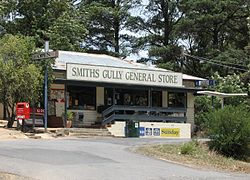
While a large number of general stores still exist in Australia, as in other parts of the world their numbers were greatly reduced by the advent of supermarkets.
Canada
[edit]The oldest continually run general store in Canada is Trousdale's, located in Sydenham, Ontario, which has been operated by the Trousdale family since 1836. Sociability has always been a feature, as locals come to chat as well as buy.[6] Gray Creek Store in Gray Creek, Kootenay Bay, Canada is the largest and oldest general dealer in the Kootenay Lake region[7] Enniskillen General Store in Clarington, Ontario has been in operation since 1840 and still continues today. Robinson's General Store in Dorset, Ontario, voted "Canada's Best Country Store", has been owned and operated by the same family since 1921.
Dominican Republic
[edit]
In the Dominican Republic, a colmado is the country's equivalent of a general store. Colmado literal translation is 'full to the brim'[8] implying its great density of goods in a small space. The colmado is much more than just a general store, for it offers a social gathering point for the residents of the town or neighborhood. The colmado is an important institution in the Dominican Republic serving as an economic, social and political center for every small community. It is common for colmados to have loud Dominican music such as merengue, bachata, or salsa playing. A common pastime for Dominican men is to play dominoes and drink a beer at their local colmado on Sundays. Another particularity of the colmado is that they provide delivery service of their products directly to the customer's dwelling. Products range from beer, snacks, toilet paper to flashlights and canned food.
Egypt
[edit]The Greek merchants in Egypt were called bakal.[9]
Finland
[edit]

General stores (sekatavarakauppa) first appeared in Finland in 1859 when fixed shop retailers were allowed to set up shops in rural towns for the first time. Prior to that, authorised trade in rural products other than those produced in the same region depended on city travel, open-air markets and fairs.[10] A related type of store is the village store (kyläkauppa), typically located in sparsely populated towns, which still performs many similar functions to general stores. As in many other countries, their numbers were greatly reduced with the advent of supermarkets, from over 3400 such shops in 1980 to 241 in 2017.[11]
India
[edit]
In India, a tapri is a regional version of a general store. It stores all home, personal, medical, and hygienic daily-use products. Many Kirana shops sell products other than food, such as clothing or household items, stationery, toys, tools, and medicines. Small Kirana stores, which are generally located on the corner of streets and generally known as katta or tapri, sell cigarettes, tobacco, and tea.[12]

Recently, there has been a notable integration of Aadhaar-enabled Payment System (AePS) services in Kirana or general stores across India. AePS allows customers to conduct basic banking transactions such as cash withdrawal, balance inquiry, and fund transfer using their Aadhaar number and biometric authentication. This integration has enabled Kirana stores to serve as financial service points, offering convenient banking services to local communities.
On 30 July 2024, Open Network for Digital Commerce (ONDC) introduced an interoperable QR code to link neighborhood store owners with consumers. With ONDC-registered buyer apps like Magicpin and Paytm, merchants can create a unique QR code that customers can scan to access their online store on the ONDC platform.[13]
Namibia
[edit]Due to its sparse population, there are still a number of general dealers in Namibia, for instance, the Solitaire General Dealer in Solitaire, an important stopover for tourists through Namibia's Namib-Naukluft Park.[14]
Puerto Rico
[edit]In Puerto Rico, a US territory, several general stores ("colmado") have proliferated since the 1970s.
South Africa
[edit]There are still many general dealers in South Africa; the oldest is Oom Samie se Winkel (Afrikaans: Uncle Sammie's Shop) in Dorp Street, Stellenbosch.[15] Oepverkoop is the oldest general dealer in Paternoster, Western Cape.[16] Goodwood Museum in Cape Town displays the operation of a general dealer shop.[17]
United Kingdom
[edit] |

Village shops are becoming less common in the densely populated parts of the country, although they remain common in remote rural areas.
Their rarity in England is due to several factors, such as the rise in car ownership, competition from large chain supermarkets, the rising cost of village properties, and the increasing trend of the wealthy to own holiday homes in picturesque villages, consequently these houses which used to be occupied full-time by potential customers are often vacant for long periods.
Of those villages in England who still have shops, these days they are often a combination of services under one roof to increase the likelihood of profit and survival. Extra services may include a post office, private business services such as tearooms, cafes, and bed and breakfast accommodation; or state services such as libraries and General Practitioner (GP) or Dental clinics; and charity partners such as Women's Institute (WI) coffee mornings held on the day most elderly villagers might collect their weekly pensions.
Community shops have become popular in some villages, often jointly owned and run by many villagers as a co-operative. The Village Retail Services Association promotes the role and function of the village shop in the UK.[18] Many modern village shops choose to stock items which draw in customers from neighboring areas who are seeking locally sourced, organic and specialist produce such as local cuts of meat, local cheeses, wines etc.
Corner shops are usually so-called because they are located on the corner plot or street end of a row of terraced housing, often Victorian or Edwardian factory workers' houses. The doorway into the shop was usually on the corner of the plot to maximize shop floor space within, this also offered two display windows onto two opposing streets. Many have now altered the original shop front layout in favor of a mini-supermarket style. Although it is common that corner shops found in the UK were former grocers' shops, other specialist retailers also occupied such plots and have suffered the same fate of being largely replaced by supermarkets and hypermarkets, such retailers as greengrocers, bakers, butchers and fishmongers.
In popular culture
[edit]Many British television and radio series, especially soap operas, feature corner shops or village shops as cornerstones for community gatherings and happenings. A prominent example is the village shop in Ambridge, the fictional village in the BBC Radio 4 series, The Archers, (1950–present). The ITV1 soap opera Coronation Street (1960–present) has featured a corner shop since the first episode; originally owned by Florrie Lindley, it was later acquired by Alf Roberts the grocer, and after his death in the late-1990s was bought by Dev Alahan, reflecting this common change in British culture to Asian shopkeepers. The dying days and changing culture of the traditional British grocer were explored to great effect in the BBC TV comedy series Open All Hours (1976–1985), set in the real suburb of Balby in Doncaster; the shop front used for the street scenes in the series does actually exist in the area and is now a hairdressing salon. The BBC Scotland comedy series Still Game has a corner shop as a recurring location where characters can meet and gossip; the actor who plays its owner, Navid Harrid (Sanjeev Kohli), plays a similar role as Bangaram in the Radio 4 comedy series Fags, Mags and Bags which is set entirely in Ramesh's shop.
The band Cornershop in part base their image on the perception that many convenience shops are now owned by British Asian people. In terms of British popular culture, these media representations give some idea of the importance attached to local shops in the national psyche and as a mainstay of community life.
United States
[edit].jpg)

General stores and itinerant peddlers dominated in rural America until the coming of the automobile after 1910. Farmers and ranchers depended on general stores that had a limited stock and slow turnover; they made enough profit to stay in operation by selling at high prices. Often farmers would barter butter, cheese, eggs, vegetables or other foods which the merchant would resell. Prices were not marked on each item; instead the customer negotiated a price. Men did most of the shopping, since the main criterion was credit rather than quality of goods. Indeed, most customers shopped on credit, paying later when crops or cattle were sold; the owner's ability to judge credit worthiness was vital to his success. The store was often a gathering point for local men to chat, pass around the weekly newspaper, and talk politics.[19]
In the South, the general store was especially important after the Civil War, as the merchant was one of the few sources of credit available until the cash crops (usually cotton or tobacco) came in. By 1878, for example, there were 1,468 local merchants in Alabama, or 12 for every 10,000 people.[20] There were few towns and very few cities, so rural general stores and itinerant peddlers were the main sources of supply.[21][22][23][24]
During the first half of the 20th century, general stores were displaced in many areas of the United States by many different types of specialized retailers in trading towns and small cities. However, from the 1960s to the present, many small specialized retailers have in turn been crushed by the so-called "category killers", which are "big-box" wholesale-type retailers large enough to carry the majority of best-selling goods in a specific category, like sporting goods or office supplies. Gray's General Store of Adamsville, Rhode Island is reputed to be the oldest continually operating general store in the United States until its temporary closure in 2012.[25] It subsequently reopened in the summer of 2013.[26]
However, the convenience inherent in the general store has been revived in the form of the modern convenience store. A few variety stores draw upon the concept of having a broad variety of goods servicing small communities where big-box retailers are absent; Dollar General stores, in particular, draws its name from both the "dollar store" concept of having items at a fixed price point and the general store.
List of general stores
[edit]This is a select list of historical general stores in the United States, listed in alphabetical order.
- A. D. Strickland Store (c.1878–1972), Dalton, Georgia[27]
- Barker General Store (c. 1847–?), Beecher Hollow, Saratoga County, New York[28]
- E. J. Caire Store (1860–mid-1970s), Edgard, Louisiana
- Felt Cobblestone General Store (1835–?), Victor, New York
- F. H. Gillingham & Sons (1886–Present), Woodstock, Vermont
- Good Hart General Store (1934-Present), Good Hart, Michigan
- Gray's General Store (1788–2012), Adamsville, Rhode Island[25]
- Harkin's General Store (1867–1901), West Newton, Minnesota
- Hussey's General Store (1923–1954), Windsor, Maine
- Jones Store, Sierra National Forest, California
- Jorgensen's General Store, Grant-Valkaria, Florida
- Lost River General Store (1898–?), Lost River, Hardy County, West Virginia
- Manion's General Store (before 1908–1970s), Ferndale, Sullivan County, New York
- Mast General Store (1887–?), Valle Crucis, North Carolina
- McClellan's General Store, New London, Iowa
- Mikulich General Store, Traunik, Michigan
- Ruddell General Store, Glenville, West Virginia
- Simons General Store, Ancram, New York
- Saint James General Store, Saint James, New York
- Tioga Centre General Store, Tioga, New York
- Vorous General Store, Fish Creek, Wisconsin
- Welty's General Store, Dubois, Wyoming
- United States general stores
-
 The Oldwick General Store in Tewksbury Township, New Jersey
 -
 The Grays General Store (1788) in Adamsville, Rhode Island
 -
-
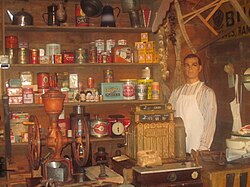
 Country Store, Spuyten Duyvil, Bronx, early 20th century


.jpg)
See also
[edit]Footnotes
[edit]- ^ "North American Industry Classification (NAICS) 2002, "452 General Merchandise Stores (US)"". Archived from the original on 2008-06-16. Retrieved 2008-07-29.
- ^ "America's top stores". Consumer Reports June 2010, p. 17.
- ^ Lang, John Dunmore (1834). An historical and statistical account of New South Wales: both as a penal settlement and as a British colony. Vol. 1. Cochrane and M'Crone. pp. 236, 237.
- ^ "The Jewish Community". News history. Archived from the original on 11 June 2012. Retrieved 2 December 2011.
Through their trading activities these merchant capitalists accelerated the transition from a subsistence to a cash economy.
- ^ Wild, V (1992). "An Outline of African Business History in Colonial Zimbabwe" (PDF). Zambezia. 19 (1). Retrieved 9 June 2011.
- ^ Richard Bauman, "The La Have Island general store: Sociability and verbal art in a Nova Scotia community." Journal of American Folklore (1972): 330-343. in JSTOR
- ^ "Gray Creek". britishcolumbia.com. Archived from the original on 28 January 2015. Retrieved 25 January 2015.
- ^ "The Colmado in the Dominican Republic - JetSettlers Magazine". 10 November 2011. Archived from the original on 12 March 2016. Retrieved 2 March 2016.
- ^ Turner, Bryan (2000). Modern Egypt, Part Two: Orientalism (reprinted ed.). p. 251. ISBN 9780415209069.
- ^ Kaarniranta, Kim: "Elämää rahaa käärien ja velkoen" : Pohjois-Karjalan maaseudun sekatavarakauppiaat ja heidän velallisensa 1860- ja 1870-luvuilla. Väitöskirja : Joensuun yliopisto. Helsinki: Suomalaisen Kirjallisuuden Seura, 2001. ISBN 951-746-302-2.
- ^ Mainio, Tapio (24 November 2018). ""Kauppoja kuolee noin 30 kaupan vuosivauhdilla" – Mönkijät, jatsarit tai hifi-laitteet pitävät kyläkauppoja hengissä". Talouselämä (in Finnish). Retrieved 2020-02-24.
- ^ Piyali Ghosh, et al., "Customer expectations of store attributes: A study of organized retail outlets in India." Journal of Retail & Leisure Property 9.1 (2010): 75-87.
- ^ "ONDC launches interoperable QR Code to empower local sellers, artisans". ETRetail.com. 30 July 2024. Retrieved 2024-08-01.
- ^ "Solitaire Country Lodge". The Cardboard Box travel shop. Retrieved 1 July 2014.
- ^ "Historic Town of Character". Sustainable Stellenbosch. Archived from the original on 17 December 2011. Retrieved 2 December 2011.
- ^ "Paternoster Service Guide". capewestcoastpeninsula.co.za. Archived from the original on 3 June 2015. Retrieved 1 July 2014.
- ^ "Catalog report - Other Material by Subject". South African Heritage Resources Agency. Archived from the original on 15 November 2010. Retrieved 29 October 2010.
John Olsen's dream for children to see how an old times general dealer's shop use to function has been created at the Goodwood Museum.
- ^ "Virsa.org". www.virsa.org.
- ^ Lewis E. Atherton, The Frontier Merchant in Mid-America (University of Missouri Press, 1971).
- ^ Louis Kyriakoudes, "The Rise of Merchants and Market Towns in Reconstruction-Era Alabama." Alabama Review 49 (1996): 83-107. p.99
- ^ The best source is Thomas C. Clark, Pills Petticoats and Plows: The Southern Country Store (1944) online; also see online review of this book.
- ^ Jacqueline P. Bull, "The General Merchant in the Economic History of the New South." Journal of Southern History 18.1 (1952): 37-59. in JSTOR
- ^ Glenn N. Sisk, "Rural Merchandising in the Alabama Black Belt, 1875–1917." Journal of Farm Economics 37.4 (1955): 705-715.
- ^ Roger Ransom, and Richard Sutch. "Credit merchandising in the post-emancipation south: Structure, conduct, and performance." Explorations in Economic History 16.1 (1979): 64-89; heavily statistical online Archived 2015-09-23 at the Wayback Machine
- ^ a b "Rhode Island general store closes after 224 years of operation". Tampa Bay Times. Associated Press. July 31, 2012. Retrieved 2021-05-18.
- ^ "Gray's General Store in Adamsville re-opens". EastBayRI.com. 17 July 2013. Retrieved 2022-12-14.
- ^ "A. D. Strickland Store". NPGallery Digital Asset Management System, National Park Service, U.S. Department of the Interior.
- ^ Raymond W. Smith (January 2002). "National Register of Historic Places Registration: Barker General Store". New York State Office of Parks, Recreation and Historic Preservation. Archived from the original on 2012-10-17. Retrieved 2010-12-12. See also: "Accompanying seven photos". Archived from the original on 2012-10-17. Retrieved 2021-05-18.
Further reading
[edit]- Dannhaeuser, Norbert. "The role of the neighborhood store in developing economies: the case of Dagupan City, Philippines." Journal of Developing Areas (1980): 157–174. in JSTOR
- English, Linda. By All Accounts: General Stores and Community Life in Texas and Indian Territory. (University of Oklahoma Press, 2013)
- Kaynak, Erdener, and S. Tamer Cavusgil. "The evolution of food retailing systems: contrasting the experience of developed and developing countries." Journal of the Academy of Marketing Science (1982) 10#3 pp: 249–268.
- Lejoyeux, Michel, et al. "Prevalence of compulsive buying among customers of a Parisian general store." Comprehensive Psychiatry (2007) 48#1 pp: 42–46.
| International | |
|---|---|
| National | |
| Other | |

General store
View on GrokipediaCharacteristics
Definition
A general store is a retail establishment, typically situated in rural or small-town settings, that sells a wide variety of merchandise without specializing in any single category. These stores carry an eclectic mix of goods, including groceries, clothing, hardware, and household items, serving as a one-stop shop for local communities where access to larger retailers is limited.[4] The term "general store" emerged in early 19th-century American English in 1832, describing unspecialized shops that catered to diverse needs in isolated areas, evolving from earlier trading post concepts.[5] This nomenclature highlights the store's role in providing general provisions, distinguishing it from more focused commercial ventures of the era. General stores differ markedly from other retail formats in scale, structure, and focus. Unlike department stores, which are expansive urban outlets divided into specialized sections for apparel, home goods, and more, general stores maintain a compact, undivided layout without departmental organization. They also contrast with supermarkets, large self-service operations centered on food, beverages, and household essentials arranged in aisles for efficient browsing.[6] In opposition to specialty shops, which offer deep selections within narrow categories like sporting goods or books, general stores prioritize breadth over depth in their inventory.[7] Over time, the general store concept has adapted to encompass both its traditional form and contemporary survivals, particularly in remote regions where it remains a vital community resource amid the dominance of chain retailers and e-commerce.[8]Merchandise and Inventory
General stores typically stocked a wide array of essential and miscellaneous goods to meet the needs of rural and isolated communities, including groceries such as flour, sugar, tea, canned tomatoes, and yeast; dry goods like bolts of fabric, clothing accessories, hats, and bonnets; hardware and farm supplies such as tools, pans, sledgehammers, and plows; medicines including patent cures and opium-based remedies; and notions like thread, buttons, and personal care items.[9][10] Household items such as enamelware coffee boilers, stoneware, glass jars, tin cans, utensils, plates, and even furniture and musical instruments were also common, reflecting the store's role as a one-stop provider for daily necessities.[9][10] Inventory was sourced primarily from wholesalers and factories for mass-produced items like ready-made shoes, preserved foods in tin cans, and iron tools, often transported via trains or ships from urban centers, while local producers supplied fresh goods such as butter, eggs, meats, fruits, vegetables, and sewn clothing through direct sales or barter systems.[10][11] In early models, barter was prevalent, allowing community members to exchange produce or livestock for store items, and inventory adapted to seasonal demands, such as stocking farming tools like plows during planting seasons or holiday treats like nuts and oranges in winter.[11] National suppliers contributed specialized products, including teas from China or cigars from Detroit, ensuring a mix of bulk staples and varied qualities to accommodate different budgets.[9] Pricing strategies balanced accessibility with profitability, often featuring fixed prices for manufactured goods—such as $0.08–0.12 per pound for sugar or $0.15 per can for tomatoes—while haggling or barter applied to locally sourced items to foster community trade.[9][10] Stores carried both essential staples and occasional luxuries, like higher-grade teas at $0.45–0.75 per pound or derby hats at $2.50, to serve diverse customer needs in remote areas where travel to specialized shops was impractical.[9] Unique to general stores were non-commercial elements integrated into operations, such as maintaining credit ledgers for customers to purchase on account and providing postal services for mail pickup and letter-writing assistance.[11]Store Layout and Operations
The typical layout of a historical general store featured a central counter for service, often constructed from wood planks, with open shelving lining the walls to display a wide array of goods. These shelves held items like dry goods, tools, and fabrics, while the floor was usually made of wooden planks, contributing to the rustic and functional design.[12] In the middle of the store, between parallel counters, a pot-bellied stove provided heat and served as a gathering point, surrounded by chairs and barrels for commodities such as pickles or nails; this arrangement facilitated both commerce and social interaction.[13] Over time, layouts evolved from cluttered displays—where goods were piled haphazardly to maximize space—to more organized setups with categorized sections, reflecting improvements in inventory management during the late 19th and early 20th centuries. General stores operated primarily as owner-managed enterprises, with the proprietor handling most tasks from stocking shelves to sales, often without additional staff in smaller rural locations.[14] Accounting was conducted manually using ledgers to record transactions, inventory, and customer debts, a practice that persisted into the early 20th century before mechanical systems emerged.[15] To accommodate farmers' irregular schedules tied to planting and harvest cycles, stores maintained extended hours, sometimes remaining open from dawn until late evening or on Sundays, ensuring accessibility for rural customers.[16] Customer service emphasized personalized interactions, as the storekeeper often knew patrons by name and their needs, fostering trust in tight-knit communities.[14] Credit extension through "charge accounts" was common, allowing customers—particularly farmers—to purchase essentials on promise of future payment from crop sales, stabilizing local economies but requiring careful ledger tracking by the owner.[17] The storekeeper played a multifaceted advisory role, offering guidance on product selection, farm supplies, or even community news, beyond mere transactions.[18] Without modern refrigeration, stores handled perishables like meat, dairy, and produce by limiting stock to small quantities, displaying them briefly, or relying on natural cooling methods such as spring houses or shaded areas, which restricted sales during warmer months.[19] Fire risks were significant due to open flames from pot-bellied stoves and lanterns, necessitating vigilant maintenance like clearing creosote buildup in chimneys to prevent chimney fires, especially in wooden structures stocked with flammable goods.[20]Historical Development
Origins and Early Forms
The origins of general stores trace back to pre-industrial Europe, where they evolved from medieval peddlers and itinerant hawkers who traversed rural areas and towns selling miscellaneous goods at markets and fairs.[21] These mobile traders catered to local populations by offering a broad assortment of everyday items, from textiles and tools to foodstuffs, filling gaps left by limited fixed retail infrastructure in agrarian societies. By the early modern period, this itinerant trade began transitioning into more permanent village shops, which operated as proto-general stores stocking diverse wares to serve isolated communities. In 17th-century England, haberdasheries exemplified early fixed retail forms resembling general stores, vending an array of small wares including fabrics, needles, pins, ribbons, threads, stockings, and related sundries often blended with other household essentials.[22] These shops, typically located in provincial towns and villages, provided one-stop access to sewing and clothing supplies, reflecting the era's emphasis on multifunctional retail amid growing consumer demand for imported and domestic goods. Similarly, in the Dutch Republic during the same period, "general wares" establishments—known for handling universal merchandise like household goods, textiles, and provisions—emerged in urban and rural settings, supporting the burgeoning trade networks of the Golden Age economy.[23] Such shops arose from the need for centralized distribution in regions with expanding commerce but sparse specialized outlets. The concept crossed the Atlantic with European colonization, manifesting in 17th-century North America as trading posts that functioned as rudimentary general stores for settlers. In New England, these posts were integral to the fur trade and mercantile systems, where merchants exchanged European goods like tools, cloth, and metalware for pelts and local produce from Indigenous peoples and colonists.[24] A notable example is John Pynchon's trading operation in the upper Connecticut Valley starting in 1652, which supplied settlers with a wide range of imported items while facilitating economic exchange in frontier areas.[24] Earlier, in Virginia, the Virginia Company's Magazine, established in 1618 as a supply depot, served as one of the first documented centralized stores, distributing provisions, tools, and trade goods to Jamestown colonists amid harsh settlement conditions.[25] These early forms were driven by socioeconomic necessities in remote or developing regions, where specialized trades were impractical and self-sufficiency demanded versatile supply points. In both European villages and American frontiers, general stores and their precursors addressed the lack of infrastructure by consolidating mercantile activities, enabling survival and modest commerce in environments devoid of urban retail diversity.[26]19th-Century Expansion
The expansion of general stores in the 19th century was profoundly shaped by the Industrial Revolution, particularly through advancements in transportation and manufacturing. The development of railroads beginning in the 1830s in the United States facilitated wider distribution networks, allowing stores to access goods from distant factories and ports more efficiently than wagon-based systems.[27] Mass production techniques, which surged after the Civil War, enabled stores to stock a broader inventory of branded items like canned foods and textiles, transforming them from local barter points into diversified retail outlets.[9] In Canada, similar railroad expansions in the mid-19th century supported agricultural settlements, where general stores became essential for distributing manufactured goods to remote rural areas.[28] By the 1850s, general stores had proliferated across rural North America, numbering in the thousands and serving as vital outposts in settler societies. In the United States, they played a key role in westward expansion, supplying pioneers along routes like the Oregon Trail with essentials such as wagons, tools, and provisions from hubs like Independence, Missouri.[29] These stores often preceded permanent settlements, establishing economic footholds in frontier regions and enabling the rapid settlement of the West. In Canada, the stores similarly supported prairie immigration and farming communities. Business models evolved to accommodate growing rural economies, blending traditional credit systems with emerging cash-and-carry practices. Farmers frequently purchased on credit against future harvests, with store ledgers tracking debts until crop sales, though cash transactions increased as railroads lowered prices and encouraged impulse buys.[2] Precursors to modern chains, such as the Great Atlantic & Pacific Tea Company (A&P), began in 1859 as a tea wholesaler and expanded to over 70 grocery outlets by 1878, pioneering volume discounts and direct sourcing to compete with independents.[30] Socially, general stores functioned as central community hubs, distributing mail, newspapers, and gossip in isolated areas. In the 1870s United States, mining town booms—such as in Atlantic City, Wyoming—spurred the opening of multiple stores per settlement to meet sudden influxes of prospectors, fostering social cohesion amid rapid growth.[31] These roles solidified the stores' importance until late-century shifts toward specialized retail began to challenge their dominance.[32]20th-Century Evolution and Decline
In the early 20th century, general stores in rural America faced initial adaptations driven by technological and logistical shifts. The widespread adoption of automobiles and the expansion of road infrastructure in the 1920s enabled rural residents to travel more easily to larger towns and cities for shopping, reducing reliance on local general stores.[33] This period saw a notable decline, with general stores dropping by 36% across eight sample states from 1922 to 1930, and rural outlets specifically falling by 30%, as improved highways facilitated access to centralized retail options.[33] Concurrently, mail-order catalogs from companies like Sears, Roebuck & Co., which expanded dramatically in the 1890s and peaked through the 1940s, intensified competition by delivering a broader array of goods directly to remote households at lower prices, bypassing the limited inventory of traditional stores.[34] The post-World War II era marked the accelerated decline of general stores amid suburbanization and the rise of supermarkets. In the United States, the suburban boom of the 1950s, fueled by automobile ownership and economic prosperity, shifted consumer patterns toward larger, self-service formats located in outlying areas, making small rural and village stores obsolete for many.[35] Supermarkets proliferated from just 386 outlets in 1935 to over 26,000 by 1982, capturing 74.5% of grocery sales and contributing to a halving of total food stores—from approximately 400,000 in 1935 to 162,000 by 1982—as independent general stores struggled against the economies of scale and variety offered by chains.[35] This structural shift led to a sharp reduction in general stores, with many closing as consumers favored one-stop shopping experiences over fragmented local trade.[35] Despite their decline, general stores have experienced niche revivals in the late 20th and early 21st centuries, often as tourist attractions or community-focused outlets emphasizing local and sustainable goods. Historic examples, such as those in rural California and Ohio, have adapted by offering curated selections of artisanal products, meals, and nostalgic experiences to draw visitors, preserving their role as cultural landmarks amid broader retail consolidation.[36] Some modern iterations incorporate eco-friendly elements, like organic produce and zero-waste initiatives, appealing to contemporary interests in sustainability while evoking historical charm.[37] This resurgence is reflected in media portrayals, where general stores symbolize Americana and rural nostalgia, sustaining a few dozen surviving operations as heritage sites. Similar patterns of evolution and decline unfolded globally, tied to urbanization and modern retail. In the United Kingdom during the 1960s, the growth of supermarkets and out-of-town shopping centers, spurred by post-war suburban expansion, led to widespread closures of independent village shops and general stores.[38] In Australia, the 1950s and 1960s saw suburbanization and automobile diffusion transform retail landscapes, as traditional general stores in regional towns declined in favor of centralized shopping centers that offered greater convenience and scale to urbanizing populations.[39] These trends underscored the general store's vulnerability to broader economic modernization across Western contexts.Regional Variations
North America
In North America, general stores emerged as vital hubs in rural and frontier communities, shaped by colonial settler economies and vast landscapes that necessitated self-sufficient outposts for trade and supplies. Drawing from British and French colonial influences, these stores facilitated the exchange of goods between European settlers, farmers, and Indigenous peoples, evolving from fur trade posts to multifaceted retailers supporting agricultural lifestyles. Their role emphasized adaptability to local needs, from bartering furs and grains to providing credit during economic hardships. In the United States, general stores hold an iconic place in the cultural fabric of regions like Appalachia and the Midwest, serving as social and economic anchors for isolated farming communities. These establishments stocked everything from dry goods and tools to patent medicines, often doubling as post offices or gathering spots. A notable example is the Berry and Lincoln General Store, co-owned by Abraham Lincoln in New Salem, Illinois, established in 1833, which exemplified the entrepreneurial spirit of Midwestern frontier life by offering a mix of groceries, hardware, and even liquor. Surviving historic general stores continue to operate as testaments to this legacy, blending preservation with modern commerce. Key examples include:- Mast General Store in Valle Crucis, North Carolina (opened 1883), a preserved Appalachian outpost now expanded into a chain while retaining its original rustic charm.[36]
- Old Sautee Store in Sautee Nacoochee, Georgia (1896), an Appalachian relic that stocks local crafts and foods, drawing visitors to its vintage counters.[40]
- End of the Commons General Store in Oberlin, Ohio (1840s), a Midwestern survivor offering penny candy and hardware in its original building.[3]
- Amana General Store in Amana, Iowa (1860s), rooted in German settler communities and focused on handmade goods and local produce.[3]
- Wall Drug in Wall, South Dakota (1931), a Midwestern icon that grew from a small store into a tourist mecca with diners and souvenirs.[41]
- Berdine's Five and Dime in Harrisville, West Virginia (1898), an Appalachian variety store preserving early 20th-century merchandising.[42]
- Zoar Store in Zoar, Ohio (1833), one of the earliest continuously operating stores, tied to a utopian community's history.[43]
- Forbus General Store in Jamestown, Tennessee (1930s), an Appalachian outpost known for moonshine lore and rural essentials.[44]
- Ewing General Store in Ewing, Virginia (1955), a family-run Appalachian holdout stocking hunting gear and homemade treats.[45]
- The Brick Store in Bath, New Hampshire (1790s, near Midwest borders), operating as a multi-generational general store with regional farm supplies.[46]