Hubbry Logo
Cosmas IndicopleustesCosmas IndicopleustesMain
Open search
Cosmas Indicopleustes
Community hub
Cosmas Indicopleustes
logo
8 pages, 0 posts
0 subscribers
Be the first to start a discussion here.
Cosmas Indicopleustes
from Wikipedia
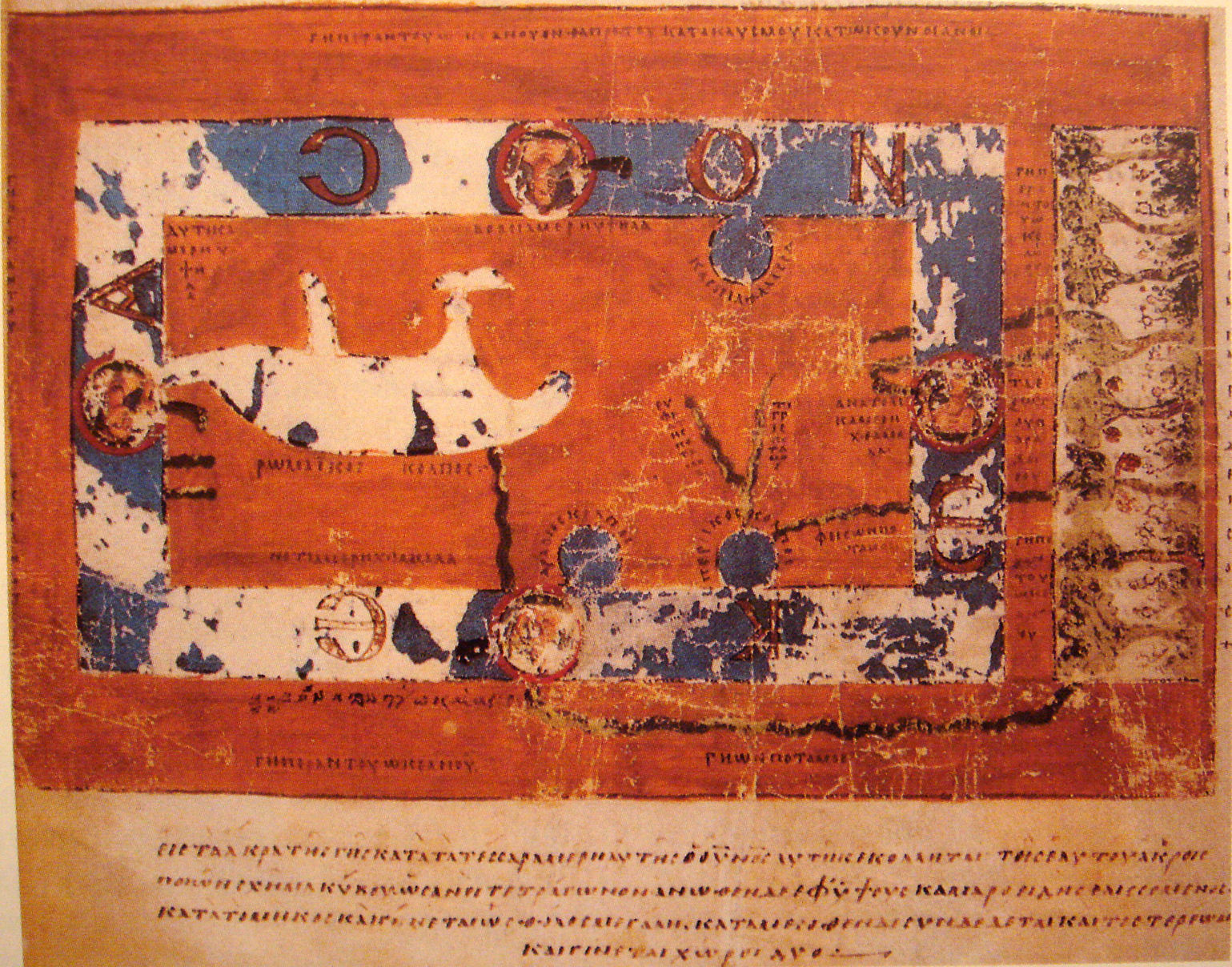
World map, by Cosmas Indicopleustes. The map is oriented with north to the top.

Cosmas Indicopleustes (Koine Greek: Κοσμᾶς Ἰνδικοπλεύστης, lit.'Cosmas who sailed to India'; also known as Cosmas the Monk) was a merchant and later hermit from Alexandria in Egypt.[1] He was a 6th-century traveller who made several voyages to the Kingdom of Aksum, and India during the reign of emperor Justinian. His work Christian Topography contained some of the earliest and most famous world maps.[2][3][4] Cosmas was a pupil of the East Syriac Patriarch Aba I and was himself a follower of the Church of the East.[5][6]

Voyage

[edit]

Around AD 550, while a monk in the retirement of a Sinai cloister,[7] Cosmas wrote the once-copiously illustrated Christian Topography, a work partly based on his personal experiences as a merchant on the Red Sea and Indian Ocean in the early 6th century. His description of India and Ceylon during the 6th century is invaluable to historians. Cosmas seems to have personally visited the Kingdom of Axum in modern day northern Ethiopia, as well as Eritrea. He sailed along the coast of Socotra, but it cannot be ascertained that he really visited India and Ceylon.

Indicopleustes

[edit]

"Indicopleustes" means "Indian voyager", from πλέω "(I) sail".[8] While it is known from classical literature, especially the Periplus Maris Erythraei, that there had been trade between the Roman Empire and India from the first century BC onwards, Cosmas's report is one of the few from individuals who had actually made the journey. He described and sketched some of what he saw in his Topography. Some of these have been copied into the existing manuscripts, the oldest dating to the 9th century. In 522 AD, he mentions several ports of trade on the Malabar Coast (South India). He is the first traveller to mention Soriyani Christians in present-day Kerala in India. He wrote:

"Even in Taprobane, an island in Further India, where the Indian sea is, there is a Church of Christians, with clergy and a body of believers, but I know not whether there be any Christians in the parts beyond it. In the country called Malê, where the pepper grows, there is also a church, and at another place called Calliana there is moreover a bishop, who is appointed from Persia. In the island, again, called the Island of Dioscoridês, which is situated in the same Indian sea, and where the inhabitants speak Greek, having been originally colonists sent thither by the Ptolemies who succeeded Alexander the Macedonian, there are clergy who receive their ordination in Persia, and are sent on to the island, and there is also a multitude of Christians. […] The island [of Sri Lanka] has also a church of Persian Christians who have settled there, and a Presbyter who is appointed from Persia, and a Deacon and a complete ecclesiastical ritual. But the natives and their kings are heathens."[9]

Christian Topography

[edit]
A theoretical model of the universe.
World picture from Christian Topography.

A major feature of his Christian Topography is his worldview that the surface of ocean and earth is flat (that is, nonconvex and nonspherical, as perceived by the human senses) and that the heavens form the shape of a box with a curved lid. He was scornful of Ptolemy and others who held that the world's surface was, contrary to human perceptual experience, a spherical shape. Cosmas aimed to prove that pre-Christian geographers had been wrong in asserting that the surface of the earth and surface of the ocean was convex and spherical in shape, and that it was in fact modelled on the tabernacle, the house of worship described to Moses by God during the Jewish Exodus from Egypt. In the centre of the plane is the inhabited earth, surrounded by ocean, beyond which lies the paradise of Adam. The sun revolves round a conical mountain to the north: round the summit in summer, round the base in winter, which accounts for the difference in the length of the day.[7]

However, his idea that the surface of the ocean and earth is nonspherical had been a minority view among educated Western opinion since the 3rd century BC.[10] Cosmas's view was never influential even in religious circles; a near-contemporary Christian, John Philoponus, sought to refute him in his De opificio mundi as did many Christian philosophers of the era.[2]

David C. Lindberg asserts:

Cosmas was not particularly influential in Byzantium, but he is important for us because he has been commonly used to buttress the claim that all (or most) medieval people believed they lived on a flat earth. This claim...is totally false. Cosmas is, in fact, the only medieval European known to have defended a flat earth cosmology, whereas it is safe to assume that all educated Western Europeans (and almost one hundred percent of educated Byzantines), as well as sailors and travelers, believed in the earth's sphericity.[11]

Cosmas was mentioned in Umberto Eco's historical novel, Baudolino. In the book, a Byzantine priest and spy, Zozimas of Chalcedon, refers to his world topography as the key to finding the mythical Prester John:

Well, in the empire of us Romans, centuries ago there lived a great sage, Cosmas Indicopleustes, who traveled to the very confines of the world, and in his Christian Topography demonstrated in irrefutable fashion that the earth truly is in the form of a tabernacle, and that only thus can we explain the most obscure phenomena.[12]

Cosmology aside, Cosmas proves to be an interesting and reliable guide, providing a window into a world that has since disappeared. He happened to be in Adulis on the Red Sea Coast of modern Eritrea at the time (c. AD 525) when the King of Axum was preparing a military expedition to attack the Jewish king Dhu Nuwas in Yemen, who had recently been persecuting Christians. On request of the Axumite king and in preparation for this campaign, he recorded now-vanished inscriptions such as the Monumentum Adulitanum which he mistook for a continuation of another monument detailing Ptolemy III Euergetes's conquests in Asia. Neither have been located by archeologists.[13] Allusions in the Topography suggest that Cosmas was also the author of a larger cosmography, a treatise on the motions of the stars, and commentaries on the Psalms and Canticles.[7]

See also

[edit]

References

[edit]

Further reading

[edit]
[edit]
Revisions and contributorsEdit on WikipediaRead on Wikipedia
from Grokipedia
Cosmas Indicopleustes (fl. 545 CE), also known as Cosmas the Indian Voyager, was a Byzantine Greek merchant, traveler, and Christian theologian from , , who later became a and is best known for his illustrated treatise , a work blending personal observations from his voyages with a biblically inspired cosmology that challenged prevailing Greco-Roman views of the . As a Nestorian Christian influenced by Antiochene exegesis, he sailed extensively during the reign of Emperor (527–565 CE), trading goods and documenting distant lands, including , the , the , , and possibly Ceylon (modern ). His journeys, undertaken before he took monastic vows, encompassed key ports like on the , where he witnessed the aftermath of the Axumite-Himyarite wars around 522 CE and copied ancient inscriptions under the orders of the Ethiopian king Kaleb. Composed between 547 and 549 CE as a twelve-book text, was initially dedicated to a friend named Pamphilus and later expanded to refute critics, incorporating detailed descriptions of flora, fauna, trade routes, and the spread of Christianity to regions such as the Nile Valley, , southern , and Ceylon. In it, Cosmas, an autodidact argumentative against pagan and Aristotelian , proposed a flat, rectangular measuring approximately 12,000 miles in and 6,000 miles in width, surrounded by an encircling ocean and overlooked by Paradise, with the entire vaulted like the biblical of . This model, supported by scriptural interpretations rather than empirical astronomy, positioned the as the center of a habitable world beneath a adorned with stars, rejecting the spherical endorsed by figures like . Cosmas's work, preserved in illuminated manuscripts such as a 10th-century codex in and an 8th- or 9th-century Vatican exemplar with his original sketches, offers invaluable historical insights into 6th-century Byzantine commerce, Ethiopian geopolitics, and early Christian missionary activities, while reflecting theological debates of the era, including his opposition to the philosopher . Largely forgotten in the medieval West until its rediscovery in the , Christian Topography endured in Eastern traditions, influencing perceptions of geography and cosmology in Nestorian and Ethiopian circles for centuries.

Biography

Early Life and Origins

Cosmas Indicopleustes, a Greek Christian, was born in , , in the , identifying the city as his native home in his writings. He received only an elementary education, lacking formal advanced training in or the sciences, which he later acknowledged in his work. Affiliated with the and its Nestorian doctrines, Cosmas venerated Patriarch Aba I (r. 540–552 AD) as an "exceedingly holy man and great teacher" from whom he derived much of his scriptural knowledge. He attended Aba I's lectures during the patriarch's time in , adopting and propagating the teachings of figures like and central to Nestorian . In the 6th-century , functioned as a premier Mediterranean port and commercial nexus, linking the trade routes to the and facilitating exchanges of spices, , , and that exposed residents like Cosmas to diverse geographies and mercantile practices from youth. The city also thrived as a focal point of theological contention, particularly Christological debates between Chalcedonian and miaphysite views, shaping the intellectual milieu of its Christian communities. This environment of vibrant trade and doctrinal discourse laid the groundwork for Cosmas's eventual shift toward .

Merchant Career and Conversion

Cosmas Indicopleustes pursued a prosperous career as a in the early sixth century, primarily operating out of in , where he engaged in extensive across the Mediterranean and routes. His commercial activities involved importing spices and other goods, with voyages taking him to key ports such as on the coast of , the Somali coast at Zingion, , the of , and even as far as Ceylon (modern ). These travels, likely spanning the 520s and 530s, provided him with firsthand knowledge of distant regions, including observations of local , , and networks, which later informed his writings. Around AD 550, Cosmas underwent a profound personal transformation, renouncing his mercantile life to become a and , dedicating himself to religious devotion and scriptural study. This conversion marked a deliberate shift from worldly commerce to , as he settled in , where he suffered from health issues like and eye that may have prompted his retreat from active trading. He was not alone in this path; his friend Menas, another former merchant, similarly embraced , reflecting a broader pattern among traders influenced by Christian ideals of . Cosmas's worldview was deeply shaped by Nestorian theology, a dyophysite tradition emphasizing the distinct human and divine natures of Christ, which positioned him in opposition to the Chalcedonian orthodoxy established at the in 451. As a follower of the Nestorian catholicos Mār Aba (r. 540–552), he drew from Antiochene exegetes such as and , whose interpretations prioritized literal biblical readings over allegorical ones. His anti-Chalcedonian leanings are evident in his selective use of sources, including Monophysite patriarchs like Timothy III of Alexandria (r. 517–535) and (r. 535–567), to bolster arguments for Christ's two natures while critiquing imperial Chalcedonian impositions. This religious commitment directly fueled Cosmas's motivations for authoring the , a work composed shortly after his conversion to defend orthodox Christian faith against what he perceived as corrupting influences from secular, pagan learning. He sought to reconcile biblical descriptions of the with empirical observations from his travels, explicitly aiming to refute Greek astronomical models—such as the advocated by —by demonstrating their incompatibility with divine scripture. Through this text, Cosmas positioned himself as a defender of scriptural authority, urging fellow to prioritize sacred texts over philosophical speculations that he viewed as idolatrous.

Voyages

Expedition to Ethiopia and the Red Sea

Cosmas Indicopleustes, a Christian merchant based in Alexandria, embarked on a trading expedition to the Red Sea around 522 AD, departing from Egypt and sailing southward along the African coast to the bustling port of Adulis in the Kingdom of Aksum, corresponding to modern-day Eritrea. This journey was primarily a commercial venture, leveraging his experience as a trader to exchange goods such as spices, textiles, and ivory, though it carried religious undertones as he documented Christian sites and communities encountered along the way. Upon reaching Adulis, Cosmas engaged with local Aksumite officials and witnessed the kingdom's strategic importance as a hub for commerce and maritime power. He arrived during a period of heightened military activity, coinciding with preparations by King Kaleb (also known as Elesbaas) for an expedition against Jewish forces in around 525 AD, prompted by the under the Himyarite ruler Yusuf As'ar Yath'ar. As a guest in the Aksumite court, Cosmas observed the mobilization efforts, including the gathering of troops and resources for the campaign, which ultimately succeeded in restoring Christian influence in the region. A notable aspect of his time in Adulis involved the recording of inscriptions on the so-called Throne of Adulis, a monumental elephant throne erected by an earlier Aksumite ruler, likely King in the early 4th century AD. Commissioned by the local governor, Cosmas and a companion named Menas transcribed these texts, which detailed the king's conquests over neighboring peoples in and Arabia; the originals have since been lost, surviving only through Cosmas's copies in Book II of his . These inscriptions highlighted Aksum's imperial reach, including victories over Ethiopian tribes and Arab groups, underscoring the kingdom's historical dominance in the Red Sea trade networks. Extending his travels, Cosmas sailed to , located in the off the , where he noted the presence of established Christian communities adhering to Nestorian doctrines under the authority of the of Persia. He described churches and monasteries on the island, populated by Greek-speaking who maintained ties to the broader Eastern Christian world, reflecting the through maritime routes during the . These voyages, spanning several years in the early sixth century, provided Cosmas with firsthand accounts that informed his later writings.

Descriptions of India and Sri Lanka

Cosmas Indicopleustes provided detailed accounts of trade ports and commercial activities along the western coast of in his , drawing on observations from his merchant voyages in the early sixth century. He described several key marts, including Kalliana (modern near ), which exported copper, sacking cloth, and logs, serving as a hub for maritime exchange between the Roman world and the subcontinent. Other ports such as Sindu, Orrhotha, and Sibor facilitated trade in spices, silk, and gems, with local kings maintaining armies of 500 to 600 elephants for protection and regional dominance. Further south, on the (referred to as the region), five ports—Parti, Mangarouth, Salopatana, Nalopatana, and Poudopatana—were renowned for exporting pepper, a vital to long-distance , underscoring 's role as a linchpin in the network during Justinian's reign. A notable feature of Cosmas's ethnography was his documentation of Christian communities in these areas, reflecting the spread of through Persian merchants. In the region of the , he noted the presence of churches and believers, reflecting longstanding Syriac Christian communities linked to Nestorian influences from the . Similarly, at Kalliana, Christian settlements with ecclesiastical structures were reported, linked to Nestorian influences from the , where presbyters and deacons conducted services in Syriac. These accounts highlight the integration of and commerce, with bishops often appointed from Persia to oversee distant congregations. Turning to Sri Lanka, which Cosmas identified as Taprobane (also called Sielediba by locals), he portrayed it as a vast island approximately 900 miles in length and breadth, positioned as a central entrepôt in the Indian Sea. The island's thrived on pearl fisheries off its coasts, where divers harvested gems amid seasonal trade fairs, and production in interior regions, which was exported alongside , aloes, cloves, and to ports in , Persia, and . Two kings governed: one over the hyacinth (sapphire) mines and another controlling the principal harbor, where ships converged for barter, though the population remained predominantly heathen despite a large stone venerated in a temple. Cosmas also recorded a church on Taprobane served by Persian Christians, including a , , and full liturgical practices imported from the , indicating a small but established community amid the island's pagan majority. Historiographical debate persists regarding the extent of Cosmas's personal involvement in these eastern reaches, with his text blending firsthand merchant experiences—such as voyages from the —with secondhand reports from traders, as he explicitly notes inquiries for some details on Indian kings and ports. While tradition holds that he sailed to around AD 522 before his monastic conversion, scholars caution that descriptions of interior regions like the White Huns' territories may derive from hearsay rather than direct observation.

Christian Topography

Composition and Structure

Cosmas Indicopleustes composed his around 547 CE, originally as five books after retiring from his mercantile career to become a , likely in or a nearby in . It was later expanded to twelve books to refute critics. The work spans 12 books and functions primarily as an apologetic treatise, integrating geographical observations, theological arguments, and polemics against pagan scientific doctrines, particularly the model derived from Greek philosophy. This synthesis aims to affirm a biblically grounded understanding of the , drawing on scriptural authority to counter secular cosmologies while incorporating the author's firsthand knowledge from Eastern travels. The text is organized into distinct thematic sections across its 12 books, reflecting a progression from foundational cosmological principles to descriptive and interpretive elements. The first ten books primarily address cosmological and theological arguments, including refutations of opposing views and scriptural proofs for the universe's structure, with geographical descriptions integrated, particularly in Book 11. Books 11 and 12 incorporate detailed accounts of the inhabited world, its regions, peoples, and trade routes based on the author's experiences, alongside biblical that applies these to interpretations of sacred texts and reinforces the work's theological coherence. This division underscores the treatise's intent to build a unified , with each section supporting the others without rigid separation. Central to the Topography's framework is the use of biblical analogies, especially the Mosaic Tabernacle described in Exodus, which Cosmas employs as a typological model for the universe's architecture. He likens the Tabernacle's rectangular form and internal divisions—such as the outer court and inner sanctuary—to the Earth's shape and the separation between the visible world and the heavenly realm, portraying the as a divine dwelling place. This analogy permeates the structure, providing a scriptural blueprint that ties cosmology, geography, and together in a cohesive apologetic .

Cosmological Arguments

Cosmas Indicopleustes presented a distinctive cosmological framework in his Christian Topography, envisioning the Earth as a flat, rectangular plane enclosed beneath a vaulted heaven that mirrored the structure of the Mosaic Tabernacle described in Exodus 25–27. In this model, the Earth formed the base, twice as long as it was wide, with the firmament serving as a protective vault overhead, akin to the Tabernacle's roof and curtains. He argued that this design reflected divine revelation to Moses, positioning the cosmos as a sacred enclosure rather than a spherical entity. Central to Cosmas's arguments was his vehement rejection of Ptolemy's and the associated geocentric , which he condemned as pagan inventions derived from erroneous Greek philosophy. He dismissed these classical views as incompatible with biblical truth, asserting that proponents of a "disbelieve the divine scripture" by prioritizing human speculation over God's word. Instead, Cosmas insisted on a literal interpretation of passages like Isaiah 40:22, which he read as describing a stretched-out, flat expanse rather than a . The inhabited world, in Cosmas's description, occupied a rectangular plane surrounded by encircling oceans, with Paradise situated at the eastern extremity beyond these waters. The sun and moon traversed this plane parallel to the Earth's surface under the vaulted firmament, rising in the east and setting toward the north—movements he compared explicitly to the lamps of the Tabernacle, tended by angelic powers rather than orbiting a central sphere. This configuration divided the universe into two regions: the lower realm of earth, sea, and visible heavens, and an upper domain reserved for the righteous. By grounding his cosmology in , Cosmas sought to counter the pervasive influences of Aristotelian and Neoplatonic thought, which he viewed as corrupting Christian doctrine with mythological elements. He emphasized scriptural authority from Genesis, , and the prophets, portraying as a fixed, divinely ordered that affirmed God's against philosophical abstractions. This approach positioned the as a defense of faith-based over empirical or rationalist cosmologies.

Geographical and Ethnographical Content

Cosmas Indicopleustes provides a detailed mapping of , or oikoumene, in his , portraying it as a flat, rectangular expanse extending from the western regions associated with the (including Britain) to the eastern limits of , with the southern boundary marked by Aksum in . This configuration divides the inhabited world into four principal zones: Indians to the east, to the south, to the north, and to the west, all enclosed by the encircling and connected via four major gulfs—the Roman, Arabian, Persian, and Caspian—that penetrate from the surrounding seas. His descriptions emphasize the accessibility of these areas through maritime and overland routes, reflecting his firsthand experiences, while positioning Aksum as the southernmost hub of Christian and trade. In outlining trade networks, Cosmas highlights interconnected routes that facilitated the exchange of across and , drawing from his voyages to illustrate the flow of commerce within his flat-earth framework. Silk originates from the distant land of Tzinista () and reaches the Roman world either overland through Persia or by sea via Ceylon (Taprobane), where it is transshipped to the ports. is procured from African sources, particularly along the Ethiopian coast near , where elephants are hunted and exported alongside and other commodities to and beyond. Spices, such as pepper, dominate Indian trade, shipped from eastern ports through the to Roman territories, underscoring the economic vitality of these pathways that Cosmas navigated during his career. Cosmas's ethnographical observations focus on the peoples he encountered or learned of through trade, often noting their customs, religious affiliations, and interactions with Christian missionaries. The Himyarites of southern Arabia (Arabia Felix), formerly known in antiquity as part of the Sabaeans but in Cosmas's time called Homerites, are depicted as a trading society whose region became a site of Christian persecution and Axumite intervention around 525 CE under Byzantine influence. The Blemmyes, nomadic tribes inhabiting the deserts near Nubia and the Red Sea, are characterized as raiders who extend into Ethiopian territories, posing challenges to southern trade routes. Ethiopian Christians receive particular attention as a thriving community south of Egypt, centered in Aksum and converted in the 4th century by Frumentius, featuring organized churches, bishops, and martyrs that demonstrate the faith's extension to the world's southern periphery. Integrating biblical geography, Cosmas situates sacred locations within his oikoumene to align scripture with observed reality, placing the in the eastern extremities beyond the , near , as an inaccessible paradise from which the four rivers—, , , and —originate. The and are traced from to the , while the flows through and , and is located in the Armenian mountains of Ararat in Persia following the . serves as a central earthly reference point, tying these waterways to the inhabited world's core, with sites like the crossing and the wilderness reinterpreted through his trade-informed lens.

Illustrations and Manuscript Tradition

The Christian Topography is distinguished by its extensive use of illustrations, which integrate diagrams of the cosmos modeled on the biblical , schematic world maps portraying a flat, rectangular enclosed under a vaulted , and depictions of geographical features, animals, and ports encountered during Cosmas's voyages. These visuals, numbering in the dozens across surviving codices and likely prepared under Cosmas's supervision to support his textual descriptions, include representations of the four rivers flowing from Paradise and the arrangement of lands around the encircling ocean. The original sixth-century autograph manuscript of the work is lost, but it survives in three principal Greek codices from the to eleventh centuries, all lavishly illustrated and demonstrating a consistent iconographic tradition. The earliest is Vaticanus Graecus 699, a -century manuscript in the containing books 1–10 with over 100 folios and integrated miniatures. The other key exemplars are Pluteus 9.28 in the in and Codex Graecus 1186 at on , both eleventh-century copies that include the full twelve books and the richest collections of drawings, particularly the Sinai codex. These Byzantine-era manuscripts reproduce much of the original's unique with fidelity, though later copies occasionally adapt certain illustrations—such as enhancing biblical scenes—to align with evolving theological emphases in medieval . The consistency in cosmological diagrams and maps across the codices underscores their role in preserving Cosmas's distinctive visual schema, which blends scriptural motifs with empirical observations from late antique trade routes.

Legacy

Contemporary Reception and Criticisms

Cosmas Indicopleustes' Christian Topography, with its advocacy for a flat-earth cosmology derived from literal biblical interpretation, received limited adoption even within Nestorian communities, where it found some authority primarily among Syrian adherents influenced by Antiochene . Mainstream Byzantine scholars in the viewed his ideas as eccentric, prioritizing established Ptolemaic models of a over his rectangular, vaulted world structure. This marginalization stemmed from the work's perceived divergence from classical astronomy, confining its influence to niche theological debates rather than broader scholarly discourse. A prominent refutation came from the Alexandrian scholar in his De Opificio Mundi (c. 550–560), where he countered flat-earth models such as that proposed by Cosmas by defending the of the earth and heavens as compatible with Genesis. argued that ' writings served theological purposes, not astronomical instruction, and reinterpreted passages like Isaiah 40:22 to support a spherical , dismissing Cosmas' literalist claims as ignorant of . He further rejected Cosmas' notion of angels physically moving celestial bodies, proposing instead an incorporeal angelic nature and impetus-based motion, thus reconciling biblical with Ptolemaic astronomy. The text circulated modestly in 6th–7th-century monastic circles, evidenced by its preservation in early codices at sites like Sinai and Vatican monasteries, though it remained overshadowed by Ptolemaic geography's dominance in Byzantine intellectual life. Early mentions appear in Syriac manuscripts, such as a note in Oxford's New College MS 333 excerpting Cosmas' topographical descriptions, indicating transmission among East Syrian scribes. Similarly, Ethiopian texts from the period reference Cosmas' accounts of Aksumite voyages and inscriptions, reflecting his work's relevance to regional Christian networks without widespread translation.

Historical Significance and Modern Views

Cosmas Indicopleustes' Christian Topography serves as a vital primary source for understanding 6th-century trade networks across the , documenting merchant activities from to , the , and beyond, including the exchange of goods like , spices, and textiles. His accounts preserve details of Aksumite royal inscriptions that are now lost, such as those at describing conquests and maritime prowess, offering unique epigraphic evidence for the kingdom's imperial reach during the reign of King Kaleb. Furthermore, the work provides early testimony to the in the Indian Ocean region, noting organized Christian communities under Persian bishops in places like the and , highlighting the role of Nestorian missionaries in establishing ecclesiastical structures amid commercial hubs. In modern scholarship, Cosmas is recognized for his ethnographic insights into diverse cultures, despite the theological biases in his flat-earth cosmology, with his descriptions of —referred to as communities served by a metropolitan from Persia—and Sri Lankan trade entrepôts like Mantai offering valuable glimpses into intercultural exchanges and local in pre-Islamic . These observations have informed studies on early global connectivity, underscoring how facilitated religious diffusion, even as his work's scientific inaccuracies limited its geographical authority until rediscovery in the . His figure also appears in , such as Umberto Eco's novel (2000), where he symbolizes the rigid, scripture-bound medieval worldview, contrasting empirical exploration with dogmatic certainty. Ongoing research highlights gaps in understanding Cosmas's life and text, including uncertainty about whether he personally visited —his "Indicopleustes" may reflect second-hand knowledge rather than direct experience, as he provides no explicit personal anecdotes from the subcontinent. Scholars call for deeper studies on Nestorian doctrinal influences in his , particularly how Antiochene shaped his anti-spherical arguments, and on variants, where issues in stemma codicum and editorial traditions have led to unresolved textual discrepancies across surviving Greek and Ethiopic copies. Recent studies (as of 2023) have shed new light on the sources of the illuminations in surviving manuscripts, tracing influences from and earlier geographical diagrams.

References

Add your contribution
Related Hubs
User Avatar
No comments yet.