


Community hub
Recent from talks
Contribute something
Nothing was collected or created yet.
Crossbuck
View on Wikipedia
 | This article has multiple issues. Please help improve it or discuss these issues on the talk page. (Learn how and when to remove these messages)
|


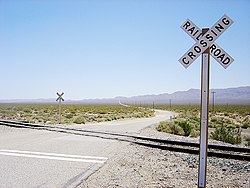
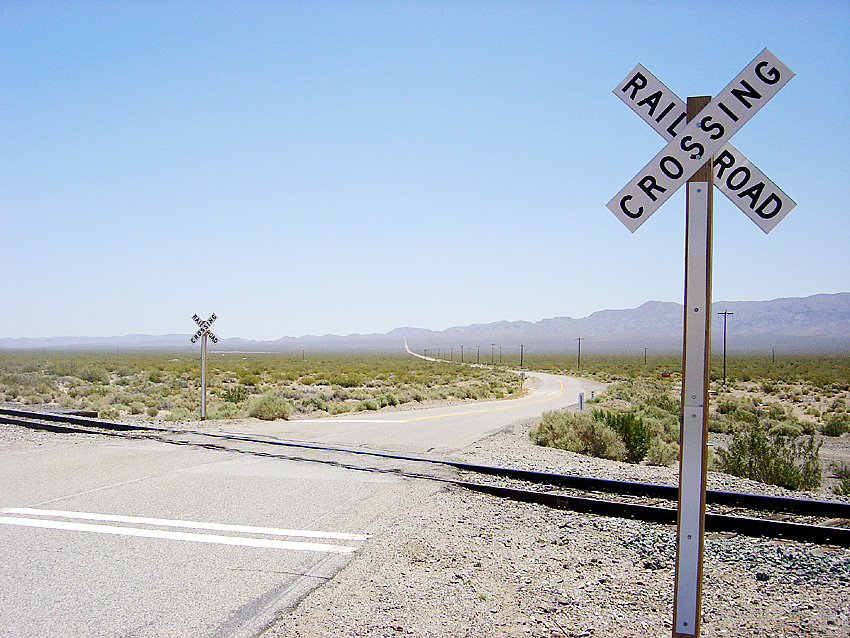
A crossbuck is a traffic sign used to indicate a level railway crossing. It is composed of two slats of wood or metal of equal length, fastened together on a pole in a saltire formation (resembling the letter X). Crossbucks are often supplemented by electrical warnings of flashing lights, a bell, and/or a boom barrier that descends to block the road and prevent traffic from crossing the tracks.
Vienna Convention
[edit]The Vienna Convention on Road Signs and Signals, a multilateral treaty of the United Nations with the intention of standardizing traffic signs around the world, prescribes several different regulations for the "crossbuck" sign.
The sign should consist of two arms not less than 1.2 metres (3.9 ft) long, crossed in the form of an  . The first model may have a white or yellow background with a thick red or black border. The second model may have a white or yellow background with a thin black border and an inscription, for example, "railroad crossing", "railway crossing", etc. If lateral clearance obstructs the placement of the sign, it may be rotated 90° so that its points are directed vertically. If used at a level crossing with more than one track, a half cross or a supplementary plate stating the number of tracks may be added below.
It specified these models:
-
 A-28a-V1-1
 -
 A-28a-V1-2
 -
 A-28a-V1-1-EA
 -
 28a-V1-2-EA
 -
 A-28c-V1-1


It also specified multi-track models:
-
 A-28b-V1-1
 -
 A-28b-V1-2
 -
 A-28b-V1-1-EA
 -
 A-28b-V1-2-EA
 -
 A-28c-V3-1


Variants around the world
[edit]

In the United States, the crossbuck carries the words "rail" and "road" on one arm and "crossing" on the other ("rail" and "road" are separated by the "crossing" arm), in black text on a white background. Older variants simply used black and white paint; newer installations use a reflective white material with non-reflective lettering. Some antique U.S. crossbucks were painted in other color schemes, and used glass "cat's eye" reflectors on the letters to make them stand out. Other countries, such as China, also use this layout, but with appropriately localized terms. Often, a supplemental sign below the crossbuck indicates the number of tracks at the crossing. In the 1990s, the state of Ohio experimented with the modified Buckeye Crossbuck, which had a specialized accompanying plate.


In Canada, crossbucks have a red border and no lettering. These were installed in the 1980s shortly after English-French bilingualism was made official, replacing signs of a style similar to those used in the U.S., except the word "railway" was used instead of "railroad" and in certain areas the words "traverse de chemin de fer" were used.
In Mexico, the crossbucks read "cruces ferrocarril", a literal translation of its U.S. counterpart. Older designs read "cuidado con el tren", meaning "beware of the train".
In Argentina, the most common legend is "peligro ferrocarril" ("danger: railroad"). Other crosses also read "cuidado con los trends – pare mire escuche ("beware of the trains – stop, look, listen") for the Ferrocarril Belgrano, "paso a nivel – ferro carril" for the Ferrocarril Mitre and "cuiado con los trenes" ("beware of the trains") for the Ferrocarril Roca.
In parts of Europe, the cross is white with red trimmings or ends, sometimes on a rectangular background; in Finland and Greece the cross is yellow, trimmed with red.
Taiwan uses two crossbucks: a version with a yellow and black cross, and one with the cross in white with a red border. A special symbol in the center indicates an electric railroad crossing, cautioning road users about excessive height cargo that may contact the electric wires.
In Australia, the crossbuck is a St Andrews Cross as in Europe, but uses words and the same color as the American crossbuck. In contrast to the American "railroad crossing", Australian signs say "railway crossing" or "tramway crossing". (Most cases where a tram in its own right-of-way crosses a road do not use a crossbuck and so are regular intersections rather than level crossings.)
Different countries may classify the sign differently. For example, in Australia it is considered a regulatory sign, while in close neighbour New Zealand it is considered a warning sign. Some countries, such as Australia, France, New Zealand, Slovakia and Slovenia may place the crossbuck design on a "target board", while other countries quite often do not. In the United Kingdom, it is only used for crossings with no barriers or signal lights.
Crossbucks of the world
[edit]-
![Australia (variant) [1]](//upload.wikimedia.org/wikipedia/commons/thumb/7/70/Australia_road_sign_R6-25.svg/120px-Australia_road_sign_R6-25.svg.png) Australia (variant) [1]
Australia (variant) [1] -
![Austria [2]](//upload.wikimedia.org/wikipedia/commons/thumb/d/d7/Gefahrenzeichen_6d_liegend.svg/120px-Gefahrenzeichen_6d_liegend.svg.png) Austria [2]
Austria [2] -
![Austria (vertical) [3]](//upload.wikimedia.org/wikipedia/commons/thumb/1/13/Gefahrenzeichen_6d.svg/60px-Gefahrenzeichen_6d.svg.png) Austria (vertical) [3]
Austria (vertical) [3] -
![Austria (variant) [4]](//upload.wikimedia.org/wikipedia/commons/thumb/0/01/Gefahrenzeichen_6d_Tafel.svg/120px-Gefahrenzeichen_6d_Tafel.svg.png) Austria (variant) [4]
Austria (variant) [4] -
![Belgium [5]](//upload.wikimedia.org/wikipedia/commons/thumb/2/27/Belgian_traffic_sign_A45.svg/120px-Belgian_traffic_sign_A45.svg.png) Belgium [5]
Belgium [5] -
![Brazil [citation needed]](//upload.wikimedia.org/wikipedia/commons/thumb/a/a3/Brasil_A-41a.svg/120px-Brasil_A-41a.svg.png) Brazil [citation needed]
Brazil [citation needed] -
![Bulgaria [citation needed]](//upload.wikimedia.org/wikipedia/commons/thumb/7/76/BG_road_sign_%D0%9034.1.svg/120px-BG_road_sign_%D0%9034.1.svg.png) Bulgaria [citation needed]
Bulgaria [citation needed] -
![Canada [6]](//upload.wikimedia.org/wikipedia/commons/thumb/a/ad/CA-MUTCDC_RA-006.svg/120px-CA-MUTCDC_RA-006.svg.png) Canada [6]
Canada [6] -
![Canada (former) [citation needed]](//upload.wikimedia.org/wikipedia/commons/thumb/4/40/Canadian_Railway_Crossbuck_%28with_red_backing_board%29.png/120px-Canadian_Railway_Crossbuck_%28with_red_backing_board%29.png) Canada (former) [citation needed]
Canada (former) [citation needed] -
![Canada (former) [citation needed]](//upload.wikimedia.org/wikipedia/commons/thumb/a/ab/Canadian_Railway_Crossing_Sign_%28English%29_%28old%29.svg/120px-Canadian_Railway_Crossing_Sign_%28English%29_%28old%29.svg.png) Canada (former) [citation needed]
Canada (former) [citation needed] -
![Canada (former) [citation needed]](//upload.wikimedia.org/wikipedia/commons/thumb/6/67/Canadian_Crossbuck_%28Old%29.svg/120px-Canadian_Crossbuck_%28Old%29.svg.png) Canada (former) [citation needed]
Canada (former) [citation needed] -
![Canada (used in Ontario in the 1950s) [citation needed]](//upload.wikimedia.org/wikipedia/commons/thumb/5/53/1950%27s_Ontario_warning_traffic_sign%2C_railroad_crossing.svg/120px-1950%27s_Ontario_warning_traffic_sign%2C_railroad_crossing.svg.png) Canada (used in Ontario in the 1950s) [citation needed]
Canada (used in Ontario in the 1950s) [citation needed] -
![Canada (formerly used in Quebec) [citation needed]](//upload.wikimedia.org/wikipedia/commons/thumb/5/5d/Canadian_Railway_Crossing_Sign_%28French%29_%28old%29.svg/120px-Canadian_Railway_Crossing_Sign_%28French%29_%28old%29.svg.png) Canada (formerly used in Quebec) [citation needed]
Canada (formerly used in Quebec) [citation needed] -
![Central American Integration System Member States [7]](//upload.wikimedia.org/wikipedia/commons/thumb/d/d4/SIECA_road_sign_R-1-6.svg/120px-SIECA_road_sign_R-1-6.svg.png) Central American Integration System Member States [7]
Central American Integration System Member States [7] -
![Chile [citation needed]](//upload.wikimedia.org/wikipedia/commons/thumb/9/91/Chile_road_sign_PI-2a.svg/120px-Chile_road_sign_PI-2a.svg.png) Chile [citation needed]
Chile [citation needed] -
![Colombia (former) [citation needed]](//upload.wikimedia.org/wikipedia/commons/thumb/3/39/Colombia_road_sign_SP-54_%28old%29.svg/120px-Colombia_road_sign_SP-54_%28old%29.svg.png) Colombia (former) [citation needed]
Colombia (former) [citation needed] -
![Denmark [8]](//upload.wikimedia.org/wikipedia/commons/thumb/e/e8/Denmark_road_sign_A74.1.svg/120px-Denmark_road_sign_A74.1.svg.png) Denmark [8]
Denmark [8] -
![Germany [9]](//upload.wikimedia.org/wikipedia/commons/thumb/8/8e/Zeichen_201-50_%E2%80%93_Andreaskreuz_-_Dem_Schienenverkehr_Vorrang_gew%C3%A4hren%21_StVO_1992.svg/120px-Zeichen_201-50_%E2%80%93_Andreaskreuz_-_Dem_Schienenverkehr_Vorrang_gew%C3%A4hren%21_StVO_1992.svg.png) Germany [9]
Germany [9] -
![Germany (Level Crossings on Electrified Lines) [citation needed]](//upload.wikimedia.org/wikipedia/commons/thumb/c/ce/Zeichen_201-51_-_Andreaskreuz_%28stehend%29_mit_Blitzpfeil%2C_StVO_1992.svg/120px-Zeichen_201-51_-_Andreaskreuz_%28stehend%29_mit_Blitzpfeil%2C_StVO_1992.svg.png) Germany (Level Crossings on Electrified Lines) [citation needed]
Germany (Level Crossings on Electrified Lines) [citation needed] -
![Italy [citation needed]](//upload.wikimedia.org/wikipedia/commons/thumb/9/9a/Italian_traffic_signs_-_croce_di_S.Andrea.svg/120px-Italian_traffic_signs_-_croce_di_S.Andrea.svg.png) Italy [citation needed]
Italy [citation needed] -
![Mexico [10]](//upload.wikimedia.org/wikipedia/commons/thumb/a/ad/MX_road_sign_SIR-9.svg/120px-MX_road_sign_SIR-9.svg.png) Mexico [10]
Mexico [10] -
![Netherlands [11]](//upload.wikimedia.org/wikipedia/commons/thumb/d/d7/Nederlands_verkeersbord_J12.svg/60px-Nederlands_verkeersbord_J12.svg.png) Netherlands [11]
Netherlands [11] -
 New Zealand (variant)
 -
 Norway
 -
 Panama
 -
 Peru
Peru -
 Poland
 -
 Romania
 -
 Romania (variant used for railway crossings without gates and lights)
 -
 Singapore
 -
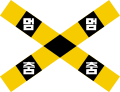 South Korea
 -
 Sweden
 -
 Taiwan
 -
 Thailand
 -
 United States
 -
 United States (inverted variant)
 -
 United States (experimental version used in Ohio for a time)
 -
 United States (variant, former)
 -
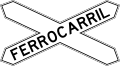 Venezuela
 -
 Vietnam
![Australia (variant) [1]](https://en.wikipedia.org/wiki/File:Australia_road_sign_R6-25.svg)
![Austria [2]](https://en.wikipedia.org/wiki/File:Gefahrenzeichen_6d_liegend.svg)
![Austria (vertical) [3]](https://en.wikipedia.org/wiki/File:Gefahrenzeichen_6d.svg)
![Austria (variant) [4]](https://en.wikipedia.org/wiki/File:Gefahrenzeichen_6d_Tafel.svg)
![Belgium [5]](https://en.wikipedia.org/wiki/File:Belgian_traffic_sign_A45.svg)
![Brazil [citation needed]](https://en.wikipedia.org/wiki/File:Brasil_A-41a.svg)
![Bulgaria [citation needed]](https://en.wikipedia.org/wiki/File:BG_road_sign_%D0%9034.1.svg)
![Canada [6]](https://en.wikipedia.org/wiki/File:CA-MUTCDC_RA-006.svg)
![Canada (former) [citation needed]](https://en.wikipedia.org/wiki/File:Canadian_Railway_Crossbuck_(with_red_backing_board).png)
![Canada (former) [citation needed]](https://en.wikipedia.org/wiki/File:Canadian_Railway_Crossing_Sign_(English)_(old).svg)
![Canada (former) [citation needed]](https://en.wikipedia.org/wiki/File:Canadian_Crossbuck_(Old).svg)
![Canada (used in Ontario in the 1950s) [citation needed]](https://en.wikipedia.org/wiki/File:1950%27s_Ontario_warning_traffic_sign,_railroad_crossing.svg)
![Canada (formerly used in Quebec) [citation needed]](https://en.wikipedia.org/wiki/File:Canadian_Railway_Crossing_Sign_(French)_(old).svg)
![Central American Integration System Member States [7]](https://en.wikipedia.org/wiki/File:SIECA_road_sign_R-1-6.svg)
![Chile [citation needed]](https://en.wikipedia.org/wiki/File:Chile_road_sign_PI-2a.svg)
![Colombia (former) [citation needed]](https://en.wikipedia.org/wiki/File:Colombia_road_sign_SP-54_(old).svg)
![Denmark [8]](https://en.wikipedia.org/wiki/File:Denmark_road_sign_A74.1.svg)
![Germany [9]](https://en.wikipedia.org/wiki/File:Zeichen_201-50_%E2%80%93_Andreaskreuz_-_Dem_Schienenverkehr_Vorrang_gew%C3%A4hren!_StVO_1992.svg)
![Germany (Level Crossings on Electrified Lines) [citation needed]](https://en.wikipedia.org/wiki/File:Zeichen_201-51_-_Andreaskreuz_(stehend)_mit_Blitzpfeil,_StVO_1992.svg)
![Italy [citation needed]](https://en.wikipedia.org/wiki/File:Italian_traffic_signs_-_croce_di_S.Andrea.svg)
![Mexico [10]](https://en.wikipedia.org/wiki/File:MX_road_sign_SIR-9.svg)
![Netherlands [11]](https://en.wikipedia.org/wiki/File:Nederlands_verkeersbord_J12.svg)


.svg)


Multiple tracks
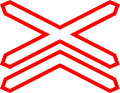
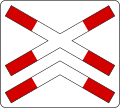
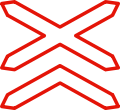
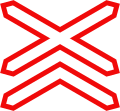
[edit]Several countries use a sign to indicate that multiple tracks must be crossed at a level crossing. In Australia, Canada, New Zealand, and the U.S., a sign is mounted beneath the crossbuck (above the warning light assembly, if any) with the number of tracks. Many European countries use multiple crossbucks or additional chevrons ("half-crossbucks") below the first one. Taiwan also uses half-crossbucks below the regular crossbuck.
-
 Argentina
 -
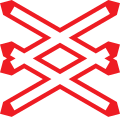 Austria
 -
 Austria
 -
 Austria (variant)
 -
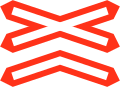 Bangladesh
 -
 Belgium
 -
 Bulgaria
 -
 Cambodia
 -
 China
China -
 Croatia
 -
 Czechia
 -
 Denmark
 -
 Estonia
 -
 Finland
 -
 France
 -
 Greece
 -
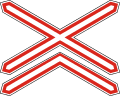 Hungary
 -
 Hungary
 -
 Indonesia
 -
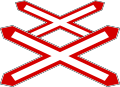 Italy
Italy -
 Latvia
 -
 Luxembourg
 -
 Netherlands
 -
 Norway
 -
 Poland
 -
 Portugal
 -
 Romania
 -
 Romania (variant used for railway crossings without gates and lights)
 -
 Russia
 -
 Serbia
 -
 Slovakia
 -
 Slovenia
 -
 Slovenia (former)
 -
 Spain
Spain -
 Sweden
 -
 Switzerland
 -
 Taiwan (variant)
 -
 Taiwan (variant used for electrified railway crossings)
 -
 Tunisia
 -
 Turkey (variant)
 -
 Ukraine
 -
 Vietnam


.svg)


.svg)


Advance warning
[edit]Several countries include the crossbuck icon on their railway crossing ahead warning signs. In Argentina, railway crossing ahead signs used a common red-bordered triangle defaced with a black steam locomotive icon placed on white background according Vienna Convention as well as the most other countries in the world outside of the Americas.[a]
-
 Vienna Convention; Aa-26b-V1
 -
 Vienna Convention; Ab-26b-V1
 -
 Australia
 -
 Australia (former)
 -
 Australia (side road)
 -
 Australia (variant with warning lights)
 -
 Canada
 -
 Canada (variant for left-skewed crossing)
 -
 Canada (variant for right-skewed crossing)
 -
 Canada (former)
 -
 Iraq
Iraq -
 Panama (variant for railroad crossings without gates but with lights)
 -
 Philippines
 -
 United States
 -
 United States (exempt railroad crossing, the usual requirement for commercial and mass transit vehicles to stop at the crossing regardless of activity on the line need not be obeyed)


.svg)
.svg)


.svg)


Notes
[edit]- ^ Used for unprotected railway crossings in most other countries in the world. In Argentina, Germany, Israel — it is used for both protected and unprotected railway crossing ahead signs.
References
[edit]- ^ "Australian Road Rules" (PDF). Australasian Parliamentary Counsel's Committee. 120 What is a level crossing. p. 112.
{{cite web}}: CS1 maint: location (link) - ^ "292. Verordnung der Bundesministerin für Verkehr, Innovation und Technologie, mit der die Verordnung über Straßenverkehrszeichen (Straßenverkehrszeichenverordnung 1998 – StVZVO 1998) geändert wird (1. Novelle zur StVZVO 1998)" (in German). Gefahrenzeichen. p. 11.
- ^ "292. Verordnung der Bundesministerin für Verkehr, Innovation und Technologie, mit der die Verordnung über Straßenverkehrszeichen (Straßenverkehrszeichenverordnung 1998 – StVZVO 1998) geändert wird (1. Novelle zur StVZVO 1998)" (in German). Gefahrenzeichen. p. 11.
- ^ "292. Verordnung der Bundesministerin für Verkehr, Innovation und Technologie, mit der die Verordnung über Straßenverkehrszeichen (Straßenverkehrszeichenverordnung 1998 – StVZVO 1998) geändert wird (1. Novelle zur StVZVO 1998)" (in German). Gefahrenzeichen. p. 11.
- ^ "Koninklijk besluit van 1 december 1975 houdende algemeen reglement op de politie van het wegverkeer en van het gebruik van de openbare weg" (PDF). static.tijd.be (in Flemish). p. 83.
- ^ "Grade Crossings Standards". Figure 4-1 – Railway Crossing Sign and Number of Tracks Sign.
{{cite web}}: CS1 maint: location (link) - ^ "ACUERDO CENTROAMERICANO SOBRE CIRCULACIÓN POR CARRETERAS, EN MATERIA DE PESOS Y DIMENSIONES DE VEHÍCULOS DE CARGA" (PDF). 2.2.4 SERIE DERECHOS Y PRIORIDAD DE PASO (R-1-1 A R-1-9). p. 59.
{{cite web}}: CS1 maint: location (link) - ^ "Faerdselstavle" (PDF). Advarselstavler. p. 2.
- ^ "VzKat 2017". Teil 3.
{{cite web}}: CS1 maint: location (link) - ^ "ACUERDO CENTROAMERICANO SOBRE CIRCULACIÓN POR CARRETERAS, EN MATERIA DE PESOS Y DIMENSIONES DE VEHÍCULOS DE CARGA" (PDF). Figura VIII.1-5 Señalización para CRUCE DE FERROCARRIL. p. 882.
{{cite web}}: CS1 maint: location (link) - ^ "VERKEERSBORDENOVERZICHT.NL". J-serie: Waarschuwing.
External links
[edit]
Crossbuck
View on GrokipediaOverview and Design
Definition and Purpose
A crossbuck is a passive regulatory traffic sign used at railroad grade crossings, consisting of an X-shaped assembly formed by two slats of wood or metal of equal length, typically retroreflectorized white with black lettering reading "RAILROAD CROSSING."[1] The design serves as a visual warning marker, with the crossed slats symbolizing danger and the text explicitly indicating the presence of tracks.[5] The primary purpose of the crossbuck is to alert motorists and pedestrians to the location of a rail line at a level crossing, prompting them to slow down, look for oncoming trains, and yield the right-of-way to rail traffic.[1] As a yield-equivalent sign, it functions without active controls like gates or lights, relying on drivers' vigilance to prevent collisions at ungated or passively protected crossings.[4] In the United States, it carries legal weight as a yield sign under traffic regulations, requiring drivers to stop if a train is approaching and always granting trains absolute priority to ensure safety.[1][6]Physical Specifications and Materials
The Crossbuck sign in the United States adheres to standardized dimensions as outlined in the Manual on Uniform Traffic Control Devices (MUTCD) 11th Edition (2023), with each arm measuring 48 inches (1,200 mm) in height by 9 inches (225 mm) in width, forming an X-shape through perpendicular assembly.[1] These proportions ensure the sign's distinctive silhouette is visible from a distance, while international standards, such as those under the Vienna Convention on Road Signs and Signals, generally require arms no shorter than 1.2 meters (3.9 feet) but vary by country without uniform global dimensions. Construction materials for Crossbuck signs have evolved from traditional wood or early metal slats to modern aluminum panels, which provide structural integrity and resistance to environmental degradation.[7] The sign faces are overlaid with retroreflective sheeting compliant with ASTM D4956 standards, often Type XI (Diamond Grade) for superior nighttime visibility through cube-corner microprisms that reflect headlights back to drivers.[8] Black lettering and borders are also retroreflectorized to enhance legibility in low-light conditions, with a minimum 2-inch-wide white retroreflective strip required on the back of each blade and support post.[1] Mounting typically involves single or double U-channel or square posts. The mounting height of Crossbuck signs, measured vertically from the center of the sign to the elevation of the near edge of the pavement, should be approximately 9 feet (2.7 m), which may be varied as required by local conditions and increased to accommodate signs mounted below the Crossbuck sign; the assembly is often angled slightly toward approaching traffic for better conspicuity.[1][9] Durability features include weather-resistant aluminum substrates and sheeting designed to withstand corrosion, UV fading, and vandalism, meeting Federal Highway Administration (FHWA) retroreflectivity requirements that ensure maintained performance over a 10-year service life under typical exposure conditions.[10][11]Historical Development
Origins in North America
The crossbuck sign originated in the United States in the late 19th to early 20th century as a warning for railroad crossings, with widespread adoption and standardization in the early 20th century amid growing traffic including automobiles.[2][12] As one of the earliest national traffic signs dedicated to rail safety, it provided a simple, visible warning at grade crossings where vehicles and trains intersected at the same level.[12] This invention responded directly to the escalating dangers of motorized travel, where drivers often lacked the visibility and auditory cues available to horse-drawn vehicles, leading to frequent accidents at unguarded sites.[2] In the 1910s, the United States experienced thousands of rail-highway grade crossing accidents annually, contributing to over a thousand fatalities and underscoring the urgent need for uniform safety measures.[13] Initial crossbuck designs consisted of a basic wooden X-shaped structure without any text, relying on the universal symbol of an intersecting saltire to convey danger, much like a skull and crossbones emblem.[14][5] These passive signs were erected at crossings lacking bells, gates, or lights, marking the first widespread effort to standardize visual alerts amid inconsistent local practices.[12] The design was first standardized in the 1935 Manual on Uniform Traffic Control Devices (MUTCD), which specified its dimensions, placement, and retroreflective requirements.[12] Early adoption accelerated in the 1920s, with crossbucks becoming a staple at passive railroad crossings across the US rail network.[2] The American Railway Association played a pivotal role by formulating uniform standards for crossing warning systems in 1916 to promote consistency among railroads.[15] This standardization facilitated broader implementation, reducing variability in signage and enhancing driver awareness at thousands of intersections.[15] In Canada, the crossbuck saw parallel development and adoption in the early 1900s, closely mirroring US innovations due to shared rail infrastructure and safety concerns.[12] Influenced by American standards, Canadian railroads deployed similar X-shaped signs at passive crossings, with bilingual features—incorporating English "Railway Crossing" alongside French "Traversée Ferroviaire"—appearing from the late 1960s onward following official bilingual policies.[12][16]Global Adoption and Evolution
Following World War II, the crossbuck design, originally developed in the United States as a simple X-shaped warning for railway level crossings, gained international traction through United Nations efforts to standardize road safety infrastructure. The 1949 Geneva Protocol on Road Signs and Signals, adopted by numerous European nations, formalized the use of the St. Andrew's cross—a symbol identical to the crossbuck—for unguarded level crossings, marking its initial spread beyond North America to promote uniform hazard recognition amid postwar reconstruction and expanding motor vehicle use.[17][18] This protocol emphasized symbolic, language-independent signage to facilitate cross-border travel, influencing early adopters in Europe and laying the groundwork for broader global harmonization. Key milestones in the crossbuck's evolution included the 1968 Vienna Convention on Road Signs and Signals, which further standardized the sign's form and placement for railway crossings, requiring a white or yellow background with red borders for enhanced visibility and integrating it into a comprehensive system applicable to signatory states worldwide.[19] Technological advancements drove material evolutions, transitioning from wooden slats, which were prone to weathering, to durable metal constructions like steel and aluminum by the 1960s and 1970s, improving longevity and resistance to environmental damage.[12] The 1990s saw widespread adoption of prismatic retroreflective sheeting on the front and back of crossbucks, boosting nighttime visibility by reflecting vehicle headlights back to drivers up to 1,000 feet away, a critical upgrade for safety as global roadways darkened with higher traffic densities.[2] Minor design adaptations also emerged, such as angled placements or supplementary panels for pedestrian pathways versus vehicular routes, ensuring context-specific warnings without altering the core X-shape. The crossbuck's global proliferation was propelled by escalating rail freight and passenger volumes alongside booming automobile ownership, which heightened level-crossing exposures and prompted numerous countries to implement variants by 2000, often modeled on U.S. origins but tailored to local conventions.[20] This widespread use underscored its role as a cost-effective, universally intuitive passive warning, contributing to reduced accident rates in adopting regions through standardized hazard communication.International and National Standards
Vienna Convention Requirements
The Vienna Convention on Road Signs and Signals, adopted by the United Nations on 8 November 1968 and entering into force on 6 June 1978, establishes a unified system of road signs and signals to promote safe and efficient international road traffic.[20] Among its provisions for warning and regulatory signs, the convention specifies standards for level crossing indicators, including the crossbuck designated as sign A,28 in Annex 1, Section A, depicted as an X-shaped (St. Andrew's cross) symbol to denote railway crossings.[19] This design prioritizes symbolic representation over textual elements to ensure immediate recognition across linguistic boundaries, facilitating harmonized signage for cross-border travel. Sign A,28 features a white background with a red border, as the preferred form for universality, though supplementary indications like the number of tracks may be added below in some cases.[19] The arms of the X measure 90 cm in length for the standard size on major roads, with the overall sign mounted on a post at the crossing approach to command attention.[19] The convention mandates placement of this sign at all unguarded level crossings or those without full barriers, positioned in the immediate vicinity to alert drivers to yield to trains.[19] Over 70 contracting parties, including most European nations and several in Africa, Asia, and Latin America, are bound to implement or adapt these specifications to maintain interoperability for international drivers; in multilingual regions, bilingual or local-language supplements are permitted beneath the symbol if essential for clarity.[20] Non-symbolic text is discouraged to preserve the convention's emphasis on intuitive, non-verbal communication. Amendments consolidated in 2006, building on earlier revisions, enhanced visibility standards by requiring retroreflective materials for all signs, including the crossbuck, to ensure effective illumination under low-light conditions from vehicle headlights.[19]United States MUTCD Guidelines
The Manual on Uniform Traffic Control Devices (MUTCD), issued by the Federal Highway Administration (FHWA), establishes national standards for traffic control devices, including those at highway-rail grade crossings, to promote uniformity and safety across the United States. The current 11th edition, published December 2023 and effective January 18, 2024, updates the previous 2009 edition with revisions to signage provisions, such as enhanced clarity for passive and active warning systems. Under Section 8B.03, the MUTCD requires a Crossbuck sign (R15-1)—a retroreflective white X-shaped regulatory sign with the legend "RAILROAD CROSSING"—at every public highway-rail grade crossing, either alone or in combination with other devices, to alert drivers to yield the right-of-way to rail traffic.[1] Placement guidelines emphasize visibility and approach-specific installation to minimize hazards. Section 8B.03 mandates at least one Crossbuck per highway approach, positioned on the right-hand side unless sight distance restrictions or multi-lane conditions necessitate an additional left-side sign; the sign should be mounted such that its center is approximately 9 feet above the near edge of the pavement for standard conditions, adjustable based on local geometry. When two or more tracks are present, a supplementary Number of Tracks plaque (R15-2P) must be attached below the Crossbuck in an inverted T configuration to indicate the exact count. Setbacks from the tracks are governed by railroad or transit agency standards for clearance, with a minimum distance of 12 feet from the center of the nearest track recommended for pathway and sidewalk crossings to ensure safe positioning.[1][21] Maintenance requirements focus on durability and visibility to sustain effectiveness over time. Crossbuck signs must use retroreflective sheeting compliant with ASTM D4956 standards for Types I through XI, ensuring minimum maintained retroreflectivity levels (e.g., 150 candela per lux per square meter for white backgrounds on Type I sheeting) as outlined in MUTCD Table 2A.3; a 2-inch-wide retroreflective white strip is required on the back of posts at passive crossings for nighttime conspicuity. FHWA guidance recommends visual nighttime inspections of all signs, including Crossbucks, at least every 2 years by trained personnel to verify condition and retroreflectivity, with more frequent checks in high-degradation areas. For passive crossings without active signals, a YIELD (R1-2) sign is optional beneath the Crossbuck assembly but strongly recommended to reinforce yielding obligations, while STOP signs (R1-1) require an engineering study justification per Section 8B.04.[22][1] Enforcement of MUTCD provisions is tied to federal funding eligibility under 23 U.S.C. § 109, where non-compliance by states or railroads—such as improper installation or maintenance of Crossbucks—can lead to withholding of Federal-aid highway funds; state laws may impose additional civil penalties, with fines reaching up to $5,000 for violations like failure to notify authorities of crossing issues. Integration with the Americans with Disabilities Act (ADA) is addressed in Sections 8D.02 and 8E.04, requiring accessible features such as audible bells with flashing-light signals at active crossings and truncated dome detectable warnings at pedestrian pathways, extending the full crossing width with at least a 2-foot depth in the direction of travel.[23][24][1]Regional Variations
Europe and Asia
In Europe, crossbuck signs for railway level crossings adhere to the standards outlined in the Vienna Convention on Road Signs and Signals, which prescribes a white saltire (Saint Andrew's Cross or inverted V shape) with a red border to indicate an unguarded crossing, serving as a universal symbolic warning without mandatory text.[19] In the United Kingdom, this design incorporates the word "RAILWAY" in black lettering on the white background, positioned at crossings to alert drivers of potential hazards, with advance warning signs featuring a similar cross placed 50-100 meters prior depending on speed limits.[25] France employs a purely symbolic version of the red-bordered white X, known as the "panneau de passage à niveau," placed at all level crossings to emphasize the intersection without linguistic elements, ensuring clarity for international drivers.[26] In multilingual regions such as Belgium, level crossings typically feature crossbucks with two red flashing lights (and an optional white light indicating clear passage), bells, and barriers, adhering to EU standards while addressing regional linguistic diversity through general signage practices. Standard sizes for these signs across the EU typically range from 60 to 90 cm in height for the cross elements, as specified in national implementations of the convention to maintain visibility.[27] Unique enhancements in Europe include the addition of flashing LED lights to crossbuck signs in high-risk areas, such as those with poor visibility or high traffic volumes, to heighten driver awareness; these are often integrated with existing signals, as seen in initiatives like Germany's PeriLight project, which uses peripheral blinking lights at non-secured crossings to improve safety.[28] Adoption of standardized crossbuck designs has been nearly universal in the EU since the 1990s, driven by harmonization efforts under the Vienna Convention and EU rail safety directives, resulting in approximately 114,000 level crossings as of 2014, with ongoing reductions through safety upgrades.[29] In Asia, crossbuck variations reflect diverse regulatory frameworks and cultural influences, often diverging from strict Vienna Convention adherence. Japan utilizes a white X-shaped sign with red borders, accompanied by katakana text "テツドウゴジョウ" (Tetsudō Gojō, meaning "railway crossing") in black, placed at urban and rural intersections to provide clear warnings in line with the country's road sign order. China's designs feature a symbolic red-bordered X on a white background for warning at level crossings, with yellow backgrounds and black borders for broader cautionary signs, emphasizing visual prominence in high-density rail networks without extensive text. In India, post-colonial influences yield English-language variants, such as the guarded railway crossing sign depicting a black X on a red circle with "RAILWAY CROSSING" text, installed on approaches to manned crossings to alert vehicular traffic.[30] These signs are typically 90 cm in size for visibility on busy roads.[31] Asian implementations often integrate crossbucks with pedestrian gates in urban settings, particularly in densely populated cities, where barriers and signals synchronize with rail operations to manage foot traffic flow and reduce collision risks.[32] For instance, smart systems in Chinese and Indian metros combine crossbuck signage with automated gates and real-time monitoring for enhanced safety at pedestrian-heavy crossings.[32] Enforcement of these signs varies across Asia due to fragmented rail systems and differing national priorities, with stricter compliance in Japan and China compared to more inconsistent application in India amid diverse infrastructure challenges.[33] Overall, adoption rates reflect regional rail densities, with near-universal use in East Asia but patchy implementation in South Asia tied to ongoing modernization efforts.[34]Other Global Examples
In Africa, crossbuck signs at railway level crossings in South Africa typically feature an X-shaped hazard marker designated as W403 for single-track lines or W404 for multiple tracks, inscribed with "RAILWAY CROSSING" in English, reflecting British colonial influences on signage standards.[35] Bilingual variants incorporating Afrikaans, such as "Spoorweg Oorgang," appear in some regional implementations, blending local linguistic adaptations with the standard symbolic X form. In French-speaking West African countries, crossbuck designs generally adhere to international conventions with symbolic X forms, though rural areas face maintenance challenges due to underinvestment in rail infrastructure.[36] South American implementations show strong influences from U.S. designs via historical trade and technical exchanges, leading to crossbuck adoption in several nations. In Brazil, the sign is known as "Passagem de Nível" and features a white X with black borders, often paired with yield or stop indicators at passive crossings.[37] Argentina employs a similar X-shaped crossbuck labeled "Paso a Nivel" in Spanish, emphasizing the level crossing hazard. In Oceania, Australian crossbucks in states like New South Wales display "RAILWAY CROSSING" on the X slats, integrated with regulatory signs such as "GIVE WAY" or "STOP ON RED SIGNAL" for enhanced visibility at level crossings.[38] New Zealand follows Austroads-aligned standards with symbolic X crossbucks under code PW-14, often including a target board for track numbering and minimal text like "RAILWAY LEVEL CROSSING," prioritizing the universal X motif for driver recognition.[39] Across these regions, crossbuck designs exhibit hybrid influences from the Vienna Convention's symbolic X requirements and U.S. MUTCD-style textual additions, particularly in former British and Portuguese colonies. In developing areas of Africa and South America, wooden constructions remain prevalent over metal due to cost constraints and local resource availability, though this contributes to higher vulnerability in remote settings.[40]Special Configurations
Multiple-Track Crossings
At railway-highway grade crossings with two or more tracks, the Crossbuck sign in the United States is supplemented by a Number of Tracks plaque (R15-2P), which displays the numeral or numerals corresponding to the track count in black on a white rectangular background, mounted directly below the Crossbuck (R15-1). This configuration, along with a YIELD (R1-2) sign mounted below, forms the standard Crossbuck Assembly as specified in Section 8B.04 of the Manual on Uniform Traffic Control Devices (MUTCD).[1] The plaque alerts drivers to the presence of multiple tracks, emphasizing the need to verify clearance on all lines before proceeding.[1] Separate Crossbuck Assemblies are required on each highway approach to the crossing, positioned on the right-hand side relative to traffic flow, with at least one assembly per direction. Where sight distance is restricted, highway geometry is unfavorable, or the approach is a multi-lane one-way roadway, an additional assembly may be installed on the left-hand side. The signs are oriented perpendicular to the roadway or angled as needed to optimize visibility across multiple parallel tracks, mounted at approximately 9 feet above the pavement edge, adjustable for local conditions, to ensure clear view for approaching drivers.[1] Multiple-track crossings heighten collision risks compared to single-track sites, primarily because a passing train on one track can obscure or "hide" an approaching train on an adjacent parallel track, leading drivers to mistakenly assume the crossing is clear after the first train departs. Research shows drivers often fail to recheck all tracks, contributing to accidents where vehicles proceed prematurely without confirming visibility on every line.[41] Internationally, analogous supplementary signage addresses multiple tracks through plaques or add-ons to the basic crossing warning symbol. In Europe, countries adhering to the Vienna Convention on Road Signs and Signals often use plates below the cross indicating track numbers, such as "2 voies" in France to denote two tracks. In Asia, numeric indicators are typically employed on crossing signs to specify the track count, as seen in systems in Japan and other nations.[19]Integration with Active Warning Systems
In active railroad crossings, crossbucks are integrated as a passive visual element alongside dynamic warning devices such as flashing lights, bells, and gates to provide comprehensive alerts to motorists and pedestrians. The crossbuck is typically mounted on the same support structure as the flashing lights, positioned above the lights for optimal visibility, or on cantilevered arms extending over the roadway in multi-lane configurations to ensure clear sightlines from all approaches.[1] The active warning system activates through train detection circuits, such as track circuits or axle counters, which trigger the devices 20 to 30 seconds before the train's arrival at the crossing, allowing sufficient time for vehicles to clear the tracks; Federal Railroad Administration (FRA) regulations mandate a minimum warning time of 20 seconds to prevent activation failures.[42][43] Flashing lights consist of pairs of red LED units with 8-inch or 12-inch nominal diameter lenses for enhanced visibility, accompanied by an audible bell, while gates descend to physically block the roadway; the crossbuck itself remains unpowered and retroreflective, serving as a constant yield reminder even when active elements are dormant.[1][44] According to the Manual on Uniform Traffic Control Devices (MUTCD), a crossbuck is required at every active highway-rail grade crossing, mounted on the right-hand side of each approach and synchronized with the active components to form a unified warning assembly.[1] Internationally, similar integrations occur with regional variations. In Europe, the St. Andrew's Cross—analogous to the crossbuck—is often combined with flashing amber and red lights and acoustic signals at automatic level crossings, as outlined in national standards compliant with the Vienna Convention on Road Signs and Signals, where lights flash alternately to indicate train approach.[45][46] In urban areas of Japan, crossbuck-style signs are paired with rotating red lanterns, continuous or mechanical bells, and full barriers, activated by proximity sensors to provide early warnings in high-density settings, per Ministry of Land, Infrastructure, Transport and Tourism guidelines.[47]Safety and Usage
Effectiveness and Risk Reduction
Crossbucks serve as a fundamental passive warning device at highway-rail grade crossings, contributing to risk reduction by alerting drivers to the presence of tracks and potential train traffic. According to the Federal Highway Administration (FHWA), installing a crossbuck assembly at previously unsigned crossings reduces collisions by approximately 25%.[48] Historical data from the U.S. Federal Railroad Administration (FRA) indicate that annual grade crossing incidents exceeded 2,000 in the early 20th century prior to crossbuck standardization in the 1920s, with subsequent widespread adoption linked to a roughly 40% decline in such incidents over the following decades as signage became uniform and reflectorized.[49] In modern contexts, passive crossings exhibit a fatality rate of approximately 0.6 per million train-miles in the early 2000s, with overall rates declining to about 0.37 per million train-miles as of 2024, though still highlighting the need for ongoing improvements. As of 2024, the U.S. recorded 2,261 highway-rail grade crossing collisions and 262 fatalities, with passive crossings continuing to represent a disproportionate share of incidents.[50][51] Research on enhanced crossbuck designs, such as the Buckeye crossbuck, indicates increased driver caution, with median decision times before violations extending by 25%, though violation rates remain similar.[52] However, their effectiveness increases substantially—up to 70% greater impact—when supplemented with active elements like flashing lights or gates, or passive additions such as stop signs, which provide clearer directives on driver behavior.[53] The National Transportation Safety Board (NTSB) analysis of 1990s data further supports this, showing that passive crossings with crossbucks accounted for 54% of all grade crossing accidents and 60% of fatalities in 1996, underscoring the enhanced safety from combined systems.[54] Despite these benefits, crossbucks have notable limitations, particularly in adverse conditions. They are less effective during low-visibility weather, such as fog or heavy rain, where reliance on visual detection fails without supplemental lighting or audio cues.[54] Additionally, risks remain elevated at high-speed rail corridors or urban crossings lacking active warnings, as limited sight distances, obstructions like vegetation or buildings, and higher vehicle volumes can prevent timely train detection, leading to higher collision probabilities.[54] From a cost-benefit perspective, crossbucks offer an economical safety measure, with installation costs typically ranging from $500 to $1,500 per sign, compared to $13.7 million (2024) in societal costs per prevented fatality based on U.S. Department of Transportation valuations.[48][55] This low upfront investment yields substantial returns in accident prevention, especially at low-volume rural crossings where active systems may not be justified.[56]Regulatory Compliance and Best Practices
Rail operators in the United States bear primary responsibility for maintaining crossbuck signs and associated warning devices at highway-rail grade crossings to ensure ongoing safety and visibility. Under federal regulations outlined in 49 CFR Part 234, railroads must conduct periodic inspections and tests of grade crossing systems, including annual comprehensive tests for components like flashing lights and gates, while passive elements such as crossbucks require regular checks for legibility, positioning, and freedom from obstructions.[57] The Federal Railroad Administration (FRA) mandates that railroads update the National Highway-Rail Crossing Inventory every three years, incorporating maintenance records to verify compliance with safety standards.[58] The Manual on Uniform Traffic Control Devices (MUTCD) specifies that crossbuck signs must remain retroreflective to meet minimum maintained levels, such as 250 cd/lx/m² for white sheeting on regulatory signs, with immediate replacement required for any that are faded, damaged, or below these thresholds to preserve nighttime visibility.[11] For pedestrian facilities at railroad crossings, the Americans with Disabilities Act (ADA) mandates the provision of curb ramps during street alterations or new construction where pedestrian walkways intersect tracks, ensuring a maximum slope of 1:12, a minimum clear width of 36 inches, and compliance with accessibility standards to facilitate safe passage for individuals with disabilities.[59][60] Best practices emphasize proactive education and oversight to reinforce crossbuck effectiveness. Driver licensing programs across states, such as those administered by the New York Department of Motor Vehicles, integrate railroad crossing modules into written and practical tests, teaching recognition of crossbucks as yield points and the need to stop, look, and listen before proceeding.[61] Public awareness initiatives, including Operation Lifesaver's campaigns like "See Tracks? Think Train®," conduct nationwide outreach through presentations, media, and partnerships with law enforcement to educate motorists on crossbuck protocols and reduce trespassing or misuse at crossings.[62] Railroads are encouraged to perform signage audits aligned with FRA inventory cycles or state requirements, typically every three years, alongside routine visual inspections to confirm reflectivity and placement, ensuring signs are not obscured by vegetation or structures. Enforcement mechanisms deter non-compliance and promote accountability. The FRA imposes civil penalties on railroads for failing to maintain crossing devices, with base fines starting at approximately $1,300 per violation and escalating to over $31,000 for grossly negligent or repeated offenses, as adjusted for 2025 in the agency's penalty schedules.[63][64] Drivers who ignore crossbuck signals or barriers face state-specific fines, such as up to $243 in New York for failing to stop, plus five points on their license, or mandatory minimums like $500 in Illinois for disobeying signals.[65][66] To aid enforcement and prevention, GPS navigation apps like Waze integrate real-time railroad crossing alerts through partnerships with entities such as Amtrak, notifying users of approaching tracks and potential delays to encourage adherence to crossbuck directives.[67] Internationally, regulatory approaches align with global safety goals by embedding crossbuck-equivalent signage compliance into training and oversight. In the European Union, driver education programs incorporate level crossing safety modules, with initiatives like the European Road Safety Charter's workshops for driving school instructors focusing on recognition of crossing signals, hazard anticipation, and legal obligations to yield, aiming to address the roughly 300 annual fatalities at such sites.[68][69]References
- https://wiki.openstreetmap.org/wiki/Comparison_of_Asian_road_signs
- https://commons.wikimedia.org/wiki/Category:Level_crossings_in_Brazil