Hubbry Logo
Cube houseCube houseMain
Open search
Cube house
Community hub
Cube house
logo
8 pages, 0 posts
0 subscribers
Be the first to start a discussion here.
Cube house
Cube house
from Wikipedia
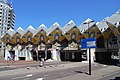
The cube houses in Rotterdam viewed from Blaak metro station

Cube houses (Dutch: kubuswoningen) are a set of innovative houses built in the cities of Helmond and Rotterdam in the Netherlands, designed by architect Piet Blom. They are based on the concept of "living as an urban roof": high density housing with sufficient space on the ground level; its main purpose being to optimize the space inside. Blom combatted the ideas of conventional residential architecture by tilting the cube shape on its corner and rested it upon a hexagon-shaped pylon. Blom's main goal was to create an urban area that felt like a village.[1] The cube houses around the world are meant to optimize the space as a house and to efficiently distribute the rooms inside.[2]

Helmond

[edit]

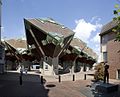
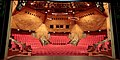
In 1972, Piet Blom was assigned to fill an empty site in the city center of Helmond with a meeting center. Blom proposed a plan that mixed cultural facilities with houses and concluded that the cube houses should surround Theater 't Speelhuis (English: the playhouse), creating an interesting architectural whole. After the underground parking garage was taken out of the plans, the plan was reduced to 60 houses. The city council was not satisfied so Minister Hans Gruijters subsidized the building of 3 test houses in the Wilhelminalaan in 1974. The project also received the national status of 'Experimental Housing', which helped to realize Theater 't Speelhuis: a forecourt surrounded by 18 cube houses at the Piet Blomplein in 1977.[3] The theatre burned down on December 29, 2011 which also damaged two adjacent cube houses..[4] The damaged houses were later restored in 2013 and 2014.[5]

Rotterdam

[edit]

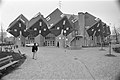
The houses in Rotterdam, the country's second largest city, are located on Overblaak Street, right above the Blaak metro station. The 1977 original plan showed 55 houses, but not all of them were built.[6] There are 38 small cubes and two so called 'super-cubes', all attached to each other.

As residents are disturbed so often by curious passers-by, one owner decided to open a "show cube", which is furnished as a normal house, and is making a living out of offering tours to visitors.

The living room of the "show cube" in Rotterdam

The houses contain three floors:

  • ground floor entrance
  • first floor with living room and open kitchen
  • second floor with two bedrooms and bathroom
  • top floor which is sometimes used as a small garden

The walls and windows are angled at 54.7 degrees. The total area of the apartment is around 100 square metres (1,100 sq ft), but around a quarter of the space is unusable because of the walls that are under the angled ceilings.

In 2006, a museum of chess pieces was opened under the houses.[7]

In 2009, the larger cubes were converted by Personal Architecture into a hostel run by Dutch hostel chain Stayokay.[8]

In 2019, the Art cube opened at Overblaak 30. The Art cube is a place where art and architecture come together. With the original living layout intact, this cube house forms the backdrop for the work of various local artists.[9]

Structure and materials

[edit]

The cube houses are constructed with reinforced concrete in the hexagonal trunk that holds the cube region. The hexagonal base tilts the cubes at a 54.7 degree angle, which in turn allows viewers inside to see the street below from the windows. The reinforced concrete floors and pillars hold up a wooden skeleton that creates the cubes. The wooden frame is curtained by fiber cement that has fiber wool in the center for insulation. All windows are structural as well, either being double glass panels or infused with wire. [10]

Spaces

[edit]

The cube houses are all linked together, and overlap to create a unique façade. The entrance to the houses enter into a narrow stair case. The ground floor is triangular in shape and is meant to be used as a living room area. The second and third floors are intended to be bedrooms and toiletry areas, most often having the bathroom on the second level.[11] The odd angle of the walls allows the area to feel more open but leaves only a quarter of the area actually usable. The second floor has the windows facing towards the sky, as well as two bedrooms, a small living area, and a bathroom. The top floor is a pyramid shaped room with 18 windows that give the viewer a sweeping view outside. All of the levels are connected by narrow wooden stairs.[12]

Similar buildings outside the Netherlands

[edit]

In 1996 a house consisting of cluster of three cubes was built along Eastern Avenue in the city of Toronto, Canada.[13] Architect Ben Kutner and partner Jeff Brown had been inspired by the original cube houses and wanted to replicate the Rotterdam design on otherwise unusable patches of land. The project was subsequently not extended further. In 2018, the land was sold for redevelopment with hopes the structures themselves could be saved and moved elsewhere.[14] In 2021, an application was submitted to the city to redevelop into a "35-storey mixed-use building atop a podium element".[15]

References

[edit]
[edit]
Revisions and contributorsEdit on WikipediaRead on Wikipedia
from Grokipedia
The Cube Houses, known in Dutch as Kubuswoningen, are a collection of 38 innovative, cube-shaped residential dwellings and two larger "supercubes" located in , , designed by Piet Blom and completed in 1984. These structures feature bright yellow cubes tilted at a 45-degree angle and elevated on hexagonal concrete pylons, creating the illusion of an abstract where the homes represent tree trunks and the rooftops form a pedestrian promenade. Positioned along Overblaak street near Rotterdam Blaak railway station, the complex spans approximately 6,000 square meters and integrates 1,000 square meters of retail space below, fostering a vibrant community hub in the city's post-World War II regenerated center. Piet Blom, a prominent Dutch Structuralist architect born in 1934 and influenced by mentors like Aldo van Eyck, conceived the Cube Houses as a response to conventional urban housing, aiming to prioritize "architecture with life" by elevating private living spaces to reclaim ground-level areas for public use and social interaction. Inspired by earlier prototypes in Helmond and concepts from Le Corbusier, Blom's design transforms the rigid geometry of cubes—each measuring about 7.5 meters per side and totaling 100–106 square meters across three levels—into dynamic, habitable volumes with timber-frame construction, rock wool insulation, and angled walls that challenge traditional interior layouts. The entrance and utility space are at the base of the hexagonal pylon, with steep stairs leading to the cube's lower level for living and kitchen areas, middle level for two bedrooms and a bathroom, and top pyramid-shaped loft for additional sleeping or lounge space, though sloped surfaces demand creative furnishing adaptations. Since their completion, the Cube Houses have become an enduring symbol of Rotterdam's progressive architectural identity, attracting tourists as a and cultural hotspot, with one cube operating as the Kijk-Kubus museum to showcase inhabitable interiors. The project faced practical challenges, including reduced usable space (only about 75% of the due to angles) and issues from urban surroundings, leading to restorations in 1997–1998 for new roofs and in 2000 for promenade enhancements. Despite these, the design's bold experimentation has influenced modern housing concepts, emphasizing community, adaptability, and the integration of with urban vitality, and remains habitable primarily by young professionals drawn to its unconventional appeal.

Overview

Definition and Characteristics

The Cube houses are innovative residential structures consisting of cubic living units tilted at an angle of approximately 54 degrees around a horizontal axis and elevated on pole-like supports, creating a distinctive tilted form that challenges conventional urban architecture. Designed by architect Piet Blom, these units resemble abstract trees, with clusters intended to evoke an integrated into city landscapes. Key characteristics include the elevation on hexagonal pylons or poles, which not only provides but also generates open at ground level for flow and interaction. This modular configuration maximizes internal living space—approximately 100 square meters of floor area per unit—within a compact , while the cubes' typical side length of 7.5 meters contributes to their dynamic, asymmetrical . The design optimizes space in dense environments, allowing for efficient stacking and orientation without compromising . Philosophically, the Cube houses seek to foster a sense of communal "village" living amid , where individual homes above a shared ground plane blend private and public realms into a cohesive whole. Blom's vision emphasizes two-level : elevated residences as the "roof" of the city, promoting social connectivity and reimagining housing as an extension of the natural and communal environment.

Designer: Piet Blom

Piet Blom was a Dutch born on February 8, 1934, in , where he grew up in the working-class neighborhood. He began his education in drafting and carpentry before attending the Academy of Architecture in , completing courses in the mid-1950s that shaped his early career. Blom passed away on June 8, 1999, while on holiday in , at the age of 65. Blom's architectural philosophy was deeply influenced by the movement, which emphasized modular, adaptable designs to foster social interaction in urban environments. A key mentor was , a pioneer of Structuralism, under whom Blom studied at the Academy of Architecture and later collaborated, absorbing ideas about integrating individual and communal spaces. These influences drew from child-centered playgrounds and organic forms, inspiring Blom's vision of elevated structures reminiscent of tree houses to harmonize nature with city living. In the , Blom conceptualized the cube houses as "living trees," where each tilted cube represented foliage atop a pole-like trunk, collectively forming an abstract to promote community in post-World War II rebuilt cities. His prototypes emerged in around 1974, evolving into full-scale implementations that elevated private dwellings above public pathways, creating shared village-like spaces amid modern urban reconstruction. Blom's experimental style extended to other projects, such as the Kasbah housing estate in completed in 1973, which mixed residential and commercial units in a structuralist framework to encourage social vitality. This approach, seen also in his urban designs like the Spaanse Kade in , underscored his commitment to unconventional forms that prioritized human-scale interactions over traditional layouts.

History

Early Experiments in Helmond

The early experiments with cube houses originated in , a suburban town near in the , during the 1970s wave of innovative housing projects responding to the persistent housing shortages that had plagued the country since the 1940s and 1950s. Commissioned as an experimental initiative, the project sought to explore high-density residential solutions through unconventional , allowing greater government funding for prototyping in a low-risk suburban setting. Piet Blom initiated the prototypes in 1974 with the construction of three single- houses elevated on hexagonal stilts, completed by 1975 along the Europaweg at the town's edge. These initial units tested the core concept of a 45-degree tilted atop a pole-like support, which not only addressed structural stability for the unconventional angle but also freed the ground level for communal uses such as parking or gardens, reflecting Blom's brief nod to tree-house inspirations for an "" aesthetic. Feedback from these prototypes confirmed the design's practicality for residential use, leading to iterative refinements in scale and integration. By 1977, the experiment expanded to a total of 18 cube houses in the same area, forming a small cluster that demonstrated the model's potential for efficient, multi-unit development. This suburban proof-of-concept validated the cube house as a viable alternative for dense yet livable housing, influencing subsequent larger-scale applications, while several of the original units continue to serve as private residences today.

Development and Construction in Rotterdam

The development of the Cube Houses in emerged in the late as part of the city's post-World War II efforts, following the 1940 bombing that devastated the Oude Haven harbor district. Architect Piet Blom was commissioned by the municipality, through developer Hans Mentink, to design innovative housing that would revitalize the area and foster a sense of community amid the reconstruction. The initial concept, presented in 1978, envisioned a larger complex of up to 74 cube units integrated with cultural facilities, but it was scaled back due to financial constraints. Drawing from earlier prototypes in , Blom's design tilted the cubes at 54.7 degrees to create an "urban forest" effect, maximizing pedestrian space below while echoing Structuralist principles influenced by . Construction began in 1982 on the Overblaak site near Blaak Station and was completed in , transforming a constrained urban plot into a landmark ensemble. The project integrated seamlessly with Blom's adjacent structures, including the cylindrical Blaaktoren ("Pencil Building") and a pedestrian bridge, forming a cohesive architectural statement along the historic harbor. Built primarily by local firms using timber-frame skeletons insulated with rock wool and sheathed in and wood-fiber board, the complex comprises 38 cube houses primarily used as residential dwellings and two larger supercubes, spanning approximately 6,000 square meters in total development area, with ground-level spaces below incorporating 1,000 square meters of retail and commercial uses. The construction faced significant challenges, including site limitations from the nearby Blaak traffic artery, an underground , preserved historic remnants, and disruptions such as a contractor's withdrawal amid the early economic . Public skepticism toward the unconventional design initially posed hurdles, with concerns over practicality in a dense urban setting, compounded by issues like integration. In 1985, one residential unit was converted into the Kijk-Kubus museum house to showcase the interior and educate visitors on the innovative layout, addressing ongoing curiosity and adaptation needs.

Architectural Features

Structure and Engineering

The core structure of the Cube Houses consists of a hexagonal pole, functioning as a "trunk," that supports an inclined representing the "branches" in Piet Blom's tree-inspired design. This pole is formed by three pillars filled with cellular walls, providing both structural support and enclosure for ground-level storage and access spaces. The itself is tilted at an angle of approximately 54.7 degrees—arising from balancing a perfect on one of its corners—elevating the living areas to create open below while adhering to Blom's philosophy of urban trees. Engineering principles emphasize vertical load distribution through the narrow hexagonal pylon, which efficiently transfers the weight of the elevated to the foundation, thereby maximizing ground-level for pedestrians and communal areas. Stability is achieved via non-slanted core walls within the that maintain structural integrity against the tilt, with the overall system designed to span challenging urban infrastructure, including a seven-lane road and an underground . Precision in foundation placement was critical, addressing historic site remnants and ensuring balanced support in Rotterdam's dense environment. The tilted cubes—each with sides measuring about 7.5 meters and a total height of around 22 meters excluding the pylon—were positioned via crane onto the prepared poles. An key innovation lies in optimizing internal space utilization, where roughly 75% of the approximately 100 square meter remains habitable despite the angular , through strategic room placements like a central triangular living area.

Materials and Construction Techniques

The cube houses feature pillars and concrete stone walls forming the hexagonal pylons that support each tilted cube, ensuring structural stability over that span challenging urban sites like metro tunnels. The cubes themselves employ a wooden framed with timber, insulated using rock wool for performance, and sheathed in 18mm cement-fiber board panels, which were painted yellow on the lower faces in to enhance visual optimism and urban vibrancy. Large double-glazed windows, including wire-glass for fire resistance, were incorporated to maximize natural light penetration while maintaining weatherproofing in the ' rainy climate. Construction primarily occurred on-site due to the complex 54.7-degree tilt and integration with the pylons, involving the pouring of for pillars and the assembly of wooden frames bolted and welded to the bases, with minimal prefabricated components to accommodate precise alignments. Zinc gutters, junctions, and roofs—added during the 1997-1998 renovation over original shingles—provide durable weatherproofing against persistent Dutch , complemented by replaced flap-windows for ventilation. These techniques prioritized adaptability to the site's noise and environmental demands, such as 70 dB levels from nearby . Interior finishes leverage the wooden skeleton with rock wool-insulated panels for energy efficiency, while floors support the multi-level layout without detailed hexagonal motifs beyond the pylon's geometry. The design's modular-like assembly of frames and panels represented an early effort to minimize on-site through controlled use, contributing to the structures' long-term with only periodic repaints in 2015 and minimal since the 1980s completion.

Locations

Helmond, Netherlands

The cube houses in Helmond, Netherlands, are situated at Piet Blomplein in the city center, adjacent to Europaweg. The project began with a prototype cluster of three stilt houses constructed in 1974–1975 next to Europaweg, which served as an early experiment in the design. In 1977, eighteen additional houses were built, arranged in a clustered formation encircling the former ‘t Speelhuis theater, forming a unified architectural ensemble that integrated residential and cultural elements. This results in a total of 21 houses, on a notably smaller scale than the 38-unit complex in . The theater, which once featured three auditoria composed of 37 interconnected cubes, was destroyed by in 2011, but the surrounding houses remain intact. Set in Helmond's relatively suburban environment near , the installation contrasts with the dense urban context of later experiments elsewhere, emphasizing a more detached and prototype-like quality. These structures are preserved as key historical examples of Piet Blom's innovative residential designs. Today, the cube houses are primarily occupied as private residences, attracting minimal tourism due to their lesser prominence compared to other sites.

Rotterdam, Netherlands

The Kubuswoningen in , located on Overblaak street in the Oude Haven district, consist of 38 yellow cubes tilted at a 54.7-degree angle atop a series of concrete pillars, forming a striking residential complex that spans a pedestrian bridge over the busy seven-lane Blaak thoroughfare. This arrangement creates a "forest" of elevated structures, with the cubes appearing to stack dynamically against the skyline, and includes the adjacent Blaaktoren, a 13-story hexagonal "" also designed by Piet Blom to serve as an apartment block and office space. The site's unique mixed-use design incorporates 38 small cube dwellings (primarily residential, including one ), two larger supercubes (one functioning as a youth hostel and the other as transitional social ), showroom, and office spaces, while the ground level features an open arcade promenade lined with shops and small businesses, drawing inspiration from historic structures like Florence's to foster pedestrian flow and commercial activity. The iconic yellow color scheme of the cubes enhances their visibility and symbolic role as a of innovative , contrasting sharply with the surrounding urban fabric. One of the cubes, known as the Kijk-Kubus, operates as a permanent showcasing the interior layout and offering public access to experience the spatial configuration. As a key element of Rotterdam's post-war urban renewal efforts following bombings, the Kubuswoningen integrate modern architectural experimentation with the city's historic harbor landscape, overlooking the Oude Haven and bridging the gap between contemporary development and preserved maritime heritage. The pedestrian-friendly design emphasizes accessibility, with the bridge providing seamless connections from the nearby market and Blaak Station to the harbor, and elevated viewpoints from the cubes offering panoramic vistas of the area. This large-scale urban landmark distinguishes itself through its bold integration into a bustling city center, unlike smaller experimental prototypes elsewhere.

Toronto, Canada (Inspired Design)

The Cube House, located at 1 Sumach Street in the Corktown neighborhood, represents a distinctive North American adaptation of the cube house concept. Constructed in , the structure consists of three modular, tilted green cubes stacked vertically on a single central access column, creating a compact, elevated form that spans the height of the three units. Each cube measures approximately 42 by 42 square feet, featuring high ceilings, loft-style sleeping areas, and multi-level interiors designed for flexible use. Designed by Ottawa-based architect Ben Kutner and his partner Jeff Brown, the project draws direct inspiration from Piet Blom's original cube houses in , , but incorporates local modifications such as the vibrant green exterior paint to enhance visibility in an urban setting. Positioned beside the busy overpasses of Adelaide Street East and Richmond Street East, near the , the elevated design maximizes its prominence against the surrounding highway infrastructure. This smaller-scale iteration, totaling just three cubes compared to larger European clusters, shifts away from primary residential purposes toward a non-residential emphasis. Since its completion, the Cube House has primarily served as artist studios and a space, accommodating studios, recording facilities, and events for creative professionals. Initially functioning briefly as a , it transitioned into creative rentals, including occupancy by figures like CBC producer Martin Trainor around 2002, underscoring its role in fostering artistic activity within 's evolving Corktown district. The modular cubes were engineered to be detachable, allowing potential reconfiguration. However, as of November 2025, the structure faces potential demolition following its sale in 2023 to Block Developments for $19.12 million, with plans proposed for two high-rise residential towers (59 and 55 storeys); efforts by artists seek to preserve or relocate the landmark.

Interior Design and Usage

Spatial Organization

The Cube Houses, designed by Piet Blom, employ a multi-level internal layout that adapts to the 54.7-degree tilt of the cubic structure, with access from the ground level via steep wooden staircases within the central hexagonal pole. This pole serves as the structural core, facilitating vertical circulation and often including storage spaces at its base. The main living areas are distributed across tilted planes, optimizing the unusual geometry while creating a sense of elevation above the urban environment. Room configurations follow a hexagonal inherent to the cube's orientation, promoting open-plan spaces that enhance views in multiple directions. Typically divided into three levels totaling approximately 100 square meters of , of which about 75% is usable livable space, the lower level functions as an entrance and primary living area, incorporating an open and triangular seating zones that align with the slanted walls. The middle level houses and a , often with two compact sleeping quarters fitted with built-in, angular furniture such as triangular beds to accommodate the incline. The uppermost level, resembling a pyramidal with extensive glazing, serves as an additional , study, or sun lounge, maximizing natural light through windows on all sides. Flow and accessibility within the Cube Houses are achieved through compact spiral staircases that connect the levels, though their steepness requires careful navigation. Abundant windows—often operable and positioned to capture panoramic vistas—flood the interiors with daylight, while the open layouts encourage fluid movement between zones. In , the units generally feature 4-5 rooms across these levels, with some supercubes offering expanded configurations including hobby spaces.

Living Challenges and Adaptations

Residing in cube houses presents several practical challenges stemming from their unconventional tilted design. The cubes, angled at 54.7 degrees, result in sloping walls and ceilings that render approximately 25% of the roughly 1,100 square feet of living space unusable, particularly for standard furniture placement and storage. Sloped ceilings further restrict vertical usability, making it difficult to install conventional bookshelves or hang artwork without custom solutions. Additionally, their urban locations expose residents to significant external noise, such as the 70 dB levels from Rotterdam's nearby Blaak and market square, though built-in insulation from panels and rockwool helps dampen this to some extent. To address these issues, have implemented various adaptations tailored to the . Custom-angled furniture is essential, as off-the-shelf pieces do not fit the slanted interiors, and storage solutions often utilize the hexagonal support pylons beneath the cubes. features like added railings along narrow staircases mitigate risks from the disorienting layout. Energy efficiency has been enhanced through renovations, including the 1998 installation of roofs on the structures, which improved insulation and weatherproofing. In the Toronto-inspired cube house, built in 1996 as an experimental housing project, the design was repurposed as studios for music recording and events, circumventing full-time residential challenges by avoiding traditional living arrangements. However, following its sale in late 2023, the faces as of 2025 to make way for two high-rise mixed-use buildings (59 and 55 storeys), with plans to repurpose some materials through with Benjamin Von Wong. Resident experiences highlight a mix of novelty and frustration, with initial low occupancy in the and complexes attributed to the perceived oddity and impracticality of the design upon completion in the early . Over time, the spaces have gained appeal among artists and creative professionals, who value the abundant , panoramic views, and unique spatial dynamics for inspiration, leading to reconfigurations of ground-level retail areas into live-work studios. Maintenance remains an ongoing concern due to the tilted roof , which can complicate repairs, though post-occupancy upgrades have stabilized habitability. Usage has evolved from purely experimental housing to include tourist rentals in select units, such as the "Show Cube" and nearby youth hostels, blending private residency with public access.

Cultural Impact and Current Status

Tourism and Public Perception

The Cube Houses in , particularly the Kijk-Kubus museum house, serve as a major architectural attraction, drawing tourists interested in innovative design since the structure's public opening in 1985. This interactive exhibit allows visitors to explore a fully furnished cube interior, complete with custom adaptations for slanted walls, and has hosted thousands annually through guided tours available daily from 10:00 to 18:00. In , the 18 Cube Houses attract fewer visitors but provide a quieter alternative to Rotterdam's bustling site. Public perception positions the Cube Houses as an enduring icon of Dutch modernism, symbolizing urban experimentation and futuristic living. They are often celebrated for their bold, tree-like arrangement—cubes tilted at 54.7 degrees on hexagonal pillars—evoking a playful challenge to conventional housing norms. This appeal extends to inspired designs like Toronto's Cube House at 1 Sumach Street, built in , which functions as a local landmark drawing design enthusiasts and photographers despite its smaller scale. Media coverage has evolved from early 1980s portrayals of the structures as eccentric novelties during their construction phase to 2020s viral fame as "weird architecture" on platforms like and , where their photogenic tilt garners millions of views for striking urban visuals. While specific films and books occasionally reference them as exemplars of homes—such as in architectural surveys of Piet Blom's oeuvre—their prominence stems more from shares emphasizing the surreal geometry against Rotterdam's harbor backdrop. The tourism generated by the Cube Houses contributes economically to Rotterdam's Oude Haven area, boosting nearby shops and harbor-related businesses through increased foot traffic from architectural tours and photo stops. This influx supports local , with the site's role in walking itineraries enhancing the broader appeal of Rotterdam's modernist heritage.

Preservation Efforts

The Cube Houses in and have been recognized as sites in the since the early 2000s, with the structures in Rotterdam officially registered as part of the city's heritage to protect their innovative design amid urban development. These designations ensure that any modifications require approval from heritage authorities, safeguarding the original concept by architect Piet Blom. In , where the initial prototypes were constructed in the 1970s, the houses are similarly valued as pioneering examples of structuralist , contributing to their inclusion in broader preservation frameworks for post-war experimental housing. Minor restoration efforts have focused on rather than major overhauls, emphasizing the of the designs. For instance, in 2015, the Cube Houses underwent repainting of their iconic yellow facades, along with replacement of glass and seals in upper windows to address from decades of exposure. These interventions, coordinated by local authorities and residents' associations, have helped preserve the structural integrity without altering the tilted cube forms, reflecting a commitment to adaptive conservation that balances functionality with historical authenticity. In Toronto, preservation challenges intensified following the 2023 sale of the inspired Cube House at 1 Sumach Street for $19.125 million to developer Block Developments, which announced plans to demolish the site for two mixed-use towers of 55 and 59 storeys. The property, built in 1996 as an artistic homage to Blom's work and serving as a creative hub for the Sumach Artsplace community, holds heritage-listed status with the City of Toronto, prompting debates over relocating the structure rather than destruction. Artist-led campaigns, including the Cube House Collective's petitions and advocacy for dismantling and museum relocation, have mobilized tenants, musicians, and architectural supporters to push for adaptive reuse, highlighting tensions between modernism preservation and the pressing need for affordable housing. Evictions of tenants began in 2024. As of November 2025, the Dutch Cube Houses remain stable under heritage protections, with ongoing and architectural society involvement ensuring their role as living monuments. In contrast, the site has seen evictions since 2024, but the structure persists as consultations for the proposed development continue, with relocation proposals gaining traction through and professional , underscoring global efforts to reconcile experimental with contemporary urban pressures.

References

Add your contribution
Related Hubs
User Avatar
No comments yet.