Hubbry Logo
search
logo

Cylinder set

logo
Community Hub0 Subscribers
Read side by side
from Wikipedia

In mathematics, the cylinder sets form a basis of the product topology on a product of sets; they are also a generating family of the cylinder σ-algebra.

General definition

[edit]

Given a collection of sets, consider the Cartesian product of all sets in the collection. The canonical projection corresponding to some is the function that maps every element of the product to its component. A cylinder set is a preimage of a canonical projection or finite intersection of such preimages. Explicitly, it is a set of the form, for any choice of , finite sequence of sets and subsets for .

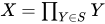
Then, when all sets in are topological spaces, the product topology is generated by cylinder sets corresponding to the components' open sets. That is cylinders of the form where for each , is open in . In the same manner, in case of measurable spaces, the cylinder σ-algebra is the one which is generated by cylinder sets corresponding to the components' measurable sets.
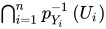
The restriction that the cylinder set be the intersection of a finite number of open cylinders is important; allowing infinite intersections generally results in a finer topology. In the latter case, the resulting topology is the box topology; cylinder sets are never Hilbert cubes.

Cylinder sets in products of discrete sets

[edit]

Let be a finite set, containing n objects or letters. The collection of all bi-infinite strings in these letters is denoted by


The natural topology on is the discrete topology. Basic open sets in the discrete topology consist of individual letters; thus, the open cylinders of the product topology on are

The intersections of a finite number of open cylinders are the cylinder sets

Cylinder sets are clopen sets. As elements of the topology, cylinder sets are by definition open sets. The complement of an open set is a closed set, but the complement of a cylinder set is a union of cylinders, and so cylinder sets are also closed, and are thus clopen.

Definition for vector spaces

[edit]

Given a finite or infinite-dimensional vector space over a field K (such as the real or complex numbers), the cylinder sets may be defined as where is a Borel set in , and each is a linear functional on ; that is, , the algebraic dual space to . When dealing with topological vector spaces, the definition is made instead for elements , the continuous dual space. That is, the functionals are taken to be continuous linear functionals.

Applications

[edit]

Cylinder sets are often used to define a topology on sets that are subsets of and occur frequently in the study of symbolic dynamics; see, for example, subshift of finite type. Cylinder sets are often used to define a measure, using the Kolmogorov extension theorem; for example, the measure of a cylinder set of length m might be given by 1/m or by 1/2m.

Cylinder sets may be used to define a metric on the space: for example, one says that two strings are ε-close if a fraction 1−ε of the letters in the strings match.

Since strings in can be considered to be p-adic numbers, some of the theory of p-adic numbers can be applied to cylinder sets, and in particular, the definition of p-adic measures and p-adic metrics apply to cylinder sets. These types of measure spaces appear in the theory of dynamical systems and are called nonsingular odometers. A generalization of these systems is the Markov odometer.

Cylinder sets over topological vector spaces are the core ingredient in the[citation needed] definition of abstract Wiener spaces, which provide the formal definition of the Feynman path integral or functional integral of quantum field theory, and the partition function of statistical mechanics.

See also

[edit]

References

[edit]
Revisions and contributorsEdit on WikipediaRead on Wikipedia
from Grokipedia
In mathematics, a cylinder set is a subset of a product space X=αAXαX = \prod_{\alpha \in A} X_\alpha, where AA is an index set, defined as the set of all points that lie in a specified subset UU of the finite-dimensional product αSXα\prod_{\alpha \in S} X_\alpha for some finite subset SAS \subset A, extended by the full spaces XαX_\alpha for all αS\alpha \notin S; formally, it takes the form U×αSXαU \times \prod_{\alpha \notin S} X_\alpha.[1] These sets are essential in both topology and measure theory, serving as a basis for the product topology on infinite products, where open sets are unions of cylinder sets with open UU, ensuring that projection maps to finite coordinates are continuous.[2] In measure theory, cylinder sets generate the product σ\sigma-algebra αAFα\bigotimes_{\alpha \in A} \mathcal{F}_\alpha, the smallest σ\sigma-algebra making all coordinate projections measurable, which is crucial for constructing product measures on infinite-dimensional spaces via Kolmogorov's extension theorem.[1] For example, in RN\mathbb{R}^\mathbb{N}, a one-dimensional cylinder set might be R×[1,2)×R×\mathbb{R} \times [-1, 2) \times \mathbb{R} \times \cdots, restricting the second coordinate while allowing others to vary freely.[1] Cylinder sets also play a key role in probability theory for defining measures on spaces of sequences or functions, such as Gaussian measures on Hilbert spaces, by specifying finite-dimensional marginals.[1]

Introduction and History

Historical Development

The name "cylinder set" derives from the geometric analogy to cylinders in finite-dimensional spaces, which are unbounded in certain directions while constrained in others. This intuition was adapted in early 20th-century measure theory as mathematicians sought to extend measures from finite to infinite products. The modern mathematical formalization of cylinder sets occurred in Andrey Kolmogorov's 1933 book Foundations of the Theory of Probability, where they were introduced to construct the product σ-algebra on infinite-dimensional spaces, ensuring consistency for probability measures defined via finite-dimensional distributions. Kolmogorov defined cylinder sets as subsets of the space $ R^M $ (with $ M $ an infinite index set) depending on finitely many coordinates, forming a field that generates the Borel σ-algebra for infinite sequences of random variables, thus enabling the rigorous treatment of stochastic processes. In the post-1930s era, the concept extended to topological vector spaces through Laurent Schwartz's work. His theory of distributions from 1945–1950 provided a framework for generalized functions in infinite dimensions, and later work, including his 1973 book Radon Measures on Arbitrary Topological Spaces and Cylindrical Measures, incorporated cylinder sets to underpin cylindrical measures—finitely additive set functions on algebras generated by finite-dimensional projections—crucial for defining Radon measures in infinite dimensions.[3] By the 1950s, cylinder sets achieved broader formalization in abstract measure theory, as seen in Paul Halmos's Measure Theory (1950), which detailed their role in product measures and σ-algebras for infinite spaces, emphasizing countable additivity extensions. Similarly, Lynn H. Loomis's An Introduction to Abstract Harmonic Analysis (1953) incorporated cylinder sets in the analysis of infinite product groups and measures, solidifying their place in harmonic and topological contexts.[4] These milestones marked the transition from probabilistic origins to a versatile tool in functional analysis.

Motivations and Basic Intuition

Cylinder sets provide a fundamental tool for analyzing infinite-dimensional spaces, such as infinite products of measurable sets, by focusing on dependencies among only finitely many coordinates at a time. This approach circumvents the challenges posed by uncountable products, where direct definitions of topologies or measures become intractable due to the vast cardinality involved. By "slicing" the space into subsets determined by finite projections, cylinder sets enable the extension of finite-dimensional structures—like measures or open sets—to the full infinite-dimensional setting, ensuring consistency across dimensions. Geometrically, the intuition for cylinder sets draws from familiar shapes in lower dimensions. In R2\mathbb{R}^2, considered as R×R\mathbb{R} \times \mathbb{R}, a basic cylinder set resembles a vertical strip, such as an open interval (a,b)(a, b) on the x-axis extended across the entire y-axis, forming (a,b)×R(a, b) \times \mathbb{R}. This "cylinder" is unbounded in one direction while constrained in the other, generalizing in higher dimensions to sets that are restricted in finitely many coordinates and unrestricted (i.e., the full space) in all others. Such constructions form the basis for the product topology, allowing intuitive visualization of open sets as finite "tubes" embedded in an otherwise free infinite expanse. A concrete example illustrates their utility in probability: consider the space {0,1}^\infty, modeling an infinite sequence of independent Bernoulli(1/2) random variables, akin to infinite coin flips with fair probability 1/21/2 for heads (1) or tails (0). A cylinder set here specifies outcomes for the first kk flips—say, the set of sequences starting with 1, 0, 1—while leaving the remaining infinite flips arbitrary; its probability is simply (1/2)k=1/8(1/2)^k = 1/8 for k=3k=3, reflecting the independence of the coordinates. This finite specification captures events of practical interest without needing to address the entire infinite tail, making cylinder sets indispensable for defining product measures on sequence spaces.[5] These concepts build essential intuition for subsequent developments, highlighting why finite intersections of projections naturally generate the relevant structures for topologies and measures in product spaces. As pioneered by Kolmogorov in his extension theorem, cylinder sets ensure that measures defined on finite-dimensional marginals can be consistently lifted to the infinite case, providing a prerequisite foundation for rigorous constructions.[6]

Definitions

General Definition in Product Spaces

In a product space $ X = \prod_{i \in I} X_i $, where $ I $ is an arbitrary index set (possibly infinite) and each $ X_i $ is a nonempty set, a cylinder set is a subset of the form
C=j=1nπij1(Aj), C = \bigcap_{j=1}^n \pi_{i_j}^{-1}(A_j),
where $ n \in \mathbb{N} $ is finite, $ i_1, \dots, i_n $ are distinct elements of $ I $, each $ \pi_{i_j}: X \to X_{i_j} $ is the canonical projection map, and each $ A_j \subseteq X_{i_j} $. When each factor space $ X_i $ is endowed with a topology $ \mathcal{T}i $, the collection of all cylinder sets for which each $ A_j $ is open in $ X{i_j} $ (with respect to $ \mathcal{T}_{i_j} $) forms a basis for the product topology on $ X $, also known as the Tychonoff topology. This basis ensures that all projection maps $ \pi_i $ are continuous and that the product topology is the coarsest topology making this property hold.[7] If instead each $ X_i $ carries a $ \sigma $-algebra $ \mathcal{M}i $, then the collection of cylinder sets where each $ A_j \in \mathcal{M}{i_j} $ generates the product $ \sigma $-algebra on $ X $, denoted $ \bigotimes_{i \in I} \mathcal{M}_i $ and also referred to as the cylinder $ \sigma $-algebra. This $ \sigma $-algebra is the smallest one containing all sets of the form $ \pi_i^{-1}(B) $ for $ B \in \mathcal{M}_i $ and $ i \in I $, with finite intersections thereof also belonging to the generating family. The product topology differs from the box topology on $ X $, whose basis consists of arbitrary products $ \prod_{i \in I} U_i $ with each $ U_i $ open in $ X_i $; these basis elements correspond to (possibly infinite) intersections of cylinder sets, whereas standard cylinder sets require only finite intersections.[7] For infinite index sets $ I $, the box topology is strictly finer than the product topology, as the latter does not include all such infinite products as open sets.[7]

Cylinder Sets in Products of Discrete Sets

In the context of symbolic dynamics, cylinder sets arise naturally in the product space $ X = S^{\mathbb{Z}} $, where $ S $ is a finite discrete set serving as the alphabet, and elements of $ X $ are bi-infinite sequences $ x = (x_i)_{i \in \mathbb{Z}} $ with each $ x_i \in S $. This space is equipped with the product topology, making it a compact metric space suitable for modeling discrete dynamical systems. The basic cylinder sets in this setting are defined as $ C_t(a) = { x \in X : x_t = a } $ for some integer time index $ t \in \mathbb{Z} $ and symbol $ a \in S $; these sets consist of all sequences that fix the coordinate at position $ t $ to the value $ a $.[8] More generally, finite cylinder sets are finite intersections of basic cylinders, denoted $ C_{t_1, \dots, t_n}(a_1, \dots, a_n) = { x \in X : x_{t_j} = a_j \ \forall j = 1, \dots, n } $, where $ t_1 < \cdots < t_n $ are distinct integers and $ a_j \in S $. These specify finite patterns or blocks of symbols at specified positions in the bi-infinite sequences, capturing local constraints on the global structure of elements in $ X $.[9] In the product topology, these finite cylinders are clopen sets—both open and closed—because they are finite intersections of basic open sets and their complements are unions of similar cylinders.[10] Moreover, the collection of all finite cylinder sets forms a basis for the topology on $ X $, meaning every open set can be expressed as a union of such cylinders, and they generate the Borel σ-algebra on $ X $, which is crucial for measure-theoretic constructions in this discrete framework.[8] A key application of cylinder sets occurs in the study of shift spaces, particularly subshifts of finite type (SFTs), which are closed shift-invariant subsets of $ X $ defined by prohibiting certain finite patterns. In an SFT, forbidden blocks correspond to empty cylinder sets; for instance, if the transition matrix $ A $ for symbols in $ S = {1, \dots, k} $ has zeros indicating disallowed consecutive symbols, then cylinders like $ C_{t,t+1}(i,j) $ are empty whenever $ A_{i,j} = 0 $, ensuring no sequence contains the forbidden block $ ij $.[10] This structure allows SFTs to be represented as path spaces on directed graphs, where edges correspond to allowed symbols and cylinders delineate admissible itineraries. For example, the even shift SFT over $ S = {0,1} $, defined by forbidding the block "11", excludes all cylinders $ C_{t,t+1}(1,1) $, resulting in sequences with no two consecutive 1s.[9]

Definition for Vector Spaces

In the context of vector spaces, cylinder sets are defined using the dual space to capture finite-dimensional projections of infinite-dimensional structures. For a vector space $ V $ over a field $ K $ (typically $ \mathbb{R} $ or $ \mathbb{C} $), the algebraic dual $ V^* $ consists of all linear functionals $ f: V \to K $. A cylinder set is then specified by a finite collection of such functionals $ f_1, \dots, f_n \in V^* $ and a Borel subset $ A \subseteq K^n $, given by
CA(f1,,fn)={xV:(f1(x),,fn(x))A}. C_A(f_1, \dots, f_n) = \{ x \in V : (f_1(x), \dots, f_n(x)) \in A \}.
This construction generalizes the notion of cylinders from product spaces to linear settings, where the map $ x \mapsto (f_1(x), \dots, f_n(x)) $ is a linear surjection onto $ K^n $.[11] In topological vector spaces, particularly locally convex ones, the definition is refined to ensure compatibility with the topology by restricting to the continuous dual $ V' \subseteq V^* $, comprising continuous linear functionals. Thus, topological cylinder sets are of the form $ C_A(\ell_1, \dots, \ell_n) = { x \in V : (\ell_1(x), \dots, \ell_n(x)) \in A } $ with $ \ell_j \in V' $ and $ A $ Borel in $ K^n $. These sets arise as preimages under finite-dimensional continuous linear maps $ L: V \to K^n $, $ L(x) = (\ell_1(x), \dots, \ell_n(x)) $, and form a basis for the weak topology $ \sigma(V, V') $, where neighborhoods are defined by finite constraints on continuous functionals. In spaces like the Schwartz space $ \mathcal{S}(\mathbb{R}^d) $ of rapidly decreasing functions, its dual $ \mathcal{S}'(\mathbb{R}^d) $ of tempered distributions uses cylinder sets based on pairings $ \langle u, \phi_j \rangle $ for test functions $ \phi_j \in \mathcal{S}(\mathbb{R}^d) $, enabling measure-theoretic constructions on infinite-dimensional spaces.[12][13] Algebraic cylinder sets, using arbitrary elements of $ V^* $, differ from topological ones by not necessarily respecting the topology, leading to coarser structures; the latter are crucial for defining weak and weak* topologies on dual pairs $ (V, V') $. For instance, in the separable Hilbert space $ \ell^2 $ of square-summable sequences over $ \mathbb{R} $, the standard orthonormal basis $ {e_k} $ induces continuous coordinate functionals $ \pi_k(x) = \langle x, e_k \rangle = x_k \in V' $, so cylinder sets include $ C_A(\pi_1, \dots, \pi_n) = { x \in \ell^2 : (x_1, \dots, x_n) \in A } $, which generate the product topology restricted to $ \ell^2 $. This framework underpins analyses in functional analysis, such as Gaussian measures on Banach spaces.[11][14]

Properties

Topological Properties

Cylinder sets play a fundamental role in defining the product topology on the Cartesian product of topological spaces. Specifically, for a product space $ \prod_{i \in I} X_i $, the collection of all sets of the form $ \pi_i^{-1}(U_i) = U_i \times \prod_{j \neq i} X_j $, where $ U_i $ is open in $ X_i $ and $ i \in I $, forms a subbasis for the product topology.[15][16] The finite intersections of these subbasic sets, known as cylinder sets with finitely many specified coordinates, constitute a basis for the topology, ensuring that every open set in the product space can be expressed as an arbitrary union of such cylinder sets.[17][15] This structure guarantees that the product topology is the coarsest topology making all projection maps $ \pi_i: \prod_{i \in I} X_i \to X_i $ continuous.[16] In general, cylinder sets are open in the product topology whenever the sets specifying the coordinates are open in their respective factor spaces.[17] For products of discrete spaces, cylinder sets are clopen, as the discrete topology renders singletons both open and closed, and their preimages under projections inherit this property.[18] More broadly, the product topology induced by cylinder sets is the initial topology with respect to the family of projection maps, meaning it is the coarsest topology such that all projections remain continuous.[15] This contrasts with the box topology, which is generated by all possible products of open sets from the factors (allowing infinitely many non-trivial specifications) and is strictly finer than the product topology for infinite index sets.[15] Cylinder sets are instrumental in establishing compactness properties of product spaces. In the context of Tychonoff's theorem, the compactness of the product $ \prod_{i \in I} X_i $ when each $ X_i $ is compact follows from the fact that the basic open cylinder sets satisfy the finite intersection property, allowing the transfer of compactness from finite subproducts to the entire space via the tube lemma or Alexander's subbase theorem.[16][17] This ensures that every open cover of the product has a finite subcover, leveraging the cylinder structure to cover the infinite-dimensional space effectively.[15]

Measure-Theoretic Properties

In measure theory, cylinder sets play a fundamental role in constructing product measures on infinite product spaces. The collection of all cylinder sets, defined as sets of the form iIAi\prod_{i \in I} A_i where II is a finite subset of the index set and each AiA_i is measurable in the factor space, generates the product σ\sigma-algebra when the factors are equipped with σ\sigma-algebras.[19] Specifically, the σ\sigma-algebra generated by these cylinder sets coincides with the product σ\sigma-algebra, which is the smallest σ\sigma-algebra containing all such cylinders.[20] Moreover, the family of cylinder sets forms a π\pi-system, as it is closed under finite intersections: the intersection of two cylinders depends only on the union of their finite coordinate sets, resulting in another cylinder.[21] This π\pi-system property, combined with the monotone class theorem or Dynkin's π\pi-λ\lambda theorem, facilitates uniqueness results for measures defined on the product σ\sigma-algebra.[22] Cylinder sets also possess a semi-ring structure, which is essential for measure construction via extension theorems. A semi-ring is a collection closed under finite intersections such that the difference of two sets can be expressed as a finite disjoint union of sets in the collection; for cylinder sets, this holds because the complement relative to a larger cylinder decomposes into disjoint sub-cylinders.[23] This semi-ring property allows the application of Carathéodory's extension theorem to extend a finitely additive set function defined on cylinders—such as a pre-measure assigning volumes based on factor measures—to a unique σ\sigma-additive measure on the generated σ\sigma-algebra, provided the pre-measure is σ\sigma-finite and continuous from below.[24] In product spaces, this extension ensures the construction of product measures like the infinite tensor product of probability measures on discrete factors.[25] For the Kolmogorov extension theorem, consistency conditions on finite-dimensional distributions guarantee the existence of a process measure on the product space. These distributions are specified on cylinder sets corresponding to finite coordinate projections, and finite additivity on disjoint cylinders—arising from the disjointness in the finite product spaces—ensures that the set function on the algebra of finite cylinder unions is well-defined and extends to the full σ\sigma-algebra.[6] The theorem requires that the finite-dimensional measures be consistent, meaning the marginals on subsets of coordinates match, which preserves finite additivity across overlapping cylinders without altering the measure values.[26] Under group actions such as the shift map on product spaces like sequence spaces, cylinder sets exhibit invariance properties with respect to certain measures. The shift transformation maps a cylinder defined by coordinates in positions j+1j+1 to j+nj+n to another cylinder in positions jj to j+n1j+n-1, preserving the class of cylinders.[27] For invariant measures, such as stationary Markov or Bernoulli measures on symbolic dynamics, the measure of a cylinder is independent of its starting position, ensuring that the shift leaves cylinder measures unchanged.[27] In broader ergodic settings, quasi-invariant measures maintain that a cylinder has positive measure if and only if its image under the shift does, allowing for Radon-Nikodym derivatives to relate the measures, though the absolute continuity may vary.[28]

Applications

In Probability and Measure Theory

Cylinder sets play a fundamental role in probability and measure theory, particularly in the construction of measures on infinite product spaces. They form the basis for defining consistent families of finite-dimensional distributions that can be extended to full probability measures on the entire space. This is exemplified by the Kolmogorov extension theorem, which relies on the algebra generated by cylinder sets to ensure the existence of such measures. The Kolmogorov extension theorem states that if a sequence of probability spaces (Ωn,Fn,Pn)(\Omega_n, \mathcal{F}_n, P_n) for n=1,2,n = 1, 2, \dots satisfies consistency conditions—specifically, marginal distributions match appropriately—then there exists a probability measure PP on the infinite product space n=1Ωn\prod_{n=1}^\infty \Omega_n such that the finite-dimensional projections agree with the given PnP_n. More precisely, for spaces (E,E)(E, \mathcal{E}), a consistent family of finite-dimensional distributions μt1,,tn\mu_{t_1, \dots, t_n} on EnE^n for times 0t1<<tn<0 \leq t_1 < \dots < t_n < \infty extends to a probability measure on the space of functions from [0,)[0, \infty) to EE equipped with the σ\sigma-algebra generated by cylinder sets, where a cylinder set is of the form {ωΩ:(ω(t1),,ω(tn))B}\{ \omega \in \Omega : (\omega(t_1), \dots, \omega(t_n)) \in B \} for BEnB \in \mathcal{E}^{\otimes n}. The proof outline proceeds by first defining a finitely additive set function on the algebra of cylinder sets via the finite-dimensional distributions, which satisfies the consistency conditions. Carathéodory's extension theorem then applies, provided the set function is countably additive and continuous at the empty set; this is verified by showing that the measure of decreasing sequences of cylinder sets converging to the empty set approaches zero, leveraging the tightness or regularity of the finite-dimensional measures. The resulting measure on the σ\sigma-algebra generated by cylinders defines the full probability space. Cylinder set measures serve as prototypes for infinite-dimensional measures, where the measure is specified on cylinder sets depending on finitely many coordinates and extended uniquely. A prominent example is Gaussian cylinder measures on Banach spaces, defined by specifying centered Gaussian distributions to finite-dimensional projections onto subspaces spanned by finitely many basis elements, with the covariance given by the restriction of the covariance operator KK, ensuring consistency across dimensions. For instance, on a separable Banach space BB, for a cylinder C=π1(B)C = \pi^{-1}(B) where π:BV\pi: B \to V is the projection onto a finite-dimensional subspace VV and BVB \subset V is Borel, μ(C)\mu(C) is the Gaussian measure of BB on VV with covariance KVK|_V; the measure extends to the full σ\sigma-algebra if the covariance KK is nuclear.[29] Specific examples illustrate these constructions. The Bernoulli measure on the space {0,1}N\{0,1\}^\mathbb{N}, equipped with the product σ\sigma-algebra generated by cylinders, assigns probability (1/2)n(1/2)^n to any cylinder set specified by the first nn coordinates, corresponding to the infinite product of fair coin toss measures; this extends via Kolmogorov to the full space and models sequences of independent Bernoulli trials. Similarly, p-adic measures on the p-adic integers Zp\mathbb{Z}_p use cylinder sets defined by congruence classes modulo pnp^n, with the Haar measure assigning pnp^{-n} to such cylinders of level nn, providing a canonical probability measure on this totally disconnected space. In abstract Wiener spaces, cylinder sets define measures on a reproducing kernel Hilbert space HH embedded continuously into a Banach space BB, where the Gaussian measure on BB is specified via finite-dimensional Gaussians on cylinders in HH, ensuring the measure is supported on BB despite HH being dense but meager. This framework, introduced by Gross, allows rigorous treatment of Wiener measure on infinite-dimensional spaces without requiring separability in the Cameron-Martin sense directly on BB.

In Dynamical Systems and Analysis

In symbolic dynamics, cylinder sets serve as the fundamental building blocks for the topology on shift spaces, particularly subshifts of finite type, where they form a basis of clopen sets in the product topology on the space of infinite sequences over a finite alphabet. These sets enable the construction of invariant measures and the computation of topological entropy, with the measure of maximal entropy—known as the Parry measure—for irreducible subshifts of finite type being uniquely determined by its values on the cylinder sets corresponding to the edges of the transition graph. For instance, in a full shift on two symbols, the Parry measure assigns equal probability to each basic cylinder of length n, yielding the Bernoulli measure with maximal entropy log 2. This framework underpins the study of mixing properties and symbolic representations of smooth dynamical systems, where cylinder sets approximate local behavior under the shift map. Cylinder sets also induce natural metrics on sequence spaces, turning the space of bi-infinite sequences into a compact metric space suitable for analyzing dynamical properties. A standard cylinder metric is defined by d(x, y) = 2^{-k}, where k is the smallest index such that the k-th coordinates of x and y differ, making each cylinder set a metric ball of radius 2^{-n} around its central sequence. This metric ensures that the shift map is continuous and expansive, facilitating proofs of uniqueness for measures of maximal entropy and the specification property in symbolic dynamics. Such metrics are essential for embedding theorems, like the one by Krieger, which classify subshifts up to conjugacy via their entropy and periodic points counted within cylinder neighborhoods. In analytical contexts, cylinder sets approximate functional integrals in Feynman path integrals for quantum mechanics, where the path space is equipped with a cylindrical σ-algebra generated by finite-dimensional projections, allowing the definition of Wiener measures on cylinder sets that extend to the full space under suitable regularity conditions. This cylindrical approximation enables rigorous treatment of the imaginary-time path integral, as in the case of the harmonic oscillator, where the measure on cylinders corresponds to Gaussian distributions on finite time slices. Similarly, in statistical mechanics, cylinder expansions compute partition functions for lattice models like the cyclic solid-on-solid (CSOS) model on cylindrical geometries, where fixed-boundary cylinder partition functions are evaluated via transfer matrix methods to determine critical exponents and phase transitions. Beyond these, cylinder sets feature in nonsingular odometers and Markov odometers, where partitions into cylinder sets generate the σ-algebra for non-singular transformations, enabling orbit equivalence classifications of ergodic systems via Bratteli-Vershik diagrams. In quantum field theory, cylindrical σ-algebras and associated measures on configuration spaces support renormalization procedures, as seen in bosonic QFTs where cylindrical Wigner measures capture semiclassical limits and local properties of field configurations, ensuring consistency across scales in interacting theories.

References

User Avatar
No comments yet.

