Hubbry Logo
Finger-countingFinger-countingMain
Open search
Finger-counting
Community hub
Finger-counting
logo
8 pages, 0 posts
0 subscribers
Be the first to start a discussion here.
Finger-counting
Finger-counting
from Wikipedia
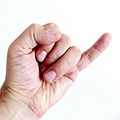
Woman counts to ten in English, using her fingers.

Finger-counting, also known as dactylonomy, is the act of counting using one's fingers. There are multiple different systems used across time and between cultures, though many of these have seen a decline in use because of the spread of Arabic numerals.

Finger-counting can serve as a form of manual communication, particularly in marketplace trading – including hand signaling during open outcry in floor trading – and also in hand games, such as morra.

Finger-counting is known to go back to ancient Egypt at least, and probably even further back.[Note 1]

Historical counting

[edit]
Finger positions used for counting up to 9999 from Luca Pacioli's 1494 Summa de arithmetica, based on the earlier Arabic system.

Complex systems of dactylonomy were used in the ancient world.[1] The Greco-Roman author Plutarch, in his Lives, mentions finger counting as being used in Persia in the first centuries CE, so the practice may have originated in Iran. It was later used widely in medieval Islamic lands. The earliest reference to this method of using the hands to refer to the natural numbers may have been in some Prophetic traditions going back to the early days of Islam during the early 600s. In one tradition as reported by Yusayra, Muhammad enjoined upon his female companions to express praise to God and to count using their fingers (=واعقدن بالأنامل )( سنن الترمذي).

In Arabic, dactylonomy is known as "Number reckoning by finger folding" (=حساب العقود ). The practice was well known in the Arabic-speaking world and was quite commonly used as evidenced by the numerous references to it in Classical Arabic literature. Poets could allude to a miser by saying that his hand made "ninety-three", i.e. a closed fist, the sign of avarice. When an old man was asked how old he was he could answer by showing a closed fist, meaning 93. The gesture for 50 was used by some poets (for example Ibn Al-Moutaz) to describe the beak of the goshawk.

Some of the gestures used to refer to numbers were even known in Arabic by special technical terms such as Kas' (=القصع ) for the gesture signifying 29, Dabth (=الـضَـبْـث ) for 63 and Daff (= الـضَـفّ) for 99 (فقه اللغة). The polymath Al-Jahiz advised schoolmasters in his book Al-Bayan (البيان والتبيين) to teach finger counting which he placed among the five methods of human expression. Similarly, Al-Suli, in his Handbook for Secretaries, wrote that scribes preferred dactylonomy to any other system because it required neither materials nor an instrument, apart from a limb. Furthermore, it ensured secrecy and was thus in keeping with the dignity of the scribe's profession.

Books dealing with dactylonomy, such as a treatise by the mathematician Abu'l-Wafa al-Buzajani, gave rules for performing complex operations, including the approximate determination of square roots. Several pedagogical poems dealt exclusively with finger counting, some of which were translated into European languages, including a short poem by Shamsuddeen Al-Mawsili (translated into French by Aristide Marre) and one by Abul-Hasan Al-Maghribi (translated into German by Julius Ruska[2]).

A very similar form is presented by the English monk and historian Bede in the first chapter of his De temporum ratione, (725), entitled "Tractatus de computo, vel loquela per gestum digitorum",[3][1] which allowed counting up to 9,999 on two hands, though it was apparently little-used for numbers of 100 or more. This system remained in use through the European Middle Ages, being presented in slightly modified form by Luca Pacioli in his seminal Summa de arithmetica (1494).

By country or region

[edit]

Finger-counting varies between cultures and over time, and is studied by ethnomathematics. Cultural differences in counting are sometimes used as a shibboleth, particularly to distinguish nationalities in war time. These form a plot point in the film Inglourious Basterds, by Quentin Tarantino, and in the book Pi in the Sky, by John D. Barrow.[4][3]

Asia

[edit]

Finger-counting systems in use in many regions of Asia allow for counting to 12 by using a single hand. The thumb acts as a pointer touching the three finger bones of each finger in turn, starting with the outermost bone of the little finger. One hand is used to count numbers up to 12. The other hand is used to display the number of completed base-12s. This continues until twelve dozen is reached, therefore 144 is counted.[5][6]

Chinese number gestures count up to 10 but can exhibit some regional differences.

In Japan, counting for oneself begins with the palm of one hand open. Like in East Slavic countries, the thumb represents number 1; the little finger is number 5. Digits are folded inwards while counting, starting with the thumb.[7] A closed palm indicates number 5. By reversing the action, number 6 is indicated by extending the little finger.[8] A return to an open palm signals the number 10. However to indicate numerals to others, the hand is used in the same manner as an English speaker. The index finger becomes number 1; the thumb now represents number 5. For numbers above five, the appropriate number of fingers from the other hand are placed against the palm. For example, number 7 is represented by the index and middle finger pressed against the palm of the open hand.[9] Number 10 is displayed by presenting both hands open with outward palms.

In Korea, Chisanbop allows for signing any number between 0 and 99.

Western world

[edit]

In the Western world a finger is raised for each unit. While there are extensive differences between and even within countries, there are, generally speaking, two systems. The main difference between the two systems is that the "German" or "French" system starts counting with the thumb, while the "American" system starts counting with the index finger.[10]

In the system used for example in Germany and France, the thumb represents 1, the thumb plus the index finger represents 2, and so on, until the thumb plus the index, middle, ring, and little fingers represents 5. This continues on to the other hand, where the entire one hand plus the thumb of the other hand means 6, and so on.

In the system used in the Americas, the index finger represents 1; the index and middle fingers represents 2; the index, middle and ring fingers represents 3; the index, middle, ring, and little fingers represents 4; and the four fingers plus the thumb represents 5. This continues on to the other hand, where the entire one hand plus the index finger of the other hand means 6, and so on.

In the United Kingdom, counting starting with the thumb and counting starting with the index finger are both equally acceptable.

Non-decimal finger counting

[edit]

In finger binary (base 2), each finger represents a different bit, for example thumb for 1, index for 2, middle for 4, ring for 8, and pinky for 16. This allows counting from zero to 31 using the fingers of one hand, or 1023 using both.

In senary finger counting (base 6), one hand represents the units (0 to 5) and the other hand represents multiples of 6. It counts up to 55senary (35decimal). Two related representations can be expressed: wholes and sixths (counts up to 5.5 by sixths), sixths and thirty-sixths (counts up to 0.55 by thirty-sixths). For example, "12" (left 1 right 2) can represent eight (12 senary), four-thirds (1.2 senary) or two-ninths (0.12 senary).

Other body-based counting systems

[edit]

Undoubtedly the decimal (base-10) counting system came to prominence due to the widespread use of finger counting[citation needed], but many other counting systems have been used throughout the world. Likewise, base-20 counting systems, such as used by the Pre-Columbian Mayan, are likely due to counting on fingers and toes. This is suggested in the languages of Central Brazilian tribes, where the word for twenty often incorporates the word for "feet".[13] Other languages using a base-20 system often refer to twenty in terms of "men", that is, 1 "man" = 20 "fingers and toes". For instance, the Dene-Dinje tribe of North America refer to 5 as "my hand dies", 10 as "my hands have died", 15 as "my hands are dead and one foot is dead", and 20 as "a man dies".[14]

Even the French language today shows remnants of a Gaulish base-20 system in the names of the numbers from 60 through 99. For example, sixty-five is soixante-cinq (literally, "sixty [and] five"), while seventy-five is soixante-quinze (literally, "sixty [and] fifteen").

The Yuki language in California and the Pamean languages[15] in Mexico have octal (base-8) systems because the speakers count using the spaces between their fingers rather than the fingers themselves.[16] More specifically, the Yuki were described as counting using sticks placed between the fingers.[17]

Counting to 27 with the body-part tally used by the Sibil Valley people of Western New Guinea[18]

In languages of New Guinea and Australia, such as the Telefol language of Papua New Guinea, body counting is used, to give higher base counting systems, up to base-27. In Muralug Island, the counting system works as follows: Starting with the little finger of the left hand, count each finger, then for six through ten, successively touch and name the left wrist, left elbow, left shoulder, left breast and sternum. Then for eleven through to nineteen count the body parts in reverse order on the right side of the body (with the right little finger signifying nineteen). A variant among the Papuans of New Guinea uses on the left, the fingers, then the wrist, elbow, shoulder, left ear and left eye. Then on the right, the eye, nose, mouth, right ear, shoulder, wrist and finally, the fingers of the right hand, adding up to 22 anusi which means little finger.[19]

See also

[edit]

Notes

[edit]

References

[edit]
[edit]
Revisions and contributorsEdit on WikipediaRead on Wikipedia
from Grokipedia
Finger-counting is the practice of using fingers to represent and manipulate quantities through one-to-one correspondence, where each finger stands for a single unit, enabling individuals to track numbers and perform basic arithmetic without relying on abstract symbols or tools. This method predates written numeral systems and has been employed since prehistoric times for practical tasks such as tallying goods, livestock, or resources, as evidenced by its spontaneous use across early human societies. Aristotle attributed the base-10 numeral system to the human possession of ten fingers, highlighting its foundational influence on numerical cognition. Historically, finger-counting evolved into sophisticated systems in ancient civilizations, serving as a primary calculating aid in administration and trade. In , , Persia, and the , it was standard for representing numbers up to 9,999 using both hands, facilitating , , and even through specific finger positions. The Venerable documented one of the earliest detailed accounts around 725 CE in De temporum ratione, while the medieval mathematician described advanced place-value techniques in his 1202 work , underscoring its role in bridging oral and written mathematics. These systems persisted into the , coexisting with the until the widespread adoption of Indo-Arabic numerals in diminished their prominence. Culturally, finger-counting exhibits significant variation, reflecting local numerical bases and bodily extensions. In and , methods using finger joints allow counting up to 28, while some South African traditions involve multiple people to denote units, tens, and hundreds beyond 100. Indigenous groups in and the incorporate the entire body—fingers, toes, eyes, and joints—to reach quantities up to 41, adapting the practice to communal and environmental contexts. Such diversity influenced numeral systems, with many Native American tribes developing base-5 or base-10 structures derived from finger-based counting. In cognitive and educational development, finger-counting plays a crucial role as a sensorimotor bridge to abstract numerical understanding, particularly in children. It reduces cognitive load during early arithmetic by externalizing counts on the body, fostering number sense and outperforming non-users in problem-solving tasks. Research shows it benefits at-risk learners by improving math attitudes and skills, as seen in studies on methods like Chisanbop, a Korean system from the 1940s that assigns place values to fingers for efficient computation. Even adults continue to use it for visuo-motor support in processing larger numerosities, linking manual action to mathematical cognition across the lifespan.

Introduction

Definition and Basics

Finger-counting, also known as dactylonomy, is the practice of using one's fingers, and sometimes knuckles or the entire hand, to represent and track numerical quantities without relying on external tools or written symbols. This method serves as a fundamental sensorimotor tool for quantification, engaging both motor actions and cognitive processes to encode numbers through physical gestures. The basic of finger-counting involve sequential or positional assignment of numbers to digits, with variations in whether it is performed unimanually (using one hand, typically representing up to 5 or 10 counts) or bimanually (using both hands, extending to 10 or 20 counts). For instance, unimanual counting might raise fingers one by one on a single hand, while bimanual approaches coordinate both hands to double the capacity. Starting fingers can differ, such as beginning with the as 1 in some systems or the in others, and the direction of counting may proceed inward (from to ) or outward (from to ), influencing the flow of . These mechanics allow for intuitive tracking of small quantities in everyday tasks like tallying items. Universally, finger-counting is rooted in human anatomy, particularly the standard possession of 10 digits across two hands, which has profoundly shaped the prevalence of (base-10) number systems worldwide. A simple example is the straightforward method where fingers are raised sequentially on one or both hands to denote 1 through 10, providing a direct visual and tactile representation of numbers. While core principles remain consistent, cultural variations introduce diverse conventions for finger assignment and gesture interpretation.

Cultural and Historical Importance

Finger-counting has played a pivotal role in human society since prehistoric times, serving as a foundational tool for quantification and record-keeping. Archaeological evidence, such as the 42,000-year-old notched baboon fibula from South Africa's Border Cave, suggests early humans used on bones as memory aids for to track quantities of resources or lunar cycles. This method persisted across cultures, evolving from simple notches to more complex systems, as seen in the 20,000-year-old from the Democratic Republic of Congo, which features grouped incisions possibly representing arithmetic operations. Such artifacts highlight finger-counting's endurance as a low-tech, accessible means of mental arithmetic in illiterate or resource-scarce contexts, where villagers in modern studies have been observed using finger joints for doubling and in daily calculations. The practice influenced the development of numerical systems, particularly the (base-12) framework, by leveraging the anatomy of the hand. Ancient Babylonians employed their to count the three phalangeal joints on each of the four fingers, yielding 12, and extended this by using the fingers of to tally multiples up to 60, facilitating , astronomy, and timekeeping that endure in modern divisions of hours and minutes. Historian Georges Ifrah traces this to widespread finger-counting techniques, noting that the preference for base-12 in various Asian and Mesopotamian societies stemmed from such embodied methods, which offered practical advantages for dividing quantities in and rituals like calendrical computations. In societal roles, finger-counting enabled discreet signaling in marketplaces and , as documented in ancient Roman sources where it supported quick transactions and strategic play without verbal disclosure. In contemporary contexts, finger-counting retains relevance as an educational aid and cultural marker, bridging embodied cognition with abstract mathematics. Research demonstrates that training kindergarten children in finger-counting strategies significantly improves arithmetic performance, with non-finger-counters improving from 37% to 77% correct responses post-intervention, underscoring its value in fostering numerical fluency. Psychologically, it embeds numerical representations in sensorimotor experiences, activating finger-related brain areas during mental calculations and facilitating the transition to symbolic math, as evidenced by neuroimaging studies linking finger gnosis to better arithmetical skills. Culturally, habitual finger-counting patterns reveal national origins—such as starting with the thumb in Europe versus the index finger in the US—serving as an unconscious identity signal in multicultural interactions, as explored in cross-cultural analyses.

Historical Development

Ancient Civilizations

In ancient civilizations, finger-counting served as a foundational method for , often integrated with emerging numeral systems and practical applications in , , and astronomy. Archaeological suggests early precursors to structured counting, with notched bones indicating tallying that may derive from finger-based tracking. For instance, the , a dated to approximately 35,000 BCE from Border Cave in , features 29 incised markings interpreted as tallies, potentially mimicking finger counts for lunar cycles or quantities. Similarly, the , discovered near the River's sources in the of Congo and dated to around 20,000 BCE, bears grouped notches (e.g., 11, 13, 17, and 19) that some researchers link to systematic counting, possibly using fingers to group units in a base-10 or pattern, reflecting early mathematical in African Valley contexts. These artifacts predate written records and highlight finger-derived tallying as a widespread practice across and . In , particularly among the Sumerians around 3000 BCE, finger-counting facilitated the (base-60) system, which influenced timekeeping and astronomy. Practitioners used the thumb of one hand to point at the three knuckles (phalangeal joints) on each of the four fingers of the other hand, allowing counts of 1 to 12 per set; the five fingers of the second hand then served as multipliers up to 60, aligning with the influence of finger joints. This method, evident in records of and administration, enabled efficient handling of large quantities in urban economies like those of . Ancient Egyptian practices, from circa 3000 BCE, incorporated finger-counting into a predominantly system, with evidence suggesting a base-12 variant based on joint enumeration. Egyptians counted the three joints on each of four fingers (excluding ), reaching 12 per hand using as a pointer, which supported divisions in calendars and measurements. Hieroglyphs depicted numeral symbols—such as a single stroke for 1, a heel bone for 10, and a coiled for 100—but also included determinatives showing raised hands or fingers to denote actions, as seen in tomb reliefs and papyri like the . These gestures were practical for Nile River trade, where merchants tallied goods like or without writing, and for pyramid construction, where finger-width units aided in scaling massive stones and alignments. Greek and Roman systems advanced finger-signaling for commerce and computation. Ancient writers like described a chirognomic method using both hands to represent numbers up to : the left hand's fingers indicated units (e.g., index for 1, middle for 2, up to closed fist for 10), while the right hand multiplied by 10, 100, or 1,000 through postures like extended fingers or thumb positions; for example, the thumb touching the forearm signified 5, and wrist contact denoted 50. Roman merchants, building on this, used hand postures to signal multiples up to 1,000 in marketplace dealings, facilitating rapid transactions in forums without verbal exchange. On the , Vedic numeral systems from around 1500–500 BCE incorporated (base-5) elements, tied to the five fingers per hand, within a broader framework for astronomical calculations and rituals. This approach, evident in Sulba Sutras for geometric constructions, laid groundwork for later dust-board abacuses by simulating bead shifts with finger pressures, supporting trade in the Indus Valley and Vedic societies.

Medieval and Early Modern Periods

In medieval , finger-counting systems evolved as practical tools for both monastic computus and mercantile trade, building on ancient foundations but adapted to Christian liturgical needs and expanding commerce. Monks in Northumbrian monasteries, such as at , employed finger reckoning to perform calendar calculations and arithmetic silently, as detailed in eighth-century texts like Bede's De computo vel loquela digitorum, which described gestures for numbers up to 10,000 using hand positions to maintain during computations. By the twelfth century, these methods gained prominence in trade contexts, with Italian merchants using finger gestures to negotiate prices and tally goods across language barriers in Mediterranean markets. A key advancement appeared in Leonardo Fibonacci's Liber Abaci (1202), which integrated finger-counting with the emerging Hindu-Arabic numeral system and abacus for commercial arithmetic. In the first chapter, Fibonacci described a sophisticated hand-based mnemonic for memorizing numbers, such as curving the little finger of the left hand for 1 or the little, ring, and middle fingers for 4, extending to higher values like hundreds and thousands on the right hand to support place-value calculations without excessive writing. This system facilitated multiplication and addition in trade scenarios, such as barter exchanges, and reflected the transition from Roman numerals to more efficient tools, prized for its portability among merchants traveling between Italian city-states and North African ports. During the (eighth to thirteenth centuries), finger reckoning flourished as one of three primary calculation systems alongside Hindu numerals and the abjad system, aiding algebraic problem-solving and daily commerce. Persian mathematician (c. 780–850) contributed through his lost Book of Adding and Subtracting, believed to be an early treatise on finger-reckoning techniques for operations up to 10,000, which implied manual aids for verifying algebraic equations in works like . These methods, often using joint positions on fingers to represent digits, were documented in Persian-influenced texts as "finger alphabets" for numerical notation, enabling merchants to compute silently during transactions in bustling bazaars from to . In medieval Asia, finger-counting persisted in various cultural and practical contexts. Chinese systems using finger joints to count up to higher numbers were referenced in mathematical texts, supporting arithmetic in scholarly and settings. Colonial encounters in the documented indigenous finger-counting systems, facilitating initial numerical communication during European explorations. In sixteenth-century , Spanish chroniclers like recorded Aztec and Maya use of hand gestures for counting goods and time, which explorers mimicked to negotiate and estimate populations, as seen in interactions where finger positions signified quantities beyond spoken language. These exchanges also spread binary-like finger methods from European navigators to indigenous groups, aiding celestial calculations for transatlantic voyages. Early modern psychological observations highlighted finger-counting's cognitive role, with (1596–1650) noting in his philosophical works on method and sensation how manual gestures supported abstract thinking, such as using finger positions to model geometric relations or tactile proofs in . This reflected a broader shift toward viewing embodied practices like finger reckoning as foundational to amid the emphasis on empirical observation.

Regional and Cultural Variations

Asian Traditions

In Chinese finger-counting traditions, the system utilizes a single hand to represent numbers 1 through 10, beginning with the index finger extended for 1, index and middle fingers for 2, thumb with index and middle for 3, the other four fingers extended (thumb folded) for 4, and all five fingers for 5. Numbers 6 to 10 are formed symbolically, such as thumb and pinky extended (others folded) for 6, thumb rubbing against the fingers for 7, an L-shape with thumb and index for 8, a hooked index finger for 9, and crossed index fingers or a closed fist for 10. This method facilitates discreet communication and is rooted in longstanding cultural practices for enumeration and gesture-based expression. Japanese finger-counting emphasizes directional and privacy-oriented techniques, with one common approach involving the folding of fingers from an open palm—starting with tucked in for 1, followed by the index for 2, up to the little finger for 5—before reversing the sequence for 6 to 10 to maintain subtlety. For more visible counting, fingers are extended sequentially from a closed , often beginning with the for 1 (to 5 with the thumb last) and incorporating symbolic taps on the palm or knuckles to reach up to 12, a practice suited to social contexts requiring , such as informal transactions. This closed-fist variation, sometimes referred to in traditional contexts as a form of inward-pointing , underscores the cultural preference for non-verbal, inward-directed motions. In Indian and broader South Asian traditions, a one-handed system employs the thumb to successively touch the three phalangeal segments of each of the four fingers, starting from the outer joint of the (1) and spiraling inward across the joints (up to 12), with additional touches to the palm or base for 13 to 20. This positional method, which leverages the anatomical segments for precision, traces back to ancient practices and shares symbolic parallels with Vedic-era mudras, where similar thumb-to-finger contacts represent numerical or energetic concepts in meditative and ritualistic settings for higher or abstract counts. Modern variations in Asian finger-counting include systems among the Kula people of , , who use a base-5 approach starting with the on the left hand and progressing sequentially to the thumb, then to the right hand. In Tibetan Buddhist practices, a one-handed approach uses the thumb to navigate the joints and segments of the fingers (12 segments per hand), integrated into and meditative contexts for counting mantras up to 108 through multiple cycles.

Western and European Practices

In Western and European practices, finger-counting primarily follows a system, utilizing the ten fingers to represent numbers from 1 to 10, often starting with a closed and extending fingers sequentially for and basic arithmetic. This method emphasizes visible, outward gestures, contrasting with more symbolic or hidden approaches in some Asian traditions. Historically rooted in ancient Roman dactylonomy, it evolved into standardized habits by the medieval period, aiding merchants and educators in calculations without written numerals. In Britain and , counting typically begins with as 1, followed by the for 2, middle finger for 3, for 4, and pinky for 5, with the full hand representing 5 and bimanual extension reaching 10. This sequence, common across much of as well, facilitates quick enumeration in everyday interactions. Historical nursery rhymes like "Tommy Thumb," dating to the , embed finger identification and counting by naming digits—Tommy Thumb (), Peter Pointer (index), and so on—reinforcing the habit through play and . Continental European variations, such as in and , align closely with the British model, starting with the thumb for 1 and progressing to the pinky for 5, often using both hands for numbers up to 10 by mirroring the sequence on the opposite hand. During the medieval period, elaborate finger-reckoning systems, like that described by the monk in the , enabled silent calculations up to 10,000 using phalange joints and hand positions, supporting among merchants and guilds who negotiated without alerting competitors. These gestural signals allowed discreet price haggling in markets, where guilds regulated standards. American practices diverge slightly, with the favoring the index finger as 1, followed by the middle finger for 2, ring finger for 3, pinky for 4, and thumb for 5, while often mirrors this but retains some European thumb-start influences due to bilingual and multicultural populations. In the , finger-counting was integrated into curricula across and to teach basic arithmetic, with educators viewing it as a foundational tool for numerical comprehension, though some debated its long-term reliance. Modern persistence is evident in sports and games, where referees in soccer use finger extensions to signal countdowns, such as the six-second rule for goalkeepers, displaying sequentially. Players also employ finger counts to indicate defensive formations or player numbers discreetly. Studies, including a 2021 analysis, demonstrate that these ingrained habits reveal nationality; for instance, observing someone count to three distinguishes thumb-starters from index-starters with high accuracy. In and , right-hand starts predominate (77% and 56% preference, respectively), though minorities (32% in , 17% in ) begin with the pinky, reflecting intra-European diversity.

African and Indigenous American Systems

In various Bantu-speaking communities in , finger-counting employs a symmetric bimanual approach, where both hands are used equivalently to represent numbers from 1 to 10, often starting with the thumbs and progressing outward in a mirrored fashion across the fingers. Historical records from the document base-5 systems in several African groups, including the use of knuckles on one hand to denote units up to 12, with the opposite hand signaling multiples of five, as observed in ethnographic accounts of sub-Saharan pastoralists. In , Berber communities practice a one-handed system from 1 to 12 by tapping the thumb sequentially against the phalanges of the other fingers, starting from the index and moving inward, which allows for compact enumeration in social or market settings. Ancient Egyptian texts like the (c. 1600 BCE) reference finger-counting methods, though direct continuity with modern North African practices is not established. Among Indigenous American groups, the Tsimane' of initiate finger-counting with the pinkie finger and proceed inward toward for numbers 1 through 5, reversing the typical Western sequence from thumb to pinkie and highlighting culturally specific spatial mappings of numerals. This inward progression aligns with broader Amazonian routines observed in 2023 studies, where over 90% of Tsimane' participants favored pinkie-start patterns, underscoring variability in embodied . The ancient Maya numeral system incorporated (base-5) elements within a (base-20) framework, likely derived from finger enumeration on one hand for fives and toes for twenties, influencing positional notations in codices and calendars. South American Indigenous practices, such as those of the in and , utilize bimanual techniques for higher counts, with one finger representing 1 (imi) and a full hand 5 (imik), extending to body parts for numbers beyond 10 in communal contexts like resource sharing. Across these African and Indigenous American systems, common traits include body-integrated extensions beyond fingers—such as or gestures for numbers exceeding 20—and reliance on oral transmission in non-literate societies, where elders verbally guide learners through sequences during rituals or daily tasks, preserving cultural specificity without written aids.

Non-Decimal and Specialized Systems

Binary and Positional Methods

Binary finger counting assigns each finger a value corresponding to a power of 2, enabling the representation of numbers through combinations of raised or lowered digits. Typically, using the right hand, the thumb represents 1 (2^0), the 2 (2^1), the 4 (2^2), the ring finger 8 (2^3), and the pinky 16 (2^4). By raising specific fingers, a user can sum their values to denote any from (all fingers down) to 31 (all fingers up). Extending to both hands, the left hand continues with higher powers—thumb 32 (2^5), 64 (2^6), 128 (2^7), ring finger 256 (2^8), and pinky 512 (2^9)—allowing counts up to (2^10 - 1). This method's mathematical foundation is expressed as: Number=i=0n(vi×si)\text{Number} = \sum_{i=0}^{n} (v_i \times s_i) where viv_i is the value of the ii-th finger (a power of 2), sis_i is the state (1 if raised, 0 if lowered), and nn is the number of fingers used. For example, raising the thumb and yields 1+4=51 + 4 = 5. One key advantage of binary finger counting is its efficiency in representing large numbers without external tools, far exceeding finger systems limited to 10 per hand. This allows quick tallying or in scenarios lacking paper or devices, such as during conversations or fieldwork. Positional variants adapt finger counting to non-decimal bases by leveraging anatomical features like joints. In ancient Sumerian practice, circa 3000 BCE, counters used the 12 phalangeal segments (three per finger across four fingers, excluding the thumb) of one hand, touched by the thumb, to denote units in a (base-12) system. The opposite hand's fingers then served as placeholders for multiples of 12, facilitating counts up to 60 (12 × 5) and influencing the (base-60) system for time and angles. In modern contexts, binary finger counting has gained popularity among programmers and s as a practical skill for binary manipulation and subtle communication. Members of hacker collectives like NYC Resistor have demonstrated it through videos and projects, such as a displaying time via finger positions, highlighting its utility in tech communities for encoding data discreetly.

Sub-Base Systems

Sub-base systems in finger counting utilize fingers as markers for numerical bases such as 5, 10, or 12, often derived from hand anatomy. These systems are common in historical trade practices and mental arithmetic, where the structure of the hand naturally suggests groupings. For instance, base-5 (quinary) arises from counting to five fingers on one hand, while base-10 (decimal) extends to ten fingers across both hands. Base-12 (duodecimal) is linked to the 12 phalangeal joints on one hand (three per finger on four fingers, pointed by the thumb), as seen in ancient Babylonian and Egyptian methods used for commerce and measurement. Psychological studies indicate that these sub-base structures influence early numerical cognition and arithmetic strategies in children, facilitating efficient mental calculations in trade contexts.

Chisanbop and Arithmetic Techniques

, also known as finger calculation or Korean finger math, is a method developed in Korea during the by Sung Jin Pai and later refined by his son Hang Young Pai for educational purposes. In this system, the fingers of each hand are assigned specific values to facilitate arithmetic operations up to 99 without the need for external tools, drawing inspiration from principles. The right hand represents units, with each finger (index through pinky) valued at 1 and at 5, allowing representation of 0 to 9. The left hand handles tens, with each finger valued at 10 and the thumb at 50, enabling totals from 0 to 99 when combined. The technique emphasizes pressing fingers against the palm to "activate" their values, promoting tactile and visual learning for addition, subtraction, and basic multiplication. For addition and subtraction, users start by displaying the first number and then adjust fingers accordingly, carrying over when exceeding 9 on the right hand by resetting it to 0 and adding 1 to the left hand. For example, to compute 23 + 17: represent 23 with two left fingers (20) and three right fingers (3); adding 17 involves pressing seven more on the right (3 + 7 = 10), so reset right to 0 and carry 1 to left (2 + 1 = 3 fingers for 30); however, the tens are 2 + 1 (from 17) + 1 carry = 4 fingers on left for 40, with right at 0. Multiplication is achieved through repeated addition on the hands, such as computing 3 × 4 by adding 4 three times using finger presses. In the , gained prominence in the United States after Hang Young Pai introduced it in 1977, leading to its adoption in schools during the late as a tool to enhance mental arithmetic skills. It was taught in classrooms across New York and other states, with programs emphasizing daily practice sessions of 15–30 minutes to build computational fluency. A 2014 study on at-risk elementary students, including those with math difficulties akin to , found that training significantly improved attitudes toward mathematics ( 1.86) and applied problem-solving skills (p = 0.018) in second graders, though gains in basic computation were less consistent for fifth graders. Beyond , similar arithmetic techniques using fingers as aids appear in other traditions, such as Japanese methods inspired by the . In these approaches, fingers mimic abacus beads: the thumb represents 5 (like the heaven bead), and the other fingers represent 1 each (earth beads), allowing users to perform and by manipulating hand positions to simulate rod movements on the . This finger-based visualization supports mental calculations and transitions to full mental arithmetic (anzan). In Indian , while primarily mental, some instructional variants incorporate finger gestures or taps to reinforce tables and basic operations, though specialized finger methods for squaring are less documented and often integrated into broader speed calculation sutras.

Cognitive and Developmental Perspectives

Role in Child Development

Finger-counting plays a pivotal role in , emerging instinctively as children around ages 2 to 3 begin using their fingers to represent and manipulate small quantities, such as holding up one finger for "one" or coordinating both hands for numbers up to 10. This concrete approach serves as a foundational tool for , allowing toddlers to link physical actions with numerical concepts during play and daily interactions. By ages 6 to 7, most children transition from overt finger-raising to internalized strategies, internalizing finger patterns mentally to support more abstract arithmetic without visible gestures. Cultural patterns in finger-counting are transmitted from caregivers to children, shaping habitual starting points and sequences. For instance, among 10- to 12-year-old children, 59% of those in and 65% of those in initiate counting with the right-hand , reflecting learned conventions rather than innate preferences. Explicit training in finger-counting further enhances mathematical skills; a 2024 study with kindergarteners found that those without prior finger-counting habits showed substantial pre- to post-test improvements in performance after structured instruction, with accuracy gains exceeding 40% in some groups. Educationally, finger-counting fosters key strategies like subitizing—rapid recognition of quantities through familiar finger configurations—and counting-on, where children start from a known number rather than recounting from one, thereby building efficiency in early arithmetic. These benefits are universal across cultures but adapted locally; for example, indigenous groups in the Amazon, such as the Tsimane', exhibit variations in finger-counting that align with their numerical systems, often incorporating elements of base-5 structures. As an practice, finger-counting integrates sensorimotor experiences with numerical understanding, grounding abstract ideas in tangible actions and potentially mitigating math anxiety by lowering cognitive demands and boosting confidence in problem-solving. Studies on children with highlight how such concrete tools counteract anxiety-induced impairments, enabling better engagement with math tasks. This approach not only accelerates skill acquisition but also promotes long-term numerical fluency without reliance on external aids. A 2025 study further demonstrated that using fingers as numerical representations specifically benefits lower-performing kindergarteners in .

Influence on Numerical Cognition

Psychological research has demonstrated that finger-counting habits established in childhood persist into adulthood and influence by activating motor areas of the during number processing. A seminal 2012 neuroimaging study using found that in German adults, who typically begin counting with the thumb of the left hand, the presentation of small numbers (1–5) elicited stronger activation in the right , corresponding to left-hand finger representations, compared to larger numbers. This activation pattern suggests an embodied link between finger motor programs and abstract numerical representations, with the serving as a neural substrate for numerical thinking shaped by habitual finger use. Cultural variations in finger-counting practices further modulate spatial-numerical associations, such as the SNARC (spatial-numerical association of response codes) effect, where smaller numbers are responded to faster on the left side and larger on the right. For instance, a 2008 study revealed that individuals starting finger counting from the left hand (common in some European traditions) exhibit a stronger SNARC effect compared to right-hand starters, indicating that the directionality of finger sequences imprints on adult spatial biases in number processing. Similarly, differences between index-finger starters (prevalent in the U.S.) and thumb starters (common in the U.K.) contribute to distinct associations between numbers and spatial positions. Additionally, a 2018 behavioral experiment showed that incidental finger movements mimicking counting sequences—such as pressing buttons from thumb to pinky—speeded up the naming of corresponding numbers (e.g., faster "three" after the third finger press), highlighting automatic priming of numerical concepts by motor actions in adults. Long-term reliance on finger counting enhances arithmetic fluency in adults, as evidenced by studies linking persistent finger-based strategies to improved in simple calculations. For example, adults with strong finger-counting habits from childhood show faster and more accurate responses in and tasks, suggesting that these habits strengthen neural pathways for numerical operations. This effect is reflected in neural activation patterns, where the intensity of engagement during number tasks is proportional to the density of somatotopic finger representations, with greater activation observed in individuals and cultures emphasizing frequent finger counting. A 2021 review of research further underscores this variability, noting that differences in finger-counting systems across societies lead to distinct patterns in numerosity and , such as varying sensitivities to quantity in non-Western groups with elaborated hand-based counting.

Use of Other Body Parts

In many cultures, counting extends beyond the fingers to include toes, particularly among children as a natural progression in early numerical learning. Young children often use their toes to represent numbers 11 through 20 after exhausting the fingers on both hands, reflecting an intuitive extension of body-based tallying that aids in grasping quantities up to 20. This practice is not limited to children; vigesimal (base-20) systems in various and other indigenous cultures derive from all digits on hands and feet, where toes contribute to the foundational structure of higher numerals. African counting traditions frequently incorporate arms and other body parts for numbers beyond the hands, enhancing gesture-based systems used in daily interactions and trade. Among the of the Lower Niger Valley in , for instance, numbers 11 to 15 involve adding fingers to a base of 10 (both hands clasped), culminating in 15 represented by bending the arm so the hand touches the shoulder; higher values like 20 are indicated by waving a finger in front of the body, 30 by clapping hands and waving a finger, and 100 by waving a closed fist. Similarly, the Ekoi of employ a base-20 system that explicitly counts on toes after fingers, starting with the for 1 and integrating foot digits to reach 20. These methods, documented in ethnographic studies, demonstrate how body parts serve as tactile anchors for numerical representation in sub-Saharan contexts. Full-body sequences appear in indigenous systems of the Pacific region, where tallying progresses systematically across limbs and torso to denote larger quantities. In the Oksapmin language of , a 27-part body tally begins with (1) and proceeds through fingers, hands, arms, chest, , head, and down the opposite side to the (27); this sequence facilitates enumeration without abstract numerals. Australian Aboriginal groups also practice body tallying, extending from fingers to s (e.g., 11 in Yuwaalaraay as "dharrwaay" for elbow), shoulders (12 as "milhaa"), and further parts like noses or eyes for subsequent numbers, though systems vary by language and rarely reach a fixed 27 without . Such practices historically supported communal activities, including tallies in pre-colonial settings, where physical contact with body parts ensured verifiable counts for exchanges. These extended body-part methods, while effective for group verification and cultural transmission, are generally less portable than finger-only systems, as they require more overt movements and space, limiting their use in solitary or discreet counting scenarios.

Gestural and Symbolic Systems

In sign languages, finger-based representations of numbers serve as gestural systems for communication among deaf communities, distinct from spoken numerals. In American Sign Language (ASL), numbers 1 through 10 are formed using specific handshapes: 1 is indicated by extending the index finger upward with the other fingers closed; 2 by extending the index and middle fingers; 3 by extending the thumb, index, and middle fingers; 4 by extending all fingers except the thumb; 5 by an open hand with fingers spread; 6 by touching the pinky to the thumb with the other fingers extended; 7 by touching the ring finger to the thumb with the other fingers extended; 8 by touching the middle finger to the thumb with the other fingers extended; 9 by touching the index finger to the thumb with the other fingers extended; and 10 by a closed fist with the thumb extended upward, shaken from side to side. In Japanese Sign Language (JSL), the gesture for 5 involves forming a fist with the thumb extended upward, though informal Japanese counting gestures often use an open palm facing outward to represent five. Symbolic gestures derived from finger-counting traditions extend beyond literal enumeration to convey emphasis or abstract concepts in cultural communication. The Italian "pinched fingers" gesture, where the tips of all five fingers are brought together and raised, originated as a rhetorical device to express frustration, disbelief, or "what do you mean?" rather than a direct count, though it echoes the precision of finger manipulation in historical counting methods. In Chinese culture, hand movements mimicking an abacus—such as sliding the thumb and fingers across an imaginary bead frame—symbolize rapid mental arithmetic, a practice rooted in traditional soroban training and used gesturally to denote calculation or precision without physical tools. Cultural variations in gestural systems highlight diverse symbolic adaptations of finger pointing for numbers. In Middle Eastern traditions, such as among some groups, the number 3 is often indicated by extending the , and middle fingers, while keeping the and folded down, differing from Western index-middle-ring extensions. Recent studies on indigenous Amazonian groups, like the Tsimane' people of , have examined "montring"—a form of number pointing where fingers are directed toward body parts or objects to represent quantities—revealing both universal patterns in gesture use and culture-specific routines that integrate with for numerical communication. Modern adaptations of these gestural systems incorporate digital and immersive technologies. Emojis such as ☝️ (index pointing up for 1), ✌️ ( or 2), and 🖐️ (raised hand for 5) digitally replicate finger-counting forms, facilitating symbolic expression in text-based communication across global platforms. In environments, hand-tracking systems enable users to perform finger-counting gestures for numerical input, such as raising fingers to select quantities in simulations, enhancing cognitive strategies for number representation through tactile feedback. Historically, monastic communities in medieval developed silent signal systems, including finger-based gestures for numbers during vows of , allowing discreet communication of quantities in communal activities like .

References

Add your contribution
Related Hubs
User Avatar
No comments yet.