Recent from talks
Nothing was collected or created yet.
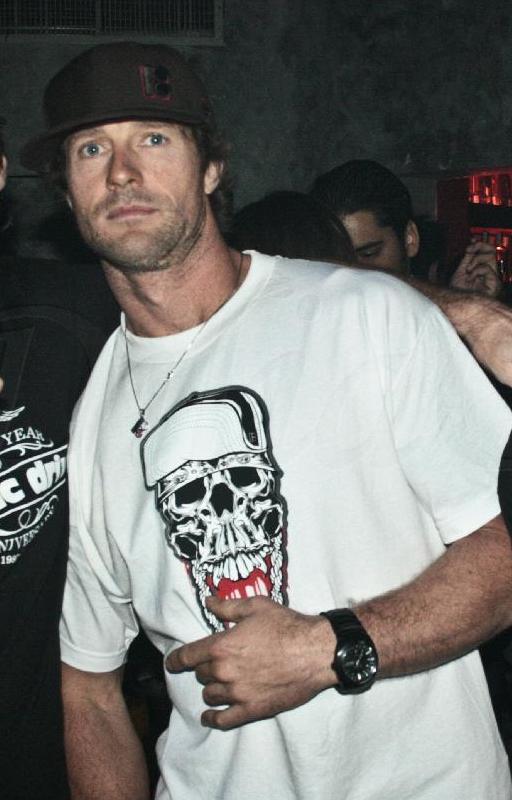
Danny Way
View on Wikipedia
Danny Way (born April 15, 1974)[1] is an American professional skateboarder. He was awarded Thrasher magazine's "Skater of the Year" award twice. He is known for extreme stunts, such as jumping into a skateboard ramp from a helicopter; that was featured on the cover of Transworld Skateboarding magazine.[2] One of his more notable stunts was jumping the Great Wall of China on a skateboard via megaramp.[3]
Key Information
Early life
[edit]Way was born in Portland, Oregon, and grew up in San Diego, California.[1][4][5] His childhood was marred by difficult circumstances.[6] His father, Dennis Way, died before Danny's first birthday – Dennis was jailed for failing to pay child support to his previous wife, and after nine days in jail was found hanged in his cell; his death was ruled a suicide.[6] Following his father's death, his mother Mary dated a number of men who abused Mary, Danny, and his brother Damon.[6] Mary subsequently remarried, to Tim O'Dea, who introduced Danny and Damon to skateboarding and surfing. The couple subsequently divorced and Tim died following a surfing session. Danny lost another adult in his life when his childhood mentor Mike Ternasky was killed by an elderly driver who ran a stop sign.[7]
Professional skateboarding
[edit]Danny Way became the youngest person (15 yrs old) to win a pro vert skateboarding contest at the World Skateboard Association Pro Vert Contest in Lansing, Michigan, sponsored by Modern Skate & Surf in 1989.[8] Way was introduced in the Powell Peralta skateboard company's video "Public Domain" in the late 80's and H-Street skateboard company's videos Shackle Me Not and Hokus Pokus and, shortly afterwards in 1991, co-founded the skateboard company Plan B, together with Mike Ternasky.[9] He has been injured repeatedly, including breaking his neck in 1994, and as of 2009 having undergone 13 operations.[3]
Plan B (1991–1998)
[edit]The Plan B company was formed as part of the Dwindle Distribution company, at that time overseen by Steve Rocco and Rodney Mullen, and, like Way, Ternasky was also formerly with H-Street, where he co-managed the company with Tony Magnusson. Ternasky, to the dismay of Magnusson, managed to convince numerous H-Street team riders to resign and assist with the development of the new brand.[10] Ternasky's intention was to create a "super team" with riders such as Way, Colin McKay, Mullen, Mike Carroll, Matt Hensley, Dan Peterka, Rick Howard and Tas Pappas.[9]
Alien Workshop (1999–2004)
[edit]After the original iteration of Plan B folded in 1998, Danny was sponsored by Alien Workshop. During his time with the company, Way had numerous pro model boards and was featured in photo advertisements. He also competed in the OP King of Skate competition. Danny was featured in two skateboarding video games: MTV Sports: Skateboarding featuring Andy MacDonald and Evolution Skateboarding.
DC Shoes (1994–present)
[edit]Danny was the first pro skateboarder for DC Shoes when the brand was founded in 1994. In the first advertisement for his first pro model shoe, Way stood still because he suffered a neck injury while surfing. DC removed Way from their skateboard team in November 2023.
Plan B (2005–onwards)
[edit]
Around 2005, rumors emerged in regard to a plan, devised by Way and McKay, to relaunch Plan B. In 2005, with the financial backing of Syndrome Distribution, Way and McKay reformed Plan B Skateboards, maintaining their roles as company co-owners, as well as professional skaters.[11]
Sponsorship
[edit]As of 2023 Way is sponsored by Pacific Drive,[12] Plan B skateboards (he is the co-owner with McKay), MegaRamp, Titan Skateboard Tools,[13] Element 115 Botanicals,[citation needed] and ASEC.[14][15][16]
Way's former sponsors include: DC Shoes, the Independent Truck Company, Nixon,[17] and Capix.[18] Way's brother Damon Way co-founded the DC Shoes company with Ken Block.[19]
Awards and achievements
[edit]- 1986: Winner of the first contest he entered at eleven years of age
- 1989: Winner of the first vert contest he entered in Michigan, United States
- 1991: Thrasher magazine "Skater of the Year"[20]
- 1997: World record for "Biggest Air" – 12 feet (3.7 m) kickflip
- 1997: First skateboarder to drop into a ramp from a helicopter
- 2002: World record for "Long Distance Jump" – 65 feet (20 m)
- 2002: World record for "Biggest Air" – 18 feet (5.5 m) 3 inches (7.6 cm) above the top of a ramp (this record was subsequently broken)
- 2003: Second world record for "Long Distance Jump" on June 19 at the Point X Camp mega ramp – surpassed his own previous record with a distance of 75 feet (23 m)
- 2003: Second world record for "Biggest Air" – surpassed his own previous record with a distance of 23.5 feet (7.2 m) above the top of a ramp
- 2004: Gold medal at X Games
- 2004: Third world record for "Long Distance Jump" on June 19 at X Games – surpassed his own previous record with a distance of 79 feet (24 m)
- 2004: Second Thrasher "Skater of the Year" award[21]
- 2005: First skateboarder to jump over the Great Wall of China on a skateboard (Way performed this jump with a broken foot after failing a practice jump the day before.)[3]
- 2005: "Big Air" Gold medal at X Games XI
- 2006: "Big Air" Gold medal at X Games XII
- 2006: First skateboarder to perform the "El Camino" ("rocket grab" backflip) skateboard trick on a mega ramp – Mexico City, Mexico[22]
- 2006: First skateboarder to drop into a ramp from the top of the guitar sculpture at the Hard Rock Cafe & Casino in Las Vegas, United States – a height of 82 feet (25 m)[23]
- 2009: World record for land speed on a skateboard – assisted by professional skateboarder and entrepreneur Rob Dyrdek[24]
- 2009: Winner of the inaugural "Big Air Rail Jam" event at X Games XV – Staples Center, Los Angeles, United States
Waiting for Lightning
[edit]In early 2012, a documentary on Way's life, produced and directed by Jacob Rosenberg,[25] was released by Samuel Goldwyn Films. Entitled Waiting for Lightning, the film focuses on the details of the first four decades of Way's life, including his childhood, the development that led to his career as a professional skateboarder, and a major project that was being constructed in China around the same time period that the documentary was being filmed.[26]
Way embarked on a tour in support of the documentary that included presentations in Canada and Australia. While Way was in Australia to promote the film, Australian skateboard photographer Steve Gourlay created a portrait of Way standing at Federation Square in Melbourne, Australia.[27] Way was also photographed at the Melbourne premiere with Australian vert skateboarders Dom Kekich and Tas Pappas.[28]
Music
[edit]Way has been involved in numerous musical projects, such as "Escalera", a band formed with fellow professional skateboarder Bob Burnquist.[17] Way revealed in the 2013 Jenkem interview that he had most recently collaborated with hip hop artists such as Mod Sun and Stevie J, explaining that he gravitates towards electronic and hip hop music producers. Way stated that his most recent collaborations have been "a good influence" in an educational sense, as his previous musical experiences have primarily involved guitar and "organic" instruments. An accompanying photograph for the published interview depicts Way seated in front of his home music studio.[29]
Filmography
[edit]- The Reality of Bob Burnquist (2005)[citation needed]
- The Man Who Souled the World (2007)
- ‘’X Games: The Movie’’ (2009)
- Waiting For Lightning (2012)[25]
Video game appearances
[edit]Way is a playable character in every installment of Electronic Arts' Skate series. In Skate, Skate It, and Skate 3, he owns a fictional mega-skating park. He is also playable in the Konami video game Evolution Skateboarding as well as MTV Sports: Skateboarding Featuring Andy Macdonald.[citation needed]
Racing record
[edit]Complete FIA World Rallycross Championship results
[edit]Supercar
[edit]| Year | Entrant | Car | 1 | 2 | 3 | 4 | 5 | 6 | 7 | 8 | 9 | 10 | 11 | 12 | 13 | Pos | Points |
|---|---|---|---|---|---|---|---|---|---|---|---|---|---|---|---|---|---|
| 2015 | JRM Racing | Mini Countryman | POR |
HOC 19 |
BEL |
GBR |
GER |
SWE |
CAN |
NOR |
FRA |
BAR |
TUR |
ITA |
ARG |
40th | 0 |
References
[edit]- ^ a b Beal, Becky (January 9, 2013). Skateboarding: The Ultimate Guide. ABC-CLIO. ISBN 978-0-313-38113-3.
- ^ "When Danny Way Dropped Out of a Helicopter | Parade". Archived from the original on January 30, 2023. Retrieved July 16, 2019.
- ^ a b c Matt Higgins (July 29, 2009). "Stepping Aside as His Creation Soars". The New York Times. Retrieved August 23, 2012.
- ^ Ledonne, Rob (October 29, 2015). "Skate legend Danny Way continues to carry a passion – and break records". San Diego Union-Tribune. Retrieved January 20, 2025.
- ^ Leonard, Tod (December 6, 2012). "Danny's Way: Film tells story of extreme skateboarder's life". San Diego Union-Tribune. Retrieved January 20, 2025.
- ^ a b c "Danny Way and the Gift of Fear Archived 2013-12-31 at the Wayback Machine", Men's Journal, Bret Anthony Johnston, Aug 2010, p. 4 Archived 2013-12-31 at the Wayback Machine
- ^ Leonard, Tod (December 6, 2012). "Danny's Way: Film tells story of extreme skateboarder's life". mcall.com. Archived from the original on October 16, 2020. Retrieved October 14, 2020.
- ^ "Danny Way's first pro contest win, Michigan 1989". YouTube. May 27, 2011. Archived from the original on December 12, 2021.
- ^ a b www.skatesonhaight.com (2008). "Plan B Skateboards". Skates on Haight. www.skatesonhaight.com. Retrieved August 26, 2012.
- ^ RIDEChannel (August 16, 2012). "Tony Magnusson Loses Fingers, H-Street, Plan B and More on Free Lunch". YouTube. Google, Inc. Archived from the original on December 12, 2021. Retrieved August 26, 2012.
- ^ "Plan B Skateboards". Skately. Skately, LLC. 2012. Archived from the original on January 30, 2013. Retrieved December 25, 2012.
- ^ "The Team – Danny Way". DC Shoes – Skate. DC Shoes, Inc. March 2013. Retrieved March 25, 2013.
- ^ "Danny Way Pro Legends Series w/ Exclusive 8th Skate Tool, Gold Finish and Pro Autograph". TITAN Skateboard Tools. Retrieved December 21, 2023.
- ^ Frank Scura (2013). "Base Camp". ASEC. Retrieved March 25, 2013.
- ^ "Danny Way". Danny Way. March 2013. Archived from the original on May 11, 2011. Retrieved March 25, 2013.
- ^ "Plan B Skateboards". CCS.com. CCS Direct LLC. 2012. Archived from the original on September 18, 2012. Retrieved September 14, 2012.
- ^ a b "Danny Way". Nixon. Nixon, Inc. March 2013. Archived from the original on March 8, 2013. Retrieved March 25, 2013.
- ^ "Team". Capix Helmets, Protective Gear, and Accessories. Capix. March 2013. Archived from the original on October 18, 2009. Retrieved March 25, 2013.
- ^ Kailee Bradstreet (April 3, 2008). "DC CO-FOUNDER DAMON WAY TAKES ON NEW ROLE; TRANSITIONS TO INCASE". Transworld Business. Bonnier Corporation. Retrieved September 14, 2012.
- ^ ThrasherMagazine (December 14, 2009). "Classics - Danny Way S.O.T.Y." YouTube. Google, Inc. Retrieved August 23, 2012.
- ^ SeanLewis06 (February 16, 2011). "Thrasher Skateboard Magazine's 2004 Skater of the Year: Danny Way" (Video upload). YouTube. Google, Inc. Retrieved August 23, 2012.
{{cite web}}: CS1 maint: numeric names: authors list (link) - ^ AXS Reports (November 4, 2011). "An Inteview [sic] With Danny Way". AXS. www.axsgear.com. Archived from the original on November 8, 2011. Retrieved August 23, 2012.
- ^ Crossfire (April 7, 2006). "Is There No Stopping Danny Way???". Caught in the Crossfire. Division Media. Retrieved March 25, 2013.
- ^ encomintor (April 17, 2009). "Danny Way Breaks Land Speed Record". Push.ca. Push. Archived from the original on January 26, 2010. Retrieved August 23, 2012.
- ^ a b Camacho, Byron (March 10, 2012). "Five Questions with Waiting for Lightning Director Jacob Rosenberg - Filmmaker Magazine". Filmmaker Magazine | Publication with a focus on independent film, offering articles, links, and resources. Retrieved May 9, 2024.
- ^ Blair Alley (February 2, 2012). "DANNY WAY WAITING FOR LIGHTNING TRAILER". Transworld Skateboarding. Bonnier Corporation. Retrieved September 14, 2012.
- ^ Steve Gourlay (May 24, 2012). "Danny Way portrait" (Photo upload). Steve Gourlay's blog o'gram. Google, Inc. Retrieved February 23, 2013.
- ^ Allday Pictures (June 2012). "DC Waiting For Lightning - Melbourne Premiere" (Video upload). Allday Pictures on Vimeo. Vimeo LLC. Retrieved February 23, 2013.
- ^ Ian Michna; Mike Blabac (January 2013). "THE DANNY WAY INTERVIEW". Jenkem. Retrieved January 18, 2013.
External links
[edit]- Danny Way Official Site Archived 2011-05-11 at the Wayback Machine
- Danny Way at IMDb
Danny Way
View on GrokipediaEarly life
Birth and family background
Danny Way was born on April 15, 1974, in Portland, Oregon, and relocated with his family to the San Diego area, including Vista and Rainbow, at a young age.[6][1] His early life was shaped by significant tragedy and instability; his father, Dennis Way, died by suicide in jail shortly before Danny's first birthday, leaving the family without a primary provider.[7][6] Way's mother, Mary, struggled with drug and alcohol addiction following her husband's death, which led to periods of neglect for Danny and his older brother, Damon, as she dated several abusive men who also mistreated the children.[7][6] Mary later remarried Tim O'Dea, a surfer and boat restorer, forming a blended family dynamic that offered temporary stability but ended in divorce.[8][9] O'Dea played a key role in introducing Danny and Damon to skateboarding and surfing, providing them with boards, ramps, and equipment that sparked their interest in action sports.[7][9] The family's challenges intensified when O'Dea died after collapsing on the beach following a surfing session, compounding the losses Danny had already endured.[6] Despite these hardships, including emotional and physical turmoil, Way developed resilience through his close bond with his brother and the supportive elements introduced by O'Dea, channeling early adversity into determination during his formative years in Southern California.[7][8]Introduction to skateboarding
Danny Way began skateboarding at the age of six in 1980, shortly after his family relocated to the San Diego area, where he was drawn to the sport through the encouragement of his stepfather, Tim O'Dea, who shared a passion for extreme activities and introduced him to the local skate scene.[6][10] Growing up in Vista, California, Way frequently visited the Del Mar Skate Ranch, a pioneering concrete skatepark that opened in 1978 and became a hub for young skaters in the region; the ranch's vert ramps and pools allowed him to experiment freely, fostering his initial enthusiasm amid a supportive yet challenging family environment marked by personal losses.[10][11] Way's early development involved a natural progression from street skating in neighborhood lots and makeshift ramps to mastering vert features at Del Mar, where he honed foundational techniques such as airs—early aerial maneuvers over transitions—and basic grinds along coping edges, building confidence through daily sessions with local peers.[12] By age 11 in 1985, he entered and won his first amateur contest, a milestone that highlighted his rapid skill acquisition and caught the attention of industry figures, leading to his initial amateur sponsorship with Powell Peralta the following years.[10] Participation in mid-1980s amateur events and the vibrant Del Mar scene, which attracted talents like Christian Hosoi and Tony Hawk, provided Way with competitive exposure and camaraderie, solidifying skateboarding as his primary pursuit despite the ranch's closure in 1987.[13][12] Throughout these formative years, Way faced early injuries from high-risk vert attempts and street falls, including fractures that tested his resilience, yet family support—rooted in his stepfather's legacy of perseverance—encouraged him to persist, viewing setbacks as part of the learning process rather than deterrents.[10][14] This period of self-directed growth amid Vista's skate-friendly suburbs laid the groundwork for his technical proficiency, emphasizing creativity over formal coaching in an era when skateboarding was still emerging from its underground roots.[11]Skateboarding career
Early professional years
Danny Way transitioned to professional status in 1988 at the age of 14, shortly after winning the amateur vert division at the inaugural Shut Up and Skate contest held at the Skatepark of Houston.[15] This victory marked his final amateur competition and led to his signing as a pro with H-Street Skateboards, where he received his first professional model board within six months.[12] Prior to this, Way had been an amateur rider for Powell Peralta, contributing footage to their 1988 video Public Domain, which featured his early aerial maneuvers including a ho-ho grab.[16] In his debut professional vert contest later that year, Way competed in Hawaii, showcasing progressive airs and rotations that hinted at his emerging style.[17] He solidified his reputation in 1989 by winning the pro vert title at the World Skateboard Association event in Lansing, Michigan—his first professional vert win and the inaugural televised skateboarding event—which established his dominance in the discipline at just 15 years old.[1] His performances in these early events, characterized by powerful launches and technical precision on ramps up to 12 feet high, quickly positioned him as a leading vert skater amid the late 1980s vert ramp scene.[18] Way's early pro video appearances further highlighted his skills, beginning with a standout part in H-Street's Shackle Me Not (1988), which demonstrated aggressive vert lines and helped elevate the team's profile in the industry.[12] This was followed by contributions to H-Street's Hokus Pokus (1990), reinforcing his vert prowess through sequences of inverted airs and transfers.[12] In 1991, he joined the newly formed Plan B Skateboards team, co-founded by H-Street associate Mike Ternasky, marking a pivotal shift toward street-influenced vert skating; his part in Plan B's Questionable (1992) blended ramp airs with urban elements, showcasing seamless transitions between vert and street terrain.[19] During this period, Way developed signature aerial variations, including method grabs combined with 540-degree spins, which added stylistic flair to his high-speed vert runs and distinguished him from contemporaries like Tony Hawk in early competitions.[20] These innovations, often performed with extended grabs and body control for added rotation, contributed to his breakthrough by emphasizing technical progression over sheer height in an era when vert skating was evolving toward more complex maneuvers.[21]Key sponsorships and team affiliations
Danny Way secured his initial long-term sponsorship with DC Shoes in 1994, shortly after the brand's founding by his brother Damon Way, Ken Block, and Clayton Blehm. This partnership led to the release of the DW1, Way's signature shoe model and the first product in DC's lineup, which immediately influenced skateboarding footwear design by emphasizing durability for both street and vert skating. Way has maintained loyalty to DC throughout his career, with the brand reissuing the DW1 in limited quantities in 2018 to commemorate its legacy, and continuing as a primary sponsor as of 2025.[22][23] Way's affiliation with Plan B Skateboards began in 1991 as part of the original team assembled by founder Mike Ternasky alongside Colin McKay, marking a pivotal shift toward innovative vert and street skating. During his tenure from 1991 to 1998, Way contributed landmark video parts, including his section in the 1992 release Questionable, which showcased groundbreaking all-terrain skating and set a benchmark for the era's progression. The company folded in 1998 following Ternasky's death, prompting Way to seek new affiliations.[12][24] From 1999 to 2004, Way joined Alien Workshop, a move that facilitated his transition between street and ramp skating styles amid evolving industry dynamics. His contributions included footage in the 2000 video Photosynthesis, highlighting east coast spots and versatile tricks that bridged his vert expertise with street elements. This period allowed Way greater creative input in board graphics and team direction, aligning with his push for innovation.[12][25] In 2005, Way and McKay relaunched Plan B under new distribution, reuniting Way with the brand through 2025 and enabling focused development on mega-ramp concepts. His return featured in promotional content leading to the 2008 full-length video Superfuture, reinforcing Plan B's emphasis on technical progression. These shifts were driven by Way's pursuit of creative control and opportunities to innovate equipment and skating formats, avoiding larger teams that diluted individual input.[26][27][12] Way's enduring sponsorships extend to Independent Trucks for hardware, Nixon for watches, and Monster Energy for beverages, all active as of 2025 and supporting his ongoing mega-ramp and motorsports endeavors. These partnerships provide stability, allowing Way to prioritize performance over frequent changes.[23]Innovations and equipment development
Danny Way pioneered the MegaRamp in the late 1990s, creating a groundbreaking massive quarter-pipe system that combined a long roll-in with towering extensions to facilitate extreme high-speed airs and bomb drops, fundamentally advancing big air skateboarding.[28] The structure typically features a steep roll-in leading to a 27-foot quarter-pipe after optional gaps, enabling skaters to achieve heights over 25 feet while maintaining momentum for complex tricks like 720s and McTwists.[29] This innovation stemmed from Way's experimentation with supersized vert ramps, evolving traditional half-pipes into scalable setups that pushed the sport's physical limits and required new levels of precision and courage.[30] The first prototype MegaRamp was constructed in 1997 for Way's world record high air attempts on a custom "Super Ramp," marking the initial step toward larger iterations.[31] By 2002, a full temporary version was built in Aguanga, California, spanning nearly nine stories and longer than a football field, which debuted at events like the X Games and set the standard for modern mega structures.[32] Way's design influenced the evolution of vert ramps industry-wide, shifting from standard 20-foot half-pipes to hybrid systems that integrated street-style gaps with vert transitions, adopted in competitions by the early 2000s.[33] In parallel with ramp development, Way contributed to equipment advancements tailored for the demands of mega structures, collaborating with DC Shoes to design the "Mega Shoe" in 2009, featuring reinforced cushioning, enhanced arch support, and superior grip to handle high-speed impacts and landings from 70-foot drops.[34] He also emphasized comprehensive protective gear, including heavy plastic-capped knee and elbow pads, a full-face helmet, and a back brace, to mitigate risks during bomb drops and airs exceeding 20 feet, influencing safer standards for extreme vert skating.[7] These modifications ensured greater stability and reduced injury in big-air setups, with Way's setups—often using reinforced Independent trucks—serving as blueprints for contemporary equipment in mega ramp events.Major feats and world records
Danny Way has achieved numerous groundbreaking accomplishments in skateboarding, particularly in big air and mega ramp disciplines, establishing multiple world records through innovative use of custom ramps. His feats often pushed the boundaries of speed, height, and distance, earning recognition from Guinness World Records and dominating competitions like the X Games.[1] One of Way's most iconic stunts occurred in 2005 when he became the first skateboarder to jump the Great Wall of China, clearing a 61-foot gap using a custom mega ramp on July 9. He successfully completed the leap multiple times, incorporating a 360-degree grab on his third attempt despite prior injuries, and set records for air height and speed during the event. This achievement highlighted his resilience, as he performed the jumps with a fractured ankle sustained in an earlier try.[1][35] Way holds the Guinness World Record for the longest skateboard ramp jump, achieving a 79-foot (24-meter) 360 air on his mega ramp at X Games X in Los Angeles on August 8, 2004. He also set the record for fastest towed land speed on a skateboard at 74 miles per hour (119 km/h), accomplished on November 4, 2008, with assistance from Rob Dyrdek. These records underscore his pioneering role in high-speed and long-distance aerial maneuvers.[36][1] In big air competitions, Way has repeatedly broken his own records for highest air on a skateboard. He first reached 23.5 feet (7.2 meters) in 2003, followed by a Guinness-certified 25 feet 6 inches (7.772 meters) on July 18, 2015, in Alpine, California. On July 18, 2025, he improved the mark to 25.5 feet (7.7 meters) during filming for his "Truth" video part, demonstrating continued innovation at age 50.[1] Way dominated X Games events, securing three gold medals in Skateboard Big Air in 2004, 2005, and 2006, including the inaugural mega ramp competition in 2004. He also earned a gold in Skateboard High Air in 1995 at the first X Games. These victories established him as a pioneer of mega ramp skating, where he performed feats like the first rocket grab backflip, known as the "El Camino," in 2006.[37][1]Awards and recognitions
Danny Way has received numerous accolades throughout his career, recognizing his dominance in vertical skateboarding and his pioneering innovations in the sport. In 1991 and 2004, he was named Thrasher Magazine's Skater of the Year, the first skateboarder to win the prestigious honor twice, highlighting his early vert prowess and later contributions to mega ramp skating.[5][38] Way's overall impact on skateboarding was further acknowledged with his induction into the Skateboarding Hall of Fame in 2009 as part of its inaugural class, celebrating his role in advancing the sport's boundaries from childhood prodigy to global innovator.[10] He earned multiple Transworld Skateboarding awards for Best Vert Skater during the 1990s and 2000s, including nominations and wins that underscored his technical mastery and consistency in high-air competitions.[39][40] Way holds several Guinness World Records for skateboarding feats, including the longest ramp jump of 24 meters (79 feet) achieved in 2004 at the X Games, and the highest air on a quarterpipe at 25.5 feet (7.7 meters) set in 2025.[36][1] In addition, Way was nominated for the ESPY Award for Best Male Action Sports Athlete in 2007, reflecting his status among elite action sports figures, and was selected as X Games Athlete of the Games in 2008, also receiving the fan-voted Subaru Most Outstanding Athlete award that year for his resilience and performance.[41][42][43]Other media and ventures
Documentary film
The 2012 documentary Waiting for Lightning chronicles the life and career of professional skateboarder Danny Way, focusing on his personal struggles and groundbreaking achievements in the sport. Directed by Jacob Rosenberg in his feature debut, the film was produced by Bandito Brothers and premiered at the South by Southwest (SXSW) Film Festival in March 2012 before receiving a limited theatrical release in the United States on December 7, 2012.[44][45][46] Production on Waiting for Lightning began in 2008, with Rosenberg drawing from his own background as a former skateboarder to capture Way's journey from a turbulent childhood to extreme feats like his 2005 attempt to jump over China's Great Wall of China on a skateboard. The film incorporates archival footage of Way's early skateboarding days, his multiple injuries from high-risk innovations, and the intense preparation for the Great Wall project, which involved constructing a custom mega-ramp and navigating logistical challenges in a foreign country. It also highlights Way's family dynamics, including the suicide of his biological father before Way's first birthday and the later death of his stepfather Tim O'Dea, who collapsed on the beach after a surfing session.[46][14][47] Central themes in the documentary revolve around overcoming profound adversity, the inherent risks of pushing skateboarding's boundaries, and Way's deep-seated motivations rooted in loss and a drive for self-validation. Through intimate interviews with Way himself, his mother, and close peers such as Tony Hawk, Laird Hamilton, and Rodney Mullen, the film explores how personal tragedy fueled Way's relentless innovation, portraying skateboarding not just as a sport but as a therapeutic outlet and legacy-building pursuit. These narratives emphasize resilience, with Way reflecting on how his father's absence and subsequent family hardships instilled a need to "break through walls" both literal and metaphorical.[45][14][48] The documentary received mixed reviews from critics, praised for its emotional depth and inspirational storytelling but critiqued for occasionally formulaic structure and limited broader context on skateboarding's evolution. On Rotten Tomatoes, it holds a 45% approval rating based on 22 reviews, with commentators noting its effectiveness in humanizing Way's daredevil persona.[45][14][49] It earned a 7.3/10 average on IMDb from 7,727 user ratings (as of November 2025), reflecting strong appeal among skateboarding enthusiasts. Financially, the film grossed $21,577 worldwide during its limited run, underscoring its niche audience.[44] Waiting for Lightning significantly elevated Danny Way's profile beyond the skateboarding community, introducing his story of perseverance to mainstream audiences and inspiring discussions on risk-taking in extreme sports. The film's festival exposure and subsequent streaming availability helped cement Way's image as a motivational figure, leading to increased public interest in his career and contributions to the sport.[47][50]Music collaborations
Danny Way has pursued music as a creative outlet alongside his skateboarding career, leveraging his home studio to produce and collaborate on various projects. He has expressed a long-standing passion for music production, building a professional studio in his house to work on tracks that align with his interests, often blending rock, hip-hop, and alternative genres.[51] One of his most notable musical endeavors was with the band Escalera, formed in 2008 with fellow professional skateboarder Bob Burnquist. Way served as lead guitarist, contributing to the band's self-titled debut album, which featured vocalist Ananda Moorman, guitarist Casey Gee, bassist Jason Mueller, and percussionist Burnquist. The album was released on iTunes, and Escalera toured in support, including a CD release party at the Belly Up Tavern in Solana Beach, California.[52][53] Way has collaborated with a range of artists and producers across genres. In the early 2010s, he worked with hip-hop musicians such as Mod Sun and Stevie J, describing these partnerships as educational influences that expanded his production approach. By 2016, he was nearing completion of a record with Scott Russo of Unwritten Law and other friends, emphasizing organic, momentum-driven projects. More recently, Way has produced tracks for artists including members of Sublime and rapper G-Eazy, marking a shift toward a fuller involvement in music as a secondary career. In 2025, Way launched the SK8BYTES NFT project, collaborating with skateboarders such as Christian Hosoi and Tommy Guerrero on digital music and art assets.[54][55][56][57] In 2023, Way released the single "Just Dont Die (Ken Block Tribute)" featuring Spray Allen, a rock-infused homage to the late rally driver and friend Ken Block, highlighting his continued engagement in music production.[58]Film and video appearances
Danny Way has made significant contributions to skateboarding media through his appearances in promotional videos, commercials, and television segments, often highlighting his pioneering work on the mega ramp. In the 2003 DC Shoes production The DC Video, Way delivered a standout part that introduced the revolutionary DC Mega Ramp to a global audience, featuring high-speed drops and airs that pushed the boundaries of vert skating.[59][60] Way served as an executive producer for Plan B Skateboards' 2014 full-length video True, and although his filmed part was ultimately withheld from the final release due to sponsorship conflicts between Plan B and his primary brand DC Shoes, the project underscored his ongoing influence in team video productions.[61][62] During the 2000s, Way starred in several DC Shoes commercials, most notably the 2005 promotional spot for his Guinness World Record attempt jumping the Great Wall of China, which included footage of the mega ramp setup and his successful 360-degree airs over the historic structure.[63][64] The campaign generated widespread media coverage, including 29 U.S. television appearances to build anticipation for the event.[64] On television, Way performed a daring helicopter drop-in stunt—jumping 15 feet onto an 18-foot-5-inch ramp—at the third annual MTV Sports & Music Festival in Las Vegas in 1999, captivating audiences with his vert expertise.[65][66] He also featured prominently in ESPN's 2001 Beyond Measure episode from the X Games series, which chronicled his innovations in skateboarding speed and ramp design, including world-record towed speeds.[67] Additional ESPN segments covered feats like his Hard Rock Cafe bomb drop and Great Wall jump, emphasizing his record-breaking achievements.[68][69]Video game features
Danny Way first appeared as a playable character in the skateboarding video game Skate (2007), developed by EA Black Box, where he is unlocked after completing the initial pumping tutorial at the community center, enabling players to access his vert-focused skating abilities emphasizing high airs and ramp transitions.[70] His motion-captured animations in the game digitize real-life tricks, such as massive airs derived from his pioneering mega ramp sessions, providing players with a virtual replication of his boundary-pushing style.[71] A key feature tied to Way is the unlockable Danny Way's Mega Compound, a expansive skate park inspired by his actual designs, which becomes available in career mode after progressing through photo and video challenges, serving as a highlight for vert and big air enthusiasts.[72] Way returned as a playable pro in subsequent titles within the Skate series, including Skate It (2008) for Wii, where players explore a mega park modeled after his innovations, complete with full pipes and massive ramps for aerial maneuvers.[73] In Skate 2 (2009), he features prominently in pro challenges and jam sessions, such as "Jam with Danny Way," where players compete against him in throwdown-style events to score points on ramps and gaps, often yielding variable results like 4,000 to 20,000 points based on performance.[74] These interactions underscore his expertise in extreme vert skating, with gameplay mechanics that reward aggressive pumping and airtime. The series culminated with Skate 3 (2010), where Way's inclusion expanded through the "Danny Way's Hawaiian Dream" downloadable content pack, introducing a custom skate paradise based on his real Hawaiian compound, featuring tropical terrain, massive ramps, and new objectives.[75] This DLC also adds an updated playable version of Way with exclusive create-a-skater gear, achievements, and trophies, enhancing customization while integrating his signature big air tricks into multiplayer and co-op modes.[75] Beyond the core series, Way is referenced in mobile skate apps, such as Transworld Endless Skater (2014), where his likeness appears as a selectable character for endless running and trick-based gameplay.[76] As of November 2025, no major updates featuring Way have been announced for the early access release of the new skate. console game, though his mega ramp legacy continues to influence virtual skate simulations.Motorsports participation
In 2014, Danny Way made his racing debut in the British Rallycross Championship, competing in the Suzuki Swift Sport class at the opening round held at Lydden Hill Race Circuit. Driving a modified Suzuki Swift, he advanced through the heats by winning the B-final and progressing to the A-final, where he finished mid-pack in a competitive field despite it being his first motorsport event.[77][78][79] Way's entry into rallycross was driven by a desire to challenge himself beyond skateboarding, leveraging his athletic background to explore high-speed, high-grip driving dynamics that echoed the balance and control required on skate ramps. Supported by international driver coach Peter Gwynne, he viewed the sport as an extension of his extreme sports ethos, with an eye toward potential progression to the FIA World Rallycross Championship.[77][80] In 2015, Way expanded his involvement to the FIA World Rallycross Championship through a guest appearance with JRM Racing, teaming up with fellow action sports athlete Dave Mirra in Mini Countryman RX Supercars for a promotional and competitive outing. The duo debuted at Round 2 in Hockenheim, Germany, marking Way's introduction to international Supercar racing, though they did not score points in the limited start. JRM Racing confirmed no full-season commitment, positioning these as exploratory efforts rather than a sustained campaign.[80][81][82] Way did not compete in rallycross after 2015, returning his focus to skateboarding and other ventures. His brief participation highlighted his versatility as an athlete but remained limited to these two documented event starts across both series.| Year | Series | Round/Event | Vehicle | Result |
|---|---|---|---|---|
| 2014 | British Rallycross Championship | Round 1: Lydden Hill (Swift Sport class) | Suzuki Swift | A-final, mid-pack finish (10 points scored) |
| 2015 | FIA World Rallycross Championship | Round 2: Hockenheim | Mini Countryman RX Supercar | Did not score (guest start) |
