Hubbry Logo
Direct methanol fuel cellDirect methanol fuel cellMain
Open search
Direct methanol fuel cell
Community hub
Direct methanol fuel cell
logo
8 pages, 0 posts
0 subscribers
Be the first to start a discussion here.
Direct methanol fuel cell
from Wikipedia
Direct methanol fuel cell

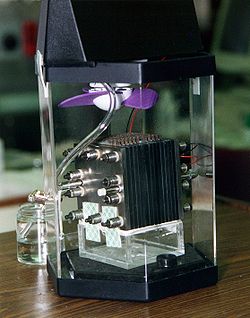
Direct methanol fuel cells or DMFCs are a subcategory of proton-exchange membrane fuel cells in which methanol is used as the fuel and a special proton-conducting polymer as the membrane (PEM). Their main advantage is low temperature operation and the ease of transport of methanol, an energy-dense yet reasonably stable liquid at all environmental conditions.

Whilst the thermodynamic theoretical energy conversion efficiency of a DMFC is 97%;[1] as of 2014 the achievable energy conversion efficiency for operational cells attains 30%[2] – 40%.[3] There is intensive research on promising approaches to increase the operational efficiency.[4]

A more efficient version of a direct fuel cell would play a key role in the theoretical use of methanol as a general energy transport medium, in the hypothesized methanol economy.

The cell

[edit]

In contrast to indirect methanol fuel cells, where methanol is reacted to hydrogen by steam reforming, DMFCs use a methanol solution (usually around 1M, i.e. about 3% in mass) to carry the reactant into the cell; common operating temperatures are in the range 50 to 120 °C (122 to 248 °F), where high temperatures are usually pressurized. DMFCs themselves are more efficient at high temperatures and pressures, but these conditions end up causing so many losses in the complete system that the advantage is lost;[5] therefore, atmospheric-pressure configurations are currently preferred.

Because of the methanol cross-over, a phenomenon by which methanol diffuses through the membrane without reacting, methanol is fed as a weak solution: this decreases efficiency significantly, since crossed-over methanol, after reaching the air side (the cathode), immediately reacts with air; though the exact kinetics are debated, the result is a reduction of the cell voltage. Cross-over remains a major factor in inefficiencies, and often half of the methanol is lost to cross-over. Methanol cross-over and/or its effects can be alleviated by (a) developing alternative membranes (e.g.[6][7]), (b) improving the electro-oxidation process in the catalyst layer and improving the structure of the catalyst and gas diffusion layers (e.g.[8] ), and (c) optimizing the design of the flow field and the membrane electrode assembly (MEA) which can be achieved by studying the current density distributions (e.g.[9] ).

Other issues include the management of carbon dioxide created at the anode, the sluggish dynamic behavior, and the ability to maintain the solution water.

The only waste products with these types of fuel cells are carbon dioxide and water.

Application

[edit]

Current DMFCs are limited in the power they can produce, but can still store a high energy content in a small space. This means they can produce a small amount of power over a long period of time. This makes them ill-suited for powering large vehicles (at least directly), but ideal for smaller vehicles such as forklifts and tuggers[10] and consumer goods such as mobile phones, digital cameras or laptops. Military applications of DMFCs are an emerging application since they have low noise and thermal signatures and no toxic effluent. These applications include power for man-portable tactical equipment, battery chargers, and autonomous power for test and training instrumentation. Units are available with power outputs between 25 watts and 5 kilowatts with durations up to 100 hours between refuelings. Especially for power output up to 0.3 kW the DMFC is suitable. For a power output of more than 0.3 kW the indirect methanol fuel cell presents a higher efficiency and is more cost-efficient.[11] Freezing of the liquid methanol-water mixture in the stack at low ambient temperature can be problematic for the membrane of DMFC (in contrast to indirect methanol fuel cell).

Methanol

[edit]

Methanol is a liquid from −97.6 to 64.7 °C (−143.7 to 148.5 °F) at atmospheric pressure. The volumetric energy density of methanol is an order of magnitude greater than even highly compressed hydrogen, about two times greater than liquid hydrogen and 2.6 times higher than lithium-ion batteries.[when?] The energy density per mass is a tenth of that of hydrogen, but 10 times higher than that of lithium-ion batteries.[12]

Methanol is slightly toxic and highly flammable. However, the International Civil Aviation Organization's (ICAO) Dangerous Goods Panel (DGP) voted in November 2005 to allow passengers to carry and use micro fuel cells and methanol fuel cartridges when aboard airplanes to power laptop computers and other consumer electronic devices. On September 24, 2007, the US Department of Transportation issued a proposal to allow airline passengers to carry fuel cell cartridges on board.[13] The Department of Transportation issued a final ruling on April 30, 2008, permitting passengers and crew to carry an approved fuel cell with an installed methanol cartridge and up to two additional spare cartridges.[14] It is worth noting that 200 ml maximum methanol cartridge volume allowed in the final ruling is double the 100 ml limit on liquids allowed by the Transportation Security Administration in carry-on bags.[15]

Reaction

[edit]

The DMFC relies upon the oxidation of methanol on a catalyst layer to form carbon dioxide. Water is consumed at the anode and produced at the cathode. Protons (H+) are transported across the proton exchange membrane - often made from Nafion - to the cathode where they react with oxygen to produce water. Electrons are transported through an external circuit from anode to cathode, providing power to connected devices.

The half-reactions are:

Equation
Anode
oxidation
Cathode
reduction
Overall reaction
redox reaction

Methanol and water are adsorbed on a catalyst usually made of platinum and ruthenium particles, and lose protons until carbon dioxide is formed. As water is consumed at the anode in the reaction, pure methanol cannot be used without provision of water via either passive transport such as back diffusion (osmosis), or active transport such as pumping. The need for water limits the energy density of the fuel.

Platinum is used as a catalyst for both half-reactions. This contributes to the loss of cell voltage potential, as any methanol that is present in the cathode chamber will oxidize. If another catalyst could be found for the reduction of oxygen, the problem of methanol crossover would likely be significantly lessened. Furthermore, platinum is very expensive and contributes to the high cost per kilowatt of these cells.

During the methanol oxidation reaction carbon monoxide (CO) is formed, which strongly adsorbs onto the platinum catalyst, reducing the number of available reaction sites and thus the performance of the cell. The addition of other metals, such as ruthenium or gold, to the platinum catalyst tends to ameliorate this problem. In the case of platinum-ruthenium catalysts, the oxophilic nature of ruthenium is believed to promote the formation of hydroxyl radicals on its surface, which can then react with carbon monoxide adsorbed on the platinum atoms. The water in the fuel cell is oxidized to a hydroxy radical via the following reaction: H2O → OH• + H+ + e. The hydroxy radical then oxidizes carbon monoxide to produce carbon dioxide, which is released from the surface as a gas: CO + OH• → CO2 + H+ + e.[16]

Using these OH groups in the half reactions, they are also expressed as:

Equation
Anode
oxidation
Cathode
reduction
Overall reaction
redox reaction

Cross-over current

[edit]

Methanol on the anodic side is usually in a weak solution (from 1M to 3M), because methanol in high concentrations has the tendency to diffuse through the membrane to the cathode, where its concentration is about zero because it is rapidly consumed by oxygen. Low concentrations help in reducing the cross-over, but also limit the maximum attainable current.

The practical realization is usually that a solution loop enters the anode, exits, is refilled with methanol, and returns to the anode again. Alternatively, fuel cells with optimized structures can be directly fed with high concentration methanol solutions or even pure methanol.[17]

Water drag

[edit]

The water in the anodic loop is lost because of the anodic reaction, but mostly because of the associated water drag: every proton formed at the anode drags a number of water molecules to the cathode. Depending on temperature and membrane type, this number can be between 2 and 6.

Ancillary units

[edit]

A direct methanol fuel cell is usually part of a larger system including all the ancillary units that permit its operation. Compared to most other types of fuel cells, the ancillary system of DMFCs is relatively complex. The main reasons for its complexity are:

  • providing water along with methanol would make the fuel supply more cumbersome, so water has to be recycled in a loop;
  • CO2 has to be removed from the solution flow exiting the fuel cell;
  • water in the anodic loop is slowly consumed by reaction and drag; it is necessary to recover water from the cathodic side to maintain steady operation.

See also

[edit]

References

[edit]

Further reading

[edit]
[edit]
Revisions and contributorsEdit on WikipediaRead on Wikipedia
from Grokipedia
A direct methanol fuel cell (DMFC) is a type of that directly converts the of liquid (CH₃OH) into electrical energy through electrochemical oxidation at the and reduction of oxygen at the , using a solid such as to conduct protons. At the , reacts with water in the presence of a platinum-ruthenium catalyst: CH₃OH + H₂O → CO₂ + 6H⁺ + 6e⁻, producing protons, electrons, and ; these protons migrate across the to the , where they combine with oxygen and electrons from the external circuit: ³/₂O₂ + 6H⁺ + 6e⁻ → 3H₂O, generating water and . The overall cell reaction is CH₃OH + ³/₂O₂ → CO₂ + 2H₂O, with a theoretical of approximately 1.2 V at 25°C and operating temperatures typically between 60°C and 130°C. DMFCs are distinguished by methanol's high —offering a theoretical gravimetric value of 6,100 Wh/kg and volumetric density of 4,800 Wh/L—compared to , along with the 's ease of storage, handling, and refueling at ambient conditions without requiring complex . These attributes make DMFCs particularly suitable for portable and low-power applications, such as powering laptop computers, battery chargers, military devices (e.g., the JENNY 600S system, which delivers up to 25 and provides runtimes of up to 72 hours depending on load and supply), and auxiliary units in transportation or stationary backup systems. Efficiencies can reach up to 96.6% under optimal low-temperature conditions, though practical systems achieve 20–40% based on the lower heating value. Despite their potential, DMFCs encounter significant hurdles, including methanol crossover—where unreacted fuel diffuses through the , poisoning the and reducing efficiency—and sluggish anode kinetics that necessitate high loadings of costly platinum-ruthenium (typically 3–5 mg/cm²). Power densities remain modest at 0.1–0.3 /cm², limiting scalability for high-power uses like automotive . Initial research dates to the by groups at Shell and , but modern DMFC development surged in the early with the invention of efficient direct-oxidation systems at NASA's , leading to demonstrations in portable power systems by the late . As of 2025, current efforts emphasize advanced , non-precious , and vapor-feed designs to mitigate challenges and advance commercialization in niche markets.

Introduction

Definition and Principles

A direct methanol fuel cell (DMFC) is a low-temperature that utilizes an aqueous solution of as the fuel at the and air or pure oxygen as the oxidant at the , generating , , and as byproducts. These cells typically operate in the temperature range of 60–130 °C, enabling relatively quick startup and compatibility with compact systems. The fundamental principles of a DMFC involve the direct electrochemical oxidation of at the , where it is converted into protons, electrons, and ; the protons then conduct through a polymer membrane to the , while electrons flow through an external circuit to produce electrical power. At the , oxygen is reduced in the presence of protons and electrons to form . Unlike reformed cells, which require an external step to convert into , DMFCs oxidize methanol directly, simplifying the system design and eliminating the need for a fuel processor. DMFCs hold particular appeal for portable power applications due to the high theoretical of liquid , approximately 6 kWh/kg, which surpasses practical densities in terms of volumetric and ease of handling under ambient conditions. Practical systems achieve electrical efficiencies of 20–30%, with an around 1.2 V that drops to 0.4–0.6 V under typical operating loads due to overpotentials and fuel crossover losses.

Historical Development

The concept of the direct methanol fuel cell (DMFC) traces its roots to the early 20th century, with initial explorations of methanol electro-oxidation by E. Müller in 1922. Significant advancements began in the 1950s, when Karl Kordesch and colleagues at the University of Vienna investigated alkaline electrolyte-based DMFCs using nickel or platinum-palladium anodes and silver cathodes, laying foundational work for low-temperature operation. By the 1960s, industrial efforts accelerated: Allis-Chalmers developed a 40-cell DMFC stack in 1963 delivering 750 W at 9 V and 40 mW/cm² power density using 5 M KOH electrolyte at 50°C, while Shell Research, Exxon, and Hitachi pursued acidic electrolyte prototypes, including Shell's 300 W unit in 1968 employing Pt-Ru catalysts. These early systems, however, suffered from low efficiency and catalyst poisoning, limiting practical viability. The 1980s marked a pivotal shift from alkaline to polymer electrolyte membrane (PEM) systems, inspired by broader PEM fuel cell (PEMFC) progress from the 1960s NASA programs. Researchers like M. Watanabe and S. Motoo advanced Pt-Ru alloy catalysts for methanol oxidation, achieving better CO tolerance, while the development and application of membranes in the 1960s by enhanced proton conductivity and reduced crossover. Influential figures such as A. Hamnett, J.B. Goodenough, and A.K. Shukla at institutions including the University of Newcastle and contributed seminal studies on anode kinetics, enabling lab-scale PEM-DMFCs with power densities approaching 100 mW/cm² by decade's end. Initial patents emerged in the early 1990s, including work by S. Srinivasan at on PEM integration for transportation applications, and Corporation's explorations of portable prototypes in the late 1990s and early 2000s, building on these foundations to target 0.3 W/cm² densities in single cells. In the 2000s, research emphasized mitigating methanol crossover through advanced membranes and microchannel designs, supported by substantial funding: the U.S. Department of Energy (DOE) allocated millions for portable DMFC R&D, while automotive fuel cell efforts under programs like FreedomCAR focused on hydrogen PEMFCs; the European Union funded projects under the Sixth Framework Programme for efficiency improvements. Key milestones included MTI Micro Fuel Cells' 2004 demonstration of a 10-25 W portable DMFC powering PDAs and smartphones, achieving energy densities competitive with batteries. Military applications gained traction with DARPA's 2006 Palm Power initiative, funding DMFC prototypes for soldier-portable units up to 150 W to replace diesel generators. Commercialization accelerated in the 2010s, led by SFC Energy AG, which scaled production of rugged DMFC systems (e.g., EFOY series) for off-grid and defense uses, delivering 7-40 W with over 500 Wh/L energy density. The 2020s have focused on enhancing catalyst durability and hybrid integrations, addressing degradation from poisoning and ORR inefficiencies. Advances in Pt-Ru core-shell structures and non-PGM alternatives, such as Fe-N-C catalysts, have extended operational life to over 5,000 hours under portable loads, as demonstrated in DOE-supported labs. Hybrid DMFC-battery systems for drones and wearables emerged, combining DMFCs for sustained power with Li-ion for peaks, though full remains challenged by cost. EU Horizon Europe programs and U.S. grants continue driving these evolutions, prioritizing scalable, durable anodes amid global decarbonization efforts. As of 2025, the DMFC market continues to expand, with projections reaching USD 640.6 million by 2030, driven by new portable systems like SFC Energy's 1 kW stack weighing under 11 kg.

Operating Principles

Electrochemical Reactions

In a direct methanol fuel cell (DMFC), the electrochemical reactions occur at the and , separated by a , to generate through the oxidation of and reduction of oxygen. The overall reaction is the complete oxidation of to and : CH3OH+32O2CO2+2H2O\text{CH}_3\text{OH} + \frac{3}{2}\text{O}_2 \rightarrow \text{CO}_2 + 2\text{H}_2\text{O} This process has a standard change of ΔG = -702 kJ/mol at 25°C, corresponding to a theoretical reversible cell voltage of 1.21 V. At the anode, undergoes multi-step oxidation in an acidic environment, requiring as a reactant: CH3OH+H2OCO2+6H++6e\text{CH}_3\text{OH} + \text{H}_2\text{O} \rightarrow \text{CO}_2 + 6\text{H}^+ + 6\text{e}^- The for this is +0.02 V versus the (SHE). The mechanism involves sequential dehydrogenation steps, producing intermediates such as , , and strongly adsorbed (COads), which poisons catalyst sites and contributes to high activation due to inherently slow kinetics. The rate-determining step is typically the initial dehydrogenation to form COads, limiting the overall reaction rate. At the cathode, the (ORR) consumes protons and electrons from the : 32O2+6H++6e3H2O\frac{3}{2}\text{O}_2 + 6\text{H}^+ + 6\text{e}^- \rightarrow 3\text{H}_2\text{O} This has a standard potential of +1.23 V versus SHE, but in acidic media, the ORR proceeds sluggishly via either a direct four-electron pathway to or indirect routes producing peroxide intermediates, leading to additional kinetic losses. The kinetics dominate performance limitations in DMFCs, with typical operating current densities ranging from 100 to 300 mA/cm² under practical conditions, though methanol crossover can induce mixed potentials at both electrodes, reducing efficiency by altering the effective reaction environment.

Performance Metrics

The performance of direct methanol fuel cells (DMFCs) is quantified using key metrics such as , , and , which highlight their practical limitations compared to theoretical potentials. measures electrical output per unit area and varies significantly between system types; active DMFCs, employing pumps for fuel and air delivery, achieve peak values up to 200 mW/cm² under optimized conditions with 1-2 M feed. Passive DMFCs, relying on diffusion-driven without auxiliaries, typically reach lower peaks around 50 mW/cm², suitable for portable applications but constrained by slower reactant supply. , reflecting the fraction of 's converted to , ranges from 20% to 40%, limited by incomplete oxidation pathways that produce partial products like and CO rather than full CO₂. System-level , accounting for stack and ancillary components, falls in the 1-2 kWh/kg range, leveraging 's inherent 6.1 kWh/kg density but diminished by inefficiencies and weight. Voltage losses in DMFCs reduce the operating potential from the theoretical 1.21 V open-circuit value, as depicted in the characteristic polarization curve, which traces cell voltage versus . At low currents, losses predominate due to sluggish kinetics, modeled by the : ηa=a+blogi\eta_a = a + b \log i where ηa\eta_a is the overpotential, ii is , aa incorporates the , and b=2.303RT/αFb = 2.303 RT / \alpha F is the Tafel slope (RR: , TT: temperature, α\alpha: transfer coefficient, FF: ). In the mid-current region, ohmic losses cause a linear via Vohmic=iRmV_{ohmic} = i R_m, where RmR_m is the membrane-specific resistance, influenced by ionic conductivity and thickness. High-current operation incurs concentration losses from reactant depletion at surfaces, approximated by Nernstian limits: ηc(RT/nF)ln(1i/iL)\eta_c \approx (RT / nF) \ln(1 - i / i_L), with iLi_L as the limiting current density and nn the number. These losses collectively yield typical operating voltages below 0.5 V at practical power outputs. Efficiency in DMFCs is decomposed into voltage and fuel utilization components. Voltage efficiency is defined as ηv=Vop/1.21\eta_v = V_{op} / 1.21, where VopV_{op} is the operating cell voltage, capturing thermodynamic losses from non-ideal reversibility. Fuel utilization efficiency, however, remains below 100% due to methanol crossover—where unreacted fuel permeates to the cathode, mixing with oxygen and generating heat instead of power—and side reactions forming intermediates like formaldehyde that evade complete oxidation. Overall , the product of voltage efficiency and fuel utilization, thus typically aligns with the 20-40% range, underscoring the need for crossover mitigation to approach higher values. Modeling DMFC performance relies on electrochemical kinetics captured by the Butler-Volmer equation for net current at electrodes: i=i0[exp(αaFηaRT)exp(αcFηcRT)]i = i_0 \left[ \exp\left( \frac{\alpha_a F \eta_a}{RT} \right) - \exp\left( -\frac{\alpha_c F \eta_c}{RT} \right) \right] where i0i_0 is the , and subscripts denote anodic (aa) and cathodic (cc) processes; this framework integrates activation overpotentials with mass transport and ohmic terms for full polarization prediction. dependence is pivotal, with optimal ranges of 80-100°C enhancing reaction rates and conductivity while balancing elevated crossover rates that degrade efficiency at higher values. Such models guide parameter optimization, revealing trade-offs in kinetics versus transport limitations central to DMFC operation.

Cell Design

Core Components

The (MEA) serves as the core functional unit in a direct methanol fuel cell (DMFC), integrating the , (PEM), and to facilitate electrochemical reactions. The typically employs a Pt-Ru catalyst supported on carbon to oxidize , enabling efficient multi-electron transfer while mitigating CO poisoning effects. On the side, a Pt or Pt-alloy catalyst on carbon support promotes the (ORR), converting oxygen and protons into water under acidic conditions. The PEM, often exemplified by , acts as a selective barrier for proton conduction from to while ideally blocking passage, with typical thicknesses ranging from 50 to 175 μm to balance ionic conductivity and fuel crossover resistance. Bipolar plates form the structural backbone of the DMFC, providing electrical current collection, mechanical support, and pathways for reactant distribution between adjacent cells. These plates are commonly fabricated from for its resistance and machinability or from metals like for enhanced conductivity and lighter weight, with engraved flow channels directing liquid to the and air or oxygen to the . DMFC designs incorporate active systems, which use pumps and fans for of reactants, or passive air-breathing configurations that rely on natural for oxygen supply, simplifying the setup for portable applications. In a DMFC stack, multiple single cells are connected in electrical series to achieve desired voltage output, typically comprising 5 to 50 cells depending on power requirements. The assembly is compressed between rigid end plates using tie rods or bolts to ensure uniform contact pressure, minimizing electrical resistance and maintaining structural integrity under operation. Sealing materials, such as gaskets around the MEA perimeter and flow channels, prevent leaks of solution or gases, ensuring safe and efficient reactant containment. Flow field designs in the bipolar plates are critical for uniform distribution of the methanol feed, typically at concentrations of 1-2 M to optimize reaction kinetics without excessive crossover. Serpentine channels guide the fuel in a single, winding path across the active area, promoting convective transport and removal of reaction byproducts, while interdigitated patterns force reactants through the porous layers for enhanced efficiency. These configurations help maintain consistent performance across the cell area in both active and passive DMFC setups.

Materials and Construction

The in direct methanol fuel cells (DMFCs) primarily utilizes a , often in a 1:1 , to tolerate during oxidation. Typical loadings range from 0.2 to 1 mg/cm² Pt equivalent, though higher values up to 2-4 mg/cm² are used for improved activity, supported on carbon materials for dispersion. At the , or Pt/C catalysts prevail for oxygen reduction, with loadings of 0.5-2 mg/cm² to balance activity and tolerance. Alternatives such as , including Pd-Fe or Pd-Co, offer cost reductions while maintaining comparable performance, particularly for non-platinum group metal (non-PGM) cathodes like Fe-N-C. Proton exchange membranes in DMFCs commonly employ perfluorosulfonic acid (PFSA) materials, such as with a thickness of about 180 µm, providing high proton conductivity but prone to methanol crossover. Hydrocarbon-based alternatives, like sulfonated poly(ether ether ketone) (SPEEK), reduce costs and methanol permeability (e.g., 0.52 × 10⁻⁶ cm²/s versus 4.29 × 10⁻⁶ cm²/s for ), though with potentially lower conductivity around 47 mS/cm. Membrane thickness influences ohmic resistance, typically 0.1-0.2 Ω cm², where thinner variants (30-50 µm) lower resistance but increase crossover risks. Catalyst supports often consist of carbon black, such as Vulcan XC-72, at 40-60 wt% to ensure uniform dispersion and electrical conductivity. Gas diffusion layers (GDLs) incorporate polytetrafluoroethylene (PTFE) treatment for hydrophobicity, facilitating reactant transport and water management in porous carbon structures. Membrane electrode assemblies (MEAs) are fabricated via hot-pressing, applying 1-5 MPa at 120-150°C to bond catalyst layers and membranes effectively. Recent advances in the 2020s feature nanomaterials like graphene supports for Pt-Ru catalysts, enhancing CO tolerance. Metal-organic framework (MOF)-derived catalysts, such as Fe-N-C from ZIF/MIL precursors, have been explored as non-PGM alternatives for cathodes. As of 2025, further progress includes novel anode flow field designs that enhance mass transport and performance, as well as machine learning-guided optimizations for cell components to predict and improve efficiency.

Fuel and Feedstocks

Methanol Properties

(CH₃OH) is a colorless, volatile at , with a of 64.7°C and a of 0.791 g/cm³ at 20°C, making it suitable for compact storage in direct methanol fuel cells (DMFCs) without the need for high-pressure containment. Its volumetric is approximately 15.8 MJ/L, which is about half that of (32 MJ/L), while its gravimetric is 20 MJ/kg, providing a balance between and system portability in fuel cell applications. Chemically, methanol exhibits moderate toxicity, with an oral LD50 in rats of 5.628 g/kg, necessitating careful handling to avoid ingestion or inhalation risks during fuel cell operations. It is highly flammable, with a flash point of 11°C, which requires appropriate safety measures in storage and transport environments. Methanol is fully miscible with water, allowing its use in dilute aqueous solutions typically ranging from 0.5 to 2 M for DMFC feeds to optimize performance while mitigating crossover issues. For storage and handling in DMFCs, methanol's non-cryogenic nature enables straightforward transportation as a at ambient conditions, contrasting with the compression challenges of fuels. Its small molecular kinetic diameter of approximately 0.38 nm contributes to crossover risks through polymer electrolyte membranes, influencing membrane design choices. High purity levels exceeding 99.5% are required to minimize impurities such as , which can degrade performance and cell . Economically, methanol is cost-effective at approximately $0.3–0.7 per liter (as of 2025, with regional variations), primarily derived from or via catalytic processes, with potential for renewability through to support sustainable DMFC deployment.

Oxidant and Electrolyte Systems

In direct methanol fuel cells (DMFCs), the oxidant at the is typically oxygen, supplied either as pure O₂ or as air, with pure oxygen enabling higher performance due to the absence of dilution. Pure oxygen operation can achieve power densities up to approximately 200 mW/cm² at a cell voltage of 500 mV under elevated and conditions, while air-fed systems generally yield around 100 mW/cm² or less owing to the lower oxygen from the 21% O₂ content in air. For active DMFC systems, oxidant supply involves controlled flow rates to ensure adequate mass transport to the layer, typically ranging from 1 to 5 L/min depending on cell size and operating current density. In contrast, passive air-breathing configurations, common in portable applications, rely on natural of ambient oxygen without pumps, simplifying design but limiting performance to lower power densities around 20-50 mW/cm² due to restricted oxygen availability. The electrolyte in modern DMFCs is primarily a (PEM), such as , which facilitates H⁺ ion transport from to while acting as an electronic insulator to prevent short-circuiting and crossover of electrons. PEMs exhibit proton conductivities of about 0.1 S/cm at 80°C under hydrated conditions, enabling efficient operation at moderate temperatures. Early DMFC designs employed flowing liquid electrolytes, such as solutions, to enhance ion mobility and mitigate , but these were largely supplanted by fixed solid PEMs for improved stability and reduced complexity. Key interactions between the oxidant and electrolyte include limitations in (ORR) mass transport when using humidified air, where reduces the effective oxygen concentration and exacerbates barriers at higher currents. flooding arises from produced during the ORR (as referenced briefly in electrochemical ), accumulating in the gas layer and impeding oxidant access, which can reduce performance by up to 50% in active systems if not managed. In passive modes, back- of oxygen through the supports limited operation but is constrained by low flux rates. Emerging alternatives to acidic PEM-based DMFCs include alkaline variants using potassium hydroxide (KOH) electrolytes, which enable the use of non-platinum group metal (non-PGM) catalysts at both electrodes due to favorable ORR kinetics in alkaline media. Research in the 2020s has focused on anion exchange membranes (AEMs) like Fumasep FAA3-50, achieving peak power densities of up to 50 mW/cm² with PGM-free materials, positioning alkaline DMFCs as a cost-effective option for portable and stationary applications. As of 2025, ongoing efforts include vapor-feed configurations to further enhance performance and reduce methanol crossover.

Operational Challenges

Methanol Crossover

Methanol crossover in direct fuel cells (DMFCs) is the permeation of unreacted from the to the through the (PEM), primarily driven by diffusion due to the concentration gradient across the membrane. In standard operation, the maintains a concentration of approximately 1 M, while the concentration is near 0 M, creating a strong driving force for this transport. This phenomenon exploits the PEM's affinity for water- mixtures, as 's with water facilitates its passage through hydrophilic channels in membranes like . The primary mechanism is passive governed by Fick's first law, with permeability in typically ranging from 10710^{-7} to 10610^{-6} cm²/s at , depending on concentration and hydration state. Electro-osmotic drag contributes minimally under low current densities but can enhance crossover at higher loads. This not only depletes anode fuel but also degrades cathode by introducing to the oxygen reduction sites. The effects of crossover are multifaceted and severely limit DMFC . At the cathode, permeated undergoes oxidation (MOR), generating a mixed potential that depolarizes the (ORR) and causes an drop of 200–400 mV compared to the ideal 1.23 V. This mixed reaction also leads to fuel loss, with crossover accounting for up to 40% penalty through wasted that is oxidized without contributing to net power output. Furthermore, the MOR produces CO₂ bubbles at the cathode, which obstruct pores in the gas diffusion layer, exacerbating limitations and reducing overall cell . Quantification of methanol crossover is essential for performance analysis and is often expressed as an equivalent crossover , approximating the limiting current due to diffusive : icross=6FDCLi_{\text{cross}} = \frac{6 F D C}{L} where 6 is the number of electrons transferred in the complete (\ceCH3OH+H2O>CO2+6H++6e\ce{CH3OH + H2O -> CO2 + 6H+ + 6e-}), FF is Faraday's constant (96,485 C/mol), DD is the methanol (typically 1×1061 \times 10^{-6} cm²/s in at 60°C), CC is the bulk anode methanol concentration, and LL is the membrane thickness. This value is experimentally determined via on the under atmosphere, where the plateau current reflects the oxidation of permeated methanol. For a 117 membrane (183 µm thick) with 1 M methanol, icrossi_{\text{cross}} can reach 100–200 mA/cm² at 60°C. Key factors influencing methanol crossover include operating temperature, fuel concentration, and membrane characteristics. Elevated temperatures enhance the diffusion coefficient following an Arrhenius relationship, roughly doubling crossover flux every 10–15°C due to increased membrane swelling and mobility. Anode methanol concentration drives crossover linearly, as higher levels (e.g., >2 M) amplify the gradient without proportional power gains. Membrane thickness inversely scales with permeation; thinner PEMs (e.g., 112 at 50 µm) exhibit 2–4 times higher crossover than thicker variants (e.g., 117 at 183 µm), though they offer lower ohmic losses. Alternative membrane compositions can further modulate these effects by altering selectivity.

Water Management

Water management in direct methanol fuel cells (DMFCs) is critical due to the net production of during operation, which arises from the electrochemical reactions. At the , the oxidation of consumes 1 mole of per mole of (CH₃OH + H₂O → CO₂ + 6H⁺ + 6e⁻), while at the , the reduction of oxygen generates 3 moles of per mole of (1.5O₂ + 6H⁺ + 6e⁻ → 3H₂O), resulting in a net production of 2 moles of per mole of overall. This excess must be effectively removed or recycled to prevent performance degradation, as accumulation can lead to operational inefficiencies. Water transport across the membrane electrode assembly occurs through three primary mechanisms: electro-osmotic drag, back-diffusion, and hydraulic permeation. Electro-osmotic drag, driven by proton flux, carries water molecules from the anode to the cathode, with the drag coefficient (ξ) typically ranging from 2 to 3 water molecules per proton in Nafion membranes, increasing with temperature (e.g., ξ ≈ 2.08 at 23°C and ≈3 at 60°C). Back-diffusion counteracts this by moving water from the cathode to the anode due to a concentration gradient, while hydraulic permeation results from pressure differences across the membrane, often enhanced by hydrophobic gas diffusion layers. These processes collectively determine the net water flux, which can exceed the reaction-produced water under high current densities. The effects of improper water management manifest as cathode flooding and anode dehydration. Cathode flooding occurs when excess water accumulates in the gas diffusion layer, impeding oxygen access and causing mass transport losses that reduce cell voltage and power density. Conversely, at high current densities, electro-osmotic drag can dehydrate the anode, limiting proton conductivity if the water supply is insufficient. Effective humidity control is essential for membrane performance, with optimal relative humidity (RH) maintained at 80-100% to ensure adequate hydration of sulfonate groups in Nafion without excessive swelling. Management strategies focus on balancing water production and , particularly in passive and active DMFC systems. In passive DMFCs, wick structures or porous separators facilitate to remove from the cathode and recycle it to the , preventing flooding while minimizing external components. recycling systems can achieve recovery ratios up to 50%, where condensed cathode exhaust is returned to the feed, reducing the need for external addition and improving overall efficiency. Ancillary pumps may assist in active systems for precise circulation, as detailed in discussions.

System Integration

Ancillary Units

Ancillary units in direct methanol fuel cells (DMFCs) encompass the peripheral devices essential for delivering fuel, supplying oxidant, monitoring operational parameters, and managing thermal conditions to ensure reliable . These components operate in with the core cell but focus on immediate support functions, such as precise fluid handling and real-time feedback, without encompassing overall system architecture. Fuel delivery systems primarily utilize peristaltic or gear pumps to circulate the methanol-water solution to the at controlled flow rates typically ranging from 1 to 10 /min, enabling efficient reactant supply while minimizing . Peristaltic pumps are favored for their non-contact operation, which reduces risks in the aqueous methanol , whereas gear pumps provide robust for higher pressures in compact setups. Operation can occur in dead-end mode, where fuel is supplied without recirculation to limit waste and crossover by purging accumulated CO₂ periodically, or in flow-through mode for continuous refreshment of the anode feed to maintain concentration stability. Air supply units employ low-pressure blowers or compressors to deliver oxygen-rich air to the at pressures of 0.1 to 1 bar, ensuring adequate oxidant availability for the while avoiding excessive parasitic power draw. Integrated humidifiers, often wick-based or membrane types, precondition the gas stream to prevent of the , thereby sustaining ionic conductivity and mitigating performance degradation at elevated currents. Sensors are critical for real-time monitoring and control, including thermocouples that measure stack temperatures within the 60–130°C operating range to optimize reaction kinetics and avoid hotspots. Pressure transducers track inlet and outlet conditions in fuel and air lines to detect blockages or leaks, while current and voltage monitors provide feedback on electrochemical output for load matching. Methanol concentration is assessed using conductivity probes in the fuel loop, which correlate solution resistivity to methanol levels (typically 0.5–2 M) for dynamic adjustment and crossover prevention. Thermal management via cooling and heating units facilitates rapid startup and steady-state operation, with thermoelectric modules (Peltier devices) enabling heating from ambient temperatures to operational levels in minutes by direct electrical input, often supplemented by the cell's own exothermic reactions. Liquid cooling loops, circulating coolant through external channels, dissipate excess heat during high-load conditions and can double as startup heaters when integrated with resistive elements, maintaining isothermal profiles across the stack.

Balance of Plant

The balance of plant (BOP) in direct methanol fuel cell (DMFC) systems encompasses the auxiliary components and subsystems that support the operation of the stack, ensuring efficient power delivery, thermal regulation, and overall system reliability. These elements include pumps, sensors, valves, and electronic controls that manage and oxidant flow, while minimizing parasitic power losses. Control systems in DMFC BOP typically employ microcontrollers to enable load following, adjusting delivery and in real-time to match varying power demands. For instance, valves controlled by microcontrollers regulate methanol flow rates based on feedback from flow sensors, optimizing performance in portable prototypes. Additionally, periodic purge cycles remove accumulated CO2 from the compartment, preventing pressure buildup and maintaining stable operation over extended periods. , such as DC-DC converters, condition the stack output to stable voltages like 12-48 V for end-use devices, with efficiency rates often exceeding 90% in integrated systems. Safety features are integral to DMFC BOP to mitigate risks associated with methanol's flammability and . Leak detectors monitor methanol vapor concentrations, alerting systems when levels approach the lower explosive limit of 6% or upper limit of 36% in air, triggering ventilation or shutdown protocols. Pressure relief valves prevent overpressurization in fuel lines and the stack, while automatic shutdown mechanisms activate on overheating beyond 150°C to avoid catalyst degradation or fire hazards. These safeguards comply with standards like IEC for portable cells, enabling safe deployment in consumer applications. BOP integration significantly influences overall DMFC system efficiency, contributing a substantial portion to total weight and power consumption due to ancillary components like pumps and heat exchangers. In portable systems, passive BOP designs eliminate mechanical pumps, relying instead on and natural for fuel and , which reduces complexity and extends runtime in low-power scenarios. Active BOP variants, incorporating motorized pumps and fans, provide higher power output but increase overhead, as seen in hybrid systems combining DMFC stacks with batteries for peak load handling. Recent advances in the 2020s have introduced smart BOP architectures leveraging for enhanced efficiency, such as algorithms that dynamically adjust concentration and supply to minimize fluctuations and boost net power by up to 1%. models also optimize voltage control in real-time, improving average power output by over 150% while extending catalyst lifespan in experimental DMFC setups. These AI-driven approaches enable and fuel management, addressing traditional BOP limitations in variable-load environments.

Applications and Commercialization

Current Uses

Direct methanol fuel cells (DMFCs) are primarily deployed in portable and low-power applications where their high and ease of fuel handling provide advantages over batteries. In portable , DMFCs serve as backup power sources for devices such as laptops and phones, exemplified by SFC Energy's JENNY 600S system, which delivers 25 W continuous output and 600 Wh per day at a weight of 1.7 kg, enabling battery charging for mobile users. Military applications include soldier-portable systems, with DARPA-funded prototypes like a 20 W DMFC designed to power individual soldier equipment, reducing battery carry weight by up to 80% during extended missions. In September 2025, SFC Energy introduced the EMILY 12000, a next-generation DMFC system for tactical defense applications, offering higher power ranges. For stationary and micro-scale uses, DMFCs power remote sensors and in off-grid locations, providing reliable 10-100 W output for and detection towers in isolated areas such as mountains or deserts. units (APUs) based on DMFCs, such as SFC Energy's EFOY series (e.g., EFOY 80 at 40 W and 80 Ah/day), support recreational vehicles (RVs) and boats by automatically charging 12 V or 24 V batteries, offering quiet, emission-reduced operation for onboard systems during extended outings. In transportation, early automotive trials featured a 2000 DaimlerChrysler-Ballard prototype with a 3 kW DMFC powering a one-person demonstration vehicle, highlighting potential for methanol-based without complex reforming. Current niche applications include unmanned aerial vehicles (UAVs), where lightweight DMFC systems like a 200 W stack using carbon-composite materials have enabled cruise flight demonstrations, supporting 2-4 hour durations with 2 M feed. As of , the global DMFC market was valued at approximately USD 328 million, primarily in and , with 2025 estimates around USD 365 million, and system costs ranging from $2,000-4,000 per kW for stacks in the 5 kW range.

Future Prospects

Ongoing research in direct methanol fuel cells (DMFCs) focuses on developing non- catalysts to reduce costs and improve (ORR) performance at the . Iron-nitrogen-carbon (Fe-N-C) catalysts, for instance, have shown promise as methanol-tolerant alternatives to , achieving half-wave potentials comparable to commercial Pt/C benchmarks while maintaining stability in acidic environments. Additionally, efforts to mitigate methanol crossover include thinner composite membranes, such as those assembled via layer-by-layer deposition on , which enhance proton conductivity and reduce fuel , leading to improvements of up to 42% in DMFC tests. Scalability advancements target integration in hybrid systems for electric vehicles (EVs) and low-power Internet of Things (IoT) devices. Hybrid DMFC-battery configurations enable onboard recharging to extend EV range beyond 500 km using compact fuel cartridges, with current prototypes delivering 0.6–2.2 kW to support small-vehicle applications, aiming for higher outputs through modular stacking. For IoT, micro-DMFCs provide continuous power below 1 W (typically 1–50 mW) in volumes under 10 cm³, with prototypes demonstrating operational lifetimes exceeding 5,000 hours and degradation rates under 5% per 1,000 hours, suitable for remote sensor networks. Key barriers to widespread adoption include high system , limited , and concerns. Current DMFC stacks cost around $2,000–2,100 per kW, far exceeding of $50–100 per kW needed for competitiveness with internal combustion engines. remains challenging, with lab systems achieving 3,000–5,000 hours before significant degradation, though commercial aim for 10,000–20,000 hours to match automotive requirements. Environmentally, reliance on fossil-derived methanol raises emissions issues, but sourcing from CO₂ capture via (DAC) or enables green variants, potentially reducing lifecycle gases by 65–95%. Future prospects are bolstered by projected market growth and synergies with renewables. The global DMFC market, valued at USD 328 million in 2024, is projected to grow at a CAGR of 11.36% to reach USD 905 million by 2033, with 2025 estimates at approximately USD 365 million, driven by portable and stationary applications. Integration with for e-methanol production—using and captured CO₂—supports decarbonization, with costs projected to fall to $250–630 per ton by 2050. Compared to lithium-ion batteries, DMFCs offer advantages like rapid refueling in minutes versus hours of charging, enhancing in mobile and remote scenarios.

References

Add your contribution
Related Hubs
User Avatar
No comments yet.




