



Community hub
Recent from talks
Contribute something
Nothing was collected or created yet.
Prime number theorem
View on Wikipedia | This article duplicates the scope of other articles, specifically Prime-counting function. (December 2024) |
In mathematics, the prime number theorem (PNT) describes the asymptotic distribution of prime numbers among the positive integers. It formalizes the intuitive idea that primes become less common as they become larger by precisely quantifying the rate at which this occurs. The theorem was proved independently by Jacques Hadamard[1] and Charles Jean de la Vallée Poussin[2] in 1896 using ideas introduced by Bernhard Riemann (in particular, the Riemann zeta function).
The first such distribution found is π(N) ~ N/log(N), where π(N) is the prime-counting function (the number of primes less than or equal to N) and log(N) is the natural logarithm of N. This means that for large enough N, the probability that a random integer not greater than N is prime is very close to 1 / log(N). In other words, the average gap between consecutive prime numbers among the first N integers is roughly log(N).[3] Consequently, a random integer with at most 2n digits (for large enough n) is about half as likely to be prime as a random integer with at most n digits. For example, among the positive integers of at most 1000 digits, about one in 2300 is prime (log(101000) ≈ 2302.6), whereas among positive integers of at most 2000 digits, about one in 4600 is prime (log(102000) ≈ 4605.2).
Statement
[edit]

Let π(x) be the prime-counting function defined to be the number of primes less than or equal to x, for any real number x. For example, π(10) = 4 because there are four prime numbers (2, 3, 5 and 7) less than or equal to 10. The prime number theorem then states that x / log x is a good approximation to π(x) (where log here means the natural logarithm), in the sense that the limit of the quotient of the two functions π(x) and x / log x as x increases without bound is 1:
![{\displaystyle \lim _{x\to \infty }{\frac {\;\pi (x)\;}{\;\left[{\frac {x}{\log(x)}}\right]\;}}=1,}](https://wikimedia.org/api/rest_v1/media/math/render/svg/e9ed65721795163fd29d7d249caa626094b3080a)
known as the asymptotic law of distribution of prime numbers. Using asymptotic notation this result can be restated as
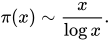
This notation (and the theorem) does not say anything about the limit of the difference of the two functions as x increases without bound. Instead, the theorem states that x / log x approximates π(x) in the sense that the relative error of this approximation approaches 0 as x increases without bound.
The prime number theorem is equivalent to the statement that the nth prime number pn satisfies
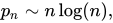
the asymptotic notation meaning, again, that the relative error of this approximation approaches 0 as n increases without bound. For example, the 2×10¹⁷th prime number is 8512677386048191063,[4] and (2×10¹⁷)log(2×10¹⁷) rounds to 7967418752291744388, a relative error of about 6.4%.
On the other hand, the following asymptotic relations are logically equivalent:[5]: 80–82

As outlined below, the prime number theorem is also equivalent to
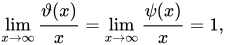
where ϑ and ψ are the first and the second Chebyshev functions respectively, and to
- [5]: 92–94
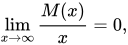
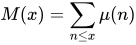
where is the Mertens function.
History of the proof of the asymptotic law of prime numbers
[edit]Based on the tables by Anton Felkel and Jurij Vega, Adrien-Marie Legendre conjectured in 1797 or 1798 that π(a) is approximated by the function a / (A log a + B) , where A and B are unspecified constants. In the second edition of his book on number theory (1808) he then made a more precise conjecture, with A = 1 and B = −1.08366 . Carl Friedrich Gauss considered the same question at age 15 or 16 "in the year 1792 or 1793", according to his own recollection in 1849.[6] In 1838 Peter Gustav Lejeune Dirichlet came up with his own approximating function, the logarithmic integral li(x) (under the slightly different form of a series, which he communicated to Gauss). Both Legendre's and Dirichlet's formulas imply the same conjectured asymptotic equivalence of π(x) and x / log(x) stated above, although it turned out that Dirichlet's approximation is considerably better if one considers the differences instead of quotients.
In two papers from 1848 and 1850, the Russian mathematician Pafnuty Chebyshev attempted to prove the asymptotic law of distribution of prime numbers. His work is notable for the use of the zeta function ζ(s), for real values of the argument "s", as in works of Leonhard Euler, as early as 1737. Chebyshev's papers predated Riemann's celebrated memoir of 1859, and he succeeded in proving a slightly weaker form of the asymptotic law, namely, that if the limit as x goes to infinity of π(x) / (x / log(x)) exists at all, then it is necessarily equal to one.[7] He was able to prove unconditionally that this ratio is bounded above and below by 0.92129 and 1.10555, for all sufficiently large x.[8][9] Although Chebyshev's paper did not prove the Prime Number Theorem, his estimates for π(x) were strong enough for him to prove Bertrand's postulate that there exists a prime number between n and 2n for any integer n ≥ 2.
An important paper concerning the distribution of prime numbers was Riemann's 1859 memoir "On the Number of Primes Less Than a Given Magnitude", the only paper he ever wrote on the subject. Riemann introduced new ideas into the subject, chiefly that the distribution of prime numbers is intimately connected with the zeros of the analytically extended Riemann zeta function of a complex variable. In particular, it is in this paper that the idea to apply methods of complex analysis to the study of the real function π(x) originates. Extending Riemann's ideas, two proofs of the asymptotic law of the distribution of prime numbers were found independently by Jacques Hadamard[1] and Charles Jean de la Vallée Poussin[2] and appeared in the same year (1896). Both proofs used methods from complex analysis, establishing as a main step of the proof that the Riemann zeta function ζ(s) is nonzero for all complex values of the variable s that have the form s = 1 + it with t > 0 .[10]
During the 20th century, the theorem of Hadamard and de la Vallée Poussin also became known as the Prime Number Theorem. Several different proofs of it were found, including the "elementary" proofs of Atle Selberg (1949)[11] and Paul Erdős (1949).[12] Hadamard's and de la Vallée Poussin's original proofs are long and elaborate; later proofs introduced various simplifications through the use of Tauberian theorems but remained difficult to digest. A short proof was discovered in 1980 by the American mathematician Donald J. Newman.[13][14] Newman's proof is arguably the simplest known proof of the theorem, although it is not "elementary" since it uses Cauchy's integral theorem from complex analysis.
Proof sketch
[edit]Here is a sketch of the proof referred to in one of Terence Tao's lectures.[15] Like most proofs of the PNT, it starts out by reformulating the problem in terms of a less intuitive, but better-behaved, prime-counting function. The idea is to count the primes (or a related set such as the set of prime powers) with weights to arrive at a function with smoother asymptotic behavior. The most common such generalized counting function is the Chebyshev function ψ(x), defined by

This is sometimes written as

where Λ(n) is the von Mangoldt function, namely

It is now relatively easy to check that the PNT is equivalent to the claim that
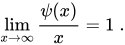
Indeed, this follows from the easy estimates

and (using big O notation) for any ε > 0,

The next step is to find a useful representation for ψ(x). Let ζ(s) be the Riemann zeta function. It can be shown that ζ(s) is related to the von Mangoldt function Λ(n), and hence to ψ(x), via the relation
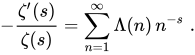
A delicate analysis of this equation and related properties of the zeta function, using the Mellin transform and Perron's formula, shows that for non-integer x the equation

holds, where the sum is over all zeros (trivial and nontrivial) of the zeta function. This striking formula is one of the so-called explicit formulas of number theory, and is already suggestive of the result we wish to prove, since the term x (claimed to be the correct asymptotic order of ψ(x)) appears on the right-hand side, followed by (presumably) lower-order asymptotic terms.
The next step in the proof involves a study of the zeros of the zeta function. The trivial zeros −2, −4, −6, −8, ... can be handled separately:
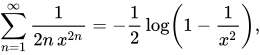
which vanishes for large x. The nontrivial zeros, namely those on the critical strip 0 ≤ Re(s) ≤ 1, can potentially be of an asymptotic order comparable to the main term x if Re(ρ) = 1, so we need to show that all zeros have real part strictly less than 1.
Non-vanishing on Re(s) = 1
[edit]To do this, we take for granted that ζ(s) is meromorphic in the half-plane Re(s) > 0, and is analytic there except for a simple pole at s = 1, and that there is a product formula
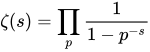
for Re(s) > 1. This product formula follows from the existence of unique prime factorization of integers, and shows that ζ(s) is never zero in this region, so that its logarithm is defined there and

Write s = x + iy ; then
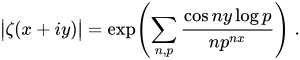
Now observe the identity

so that

for all x > 1. Suppose now that ζ(1 + iy) = 0. Certainly y is not zero, since ζ(s) has a simple pole at s = 1. Suppose that x > 1 and let x tend to 1 from above. Since has a simple pole at s = 1 and ζ(x + 2iy) stays analytic, the left hand side in the previous inequality tends to 0, a contradiction.

Finally, we can conclude that the PNT is heuristically true. To rigorously complete the proof there are still serious technicalities to overcome, due to the fact that the summation over zeta zeros in the explicit formula for ψ(x) does not converge absolutely but only conditionally and in a "principal value" sense. There are several ways around this problem but many of them require rather delicate complex-analytic estimates. Edwards's book[16] provides the details. Another method is to use Ikehara's Tauberian theorem, though this theorem is itself quite hard to prove. D.J. Newman observed that the full strength of Ikehara's theorem is not needed for the prime number theorem, and one can get away with a special case that is much easier to prove.
Newman's proof of the prime number theorem
[edit]D.J. Newman gives a quick proof of the prime number theorem (PNT). The proof is "non-elementary" by virtue of relying on complex analysis, but uses only elementary techniques from a first course in the subject: Cauchy's integral formula, Cauchy's integral theorem and estimates of complex integrals. Here is a brief sketch of this proof. See [14] for the complete details.
The proof uses the same preliminaries as in the previous section except instead of the function the Chebyshev function is used, which is obtained by dropping some of the terms from the series for Similar to the argument in the previous proof based on Tao's lecture, we can show that ϑ (x) ≤ π(x) log x , and ϑ (x) ≥ ( 1 − ɛ ) ( π(x) + 𝒪( x 1 − ɛ ) ) log x for any 0 < ɛ < 1 . Thus, the PNT is equivalent to Likewise instead of the function is used, which is obtained by dropping some terms in the series for The functions and differ by a function holomorphic on Since, as was shown in the previous section, has no zeroes on the line and has no singularities on


One further piece of information needed in Newman's proof, and which is the key to the estimates in his simple method, is that is bounded. This is proved using an ingenious and easy method due to Chebyshev.

Integration by parts shows how and are related: For


Newman's method proves the PNT by showing the integral

converges, and therefore the integrand goes to zero as which is the PNT. In general, the convergence of the improper integral does not imply that the integrand goes to zero at infinity, since it may oscillate, but since is increasing, it is easy to show in this case.


To show the convergence of for let


- and where


then

which is equal to a function holomorphic on the line

The convergence of the integral and thus the PNT, is proved by showing that This involves change of order of limits since it can be written and therefore classified as a Tauberian theorem.


The difference is expressed using Cauchy's integral formula and then shown to be small for large by estimating the integrand: Fix and so that is holomorphic in the region where and and let be the boundary of that region. Since 0 is in the interior of the region, Cauchy's integral formula gives


where is the factor introduced by Newman, which does not change the integral since is entire and


To estimate the integral, break the contour into two parts, where and Then


where Note that and hence are bounded; so let be some upper bound:


This bound, combined with the estimate for together give that the absolute value of the first integral must be The integrand over in the second integral is entire, so by Cauchy's integral theorem, the contour can be modified to a semicircle of radius in the left half-plane without changing the integral, and the same argument as for the first integral gives the absolute value of the second integral must be Finally, letting the third integral goes to zero since and hence goes to zero on the contour. Combining the two estimates and the limit get


This holds for any so and the PNT follows.

Prime-counting function in terms of the logarithmic integral
[edit]In a handwritten note on a reprint of his 1838 paper "Sur l'usage des séries infinies dans la théorie des nombres", which he mailed to Gauss, Dirichlet conjectured (under a slightly different form appealing to a series rather than an integral) that an even better approximation to π(x) is given by the offset logarithmic integral function Li(x), defined by

Indeed, this integral is strongly suggestive of the notion that the "density" of primes around t should be 1 / log t. This function is related to the logarithm by the asymptotic expansion

So, the prime number theorem can also be written as π(x) ~ Li(x). In fact, in another paper[17] in 1899 de la Vallée Poussin proved that

for some positive constant a, where O(...) is the big O notation. This has been improved to
- where .[18]


In 2016, Timothy Trudgian proved an explicit upper bound for the difference between and :



for .[19]

The connection between the Riemann zeta function and π(x) is one reason the Riemann hypothesis has considerable importance in number theory: if established, it would yield a far better estimate of the error involved in the prime number theorem than is available today. More specifically, Helge von Koch showed in 1901[20] that if the Riemann hypothesis is true, the error term in the above relation can be improved to

(this last estimate is in fact equivalent to the Riemann hypothesis). The constant involved in the big O notation was estimated in 1976 by Lowell Schoenfeld,[21] assuming the Riemann hypothesis:
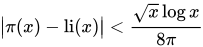
for all x ≥ 2657. He also derived a similar bound for the Chebyshev prime-counting function ψ:

for all x ≥ 73.2 . This latter bound has been shown to express a variance to mean power law (when regarded as a random function over the integers) and 1/ f noise and to also correspond to the Tweedie compound Poisson distribution. (The Tweedie distributions represent a family of scale invariant distributions that serve as foci of convergence for a generalization of the central limit theorem.[22]) A lower bound is also derived by J. E. Littlewood, assuming the Riemann hypothesis:[23][24][25]

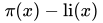
The logarithmic integral li(x) is larger than π(x) for "small" values of x. This is because it is (in some sense) counting not primes, but prime powers, where a power pn of a prime p is counted as 1/ n of a prime. This suggests that li(x) should usually be larger than π(x) by roughly and in particular should always be larger than π(x). However, in 1914, Littlewood proved that changes sign infinitely often.[23] The first value of x where π(x) exceeds li(x) is probably around x ~ 10316 ; see the article on Skewes' number for more details. (On the other hand, the offset logarithmic integral Li(x) is smaller than π(x) already for x = 2; indeed, Li(2) = 0, while π(2) = 1.)

Elementary proofs
[edit]In the first half of the twentieth century, some mathematicians (notably G. H. Hardy) believed that there exists a hierarchy of proof methods in mathematics depending on what sorts of numbers (integers, reals, complex) a proof requires, and that the prime number theorem (PNT) is a "deep" theorem by virtue of requiring complex analysis.[9] This belief was somewhat shaken by a proof of the PNT based on Wiener's tauberian theorem, though Wiener's proof ultimately relies on properties of the Riemann zeta function on the line , where complex analysis must be used.

In March 1948, Atle Selberg established, by "elementary" means, the asymptotic formula

where

for primes p.[11] By July of that year, Selberg and Paul Erdős[12] had each obtained elementary proofs of the PNT, both using Selberg's asymptotic formula as a starting point.[9][26] These proofs effectively laid to rest the notion that the PNT was "deep" in that sense, and showed that technically "elementary" methods were more powerful than had been believed to be the case. On the history of the elementary proofs of the PNT, including the Erdős–Selberg priority dispute, see an article by Dorian Goldfeld.[9]
There is some debate about the significance of Erdős and Selberg's result. There is no rigorous and widely accepted definition of the notion of elementary proof in number theory, so it is not clear exactly in what sense their proof is "elementary". Although it does not use complex analysis, it is in fact much more technical than the standard proof of PNT. One possible definition of an "elementary" proof is "one that can be carried out in first-order Peano arithmetic." There are number-theoretic statements (for example, the Paris–Harrington theorem) provable using second order but not first-order methods, but such theorems are rare to date. Erdős and Selberg's proof can certainly be formalized in Peano arithmetic, and in 1994, Charalambos Cornaros and Costas Dimitracopoulos proved that their proof can be formalized in a very weak fragment of PA, namely IΔ0 + exp.[27] However, this does not address the question of whether or not the standard proof of PNT can be formalized in PA.
A more recent "elementary" proof of the prime number theorem uses ergodic theory, due to Florian Richter.[28] The prime number theorem is obtained there in an equivalent form that the Cesàro sum of the values of the Liouville function is zero. The Liouville function is where is the number of prime factors, with multiplicity, of the integer . Bergelson and Richter (2022) then obtain this form of the prime number theorem from an ergodic theorem which they prove:


- Let be a compact metric space, a continuous self-map of , and a -invariant Borel probability measure for which is uniquely ergodic. Then, for every ,


This ergodic theorem can also be used to give "soft" proofs of results related to the prime number theorem, such as the Pillai–Selberg theorem and Erdős–Delange theorem.
Computer verifications
[edit]In 2005, Avigad et al. employed the Isabelle theorem prover to devise a computer-verified variant of the Erdős–Selberg proof of the PNT.[29] This was the first machine-verified proof of the PNT. Avigad chose to formalize the Erdős–Selberg proof rather than an analytic one because while Isabelle's library at the time could implement the notions of limit, derivative, and transcendental function, it had almost no theory of integration to speak of.[29]: 19
In 2009, John Harrison employed HOL Light to formalize a proof employing complex analysis.[30] By developing the necessary analytic machinery, including the Cauchy integral formula, Harrison was able to formalize "a direct, modern and elegant proof instead of the more involved 'elementary' Erdős–Selberg argument".
Prime number theorem for arithmetic progressions
[edit]Let πd,a(x) denote the number of primes in the arithmetic progression a, a + d, a + 2d, a + 3d, ... that are less than x. Dirichlet and Legendre conjectured, and de la Vallée Poussin proved, that if a and d are coprime, then
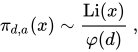
where φ is Euler's totient function. In other words, the primes are distributed evenly among the residue classes [a] modulo d with gcd(a, d) = 1 . This is stronger than Dirichlet's theorem on arithmetic progressions (which only states that there is an infinity of primes in each class) and can be proved using similar methods used by Newman for his proof of the prime number theorem.[31]
The Siegel–Walfisz theorem gives a good estimate for the distribution of primes in residue classes.
Bennett et al.[32] proved the following estimate that has explicit constants A and B (Theorem 1.3): Let d be an integer and let a be an integer that is coprime to d. Then there are positive constants A and B such that


where

and

Prime number race
[edit]

Although we have in particular

empirically the primes congruent to 3 are more numerous and are nearly always ahead in this "prime number race"; the first reversal occurs at x = 26861.[33]: 1–2 However Littlewood showed in 1914[33]: 2 that there are infinitely many sign changes for the function

so the lead in the race switches back and forth infinitely many times. The phenomenon that π4,3(x) is ahead most of the time is called Chebyshev's bias. The prime number race generalizes to other moduli and is the subject of much research; Pál Turán asked whether it is always the case that πc,a(x) and πc,b(x) change places when a and b are coprime to c.[34] Granville and Martin give a thorough exposition and survey.[33]

Another example is the distribution of the last digit of prime numbers. Except for 2 and 5, all prime numbers end in 1, 3, 7, or 9. Dirichlet's theorem states that asymptotically, 25% of all primes end in each of these four digits. However, empirical evidence shows that, for a given limit, there tend to be slightly more primes that end in 3 or 7 than end in 1 or 9 (a generation of the Chebyshev's bias).[35] This follows that 1 and 9 are quadratic residues modulo 10, and 3 and 7 are quadratic nonresidues modulo 10.
Non-asymptotic bounds on the prime-counting function
[edit]The prime number theorem is an asymptotic result. It gives an ineffective bound on π(x) as a direct consequence of the definition of the limit: for all ε > 0, there is an S such that for all x > S,

However, better bounds on π(x) are known, for instance Pierre Dusart's

The first inequality holds for all x ≥ 599 and the second one for x ≥ 355991.[36]
The proof by de la Vallée Poussin implies the following bound: For every ε > 0, there is an S such that for all x > S,

The value ε = 3 gives a weak but sometimes useful bound for x ≥ 55:[37]

In Pierre Dusart's thesis there are stronger versions of this type of inequality that are valid for larger x. Later in 2010, Dusart proved:[38]

Note that the first of these obsoletes the ε > 0 condition on the lower bound.
Approximations for the nth prime number
[edit]As a consequence of the prime number theorem, one gets an asymptotic expression for the nth prime number, denoted by pn:

A better approximation is by Cesàro (1894):[40]


Again considering the 2×10¹⁷th prime number 8512677386048191063, assuming the trailing error term is zero gives an estimate of 8512681315554715386; the first 5 digits match and relative error is about 0.46 parts per million.
Cipolla (1902)[41][42] showed that these are the leading terms of an infinite series which may be truncated at arbitrary degree, with

where each Pi is a degree-i monic polynomial. (P1(y) = y − 2, P2(y) = y2 − 6y + 11, P3(y) = y3 − 21/2y2 + 42y + 131/2, and so on.[42])
Rosser's theorem[37] states that

Dusart (1999).[43] found tighter bounds using the form of the Cesàro/Cipolla approximations but varying the lowest-order constant term. Bk(x; C) is the same function as above, but with the lowest-order constant term replaced by a parameter C:

The upper bounds can be extended to smaller n by loosening the parameter. For example, pn < n B1(log n; 0.5) for all n ≥ 20.[44]
Axler (2019)[44] extended this to higher order, showing:

Again, the bound on n may be decreased by loosening the parameter. For example, pn < n B2(log n; 0) for n ≥ 3468.
Table of π(x), x / log x, and li(x)
[edit]The table compares exact values of π(x) to the two approximations x / log x and li(x). The approximation difference columns are rounded to the nearest integer, but the "% error" columns are computed based on the unrounded approximations. The last column, x / π(x), is the average prime gap below x.
x π(x) π(x) − x/log(x) li(x) − π(x) % error x/π(x) x/log(x) li(x) 10 4 0 2 8.22% 42.606% 2.500 102 25 3 5 14.06% 18.597% 4.000 103 168 23 10 14.85% 5.561% 5.952 104 1,229 143 17 12.37% 1.384% 8.137 105 9,592 906 38 9.91% 0.393% 10.425 106 78,498 6,116 130 8.11% 0.164% 12.739 107 664,579 44,158 339 6.87% 0.051% 15.047 108 5,761,455 332,774 754 5.94% 0.013% 17.357 109 50,847,534 2,592,592 1,701 5.23% 3.34×10⁻³ % 19.667 1010 455,052,511 20,758,029 3,104 4.66% 6.82×10⁻⁴ % 21.975 1011 4,118,054,813 169,923,159 11,588 4.21% 2.81×10⁻⁴ % 24.283 1012 37,607,912,018 1,416,705,193 38,263 3.83% 1.02×10⁻⁴ % 26.590 1013 346,065,536,839 11,992,858,452 108,971 3.52% 3.14×10⁻⁵ % 28.896 1014 3,204,941,750,802 102,838,308,636 314,890 3.26% 9.82×10⁻⁶ % 31.202 1015 29,844,570,422,669 891,604,962,452 1,052,619 3.03% 3.52×10⁻⁶ % 33.507 1016 279,238,341,033,925 7,804,289,844,393 3,214,632 2.83% 1.15×10⁻⁶ % 35.812 1017 2,623,557,157,654,233 68,883,734,693,928 7,956,589 2.66% 3.03×10⁻⁷ % 38.116 1018 24,739,954,287,740,860 612,483,070,893,536 21,949,555 2.51% 8.87×10⁻⁸ % 40.420 1019 234,057,667,276,344,607 5,481,624,169,369,961 99,877,775 2.36% 4.26×10⁻⁸ % 42.725 1020 2,220,819,602,560,918,840 49,347,193,044,659,702 222,744,644 2.24% 1.01×10⁻⁸ % 45.028 1021 21,127,269,486,018,731,928 446,579,871,578,168,707 597,394,254 2.13% 2.82×10⁻⁹ % 47.332 1022 201,467,286,689,315,906,290 4,060,704,006,019,620,994 1,932,355,208 2.03% 9.59×10⁻¹⁰ % 49.636 1023 1,925,320,391,606,803,968,923 37,083,513,766,578,631,309 7,250,186,216 1.94% 3.76×10⁻¹⁰ % 51.939 1024 18,435,599,767,349,200,867,866 339,996,354,713,708,049,069 17,146,907,278 1.86% 9.31×10⁻¹¹ % 54.243 1025 176,846,309,399,143,769,411,680 3,128,516,637,843,038,351,228 55,160,980,939 1.78% 3.21×10⁻¹¹ % 56.546 1026 1,699,246,750,872,437,141,327,603 28,883,358,936,853,188,823,261 155,891,678,121 1.71% 9.17×10⁻¹² % 58.850 1027 16,352,460,426,841,680,446,427,399 267,479,615,610,131,274,163,365 508,666,658,006 1.64% 3.11×10⁻¹² % 61.153 1028 157,589,269,275,973,410,412,739,598 2,484,097,167,669,186,251,622,127 1,427,745,660,374 1.58% 9.05×10⁻¹³ % 63.456 1029 1,520,698,109,714,272,166,094,258,063 23,130,930,737,541,725,917,951,446 4,551,193,622,464 1.53% 2.99×10⁻¹³ % 65.759
The value for π(1024) was originally computed assuming the Riemann hypothesis;[45] it has since been verified unconditionally.[46]
Analogue for irreducible polynomials over a finite field
[edit]There is an analogue of the prime number theorem that describes the "distribution" of irreducible polynomials over a finite field; the form it takes is strikingly similar to the case of the classical prime number theorem.
To state it precisely, let F = GF(q) be the finite field with q elements, for some fixed q, and let Nn be the number of monic irreducible polynomials over F whose degree is equal to n. That is, we are looking at polynomials with coefficients chosen from F, which cannot be written as products of polynomials of smaller degree. In this setting, these polynomials play the role of the prime numbers, since all other monic polynomials are built up of products of them. One can then prove that

If we make the substitution x = qn, then the right hand side is just

which makes the analogy clearer. Since there are precisely qn monic polynomials of degree n (including the reducible ones), this can be rephrased as follows: if a monic polynomial of degree n is selected randomly, then the probability of it being irreducible is about 1/n.
One can even prove an analogue of the Riemann hypothesis, namely that
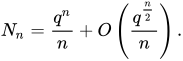
The proofs of these statements are far simpler than in the classical case. It involves a short, combinatorial argument,[47] summarised as follows: every element of the degree n extension of F is a root of some irreducible polynomial whose degree d divides n; by counting these roots in two different ways one establishes that
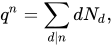
where the sum is over all divisors d of n. Möbius inversion then yields
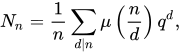
where μ(k) is the Möbius function. (This formula was known to Gauss.) The main term occurs for d = n, and it is not difficult to bound the remaining terms. The "Riemann hypothesis" statement depends on the fact that the largest proper divisor of n can be no larger than n/2.
See also
[edit]- Abstract analytic number theory for information about generalizations of the theorem.
- Landau prime ideal theorem for a generalization to prime ideals in algebraic number fields.
- Riemann hypothesis
Citations
[edit]- ^ a b Hadamard, Jacques (1896), "Sur la distribution des zéros de la fonction ζ(s) et ses conséquences arithmétiques.", Bulletin de la Société Mathématique de France, 24, Société Mathématique de France: 199–220, archived from the original on 2024-09-10
- ^ a b de la Vallée Poussin, Charles-Jean (1896), "Recherches analytiques sur la théorie des nombres premiers.", Annales de la Société scientifique de Bruxelles, 20 B, 21 B, Imprimeur de l'Académie Royale de Belgique: 183–256, 281–352, 363–397, 351–368
- ^ Hoffman, Paul (1998). The Man Who Loved Only Numbers. New York: Hyperion Books. p. 227. ISBN 978-0-7868-8406-3. MR 1666054.
- ^ "Prime Curios!: 8512677386048191063". Prime Curios!. University of Tennessee at Martin. 2011-10-09.
- ^ a b Apostol, Tom M. (1976). Introduction to Analytic Number Theory. Undergraduate Texts in Mathematics (1 ed.). Springer. doi:10.1007/978-1-4757-5579-4. ISBN 978-1-4757-5579-4.
- ^ Gauss, C. F. (1863), Werke, vol. 2 (1st ed.), Göttingen: Teubner, pp. 444–447.
- ^ Costa Pereira, N. (August–September 1985). "A short proof of Chebyshev's theorem". American Mathematical Monthly. 92 (7): 494–495. doi:10.2307/2322510. JSTOR 2322510.
- ^ Nair, M. (February 1982). "On Chebyshev-type inequalities for primes". American Mathematical Monthly. 89 (2): 126–129. doi:10.2307/2320934. JSTOR 2320934.
- ^ a b c d Goldfeld, Dorian (2004). "The elementary proof of the prime number theorem: an historical perspective" (PDF). In Chudnovsky, David; Chudnovsky, Gregory; Nathanson, Melvyn (eds.). Number theory (New York, 2003). New York: Springer-Verlag. pp. 179–192. doi:10.1007/978-1-4419-9060-0_10. ISBN 978-0-387-40655-8. MR 2044518.
- ^ Ingham, A.E. (1990). The Distribution of Prime Numbers. Cambridge, UK: Cambridge University Press. pp. 2–5. ISBN 978-0-521-39789-6.
- ^ a b Selberg, Atle (1949), "An Elementary Proof of the Prime-Number Theorem", Annals of Mathematics, 50 (2): 305–313, doi:10.2307/1969455, JSTOR 1969455, MR 0029410, S2CID 124153092
- ^ a b Erdős, Paul (July 1949). "On a new method in elementary number theory which leads to an elementary proof of the prime number theorem" (PDF). Proceedings of the National Academy of Sciences of the U.S.A. 35 (7): 374–384. Bibcode:1949PNAS...35..374E. doi:10.1073/pnas.35.7.374. PMC 1063042. PMID 16588909 – via renyi.hu.
- ^ Newman, D.J. (1980). "Simple analytic proof of the prime number theorem". American Mathematical Monthly. 87 (9): 693–696. doi:10.2307/2321853. JSTOR 2321853. MR 0602825.
- ^ a b Zagier, Don (1997). "Newman's short proof of the prime number theorem". American Mathematical Monthly. 104 (8): 705–708. doi:10.2307/2975232. JSTOR 2975232. MR 1476753 – via maa.org.
- ^ Tao, Terence (10 December 2014). "254A, Notes 2: Complex-analytic multiplicative number theory". Terence Tao's blog.
- ^ Edwards, Harold M. (2001). Riemann's zeta function. Courier Dover Publications. ISBN 978-0-486-41740-0.
- ^ de la Vallée Poussin, Charles-Jean (1899), "Sur la fonction ζ(s) de Riemann et le nombre des nombres premiers inférieurs a une limite donnée.", Mémoires couronnés de l'Académie de Belgique, 59, Imprimeur de l'Académie Royale de Belgique: 1–74
- ^ Kevin Ford (2002). "Vinogradov's Integral and Bounds for the Riemann Zeta Function" (PDF). Proc. London Math. Soc. 85 (3): 565–633. arXiv:1910.08209. doi:10.1112/S0024611502013655. S2CID 121144007.
- ^ Timothy Trudgian (February 2016). "Updating the error term in the prime number theorem". Ramanujan Journal. 39 (2): 225–234. arXiv:1401.2689. doi:10.1007/s11139-014-9656-6. S2CID 11013503.
- ^ von Koch, Helge (1901). "Sur la distribution des nombres premiers" [On the distribution of prime numbers]. Acta Mathematica (in French). 24 (1): 159–182. doi:10.1007/BF02403071. MR 1554926. S2CID 119914826.
- ^ Schoenfeld, Lowell (1976). "Sharper Bounds for the Chebyshev Functions ϑ(x) and ψ(x). II". Mathematics of Computation. 30 (134): 337–360. doi:10.2307/2005976. JSTOR 2005976. MR 0457374.
- ^ Jørgensen, Bent; Martínez, José Raúl; Tsao, Min (1994). "Asymptotic behaviour of the variance function". Scandinavian Journal of Statistics. 21 (3): 223–243. JSTOR 4616314. MR 1292637.
- ^ a b Littlewood, J.E. (1914), "Sur la distribution des nombres premiers", Comptes Rendus, 158: 1869–1872, JFM 45.0305.01
- ^ Hardy, G. H.; Littlewood, J. E. (1916). "Contributions to the theory of the Riemann zeta-function and the theory of the distribution of primes". Acta Mathematica. 41: 119–196. doi:10.1007/BF02422942.
- ^ Davenport, Harold; Montgomery, Hugh L. (2000). Multiplicative Number Theory. Graduate Texts in Mathematics. Vol. 74 (revised 3rd ed.). Springer. ISBN 978-0-387-95097-6.
- ^ Baas, Nils A.; Skau, Christian F. (2008). "The lord of the numbers, Atle Selberg. On his life and mathematics" (PDF). Bull. Amer. Math. Soc. 45 (4): 617–649. doi:10.1090/S0273-0979-08-01223-8. MR 2434348.
- ^ Cornaros, Charalambos; Dimitracopoulos, Costas (1994). "The prime number theorem and fragments of PA" (PDF). Archive for Mathematical Logic. 33 (4): 265–281. doi:10.1007/BF01270626. MR 1294272. S2CID 29171246. Archived from the original (PDF) on 2011-07-21.
- ^ Bergelson, V., & Richter, F. K. (2022). Dynamical generalizations of the prime number theorem and disjointness of additive and multiplicative semigroup actions. Duke Mathematical Journal, 171(15), 3133-3200.
- ^ a b Avigad, Jeremy; Donnelly, Kevin; Gray, David; Raff, Paul (2008). "A formally verified proof of the prime number theorem". ACM Transactions on Computational Logic. 9 (1): 2. arXiv:cs/0509025. doi:10.1145/1297658.1297660. MR 2371488. S2CID 7720253.
- ^ Harrison, John (2009). "Formalizing an analytic proof of the Prime Number Theorem". Journal of Automated Reasoning. 43 (3): 243–261. CiteSeerX 10.1.1.646.9725. doi:10.1007/s10817-009-9145-6. MR 2544285. S2CID 8032103.
- ^ Soprounov, Ivan (1998). "A short proof of the Prime Number Theorem for arithmetic progressions". Ohio: Cleveland State University. CiteSeerX 10.1.1.179.460.
- ^ Bennett, Michael A.; Martin, Greg; O'Bryant, Kevin; Rechnitzer, Andrew (2018). "Explicit bounds for primes in arithmetic progressions". Illinois J. Math. 62 (1–4): 427–532. arXiv:1802.00085. doi:10.1215/ijm/1552442669. S2CID 119647640.
- ^ a b c Granville, Andrew; Martin, Greg (2006). "Prime number races" (PDF). American Mathematical Monthly. 113 (1): 1–33. doi:10.2307/27641834. JSTOR 27641834. MR 2202918.
- ^ Guy, Richard K. (2004). Unsolved Problems in Number Theory (3rd ed.). Springer-Verlag. §A4, p. 13–15. ISBN 978-0-387-20860-2. Zbl 1058.11001. This book uses the notation π(x;a,c) where this article uses πc,a(x) for the number of primes congruent to a modulo c.
- ^ Lemke Oliver, Robert J.; Soundararajan, Kannan (2016-08-02). "Unexpected biases in the distribution of consecutive primes". Proceedings of the National Academy of Sciences. 113 (31): E4446-54. arXiv:1603.03720. Bibcode:2016PNAS..113E4446L. doi:10.1073/pnas.1605366113. ISSN 0027-8424. PMC 4978288. PMID 27418603.
- ^ Dusart, Pierre (26 May 1998). Autour de la fonction qui compte le nombre de nombres premiers [About the prime-counting function] (PDF). département de Mathématiques (Ph.D. thesis) (in French). Limoges, France: l'Université de Limoges.
- ^ a b Rosser, Barkley (1941). "Explicit bounds for some functions of prime numbers". American Journal of Mathematics. 63 (1): 211–232. doi:10.2307/2371291. JSTOR 2371291. MR 0003018.
- ^ Dusart, Pierre (2 February 2010). "Estimates of some functions over primes, without R.H.". arXiv:1002.0442 [math.NT].
- ^ "Why is pn ∼ n ln(n)?". Mathematics Stack Exchange. Retrieved 2024-10-11.
- ^ Cesàro, Ernesto (1894). "Sur une formule empirique de M. Pervouchine". Comptes Rendus Hebdomadaires des Séances de l'Académie des Sciences (in French). 119: 848–849.
- ^ Cipolla, Michele (1902). "La determinazione assintotica dell'nimo numero primo" [The asymptotic determination of the nth prime number]. Matematiche Napoli. 8 (in Italian). 3: 132–166.
- ^ a b Arias de Reyna, Juan; Toulisse, Jérémy (2013). "The n-th prime asymptotically". Journal de théorie des nombres de Bordeaux. 25 (3): 521–555. arXiv:1203.5413. doi:10.5802/jtnb.847. MR 3179675. Zbl 1298.11093.
- ^ Dusart, Pierre (1999). "The kth prime is greater than k(log k + log log k − 1) for k ≥ 2". Mathematics of Computation. 68 (225): 411–415. doi:10.1090/S0025-5718-99-01037-6. MR 1620223.
- ^ a b Axler, Christian (2019). "New Estimates for the nth Prime Number". Journal of Integer Sequences. 22 19.4.2. arXiv:1706.03651.
- ^ "Conditional Calculation of π(1024)". Chris K. Caldwell. Archived from the original on 2010-08-04. Retrieved 2010-08-03.
- ^ Platt, David (2015). "Computing π(x) analytically". Mathematics of Computation. 84 (293): 1521–1535. arXiv:1203.5712. doi:10.1090/S0025-5718-2014-02884-6. MR 3315519. S2CID 119174627.
- ^ Chebolu, Sunil; Mináč, Ján (December 2011). "Counting Irreducible Polynomials over Finite Fields Using the Inclusion π Exclusion Principle". Mathematics Magazine. 84 (5): 369–371. arXiv:1001.0409. doi:10.4169/math.mag.84.5.369. JSTOR 10.4169/math.mag.84.5.369. S2CID 115181186.
References
[edit]- Granville, Andrew (1995). "Harald Cramér and the distribution of prime numbers" (PDF). Scandinavian Actuarial Journal. 1: 12–28. CiteSeerX 10.1.1.129.6847. doi:10.1080/03461238.1995.10413946.
- Hardy, G.H.; Littlewood, J.E. (1916). "Contributions to the theory of the Riemann zeta-function and the theory of the distribution of primes". Acta Mathematica. 41: 119–196. doi:10.1007/BF02422942. S2CID 53405990.
- Hardy, G. H.; Wright, E. M. (2008) [1st ed. 1938], An Introduction to the Theory of Numbers, Revised by D. R. Heath-Brown and J. H. Silverman, with a foreword by Andrew Wiles (6th ed.), Oxford: Oxford University Press, ISBN 978-0-19-921985-8
- Narkiewicz, Władysław (2000), The Development of Prime Number Theory: From Euclid to Hardy and Littlewood, Springer Monographs in Mathematics, Springer-Verlag, doi:10.1007/978-3-662-13157-2, ISBN 978-3-540-66289-1, ISSN 1439-7382
External links
[edit]- "Distribution of prime numbers", Encyclopedia of Mathematics, EMS Press, 2001 [1994]
- Table of Primes by Anton Felkel.
- Short video visualizing the Prime Number Theorem.
- Prime formulas and Prime number theorem at MathWorld.
- How Many Primes Are There? Archived 2012-10-15 at the Wayback Machine and The Gaps between Primes by Chris Caldwell, University of Tennessee at Martin.
- Tables of prime-counting functions by Tomás Oliveira e Silva
- Eberl, Manuel and Paulson, L. C. The Prime Number Theorem (Formal proof development in Isabelle/HOL, Archive of Formal Proofs)
- The Prime Number Theorem: the "elementary" proof − An exposition of the elementary proof of the Prime Number Theorem of Atle Selberg and Paul Erdős at www.dimostriamogoldbach.it/en/
Prime number theorem
View on GrokipediaCore Formulation
Statement of the Theorem
The prime-counting function is defined as the number of prime numbers less than or equal to the real number .[9] The Prime Number Theorem states that as , where the notation means that .[10] This asymptotic relation indicates that the density of primes near decreases like , providing a precise measure of how primes become sparser among the integers as numbers grow larger.[11] Equivalent formulations of the theorem involve the Chebyshev functions. The first Chebyshev function is defined as and the Prime Number Theorem is equivalent to as .[12] Similarly, the second Chebyshev function is where is the von Mangoldt function satisfying if for a prime and integer , and otherwise; the theorem is also equivalent to as .[13][14] The Prime Number Theorem was proved independently by Jacques Hadamard and Charles Jean de la Vallée Poussin in 1896, and the term itself was coined by Edmund Landau in 1909.[13][15]Prime-Counting Function and Logarithmic Integral
The prime-counting function, denoted , is defined as the number of prime numbers less than or equal to a positive real number .[16] It is a non-decreasing step function that remains constant between consecutive primes and increases by exactly 1 at each prime number , so that , where denotes the value just before .[16] For example, , , and , reflecting the jump at 3 and constancy up to 4. The average order of , which describes its typical growth rate, is given asymptotically by the prime number theorem as approximately .[1] A more precise approximation to is provided by the logarithmic integral function, denoted , defined as the Cauchy principal value of the integral for .[17] This definition addresses the singularity at , where and the integrand diverges; the principal value ensures convergence by symmetrically excluding the pole. Equivalently, can be expressed as , where incorporates constant terms from the lower limit adjustments, such as and contributions near the singularity.[17] The function asymptotically satisfies as , with a more refined expansion [17] This series arises from repeated integration by parts and captures higher-order corrections to the leading term. The prime number theorem asserts that , and in fact, the theorem is equivalent to the statement .[1] The logarithmic integral outperforms the simpler as an approximation to because it incorporates the next-order term in the asymptotic expansion. The difference exhibits oscillatory behavior due to the non-trivial zeros of the Riemann zeta function.[18]Historical Context
Early Conjectures and Motivations
The awareness of prime numbers dates back to ancient times, with Euclid providing the first rigorous proof of their infinitude around 300 BCE in his Elements. In Book IX, Proposition 20, Euclid demonstrated that no finite list of primes can exhaust all such numbers by constructing a new prime from the product of existing ones plus one, implying an unending supply without specifying a precise density. This result established that primes are unbounded but offered no quantitative insight into their distribution among the naturals.[19] In the 18th century, Leonhard Euler advanced understanding by proving the divergence of the sum of reciprocals of primes, , in his 1737 paper "Variae observationes circa series infinitas." Euler linked this to the harmonic series via the Euler product for the Riemann zeta function at , showing that the primes' "density" must grow sufficiently to make the sum diverge, akin to for partial sums up to . This suggested primes occur with frequency roughly , motivating deeper asymptotic studies.[20] By the late 18th and early 19th centuries, empirical observations fueled precise conjectures. In 1792, at age 15, Carl Friedrich Gauss, based on tables of primes, hypothesized that the prime-counting function approximates the logarithmic integral . Independently, Adrien-Marie Legendre proposed a similar form in his 1808 Essai sur la théorie des nombres, refining estimates from prime lists up to 3 million. These conjectures, rooted in numerical evidence rather than proof, pointed to as the asymptotic density.[21] Pafnuty Chebyshev's 1850 memoir "Mémoire sur les nombres premiers" provided the first rigorous bounds, establishing constants and such that for sufficiently large . This confirmed the conjectured order of magnitude without proving the exact asymptotic. Such results were motivated by broader number theory challenges, including Joseph Bertrand's 1845 postulate that a prime exists between and for , which Chebyshev proved in 1852 using similar techniques to bound prime gaps and support density estimates.[22][23]Development and Proofs
Bernhard Riemann laid the foundational groundwork for the analytic study of prime distribution in his 1859 paper "Ueber die Anzahl der Primzahlen unter einer gegebenen Grösse," where he introduced the Riemann zeta function and outlined an explicit formula linking the prime-counting function to the non-trivial zeros of the zeta function, implicitly suggesting an asymptotic behavior for the density of primes without formally stating the Prime Number Theorem.[24] This work built on earlier bounds established by Chebyshev in the 1850s, which demonstrated that the prime-counting function π(x) satisfies c₁ x / log x < π(x) < c₂ x / log x for suitable constants c₁ and c₂.[25] The first rigorous proofs of the Prime Number Theorem emerged in 1896, independently provided by Jacques Hadamard and Charles Jean de la Vallée Poussin, who established that π(x) ∼ x / log x through complex analytic methods centered on the zeta function.[26][6] Hadamard's proof, detailed in his paper "Sur la distribution des zéros de la fonction ζ(s) et ses conséquences arithmétiques," utilized contour integration to show that the zeta function has no zeros on the critical line Re(s) = 1, thereby deriving the asymptotic equivalence.[26] Similarly, de la Vallée Poussin's comprehensive memoir "Recherches analytiques sur la théorie des nombres premiers" employed analogous techniques, including estimates on the growth of the zeta function, to confirm the theorem and provide initial error term bounds.[6] These proofs marked a culmination of efforts in complex analysis applied to number theory, resolving a conjecture that had persisted since the late 18th century. In the early 20th century, further advancements refined the theorem's implications and equivalences. Edmund Landau's 1909 treatise "Handbuch der Lehre von der Verteilung der Primzahlen" articulated several equivalent formulations of the Prime Number Theorem, including connections to the summatory function of the von Mangoldt function and explicit criteria involving the zeta function's behavior near s = 1. These equivalences facilitated broader applications in analytic number theory. Meanwhile, the development of tauberian theorems provided alternative pathways to the result; the Wiener-Ikehara theorem, formulated in the 1930s by Norbert Wiener and Kiyoshi Ikehara, established a general tauberian principle under which limits of Dirichlet integrals imply asymptotic behaviors, offering a unified framework for deriving PNT-like results from analytic continuations.[27] Albert Ingham's 1932 monograph "The Distribution of Prime Numbers" synthesized and extended these analytic developments, providing sharper estimates on the error term in the Prime Number Theorem and exploring conditional improvements under assumptions about the zeta function's zeros.[28] Ingham's work emphasized the role of zero-free regions in the critical strip, building directly on the 1896 proofs to advance quantitative aspects of prime distribution.[29]Analytic Approaches
Riemann Zeta Function and Complex Analysis
The Riemann zeta function is initially defined for complex numbers with real part by the infinite series This series converges absolutely in that half-plane, representing the function as a Dirichlet series. Bernhard Riemann extended via analytic continuation to a meromorphic function on the entire complex plane, with a single simple pole at and residue 1 there; the continuation preserves the analyticity elsewhere, including at the trivial zeros at negative even integers.[24] A fundamental representation linking directly to the primes is the Euler product formula, valid for : where the product runs over all prime numbers . This infinite product arises from the unique prime factorization of integers, as expanding each geometric series and multiplying yields the original series for ; the formula underscores the intimate connection between the zeta function and the distribution of primes.[30] The functional equation relates values of across the complex plane: where denotes the gamma function. This symmetric relation, derived using the gamma function's integral representation and contour integration techniques, facilitates the analytic continuation and reveals the function's behavior in the critical strip , including the locations of its non-trivial zeros.[24] An explicit formula expressing the prime powers in terms of the zeros of is given by von Mangoldt for the Chebyshev function , where if for prime and integer , and otherwise: with the sum over all non-trivial zeros of . This formula quantifies the deviation of from as a sum over the zeros, highlighting their role in prime distribution; the logarithmic terms account for contributions from the pole at and trivial zeros.[31] The analytic proof of the prime number theorem relies on Perron's formula, which inverts Dirichlet series to express partial sums like as a contour integral: for and large . Shifting the contour leftward into the critical strip captures the residue at the pole of , yielding the main term ; remaining contributions from zeros and the shifted integral provide the error term, whose size depends on the distribution of zeros near . This approach was employed in the original proofs by Hadamard and de la Vallée Poussin in 1896.[32]Non-Vanishing on the Line Re(s) = 1
The non-vanishing of the Riemann zeta function on the line is essential for establishing the asymptotic in the Prime Number Theorem, as a zero at with would introduce persistent oscillations in the prime-counting function via the Perron formula or inverse Mellin transform, disrupting the main term.[5][6] Jacques Hadamard proved this non-vanishing in 1896 by applying the argument principle to a rectangular contour that avoids the line but encircles potential zeros, combined with precise growth estimates for and its derivative in the half-plane , showing that the change in argument along the boundary implies no zeros on the line.[5] Independently, Charles-Jean de la Vallée Poussin established the same result in 1896 by analyzing , which approximates plus contributions from higher prime powers that are negligible for large . To demonstrate that this sum cannot diverge to (indicating a zero), de la Vallée Poussin bounded it from below using the non-negativity of the trigonometric polynomial , applied to the distribution of modulo 1, leveraging the density of primes to ensure the phases cannot align excessively negatively.[6] de la Vallée Poussin further proved a zero-free region for with an absolute constant, obtained by perturbing the argument around the line and controlling the real part via similar prime sum estimates.[6] Hadamard derived an analogous zero-free region using comparable growth and contour techniques.[5] This zero-free region yields an effective Prime Number Theorem: for some , where the error bound follows from integrating over the zero-free domain in the Tauberian theorem applied to .[5][6]Newman's Simplified Proof
In 1980, Donald J. Newman published a streamlined analytic proof of the prime number theorem that significantly simplifies the classical approaches by Hadamard and de la Vallée Poussin. The proof assumes the non-vanishing of the Riemann zeta function on the line , ensuring that the function is analytic in and extends continuously to the boundary . By establishing a uniform bound for with an absolute constant , Newman applies a tauberian theorem to derive the desired asymptotic. This method bypasses the need for detailed zero-free region estimates deeper in the critical strip, relying instead on basic complex analysis and Fourier techniques for the bound. The central result is the asymptotic , where is the von Mangoldt function. This follows from applying Ikehara's tauberian theorem to the Dirichlet series . The theorem states that if for all , the associated Dirichlet series equals for , where is analytic in this half-plane and satisfies for with constants , then as . In this context, , , and , yielding the sum with error . Newman employs a specialized, elementary version of this theorem tailored to the prime number theorem, proved via integration by parts and positivity without invoking the full Wiener-Ikehara machinery. Newman's key innovation lies in proving the bound on using Fourier analysis on . Specifically, for , the real part is expressed as an integral transform involving the Fourier coefficients derived from , or more precisely, through Parseval's identity applied to the expansion. The growth estimate and the positivity of the spectral measure ensure that the contributions from the oscillatory terms average out, yielding . A similar argument bounds the imaginary part using the boundedness of , resulting in the uniform bound . This direct spectral approach replaces cumbersome contour shifts and growth estimates in prior proofs. From , the Chebyshev function satisfies . This is obtained via partial summation: . Setting the integral form equal to and applying a basic tauberian principle (or direct differentiation under the assumption of slower growth) implies . The prime-counting function then follows as by another partial summation step: . Newman's proof spans just four pages and requires only undergraduate-level complex analysis, making it more accessible than earlier versions while preserving rigor. Its elegance has inspired expositions, such as Don Zagier's 1997 presentation framing it as a sequence of five lemmas that highlight the interplay between analytic continuation, bounds, and tauberian inversion.Elementary Proofs
Selberg-Erdős Method
The Selberg-Erdős method refers to the groundbreaking elementary proof of the prime number theorem developed independently by Atle Selberg and Paul Erdős in 1949, marking the first demonstration of the theorem without relying on complex analysis. This approach was particularly motivated by the challenges of World War II, during which Selberg, working in isolation in Norway, sought methods accessible without the full apparatus of analytic number theory that had become difficult to access due to wartime disruptions. At the heart of Selberg's proof lies his symmetry formula, an elementary identity relating sums involving the von Mangoldt function Λ(n), defined as log p if n is a power of a prime p and 0 otherwise. The formula states that where the error term is bounded elementarily. This identity is derived using basic tools from arithmetic functions, such as Möbius inversion and properties of Dirichlet convolution, without invoking the Riemann zeta function. Selberg established it by considering the second moment of the Chebyshev function ψ(x) = ∑_{n ≤ x} Λ(n), showing that which implies the average value of (ψ(x) - x)^2 / x is small, thereby yielding ψ(x) ∼ x asymptotically. The key steps involve first proving preliminary estimates on sums of Λ(n) using sieve-like techniques and partial summation, then applying the symmetry formula to control the variance of ψ(x) around x. By differentiating and integrating the resulting relations, Selberg extracts the main term, confirming that the number of primes up to x is asymptotically x / log x. His original paper presents this in a concise argument spanning roughly nine pages. Erdős contributed an independent elementary proof shortly after, building on Selberg's ideas but employing a distinct combinatorial approach with binomial coefficients and density arguments from sieve theory to bound the error in prime distribution. This method also avoids complex variables, emphasizing upper and lower bounds for ψ(x) through estimates on the number of integers free of small prime factors. The joint simplification by Selberg and Erdős further streamlined the proof, highlighting its accessibility using only undergraduate-level number theory. The significance of this method lies in its demonstration that the prime number theorem could be proved elementarily, without the zeta function's non-vanishing properties, inspiring subsequent developments in additive combinatorics and sieve methods in number theory.Key Elementary Techniques
The hyperbola method is a fundamental combinatorial tool in elementary proofs of the prime number theorem, enabling the asymptotic evaluation of Dirichlet convolutions without complex analysis by partitioning sums based on the size of factors. In particular, Selberg applied this method to the sum , where is the von Mangoldt function, by splitting the sum into terms where (using direct summation) and (where is small, allowing reversal to sum over small quotients).[33] This yields , with , providing an initial estimate that is refined further in the proof.[33] A key identity derived via Dirichlet convolution in Selberg's approach is , obtained by Möbius inversion of the relation , but more precisely from convolving the logarithmic identity twice and applying the hyperbola splitting to handle the double sum.[33] This convolution identity, central to the Selberg-Erdős method, expresses the square of the Chebyshev function in terms of error terms controllable by elementary means, leading to improved bounds on . Estimates on weighted sums like for smooth test functions (e.g., or polynomials) are then obtained using integration by parts or density arguments, bounding the contribution from large prime powers via sieve-like exclusions.[33] Erdős's complementary approach employs binomial coefficients to establish upper and lower bounds on the prime counting function, leveraging the expansion of to count integers up to that are products of small primes. Specifically, by showing that is not divisible by any prime , one derives that the number of integers up to divisible by primes larger than is at least a positive proportion, implying and upper bounds via similar density estimates on smooth numbers. Common tools across these elementary techniques include partial summation (analogous to integration by parts for sums), which converts estimates on to those on via , yielding from , and Abel summation for handling oscillatory integrals in error terms. Density arguments, such as bounding the contribution of primes in short intervals or excluding composites via inclusion-exclusion with the Möbius function, further refine these without invoking contour integration.[33] Despite their elegance, these elementary methods yield weaker error terms compared to analytic proofs, typically achieving for some constant , rather than the sharper from Riemann's explicit formula.[33]Extensions
Arithmetic Progressions
The prime number theorem in arithmetic progressions provides an asymptotic formula for the distribution of prime numbers within specific residue classes. For positive integers and with , let denote the number of primes less than or equal to that are congruent to modulo . The theorem states that as , where is Euler's totient function. This result implies that primes are equidistributed among the residue classes coprime to , each receiving approximately an equal share of the total primes up to . The theorem extends Dirichlet's 1837 result on the infinitude of primes in such progressions by quantifying their density relative to the overall prime distribution.[6] This asymptotic was established by Charles Jean de la Vallée Poussin in 1896, building on his proof of the classical prime number theorem. The proof employs complex analysis on Dirichlet L-functions, which are defined for each Dirichlet character modulo as These functions generalize the Riemann zeta function (, where is the principal character) and possess Euler products over primes, reflecting the multiplicative structure of characters. The prime power sum is analyzed via the logarithmic derivative of , leading to an explicit formula involving the zeros of these L-functions. By establishing a zero-free region to the left of analogous to the zeta function case, de la Vallée Poussin derives the desired asymptotic for the non-principal characters, combining with the principal case to yield the equidistribution.[6] A key ingredient is the non-vanishing of on the line . For the principal character, this follows from the pole of at . For non-principal , ; this was initially shown by Dirichlet for primitive real (quadratic) characters using properties of the Dedekind zeta function and the class number formula for imaginary quadratic fields, where with the class number, the number of units, and the discriminant, so since , [34]. For general non-principal , density arguments or extensions of these ideas confirm , ensuring no zeros at . Broader non-vanishing on is obtained via contradiction arguments assuming a zero, leading to logarithmic singularities inconsistent with the convergence of .[35] Effective versions of the theorem quantify the error term , where is the logarithmic integral. Unconditionally, the Siegel–Walfisz theorem provides uniformly for and any , with explicit constants depending on . Under the generalized Riemann hypothesis (GRH), which posits all non-trivial zeros of lie on , sharper bounds hold: , uniform in and . These improvements arise from truncating the explicit formula at height , leveraging the zero-free half-plane.[36] The theorem also reveals subtle biases in the distribution of primes across residue classes, known as prime number races. For instance, Chebyshev observed that there appear to be more primes congruent to 3 modulo 4 than to 1 modulo 4 up to , a phenomenon called Chebyshev's bias: holds for the logarithmic density of approaching about 0.9959. This bias, counterintuitive given equidistribution, stems from the low-lying zeros of the associated L-functions; the non-principal character modulo 4 has a real zero at the central point, skewing the race in favor of the 3 mod 4 class. Similar biases occur in other progressions, quantified via the distribution of zeros under assumptions like the linear independence of zero imaginaries.Analogues in Finite Fields
In the context of function fields, the prime number theorem finds a natural analogue through the study of monic irreducible polynomials in the polynomial ring , where is the finite field with elements and is a prime power. These irreducible polynomials serve as the primes in this setting, and the analogy measures the "size" of polynomials by , where is the degree, corresponding to in the classical case. The counting function denotes the number of such monic irreducibles of degree at most .[37] The prime polynomial theorem asserts that as . This asymptotic distribution parallels the classical prime number theorem . An exact formula for the number of monic irreducibles of precise degree is , where is the Möbius function defined on the positive integers via divisors of . Summing these yields , from which the leading asymptotic term emerges directly.[37] The proof relies on the zeta function of , defined for by the Dirichlet series , with . This function factors as the Euler product , taken over all monic irreducibles . Remarkably, it admits the explicit closed-form expression , which is meromorphic on with simple poles at the points for . The prime polynomial theorem follows from analyzing the logarithmic derivative , using partial summation or Tauberian methods to extract the sum over irreducibles.[37] The analogue of the Riemann hypothesis holds unconditionally in this function field setting, as the explicit form of reveals no zeros in the half-plane ; the poles lie entirely on the critical line , and the function is otherwise holomorphic there. This yields a precise error term: . The Möbius inversion formula for provides an exact count without approximation, highlighting the stronger control available compared to the integer case.[37] These analogues extend to applications in coding theory, where monic irreducible polynomials generate finite field extensions essential for constructing algebraic-geometric codes and cyclic codes like BCH and Reed-Solomon, enabling efficient error detection and correction in digital communications. They also inform finite geometry, particularly in counting irreducible components or points on varieties over .Applications in Cryptography
The Prime Number Theorem (PNT) describes the asymptotic distribution of prime numbers, stating that the number of primes up to , denoted , is approximately . This provides an estimate of the density of primes, which decreases as for large , ensuring that sufficiently many large primes exist despite their relative rarity. In modern cryptography, this density is vital for the efficient generation of large prime numbers required in public-key cryptosystems, such as the RSA algorithm. RSA relies on the product of two large primes as its modulus, with security based on the computational difficulty of factoring this semiprime. The PNT informs probabilistic primality tests and prime generation methods, like the Miller-Rabin algorithm, by predicting the likelihood of encountering primes in random selections from large intervals, thereby enabling practical implementation of secure key generation.[8][38][39]Bounds and Approximations
Error Terms in the Prime-Counting Function
The error term in the prime number theorem quantifies the deviation between the prime-counting function and its asymptotic approximation . In 1899, Charles Jean de la Vallée Poussin established a classical zero-free region for the Riemann zeta function, leading to the bound for some positive constant .[40] This bound was significantly improved in 1958 by Nikolai Korobov and Ivan Vinogradov, who utilized advanced estimates on exponential sums to derive a stronger zero-free region. Their work yields for some positive constant , representing the state-of-the-art asymptotic form for unconditional error estimates.[40] Subsequent refinements, including poly-logarithmic adjustments to the exponent up to around 0.6 in recent analyses as of 2025, have optimized the constants but preserved the essential structure of this bound.[41] Assuming the Riemann hypothesis, the error term simplifies dramatically. In 1901, Helmut von Koch showed that the hypothesis implies . An explicit version of this was provided by Lowell Schoenfeld in 1976, stating that under the Riemann hypothesis, for all . The error term oscillates and changes sign infinitely often, as proved by John Edensor Littlewood in 1914 using properties of the zeta function's zeros. The first such sign change, where , is known to occur before , based on computational and analytic bounds by Carter Bays and Richard H. Hudson in 2000. For finite , non-asymptotic inequalities provide practical lower bounds. Rosser and Schoenfeld established in 1962 that for all , ensuring the prime-counting function exceeds the simplest asymptotic form in this range.Estimates for the nth Prime
The prime number theorem implies that the nth prime number satisfies as . This asymptotic equivalence follows directly from inverting the relation , where , leading to and solving for .[42] Refined asymptotic expansions provide greater precision. One such expansion is derived from higher-order terms in the inverse of the logarithmic integral function and verified through explicit estimates without assuming the Riemann hypothesis. This form captures the leading corrections to the basic asymptotic and stems from work by Pierre Dusart in the early 2010s.[43] Explicit bounds offer practical inequalities for computation. For , These inequalities, established by Dusart, provide tight intervals that improve on earlier results and hold unconditionally.[43] Under the Riemann hypothesis, sharper error bounds are possible. Specifically, , reflecting the improved error term in the prime number theorem for . This conditional estimate significantly narrows the gap around the main term for large . Historically, such bounds have been progressively tightened through computational methods verifying the prime number theorem up to enormous scales, with recent advancements extending explicit guarantees to exceeding via optimized sieving and zero-free region analyses.[44]Computational Verification
Tables and Numerical Data
The computation of the prime-counting function π(x) has a long history, beginning with manual calculations by Carl Friedrich Gauss in the late 18th century. Gauss estimated π(x) for x up to 10^8 using sieving methods documented in his mathematical diary from 1792–1793, providing early empirical evidence for the prime number theorem's asymptotic behavior. In the 19th century, Adrien-Marie Legendre contributed similar tables up to 10^7. Modern computations leverage advanced sieve algorithms and distributed computing, achieving values up to x = 10^{27} as of 2021 using tools like the primecount software by Kim Walisch, which employs combinatorial methods for efficiency.[45] A key tool in these computations is the Meissel-Lehmer algorithm, originally developed by Ernst Meissel in 1870 and refined by Derrick Henry Lehmer in 1959. This combinatorial method reduces the counting of primes to evaluating inclusion-exclusion over prime factors, enabling fast calculation of π(x) for large x without enumerating all primes. It forms the basis for many contemporary implementations, allowing verification of the prime number theorem to extreme scales. The following table provides a sample of computed values for π(x), the approximation x / \ln x, and the offset logarithmic integral Li(x) at x = 10^k for k from 1 to 10. Here, \ln denotes the natural logarithm, and Li(x) is defined as \int_2^x \frac{dt}{\ln t}. The values demonstrate the increasing accuracy of these approximations as x grows, with Li(x) generally providing a closer fit than x / \ln x. Data for π(x) are from standard tabulations verified across multiple sources; Li(x) values are computed to high precision using series expansions.[46] | k | x = 10^k | π(x) | x / \ln x | Li(x) | Relative error |π(x) - Li(x)| / x | |-----|--------------|---------------|---------------|---------------|----------------|-----------------------------| | 1 | 10 | 4 | 4.34 | 5.12 | 1.12 × 10^{-1} | | 2 | 100 | 25 | 21.71 | 29.08 | 4.08 × 10^{-2} | | 3 | 1,000 | 168 | 144.76 | 177.61 | 9.61 × 10^{-3} | | 4 | 10,000 | 1,229 | 1,085.74 | 1,248.43 | 1.94 × 10^{-3} | | 5 | 100,000 | 9,592 | 8,685.89 | 9,629.11 | 3.71 × 10^{-4} | | 6 | 1,000,000 | 78,498 | 72,382.41 | 78,628.17 | 1.30 × 10^{-4} | | 7 | 10,000,000 | 664,579 | 620,420.62 | 664,918.40 | 3.39 × 10^{-5} | | 8 | 100,000,000 | 5,761,455 | 5,428,630.42 | 5,762,139.82 | 6.85 × 10^{-6} | | 9 | 1,000,000,000| 50,847,534 | 48,254,942.57 | 50,849,601.18 | 2.07 × 10^{-6} | | 10 | 10,000,000,000| 455,052,511 | 434,294,481.90| 455,055,615.24| 3.10 × 10^{-7} | For larger x, such as up to 10^{25}, the patterns persist: π(10^{25}) = 172,669,445,638,873,604,178,630, with Li(10^{25}) ≈ 172,669,445,670,988,464,000,000, showing continued convergence.[46] Empirical observations from these tables reveal that Li(x) slightly overestimates π(x) for small to moderate x, with the difference π(x) - Li(x) being negative but decreasing relatively. However, under the Riemann hypothesis, the first crossover where π(x) > Li(x) occurs near the Skewes number, an upper bound of approximately 10^{10^{10^{34}}} given by S. Skewes in 1933 assuming the negation of the Riemann hypothesis.[47] These computations verify the prime number theorem empirically to remarkable precision. For instance, at x = 10^{24}, the relative error satisfies |π(10^{24}) - Li(10^{24})| / 10^{24} < 10^{-10}, consistent with bounds under the Riemann hypothesis derived by L. Schoenfeld in 1976. This holds for all verified x up to 10^{27}, confirming the asymptotic π(x) ∼ x / \ln x with extraordinary accuracy.Prime Races and Oscillations
Prime races refer to the competitive behavior between the distributions of primes in different residue classes modulo a fixed integer . Specifically, for coprime integers , the race compares the prime-counting functions and , which count the number of primes up to congruent to and modulo , respectively. The difference oscillates as grows, reflecting subtle biases in the prime distribution predicted by the prime number theorem for arithmetic progressions.[48] A prominent example is Chebyshev's bias, first observed by Chebyshev in 1853, which indicates that there are typically more primes congruent to 3 modulo 4 than to 1 modulo 4 up to large . This bias arises from the non-vanishing of for the non-principal Dirichlet character modulo 4, leading to a logarithmic preference for the non-residue class. Although Littlewood proved in 1914 that the lead reverses infinitely often under the Riemann Hypothesis, numerical evidence shows these reversals are rare. Rubinstein and Sarnak quantified this in 1994, demonstrating under the Riemann Hypothesis and the linear independence hypothesis for the zeros of Dirichlet -functions that the logarithmic density of the set where is approximately 0.9959, meaning the bias holds for about 99.59% of the time.[48] Computational studies confirm the persistence of these biases to extraordinarily large scales. Early calculations by Bays and Hudson in 1978 identified the first reversal in the modulo 4 race at , with subsequent ones occurring sporadically but infrequently. More extensive verifications, leveraging advanced algorithms, have extended these races up to , where the 3 modulo 4 class maintains its lead without further major reversals, aligning with the predicted densities. Recent distributed computing efforts continue to explore these biases at large scales.[48] Beyond pairwise races, the oscillatory nature of prime distributions manifests in the error term of the prime number theorem itself, particularly in , where is the offset logarithmic integral. These oscillations are primarily driven by the low-lying zeros of the Riemann zeta function, with the spacing and imaginary parts of these zeros dictating the frequency and amplitude of sign changes. Littlewood established in 1914 that changes sign infinitely often, with the first positive crossing (where ) estimated by Bays and Hudson in 2000 to occur near , based on detailed analysis of zeta zero contributions. This huge scale underscores the subtle interplay between analytic number theory and computational verification in understanding prime oscillations.References
- https://en.wikipedia.org/wiki/Class_number_formula