Hubbry Logo
search
logo
1815068

Dutch India

logo
Community Hub0 Subscribers
Read side by side
from Wikipedia

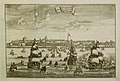
A View of Chinsura the Dutch Settlement in Bengal (1787).

Dutch India (Dutch: Nederlands Voor-Indië) consisted of the settlements and trading posts of the Dutch East India Company on the Indian subcontinent. It is only used as a geographical definition, as there was never a political authority ruling all Dutch India. Instead, Dutch India was divided into the governorates Dutch Ceylon and Dutch Coromandel, the commandment Dutch Malabar, and the directorates Dutch Bengal and Dutch Suratte.

The Dutch Indies, on the other hand, were the Dutch East Indies (present-day Indonesia) and the Dutch West Indies (present-day Suriname and the former Netherlands Antilles).

History

[edit]

Dutch presence on the Indian subcontinent lasted from 1605 to 1825. Merchants of the Dutch East India Company first established themselves in Dutch Coromandel, notably Pulicat, as they were looking for textiles to exchange with the spices they traded in the East Indies.[1] Dutch Suratte and Dutch Bengal were established in 1616 and 1627 respectively.[2][3] After the Dutch conquered Ceylon from the Portuguese in 1656, they took the Portuguese forts on the Malabar coast five years later as well, as both were major spice producers, to create a Dutch monopoly for the spice trade.[4][5]

Apart from textiles, the items traded in Dutch India include precious stones, indigo, and silk across the Indian Peninsula, saltpeter and opium in Dutch Bengal, and pepper in Dutch Malabar. Indian slaves were exported to the Spice Islands and the Cape Colony.

In the second half of the eighteenth century, the Dutch lost their influence more and more following the Travancore–Dutch War. The Kew Letters relinquished all Dutch colonies to the British, to prevent them from being overrun by the French. Although Dutch Coromandel and Dutch Bengal were restored to Dutch rule by the Anglo-Dutch Treaty of 1814, they returned to British rule owing to the provisions of the Anglo-Dutch Treaty of 1824. Under the terms of the treaty, all transfers of property and establishments were to take place on 1 March 1825. By the middle of 1825, therefore, the Dutch had lost their last trading posts in India.

Coinage

[edit]
Gold pagoda with an image of Lord Venkateswara, a form of the Hindu god Vishnu, issued at the Dutch mint at Pulicat, c. 17th or 18th century.

Dutch mints in Cochin, Masulipatnam, Nagapatnam, Pondicherry (for the five years 1693–98 when the Dutch had gained control from the French), and Pulicat issued coins modeled on local Indian coinages.[6] Coins struck included:

  • the puttan (single and double)[6][7]
  • the fanam[8]

The Dutch also imported coins struck in the Netherlands, including:

  • the real, modeled on the Spanish colonial real, in denominations of 14, 12, 1, 2, 4, and 8 reels[9]

Map

[edit]
  Dutch Ceylon   Dutch Coromandel   Dutch Malabar   Dutch Suratte   Dutch Bengal
[edit]

See also

[edit]

References

[edit]
[edit]
Revisions and contributorsEdit on WikipediaRead on Wikipedia
from Grokipedia
Dutch India denoted the network of trading factories and coastal settlements maintained by the Dutch East India Company (VOC) on the Indian subcontinent from 1605 to 1825.[1][2][3] Established shortly after the VOC's formation in 1602, these outposts centered on commercial activities rather than large-scale territorial governance, with the first factory founded at Masulipatnam in 1605.[1][2][3] Key locations included Pulicat as the Coromandel headquarters, Surat for western trade, Chinsurah in Bengal, and Cochin on the Malabar Coast, captured from the Portuguese in 1663 to secure pepper supplies.[1][2][3] The Dutch prioritized exporting Indian textiles, spices, indigo, silk, saltpetre, opium, and rice to Europe and intra-Asian markets, achieving temporary dominance in certain trades through naval superiority over rivals like the Portuguese.[1][2] However, internal corruption, escalating rivalry with the British East India Company, and defeats in conflicts such as the Battle of Colachel in 1741 eroded their position, culminating in the 1825 Anglo-Dutch Treaty that transferred remaining holdings to Britain.[1][3]

Origins and Establishment

Formation of the VOC and Initial Trade Ventures

The Vereenigde Oostindische Compagnie (VOC), commonly known as the Dutch East India Company, was chartered on 20 March 1602 by the States General of the Dutch Republic, consolidating six rival trading outfits into a single entity with a 21-year monopoly on Dutch commerce east of the Cape of Good Hope.[4][5] This structure provided the VOC with unprecedented corporate powers, including the authority to form alliances, declare war, build fortresses, and administer justice, enabling it to function as a proto-state in distant territories.[4] The company's formation addressed the inefficiencies and infighting of prior ventures, such as the 1595-1597 expedition led by Cornelis de Houtman, which had demonstrated the profitability of direct Asian trade routes but highlighted the need for unified organization amid Portuguese naval superiority.[6] Primarily aimed at securing spices from the Indonesian archipelago, the VOC's charter implicitly encouraged broader intra-Asian exchanges, drawing it toward Indian ports for essential barter goods like textiles.[6] Dutch trade ventures in India under the VOC began in earnest in 1605, when the company established its inaugural factory at Masulipatnam (modern Machilipatnam) on the Coromandel Coast, securing trading privileges from the Golconda Sultanate.[2][1] This outpost focused on exporting cotton and silk cloths, indigo, and saltpeter, which the VOC exchanged for spices in the East Indies, leveraging India's textile production to undercut Portuguese intermediaries.[7][6] Initial shipments from Masulipatnam proved viable, with early fleets departing in 1606 after Dutch envoys explored nearby sites like Pulicat for superior anchorage and local weaving capabilities.[2] However, intermittent local hostilities and Portuguese interference prompted relocation; by 1610, the VOC founded a fortified factory at Pulicat, which it developed into Fort Geldria by 1613, marking the onset of more stable operations.[2][1] These ventures yielded modest initial returns—estimated at several thousand guilders in textiles per season—but laid the groundwork for the Coromandel region's role as a VOC supply hub, with annual exports reaching tens of thousands of pieces of cloth by the 1620s.[7]

First Factories and Agreements with Local Powers

The Dutch East India Company (VOC), seeking textiles to exchange for spices in the Indonesian archipelago, established its first factory in India at Masulipatnam on the Coromandel Coast in 1605. This outpost was secured through negotiations with the Golconda Sultanate, which granted trading privileges amid competition from Portuguese merchants and local intermediaries.[8][9] Political instability in the region, including conflicts involving local nayaks and the sultan's authority, prompted the VOC to relocate its primary Coromandel operations to Pulicat by 1610, where a fortified factory was constructed. Agreements with the local ruler of Pulicat allowed the Dutch to fortify the site and conduct trade in cotton and indigo, establishing it as the regional headquarters until the mid-17th century.[10][11] In Gujarat, the VOC opened a factory at Surat in 1616 after diplomatic efforts with Mughal officials, obtaining a firman that permitted duty-free trade in textiles and other goods in exchange for naval support against Portuguese shipping. This agreement reflected the VOC's strategy of leveraging military capabilities to secure commercial concessions from the Mughal Empire, which controlled key ports.[10][11] Further early establishments included outposts at Bimlipatam (Visakhapatnam) and Negapatam, supported by similar pacts with Golconda and local powers, emphasizing the VOC's reliance on alliances with Indian rulers to counter European rivals and ensure access to high-demand export commodities like fine cotton cloth. These initial factories laid the foundation for the Dutch trade network, prioritizing intra-Asian exchange over direct European-Indian shipping.[10][12]

Expansion and Peak Influence

Development of Key Settlements

The Dutch East India Company (VOC) established its initial foothold in India on the Coromandel Coast, with the first factory at Masulipatnam in 1605, though operations there were limited and soon overshadowed by more strategic sites.[2] In 1609, the VOC captured Pulicat from the Portuguese, constructing Fort Geldria and developing it into the administrative headquarters for Dutch Coromandel, a role it held until 1690 when Nagapattinam assumed primacy.[7] Pulicat's growth involved fortification expansions, shipbuilding facilities, and integration of local labor for textile production, exporting painted cloths and indigo to Southeast Asia in exchange for spices, with annual trade volumes reaching thousands of pieces by the mid-17th century.[12] Nagapattinam emerged as a complementary settlement after its seizure from the Portuguese in 1658, featuring a fortified factory and serving as a key port for Coromandel textiles and pepper, with Dutch ships frequenting the harbor for bulk shipments that bolstered VOC revenues in the 1660s and 1670s.[7] By the late 17th century, Nagapattinam's infrastructure included warehouses and administrative buildings, supporting a population of several hundred Europeans and local agents, though silting harbors gradually diminished its viability.[1] On the Malabar Coast, Cochin's development accelerated following the VOC's capture of the city from the Portuguese in January 1663 under Rijckloff van Goens, who razed Portuguese fortifications and erected Dutch bastions, transforming it into the primary pepper entrepôt with monopolistic agreements from local nayars.[1] Cochin's settlements expanded to include fortified suburbs and slave quarters, facilitating exports of over 1,000 metric tons of pepper annually by the 1680s, while serving as a naval base against rivals.[12] In Bengal, Hugli-Chuchura developed from a modest factory established in the 1630s into the region's command center by 1655, with stone warehouses and garrisons supporting cotton and silk trade, peaking at shipments valued in the millions of guilders during the 1660s under Mughal permissions.[12] The settlement's growth included riverine defenses against piracy, accommodating up to 200 VOC personnel and local brokers by the 1670s.[2] Gujarat's Surat factory, opened in 1616 with Mughal emperor Jahangir's firman, evolved into a cotton and indigo hub, featuring a lodge expanded in the 1620s for storing goods destined for Persia and Europe, though it remained subordinate to Coromandel operations with trade fluctuating due to local politics.[13] Smaller outposts like Vengurla on the Konkan coast supplemented these, providing ancillary ports for cinnamon and areca nuts from the 1620s onward.[1] These settlements collectively fortified Dutch commercial networks, emphasizing fortified factories over large civilian colonies, with total European presence rarely exceeding 1,000 across India by the mid-17th century.[12]

Trade Networks and Economic Dominance

The Dutch East India Company (VOC) began constructing its trade networks in India with the establishment of its first factory at Masulipatnam on the Coromandel Coast in 1605, serving as an initial base for procuring textiles and other goods.[14] This was rapidly followed by the founding of the Pulicat factory in 1610, which functioned as the regional headquarters and a primary center for textile production and export until the late 17th century.[15] Additional key establishments included the Surat factory in 1616 on the west coast, targeting indigo, cotton, and silk trades within Mughal domains, and the Hugli-Chinsurah factory in Bengal from 1635, focused on fine muslins, silks, and saltpeter.[16][17] These factories interconnected via maritime routes linking Indian ports to Batavia (modern Jakarta), enabling the VOC to integrate India into its broader intra-Asian trade system. Textiles from Coromandel and Bengal, including painted and printed cloths, comprised the core exports, bartered primarily for spices in the Indonesian archipelago, with pepper from Malabar also playing a significant role after the VOC's capture of Cochin in 1663.[18][19] The networks facilitated annual shipments of thousands of textile pieces, underpinning the VOC's profitability by supplying high-demand goods to Southeast Asian markets where local currencies were scarce.[20] The VOC achieved economic dominance in select Indian trade sectors during the mid-17th century, leveraging its state-granted monopoly on Dutch Asian voyages and military advantages to control substantial portions of the textile and pepper flows.[21] In Coromandel, Pulicat's operations dominated local procurement, matching or exceeding European rivals in volume through enforced contracts with weavers and exclusion of competitors.[18] Similarly, in Bengal, the company's factories handled a central share of exports to Asia, contributing to overall VOC trade values that peaked before declining amid rising English competition and internal mismanagement by the century's end.[22] This dominance stemmed from the VOC's ability to enforce monopolistic practices, including forced deliveries and naval blockades, yielding high returns until overextension eroded efficiencies.[12]

Governance and Society

Administrative Framework

The administrative framework of Dutch India operated under the Verenigde Oost-Indische Compagnie (VOC), a chartered company granted quasi-sovereign powers by the Dutch States-General in 1602, including the authority to establish settlements, negotiate treaties, maintain armed forces, and administer justice over its personnel.[23] In Asia, day-to-day governance fell under the Governor-General and Council of the Indies in Batavia, who oversaw regional commands in India, appointing governors and directors for key areas such as the Coromandel Coast, Bengal, and the Malabar Coast.[4] This structure emphasized trade facilitation over territorial expansion, with factories serving as self-contained units combining commercial, judicial, and defensive functions. Regional administration varied by command. The Coromandel command, established around 1610 with Pulicat as initial headquarters until 1690 and later Nagapattinam, was led by a governor and director who managed trade in textiles and supervised subordinate factories at places like Masulipatnam and Porto Novo.[24] In Bengal, the VOC's presence began with the Hooghly factory in 1635, shifting headquarters to Chinsura by the late 17th century; initially administered jointly with Coromandel, it gained semi-autonomy under a senior merchant or director who coordinated silk and saltpeter procurement while navigating Mughal firman privileges.[25] The Malabar command, formalized in 1669 after the 1663 capture of Cochin from the Portuguese, operated under a commander in Cochin, enforcing pepper monopolies through treaties with local rulers like the Zamorin of Calicut and maintaining forts for enforcement. At the factory level, a council of senior officials—including the chief merchant (opperkoopman), bookkeeper, and fiscal—handled operations, with the fiscal overseeing legal matters among VOC employees and slaves, often applying Roman-Dutch law.[26] Military detachments, typically numbering 100-300 soldiers per major settlement, provided security and supported revenue collection via tolls or local levies, though direct territorial control was limited outside fortified enclaves like Cochin. Interactions with Indian authorities involved annual payments or tribute for trading rights, as in Bengal where VOC directors petitioned Mughal subahdars for exemptions, blending corporate autonomy with dependence on local political stability.[27] This framework prioritized profitability, often leading to tensions from private trading by officials, but sustained VOC influence until the late 18th century.[28]

Interactions with Indian Rulers and Communities

The Dutch East India Company (VOC) established its presence in India through diplomatic negotiations and agreements with local rulers, securing permissions to build factories and conduct trade in exchange for tribute payments or mutual protection. In the Coromandel region, the VOC obtained approval from the king of Chandragiri in 1610 to found a factory at Pulicat, following initial setbacks at Masulipatnam where an agreement was signed with local Muslim rulers in 1605.[29][30] These pacts with Nayak rulers of Gingee and Thanjavur provided the VOC with territorial concessions and safeguards against regional instability, though they often led to rivalries with other European traders like the English.[31][32] In Bengal, under Mughal oversight, the VOC navigated imperial bureaucracy by securing firmans that permitted trade operations contingent on compliance with local regulations and duty payments. A key firman from Emperor Shah Jahan in 1635 formally recognized the company's rights to trade in Bengal, enabling factories such as Chinsurah, leased in 1656 from Mughal authorities.[26] Relations involved ongoing diplomacy with subahdars and officials, including resolutions of disputes through Mughal courts, as evidenced by a 1672 case where VOC director Constantijn Ranst compensated a local widow via qazi adjudication alongside company proceedings.[26] On the Malabar Coast, VOC interactions shifted toward coercive diplomacy after displacing the Portuguese between 1638 and 1663, including the capture of Cochin in 1663, after which the company imposed exclusive trade agreements on local rulers to monopolize pepper supplies.[12] In Kerala, the VOC assumed co-ruling roles, blending military enforcement with alliances to extract resources and maintain order.[33] With local communities, the VOC depended on indigenous brokers, merchants, and laborers for procuring textiles, silk, and other commodities, fostering pragmatic economic ties despite cultural separation in factory enclaves. In Bengal, brokers like Jadu and Deepchand mediated trade and testified in VOC internal probes, such as the 1684–1686 corruption investigation involving company officials.[26] These interactions occasionally sparked conflicts over payments or quality, but sustained two centuries of coexistence, with the VOC leveraging local networks for intra-Asian commerce while adhering minimally to community customs beyond commercial necessities.[34][12]

Military Engagements and Rivalries

Conflicts with the Portuguese

The Dutch East India Company (VOC) engaged in prolonged conflicts with the Portuguese in the Indian subcontinent as part of broader efforts to dismantle Iberian trade monopolies in the Indian Ocean. Early hostilities included naval blockades of Goa, the Portuguese administrative center in India, in 1603 and again in 1639, though these did not result in territorial conquests.[4][35] Following the VOC's conquest of Portuguese Ceylon by 1658, attention shifted to the nearby Malabar Coast, where Portuguese forts controlled lucrative pepper exports. In late October 1662, Admiral Rijckloff van Goens initiated a siege of Cochin, allying with the Raja of Cochin, who sought to expel Portuguese influence.[36][37] The campaign involved a VOC fleet and ground forces exploiting low water levels in defensive moats to launch assaults.[38] On January 6, 1663, van Goens personally commanded the final attack, leading to the Portuguese garrison's surrender two days later under Commander Sermento after intense fighting.[38][39] This victory secured Cochin as a major Dutch stronghold, enabling fortified reconstruction and dominance in the regional spice trade, while the Raja formalized an alliance with the VOC via treaty.[37][40] Subsequent operations targeted other Portuguese outposts on the Malabar Coast, including Cranganore and Quilon, further eroding Portuguese presence in southern India by the mid-1660s. These engagements, culminating amid the Dutch-Portuguese War's closure via the 1661 Treaty of The Hague, shifted commercial advantages to the VOC without fully eliminating Portuguese holdings like Goa.[36][35]

Competition with the English and Other Europeans

The Dutch East India Company (VOC) initially held advantages in several Indian trading regions due to its earlier establishment of factories, but the arrival of the English East India Company (EIC) from the early 17th century introduced intense commercial rivalry, particularly over textiles, indigo, and saltpetre. In Surat, the EIC established a factory in 1612, preceding the Dutch by four years, leading to competition for Mughal trade privileges and local brokerage networks in Gujarat's cotton goods market.[41] Both companies vied for favorable firman grants from Mughal emperors, with the Dutch leveraging their naval strength to undercut English shipments en route, though direct military clashes in India remained rare compared to the East Indies.[42] On the Coromandel Coast, the VOC's factory at Pulicat (established 1610) faced EIC encroachment at Masulipatam (1611) and later Fort St. George (Madras, 1639), sparking bidding wars with local Nayak rulers for painting and weaving monopolies on chintz and calicoes. This escalated into a prolonged price war from 1675 to 1683, where both companies overbid for goods and slashed export prices, driving textile procurement costs up by over 50% in some years and nearly bankrupting the EIC while straining VOC finances.[7] The VOC's relocation to Nagapattinam in 1690, intended to consolidate control, inadvertently ceded market share to the English by distancing Dutch operations from prime weaving centers.[18] In Bengal, Dutch factories at Pippli (1624) and Hooghly (1632) competed with the EIC's Calcutta outpost (1651) for saltpetre and silk, with rivalries manifesting in espionage over brokerage contracts and occasional seizures of rival vessels during Anglo-Dutch Wars. The Third Anglo-Dutch War (1672–1674) saw VOC privateers capture English ships in the Bay of Bengal, disrupting EIC convoys and temporarily boosting Dutch export volumes by 20–30% in nitrates.[42] Overall, these conflicts, compounded by the VOC's strategic prioritization of Indonesian spices, eroded Dutch dominance in India, as English adaptability in securing local alliances allowed greater inland penetration.[41] Rivalry extended to other Europeans, notably the French East India Company, which established Pondichéry (1674) and challenged Dutch textile quotas in the Carnatic region, leading to armed skirmishes in 1690 and 1721 over smuggling routes.[43] The Danish East India Company, with its Tranquebar settlement (1620), posed a lesser threat but clashed with the VOC in the 1640s over fort sales and trade interference, though Danish operations remained marginal, exporting under 5% of Coromandel textiles compared to Dutch volumes.[43] These multi-sided competitions underscored the VOC's challenges in maintaining exclusivity amid proliferating European footholds.

Economic Systems

Commodities and Commerce

The Dutch East India Company's (VOC) commerce in India emphasized the acquisition of textiles, indigo, saltpetre, and spices for intra-Asian barter and direct export to Europe. Textiles formed the cornerstone, with cotton cloths from the Coromandel Coast exchanged for Indonesian spices like nutmeg and cloves, while Bengal supplied silk and muslins. Saltpetre from Bihar and indigo from central India supported European military needs, and opium from Bengal added to the portfolio. The VOC financed purchases primarily with Japanese silver and European copper, advancing funds to weavers and brokers via "dadny" systems that bound production to company orders.[12][44][19] In the Coromandel region, factories at Pulicat (established 1610) and Nagapattinam specialized in painted and dyed cotton textiles, including chintz palampores customized for Indonesian markets. These goods, produced under VOC contracts, peaked in volume during the mid-17th century, enabling the company's spice monopoly by serving as currency in archipelago trade.[12][19] Bengal's Hugli factory, operational from 1635, exported raw silk, fine cotton muslins, saltpetre for gunpowder, and indigo, leveraging Mughal permissions for inland procurement. Saltpetre shipments to Europe reached significant scales by the 1660s, refined at company facilities before export. Opium and rice supplemented cargoes, with trade persisting under local nawabs into the 18th century.[12][44] On the Malabar Coast, following the 1663 capture of Cochin from the Portuguese, the VOC dominated black pepper and cardamom exports, shipping thousands of tons annually to Batavia for redistribution. This integrated pepper into the broader spice network, though competition from local traders required fortified outposts and naval patrols. Gujarat's Surat factory handled additional cotton and indigo, but volumes declined after 1700 amid English rivalry.[12][44] Commerce relied on hybrid systems blending European capital with Indian merchant networks, yielding high profits until corruption and competition eroded margins by the late 18th century. The VOC's focus on high-turnover goods like textiles—estimated at millions of pieces annually across factories—underpinned its early dominance, though over-reliance on advances led to quality fluctuations and local indebtedness.[12][19]

Coinage and Financial Innovations

The Dutch East India Company (VOC) established mints in its Coromandel Coast settlements to produce coinage tailored for local trade, addressing shortages of small-denomination currency and reducing reliance on imported or indigenous money. The inaugural VOC mint in India opened at Fort Gelria in Pulicat in 1615, striking copper kas (cash) coins imprinted with the VOC monogram and Sanskrit legends to promote circulation among Indian merchants and laborers.[45] [46] These dump-style coins, weighing approximately 3-5 grams, facilitated payments for textiles and everyday transactions in the weaving communities supplying the VOC's export trade. A second mint at Negapatnam (Nagapattinam), operational from the late 17th century, issued similar copper kas coins marked with an "N" above the VOC monogram within a beaded circle, which extended into circulation in adjacent regions including Ceylon.[47] [48] Gold pagodas, featuring images of Hindu deities like Lord Venkateswara to emulate Nayak-era designs, were also produced at Pulicat, ensuring compatibility with regional monetary customs and aiding procurement of cotton cloth from the hinterland.[46] This localized minting, spanning 1615 to the mid-18th century, totaled millions of pieces and represented an adaptation of European minting technology to Asian markets, though output declined amid VOC financial strains by the 1750s. In financial practices, the VOC innovated by integrating European bills of exchange into Indian trade networks, allowing factories in Pulicat, Negapatnam, and Chinsura to draw credits on Batavia or Amsterdam for settling debts without shipping silver or gold bullion, thereby mitigating piracy and logistical risks.[49] This system, drawn from Dutch mercantile precedents, interfaced with indigenous hundi mechanisms via partnerships with local shroffs (moneylenders) in Coromandel and Bengal, who extended advances to weavers for yarn and cloth production under VOC oversight.[11] Such arrangements enabled scalable procurement—e.g., annual textile contracts exceeding 100,000 pieces in Bengal by the 1680s—while the company's joint-stock framework provided permanent capital for long-term credits, contrasting with ad hoc financing by prior Portuguese traders. Double-entry bookkeeping, rigorously applied in Indian ledgers, further enhanced accountability in these operations, though corruption occasionally undermined efficiency.[50]

Decline and Dissolution

Internal Corruption and External Pressures

The Dutch East India Company (VOC) experienced pervasive internal corruption that eroded its operational efficiency in Indian territories during the 18th century, primarily driven by low salaries for employees, which incentivized smuggling and unauthorized private trading. Officials, including senior managers, engaged in extensive smuggling of commodities like textiles and spices from Coromandel and Bengal factories, bypassing VOC monopolies and diverting profits to personal gain; this practice intensified after 1750, severely undermining the company's revenue streams.[51][52] Administrative mismanagement compounded these issues, with uncontrolled costs and high dividend payouts to shareholders depleting capital reserves needed for maintaining Indian outposts like Nagapattinam and Chinsura.[52] In Bengal, VOC servants pursued individual interests through corrupt dealings with local Mughal officials, further fragmenting company loyalty and coherence.[27] Externally, intensifying competition from the English East India Company (EIC) pressured Dutch holdings, as the EIC adopted more aggressive territorial expansion and military strategies in regions like Bengal and the Coromandel Coast, outmaneuvering the VOC's trade-focused approach. The Fourth Anglo-Dutch War (1780–1784) proved decisive, with British forces capturing key Dutch settlements such as Negapatam in 1781 and imposing treaties that ceded control, exacerbating the VOC's financial strain amid naval blockades and disrupted shipping routes.[1] Local Indian rulers also mounted resistance; for instance, the Raja of Travancore, Marthanda Varma, decisively defeated Dutch forces at the Battle of Colachel in 1741, expelling them from Malabar coastal factories and signaling the limits of VOC military projection.[3] These pressures, combined with broader European rivalries involving French interests, forced strategic retreats, such as yielding influence in southern India to the EIC by the 1760s. By the late 18th century, the VOC's Indian operations had contracted sharply, with corruption-fueled insolvency rendering it unable to counter these multifaceted threats effectively.[53]

Transfer to British Control

During the Fourth Anglo-Dutch War (1780–1784), British forces captured key Dutch settlements in India, including Negapatam on the Coromandel Coast in November 1781.[54] This port, a major Dutch trading hub since its capture from the Portuguese in 1658, was formally ceded to Britain under the Treaty of Paris in 1783, marking the first permanent loss of significant Dutch territory in India to British control.[54] The outbreak of the French Revolutionary Wars in 1795, following the establishment of the pro-French Batavian Republic in the Netherlands, prompted Britain to occupy the remaining Dutch possessions in India to prevent French influence. British troops seized factories such as Chinsura in Bengal and residual outposts in Coromandel and Malabar, administering them under the British East India Company until the Anglo-Dutch Treaty of 1814 restored nominal Dutch control after the defeat of Napoleon.[1] Despite restoration, Dutch commercial revival was hampered by internal financial woes post-VOC bankruptcy in 1799 and geopolitical pressures. In 1818, Britain reoccupied Chinsura amid regional instability and fears of Dutch alignment with local powers. The Anglo-Dutch Treaty of 1824, signed on March 17, 1824, resolved lingering colonial disputes by delineating spheres of influence: Britain ceded Bencoolen (Bengkulu) in Sumatra to the Dutch, while the Dutch relinquished all their establishments on the Indian subcontinent, including Chinsura, Sadras, and other Coromandel factories, effective in 1825.[55] This exchange prioritized Dutch consolidation in Indonesia over marginal Indian trade outposts, which had declined in profitability due to British dominance and shifting global commerce.[3] The transfer integrated these territories into British India without significant resistance, as Dutch holdings by then comprised small enclaves with limited military presence. Chinsura, once the Bengal headquarters, was incorporated into the British district of Hooghly, while Coromandel sites like Pulicat and Tegal fell under Madras Presidency administration. This marked the effective end of Dutch colonial presence in India, with Britain gaining uncontested control over the subcontinent's European trade networks.[56]

Legacy and Assessments

Positive Economic and Institutional Impacts

The Dutch East India Company's (VOC) trading activities in India generated economic benefits primarily through export demand for local commodities, particularly textiles from the Coromandel Coast and Bengal regions. In Coromandel, the VOC's focus on procuring dyed and painted cotton cloths for European and intra-Asian markets elevated Pulicat and Nagapattinam as key production centers, spurring local weaving and dyeing industries that employed thousands of artisans and expanded agricultural support for cotton cultivation between the early 17th and mid-18th centuries.[6] Similarly, in Bengal, VOC factories at Hugli and Chinsura drove procurement of raw silk, saltpetre, and fine muslins, with annual exports reaching significant volumes—such as over 1 million pounds of silk in peak years—providing steady markets and advance payments that integrated rural producers into global supply chains.[57] [22] Monetary inflows from VOC silver payments, derived from European and Japanese sources, augmented local economies by increasing circulating currency and facilitating barter-to-cash transitions in trade-dependent areas. Between 1602 and 1796, the VOC's overall Asian operations injected substantial bullion into Indian ports, where goods like textiles were exchanged, thereby stimulating internal commerce and artisan specialization without the extensive territorial extraction seen in other colonial models.[58] This silver flow, estimated in millions of guilders annually across VOC networks, supported price stability and economic diversification in coastal enclaves like those in Coromandel, where textile output rose to meet export quotas.[19] Institutionally, the VOC's factories introduced formalized contracting systems, including advances (voorschot) to weavers and quality oversight mechanisms, which enhanced production efficiency and commercial reliability in regions like Coromandel and Bengal. These practices prefigured organized proto-industrial networks, enabling local merchants to scale operations and negotiate with European buyers directly, as evidenced by sustained textile trade volumes into the 1740s despite competitive pressures.[59] The enduring infrastructure of warehouses and docks at sites such as Chinsura persisted post-VOC, aiding seamless transitions to British oversight and underscoring the VOC's role in embedding trade-oriented administrative precedents.[2]

Criticisms of Exploitation and Violence

The Dutch East India Company's (VOC) activities in India drew criticism for systemic exploitation through slave trading, which involved coercive procurement and violence against local populations, particularly during times of famine, war, and political instability. In the Coromandel Coast, the VOC capitalized on crises such as the 1659–1661 Bijapuri invasions and subsequent droughts to acquire slaves via raids and opportunistic purchases, exporting an estimated 8,000–10,000 individuals to Dutch holdings in Ceylon between 1659 and 1661 alone.[60] Earlier episodes included shipments of 1,900 slaves in 1622–1623 amid drought and 2,118 in 1646 following the Nayaka revolt, with methods often entailing armed expeditions to capture or barter for captives from distressed communities.[60] These practices exacerbated local hardships, as the VOC's agents prioritized profit over humanitarian concerns, condemning the trade's ethics in contemporary Jesuit accounts that highlighted the exchange of rice for enslaved persons during famines.[60] In the Malabar region, the VOC's enslavement intensified after the 1663 capture of Cochin from the Portuguese, enabling direct control over slave supplies; annual exports reached 50–100 individuals to Batavia, sourced through raids on coastal villages and coercion of war captives from conflicts with local rulers.[60] Bengal and Arakan-Bengal areas also supplied slaves to VOC networks, with estimates of 5,000–6,000 transported overall from these Indian subcontinental coasts to Dutch Asian outposts, often via private trade by company personnel that blurred official and illicit channels.[61] Critics, including later historians, have attributed the scale of this trade—part of a broader VOC system commodifying human labor for plantations and factories—to inherent corporate incentives for violence, as the company's charter permitted armed enforcement of monopolies, leading to forced relocations and debt bondage akin to slavery.[62] Beyond slavery, exploitation manifested in coercive commercial practices, where the VOC leveraged its fortified factories and naval power to compel local rulers and artisans to fulfill quotas for textiles and spices at below-market prices, under threat of military reprisal or trade embargoes. In Coromandel settlements like Pulicat, weavers faced advance systems that bound them to Dutch contracts, with penalties including asset seizure for non-compliance, fostering dependency and economic distortion documented in VOC records.[53] Such tactics, while less territorially expansive than in Indonesia, contributed to localized violence, including skirmishes to suppress resistance from producers or rivals, underscoring the company's prioritization of extraction over equitable exchange.[19]

References

User Avatar
No comments yet.