



Community hub
EMD Class 66
View on Wikipedia
| EMD Class 66 | |||||||||||||||||||||||||||||||||||||
|---|---|---|---|---|---|---|---|---|---|---|---|---|---|---|---|---|---|---|---|---|---|---|---|---|---|---|---|---|---|---|---|---|---|---|---|---|---|
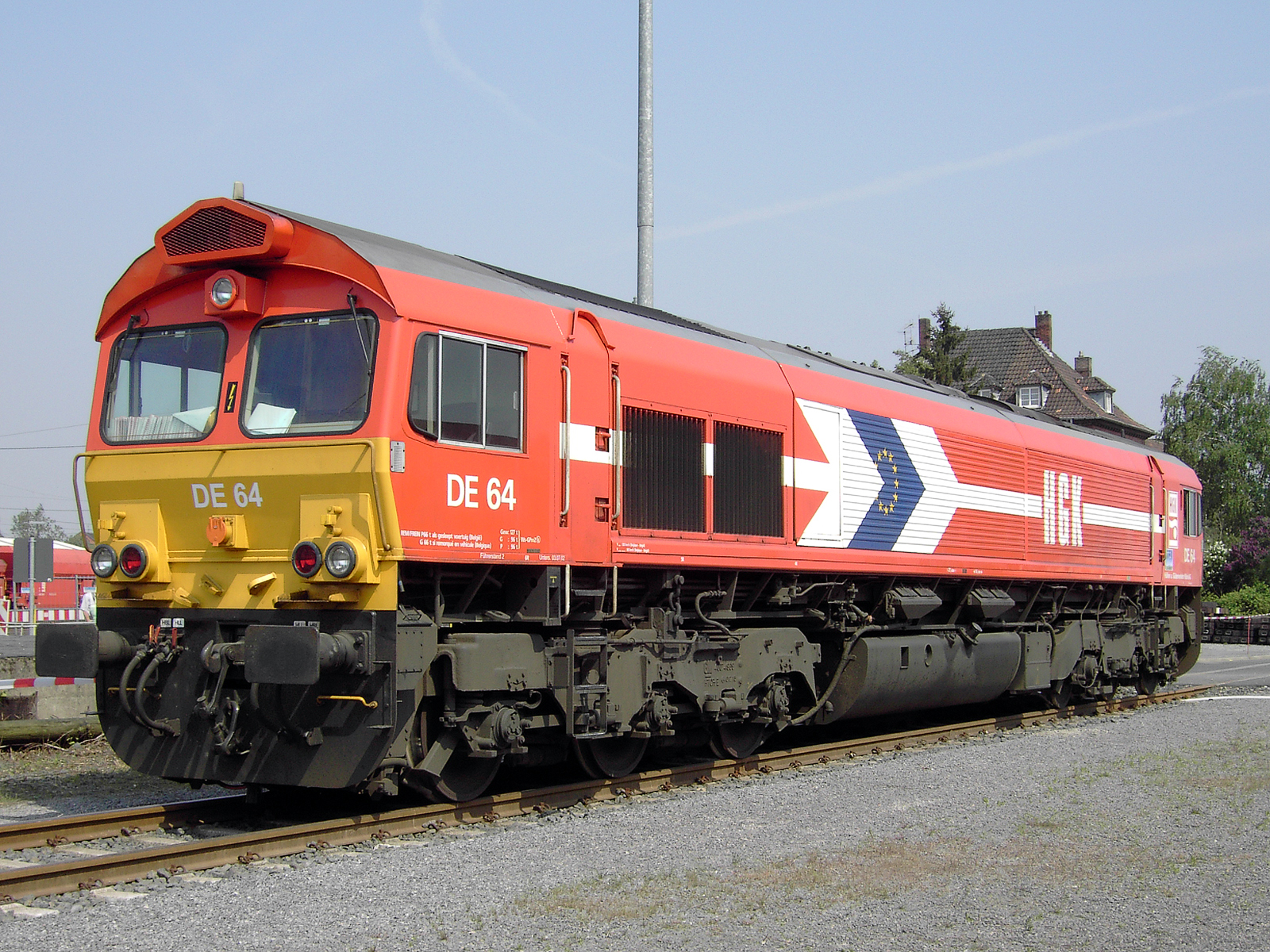
 HGK DE 64 at Godorf Hafen open day. | |||||||||||||||||||||||||||||||||||||
| |||||||||||||||||||||||||||||||||||||
| |||||||||||||||||||||||||||||||||||||
| |||||||||||||||||||||||||||||||||||||
| |||||||||||||||||||||||||||||||||||||
The Electro-Motive Diesel (EMD) Class 66 (EMD JT42CWR) are Co-Co diesel locomotives built by EMD for the European heavy freight market. Designed for use in Great Britain as the British Rail Class 66, a development of the Class 59, they have been adapted and certified for use in other European countries.[3] Outside Europe, 40 locomotives have been sold to Egyptian Railways for passenger operation.[4]
A number of locomotives built for Euro Cargo Rail in France with roof-mounted air conditioning are classed Class 77. In Germany ECR units operated for DB Schenker were numbered as class 247, re-classified as class 266 by the Eisenbahn-Bundesamt to match other Class 66 locomotives operating in Germany.[5]
History
[edit]United Kingdom
[edit]The class was designed by General Motors-Electro Motive Division[note 2] for use in the UK, and 250 were sold to English Welsh & Scottish, with orders from Direct Rail Services, Fastline, Freightliner and GB Railfreight.
Mainland Europe
[edit]With the locomotives proving successful in the UK, interest came from railway operators in continental Europe. General Motors locomotives in mainland Europe had historically been produced under license by local manufacturers. The high haulage capacity and reliability of the Class 59 (JT26-CW-SS) had led to its use by the German company Häfen und Güterverkehr Köln (HGK). The first mainland Europe order also came from HGK, for two locomotives, followed by TGOJ Trafik (Trafikaktiebolaget Grängesberg-Oxelösunds Järnvägar) in Sweden. Subsequently, many European railway operators bought locomotives.[6]
Class 77
[edit]With a high number of orders, EMD modified the locomotive for European ECR operations, including:[7]
- Powered by a 12-cylinder 710 engine that meets EU Stage IIIA emissions regulations, via latest EM2000 control system
- DC traction motors, rated at 3,300 horsepower (2,500 kW)
- Enhanced gear case, which increases tractive effort to 450 kN (100,000 lbf), making the locomotive suitable for heavier European trains
- ECR Train Protection System allowing for immediate certification for operation in France, Germany and Belgium, but meaning that they cannot operate in Great Britain
- Additional driver facilities, including cab air conditioning; a microwave and fridge in one cab; additional noise cancelling insulation; a modified seat
Designated JT42CWRM-100 by EMD and registered in France as Class 77,[7] over 100 locomotives have been purchased including 60 by DB Schenker subsidiary Euro Cargo Rail.
Class 66EU
[edit]In 2008 EMD announced plans to develop a new variant 'Class 66EU' designed for continental European operations, built within the UIC 505-1 loading gauge as opposed to the restrictive UK loading gauge. A range of European safety systems would be supported including ERTMS, and locomotives would be fitted with a dynamic brake and previous issues with driver comfort were to be addressed.[8] The project was confirmed to be cancelled in 2011.[9] A similar locomotive concept using EMD technology is the Vossloh Euro 4000 and has been delivered to operators in several countries including Norway, France, Spain, Portugal and Israel.
Technical
[edit]The locomotive uses standard EMD components - an EMD 710 prime mover, D43 traction motors, radial[note 3] (self-steering) bogies of patented design, which reduce wheel surface and flange wear[10] and are said to improve adhesion[11] and reduce track load.[12]
The class has undergone updates; other than the lower-geared class 66/6 produced for Freightliner, most of the updates have been in relation to conforming to specifications for exhaust particulate emissions.

_Class_66.jpg)
Despite being popular with rail operators, especially due to its high reliability, the class has not been universally successful: one recurring problem has been driver comfort. In particular, noise levels (including noise from the cab horn), vibration, and excessive cab-temperatures in hot weather have brought serious complaints. The cab is not isolated from the main frame, causing engine noise to be the dominant background noise;[13] notwithstanding the implications for safety (audibility of warning signals etc.), and the potential for hearing damage in the long term, the conditions drivers face led to threats of industrial action in the UK in 2007,[14] and an agreement for increased pay for drivers using this type of locomotive[15] (in Norway). By modifying using noise absorbing materials EMD succeeded in meeting TSI Noise Certification standards in 2008.[16] Tests on retrofitted cooling systems and improved seating have been carried out on some UK locomotives.[17][18]
ETCS Equipment
[edit]Between 2006 and 2010, 12 locomotives belonging to Mitsui Capital Rail Europe (MRCE), operating in the Netherlands and Germany, were equipped with ETCS, principally to allow them to work on the equipped Betuweroute, comprising the ETCS Level 1 "Havenspoorlijn" in the Rotterdam harbour area and the ETCS Level 2 "A15" route linking Rotterdam to the German border.[citation needed][note 4]. The MRCE locomotives were sold to Beacon Rail in 2015. Commencing in 2015, 15 locomotives owned by Ascendos Rail Leasing and 10 locomotives owned and operated by Crossrail Benelux were equipped with ETCS.
Idle reduction
[edit]As a fuel-saving and wear-reduction measure operator DB Schenker Rail UK is to fit ninety of its fleet with automatic engine stop start technology by the end of 2015. The modification is provided by ZTR Control Systems of London, Ontario and is expected to reduce engine running hours by about one-third.[19]
Operators
[edit]
Europe
[edit]Certification (homologation) is needed for each country of operation. The locos were initially given a temporary certificate for use in France,[note 5] and full certification came in 2009[21] (they had previously operated in France on some routes), Romanian certification came in 2007[22] The class is certified for operation in Germany, the Netherlands, Luxembourg, Belgium, Sweden, Norway, Poland and Denmark. As of 1 January 2009, certification for use in the Czech Republic and Slovakia was pending.
Africa
[edit]They are operated in Egypt by the Egyptian National Railways. They are operated on the Trans-Gabon Railway.
List of operators
[edit]| Owner | Operator | Countries | Designation | Total | Comments |
|---|---|---|---|---|---|
| Beacon Rail (15) Halifax Asset Finance (33) Eversholt Rail Group (85) Porterbrook (60) Lloyds Bank (4)[23] |
Colas Rail DB Cargo UK Direct Rail Services Freightliner GB Railfreight |
Great Britain | Class 66 | 455 | See details in the British Rail Class 66 article |
| Euro Cargo Rail[citation needed] | France | Class 66 Class 77 |
120 | 65 from parent company DB Cargo UK. 60 further locomotives during 2009 designated Class 77. | |
| Alpha Trains | Freightliner PL (FPL)[24] | Poland | Class 66[25] | 7[26] | Part of Freightliner |
| CB Rail[27] formerly Porterbrook |
Rail4Chem Benelux (R4CB) | Benelux (Belgium, Netherlands & Luxembourg) | 26 | ||
| Heavy Haul Power International (HHPI) | Germany | ||||
| Crossrail Benelux | Belgium | ||||
| Häfen und Güterverkehr Köln (HGK) | Germany | Class 266 | |||
| ERS Railways (ERSR) | Netherlands | ||||
| Railion Nederland (RN) | |||||
| Deutsche Leasing[27] | Rail4Chem Benelux (R4CB) | Benelux (Belgium, Netherlands & Luxembourg) | 1 | ||
| Egyptian National Railways (ENR) | Egypt[4][28] | 2120[citation needed] | 40[28] | First non-European customer, for passenger use. | |
| GM/Opel leasing[27] | Häfen und Güterverkehr Köln (HGK) | Germany | Class 266 | 2 | |
| GM/GMAC leasing[27] | Heavy Haul Power International (HHPI) | 1 | |||
| Eversholt Rail Group[27] | TGOJ Trafik (TGOJ)[29] | Sweden | T66 713[citation needed] | 1[citation needed] | Leased to IKEA rail AB, from 2012–07 to Rush Rail source |
| CFL Cargo DK[30] | Denmark | T66K 714 "Krudthornet" | 1 | Transferred to CFL Cargo DK in Padborg in 2010 (SE, DK ATC) | |
| CargoNet (CN) | Norway | CD66[31] | 6[32] | Problems with driver cabin conditions (see above) Named Di9 as per Di series in procurement documents,[33] in practice also called CD 66 To be replaced by Vossloh Euro 4000s on the Nordland Line[citation needed] | |
| Häfen und Güterverkehr Köln (HGK) | Germany | Class 266 | 5 | ||
| ERS Railways (ERSR) | Netherlands | 5 | |||
| KBC lease group[27] | Crossrail Benelux | Belgium | 4 | ||
| MRCE[27] | ~5 | ||||
| ERS Railways (ERSR) | Netherlands | ~6 | |||
| Häfen und Güterverkehr Köln (HGK) | Germany | Class 266 | ~2 | ||
| Afzet Container Transport System (ACTS) | Netherlands | 1 | |||
| Dortmunder Eisenbahn (DE) | Germany | ||||
| Veolia Cargo / Connex (VC) | Netherlands & France | ||||
| Trainsport AG (TS) | Belgium | ||||
| Rail4Chem (R4C) | Germany | ||||
| NedTrain | Netherlands | ||||
| Setrag | Gabon | 6 | Two units built 2008, shipped July 2011.[34] Four further units built and exported by 2012. | ||
See also
[edit]References
[edit]Notes
[edit]- ^ Klass 66: a play on the English word "class" and the Dutch boys' name "Klaas" and the word SantaKlaus (Dutch:'Sinterklaas'). The nickname came about because the first engine delivered to the Netherlands (HGK DE61) was painted red, a colour normally associated with Santa.[citation needed]
- ^ In 2005 General Motors sold its locomotive manufacturing division (EMD), the organisation is now named Electro Motive Diesel or EMD
- ^ The individual bogies are articulated rather than having two bogies connected with a Beugniot lever or equivalent
- ^ Bombardier "EBICab2000" ETCS. Includes ATB-EG specific transmission module (STM) for conventional Dutch lines and the PZB STM for Germany. A separate "Memor" unit is installed for Belgian operation.[citation needed]
- ^ Various modifications were required, including some additional to the fitment of the local train safety systems[20]
Citations
[edit]- ^ "Class 66 :: Electro-Motive Diesel JT42CWR". class66.railfan.nl. Rogier Immers. Retrieved 9 July 2011.
- ^ "CROSSRAIL Class 66 in Marienborn". YouTube.
- ^ "JT42CWRM Fact Sheet" (PDF). Electro-Motive Diesels.
- ^ a b "Commissioning of Egyptian JT42CWRM begins". Railway Gazette International. 20 May 2009. Archived from the original on 8 December 2019. Retrieved 18 October 2009.
- ^ "DB Schenker withdraws last Class 217 locomotives", Railway Herald (306): 37, 14 March 2012
- ^ "Class 66 (subsection 'History')". railfan.nl.
- ^ a b "Akiem adds Class 77s to lease fleet". Railway Gazette International. 21 June 2011. Archived from the original on 8 December 2019. Retrieved 29 April 2013.
- ^ Roden, Andrew (September 2008). "EMD plans new route for Class 66". International Railway Journal – via findarticles.com.
- ^ "EMD to produce passenger demonstrator loco", Railway Gazette International, 4 October 2011, archived from the original on 24 September 2015, retrieved 4 October 2011,
Meanwhile, EMD confirms that it has dropped plans for the 66EU, which was to have been an updated version of its popular Class 66 freight locomotive specifically adapted for the Continental European market
- ^ Swenson, C.A.; Scott, R.T. (April 1996). "The effect of locomotive radial steering bogies on wheel and rail wear". Proceedings of the 1996 ASME/IEEE Joint Railroad Conference. pp. 91–100. doi:10.1109/RRCON.1996.507964. ISBN 0-7803-3351-9. S2CID 110212136 – via ieeexplore.ieee.org.
- ^ Ahmadian, M.; Huang, Wei (2000). "Effect of self-steering locomotive trucks in improving adhesion on curved tracks". Proceedings of the 2000 ASME/IEEE Joint Railroad Conference (Cat. No.00CH37110). pp. 47–61. doi:10.1109/RRCON.2000.869987. ISBN 0-7803-6328-0. S2CID 109630742.
- ^ "EMD Class 66 Product information sheet" (PDF). EMD.
- ^ "The implications of the physical agents directive (noise): summary" (PDF). Rail Safety & Standards board. Archived from the original (PDF) on 25 October 2005.
- ^ "Boycott threat over 'dirty' locos". BBC News. 30 April 2007.
- ^ "Agreement between the NLF and CargoNet" (in Norwegian). Archived from the original on 28 September 2007.
- ^ Electro-Motive Diesel, Inc. (EMD). "Updated Class 66 European Locomotive is First to Achieve TSI Noise Certification in Europe" (Press release) – via PRNewsWire.
- ^ "Positive moves on Class 66 cabs". ASLEF. 21 March 2007. Archived from the original on 17 July 2011.
- ^ "Update on SQUASH". ASLEF. Archived from the original on 17 July 2011.
- ^ "Class 66 locos to get engine stop-start technology". Railway Gazette International. 2 October 2014. Retrieved 30 November 2014.
- ^ "Details of Class 66 modifications made for working in France". esg-railconsultancy.co.uk. Archived from the original on 28 September 2007.
- ^ EMD. "(EMD) Announces French Homologation Has Been Achieved For the Euro Cargo Rail Class 66 Locomotives" (Press release).
- ^ EMD. "Electro-Motive Diesels (EMD) certifies its Class 66 (JT42CWRM) locomotive in Romania" (Press release).
- ^ "Diesel Locomotives". AbRail Rail Databases. Archived from the original on 31 August 2012.
- ^ "Freightliner PL". Freightliner.co.uk. Archived from the original on 16 April 2009.
- ^ "Angel Trains Enters the Polish Rail Freight Market" (Press release). 23 February 2007.[permanent dead link]
- ^ "Angel Trains presentation" – via mtgsa.pl.
- ^ a b c d e f g "The Definitive Fleet List of Euro Class 66 locos - giving works numbers, running numbers, names, operators and international IDs. (up to November 2007)" (PDF). therailwaycentre.com. Archived from the original on 20 September 2009.
- ^ a b Electro-Motive Diesel. "Electro-Motive Diesel, Inc (EMD) Rolls Out The New JT42CWRM for Egyptian National Railways (ENR)" (Press release).
- ^ "Locomotive listing on sub-page". TGOJ Trafik (in Swedish). Archived from the original on 6 May 2001.
- ^ "(home)". Archived from the original on 31 March 2008. Retrieved 7 June 2011.[full citation needed]
- ^ "CargoNet diesellokomotiv type CD66". Archived from the original on 4 March 2016. Retrieved 24 January 2009.
- ^ "Norwegian rolling stock database page (with images)". Archived from the original on 6 December 2019. Retrieved 24 January 2009.
- ^ "Årlig møte med ledelsen i CargoNet AS TILSYNSRAPPORT (annual audit report) CargoNet 2002" (PDF).[permanent dead link]
- ^ "World rolling stock market September 2011", Railway Gazette International, 26 September 2011, archived from the original on 4 March 2016, retrieved 26 September 2011
Sources
[edit]- Rodney Polacek; Bozidar Simonovic, "Nothing stops a Class 66", RAIL (492), archived from the original on 10 October 2007
- R. Polacek; B. Simonovic (2004), "Class 66 - Locomotive Without Borders", Railvolution (1), archived from the original on 1 October 2011, retrieved 29 March 2012
- Локомотив для Европы без границ, Железные дороги мира (in Russian) (8), 2004, archived from the original on 3 May 2007
External links
[edit]
Classes of German diesel locomotives | ||
|---|---|---|
| Deutsche Bundesbahn (pre-1968) see also DB locomotives |  | |
| Deutsche Reichsbahn (GDR) (pre-1970) see also DR locomotives | ||
| Deutsche Bundesbahn (1968–1994) see also DB locomotives | ||
| Deutsche Reichsbahn (GDR) (1970–1994) see also DR locomotives | ||
| Deutsche Bahn AG (post-1994) see also DBAG locomotives | ||
Rolling stock of Sweden | |||||||||||||||||
|---|---|---|---|---|---|---|---|---|---|---|---|---|---|---|---|---|---|
| Locomotives |
| ||||||||||||||||
| Multiple units |
| ||||||||||||||||
| Railcars |
| ||||||||||||||||

EMD Class 66
View on GrokipediaHistory
Development and Initial Orders
The EMD Class 66, internally designated JT42CWR, was developed by General Motors' Electro-Motive Division (EMD) as a heavy freight locomotive tailored for the European market, building on the proven design of the UK Class 59 while addressing broader continental needs for reliable diesel power.[4] The model incorporated key influences from the North American SD60 series, including its six-axle Co-Co configuration and robust frame, but featured essential adaptations such as a narrower body to fit the UIC loading gauge and compatibility with European train control and signaling systems.[4] In May 1996, the newly formed English, Welsh & Scottish Railway (EWS) placed the inaugural order for 250 Class 66 locomotives in a £375 million deal financed via a long-term lease from Locomotion Capital (now Angel Trains), marking the largest single locomotive procurement in Britain since the end of steam operations.[11] This contract underscored EWS's strategy to modernize its fleet for intermodal and bulk freight haulage following rail privatization.[12] Production commenced at EMD's facility in London, Ontario, Canada, with the first locomotive, 66001, unveiled on March 23, 1998, and the initial batch of three units (66001, 66003, and 66004) arriving in the UK at Immingham Docks on April 18, 1998.[4] Deliveries to EWS continued rapidly, completing the 250-unit order by mid-2000, while subsequent contracts expanded the class's reach.[11] Freightliner placed multiple orders for Class 66 locomotives beginning in 1999 to support its intermodal operations, reaching the 100th delivery by early 2005.[13] Direct Rail Services placed an order for 10 locomotives in 2002, among the last of the standard-build variants, to enhance its nuclear flask and aggregate transport capabilities.[14] By 2005, production had exceeded 400 units for operators across the UK and Western Europe, establishing the Class 66 as a dominant force in regional freight.[13]Deployment in the United Kingdom
The rollout of the EMD Class 66 in the United Kingdom began in 1998, with English, Welsh & Scottish Railway (EWS) taking delivery of the first of an initial order for 250 units. The inaugural locomotive, 66001, arrived at Immingham Docks on April 18, 1998, after shipment from General Motors' Electro-Motive Division plant in London, Ontario, Canada. Following arrival, it underwent testing on UK routes at the Toton testing center, with its first test run occurring on May 27, 1998, hauling a loaded coal train. Full type approval and certification under the TOPS classification as Class 66 were granted on August 14, 1998, enabling operational deployment across the British rail network.[15][16][14] Early operational milestones marked a significant shift in UK freight operations, as the Class 66 rapidly replaced aging Classes 47 and 56 locomotives, which had been the mainstay for heavy haulage. EWS prioritized the new locomotives for intermodal container traffic and coal freight, leveraging their superior reliability and power for services such as coal trains from collieries to power stations. The first revenue-earning service occurred on June 2, 1998, when 66001 assisted a Class 58 on a coal diagram from Bentinck Colliery to Drakelow Power Station, with solo operations commencing shortly thereafter on September 4, 1998. By the end of 1999, the fleet had transformed EWS's efficiency, achieving availability rates exceeding 95% and enabling the withdrawal of numerous older units.[15][14][17] To suit the UK rail network, the Class 66 incorporated specific modifications, including adherence to the British Rail (BR) loading gauge for compatibility with existing infrastructure and tunnels. The locomotives were geared for a top speed of 75 mph (120 km/h), balancing freight-hauling tractive effort with line speeds on mixed-traffic routes. Integration with UK signaling and control systems was facilitated through the adoption of the American Association of Railroads (AAR) multiple working protocol, allowing seamless operation in multiple with compatible Classes 59 and 67. These adaptations ensured the Class 66 could operate effectively without major infrastructure changes.[15][14] Initial deployment faced minor teething challenges, including early electrical and bogie-related reliability issues during intensive testing and shakedown runs, which occasionally led to short-term downtime. These were systematically resolved by EMD and EWS engineering teams through design refinements and component upgrades by 2000, resulting in markedly improved performance metrics, such as a casualty rate one-eleventh that of the Class 47. The original EWS fleet was designated subclass 66/0 (66001–66250), while Freightliner's multiple orders formed subclass 66/5 (66501–66606), totaling 106 units with deliveries starting in 1999, incorporating minor enhancements for intermodal-specific operations like improved coupling compatibility.[15][5][16]Expansion to Mainland Europe
The expansion of the EMD Class 66 locomotives to mainland Europe commenced with the first non-UK order placed by the German private freight operator Häfen und Güterverkehr Köln (HGK) for two units in 1999. These locomotives, numbered DE 61 and DE 62, were leased from GMAC Bank and marked HGK as the inaugural continental European user of the type outside the United Kingdom, enabling enhanced heavy freight capabilities in the Cologne harbor region.[18] This initial adoption was swiftly followed by an order from Swedish operator TGOJ Trafik for two additional units, delivered in late 2000. These locomotives facilitated freight operations across Sweden's rail network and represented the type's entry into the Nordic market. Certification processes played a pivotal role in enabling wider deployment, with initial approvals secured for the German network in 1999 to accommodate HGK's units. By the early 2000s, further certifications were obtained for operations in the Netherlands, Belgium, and Nordic countries including Sweden and Norway, involving adaptations for standard gauge compatibility, local signaling systems, and emissions compliance to meet varying national regulations.[19] Orders proliferated among private operators throughout the 2000s, driven by the locomotive's reliability for cross-border freight. By 2010, more than 100 Class 66 units had been delivered to continental European operators, supporting key international corridors such as the Netherlands' Betuweroute dedicated freight line, which connects Rotterdam's port to Germany and beyond. A significant milestone occurred in 2007 when DB Schenker's subsidiary Euro Cargo Rail placed an order for 60 units tailored for French and broader European networks, with several equipped with the European Train Control System (ETCS) to enhance interoperability on high-speed and signaling-upgraded routes.[20] In 2011, EMD announced the cancellation of the Class 66EU development project, an updated variant intended specifically for continental European markets with improved emissions and performance features to comply with evolving EU standards; the decision followed EMD's acquisition by Progress Rail and shifted focus to alternative designs like the Vossloh Euro 4000, which incorporated similar EMD technology.[21]Design and Specifications
Powertrain and Performance
The EMD Class 66 locomotive is equipped with a EMD 12-710G3B V12 two-stroke diesel engine, featuring turbocharging and aftercooling for enhanced power delivery and efficiency. This engine delivers 3,200 hp (2,420 kW) at 900 rpm, providing the primary propulsion for heavy freight duties across European rail networks.[22][2] Power from the engine drives an AC electric transmission system, including an AR8/CA6 alternator that generates three-phase alternating current, which is rectified to direct current for the six axle-hung D43TRC traction motors—one per axle on the Co'Co' bogies. Microprocessor controls oversee the system, including wheel slip detection and correction to maintain optimal tractive performance under varying conditions.[2] In terms of performance, the Class 66 achieves a starting tractive effort of 409 kN (92,500 lbf) and a continuous tractive effort of 260 kN at 25.6 km/h, allowing it to handle substantial freight loads on standard gauge tracks. UK models are geared for a top speed of 120 km/h (75 mph), balancing acceleration with route speed limits, while certain export variants support higher velocities for specific operational needs.[2][22] The locomotive's physical dimensions include a length over buffers of 21.35 m, a width of 2.64 m, and a height of 3.9 m, with a total operating weight of 129.6 tonnes yielding an axle load of 21.6 tonnes. Fuel capacity is 6,400 L for continental models and 5,670 L for UK EU Stage IIIA compliance, enabling reliable long-haul service without frequent refueling.[2]Safety and Efficiency Features
Later models and retrofits of the EMD Class 66 locomotives incorporate the European Train Control System (ETCS) to ensure compatibility with high-speed lines across Europe, enabling Level 2 operations through balise readers for trackside data reception and onboard computers for real-time movement authorization and supervision. ETCS retrofits began in 2022, with those on DB Cargo UK and GB Railfreight units ongoing as of 2025, integrating Siemens Mobility's Trainguard onboard equipment to support the UK's East Coast Digital Programme and broader European Rail Traffic Management System (ERTMS) deployment.[23][24] These systems provide continuous train protection, reducing collision risks by enforcing speed limits and signaling via radio block centers, while accommodating multi-country operations through standardized interfaces.[25] An idle reduction system enhances operational efficiency by automatically shutting down the engine during prolonged stops, utilizing GPS for location awareness and sensors to monitor conditions like oil temperature and battery voltage before restarting. DB Schenker Rail UK installed this ZTR-supplied Auto Engine Stop-Start technology on 90 locomotives by the end of 2015, targeting idling periods that account for a significant portion of freight duty cycles.[26] The system achieves fuel savings of up to 10% overall, alongside reduced wear and emissions, with payback achieved within a year based on fleet-wide application.[27] The locomotives comply with EU Stage IIIA emissions standards through the 12-cylinder 710G3B-T2 engine and EM2000 control system, limiting particulate matter, nitrogen oxides, and hydrocarbons without aftertreatment.[28] Automatic train control interfaces, including ETCS, facilitate seamless cross-border service, such as between France, Germany, and Belgium, with cab signaling displaying movement authority directly to the driver for enhanced safety in diverse regulatory environments.[28] Post-2015 upgrades remain limited in documentation, though 2020s operations show integrations like real-time remote monitoring for fault detection via EM2000 diagnostics and potential decarbonization retrofits exploring biogas-hydrogen blends to approach Stage V compliance.[29][30]Variants
Class 77
The Class 77 represents a French-specific adaptation of the EMD Class 66 diesel-electric locomotive, developed for heavy freight operations by Euro Cargo Rail, the international freight subsidiary of SNCF Fret. In 2006, Euro Cargo Rail placed an order for 60 JT42CWRM-100 units to bolster its fleet, supplementing an initial batch of 60 similar locomotives acquired in 2003, bringing the total to over 100 units dedicated to cross-border and domestic freight services in France. These locomotives were assembled at EMD facilities and delivered between 2008 and 2010, enabling the operator to handle increased heavy-haul demands on European networks.[31][32] Key modifications distinguish the Class 77 from the baseline Class 66 design, including an upgraded EMD 12-710G3B-T2 12-cylinder two-stroke diesel engine producing 3,300 hp (2,460 kW) to meet EU Stage IIIA emissions requirements. The engine integrates with the EM2000 microprocessor control system for optimized performance and fuel efficiency. The cab features enhancements for compatibility with French train control systems, such as KVB (Contrôle de Vitesse par Balises) and provisions for ETCS (European Train Control System), along with roof-mounted air conditioning units tailored for continental operations. Starting tractive effort is rated at 409 kN, supporting robust heavy-haul capabilities.[33][34][35] Operationally, the Class 77 complies with the UIC 505-1 loading gauge for seamless integration on European infrastructure, with a top speed of 120 km/h suitable for freight services. Weighing 129.6 tonnes in working order with a Co'Co wheel arrangement and six DC traction motors, the locomotives are optimized for 1,435 mm standard gauge lines, focusing on high-tonnage cargo transport across France, Germany, and Belgium. Safety systems include KVB, RPS (Règlementation de Protection et de Sécurité), DAAT (Dispositif d'Aide à l'Adhérence et au Train), GSM-R radio, and PZB (German inductive train control). A total of over 100 units were produced exclusively for Euro Cargo Rail, forming the backbone of its French fleet.[34][32]Class 66EU
The Class 66EU was a proposed variant of the EMD Class 66 diesel locomotive, announced in 2008 as an updated model specifically designed for continental European rail operations.[36] This remodelled version aimed to address the unique requirements of mainland Europe's rail networks by complying with the UIC 505-1 loading gauge, which allows for smaller clearances compared to the British loading gauge used in the original Class 66 design. The locomotive was intended to maintain the proven reliability of the Class 66 family while enhancing compatibility with European infrastructure standards. Planned adaptations for the Class 66EU included a narrower body profile to better fit continental tunnels and platforms, alongside full integration of the European Rail Traffic Management System (ERTMS) and European Train Control System (ETCS) for improved safety and interoperability across borders. The powertrain was specified at 3,000 hp, drawing from EMD's established 12-710 series engine, with considerations for hybrid diesel-electric options to meet emerging emissions regulations in the European Union. These features positioned the Class 66EU as a versatile freight hauler capable of serving diverse routes, including potential applications in the Iberian Peninsula's networks. Development of the Class 66EU was abandoned in 2011 amid the global economic downturn following the 2008 financial crisis, which reduced demand for new diesel locomotives, and a growing industry preference for electric traction alternatives to achieve lower operating costs and environmental compliance. No prototypes were constructed, and EMD shifted focus to other projects, including passenger demonstrator locomotives. Had the variant been realized, it could have expanded the Class 66 fleet by more than 50 units, further solidifying EMD's presence in the European freight market.[21]Other Regional Adaptations
The EMD Class 66 locomotives underwent specific modifications for operation in African markets to address extreme environmental challenges. In Egypt, the Egyptian National Railways (ENR) ordered 40 JT42CWRM variants in 2007, with deliveries in 2009, marking the first export of the Class 66 family outside Europe. These units were adapted for desert operations through the addition of sand filters to prevent engine intake contamination from fine particulates and enhanced cooling systems, including modified front-end radiators and high-capacity fans, to manage ambient temperatures exceeding 50°C.[37][38][39] Similarly, in Gabon, the Société d'Exploitation du Transgabonais (SETRAG) acquired six units between 2011 and 2012 for freight service on the 648 km Libreville–Franceville line, which serves manganese mining operations. These locomotives featured reinforced underframes to withstand heavy loads on uneven tropical terrain and upgraded corrosion-resistant components to cope with high humidity and rainfall in the equatorial climate.[40][41] Beyond Africa, European operators implemented targeted tweaks for local conditions. In Poland, Class 66 units operated by Freightliner PL and DB Cargo Polska are used on the Polish State Railways (PKP) network, enabling seamless integration into national freight corridors.[42] In Norway, CargoNet's six leased units, introduced in 2005 for non-electrified routes in the Arctic regions, support operations in sub-zero temperatures and remote areas. In 2025, leasing company Akiem completed the conversion of 11 continental Class 66 locomotives to comply with the UK loading gauge, enabling their operation on British networks. These units, delivered to GB Railfreight, involved modifications such as gauge adjustments, engine overhauls, and component upgrades to meet UK infrastructure requirements, representing a £25 million investment to expand the operator's fleet.[43] All export variants, including those for Africa, were produced at EMD's London, Ontario facility in Canada, with customizations addressing gauge compatibility (primarily 1,435 mm standard) and environmental resilience; by 2015, approximately 46 such units had been delivered to non-European markets. While baseline specifications like the 12-710G3B engine remain consistent, these adaptations prioritize durability over the standard European design. Coverage of potential 2020s retrofits for digital signaling, such as ETCS, in these export fleets remains limited, with no widespread implementations reported in African operations as of 2025.[37]Operators
European Operators
In the United Kingdom, DB Cargo UK maintains the largest fleet of Class 66 locomotives, with approximately 170 units primarily deployed for intermodal and coal freight services.[44] Freightliner operates around 108 Class 66s, focusing on container transport across its network, including special 60th anniversary liveries applied to units 66501 and 66601 in 2025 to commemorate the company's founding.[44][45] GB Railfreight runs about 115 Class 66s, mainly for aggregates and bulk freight, with recent expansions including 11 units sourced from mainland Europe in 2025.[44][46] On the European mainland, Euro Cargo Rail utilizes Class 66 locomotives for cross-border freight between France and Germany, supporting intermodal and general cargo operations. Rail4Chem Benelux employs these units for chemical transport in the Benelux region, leveraging their reliability for specialized hauls. Freightliner Poland has operated Class 66s since 2010, initially with seven units ordered for domestic and international freight, supplemented by transfers from the UK fleet including five additional locomotives relocated by 2023.[47][48] Class 66 locomotives dominate European freight operations, forming the backbone of heavy haulage in the UK and select continental routes. They hold certifications for operation in at least 11 European countries, including the UK, Germany, France, Belgium, the Netherlands, Poland, and others, enabling versatile cross-border deployment. Post-2020, some operators have initiated trials with alternative fuels, such as biogas and hydrogen blends compatible with the Class 66's engine, to reduce emissions amid regulatory pressures. However, data on potential 2025 fleet reductions remains limited, particularly as electrification expands on key corridors, potentially displacing diesel units. Recent upgrades include European Train Control System (ETCS) retrofits on UK fleets as of 2025.[28][49][10]African Operators
The EMD Class 66 locomotives have seen limited adoption in African rail networks, primarily serving operations in Egypt and Gabon amid harsh climatic conditions that demand specialized adaptations. Egyptian National Railways (ENR) operates 40 JT42CWRM variants, delivered between 2009 and 2010, primarily for passenger services along key routes including the Alexandria-Cairo corridor. These units feature modifications such as reinforced air conditioning and enhanced filtration systems to withstand temperatures exceeding 40°C and pervasive dust in desert environments. The locomotives' robust design supports reliable performance in high-heat scenarios, drawing from the Class 66's proven European heavy-haul heritage with minor regional tweaks for thermal management.[37][38] The Trans-Gabon Railway, managed by Société d'Exploitation du Transgabonais (SETRAG), acquired 6 units starting in 2010 to handle timber and ore transport through dense equatorial forests and humid terrain. Equipped with upgraded corrosion-resistant coatings and sealed components to resist moisture, vegetation ingress, and tropical weathering, these locomotives facilitate the movement of bulk commodities like manganese ore over the 670 km network. Their introduction marked an expansion of the Class 66 platform beyond Europe, tailored briefly for anti-corrosive durability without altering core powertrain specs.[50][51] In operational terms, the Class 66 has significantly enhanced freight capacity in these regions; ENR's fleet, for instance, routinely manages 1,500-tonne trains at up to 80 km/h, improving throughput on mineral routes despite infrastructural constraints. Across both operators, the locomotives underscore the type's versatility in boosting haulage efficiency for resource extraction and export.[38][8] Key challenges for African operators include complex maintenance logistics and inconsistent spare parts supply, often exacerbated by remote locations and import dependencies, resulting in lower fleet availability—ENR reported only about 12 of its 41 units (including a training loco) operational by late 2017. No additional orders have followed since 2014, partly due to production cessation of the JT42CWRM in 2016 and emerging competition from electrification initiatives in freight corridors.[38][8]Fleet Composition and Status
The EMD Class 66 fleet comprises a total of 651 standard production units plus 7 prototypes, built between 1998 and 2016. Production is distributed across regions, with 480 units allocated to the UK as Class 66 locomotives, 115 units as Class 77 variants for mainland Europe, 40 units for Egyptian National Railways, and additional allocations for African and other operators, including smaller batches for countries like Poland and the Netherlands.[51][38][6]| Region/Subclass | Number Built | Key Notes |
|---|---|---|
| UK Class 66 (total) | 480 | Includes originals for EWS, Freightliner, and other UK operators; additional units imported post-production. |
| Class 66/0 (EWS originals) | 250 | Initial batch for heavy freight in the UK.[52] |
| Class 66/4 (Freightliner) | 75 | Dedicated to intermodal and bulk freight services. |
| Class 66/6 (upgraded UK) | Variable (subset of total) | Enhanced for specific performance needs, including re-gearing. |
| Mainland Europe Class 77 | 115 | Adapted for continental gauge and operations, primarily for DB Cargo and Euro Cargo Rail. |
| Egypt | 40 | Passenger-oriented variants delivered in 2009.[38] |
| Africa/Other | ~50 | Includes units for operators in Gabon and Poland; exact figures vary by export. |