


Community hub
Recent from talks
Contribute something
Nothing was collected or created yet.
Edo-Tokyo Open Air Architectural Museum
View on WikipediaThe Edo-Tokyo Open Air Architectural Museum (江戸東京たてもの園, Edo Tōkyō Tatemono En; lit. "Edo Tokyo Buildings Garden") is an open-air museum located within Koganei Park, Tokyo, Japan. It opened in 1993 as a branch of the Edo-Tokyo Museum and is operated by the Tokyo Metropolitan Foundation for History and Culture, a public interest incorporated foundation. The museum relocates and reconstructs buildings that originally stood in Tokyo (formerly Edo) from the Edo period through the mid-Showa era, which could no longer be preserved at their original locations, and presents them as part of the city's cultural heritage.[2] The site covers an area of 70,164 m2 (17.338 acres).[3]
Key Information


The museum grounds feature 30 restored structures, including the private residences of politicians, entrepreneurs, architects, and farmers from different historical periods, as well as traditional businesses such as an izakaya (Japanese-style pub), a sentō (public bathhouse), and a ryokan (traditional inn). These buildings recreate the appearance of historic Japanese streetscapes, and visitors are able to enter and explore their interiors.[3]
The origins of the open-air museum date back to 1934 with the opening of the Tokyo Kyōdo Shiryō Chinretsukan (lit. "Tokyo Local History Exhibition Hall") in Arisugawa-no-miya Memorial Park. In 1948, it was relocated to Inokashira Park and renamed the Musashino Hakubutsukan (lit. "Musashino Museum"). In 1954, it was moved again to Koganei Park and reopened as the Musashino Kyōdokan (lit. "Musashino Folklore Museum"), which remained in operation until 1991.[4]
The animator Hayao Miyazaki often visited here during the creation of his film, Spirited Away, for inspiration.[5]
Restored buildings
[edit]
The park is divided into three zones. The west zone is lined with Musashino farm homes and Yamanote houses, the center zone is lined with prestigious historic buildings, and the east zone is a reproduction of the downtown area. The following is a complete list of buildings exhibited at the Edo-Tokyo Open Air Architectural Museum.[3]
Center Zone
[edit]- Former Kōkaden Hall (now Museum Visitor Center): A temporary building erected in the Imperial Palace Outer Garden as the venue of 2600 years commemoration ceremony in 1940. It was relocated to this area in 1941 after the ceremony.
- Former Jishōin Mausoleum: A mausoleum built in 1652 in the early Edo period by Kōra Muneyoshi, a master builder of the Shogunate. Third Shogun Tokugawa Iemitsu's concubine Jishōin (great-granddaughter of Ishida Mitsunari) was enshrined. It is a Designated Tangible Cultural Property (building) of the Tokyo Metropolitan Government.
- House of Takahashi Korekiyo: The residence of Takahashi Korekiyo, a politician who was assassinated in February 26 Incident on the building's second floor. It was completed in 1902 (Meiji 35) and made entirely of tsuga wood. This is an early example of using window glass in a Japanese-style mansion.
- Nishikawa Annex: A house of Izaemon Nishikawa, the founder of Nishikawa Silk Reeling, used as a guesthouse and retreat. It was completed in 1922 (Taisho 11).
- Date Family Gate: The front gate of a mansion built by the Date Marquis family (formerly the Date family of the Uwajima Domain) in Shirokane Sankocho during the Taishō era. It is built in the style of a daimyo mansion with a one-sided office.
- Kaisuian: A Taisho era Chashitsu (tearoom) by Sohenryu (宗徧流) tea masters Yamagishi Soju (Kaisui).
-
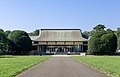 Former Kōkaden
 -
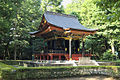 Former Jishōin mauseolum
 -
 House of Takahashi Korekiyo
 -
 Nishikawa Annex
 -
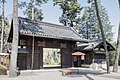 Date clan gate
 -
 Kaisuian interior


West Zone
[edit]- Tokiwadai Photo Studio: A photo studio built in Tokiwadai, a suburban residential area in the early Showa period. The Art Deco-style building, erected in 1937, utilizes large areas of windows on the north side to allow indirect light to enter.
- Mitsui Hachirōemon Residence: A Japanese-style residence of the Mitsui Zaibatsu family, which was relocated from Kyoto to Azabu, Minato-ku after the end of World War II. A tangible cultural property (building) designated by the Tokyo Metropolitan Government.
- Takakura in Amami: A grain storehouse built in Uken Village, Amami Ōshima, around the end of the Edo period. In the Takakura style, the thatched roof is used as a storage.
- Yoshinoya farmhouse: A farm house in Nozaki Village, Tama County (多摩郡) (currently Nozaki, Mitaka City) in the late Edo period. The house's interior has been laid out as it was around 1955.
- Hachioji Sennin Concentric (八王子千人同心) Kumigashira House: The mansion of the late Edo period Kumigashira (郷士). It has a higher style than ordinary private houses, such as a tatami room with an alcove and an entrance with a ceremony table.
- House of Kunio Maekawa: modern architecture house of Kunio Maekawa is 1942 Jitei was built in [2] . While keeping the building area small under the building control during the war, the living room with a colonnade and the second floor in a loft style are arranged in the center of the large roof. A tangible cultural property (building) designated by the Tokyo Metropolitan Government.
- Den-en-chōfu House (Okawa House): A Western-style suburban house built in the suburbs that was developed as a garden city. There is a pergola on the clapboard outer wall and terrace . Designed by Michio Mitsui, who was in Okada Shinichirō's office.
- Tsunashima family farmhouse: A valuable mid-Edo period farmhouse in Okamoto, Setagaya.
- Koide House: A house designed by architect Sutemi Horiguchi immediately after returning from Europe in 1923. It is a mixed Japanese-Western style house with a large quadrangular pyramidal roof and broad eaves. It is designated a tangible cultural property (building) by the Tokyo Metropolitan Government.
- De Lalande House: Shinjuku Shinanomachi (信濃町) there to the Western Museum. It was a one-story building that was said to have been designed by meteorologist and physicist Kitao Jiro as his own residence, but around 1910, it was extensively expanded to a three-story wooden building by the German architect Georg de Lalande. An external elevator to allow access to the second floor was added after the building was relocated to the museum.
-
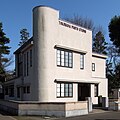 Tokiwadai Photo Studio
 -
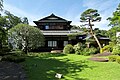 Residence of Hachiroemon Mitsui
 -
 Granary in Amami
 -
 Farmhouse of Yoshino Family
 -
 House of Leader of Hachioji Guards
 -
 Kunio Maekawa's residence
 -
 Denenchofu House (Okawa House)
 -
 Farmhouse of Tsunashima Family
 -
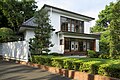 House of Koide
 -
 House of De Lalande


East Zone
[edit]- Tenmei family (farm house): A prestigious farm house with a Nagayamon (traditional Japanese gate style, 長屋門), where a wealthy farmer lived from the Edo period.
- Odera Shoyu Store: A merchant house made of girders. They sold sake, miso, and soy sauce by weight. The inside of the store reproduces the situation in the latter half of the Showa 30's.
- Kagiya (Izakaya): A popular izakaya in Shitaya, Taitō-ku (built in 1856).
- Kodakara-yu: A Sentō (public bathhouse) built in a palace in Senju, Adachi-ku ( built in 1929).
- Tailor: A townhouse made of girders. The interior recreates the workplace of a tailor in the Taisho era.
- Takei Sanshodou (Stationery Store): A stationery store in Kanda. Signboard architecture.
- Flower City Flower Shop: A flower shop in Kanda. Signboard architecture. Reliefs are applied to the copper plate of the façade.
- Manseibashi alternating: Manseibashi of the foot, the former Manseibashi Station near to there was brick of alternating. The year of completion is unknown, but it is estimated to be in the late Meiji era.
- Uemura House: A copper-plated signboard in Shintomicho.
- Maruji Shoten (Rough goods store): A rough goods store in Kanda Jimbocho (daily necessities store). Signboard architecture. The façade is finished with a copper plate using the Edo Komon pattern.
- Murakami Seikado (cosmetics store): A booth store in Ikenohata. Signboard architecture. The appearance that combines the Ionic order- style colonnades and the tile-roofed Japanese-style roof is unique.
- Kawano Shoten (Japanese umbrella wholesaler): A Japanese umbrella manufacturing wholesaler with a girder structure.
- Yamatoya Main Store (Dry Food Store): A three-story wooden store in Shirokanedai, Minato-ku.
- Mantoku Ryokan: A ryokan located along the Ōme Kaidō in Nishiwake-cho, Ōme City. The building has been restored to its original appearance, and the interior has been restored to its appearance around 1950.
-
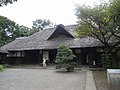 Farmhouse of Tenmyō Family
 -
 Kodera Soy Sauce Store
 -
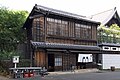 Kagiya bar (izakaya)
 -
 Kodakara-yu (communal bathhouse)
 -
 Tailors workshop
 -
 Takei Sanshōdō & Hanaichi Flower Shop
 -
 Kōban (police box) from Sudō-chō (Manseibashi)
 -
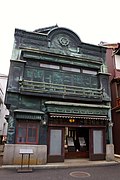 Uemura House
 -
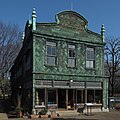 Maruni Shōten (shop)
 -
 Murakami Seikadō (cosmetics store)
 -
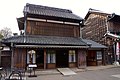 Kawano Shōten (Japanese umbrella wholesaler)
 -
 Yamatoya Main Store
 -
 Mantoku Ryokan


_from_Sudo-cho.jpg)


Outdoor exhibits
[edit]The following outdoor exhibits are part of the museum's collection.[3]
- Toei 7500 series train No. 7514: 1962 of manufacturing Tokyo Toden tram (scrapped in 1978). Since it was not remodeled into a one-person operation, it retains its original shape at the time of manufacture.
- Bonnet bus Isuzu TSD43 ( dynamics saved ): 1968 formula, Kitamura Mfg body. Originally used by the Japan Air Self-Defense Force, it used to be a Toei bus paint that was changed when the movie appeared, but now it is the same cream paint as the Toden. Privately owned. Since it is a sightseeing vehicle limited to running in the park, it does not have a license plate. Although the park was operated on holidays (drivers and conductors may wear the uniforms of the Japanese National Railways on board), it is not operating as of 2011 due to maintenance problems such as aging.
- Imperial Palace Main Gate Ishibashi Ornamental Lamp: One of the six ornamental lamps installed on the parapet of the Imperial Palace Main Gate Ishibashi (on the front side of the Nijūbashi bridge). Manufactured around 1886 (Meiji 20). Due to aging, a lamp of the same shape was manufactured and replaced in 1986 (Showa 61). The same thing is exhibited in the Meiji-mura museum.
- Ueno Fire Station (former Shimotani Fire Station) Watchtower Upper part: The watchtower (Fire lookout tower) used from 1925 (Taisho 14) to 1970 (Showa 45 ). The upper 7m of the total height of 23.6m has been relocated.
- Noonday Gun: A cannon that was placed at the site of the former Honmaru in the Imperial Palace and fired a blank gun (noon gun) that signals noon. It was used until it was switched to a siren in 1929 (Showa 4).
-
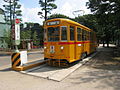 Toden 7514
 -
 Isuzu Bonnet Bus TSD43 (newly painted)
 -
 Isuzu Bonnet Bus TSD43 (old paint)
 -
 Imperial Palace Main Gate Ishibashi Ornamental Lamp
 -
 Ueno Fire Station (former Shitaya Fire Station) Upper part of the watchtower
 -
 Noonday Gun


In popular culture
[edit]According to the Studio Ghibli diary, the "Kodorayu" (Children's Bathhouse) at the museum was an inspiration for the bathhouse setting in Spirited Away.[6]
See also
[edit]- Meiji Mura, an open-air architectural museum/theme park in Inuyama, near Nagoya in Aichi prefecture
References
[edit]- ^ 平成28年度事業実績(公益目的事業) (PDF) (in Japanese). Tokyo Metropolitan Edo-Tokyo Museum. Retrieved 26 May 2020.
- ^ 江戸東京たてもの園 (in Japanese). Tokyo Metropolitan Foundation for History and Culture. Archived from the original on 17 March 2025. Retrieved 7 June 2025.
- ^ a b c d 江戸東京たてもの園 (PDF) (in Japanese). Edo-Tokyo Museum. Archived from the original (PDF) on 21 January 2025. Retrieved 7 June 2025.
- ^ 武蔵野の歴史と民俗~「武蔵野郷土館」がのこしたモノたち~ (in Japanese). Archived from the original on 7 May 2025. Retrieved 7 June 2025.
- ^ "Miyazaki on Spirited Away // Interviews // Nausicaa.net". www.nausicaa.net. May 2001. Archived from the original on 2020-02-03. Retrieved 2020-04-05.
- ^ PR Department, Studio Ghibli (2003-01-09). "2003年1月 - STUDIO GHIBLI - スタジオジブリ" [January 2003 - STUDIO GHIBLI - Studio Ghibli]. Studio Ghibli (in Japanese). 1月09日(木). Archived from the original on 2006-11-27.
映画の設定である「商店街の一角にそびえ立つ銭湯」について、大いにインスピレーションを与えたのは、「江戸東京たてもの園」の「子宝湯」(こだからゆ)です。
[The setting for the film, a "bathhouse towering in a corner of a shopping street," was heavily inspired by "Kodorayu" (Children's Bathhouse) at the Edo Tokyo Open Air Architectural Museum.]
External links
[edit]
- Official website
- Japan guide information
- unofficial video of the park — and accessible gateway to J google.
| International | |
|---|---|
| National | |
| Academics | |
| People |
|

Edo-Tokyo Open Air Architectural Museum
View on GrokipediaHistory and Establishment
Founding and Purpose
The Edo-Tokyo Open Air Architectural Museum was established by the Tokyo Metropolitan Government on March 28, 1993, as an open-air annex to the indoor Edo-Tokyo Museum.[3][5] This initiative aimed to address the rapid loss of Tokyo's historical architecture due to urbanization, disasters, and wartime destruction, by providing a dedicated space for the relocation and preservation of significant structures.[3] The museum's primary purpose is to relocate, restore, reconstruct, and exhibit buildings of great cultural value constructed between the early Edo period (starting in 1603) and the mid-Showa era (around the 1950s), thereby educating visitors on Tokyo's urban evolution and transmitting this architectural heritage to future generations.[3][5] It emphasizes the social, economic, and cultural contexts of these periods, highlighting how everyday and elite structures reflect the city's transformation from feudal Edo to modern Tokyo.[3] Upon opening, the museum featured 12 reconstructed historical buildings on a 7-hectare site within Koganei Park, incorporating collections from the former Musashino Folklore Museum to enrich its focus on regional history.[3][5] Management responsibilities were assigned to the Tokyo Metropolitan Foundation for History and Culture, which oversees operations to ensure the site's role in cultural preservation.[3] Over time, the collection has expanded to include 30 buildings, further advancing its educational mission.[5]Development and Expansions
The Edo-Tokyo Open Air Architectural Museum opened in 1993 with 12 reconstructed buildings and expanded steadily through ongoing relocations and restorations, reaching a total of 30 structures by 2013.[3] These additions included a variety of historical edifices, such as merchant houses, farm dwellings, and public facilities, sourced primarily from areas facing demolition due to urban redevelopment in Tokyo.[3] Key milestones marked the museum's growth, including the 20th Anniversary Festival in 2013, which celebrated the completion of the 30th building and highlighted two decades of preservation efforts.[3] The museum's 30th anniversary in 2023 featured special exhibitions and events reflecting on its contributions to cultural preservation.[5] In subsequent years, the museum integrated additional folklore items into its collections, enhancing exhibits on daily life and culture from the Edo to Showa periods.[6] By 2025, a special festival on March 27-28 commemorated milestone anniversaries of several relocated buildings, such as the House of Okawa in Den’enchofu (originally built in 1925), through curator-led talks and demonstrations.[6] Expansions involved the development of themed zones—central, western, and eastern—accommodating the growing number of exhibits, along with facilities like multipurpose halls for events.[3] Temporary closures for maintenance occurred periodically, including renovations to specific structures like the House of Georg de Lalande and the Musashino Sabo Cafe from January to February 2025, while ongoing preservation work addressed deterioration without major site-wide shutdowns that year.[6] Preservation challenges have centered on protecting post-World War II and earthquake-damaged structures, with relocations necessitated by urban redevelopment pressures that threaten original sites.[3] Efforts include volunteer-led measures against insect damage and adaptations for seismic resilience, ensuring the longevity of these cultural assets amid Tokyo's rapid modernization.[3]Location and Facilities
Site Overview
The Edo-Tokyo Open Air Architectural Museum is situated in the western suburbs of Tokyo, specifically in Koganei City, within the expansive Koganei Park, which covers approximately 80 hectares.[2] The museum itself occupies a 7-hectare open-air site that blends seamlessly with the park's natural landscape, offering visitors an immersive experience resembling a leisurely park stroll through historical settings.[3] Accessible by train from central Tokyo, it lies about 25 to 30 minutes from Shinjuku Station via the JR Chuo Line to Musashi-Koganei Station, followed by a 15- to 20-minute walk or short bus ride.[2][7] The site's layout is thoughtfully divided into three distinct zones—Center, West, and East—arranged to guide visitors through a chronological and thematic progression from the Edo period to the Showa era.[5] Entry occurs through the Center Zone at the main entrance, which serves as an introductory hub featuring key historical structures and orientation facilities. From there, the path branches westward into the West Zone, dedicated to Yamanote-style residences and farmhouses that evoke suburban and rural life, and eastward into the East Zone, which recreates the bustling Shitamachi townscape with merchant streets and shops.[8][5] This zonal configuration encourages a natural flow, with the total walking distance spanning roughly 1 to 2 kilometers, allowing for a gradual exploration of architectural evolution amid the park's greenery.[9] Environmental integration is a core aspect of the museum's design, with the 30 relocated and reconstructed buildings positioned amid lush trees, lawns, and winding paths that mimic authentic historical streets and alleyways.[3] This setup not only preserves the structures in a verdant, park-like setting but also enhances the thematic immersion by contrasting urban heritage with natural surroundings, such as nearby ponds and seasonal foliage.[5] The overall arrangement emphasizes accessibility on foot, promoting a serene yet educational journey through Tokyo's architectural past.[10]Visitor Amenities and Access
The Edo-Tokyo Open Air Architectural Museum is accessible primarily via public transportation, with the nearest station being Musashi-Koganei on the JR Chuo Line, approximately a 15-minute walk or a 5-minute bus ride followed by a 5-minute walk from the north exit.[7] Visitors from central Tokyo, such as Shinjuku Station, can take the JR Chuo Line directly to Musashi-Koganei (about 30 minutes) or the Seibu Shinjuku Line to Hana-Koganei Station, followed by a short bus ride to the Koganei-koen Nishi-guchi stop.[7] Driving is possible via the Chuo Expressway to the Mizumi IC, with on-site parking at Koganei Park available for 300 yen per hour for passenger cars (additional 100 yen per 20 minutes thereafter), though public transport is recommended due to weekend crowds.[7] The Tokyo Museum Grutto Pass 2025 provides one-time admission to over 100 facilities, including the museum and its sister institution, the Edo-Tokyo Museum.[11] The museum operates from 9:30 AM to 5:30 PM April through September and 9:30 AM to 4:30 PM October through March, with admission ending 30 minutes before closing; it is closed Mondays (or the following day if Monday is a holiday) and during New Year's holidays from December 29 to January 3.[12] Admission fees are structured as follows:| Category | Fee (Individual) | Fee (Groups of 20+) |
|---|---|---|
| Adults | ¥400 | ¥320 |
| Seniors (65+) | ¥200 | ¥160 |
| College students | ¥320 | ¥250 |
| High school students | ¥200 | ¥160 |
| Junior high and younger | Free | Free |