


Community hub
Recent from talks
Contribute something
Nothing was collected or created yet.
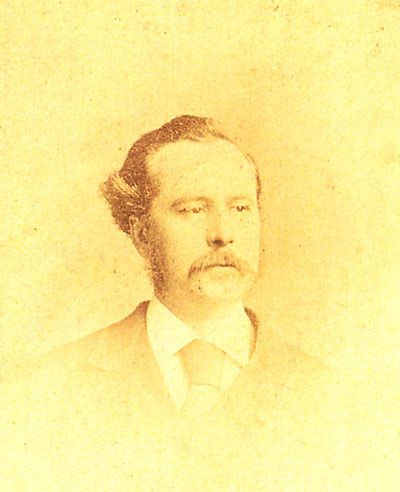
E. W. Pugin
View on Wikipedia

Key Information


Edward Welby Pugin (11 March 1834 – 5 June 1875) was an English architect, the eldest son of architect Augustus Welby Northmore Pugin and Louisa Barton. His father was an architect in the Gothic Revival style, and after his early death in 1852 Edward continued his practice. At the time of his own early death in 1875, Pugin had designed and completed more than one hundred Catholic churches. His brothers Cuthbert and Peter continued the practice as Pugin & Pugin.[1]
Career
[edit]From c.1856 he developed a style independent of his father's, in which expansive spatial planning was combined with great detail.[citation needed] He designed churches and cathedrals primarily in the British Isles. However, commissions for his work were also received from countries throughout Western Europe, Scandinavia, and North America.
As his business grew, Pugin formed partnerships which turned out to be short-lived: with James Murray in Liverpool (1857 to 1860), with George Ashlin in Dublin (1860 to 1869), and with Joseph Hansom (1862 to 1863).[1][2] He was bankrupted in 1873 by the failure of a business he was involved in, the Granville Hotel and spa at Ramsgate, Kent.[1]
Pugin was admitted as a fellow of the Royal Institute of British Architects in 1862.[1]
Personal life
[edit]Pugin was unmarried. He died on 5 June 1875 as a result of "overwork and injudicious use of chloral hydrate".[1]
Works in Ireland
[edit]- Ss Peter and Paul's, Carey's Lane, Cork (1859)
- Edermine, Enniscorthy, County Wexford (c. 1858)
- Cobh Cathedral (1867)
- Killarney Cathedral
- Fermoy Catholic Church, County Cork (1867)
- Drogheda Christian Brothers Residence (currently Scholars Townhouse Hotel (1867)
- Crosshaven Catholic Church, County Cork (1869)
- Monkstown Catholic Church, County Dublin (1866)
- Monkstown Catholic Church, County Cork (1866)
- Convent of Mercy, Skibbereen, County Cork (1867)
- Convent of Mercy, Birr, County Offaly
- John's Lane Church, Dublin
- Attributed to:
- AIB bank, Midleton
- Midleton Arms
- Church and Convent, Ramsgrange, County Wexford
- Bellevue Catholic Church, County Wexford
- Mercy Convent, Pearce Street, Nenagh County Tipperary
Works in England
[edit] |


- St Patrick's Wolverhampton (demolished)
- 1853: Our Lady Immaculate and St Cuthbert, Crook, County Durham
- 1856: Shrewsbury Cathedral, the Cathedral Church of Our Lady Help of Christians and Saint Peter of Alcantara, Town Walls, Shrewsbury (built as a cathedral)
- 1856: Our Lady Immaculate, St Domingo Road, Everton, Liverpool. Demolished. Lady Chapel of scheme for Liverpool Cathedral
- 1856: St Vincent de Paul, St. James Street, Liverpool
- 1857: Holy Cross, Croston, Lancashire; small estate church
- 1857: Sacred Heart Church, Blackpool
- 1857–1858: Our Lady of the Annunciation Church, Liverpool
- 1857–1859: Our Lady and St Hubert, Great Harwood, Lancashire
- 1858: Our Lady Help of Christians and attached Presbytery, Fortess Road, Kentish Town, London (both demolished - although the facade of the latter was rebuilt)
- 1858: St Peter's School, Woolwich
- 1859: Belmont Abbey, Hereford, Herefordshire (the Abbey Church was built as the pro-Cathedral for Wales)
- 1860: Octagonal Chapter House, Mount Saint Bernard Abbey, Leicestershire
- 1859–1860: Our Lady of la Salette, Liverpool
- 1860: St Mary Immaculate, Warwick
- 1860–1861: St Anne, Westby, Kirkham, Lancashire
- 1861: St Edward, Thurloe Street, Rusholme, Manchester
- 1861–1865: St Michael, West Derby Road, Everton, Liverpool
- 1862: St Anne, Chester Road, Stretford, near Manchester
- 1862: St Austin, Wolverhampton Road, Stafford
- 1863: St Peter, Greengate, Salford, Lancashire
- 1863: SS Henry and Elizabeth, Sheerness, Kent
- 1863: Convent of Our Lady of Charity and Refuge, Bartestree, Herefordshire (converted to flats)
- 1863: St Joseph, Bolton Road, Anderton, Chorley, Lancashire
- 1863–1864: Monument to Everard Aloysius Lisle Phillipps, VC, Cademan Wood, Whitwick, Leicestershire (demolished)
- 1864: Our Lady and All Saints, New Road, Stourbridge, Worcestershire
- 1864: St Marie, Lugsdale Road, Widnes, Cheshire (redundant)
- 1864: St Mary's Church, Croydon
- 1864: St Hubert, Dunsop Bridge, Yorkshire
- 1864–1866: Augustinian Priory, school and Church of St Monica, Hoxton Square, London N1[3]
- 1865: St Mary, Euxton, Lancashire
- 1865: St Catherine, Kingsdown, Kent
- 1865–1866: Mayfield Boys' Orphanage (later Mayfield College, from 2007 converted to residential apartments as Mayfield Grange), Mayfield, Sussex
- 1865–1867: St Joseph, York Road, Birkdale, Southport, Lancashire
- 1866: Euxton Hall Chapel, Euxton, near Chorley, Lancashire
- 1866: St Francis Monastery, Gorton, Manchester
- 1866: Our Blessed Lady and St. Joseph, Leadgate, Durham
- 1866: Chancel and transepts to Mount St Mary's Church, Leeds
- 1866–1868: Meanwood Towers, Meanwood, Leeds
- 1866–1867: St Mary's Church, Barrow-in-Furness, Lancashire
- 1866–1867: St Michael and All Angels, Mortuary Chapel and Knill Memorial, Brockley Cemetery, London, destroyed by bombing in 1944
- 1866–1867: Church of St Thomas of Canterbury and the English Martyrs, Preston, Lancashire (extended 1887–88)
- 1866–1867: The Chapel of the Immaculate Conception, Ratcliffe College, Ratcliffe on the Wreake, Leicestershire; converted for school use in 1962 on the completion of a new, larger chapel
- 1867: St Paul's Church, Dover, Kent
- 1867–1868: St Mary, Fleetwood, Lancashire
- 1867–1868: All Saints' Church in Urmston, Greater Manchester[4]
- 1867–1871: Our Lady and St Paulinus, Dewsbury, West Yorkshire
- 1868: St Begh, Coach Road, Whitehaven, Cumberland
- 1869–1872: Our Lady of the Sacred Heart, Cleator, Cumberland
- 1869: St Michael's Orphanage for Girls, aka St Joseph's College, Mark Cross, East Sussex
- 1869: Granville Hotel, Ramsgate, Kent
- 1871: Stanbrook Abbey, Powick, Worcestershire
- 1872: Grosvenor Turkish Baths (with house and shop), 119 Buckingham Palace Road, London
- 1873: St Mary's Church, Brierley Hill
- 1873–1875: Carlton Towers, Yorkshire, for Lord Beaumont
- 1875 (Edward Welby Pugin dies)
- 1875: St Anne Rommer, Highfield Road, Rockferry, Birkenhead, Wirral, Cheshire
- 1873–1876: English Martyrs Church, 30 Prescot Street, London E1[5]
- 1876: Our Lady Star of the Sea, Workington
- 1877: Sacred Heart Church, Kilburn, London
- 1877: St Mary's Church, Warrington, Cheshire
Works in Scotland
[edit]- 1854 St Mary's Star of the Sea Church, Leith, Edinburgh
- 1856 St Stephen, Blairgowrie
- 1862: Church of St Mary, Haddington, East Lothian
- 1874: Church of St Mary and St Finnan, Glenfinnan
Works in Wales
[edit]- 1857 Wrexham Cathedral: Cathedral of our Lady of Sorrows
Works on the Isle of Man
[edit]- 1865 St Patrick, Peel
Works in Belgium (province of West Flanders)
[edit]- 1856 Basilica of Our Lady in Dadizele, finished by Jean-Baptiste Bethune
- 1856 Castle of Loppem, in collaboration with James Murray and George Ashlin, finished by Jean-Baptiste Bethune
- 1861 country estate near Bruges for bishop Joannes Baptista Malou, demolished
Works with James Murray (1856–c. 1859)
[edit]Rugby Town Hall and Markets
[edit]
The old Town Hall stood on the High Street. It was built in 1857, with an extension in 1919. The upper floor became a cinema (Vint's Palace) around 1913. A fire destroyed most of the building in 1921 and it was rebuilt as Woolworths, which opened in 1923 and closed in 2009.[6]
Works in association with George Ashlin (1859-1869)
[edit]
- Saints Peter and Paul's Church, Cork, (1859)
- Convent of Mercy, Clonakilty, County Cork (1867)
- Convent and Orphanage, William Street North, Dublin (1867)
- SS Augustine and John, Thomas Street, Dublin (1860)
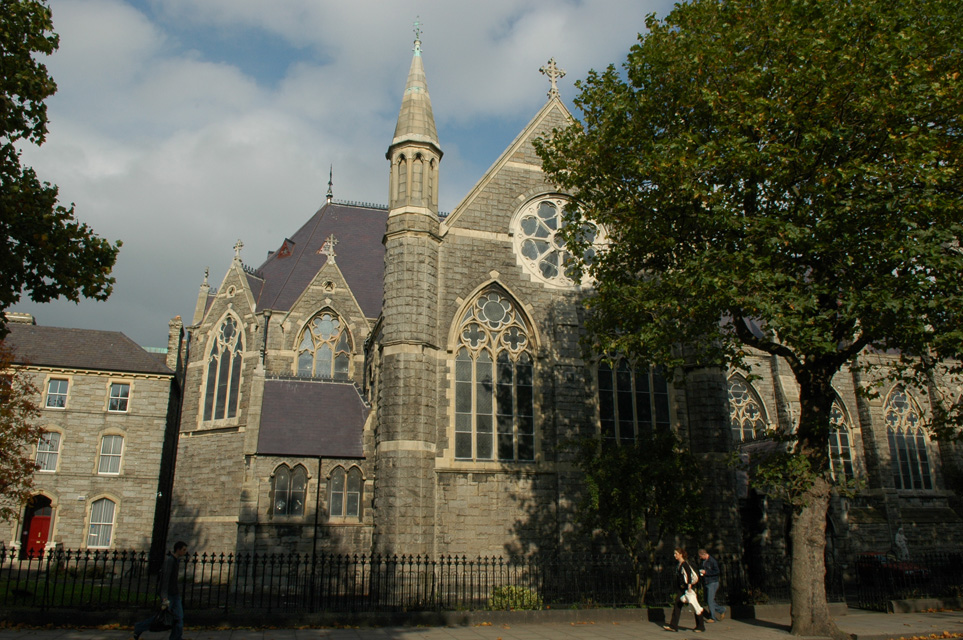
Regarded as Dublin's finest Victorian church, SS Augustine and John (John's Lane Church) in the Liberties area was designed by E. W. Pugin and executed by his partner George Ashlin for the Augustinian Fathers. It was built between 1862 and 1895. It has the tallest spire in Dublin (231 ft), and occupies a prominent position on high ground overlooking the Liffey Valley. It has a striking polychromatic appearance, being built in granite with red sandstone dressings.
The eminent Gothic revivalist Ruskin is said to have praised it, describing it as a "poem in stone".
Statues of the apostles in the niches of the spire are by James Pearse, father of Padraig and Willie, who were executed after the 1916 Easter Rising.
There is stained glass from the Harry Clarke studios.
- Presentation Convent, Fethard, County Tipperary (1862)
- Harrington Street Catholic Church, Dublin (1867); online
- Donnybrook Catholic Church, Dublin (1863)
- Monkstown Catholic Church, County Dublin (1865)
- Arles Catholic Church, Stradbally, County Laois (1965)
- Ferrybank Catholic Church, Waterford (1867)
- Kilanerin Catholic Church, Wexford (1865)
- Lady's Island Catholic Church, County Wexford (1863)
References
[edit]- ^ a b c d e "Edward Welby Pugin". Dictionary of Scottish Architects. Historic Environment Scotland. Retrieved 20 January 2025.
- ^ "Ashlin, George Coppinger". Dictionary of Irish Architects. Retrieved 20 January 2025.
- ^ 'Hoxton – St Monica's Priory Archived 5 October 2018 at the Wayback Machine' in Taking Stock: Catholic Churches of England and Wales, online resource, accessed 28 December 2016.
- ^ Historic England. "All Saints' Church (1067879)". National Heritage List for England. Retrieved 22 December 2007.
- ^ "About the Parish – Tower Hill Mission". Retrieved 28 April 2024.
- ^ Illustrated London News, 15 August 1857.
- Jean van Cleven, 'The Eternal Château': bouwgeschiedenis en kunsthistorische analyse van het neogotische kasteel van Loppem, in V. van Caloen, J. van Cleven, J. Braet Het Kasteel van Loppem, Stichting Kunstboek, 2001
- Roderick O'Donnell, E W Pugin, in Oxford Dictionary of National Biography, Lawrence Goldman (ed) vol 45, pp 525–6, 2001–2004.British Library General Reference Section YC.2009.b.1128
Further reading
[edit]- Michael Fisher, Pugin-Land: A W N Pugin, Lord Shrewsbury and the Gothic Revival in Staffordshire, Stafford Fisher, 2002.
- Rachel Hasted, Scarisbrick Hall – A Guide, Social History at Lancashire County Museum Service, 1984.
- Frederick O'Dwyer, Ecclesiastical Architecture from 1829 in W.J. McCormack (ed) Modern Irish Culture, Oxford: Blackwell, 2001.
- Frederick O'Dwyer, A Victorian Partnership – The Architecture of Pugin & Ashlin in John Graby (ed.) 150 Years of Architecture in Ireland, Dublin, Eblana Editions, 1989.
- Jeanne Sheehy, The Rediscovery of Ireland's Past, The Celtic Revival 1830–1930. London, England, 1980.
External links
[edit] Media related to Edward Welby Pugin at Wikimedia Commons
- The Pugin Society
- The Churches of EW and PP Pugin – on earlier version of the Pugin Society website, archived in 2006
- E.W. Pugin buildings on Archiseek.com, archived in 2013

| International | |
|---|---|
| National | |
| Artists | |
| People | |
| Other | |

E. W. Pugin
View on GrokipediaEarly Life and Education
Family and Childhood
Edward Welby Pugin was born on 11 March 1834 in Ellington Cottage, St Lawrence, Ramsgate, Kent, England.[5] He was the eldest son of the prominent architect Augustus Welby Northmore Pugin and his second wife, Louisa Button, whom Augustus had married in 1833.[6] As the first child of this marriage, Edward was the second overall among his father's children, following a half-sister from Augustus's first marriage; his full siblings included Agnes (born 1836), Cuthbert (1840), Katherine (1841), and Mary (1843), while a later half-brother, Peter Paul Pugin, was born in 1851 to Augustus's third wife, Jane Knill.[7] Pugin's early years began near Ramsgate, but the family moved to St Marie's Grange near Salisbury in 1835, before returning to Ramsgate and settling at The Grange—a home designed by his father—in 1844.[6] This Catholic family environment was shaped by the Pugins' conversion to Roman Catholicism in 1835, reflecting Augustus's deepening faith and commitment to Gothic Revival principles as expressions of Christian ideals.[8] From a young age, Edward was immersed in his father's architectural pursuits, observing the construction of major projects like St Augustine's Abbey in Ramsgate, which Augustus began developing in the 1840s as a personal vision of monastic life and Gothic worship.[9] The family dynamics were marked by Augustus Pugin's intense work ethic, driven by an unrelenting passion for architecture that often led to overwork, compounded by his three marriages—the first ending in his wife's death in 1832 and the second with Louisa's passing in 1844.[8] These pressures culminated in Augustus's mental health struggles, including a severe breakdown in early 1852 that resulted in his institutionalization at Bethlem Royal Hospital for several months.[10] He died on 14 September 1852 at The Grange in Ramsgate, at the age of 40, leaving a profound impact on his 18-year-old son Edward, who had witnessed the toll of his father's dedication firsthand.[8]Architectural Training
Edward Welby Pugin's architectural education was informal and entirely practical, conducted within the office of his father, Augustus Welby Northmore Pugin, without any formal academic training. From around the age of seven, he began assisting in the family practice, initially with simple tasks that developed into more substantial contributions as he matured, eventually positioning him as his father's primary aide by his teenage years. This hands-on apprenticeship immersed him in the day-to-day operations of architectural design, emphasizing the Gothic Revival principles central to his father's work.[11][1] A key component of his training involved direct exposure to medieval architecture through site visits to historic buildings in England and France, often accompanying his father on measuring and sketching expeditions that informed their designs. These outings, combined with assisting in the production of detailed drawings, fostered Pugin's technical skills and deepened his appreciation for authentic pointed architecture. His father's seminal publications, particularly The True Principles of Pointed or Christian Architecture (1841), served as foundational texts, providing theoretical guidance that complemented the practical instruction and reinforced the moral and aesthetic imperatives of Gothic design.[12][13] As a young assistant, Pugin collaborated on minor projects under his father's supervision, including contributing to decorative details for the interiors of the Palace of Westminster, where A. W. N. Pugin had been the primary artistic consultant since the 1830s. This early involvement honed his abilities in ornamental work and interior schemes, bridging theoretical study with real-world application. Upon A. W. N. Pugin's death in September 1852, when Edward was just 18, he inherited the established practice, along with his father's extensive architectural library, collection of tools, and volumes of preparatory drawings—resources that formed the bedrock of his subsequent career.[12]Professional Career
Early Independent Work
Following the death of his father, Augustus Welby Northmore Pugin, on 14 September 1852, Edward Welby Pugin, then aged 18, assumed responsibility for the family architectural practice.[11] Having been trained extensively by his father, he was positioned to oversee the completion of several ongoing projects, including the monastery complex at St Augustine's Abbey in Ramsgate, which he designed and built between 1860 and 1861 to fulfill his father's vision for the site.[14] This transition allowed Pugin to maintain continuity in the firm's Gothic Revival output while navigating the challenges of establishing his professional independence at a young age.[1] Pugin's first independent commissions emerged in the mid-1850s, marking his initial forays into new designs beyond inherited work. In 1853, he produced plans for a large cathedral at St Edward's College in Everton, Liverpool, though only the Lady Chapel and flanking chapels were constructed from his designs.[15] By 1856, at the age of 22, he secured a prestigious commission for the library at Ushaw College in Durham, outcompeting established architects J. A. and C. F. Hansom; this led to further alterations at the site, including the Junior House seminary built from 1857 to 1859.[16] These early English church-related projects demonstrated Pugin's adherence to the Decorated Gothic style of his father while adapting to the practical demands of Catholic institutions.[1] In 1862, Pugin was elected a Fellow of the Royal Institute of British Architects, recognizing his growing reputation just a decade into his career.[11] This period saw the expansion of his practice into commissions from various Catholic dioceses across England, driven by the restoration of the Catholic hierarchy in 1850, which spurred demand for new church builds and restorations amid renewed ecclesiastical confidence.[17] His initial financial stability derived from the enduring prestige of his father's name, enabling him to attract clients from diocesan clergy and religious orders without immediate financial strain.[1]Partnership with James Murray
In 1857, E. W. Pugin formed a partnership with the Irish architect James Murray (1831–1863) to address the expanding demands of his practice following the success of his early independent commissions. Murray, who had trained in Dublin and gained experience in England, relocated to London to join Pugin at the firm's office on Buckingham Street in the Strand, where he contributed expertise in engineering and business management, allowing Pugin to prioritize creative design work.[18][19] The collaboration, though brief, yielded several significant projects in the Gothic Revival style, with Rugby Town Hall and Markets in Warwickshire (1857) serving as a prominent civic example. This multi-purpose structure on High Street incorporated assembly rooms, administrative offices, and market facilities, executed in local stone with pointed arches, traceried windows, and a clock tower emblematic of Pugin's adherence to medieval precedents. Other notable joint endeavors included the Almshouses at Albury in Surrey (1857–1858), designed as a charitable complex with Gothic detailing; St. Peter's Church School in Woolwich, Kent (1857–1858), featuring a simple nave plan suited for educational use; and extensions to Mount St. Mary's College in Spinkhill, Derbyshire, enhancing the Jesuit institution's facilities during the late 1850s. Additionally, the Church of Our Lady and St. Hubert at Great Harwood in Lancashire (1857–1858) showcased their combined approach, with Murray overseeing structural elements while Pugin shaped the decorative interior, including rib-vaulted ceilings and stained glass.[20][18][21] The partnership dissolved around 1859, with formal notice of its end by mutual consent published in the London Gazette on 3 December 1858, after Murray returned to Coventry to establish his independent practice emphasizing engineering projects. This separation stemmed from differing professional priorities, as Murray increasingly focused on civil engineering, while creative tensions arose over design directions in their joint works.[18] The arrangement proved productive in its short duration, enabling Pugin to delegate administrative and technical tasks, which freed him to refine his architectural vision and pursue opportunities in Ireland and Belgium, marking a pivotal expansion in his career.[2]Association with George Ashlin
In 1860, Edward Welby Pugin established a partnership with his assistant George Coppinger Ashlin to manage the growing volume of Irish commissions, particularly following Pugin's receipt of the contract for St Peter and St Paul's Church in Cork.[22][23] Ashlin, who had trained under Pugin since 1856, relocated to Dublin to oversee local administration and supervision from an office at 90 St Stephen's Green (later also Ely Place), while Pugin directed designs and overall artistic control from his London base at 5 Gordon Square.[22][24] This arrangement allowed the firm, operating as Pugin & Ashlin, to efficiently handle ecclesiastical projects amid Ireland's Catholic revival, blending Pugin's Gothic Revival expertise with Ashlin's on-site management.[25] The partnership's output focused predominantly on Irish Catholic churches, producing at least 27 such buildings among over 40 projects during its duration.[25][22] Prominent examples include St John's Pro-Cathedral in Dublin, a Gothic Revival structure begun in 1862 and completed in phases through 1895, featuring a nave, aisles, and a prominent tower that exemplified the firm's attention to liturgical functionality and ornate detailing.[22] Another landmark was the Cathedral of St Colman (also known as Queenstown Cathedral) in Cobh, County Cork, initiated in 1868 with designs for a towering French Gothic edifice overlooking Cork Harbour; construction extended to 1915 under Ashlin's later supervision after Pugin's death.[22][26] Contributions to St Mary's Cathedral in Killarney involved refinements to the earlier Pugin family designs, including interior elements and the chapel, while the chapel at St Patrick's College, Maynooth, showcased the firm's scale with its expansive choir accommodating 454 stalls, begun in the 1860s.[22][27] Pugin's early engagement with Irish architecture earned him recognition prior to the formal partnership, as in 1858 Pope Pius IX awarded him the papal knighthood of the Order of St Sylvester for his contributions to Catholic church design in Ireland, with the honor invested by Cardinal Nicholas Wiseman.[1][21] This accolade underscored the prestige of the firm's work during the partnership phase, which aligned with a surge in Irish diocesan building programs. The collaboration dissolved in late 1868, strained by the logistical challenges of coordinating between London and Dublin, compounded by Pugin's emerging health concerns that would later contribute to his early death in 1875.[22][28] Ashlin, who had married Pugin's sister Anne in 1867, continued the Irish practice independently, completing many joint projects and expanding his own oeuvre.[22][29]Post-Partnership Practice
Following the dissolution of his partnership with George Ashlin in late 1868, Edward Welby Pugin continued his architectural practice independently, building on the foundations established during that collaboration, particularly in Ireland.[2] Although his brief partnership with Joseph Aloysius Hansom had ended acrimoniously in 1863—yielding projects such as the Church of the Immaculate Conception in Farm Street, London—several projects from that period remained active into the late 1860s, allowing Pugin to maintain momentum in his ecclesiastical commissions.[2][25] Among his major late commissions was the completion of the Church of St Francis and the associated friary at Gorton, Manchester, where construction advanced significantly from 1869 to 1875 under Pugin's direction, showcasing his mastery of Gothic Revival elements in a large-scale monastic complex.[30] Similarly, Pugin oversaw the addition of a new spire to St. George's Cathedral in Southwark between 1871 and 1872, executing a design that fulfilled aspects of his father's original vision for the structure while enhancing its vertical emphasis.[21] Pugin's ambitions extended beyond Britain, with designs proposed for churches in North America, including unbuilt projects in the United States and claims of involvement in around 30 churches and a monastery in Cuba, though few of these were realized due to logistical challenges.[2] Financial difficulties culminated in Pugin's bankruptcy declaration in 1873, triggered primarily by the failure of the Granville Hotel in Ramsgate—an overambitious seaside resort and hydropathic establishment he had designed and promoted, resulting in liabilities exceeding £187,000.[31][2] By 1875, Pugin had overseen the completion or progression of over 100 ecclesiastical buildings, often with assistance from his brothers, Cuthbert Welby Pugin and Peter Paul Pugin, who increasingly collaborated on ongoing works to sustain the family practice amid these setbacks.[1][2]Architectural Style and Influences
Continuation of Pugin Tradition
Edward Welby Pugin closely adhered to his father Augustus Welby Northmore Pugin's "true principles" of pointed or Christian architecture, as outlined in the 1841 treatise The True Principles of Pointed or Christian Architecture, which stressed the moral purpose inherent in Gothic design, the use of pointed arches to symbolize Christian aspiration, and the outright rejection of classical styles as pagan and unsuitable for ecclesiastical buildings.[32] This fidelity was evident from the outset of his independent practice, as he inherited and maintained the family's architectural firm upon A.W. Pugin's death in 1852, ensuring continuity in the application of these tenets. In his early works of the 1850s, E.W. Pugin employed a strict Perpendicular Gothic style, directly inspired by medieval English precedents, featuring intricate tracery in windows, ribbed vaults for structural elegance, and polychrome decoration to enhance church interiors with vibrant, historically authentic color schemes.[33] These elements underscored a commitment to functional integrity and aesthetic truth, where form followed the building's liturgical role without superfluous ornamentation. For instance, his restorations and additions at Ushaw College in County Durham during this period exemplified this approach, incorporating Perpendicular details to harmonize with A.W. Pugin's earlier contributions while preserving the site's Gothic coherence.[34] Central to E.W. Pugin's practice was a Catholic focus, with designs that integrated liturgical elements such as reredos, altars, and confessionals seamlessly into Gothic forms to facilitate worship and evoke spiritual depth, aligning with his father's vision of architecture as a moral and devotional tool.[21] He drew heavily on A.W. Pugin's published writings and executed examples, adapting ornate details from grand projects like the Houses of Parliament—such as finely wrought tracery and vaulting patterns—to suit smaller-scale commissions, thereby democratizing the Gothic Revival for provincial churches and institutions.[35] Raised in a household immersed in Gothic design through his father's relentless advocacy, E.W. Pugin internalized these ideals from childhood, ensuring their perpetuation in the family's oeuvre.[11]Evolution and Innovations
By the 1860s, E. W. Pugin's architectural style had evolved into a hallmark of High Victorian Gothic, marked by increased elaboration through muscular forms, banded masonry, and continental motifs that departed from the more restrained early Gothic Revival of his father.[1] This shift emphasized polychromatic effects and robust structural expressions, as seen in his designs for Roman Catholic churches across Britain and Ireland, where he integrated bold verticality and textured facades to convey spiritual vigor.[36] Influences from continental Gothic, particularly precedents from medieval French cathedrals, contributed to this development, infusing his later ecclesiastical works with decorative complexity, intricate spires, rose windows, and flowing tracery that heightened dramatic lighting and spatial depth, distinguishing his mature phase from earlier familial traditions.[1][37] Among Pugin's innovations were lavish interiors featuring marble columns, mosaic flooring, and profuse sculptural details, which transformed sacred spaces into immersive environments of opulence and symbolism.[1] In secular commissions, such as the country house at Loppem Castle near Bruges (1859–1862), he blended Gothic Revival with Renaissance motifs, employing red brick for Flemish warmth while maintaining Gothic scale and ornamentation.[38] This hybrid approach, refined through collaboration with Jean-Baptiste de Béthune, advanced neo-Gothic refinements in Belgium by incorporating local vernacular details like stepped gables.[38] His partnership with George Ashlin (1860–1868) further shaped adaptations, particularly in Ireland, where they merged Gothic principles with vernacular materials like granite and limestone to suit regional climates and traditions, as in the Lombardic-style convent at Clonakilty.[22] These collaborations extended Pugin's influence, fostering a localized High Victorian Gothic that balanced imported elaboration with indigenous forms.[22] Critically, Pugin's work was praised for its vitality and presence in ecclesiastical settings but often faulted for excess, with contemporaries like John Newman decrying the "gargantuan" scale of projects such as the Granville Hotel (c. 1868–70) as overly extravagant.[1] This duality underscored his role in pushing Gothic Revival boundaries, though it contributed to his financial ruin.[1]Works by Location
In England
E. W. Pugin's architectural output in England was predominantly ecclesiastical, with a focus on Roman Catholic institutions that reflected the growing confidence of the Catholic community following the restoration of the hierarchy in 1850. He designed and oversaw the construction of more than one hundred churches across the country, many in the Gothic Revival style inherited from his father, Augustus Welby Northmore Pugin.[1] These works spanned from the mid-1850s to the early 1870s, with early completions emphasizing partnerships and completions of paternal projects, a peak in the 1860s marked by large-scale commissions, and later efforts including spires and expansions amid his firm's expansion.[11] Among his most prominent church designs were cathedrals and major parish churches that served as focal points for Catholic worship. In the 1860s, Pugin prepared ambitious plans for St Mary's Cathedral in Northampton, a Decorated Gothic structure with nave begun in 1864 and completed in 1874, though the full building was not finished until 1920-1921 after his death, featuring a nave, aisles, and a prominent tower that established it as a key example of his mature style.[39] Other significant churches included the Church of the English Martyrs in Tower Hill, London, constructed from 1873 to 1876 shortly before his death, with its red-brick facade and interior fittings underscoring his commitment to affordable yet ornate Catholic spaces.[40] Representative early church projects from the 1850s and 1860s, such as St Mary's in Barrow-in-Furness (1866–1867), highlighted his growing independent practice, often involving presbyteries and schools integrated into parish complexes. Monasteries and colleges formed another core aspect of Pugin's English commissions, particularly during his productive 1860s phase, where he created expansive Gothic ensembles for religious orders and educational institutions. The Monastery of St Francis in Gorton, Manchester—known as Gorton Monastery—was his largest such project, designed in 1866 and built through 1872, comprising a friary, church, and cloisters in High Victorian Gothic brickwork that made it one of England's most substantial monastic complexes.[41] At Ushaw College near Durham, Pugin contributed expansions including the Refectory in the 1860s and the Junior House with its chapel around 1870, enhancing the seminary's Gothic framework originally laid by his father.[42] These works, often commissioned by orders like the Franciscans, emphasized communal spaces and liturgical functionality.[43] Civic and secular buildings, though fewer than his ecclesiastical output, demonstrated Pugin's versatility in applying Gothic principles to non-religious contexts, frequently in collaboration during his early career. The Rugby Town Hall and Markets, completed in 1857 with his partner James Murray, served as a multi-purpose civic center on High Street, featuring a market hall and assembly rooms in a restrained Gothic style until its destruction by fire in 1921.[20] In domestic architecture, Meanwood Towers in Leeds (1866–1868), a Gothic house for industrialist Thomas Stuart Kennedy, exemplified his designs for Catholic patrons with its turreted facade, central heating innovations, and landscaped grounds.[44] Pugin also undertook restorations and personal family projects tied to his heritage, particularly at sites linked to his father's legacy. At St Augustine's Abbey in Ramsgate, a family endeavor, he designed the monastery complex from 1860 to 1861, including chantries and perimeter walls in flint and stone, completing the vision of a Benedictine foundation adjacent to his childhood home, The Grange.[14] In 1856, Pugin designed the Knill Chantry at St George's Catholic Cathedral in Southwark, fulfilling aspects of his father's original 1840s design.[45] These efforts, blending preservation with innovation, rounded out his English portfolio before financial strains led to bankruptcy in 1875.[46]In Ireland
Edward Welby Pugin's architectural contributions in Ireland were predominantly realized through his partnership with George Coppinger Ashlin from 1859 to 1868, which facilitated his entry into the Irish Catholic revival following the Great Famine. This collaboration produced approximately 25 to 30 churches, along with several educational and monastic buildings, emphasizing Gothic Revival designs tailored to the needs of a resurgent Catholic community. Pugin's Irish oeuvre focused on ecclesiastical structures, adapting his father's High Victorian Gothic principles to local constraints, including the use of native granite and more restrained exteriors to accommodate limited budgets in rural and urban settings alike.[22][47] Prominent among the partnership's achievements was the Church of SS Augustine and John (commonly known as John's Lane Church) on Thomas Street in Dublin, commissioned in 1860 and dedicated in 1895 after prolonged construction. This Gothic Revival edifice, with its 223-foot tower—the tallest in Dublin—features intricate interior detailing in marble and stone, including a reredos and altars, while the exterior employs local limestone for a robust, unadorned facade reflective of budgetary pragmatism. Similarly, the partnership designed the Church of St Patrick in Monkstown, County Dublin (1861–1866), a French Pointed Gothic structure built of granite with a prominent spire, serving as a model for suburban parish churches. Other notable examples include the Church of the Sacred Heart in Donnybrook, Dublin (1863–1866), with its lancet windows and vaulted nave, and the Church of SS Peter and Paul in Cork (1859–1861), an early independent effort by Pugin costing around £11,000 (excluding the tower), showcasing his commitment to affordable yet ornate interiors using local materials.[22][48][3] Cathedral projects underscored the scale of Pugin's Irish influence, particularly the Cathedral of the Immaculate Conception (St Colman's Cathedral) in Cobh, County Cork, where designs were submitted in 1867 and construction began in 1868 under Ashlin's supervision after the partnership dissolved. Pugin's French Gothic Revival scheme, inscribed on 1873 drawings, incorporated granite facings with Bath stone cladding for durability in the coastal climate, though the ambitious spire and full interior were simplified due to funding shortages in the post-Famine era; the cathedral was not completed until 1919, long after Pugin's death. In Killarney, County Kerry, Pugin contributed the high altar and reredos to St Mary's Cathedral in 1854, an early solo effort that integrated seamlessly with the existing structure amid Ireland's recovering ecclesiastical landscape.[26][3] Educational and monastic commissions further diversified Pugin's portfolio, often prioritizing functional Gothic elements suited to institutional needs. The partnership proposed a chapel design for St Patrick's College in Maynooth, County Kildare, in the 1860s, envisioning an interior perspective with ribbed vaults, though it remained unexecuted in favor of other schemes. Monastic works included additions to the Convent of Mercy in Clonakilty, County Cork (1865–1866), featuring a Lombardic-style chapel, and extensive new buildings for the Convent of the Sacred Heart at Mount Anville, Dublin (1866), both employing local stone for cost-effective construction. Post-partnership, Pugin independently designed the Convent in Fethard, County Tipperary (1869–1871), a three-story Gothic structure with a partial chapel, occupied shortly before his health declined. These projects highlight Pugin's adaptability, using simpler exteriors and indigenous materials like granite to balance aesthetic aspirations with the economic realities of Irish Catholicism. Many initiatives, such as Cobh Cathedral, extended beyond his lifetime, with completions in the early 20th century affirming their enduring impact.[22][3][49]| Key Irish Projects | Type | Location | Dates | Notes |
|---|---|---|---|---|
| Church of SS Augustine and John (John's Lane) | Church | Dublin | 1860–1895 | Partnership; local limestone exterior, ornate interior.[22] |
| Cathedral of St Colman | Cathedral | Cobh, Co. Cork | 1868–1919 | Partnership design; granite with Bath stone; posthumous completion.[26] |
| Church of St Patrick | Church | Monkstown, Co. Dublin | 1861–1866 | Partnership; French Gothic, granite construction.[22] |
| Church of the Sacred Heart | Church | Donnybrook, Dublin | 1863–1866 | Partnership; lancet windows, vaulted nave.[22] |
| Convent of Mercy | Monastic | Clonakilty, Co. Cork | 1865–1866 | Partnership; Lombardic chapel addition.[22] |
| Convent | Monastic | Fethard, Co. Tipperary | 1869–1871 | Independent; partial Gothic structure.[3] |