
Hubbry Logo
Elliptic geometryElliptic geometryMain
Open search
Elliptic geometry
Community hub
Elliptic geometry
logo
7 pages, 0 posts
0 subscribers
Be the first to start a discussion here.
Elliptic geometry
Elliptic geometry
from Wikipedia

Elliptic geometry is an example of a geometry in which Euclid's parallel postulate does not hold. Instead, as in spherical geometry, there are no parallel lines since any two lines must intersect. However, unlike in spherical geometry, two lines are usually assumed to intersect at a single point (rather than two). Because of this, the elliptic geometry described in this article is sometimes referred to as single elliptic geometry whereas spherical geometry is sometimes referred to as double elliptic geometry.

The appearance of this geometry in the nineteenth century stimulated the development of non-Euclidean geometry generally, including hyperbolic geometry.

Elliptic geometry has a variety of properties that differ from those of classical Euclidean plane geometry. For example, the sum of the interior angles of any triangle is always greater than 180°.

Definitions

[edit]

Elliptic geometry may be derived from spherical geometry by identifying antipodal points of the sphere to a single elliptic point. The elliptic lines correspond to great circles reduced by the identification of antipodal points. As any two great circles intersect, there are no parallel lines in elliptic geometry.

In elliptic geometry, two lines perpendicular to a given line must intersect. In fact, all perpendiculars to a given line intersect at a single point called the absolute pole of that line.

Every point corresponds to an absolute polar line of which it is the absolute pole. Any point on this polar line forms an absolute conjugate pair with the pole. Such a pair of points is orthogonal, and the distance between them is a quadrant.[1]: 89 

The distance between a pair of points is proportional to the angle between their absolute polars.[1]: 101 

As explained by H. S. M. Coxeter:

The name "elliptic" is possibly misleading. It does not imply any direct connection with the curve called an ellipse, but only a rather far-fetched analogy. A central conic is called an ellipse or a hyperbola according as it has no asymptote or two asymptotes. Analogously, a non-Euclidean plane is said to be elliptic or hyperbolic according as each of its lines contains no point at infinity or two points at infinity.[2]

Two dimensions

[edit]

Elliptic plane

[edit]

The elliptic plane is the real projective plane provided with a metric. Kepler and Desargues used the gnomonic projection to relate a plane σ to points on a hemisphere tangent to it. With O the center of the hemisphere, a point P in σ determines a line OP intersecting the hemisphere, and any line L ⊂ σ determines a plane OL which intersects the hemisphere in half of a great circle. The hemisphere is bounded by a plane through O and parallel to σ. No ordinary line of σ corresponds to this plane; instead a line at infinity is appended to σ. As any line in this extension of σ corresponds to a plane through O, and since any pair of such planes intersects in a line through O, one can conclude that any pair of lines in the extension intersect: the point of intersection lies where the plane intersection meets σ or the line at infinity. Thus the axiom of projective geometry, requiring all pairs of lines in a plane to intersect, is confirmed.[3]

Given P and Q in σ, the elliptic distance between them is the measure of the angle POQ, usually taken in radians. Arthur Cayley initiated the study of elliptic geometry when he wrote "On the definition of distance".[4]: 82  This venture into abstraction in geometry was followed by Felix Klein and Bernhard Riemann leading to non-Euclidean geometry and Riemannian geometry.

Comparison with Euclidean geometry

[edit]
Comparison of elliptic, Euclidean and hyperbolic geometries in two dimensions

In Euclidean geometry, a figure can be scaled up or scaled down indefinitely, and the resulting figures are similar, i.e., they have the same angles and the same internal proportions. In elliptic geometry, this is not the case. For example, in the spherical model we can see that the distance between any two points must be strictly less than half the circumference of the sphere (because antipodal points are identified). A line segment therefore cannot be scaled up indefinitely.

A great deal of Euclidean geometry carries over directly to elliptic geometry. For example, the first and fourth of Euclid's postulates, that there is a unique line between any two points and that all right angles are equal, hold in elliptic geometry. Postulate 3, that one can construct a circle with any given center and radius, fails if "any radius" is taken to mean "any real number", but holds if it is taken to mean "the length of any given line segment". Therefore any result in Euclidean geometry that follows from these three postulates will hold in elliptic geometry, such as proposition 1 from book I of the Elements, which states that given any line segment, an equilateral triangle can be constructed with the segment as its base.

Elliptic geometry is also like Euclidean geometry in that space is continuous, homogeneous, isotropic, and without boundaries. Isotropy is guaranteed by the fourth postulate, that all right angles are equal. For an example of homogeneity, note that Euclid's proposition I.1 implies that the same equilateral triangle can be constructed at any location, not just in locations that are special in some way. The lack of boundaries follows from the second postulate, extensibility of a line segment.

One way in which elliptic geometry differs from Euclidean geometry is that the sum of the interior angles of a triangle is greater than 180 degrees. In the spherical model, for example, a triangle can be constructed with vertices at the locations where the three positive Cartesian coordinate axes intersect the sphere, and all three of its internal angles are 90 degrees, summing to 270 degrees. For sufficiently small triangles, the excess over 180 degrees can be made arbitrarily small.

The Pythagorean theorem fails in elliptic geometry. In the 90°–90°–90° triangle described above, all three sides have the same length, and consequently do not satisfy . The Pythagorean result is recovered in the limit of small triangles.

The ratio of a circle's circumference to its area is smaller than in Euclidean geometry. In general, area and volume do not scale as the second and third powers of linear dimensions.

Elliptic space (the 3D case)

[edit]

Note: This section uses the term "elliptic space" to refer specifically to 3-dimensional elliptic geometry. This is in contrast to the previous section, which was about 2-dimensional elliptic geometry. The quaternions are used to elucidate this space.

Elliptic space can be constructed in a way similar to the construction of three-dimensional vector space: with equivalence classes. One uses directed arcs on great circles of the sphere. As directed line segments are equipollent when they are parallel, of the same length, and similarly oriented, so directed arcs found on great circles are equipollent when they are of the same length, orientation, and great circle. These relations of equipollence produce 3D vector space and elliptic space, respectively.

Access to elliptic space structure is provided through the vector algebra of William Rowan Hamilton: he envisioned a sphere as a domain of square roots of minus one. Then Euler's formula (where r is on the sphere) represents the great circle in the plane containing 1 and r. Opposite points r and −r correspond to oppositely directed circles. An arc between θ and φ is equipollent with one between 0 and φ − θ. In elliptic space, arc length is less than π, so arcs may be parametrized with θ in [0, π) or (−π/2, π/2].[5]

For It is said that the modulus or norm of z is one (Hamilton called it the tensor of z). But since r ranges over a sphere in 3-space, exp(θ r) ranges over a sphere in 4-space, now called the 3-sphere, as its surface has three dimensions. Hamilton called his algebra quaternions and it quickly became a useful and celebrated tool of mathematics. Its space of four dimensions is evolved in polar co-ordinates with t in the positive real numbers.

When doing trigonometry on Earth or the celestial sphere, the sides of the triangles are great circle arcs. The first success of quaternions was a rendering of spherical trigonometry to algebra.[6] Hamilton called a quaternion of norm one a versor, and these are the points of elliptic space.

With r fixed, the versors

form an elliptic line. The distance from to 1 is a. For an arbitrary versor u, the distance will be that θ for which cos θ = (u + u)/2 since this is the formula for the scalar part of any quaternion.

An elliptic motion is described by the quaternion mapping

where u and v are fixed versors.

Distances between points are the same as between image points of an elliptic motion. In the case that u and v are quaternion conjugates of one another, the motion is a spatial rotation, and their vector part is the axis of rotation. In the case u = 1 the elliptic motion is called a right Clifford translation, or a parataxy. The case v = 1 corresponds to left Clifford translation.

Elliptic lines through versor u may be of the form

or for a fixed r.

They are the right and left Clifford translations of u along an elliptic line through 1. The elliptic space is formed from S3 by identifying antipodal points.[7]

Elliptic space has special structures called Clifford parallels and Clifford surfaces.

The versor points of elliptic space are mapped by the Cayley transform to for an alternative representation of the space.

Higher-dimensional spaces

[edit]

Hyperspherical model

[edit]

The hyperspherical model is the generalization of the spherical model to higher dimensions. The points of n-dimensional elliptic space are the pairs of unit vectors (x, −x) in Rn+1, that is, pairs of antipodal points on the surface of the unit ball in (n + 1)-dimensional space (the n-dimensional hypersphere). Lines in this model are great circles, i.e., intersections of the hypersphere with flat hypersurfaces of dimension n passing through the origin.

Projective elliptic geometry

[edit]

In the projective model of elliptic geometry, the points of n-dimensional real projective space are used as points of the model. This models an abstract elliptic geometry that is also known as projective geometry.

The points of n-dimensional projective space can be identified with lines through the origin in (n + 1)-dimensional space, and can be represented non-uniquely by nonzero vectors in Rn+1, with the understanding that u and λu, for any non-zero scalar λ, represent the same point. Distance is defined using the metric
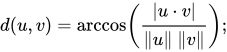
that is, the distance between two points is the angle between their corresponding lines in Rn+1. The distance formula is homogeneous in each variable, with du, μv) = d(u, v) if λ and μ are non-zero scalars, so it does define a distance on the points of projective space.

A notable property of the projective elliptic geometry is that for even dimensions, such as the plane, the geometry is non-orientable. It erases the distinction between clockwise and counterclockwise rotation by identifying them.

Stereographic model

[edit]

A model representing the same space as the hyperspherical model can be obtained by means of stereographic projection. Let En represent Rn ∪ {∞}, that is, n-dimensional real space extended by a single point at infinity. We may define a metric, the chordal metric, on En by
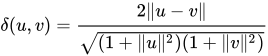
where u and v are any two vectors in Rn and is the usual Euclidean norm. We also define


The result is a metric space on En, which represents the distance along a chord of the corresponding points on the hyperspherical model, to which it maps bijectively by stereographic projection. We obtain a model of spherical geometry if we use the metric
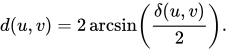
Elliptic geometry is obtained from this by identifying the antipodal points u and u / ‖u2, and taking the distance from v to this pair to be the minimum of the distances from v to each of these two points.

Self-consistency

[edit]

Because spherical elliptic geometry can be modeled as, for example, a spherical subspace of a Euclidean space, it follows that if Euclidean geometry is self-consistent, so is spherical elliptic geometry. Therefore it is not possible to prove the parallel postulate based on the other four postulates of Euclidean geometry.

Tarski proved that elementary Euclidean geometry is complete: there is an algorithm which, for every proposition, can show it to be either true or false.[8] (This does not violate Gödel's theorem, because Euclidean geometry cannot describe a sufficient amount of arithmetic for the theorem to apply.[9]) It therefore follows that elementary elliptic geometry is also self-consistent and complete.

See also

[edit]

Notes

[edit]

References

[edit]
[edit]
Revisions and contributorsEdit on WikipediaRead on Wikipedia
from Grokipedia
Elliptic geometry is a characterized by positive , where the parallel postulate is replaced by the that no exist through a point not on a given line, ensuring all lines intersect. It models the geometry of a sphere's surface, with points represented as pairs of antipodal points on and lines as great circles, the shortest paths between points. Unlike , elliptic geometry features a finite, closed without boundaries, and congruence transformations correspond to rotations of the sphere about its center. Key properties include the fact that the sum of the interior angles of any triangle exceeds 180 degrees, with the excess proportional to the triangle's area via Girard's theorem, which states that the area equals (sum of angles minus π) times the square of the sphere's radius. There are no , and betweenness is defined through separation axioms rather than the linear ordering of , leading to the absence of similar but non-congruent triangles. Distances are measured along arcs in units, and the geometry is conformal under , mapping elliptic lines to circles or lines in the plane. Elliptic geometry can be formalized through several models, including the spherical model using rotations of the 2-sphere, the projective plane model where antipodal points on the unit disk are identified, and the disk model employing Möbius transformations that preserve antipodal points. The group of transformations consists of orientation-preserving isometries, such as those given by zeiθza1azz \mapsto e^{i\theta} \frac{z - a}{1 - \overline{a}z} in the complex plane, corresponding to rotations via stereographic projection. This geometry deviates from neutral geometry by altering incidence and order axioms, resulting in properties like the Pythagorean theorem not holding and all perpendiculars to a line intersecting at a single point.

Basic Concepts

Definitions and axioms

Elliptic geometry is a defined on the surface of a where antipodal points are identified, treating each pair of opposite points as a single point in the . This identification results in a finite, closed manifold without boundaries, where the total has the of a . In this framework, points correspond to pairs of antipodal points on the , and lines are the great circles passing through these points. This model, known as single elliptic geometry, is obtained as the of by identifying antipodal points, with serving as a double cover and the identification ensuring unique intersections without redundancy from antipodes. The foundational axioms of elliptic geometry build upon those of neutral geometry but diverge critically in the treatment of parallels and intersections. A core incidence axiom states that any two distinct lines intersect in exactly one point, eliminating the possibility of entirely. This replaces from —which posits that through a point not on a given line, exactly one parallel can be drawn—with the elliptic version: through any point not on a given line, every line through that point intersects the given line. Geodesics in elliptic geometry are the shortest paths along these great circle lines, and all geodesics intersect due to the closed nature of the space. The elliptic distance between two points is measured as the length of the shorter arc along the connecting , normalized such that the maximum distance is half the of the sphere (π in units where the radius is 1), to avoid measuring the longer arc that would pass through the antipodal identification. Separation and betweenness axioms ensure that points on a line are ordered uniquely, with segments defined relative to this ordering. Additionally, the sum of the interior angles in any exceeds π radians (180 degrees), reflecting the positive of the .

Relation to spherical geometry

Spherical geometry is the study of geometric figures on the surface of a , where the geodesics, or "lines," are the great circles formed by the intersections of the with planes passing through its . In this geometry, the space has constant positive , and any two great circles intersect at exactly two antipodal points, leading to a structure where distances are bounded and paths can wrap around the . Elliptic geometry arises as a quotient of by identifying each pair of antipodal points on , resulting in a space where every point corresponds to a unique pair of opposite points from the original . This identification, known as the antipodal , transforms the SnS^n into the real projective space RPn\mathbb{RP}^n, endowing elliptic geometry with the metric inherited from the but adjusted for the equivalence. The thus serves as a double cover of the elliptic space, resolving the issue in where geodesics intersect twice by merging those points into single intersection points in the elliptic setting. This quotient construction ensures that elliptic geometry maintains the constant positive curvature of while eliminating the redundancy of antipodal duplicates, such as halving the maximum distance from πr\pi r to πr/2\pi r / 2, where rr is the sphere's . Consequently, the elliptic is compact, finite, and closed without boundary, contrasting with the infinite extent of the ; its total area or volume is half that of the corresponding , directly determined by the rr. This finite nature aligns with the modified in elliptic geometry, where no exist, as all geodesics intersect.

Models

Spherical model

The spherical model realizes elliptic geometry by constructing the space as a quotient of the standard n-sphere. Specifically, the n-dimensional elliptic space is defined as the quotient S^n / ~, where S^n denotes the n-sphere embedded in \mathbb{R}^{n+1} equipped with the round metric, and the equivalence relation ~ identifies each point p with its antipodal point -p. This identification ensures that the model captures the topology of real projective space \mathbb{RP}^n while inheriting the Riemannian structure from the sphere. The metric on this quotient space is induced by the round metric on S^n, making it a Riemannian manifold of constant positive sectional curvature. For a sphere of radius R, the Gaussian curvature is K = 1/R^2. Points in the model are represented by unit vectors in \mathbb{R}^{n+1}, and the distance between two such points x and y is given by d(x, y) = \arccos(|\langle x, y \rangle|), where \langle \cdot, \cdot \rangle denotes the standard inner product; this formula yields distances in the interval [0, \pi/2] due to the antipodal identification, corresponding to the length of the shortest great circle arc connecting the points or their antipodes. Coordinates on the spherical model employ hyperspherical coordinates on S^n, adapted to the quotient by restricting angular ranges to account for antipodal symmetry; for instance, in the two-dimensional case, these reduce to spherical coordinates (\theta, \phi) with \theta \in [0, \pi/2] and \phi \in [0, \pi) to avoid redundancy. The line element in two dimensions, for the unit sphere, is ds2=dθ2+sin2θdϕ2,ds^2 = d\theta^2 + \sin^2 \theta \, d\phi^2, which generalizes to higher dimensions via the standard expression for the round metric on S^n in hyperspherical coordinates: ds2=dχ2+sin2χ(dθ12+sin2θ1dθ22++sin2θ1sin2θn2dϕ2),ds^2 = d\chi^2 + \sin^2 \chi \left( d\theta_1^2 + \sin^2 \theta_1 \, d\theta_2^2 + \cdots + \sin^2 \theta_1 \cdots \sin^2 \theta_{n-2} \, d\phi^2 \right), where \chi \in [0, \pi/2] in the elliptic model. This construction provides an intuitive geometric realization, with spherical geometry serving as a double cover of the elliptic space.

Projective model

The projective model of elliptic geometry identifies elliptic n-space with the real projective space RPn\mathbb{RP}^n, defined as the set of all 1-dimensional linear subspaces (lines through the origin) of Rn+1\mathbb{R}^{n+1}. This construction endows the space with a natural projective structure, where the topology and geometry arise from the of the unit sphere SnRn+1S^n \subset \mathbb{R}^{n+1} by antipodal identification, ensuring a compact manifold without boundary. Points in RPn\mathbb{RP}^n are represented using homogeneous coordinates [x0:x1::xn][x_0 : x_1 : \dots : x_n], where (x0,x1,,xn)Rn+1{0}(x_0, x_1, \dots, x_n) \in \mathbb{R}^{n+1} \setminus \{0\} and two vectors define the same point if one is a scalar multiple of the other. To compute distances, representatives are normalized to unit vectors on , leveraging the linear algebra of the embedding space. Lines in this model are the projectivizations of 2-dimensional linear subspaces (2-flats) of Rn+1\mathbb{R}^{n+1}, which intersect the unit sphere in great circles; the projective ensures these lines are closed geodesics of length π\pi, free from endpoints or infinite extent. The distance dd between two points [x][ \mathbf{x} ] and [y][ \mathbf{y} ], with unit vector representatives x,ySn\mathbf{x}, \mathbf{y} \in S^n, is defined by cosd=xy,\cos d = | \mathbf{x} \cdot \mathbf{y} |, so d=arccos(xy)d = \arccos( | \mathbf{x} \cdot \mathbf{y} | ), ranging from 0 to π/2\pi/2. This formula captures the minimal angular separation on the sphere, accounting for antipodal equivalence, and induces a Riemannian metric of constant sectional curvature 1 on RPn\mathbb{RP}^n. The in derives from the round metric on , simplified for the real elliptic case by restricting to the of the radial direction in Rn+1\mathbb{R}^{n+1}; locally, in affine charts, it takes the form ds2=4dxi2(1+x2)2ds^2 = \frac{ 4 \sum dx_i^2 }{ (1 + |x|^2)^2 } after normalization. This algebraic approach highlights the model's invariance under the action of the PGL(n+1, \mathbb{R}), emphasizing incidence over embedded metrics.

Stereographic model

The stereographic model embeds elliptic geometry conformally into Euclidean space minus a point, enabling practical computations and visualizations by representing elliptic points as coordinates in Rn{0}\mathbb{R}^n \setminus \{0\}. This approach leverages the identification of antipodal points on the unit sphere to model the projective space underlying elliptic geometry. The construction begins with the standard from the of the unit SnS^n onto the equatorial , which maps points (X1,,Xn,Z)(X_1, \dots, X_n, Z) on the (with Z<1Z < 1) to (x1,,xn)Rn(x_1, \dots, x_n) \in \mathbb{R}^n via xi=Xi/(1Z)x_i = X_i / (1 - Z). To obtain the elliptic model, antipodal points on the are quotiented, effectively identifying points xx and 1/x2x-1/|x|^2 \cdot x in the plane (inversion through the unit ), yielding a conformal representation of the elliptic RPn\mathbb{RP}^n minus a point. This quotient ensures that the entire elliptic is covered without redundancy, with the origin corresponding to the and the projection avoiding the . In two dimensions, the model uses complex coordinates z=x+iyz = x + iy on the plane, where a point (x,y,w)(x, y, w) with w<1w < 1 maps to z=(x+iy)/(1w)z = (x + iy)/(1 - w), and the elliptic identification pairs zz with 1/zˉ-1/\bar{z}. This adaptation allows elliptic lines—great circles on the —to appear as circles or lines in the plane that pass through the origin or are orthogonal to the unit circle. The induced metric is conformal to the Euclidean metric, given by ds2=4dz2(1+z2)2,ds^2 = \frac{4 \, |dz|^2}{(1 + |z|^2)^2}, which pulls back the spherical metric under ; for elliptic , distances are adjusted to the half-range by taking the minimum between the spherical distance and π\pi minus that distance, ensuring geodesics do not exceed π/2\pi/2. This model preserves angles exactly due to its conformal nature but distorts distances nonlinearly, with the conformal factor 4/(1+z2)24 / (1 + |z|^2)^2 scaling lengths more severely farther from the origin, which facilitates the Euclidean-plane drawing of elliptic figures like triangles whose sides appear as circular arcs.

Low-Dimensional Cases

Two-dimensional elliptic plane

The two-dimensional elliptic plane is a model of elliptic geometry obtained as the real projective plane RP2\mathbb{RP}^2, or equivalently, as the quotient space of S2S^2 by identifying antipodal points. In this construction, points on represent lines through the origin in R3\mathbb{R}^3, and the identification ensures that opposite points are considered the same. The space is compact and closed, with a finite total area of 2πR22\pi R^2, where RR is the radius of the covering . In the elliptic plane, triangles are formed by arcs of great circles on the sphere, truncated to lengths at most π/2R\pi/2 R to avoid redundancy under antipodal identification. The sum of the interior angles A+B+CA + B + C of any such triangle exceeds π\pi radians, with the angular excess E=A+B+CπE = A + B + C - \pi serving as a measure of the triangle's size relative to the curvature. This property arises from the positive Gaussian curvature K=1/R2K = 1/R^2 inherent to the space. An analog of Girard's theorem holds, stating that the area of a triangle is given by Area=R2(A+B+Cπ).\text{Area} = R^2 (A + B + C - \pi). This formula quantifies how the excess directly corresponds to the enclosed area, scaled by the square of the radius, and applies uniformly to all triangles in the elliptic plane. A distinctive feature of the elliptic plane is that every pair of "lines"—defined as arcs of length at most π/2R\pi/2 R—intersects exactly once, reflecting the absence of and the closed akin to a . This intersection property underscores the finite, bounded nature of the space, where the entire plane can be visualized as a hemisphere with opposite boundary points glued together.

Three-dimensional elliptic space

Three-dimensional elliptic space, also known as elliptic 3-space, is the real projective space RP3\mathbb{RP}^3, which can be constructed as the 3-sphere S3S^3 with antipodal points identified, i.e., S3/{±1}S^3 / \{\pm 1\}. This identification ensures that every pair of antipodal points on the sphere represents the same point in the projective space, resulting in a compact manifold without boundary that models a closed, finite universe in three dimensions. The metric on elliptic 3-space is the standard round metric induced from the 3-sphere of radius RR, where RR is the curvature radius, yielding constant positive sectional curvature K=1/R2K = 1/R^2. The total volume of elliptic 3-space with curvature radius RR is π2R3\pi^2 R^3. This follows from the fact that the volume of the covering 3-sphere S3S^3 is 2π2R32\pi^2 R^3, and the antipodal quotient map is a 2-to-1 covering, halving the volume. In elliptic 3-space, planes are embedded elliptic 2-spaces, realized as the quotients of great 2-spheres on S3S^3 by the antipodal identification. These great 2-spheres are the intersections of S3S^3 with 3-dimensional linear subspaces through the origin in R4\mathbb{R}^4, and under the quotient, they become copies of RP2\mathbb{RP}^2. A key feature is that any two such planes intersect, as their preimages on S3S^3—great 2-spheres—always intersect in a great circle, reflecting the absence of parallel planes in elliptic geometry. The element in elliptic 3-space can be expressed using hyperspherical coordinates inherited from S3S^3, where the metric is ds2=R2[dχ2+sin2χ(dθ2+sin2θdϕ2)]ds^2 = R^2 [d\chi^2 + \sin^2 \chi (d\theta^2 + \sin^2 \theta \, d\phi^2)], with the volume form dV=R3sin2χsinθdχdθdϕdV = R^3 \sin^2 \chi \sin \theta \, d\chi \, d\theta \, d\phi. To compute the total , integrate over a fundamental domain of the antipodal action, such as χ[0,π/2]\chi \in [0, \pi/2], θ[0,π]\theta \in [0, \pi], ϕ[0,2π]\phi \in [0, 2\pi], yielding 0π/2sin2χdχ0πsinθdθ02πdϕ=(π/4)22π=π2\int_0^{\pi/2} \sin^2 \chi \, d\chi \int_0^\pi \sin \theta \, d\theta \int_0^{2\pi} d\phi = (\pi/4) \cdot 2 \cdot 2\pi = \pi^2, and thus V=π2R3V = \pi^2 R^3. Alternative parametrizations, such as those using three angles each ranging over [0,π/2][0, \pi/2] with an appropriate accounting for the , also integrate to this . In cosmology, elliptic 3-space serves as a model for a closed with positive spatial , where the finite volume π2R3\pi^2 R^3 implies a compact spatial without boundaries or infinite extents. Geodesics in this are closed loops, meaning there are no infinite rays—all paths eventually return to their starting point, and light signals propagate in finite circuits, potentially leading to observable repeating patterns in the if the scale RR is sufficiently large.

Properties and Comparisons

Differences from Euclidean geometry

Elliptic geometry differs fundamentally from in its topological structure. While is infinite and non-compact, extending indefinitely in all directions, elliptic is compact and finite, akin to the surface of a where opposite points are identified, resulting in a closed manifold without boundary. This compactness implies that any two points can be connected by a unique shortest path of length at most πR, where R is the , and the total "area" or volume is finite. Metically, elliptic geometry exhibits positive constant , in contrast to the zero of . In , distances are measured along straight lines in a flat metric, but in elliptic geometry, the metric is derived from the round metric on the sphere, leading to that are great circles. Consequently, distances "wrap around" after reaching πR, meaning that traveling far enough along a returns to the starting point, and the space lacks an infinite extent. Axiomatic divergences are most evident in the treatment of parallelism and . , a formulation of Euclid's stating that through a point not on a given line, exactly one parallel line can be drawn, fails entirely in elliptic geometry, where no parallel lines exist—all lines through a point intersect the given line. This leads to the intersection of all pairs of lines, generalizing the into , where right triangles satisfy relations involving spherical excesses rather than simple proportionality. A hallmark property of elliptic triangles is that their interior angle sum exceeds π radians (180 degrees), unlike the exact π sum in Euclidean triangles; the excess is proportional to the triangle's area, known as the spherical excess. This is reflected in the for sides, adapted to elliptic geometry: cos(cR)=cos(aR)cos(bR)+sin(aR)sin(bR)cosC\cos\left(\frac{c}{R}\right) = \cos\left(\frac{a}{R}\right) \cos\left(\frac{b}{R}\right) + \sin\left(\frac{a}{R}\right) \sin\left(\frac{b}{R}\right) \cos C where a, b, c are side lengths opposite angles A, B, C, and R is the curvature radius; this contrasts with the Euclidean law c² = a² + b² - 2ab cos C.

Self-consistency and

Elliptic geometry demonstrates through its embedding in well-established models such as projective spaces and spherical geometries, where all axioms hold without contradiction when appropriately interpreted. In the projective model, lines are defined as intersections of planes through the origin in a higher-dimensional , ensuring incidence relations are preserved and reducing the geometry to analytic computations within Euclidean coordinates. Similarly, the spherical model identifies antipodal points on a to eliminate the double intersection issue of great circles, thereby satisfying the axioms of incidence and congruence while avoiding logical inconsistencies. The parallel postulate in elliptic geometry is resolved by rejecting the existence of parallel lines altogether: through any point not on a given line, no parallel line exists, as all lines intersect within the finite space. This reinterpretation aligns with Riemann's hypothesis of positive constant curvature, where the geometry's closure ensures universal intersection, contrasting with the Euclidean case of exactly one parallel. The adaptation of Hilbert's axioms for non-Euclidean spaces, particularly by modifying the parallel axiom (Hilbert's Axiom I-7), confirms this structure's coherence without reliance on the Euclidean postulate. A sketch of consistency can be seen via the spherical excess formula, where the sum of angles in a exceeds π radians, proportional to the enclosed area on . Assuming Euclidean parallels in this model would imply infinite extent, contradicting the finite volume and universal intersection of the elliptic space, thus proving no such parallels can exist without violating the model's boundedness. In the , , , and established this consistency rigorously by reducing elliptic geometry to through coordinate systems, such as Klein's use of projective coordinates to embed the elliptic plane in .

Higher Dimensions and Generalizations

Hyperspherical constructions

Hyperspherical constructions generalize the spherical model of elliptic geometry to higher dimensions by forming the elliptic n-manifold as the quotient space Sn/{±1}S^n / \{\pm 1\}, where SnS^n is the n-dimensional sphere of radius RR equipped with its standard round metric, and the identification is via the antipodal map. This quotient inherits a Riemannian metric of constant +1/R2+1/R^2, making it a complete, only in the universal cover sense, but compact and homogeneous in the elliptic structure. Coordinates on this space can be introduced recursively using hyperspherical angles θ1,θ2,,θn\theta_1, \theta_2, \dots, \theta_n, where each θi\theta_i parameterizes nested spheres, analogous to generalizations. The line element takes the form ds2=R2(dθ12+sin2θ1dsn12)ds^2 = R^2 \left( d\theta_1^2 + \sin^2 \theta_1 \, ds_{n-1}^2 \right) on SnS^n, with the quotient metric adjusted for the identification, restricting angles appropriately (e.g., θi[0,π]\theta_i \in [0, \pi] with antipodal ). The volume form for integration involves products of sine powers, specifically sinn1θ1sinn2θ2sinθn1dθ1dθn\sin^{n-1} \theta_1 \sin^{n-2} \theta_2 \cdots \sin \theta_{n-1} \, d\theta_1 \wedge \cdots \wedge d\theta_n on the sphere, halved under the quotient to yield the elliptic measure. The total volume of the elliptic n-manifold with this metric is given by Vn=π(n+1)/2Γ(n+12)Rn,V_n = \frac{\pi^{(n+1)/2}}{\Gamma\left( \frac{n+1}{2} \right)} R^n, which is half the volume of the covering SnS^n, reflecting the twofold covering map. For example, in three dimensions, this yields a volume of π2R3\pi^2 R^3, consistent with the elliptic 3-space model. A distinctive topological feature is the of the elliptic n-manifold: it is orientable when n is odd and non-orientable when n is even, mirroring the properties of RPn\mathbb{RP}^n. This arises from the action of the antipodal map on the orientation, which reverses it in even dimensions but preserves it in odd dimensions.

Projective extensions

In , elliptic spaces emerge as metric realizations of real projective spaces equipped with a constant positive metric derived from a non-degenerate . The two-dimensional case identifies the elliptic plane with the real RP2\mathbb{RP}^2, whose points are the 1-dimensional subspaces of R3\mathbb{R}^3 (or lines through the origin), and whose lines are the 2-dimensional subspaces (or planes through the origin). This structure is obtained by quotienting the unit 2-sphere S2S^2 by antipodal identification, yielding a compact surface where every pair of lines intersects exactly once. The metric on RP2\mathbb{RP}^2 is induced by the round metric on S2S^2, with the distance dd between two points represented by unit vectors u\mathbf{u} and v\mathbf{v} in R3\mathbb{R}^3 given by d=arccos(uv)d = \arccos(|\mathbf{u} \cdot \mathbf{v}|), ensuring geodesic lengths range from 0 to π/2\pi/2 and constant 1. , or elliptic lines, correspond to great circle arcs on S2S^2 of length at most π\pi, and the total area of the space is 2π2\pi. This model satisfies the elliptic —no parallels exist—and eliminates the plane , rendering the space non-orientable. Extensions to higher dimensions generalize this construction: the n-dimensional elliptic space is the real projective space RPn\mathbb{RP}^n, comprising 1-dimensional subspaces of Rn+1\mathbb{R}^{n+1}, with the metric lifted from the standard round metric on the n-sphere SnS^n via antipodal quotient. Here, points are equivalence classes [x][\mathbf{x}] for xRn+1{0}\mathbf{x} \in \mathbb{R}^{n+1} \setminus \{\mathbf{0}\}, and the distance is d([u],[v])=arccos(uv)d([\mathbf{u}], [\mathbf{v}]) = \arccos(|\mathbf{u} \cdot \mathbf{v}|) for unit representatives, yielding constant sectional curvature 1 and compactness. The volume of RPn\mathbb{RP}^n is half that of SnS^n, specifically π(n+1)/2Γ(n+12)\frac{\pi^{(n+1)/2}}{\Gamma\left( \frac{n+1}{2} \right)}. In this setting, any two geodesics intersect, and the space serves as a model for elliptic geometry in arbitrary dimensions, though orientability holds only for odd n. This projective framework, pioneered by von Staudt and advanced by Klein in his , treats elliptic geometry as a specialization of via an absolute conic or polarity, unifying it with hyperbolic and Euclidean geometries through transformations preserving incidence. Such extensions highlight the projective space's role as an abstract elliptic geometry devoid of metric, to which is added conformally.

References

Add your contribution
Related Hubs
User Avatar
No comments yet.

