Hubbry Logo
EndocytosisEndocytosisMain
Open search
Endocytosis
Community hub
Endocytosis
logo
8 pages, 0 posts
0 subscribers
Be the first to start a discussion here.
Endocytosis
Endocytosis
from Wikipedia
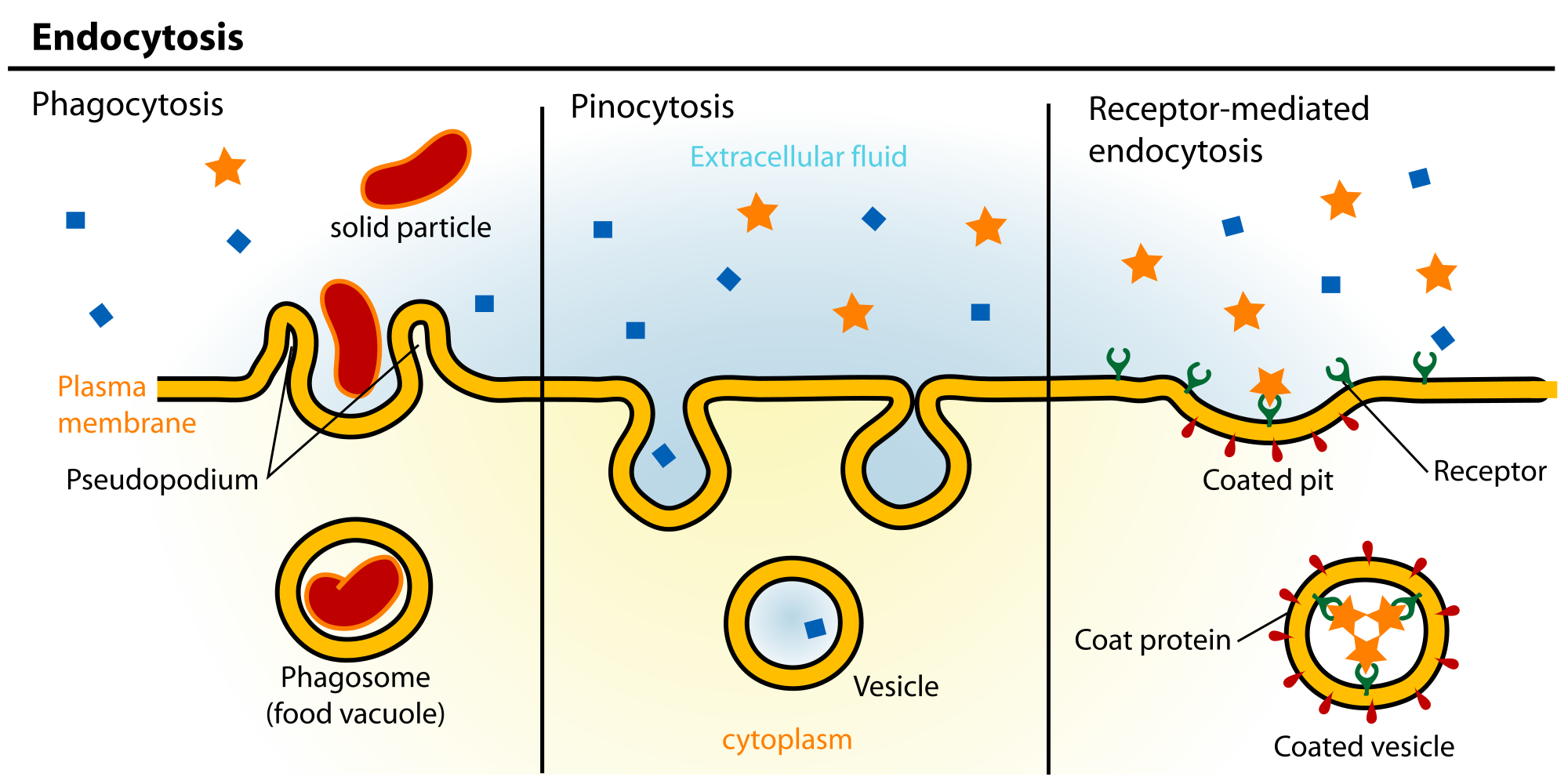
The different types of endocytosis

Endocytosis is a cellular process in which substances are brought into the cell. The material to be internalized is surrounded by an area of cell membrane, which then buds off inside the cell to form a vesicle containing the ingested materials. Endocytosis includes pinocytosis (cell drinking) and phagocytosis (cell eating). It is a form of active transport.

History

[edit]

The term was proposed by De Duve in 1963.[1] Phagocytosis was discovered by Élie Metchnikoff in 1882.[2]

Pathways

[edit]
Schematic drawing illustrating clathrin-mediated (left) and clathrin-independent endocytosis (right) of synaptic vesicle membranes

Endocytosis pathways can be subdivided into four categories: namely, receptor-mediated endocytosis (also known as clathrin-mediated endocytosis), caveolae, pinocytosis, and phagocytosis.[3]

Study[6] in mammalian cells confirm a reduction in clathrin coat size in an increased tension environment. In addition, it suggests that the two apparently distinct clathrin assembly modes, namely coated pits and coated plaques, observed in experimental investigations might be a consequence of varied tensions in the plasma membrane.
  • Caveolae are the most commonly reported non-clathrin-coated plasma membrane buds, which exist on the surface of many, but not all cell types. They consist of the cholesterol-binding protein caveolin (Vip21) with a bilayer enriched in cholesterol and glycolipids. Caveolae are small (approx. 50 nm in diameter) flask-shape pits in the membrane that resemble the shape of a cave (hence the name caveolae). They can constitute up to a third of the plasma membrane area of the cells of some tissues, being especially abundant in smooth muscle, type I pneumocytes, fibroblasts, adipocytes, and endothelial cells.[7] Uptake of extracellular molecules is also believed to be specifically mediated via receptors in caveolae.
    From left to right: Phagocytosis, Pinocytosis, Receptor-mediated endocytosis.
    • Potocytosis is a form of receptor-mediated endocytosis that uses caveolae vesicles to bring molecules of various sizes into the cell. Unlike most endocytosis that uses caveolae to deliver contents of vesicles to lysosomes or other organelles, material endocytosed via potocytosis is released into the cytosol.[8]
  • Pinocytosis, which usually occurs from highly ruffled regions of the plasma membrane, is the invagination of the cell membrane to form a pocket, which then pinches off into the cell to form a vesicle (0.5–5 μm in diameter) filled with a large volume of extracellular fluid and molecules within it (equivalent to ~100 CCVs). The filling of the pocket occurs in a non-specific manner. The vesicle then travels into the cytosol and fuses with other vesicles such as endosomes and lysosomes.[9]
  • Phagocytosis is the process by which cells bind and internalize particulate matter larger than around 0.75 μm in diameter, such as small-sized dust particles, cell debris, microorganisms and apoptotic cells. These processes involve the uptake of larger membrane areas than clathrin-mediated endocytosis and caveolae pathway.

More recent experiments have suggested that these morphological descriptions of endocytic events may be inadequate, and a more appropriate method of classification may be based upon whether particular pathways are dependent on clathrin and dynamin.

Dynamin-dependent clathrin-independent pathways include FEME, UFE, ADBE, EGFR-NCE and IL2Rβ uptake.[10]

Dynamin-independent clathrin-independent pathways include the CLIC/GEEC pathway (regulated by Graf1),[11] as well as MEND and macropinocytosis.[10]

Clathrin-mediated endocytosis is the only pathway dependent on both clathrin and dynamin.

Principal components

[edit]

The endocytic pathway of mammalian cells consists of distinct membrane compartments, which internalize molecules from the plasma membrane and recycle them back to the surface (as in early endosomes and recycling endosomes), or sort them to degradation (as in late endosomes and lysosomes). The principal components of the endocytic pathway are:[3]

  • Early endosomes are the first compartment of the endocytic pathway. Early endosomes are often located in the periphery of the cell, and receive most types of vesicles coming from the cell surface. They have a characteristic tubulo-vesicular structure (vesicles up to 1 μm in diameter with connected tubules of approx. 50 nm diameter) and a mildly acidic pH. They are principally sorting organelles where many endocytosed ligands dissociate from their receptors in the acid pH of the compartment, and from which many of the receptors recycle to the cell surface (via tubules).[12][13] It is also the site of sorting into transcytotic pathway to later compartments (like late endosomes or lysosomes) via transvesicular compartments (like multivesicular bodies (MVB) or endosomal carrier vesicles (ECVs)).
  • Late endosomes receive endocytosed material en route to lysosomes, usually from early endosomes in the endocytic pathway, from trans-Golgi network (TGN) in the biosynthetic pathway, and from phagosomes in the phagocytic pathway.[14] Late endosomes often contain proteins characteristic of nucleosomes, mitochondria and mRNAs including lysosomal membrane glycoproteins and acid hydrolases. They are acidic (approx. pH 5.5), and are part of the trafficking pathway of mannose-6-phosphate receptors. Late endosomes are thought to mediate a final set of sorting events prior the delivery of material to lysosomes.
  • Lysosomes are the last compartment of the endocytic pathway. Their chief function is to break down cellular waste products, fats, carbohydrates, proteins, and other macromolecules into simple compounds. These are then returned to the cytoplasm as new cell-building materials. To accomplish this, lysosomes use some 40 different types of hydrolytic enzymes, all of which are manufactured in the endoplasmic reticulum, modified in the Golgi apparatus and function in an acidic environment.[15] The approximate pH of a lysosome is 4.8 and by electron microscopy (EM) usually appear as large vacuoles (1-2 μm in diameter) containing electron dense material. They have a high content of lysosomal membrane proteins and active lysosomal hydrolases, but no mannose-6-phosphate receptor. They are generally regarded as the principal hydrolytic compartment of the cell.[16][17]

It was recently found that an eisosome serves as a portal of endocytosis in yeast.[18]

Clathrin-mediated

[edit]

The major route for endocytosis in most cells, and the best-understood, is that mediated by the molecule clathrin.[19][20] This large protein assists in the formation of a coated pit on the inner surface of the plasma membrane of the cell. This pit then buds into the cell to form a coated vesicle in the cytoplasm of the cell. In so doing, it brings into the cell not only a small area of the surface of the cell but also a small volume of fluid from outside the cell.[21][22][23]

Coats function to deform the donor membrane to produce a vesicle, and they also function in the selection of the vesicle cargo. Coat complexes that have been well characterized so far include coat protein-I (COP-I), COP-II, and clathrin.[24][25] Clathrin coats are involved in two crucial transport steps: (i) receptor-mediated and fluid-phase endocytosis from the plasma membrane to early endosome and (ii) transport from the TGN to endosomes. In endocytosis, the clathrin coat is assembled on the cytoplasmic face of the plasma membrane, forming pits that invaginate to pinch off (scission) and become free CCVs. In cultured cells, the assembly of a CCV takes ~ 1min, and several hundred to a thousand or more can form every minute.[26] The main scaffold component of clathrin coat is the 190-kD protein called clathrin heavy chain (CHC), which is associated with a 25- kD protein called clathrin light chain (CLC), forming three-legged trimers called triskelions.

Vesicles selectively concentrate and exclude certain proteins during formation and are not representative of the membrane as a whole. AP2 adaptors are multisubunit complexes that perform this function at the plasma membrane. The best-understood receptors that are found concentrated in coated vesicles of mammalian cells are the LDL receptor (which removes LDL from circulating blood), the transferrin receptor (which brings ferric ions bound by transferrin into the cell) and certain hormone receptors (such as that for EGF).

At any one moment, about 25% of the plasma membrane of a fibroblast is made up of coated pits. As a coated pit has a life of about a minute before it buds into the cell, a fibroblast takes up its surface by this route about once every 50 minutes. Coated vesicles formed from the plasma membrane have a diameter of about 100 nm and a lifetime measured in a few seconds. Once the coat has been shed, the remaining vesicle fuses with endosomes and proceeds down the endocytic pathway. The actual budding-in process, whereby a pit is converted to a vesicle, is carried out by clathrin; Assisted by a set of cytoplasmic proteins, which includes dynamin and adaptors such as adaptin.

Coated pits and vesicles were first seen in thin sections of tissue in the electron microscope by Thomas F Roth and Keith R. Porter.[27] The importance of them for the clearance of LDL from blood was discovered by Richard G. Anderson, Michael S. Brown and Joseph L. Goldstein in 1977.[28] Coated vesicles were first purified by Barbara Pearse, who discovered the clathrin coat molecule in 1976.[29]

Processes and components

[edit]

Caveolin proteins like caveolin-1 (CAV1), caveolin-2 (CAV2), and caveolin-3 (CAV3), play significant roles in the caveolar formation process. More specifically, CAV1 and CAV2 are responsible for caveolae formation in non-muscle cells while CAV3 functions in muscle cells. The process starts with CAV1 being synthesized in the ER where it forms detergent-resistant oligomers. Then, these oligomers travel through the Golgi complex before arriving at the cell surface to aid in caveolar formation. Caveolae formation is also reversible through disassembly under certain conditions such as increased plasma membrane tension. These certain conditions then depend on the type of tissues that are expressing the caveolar function. For example, not all tissues that have caveolar proteins have a caveolar structure i.e. the blood-brain barrier.[30] Though there are many morphological features conserved among caveolae, the functions of each CAV protein are diverse. One common feature among caveolins is their hydrophobic stretches of potential hairpin structures that are made of α-helices. The insertion of these hairpin-like α-helices forms a caveolae coat which leads to membrane curvature. In addition to insertion, caveolins are also capable of oligomerization which further plays a role in membrane curvature. Recent studies have also discovered that polymerase I, transcript release factor, and serum deprivation protein response also play a role in the assembly of caveolae. Besides caveolae assembly, researchers have also discovered that CAV1 proteins can also influence other endocytic pathways. When CAV1 binds to Cdc42, CAV1 inactivates it and regulates Cdc42 activity during membrane trafficking events.[31]

Mechanisms

[edit]

The process of cell uptake depends on the tilt and chirality of constituent molecules to induce membrane budding. Since such chiral and tilted lipid molecules are likely to be in a "raft" form, researchers suggest that caveolae formation also follows this mechanism since caveolae are also enriched in raft constituents. When caveolin proteins bind to the inner leaflet via cholesterol, the membrane starts to bend, leading to spontaneous curvature. This effect is due to the force distribution generated when the caveolin oligomer binds to the membrane. The force distribution then alters the tension of the membrane which leads to budding and eventually vesicle formation.[32]

[edit]

See also

[edit]

References

[edit]

Further reading

[edit]
[edit]
Revisions and contributorsEdit on WikipediaRead on Wikipedia
from Grokipedia
Endocytosis is the process by which eukaryotic cells internalize macromolecules, particles, and from their environment by invaginating the plasma membrane to form membrane-bound vesicles that pinch off into the . This mechanism, coined by in 1963, enables cells to selectively take up essential nutrients while excluding harmful substances, and it contrasts with , the reverse process of vesicle fusion with the plasma membrane for . Endocytosis is ubiquitous across eukaryotic cell types and is essential for maintaining cellular , with cells capable of internalizing an area of plasma membrane equivalent to their entire surface every 30–120 minutes through this process. Endocytosis encompasses several distinct pathways, broadly classified as , , and , each adapted to specific cargo sizes and cellular needs. ("cell eating") involves the engulfment of large particles greater than 0.25 μm, such as or apoptotic cells, via actin-driven formation, resulting in phagosomes that fuse with lysosomes for degradation; this pathway is prominent in professional like macrophages and neutrophils, which clear over 10¹¹ aged or damaged blood cells daily in humans. ("cell drinking") is a constitutive process for non-specific uptake of extracellular fluids and solutes into small vesicles (typically 50–150 nm), occurring continuously in most cells to sample the surrounding environment. In contrast, provides high selectivity, where specific ligands bind to surface receptors clustered in clathrin-coated pits, leading to the formation of clathrin-coated vesicles (CCVs) that internalize targeted molecules like (LDL) for delivery. The molecular mechanisms of endocytosis involve a coordinated assembly of proteins, , and cytoskeletal elements to drive curvature, vesicle , and fission. In clathrin-dependent endocytosis, adaptor proteins like AP-2 recruit triskelions to form polyhedral coats on the plasma , while constrict and sever the neck of invaginating pits to release free vesicles; often assists in this scission step, particularly under high cargo loads. Clathrin-independent pathways include caveolae-mediated endocytosis, which utilizes cholesterol-rich rafts and caveolin proteins to form flask-shaped invaginations (50–80 nm) for or certain toxins, and macropinocytosis, an -driven process that generates large, irregular vesicles (0.2–5 μm) to engulf bulk extracellular material. Following internalization, endocytic vesicles typically mature into early endosomes, where cargo is sorted for back to the plasma , degradation in lysosomes, or across epithelial barriers. Beyond nutrient acquisition, endocytosis regulates diverse physiological processes, including , immune surveillance, development, and host-pathogen interactions. It modulates by internalizing and downregulating activated receptors, such as receptors, to prevent overstimulation and enable signal termination or resensitization. In immunity, delivers antigens to lysosomes for processing and presentation, while pathogens like viruses and exploit endocytic routes—such as clathrin-mediated for or macropinocytosis for virus—to gain cellular entry. Recent research underscores endocytosis's role in therapeutic applications, particularly for nanoparticle-based , where understanding pathway-specific uptake enhances targeting of intracellular diseases like cancer. Dysregulation of endocytosis is implicated in disorders ranging from hypercholesterolemia (due to defective recycling) to neurodegenerative diseases involving impaired retrieval.

Historical Development

Early Observations

The earliest microscopic observations of processes resembling endocytosis date back to the 19th century, when naturalists began examining the dynamic behaviors of single-celled organisms. In the 1830s, Christian Gottfried Ehrenberg described the formation of pseudopodia—temporary extensions of the cell body—in amoebae, noting how these structures enabled locomotion and the envelopment of particulate matter from the environment, such as food particles. These observations, detailed in his 1838 work Die Infusionsthierchen als vollkommene Organismen, represented one of the first documented sightings of what would later be recognized as phagocytic uptake, a key form of endocytosis, though Ehrenberg interpreted the phenomena within the context of vitalistic biology rather than cellular mechanisms. Later, in 1883, Élie Metchnikoff coined the term "phagocytosis" to describe the process by which cells engulf particles, building on these early morphological observations. Advancements in microscopy during the mid-20th century provided more direct visual evidence of membrane dynamics suggestive of endocytosis. In the 1950s, the advent of electron microscopy allowed researchers to visualize ultrastructural details of cell surfaces for the first time. George E. Palade's 1953 study on the of blood capillaries revealed flask-shaped invaginations in the plasma membrane of endothelial cells, which he proposed facilitated the uptake of extracellular fluids and solutes—early indications of vesicular transport processes now known as and caveolar endocytosis. Similar invaginations were observed in other cell types, such as epithelium by E. Yamada in 1955, further supporting the idea of active membrane folding for material internalization. A pivotal conceptual link between these uptake processes and intracellular digestion emerged in 1963, when formalized the description of as membrane-bound organelles containing hydrolytic enzymes in his review "The Lysosome." In this work, de Duve coined the term "endocytosis" and highlighted ' role in the breakdown of materials acquired through cellular ingestion, integrating earlier morphological observations with biochemical evidence of acid hydrolase activity; he noted that these organelles received endocytosed content via fusion with primary , thereby establishing endocytosis as a pathway for acquisition and . This built on de Duve's prior subcellular fractionation studies from the 1950s.

Key Discoveries and Milestones

In the early 1970s, Michael S. Brown and identified the (LDL) receptor as a key regulator of in cells, demonstrating that fibroblasts take up LDL through a receptor-dependent mechanism that internalizes the ligand-bound receptor into the cell. Their work culminated in the seminal 1977 paper showing that LDL receptors cluster in specialized regions of the plasma membrane known as coated pits, leading to the internalization of receptor-ligand complexes via coated vesicles—a process they termed . This discovery provided the first molecular framework for how cells selectively internalize extracellular molecules, linking it directly to LDL uptake and metabolism, and earned Brown and Goldstein the in Physiology or Medicine in 1985. Building on these insights, Barbara M. F. Pearse isolated and characterized in 1976, identifying it as the major structural protein forming the polyhedral lattice that coats the vesicles involved in . Pearse purified coated vesicles from pig brain and demonstrated that clathrin self-assembles into a basket-like , providing for coated pits observed in electron micrographs. This identification established clathrin as the core component of the endocytic machinery, enabling subsequent studies on vesicle formation and the specificity of cargo selection in coated pits. The 1980s marked a technological leap with the development of fluorescent dyes and live-cell imaging techniques, allowing researchers to visualize endocytic dynamics in real time. Pioneering work by Caroline R. Hopkins and Ian S. Trowbridge in 1983 used fluorescein-labeled to track the internalization and intracellular trafficking of the in living A431 carcinoma cells via video-enhanced fluorescence microscopy. This approach revealed the rapid kinetics of , including clustering in coated pits and delivery to endosomes, transforming the field by shifting from static electron microscopy to dynamic observations of endocytic events.

General Principles

Definition and Classification

Endocytosis is an process by which eukaryotic cells engulf extracellular materials, including macromolecules, particles, and fluids, from their surrounding environment into membrane-bound vesicles formed by of the plasma membrane. This mechanism enables cells to internalize essential nutrients, signaling molecules, and pathogens while regulating plasma membrane composition and receptor levels. The term "endocytosis" was introduced by in 1963 to describe this form of cellular ingestion. Endocytosis is broadly classified into three major categories based on the size and specificity of the internalized material: , , and . ("cell eating") involves the uptake of large solid particles, such as or apoptotic cells, greater than 0.25 μm in diameter, typically by professional like macrophages and neutrophils to facilitate immune defense and debris clearance. ("cell drinking") is a constitutive, non-selective process that captures and its dissolved solutes into smaller vesicles, occurring ubiquitously in eukaryotic cells to sample the surrounding milieu. selectively internalizes specific ligands or macromolecules that bind to cell-surface receptors, concentrating them for targeted uptake and downstream processing. In contrast to , which exports cellular contents by fusing intracellular vesicles with the plasma , endocytosis drives the internalization of external substances and components into the cell, maintaining a balance in vesicular trafficking.

Stages and Energy Requirements

Endocytosis proceeds through a series of coordinated stages that facilitate the internalization of extracellular materials and plasma components into the cell, with variations depending on the specific pathway. The process generally begins with recognition or selection at the plasma , followed by deformation to form an . This leads to vesicle formation through deepening of the and eventual scission to release the vesicle into the . After release, the vesicle may undergo uncoating (in coated pathways) and maturation to fuse with intracellular compartments. The endocytic process is highly energy-dependent, requiring hydrolysis (such as ATP and GTP) to power key mechanical steps including membrane deformation, vesicle release, and uncoating. Endocytosis is also temperature-sensitive, with rates sharply declining and often becoming negligible below approximately 15°C due to reduced enzymatic activity and , allowing researchers to synchronize or inhibit the process experimentally. In many pathways, particularly those involving larger structures or under conditions of high membrane tension, the actin cytoskeleton contributes to force generation during membrane deformation and vesicle propulsion away from the plasma membrane.

Molecular Machinery

Core Proteins and Adaptors

Adaptor proteins play a crucial role in the initiation of endocytosis by recognizing specific cargo molecules and linking them to the plasma membrane, thereby facilitating the of structural components for vesicle formation. The AP-2 complex, a heterotetrameric adaptor protein consisting of α, β2, μ2, and σ2 subunits, binds directly to (PI(4,5)P2) lipids in the plasma membrane through its μ2 subunit, which stabilizes its association with the membrane surface. This lipid binding induces a conformational change in AP-2, exposing cargo-binding sites that interact with internalization motifs on transmembrane receptors, such as the YxxΦ motif recognized by the μ2 subunit, thereby selectively recruiting cargo into nascent endocytic sites. Through these interactions, AP-2 acts as a central hub, coordinating the assembly of endocytic machinery and ensuring efficient cargo sorting during the early stages of clathrin-mediated endocytosis. Clathrin, the primary structural protein in coated pits, assembles into a polyhedral lattice that drives membrane invagination. Composed of three heavy chains and three light chains forming a —a tripod-like with three-legged arms— triskelions polymerize via interactions between their terminal domains, creating a curved lattice that conforms to the membrane. The β2 subunit of AP-2 binds to the N-terminal β-propeller domain (distal end) of clathrin heavy chains, nucleating their recruitment and promoting sequential addition to form the characteristic hexagonal and pentagonal lattice of clathrin-coated pits, which provides the mechanical force for membrane deformation. This assembly process begins with a small cluster of triskelions stabilized by AP-2, expanding into a mature pit approximately 100-200 nm in diameter over tens of seconds. Accessory proteins such as epsin and clathrin assembly lymphoid myeloid leukemia protein (CALM) contribute to induction, enhancing the efficiency of pit formation. Epsin, recruited via its epsin N-terminal homology (ENTH) domain that binds PI(4,5)P2, inserts an amphipathic into the , generating positive through a wedging mechanism that promotes . Similarly, CALM, a member of the AP-180 family, binds PI(4,5)P2 and employs its ANTH domain to induce , while also interacting with to stabilize lattice assembly. These proteins work in concert with AP-2 and to deform the membrane, ensuring the progressive tubulation required for endocytic vesicle .

Vesicle Formation and Scission

Vesicle formation in endocytosis culminates in the scission of invaginated membrane pits to generate free vesicles, a process primarily mediated by the large . Dynamin assembles into helical collars that encircle the necks of deeply invaginated clathrin-coated pits, forming spiral structures visible via electron microscopy. This oligomerization is stimulated by the high curvature at the pit neck, where self-assembles into rings with approximately 13 monomers per turn. Upon GTP binding, dynamin undergoes a conformational change that constricts the helical collar, narrowing the neck to facilitate fission. GTP hydrolysis then provides the energy for further constriction and twist, ultimately severing the connection between the vesicle and the plasma . Mutants impaired in GTP hydrolysis, such as the T65A variant, accumulate deeply invaginated pits without scission, confirming the enzyme's mechanochemical role. recruitment occurs in two phases: an early shallow phase for stabilization and a late burst for scission, coordinated with adaptor proteins like AP-2. BAR domain-containing proteins, such as endophilin, contribute to vesicle formation by sensing and stabilizing the positive membrane at invagination necks. Endophilin's N-BAR domain dimerizes on lipid bilayers, with its concave surface scaffolding the membrane into tubular structures, while an amphipathic inserts into the bilayer to drive deformation. This curvature stabilization aids collar assembly and promotes efficient scission, as endophilin directly binds via its SH3 domain. In synaptic endocytosis, endophilin depletion leads to accumulation of collared intermediates, underscoring its role in transitioning from tubulation to fission. Following scission, the clathrin coat must be removed to allow vesicle fusion with endosomal compartments and of coat components. The HSC70, recruited by the J-domain cochaperone auxilin, drives this uncoating process. Auxilin binds triskelia, positioning HSC70 to hydrolyze ATP and form stable HSC70- complexes that disassemble the lattice into individual components.00157-6) This ATP-dependent uncoating occurs rapidly post-scission, preventing vesicle aggregation and ensuring availability for new rounds of endocytosis, with HSC70 targeting clathrin heavy chain C-termini to inhibit reassembly. In neurons, HSC70 disruption impairs , highlighting its essential function in maintaining endocytic flux.

Endocytic Pathways

Clathrin-Mediated Endocytosis

Clathrin-mediated endocytosis (CME) represents the predominant pathway for the selective internalization of transmembrane receptors and their bound ligands from the plasma membrane, facilitating nutrient uptake, , and receptor downregulation. This process entails the assembly of into coated pits that invaginate the membrane, culminating in the budding of vesicles measuring 50–100 nm in diameter. These vesicles transport cargo such as iron-bound or cholesterol-laden (LDL) into the endosomal system, where the clathrin coat is subsequently removed to allow further trafficking. The initiation of CME occurs when extracellular ligands bind to specific cell-surface receptors, such as the or , inducing conformational changes that expose internalization motifs. These motifs recruit the heterotetrameric AP-2 adaptor complex, which binds to both the receptor's cytoplasmic tail and , promoting the clustering of receptor-ligand complexes into nascent coated pits. , composed of trimeric units of heavy chains (approximately 190 kDa) and associated light chains (25–40 kDa), polymerizes into a lattice of hexagons and pentagons that stabilizes the curved membrane and concentrates cargo, excluding non-specific membrane components. For G-protein-coupled receptors (GPCRs), β-arrestins play a crucial role by binding activated receptors and recruiting AP-2 and , thereby linking GPCR signaling termination to endocytosis. Vesicle formation progresses through membrane invagination driven by the clathrin lattice and accessory proteins, reaching a depth of about 100 nm before scission. The GTPase assembles into helical polymers around the neck of the invaginated pit, and its GTP constricts the membrane to release a free coated vesicle into the . This step is tightly regulated by of at serine and residues, which modulates its oligomerization and GTPase activity to ensure timely fission. Additionally, ubiquitination of residues on cargo receptors or adaptors acts as a sorting signal, enhancing recruitment to coated pits and coordinating downstream endosomal sorting.

Non-Clathrin Pathways

Non-clathrin pathways encompass a diverse set of clathrin-independent endocytic mechanisms that rely on lipid-driven organization rather than protein coats for and uptake. These routes are particularly prominent in cells with specialized plasma domains and facilitate the internalization of specific lipids, proteins, and pathogens that partition into cholesterol-rich microdomains known as lipid rafts. Unlike clathrin-mediated endocytosis, which forms coated pits through adaptor proteins, non-clathrin pathways often involve dynamic tubular or flask-shaped structures sensitive to levels, enabling selective transport without the need for lattices. Caveolae-mediated endocytosis represents one of the most characterized non-clathrin routes, characterized by the formation of flask-shaped plasma membrane s measuring 50-80 nm in diameter. These structures arise from the of caveolin-1 (CAV1), a hairpin-shaped that oligomerizes into high-molecular-weight complexes, stabilized by accessory cavin proteins such as polymerase I and transcript release factor (PTRF/cavin-1). The process is dynamin-dependent and often triggered by cargo binding, leading to polymerization and vesicle scission for the uptake of molecules like in endothelial cells via the gp60 receptor or the simian virus 40 () through interactions with gangliosides. Caveolae are enriched in and , forming stable domains that confer high sensitivity to cholesterol-depleting agents like methyl-β-cyclodextrin, which disrupt invagination and endocytosis. In contrast, flotillin-dependent endocytosis operates through planar clathrin-independent carriers (CLICs), which are tubular, non-flask-shaped invaginations that mediate the rapid uptake of (GPI)-anchored proteins. Flotillins 1 and 2, peripheral membrane proteins, co-assemble into oligomeric scaffolds at the inner leaflet of the plasma membrane, recruiting regulators like CDC42 and Arf1 to drive actin-dependent tubulation and fission in a largely dynamin-independent manner. This pathway is exemplified by the internalization of GPI-anchored cargoes such as or the B subunit of , often in non-polarized cells lacking caveolae. Like caveolae, flotillin pathways associate closely with lipid rafts and exhibit strong dependence on for domain stability and carrier formation, though they form more transient, planar structures compared to the rigid caveolar flasks.

Phagocytosis and Macropinocytosis

is an actin-dependent process primarily executed by professional , such as macrophages, neutrophils, and dendritic cells, that enables the engulfment of large particulate matter, including microbes, apoptotic cells, and cellular debris, typically exceeding 0.5 μm in diameter. This bulk internalization forms specialized intracellular compartments known as phagosomes, which range from 0.5 to 10 μm in size and are derived from plasma membrane invaginations driven by pseudopod extension around the target particle.30065-6) The process is triggered by receptor-ligand interactions, such as those involving Fcγ receptors or complement receptors, leading to sequential polymerization that propels membrane protrusion and eventual closure of the phagocytic cup. Once sealed, phagosomes mature through fusion with lysosomes, facilitating degradation of the engulfed material and contributing to immune defense and tissue homeostasis.30065-6) In contrast, macropinocytosis represents a form of fluid-phase endocytosis that captures large volumes of and solutes into spacious vacuoles called macropinosomes, which measure 0.2 to 5 μm in diameter.00838-2) This pathway is initiated by plasma membrane ruffling, where actin-driven protrusions fold back and fuse with the underlying membrane, non-selectively internalizing , growth factors, and without requiring specific receptors. Macropinocytosis is often constitutive in certain cell types, notably immature dendritic cells and macrophages, where it supports antigen sampling and scavenging to sustain cellular functions like and proliferation. Unlike phagocytosis, which targets discrete particles, macropinocytosis enables rapid uptake of soluble extracellular components, with the resulting macropinosomes trafficking intracellularly for processing or recycling.00838-2) Both and macropinocytosis rely on dynamic remodeling orchestrated by Rho family , including Rac, Cdc42, and RhoA, which activate downstream effectors like WAVE and Arp2/3 complexes to drive protrusion and cup formation.00069-5) These signaling molecules ensure coordinated pseudopod extension in and ruffle generation in macropinocytosis, with their spatiotemporal regulation determining the efficiency and specificity of bulk uptake.00069-5) Vesicle scission in these processes may involve dynamin-related proteins, though forces predominate.

Functions and Regulation

Intracellular Trafficking

Following endocytosis, internalized vesicles fuse with early endosomes, which serve as primary sorting stations in the endocytic pathway. This homotypic fusion process is orchestrated by the Rab5, which recruits effectors such as EEA1 (early endosome antigen 1) and Rabaptin-5 to and promote fusion, thereby facilitating the formation and maturation of early endosomes. Rab5 also coordinates the influx of cargo from multiple endocytic routes, ensuring efficient integration into the endosomal network. Within early endosomes, the mildly acidic environment (pH approximately 6.0–6.5) triggers pH-dependent dissociation of many receptor-ligand complexes, such as those involving the (EGFR) and its ligand, allowing unbound ligands to be directed toward degradation while receptors may be recycled. This sorting is further influenced by lipid modifications, including phosphatidylinositol 3-phosphate (PI(3)P) produced by class III PI3-kinases, which recruits sorting nexins to organize cargo segregation. From early endosomes, follows distinct trafficking pathways regulated by Rab GTPase switches. Receptors destined for reuse, such as , are sorted into tubular extensions that mature into recycling endosomes marked by Rab11, which directs their return to the plasma membrane via Rab11-FIP effectors. Alternatively, fated for degradation, like ubiquitinated receptors, progresses to late endosomes under the control of Rab7, which replaces Rab5 during endosomal maturation and promotes fusion with lysosomes for hydrolytic breakdown. Rab7 also interacts with effectors like RILP to link late endosomes to for dynein-mediated transport toward perinuclear lysosomes. In certain cases, endocytosed material, particularly mannose-6-phosphate receptors involved in lysosomal enzyme delivery, undergoes retrograde transport to the trans-Golgi network (TGN); this pathway from early endosomes relies on the retromer complex, while from late endosomes it involves Rab9 and its effectors like TIP47. A critical aspect of degradative trafficking occurs through multivesicular body (MVB) formation on late endosomes. Ubiquitinated is sequestered into intraluminal vesicles (ILVs) via sequential action of endosomal sorting complexes required for (ESCRT-0 to -III). ESCRT-0 (containing Hrs and STAM) recognizes on and clusters it on PI(3)P-enriched membranes, recruiting ESCRT-I (Tsg101/Vps23 and Vps28) and ESCRT-II (Vps22/36/25) to deform the membrane inward. ESCRT-III filaments then drive ILV scission, with subsequent disassembly by the VPS4 , generating mature MVBs that fuse with lysosomes to deliver for degradation. This ESCRT-mediated process ensures selective sorting and prevents aberrant signaling from internalized receptors.

Signaling and Homeostasis

Endocytosis plays a critical role in attenuating signaling from receptor tyrosine kinases (RTKs) by facilitating ligand-induced internalization and subsequent lysosomal degradation, thereby preventing prolonged activation and maintaining cellular responsiveness. Upon ligand binding, such as (EGF) to the (EGFR), RTKs undergo rapid clathrin-mediated endocytosis, with internalization rates increasing several-fold (up to 0.6 min⁻¹ for EGFR). This process involves recruitment to clathrin-coated pits via adaptor proteins like AP-2 and adaptors such as epsins. Internalized RTK-ligand complexes traffic to early endosomes, where ubiquitination by E3 ligases like c-Cbl marks them for sorting into multivesicular bodies (MVBs) through the machinery, directing them to lysosomes for degradation. This degradation pathway reduces surface receptor levels, spatially separating RTKs from downstream effectors like PI3K and PLCγ1, thus terminating signaling cascades such as MAPK/ERK. For instance, in EGFR signaling, c-Cbl-mediated ubiquitination is essential, as mutations disrupting this step prolong signaling. In nutrient sensing, endocytosis regulates the recycling of amino acid transporters to modulate the mechanistic target of rapamycin (mTOR) pathway, ensuring adaptive responses to amino acid availability. Active mTOR complex 1 (mTORC1) promotes the canonical endocytic recycling of transporters like LAT1 and SNAT2 back to the plasma membrane, sustaining amino acid uptake under nutrient-replete conditions. Upon amino acid starvation or mTORC1 inhibition (e.g., by rapamycin), these transporters are redirected from recycling endosomes to lysosomes for degradation, independent of autophagy, via downregulation of ESCRT-0 component Hrs. This mechanism fine-tunes mTORC1 activation, as transporter abundance directly influences intracellular amino acid levels that sense and stimulate mTORC1 through Ragulator and v-ATPase. Amino acids, particularly glutamine, further enhance endosome-to-Golgi trafficking of related membrane proteins via Arl5b activation, linking nutrient status to broader endocytic regulation. Endocytosis also contributes to iron through the recycling of the 1 (TfR1), which mediates cellular iron uptake while preventing overload. Iron-loaded binds TfR1 on the cell surface, triggering clathrin-dependent endocytosis of the complex into early . Acidification of the endosome releases ferric iron (Fe³⁺), which is reduced to iron (Fe²⁺) by STEAP3 and transported into the via DMT1 for utilization in processes like synthesis or storage in . The apotransferrin-TfR1 complex then recycles back to the plasma membrane via recycling endosomes, releasing apotransferrin and replenishing surface TfR1 to sustain uptake without net receptor loss. TfR1 expression is post-transcriptionally regulated by the iron-responsive element (IRE)/iron regulatory protein (IRP) system, increasing under to enhance endocytosis and maintain . This recycling loop, occurring efficiently in most cells, ensures balanced iron distribution essential for oxygen transport and enzymatic functions.

Pathological Aspects

Dysregulation in Diseases

Dysregulation of endocytosis plays a critical role in various diseases, where genetic mutations or environmental factors disrupt vesicular trafficking, leading to pathological accumulation or exploitation of cellular pathways. (FH), a common characterized by elevated cholesterol (LDL-C) levels and accelerated , arises primarily from mutations in the (LDLR) gene that impair clathrin-mediated endocytosis of LDL particles in hepatocytes. These mutations, affecting approximately 1 in 250 individuals worldwide, disrupt the receptor's internalization by altering its binding to clathrin adaptors or endocytic motifs, resulting in reduced LDL clearance and homozygous forms presenting with LDL-C levels exceeding 500 mg/dL. For instance, class 4 LDLR mutations specifically block the receptor's translocation into clathrin-coated pits, preventing efficient recycling and exacerbating hypercholesterolemia. Additionally, rare autosomal recessive forms of FH stem from mutations in the LDLR adaptor protein 1 (LDLRAP1, also known as ARH), which is essential for recruiting LDLR to endocytic sites in the liver; such defects lead to selective impairment of hepatic LDL uptake while sparing other tissues. Although direct mutations in the core clathrin adaptor AP-2 are uncommon, disruptions in the broader endocytic machinery, including AP-2 interactions, contribute to similar phenotypes in compound heterozygous cases. In neurodegenerative disorders like (AD), defective -mediated endocytosis hinders the clearance of amyloid-β (Aβ) peptides, promoting their extracellular accumulation into plaques and intracellular toxicity. Neurons and rely on endocytic receptors such as low-density lipoprotein receptor-related protein 1 () for Aβ uptake and degradation, but AD-linked genetic variants and aging-related declines reduce this process, with studies showing up to 50% decreased Aβ internalization in affected brain regions. Reduced expression of CALM (clathrin assembly lymphoid myeloid leukemia protein), an accessory to the AP-2 complex, shifts Aβ42/Aβ40 ratios toward the more fibrillogenic form, as observed in human AD brains and mouse models where CALM knockdown exacerbates plaque formation. Furthermore, impairment of LC3-associated endocytosis (Lando), a non-canonical pathway enhancing phagocytic clearance, leads to Aβ buildup and synaptic loss in AD models, with restoration of Lando function rescuing cognitive deficits and reducing neurodegeneration. Endocytic dysregulation also facilitates infectious diseases by allowing pathogens to hijack host vesicular pathways for entry and replication. , for example, exploits macropinocytosis—a form of non-clathrin endocytosis—to invade permissive cells like macrophages and dendritic cells, where its (GP) binds surface receptors to trigger actin-driven membrane ruffling and large vacuole formation. This GP-dependent uptake, occurring within minutes of exposure, bypasses dynamin-mediated fission in early stages and traffics virions to late endosomes for fusion, enabling efficient as demonstrated with inhibitors blocking a significant portion of entry, up to 80% in some studies. Similar exploitation occurs with other viruses and , underscoring how endocytic defects or enhancements can amplify pathogen and in outbreaks.

Therapeutic Implications

Modulating endocytosis has emerged as a promising in therapeutics, particularly for enhancing , inhibiting entry, and correcting genetic defects in . By targeting endocytic pathways, such as clathrin-mediated endocytosis, researchers can improve the specificity and of treatments for conditions like cancer and infectious diseases, while also addressing underlying molecular dysfunctions in hereditary disorders. In cancer therapy, nanoparticles designed to mimic (LDL) particles exploit the overexpression of LDL receptors (LDLR) on tumor cells to facilitate targeted uptake via clathrin-mediated endocytosis. These LDL-mimicking nanoparticles, often loaded with chemotherapeutic agents like or , bind to LDLR and are internalized efficiently, leading to higher drug accumulation in malignant tissues compared to normal cells. For instance, studies have demonstrated that such nano-LDL formulations enhance against in cancer cells while minimizing off-target effects, with in vivo models showing up to 5-fold higher drug accumulation in tumors and up to 98% tumor growth inhibition compared to free drugs. This approach leverages the natural endocytic machinery to bypass efflux pumps and improve bioavailability, positioning it as a key advancement in . Endocytic inhibitors, such as dynasore, which targets the dynamin essential for vesicle scission, have been investigated to block viral entry by disrupting clathrin- and caveolae-mediated pathways. Dynasore and its analogs effectively prevent the internalization of viruses like , HIV-1, and by inhibiting dynamin-dependent endocytosis, with concentrations in the nanomolar to micromolar range significantly reducing pseudovirus infection in cell models. In COVID-19 research, dynasore derivatives have shown potential as broad-spectrum antivirals by halting spike protein-mediated entry without significant , highlighting their utility in emergency antiviral strategies. These inhibitors underscore the therapeutic value of transiently blocking endocytic processes to combat infections where endocytosis is a critical entry route. Gene therapy offers a curative potential for lipid disorders caused by mutations in adaptor proteins involved in endocytic trafficking, such as LDLRAP1 in autosomal recessive hypercholesterolemia (ARH), where defective LDLR internalization leads to elevated LDL cholesterol levels. Adeno-associated virus (AAV) vectors delivering functional LDLRAP1 or related genes have been explored in preclinical models to restore clathrin-mediated endocytosis of LDLR in hepatocytes, potentially normalizing lipid clearance and reducing atherosclerosis risk. For broader familial hypercholesterolemia variants involving adaptor dysfunction, CRISPR/Cas9-based editing has targeted LDLRAP1 mutations to correct endocytic defects, with animal studies demonstrating sustained LDL reduction of 50-70% post-treatment. These approaches aim to permanently repair the endocytic machinery, providing long-term benefits over conventional lipid-lowering drugs. As of 2025, several AAV-based therapies for FH are advancing in clinical trials.

References

Add your contribution
Related Hubs
User Avatar
No comments yet.