Hubbry Logo
Deformation (engineering)Deformation (engineering)Main
Open search
Deformation (engineering)
Community hub
Deformation (engineering)
logo
7 pages, 0 posts
0 subscribers
Be the first to start a discussion here.
Deformation (engineering)
from Wikipedia
Compressive stress results in deformation which shortens the object but also expands it outwards.

In engineering, deformation (the change in size or shape of an object) may be elastic or plastic. If the deformation is negligible, the object is said to be rigid.

Main concepts

[edit]

Occurrence of deformation in engineering applications is based on the following background concepts:

  • Displacements are any change in position of a point on the object, including whole-body translations and rotations (rigid transformations).
  • Deformation are changes in the relative position between internals points on the object, excluding rigid transformations, causing the body to change shape or size.
  • Strain is the relative internal deformation, the dimensionless change in shape of an infinitesimal cube of material relative to a reference configuration. Mechanical strains are caused by mechanical stress, see stress-strain curve.

The relationship between stress and strain is generally linear and reversible up until the yield point and the deformation is elastic. Elasticity in materials occurs when applied stress does not surpass the energy required to break molecular bonds, allowing the material to deform reversibly and return to its original shape once the stress is removed. The linear relationship for a material is known as Young's modulus. Above the yield point, some degree of permanent distortion remains after unloading and is termed plastic deformation. The determination of the stress and strain throughout a solid object is given by the field of strength of materials and for a structure by structural analysis.

In the above figure, it can be seen that the compressive loading (indicated by the arrow) has caused deformation in the cylinder so that the original shape (dashed lines) has changed (deformed) into one with bulging sides. The sides bulge because the material, although strong enough to not crack or otherwise fail, is not strong enough to support the load without change. As a result, the material is forced out laterally. Internal forces (in this case at right angles to the deformation) resist the applied load.

Types of deformation

[edit]

Depending on the type of material, size and geometry of the object, and the forces applied, various types of deformation may result. The image to the right shows the engineering stress vs. strain diagram for a typical ductile material such as steel. Different deformation modes may occur under different conditions, as can be depicted using a deformation mechanism map.

Permanent deformation is irreversible; the deformation stays even after removal of the applied forces, while the temporary deformation is recoverable as it disappears after the removal of applied forces. Temporary deformation is also called elastic deformation, while the permanent deformation is called plastic deformation.

Typical stress vs. strain diagram indicating the various stages of deformation.

Elastic deformation

[edit]

The study of temporary or elastic deformation in the case of engineering strain is applied to materials used in mechanical and structural engineering, such as concrete and steel, which are subjected to very small deformations. Engineering strain is modeled by infinitesimal strain theory, also called small strain theory, small deformation theory, small displacement theory, or small displacement-gradient theory where strains and rotations are both small.

For some materials, e.g. elastomers and polymers, subjected to large deformations, the engineering definition of strain is not applicable, e.g. typical engineering strains greater than 1%,[1] thus other more complex definitions of strain are required, such as stretch, logarithmic strain, Green strain, and Almansi strain. Elastomers and shape memory metals such as Nitinol exhibit large elastic deformation ranges, as does rubber. However, elasticity is nonlinear in these materials.

Normal metals, ceramics and most crystals show linear elasticity and a smaller elastic range.

Linear elastic deformation is governed by Hooke's law, which states:

where

This relationship only applies in the elastic range and indicates that the slope of the stress vs. strain curve can be used to find Young's modulus (E). Engineers often use this calculation in tensile tests. The area under this elastic region is known as resilience.

Note that not all elastic materials undergo linear elastic deformation; some, such as concrete, gray cast iron, and many polymers, respond in a nonlinear fashion. For these materials Hooke's law is inapplicable.[2]

Difference in true and engineering stress-strain curves

Plastic deformation

[edit]
Swebor-brand high-strength low alloy steel plate, showing both sides, after plastic deformation from bringing to rest projectiles in ballistics testing.

This type of deformation is not undone simply by removing the applied force. An object in the plastic deformation range, however, will first have undergone elastic deformation, which is undone simply by removing the applied force, so the object will return part way to its original shape. Soft thermoplastics have a rather large plastic deformation range as do ductile metals such as copper, silver, and gold. Steel does, too, but not cast iron. Hard thermosetting plastics, rubber, crystals, and ceramics have minimal plastic deformation ranges. An example of a material with a large plastic deformation range is wet chewing gum, which can be stretched to dozens of times its original length.

Under tensile stress, plastic deformation is characterized by a strain hardening region and a necking region and finally, fracture (also called rupture). During strain hardening the material becomes stronger through the movement of atomic dislocations. The necking phase is indicated by a reduction in cross-sectional area of the specimen. Necking begins after the ultimate strength is reached. During necking, the material can no longer withstand the maximum stress and the strain in the specimen rapidly increases. Plastic deformation ends with the fracture of the material.

Diagram of a stress–strain curve, showing the relationship between stress (force applied) and strain (deformation) of a ductile metal.

Failure

[edit]

Compressive failure

[edit]

Usually, compressive stress applied to bars, columns, etc. leads to shortening.

Loading a structural element or specimen will increase the compressive stress until it reaches its compressive strength. According to the properties of the material, failure modes are yielding for materials with ductile behavior (most metals, some soils and plastics) or rupturing for brittle behavior (geomaterials, cast iron, glass, etc.).

In long, slender structural elements — such as columns or truss bars — an increase of compressive force F leads to structural failure due to buckling at lower stress than the compressive strength.

Fracture

[edit]

A break occurs after the material has reached the end of the elastic, and then plastic, deformation ranges. At this point forces accumulate until they are sufficient to cause a fracture. All materials will eventually fracture, if sufficient forces are applied.

Types of stress and strain

[edit]

Engineering stress and engineering strain are approximations to the internal state that may be determined from the external forces and deformations of an object, provided that there is no significant change in size. When there is a significant change in size, the true stress and true strain can be derived from the instantaneous size of the object.

Engineering stress and strain

[edit]

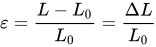
Consider a bar of original cross sectional area A0 being subjected to equal and opposite forces F pulling at the ends so the bar is under tension. The material is experiencing a stress defined to be the ratio of the force to the cross sectional area of the bar, as well as an axial elongation:

Eng. stress & strain equations
Stress Strain

Subscript 0 denotes the original dimensions of the sample. The SI derived unit for stress is newtons per square metre, or pascals (1 pascal = 1 Pa = 1 N/m2), and strain is unitless. The stress–strain curve for this material is plotted by elongating the sample and recording the stress variation with strain until the sample fractures. By convention, the strain is set to the horizontal axis and stress is set to vertical axis. Note that for engineering purposes we often assume the cross-section area of the material does not change during the whole deformation process. This is not true since the actual area will decrease while deforming due to elastic and plastic deformation. The curve based on the original cross-section and gauge length is called the engineering stress–strain curve, while the curve based on the instantaneous cross-section area and length is called the true stress–strain curve. Unless stated otherwise, engineering stress–strain is generally used.

True stress and strain

[edit]
The difference between true stress–strain curve and engineering stress–strain curve

In the above definitions of engineering stress and strain, two behaviors of materials in tensile tests are ignored:

  • the shrinking of section area
  • compounding development of elongation

True stress and true strain are defined differently than engineering stress and strain to account for these behaviors. They are given as

True stress & strain equations
Stress Strain

Here the dimensions are instantaneous values. Assuming volume of the sample conserves and deformation happens uniformly,

The true stress and strain can be expressed by engineering stress and strain. For true stress,

For the strain,

Integrate both sides and apply the boundary condition,
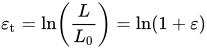
So in a tension test, true stress is larger than engineering stress and true strain is less than engineering strain. Thus, a point defining true stress–strain curve is displaced upwards and to the left to define the equivalent engineering stress–strain curve. The difference between the true and engineering stresses and strains will increase with plastic deformation. At low strains (such as elastic deformation), the differences between the two is negligible. As for the tensile strength point, it is the maximal point in engineering stress–strain curve but is not a special point in true stress–strain curve. Because engineering stress is proportional to the force applied along the sample, the criterion for necking formation can be set as

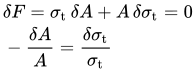
This analysis suggests nature of the ultimate tensile strength (UTS) point. The work strengthening effect is exactly balanced by the shrinking of section area at UTS point.

After the formation of necking, the sample undergoes heterogeneous deformation, so equations above are not valid. The stress and strain at the necking can be expressed as:

An empirical equation is commonly used to describe the relationship between true stress and true strain.

Here, n is the strain-hardening exponent and K is the strength coefficient. n is a measure of a material's work hardening behavior. Materials with a higher n have a greater resistance to necking. Typically, metals at room temperature have n ranging from 0.02 to 0.5.[3]

Discussion

[edit]

Since we disregard the change of area during deformation above, the true stress and strain curve should be re-derived. For deriving the stress strain curve, we can assume that the volume change is 0 even if we deformed the materials. We can assume that:

Then, the true stress can be expressed as below:

Additionally, the true strain εT can be expressed as below:

Then, we can express the value as

Thus, we can induce the plot in terms of and as right figure.

Additionally, based on the true stress-strain curve, we can estimate the region where necking starts to happen. Since necking starts to appear after ultimate tensile stress where the maximum force applied, we can express this situation as below:

so this form can be expressed as below:
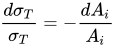
It indicates that the necking starts to appear where reduction of area becomes much significant compared to the stress change. Then the stress will be localized to specific area where the necking appears.

Additionally, we can induce various relation based on true stress-strain curve.

1) True strain and stress curve can be expressed by the approximate linear relationship by taking a log on true stress and strain. The relation can be expressed as below:

Where is stress coefficient and is strain-hardening coefficient. Usually, the value of has range around 0.02 to 0.5 at room temperature. If is 1, we can express this material as perfect elastic material.[4][5]

2) In reality, stress is also highly dependent on the rate of strain variation. Thus, we can induce the empirical equation based on the strain rate variation.

True stress-strain curve of FCC metal and its derivative form[4]

Where is constant related to the material flow stress. indicates the derivative of strain by the time, which is also known as strain rate. is the strain-rate sensitivity. Moreover, value of is related to the resistance toward the necking. Usually, the value of is at the range of 0-0.1 at room temperature and as high as 0.8 when the temperature is increased.

By combining the 1) and 2), we can create the ultimate relation as below:

Where is the global constant for relating strain, strain rate and stress.

3) Based on the true stress-strain curve and its derivative form, we can estimate the strain necessary to start necking. This can be calculated based on the intersection between true stress-strain curve as shown in right.

This figure also shows the dependency of the necking strain at different temperature. In case of FCC metals, both of the stress-strain curve at its derivative are highly dependent on temperature. Therefore, at higher temperature, necking starts to appear even under lower strain value.

All of these properties indicate the importance of calculating the true stress-strain curve for further analyzing the behavior of materials in sudden environment.

4) A graphical method, so-called "Considere construction", can help determine the behavior of stress-strain curve whether necking or drawing happens on the sample. By setting as determinant, the true stress and strain can be expressed with engineering stress and strain as below:


Therefore, the value of engineering stress can be expressed by the secant line from made by true stress and value where to . By analyzing the shape of diagram and secant line, we can determine whether the materials show drawing or necking.

Considere Plot. (a) True stress-strain curve without tangents. There is neither necking nor drawing. (b) With one tangent. There is only necking. (c) With two tangents. There are both necking and drawing.[6]

On the figure (a), there is only concave upward Considere plot. It indicates that there is no yield drop so the material will be suffered from fracture before it yields. On the figure (b), there is specific point where the tangent matches with secant line at point where . After this value, the slope becomes smaller than the secant line where necking starts to appear. On the figure (c), there is point where yielding starts to appear but when , the drawing happens. After drawing, all the material will stretch and eventually show fracture. Between and , the material itself does not stretch but rather, only the neck starts to stretch out.

Misconceptions

[edit]

A popular misconception is that all materials that bend are "weak" and those that do not are "strong". In reality, many materials that undergo large elastic and plastic deformations, such as steel, are able to absorb stresses that would cause brittle materials, such as glass, with minimal plastic deformation ranges, to break.[7]

See also

[edit]

References

[edit]
Revisions and contributorsEdit on WikipediaRead on Wikipedia
from Grokipedia
In engineering, deformation refers to the change in the dimensions or geometry of a material or structure resulting from applied mechanical forces or loads. This phenomenon is fundamental to the mechanics of materials, where it is quantified through strain, defined as the ratio of the deformation (such as elongation or contraction) to the original length or dimension, often approximated for small changes as engineering strain. Deformation arises from atomic or molecular rearrangements under stress and is critical for assessing how engineering components respond to external influences like tension, compression, shear, or torsion. Deformation is broadly categorized into elastic and plastic types based on reversibility. Elastic deformation occurs when the applied stress remains below the material's elastic limit, allowing the structure to return to its original configuration upon load removal, as bonds between atoms stretch but do not break. In contrast, plastic deformation takes place beyond the yield point, where atomic planes permanently shift, resulting in irreversible shape changes and strain hardening or softening depending on the material. The behavior is typically visualized in a stress-strain diagram, with the initial linear region representing elastic response following (stress proportional to strain), transitioning to a nonlinear plastic regime at higher loads. Studying deformation is essential for safe and efficient design, as it informs predictions of structural , load-bearing capacity, and failure modes under service conditions. Engineers use deformation to select materials with appropriate or , optimize geometries to minimize excessive , and apply safety factors in fields such as civil, mechanical, and , ultimately preventing catastrophic failures like or yielding. Advanced models, including finite element , further quantify deformation gradients and tensors for complex scenarios involving large strains or anisotropic materials.

Fundamentals

Definition and Scope

In engineering, deformation refers to the change in of a or structural system resulting from applied loads, encompassing alterations in , , or internal that may be either temporary or permanent. This phenomenon is central to understanding how materials respond to external forces, enabling the of safe and reliable structures and components. Deformation can occur reversibly, where the returns to its original configuration upon load removal, or irreversibly, leading to lasting changes. The recognition of deformation dates back to the 17th century, when English scientist first described the proportional relationship between applied force and elastic deformation in materials like springs, laying the groundwork for elasticity theory in his 1678 publication De Potentia Restitutiva. This early insight evolved significantly in the through the works of mathematicians and engineers such as , who formalized and the concepts of stress and strain to describe deformation in solids more rigorously. These developments marked the transition from empirical observations to a systematic framework in material science and . The scope of deformation in primarily focuses on solid materials subjected to mechanical loads, where changes are discrete and often recoverable, in contrast to fluids that exhibit continuous flow under similar conditions. Key factors influencing deformation include the nature of the applied load—such as tensile (pulling), compressive (pushing), or shear (sliding)—along with intrinsic material properties like (ability to deform without fracturing) versus , and extrinsic environmental conditions such as and loading rate, which can alter the extent and type of response. Stress and strain provide the basic quantitative measures for assessing these loads and deformations. Representative examples illustrate deformation's practical relevance: the bending of a structural beam under weight distribution in bridges or buildings, or the stretching of a metallic wire in tension during manufacturing processes like wire drawing. These cases highlight how controlled deformation ensures structural integrity while avoiding failure.

Stress and Strain Concepts

In engineering mechanics, stress is defined as the internal force per unit area acting within a material subjected to external loads. This measure quantifies the intensity of forces that cause deformation, with units typically expressed in pascals (Pa) in the International System of Units (SI) or pounds per square inch (psi) in the US customary system. Stress can be categorized into normal stress, which acts perpendicular to the surface and includes tensile stress (resulting from pulling forces that elongate the material) and compressive stress (from pushing forces that shorten it), and shear stress, which acts parallel to the surface causing sliding or angular distortion. Strain represents the relative deformation or displacement of a material in response to applied stress, serving as a dimensionless measure of geometric change. Normal strain describes linear deformation, such as elongation under tensile stress or shortening under compression, calculated as the change in length divided by the original length. Shear strain, in contrast, quantifies angular distortion from shear stress, defined as the tangent of the angle of deformation or the displacement divided by the original dimension perpendicular to the direction of shear. Unlike stress, strain has no units, as it is a ratio. In uniaxial loading, where stress acts along a single axis, the relationship between stress (σ) and strain (ε) in the linear elastic region is governed by , expressed as σ=Eϵ\sigma = E \epsilon, where E is the , a representing . This linear proportionality holds for small deformations where the is elastic and recoverable. Under multiaxial stress states, involving forces in multiple directions, the stress tensor is analyzed through principal stresses, which are the maximum and minimum normal stresses acting on planes with no shear components, defining the full stress state via three orthogonal values. A key invariant for assessing yielding in ductile materials is the von Mises equivalent stress, which combines principal stresses to predict the onset of plastic deformation based on distortion energy. The stress-strain curve illustrates these concepts, particularly in its initial linear elastic portion, where stress increases proportionally with strain according to , providing a visual representation of compliance up to the elastic limit. This ends at the proportional limit, beyond which deviations from linearity may occur.

Deformation Behaviors

Elastic Deformation

Elastic deformation refers to the reversible change in a material's shape or size under applied stress, where the material returns to its original configuration upon removal of the load, due to the stretching of atomic or molecular bonds without breakage or permanent atomic displacement./01%3A_Tensile_Response_of_Materials/1.02%3A_Atomistics_of_Elasticity) This process involves interatomic forces that act like springs, allowing bonds to elongate proportionally to the applied force while maintaining structural integrity./01%3A_Tensile_Response_of_Materials/1.02%3A_Atomistics_of_Elasticity) In , which applies to small deformations in most materials, the relationship between stress (σ\sigma) and strain (ϵ\epsilon) follows , expressed as σ=Eϵ\sigma = E \epsilon, where EE is the , a measure of the material's . For example, mild has a Young's modulus of approximately 210 GPa, indicating high resistance to deformation, while rubber exhibits a much lower value of about 0.02 GPa, allowing greater flexibility under load. This linear behavior holds within the elastic regime, enabling predictable recovery without energy dissipation. Nonlinear elasticity occurs in materials subjected to larger strains, where the stress-strain relationship deviates from , often observed in polymers and biological tissues that exhibit strain stiffening or softening. In such cases, the material's response adapts to deformation, as seen in rubber-like elastomers where initial compliance gives way to increased resistance at higher strains, without permanent damage. Accompanying axial deformation is lateral contraction or expansion, quantified by Poisson's ratio (ν\nu), defined as ν=ϵlateralϵaxial\nu = -\frac{\epsilon_{\text{lateral}}}{\epsilon_{\text{axial}}}, which describes the negative ratio of transverse to longitudinal strain under uniaxial loading. For most engineering materials, ν\nu ranges from 0.2 to 0.5, with metals typically around 0.3, reflecting near-incompressible behavior that conserves volume during elastic straining. During elastic deformation, the material stores energy as elastic potential energy, with the energy density given by 12σϵ\frac{1}{2} \sigma \epsilon per unit volume, representing the work done to deform the bonds reversibly. This stored energy is fully recoverable, highlighting the conservative nature of elastic processes in engineering applications like springs and structural components. The boundaries of elastic deformation are marked by the proportional limit, the maximum stress at which the stress-strain curve remains linear and obeys , and the elastic limit, the highest stress beyond which permanent deformation occurs upon unloading. These limits define the safe operating range for reversible behavior, with the proportional limit often coinciding closely with the elastic limit in ductile materials like metals.

Plastic Deformation

Plastic deformation refers to the irreversible change in shape or size of a material under applied stress, occurring when the stress exceeds the material's yield strength and results in permanent strain. Unlike elastic deformation, which precedes yielding and allows full recovery upon unloading, plastic deformation involves energy dissipation through atomic rearrangements, leading to a new equilibrium structure. This process is fundamental in engineering for shaping materials without fracture, as seen in various manufacturing techniques. The primary mechanism of plastic deformation in crystalline materials, particularly metals, is the movement of dislocations—linear defects in the crystal lattice—along specific crystallographic planes and directions known as slip systems. Slip occurs when on a slip plane reaches a , enabling blocks of atoms to slide past one another, accommodating large strains without breaking atomic bonds. In face-centered cubic (FCC) metals like aluminum, multiple slip systems (e.g., {111} planes and <110> directions) facilitate high , while body-centered cubic (BCC) metals exhibit fewer active systems at , influencing their deformation behavior. Yield strength, denoted as σy\sigma_y, marks the onset of plastic deformation, defined as the stress at which a material begins to exhibit 0.2% permanent strain in a tensile test. Beyond yielding, materials often undergo (or strain hardening), where plastic deformation increases the density of dislocations, impeding further motion and raising the for subsequent deformation. This phenomenon enhances strength but reduces , as quantified by the strain-hardening exponent in power-law models of stress-strain behavior. Ductility measures a material's capacity to undergo significant strain before , reflecting its ability to deform extensively without cracking. It is typically quantified by percent elongation, calculated as the ratio of change in gauge length to original at , multiplied by 100, with ductile metals like achieving 30-50% elongation. The total strain εtotal\varepsilon_{total} decomposes into elastic and components via the equation εp=εtotalεelastic\varepsilon_p = \varepsilon_{total} - \varepsilon_{elastic}, where εp\varepsilon_p represents the permanent deformation recoverable only through processes like annealing. In , after uniform plastic elongation, necking initiates—a localized reduction in cross-sectional area—marking the (UTS), the maximum engineering stress the material can sustain. Necking accelerates strain localization due to reduced area and limits, leading to eventual , though UTS provides a key metric for design limits in ductile materials. Practical applications exploit plastic deformation in bulk forming processes such as , where compressive forces reshape metals like into components with improved grain structure, and , which reduces diameter through tensile pulling via dies, enhancing uniformity and strength. These methods rely on controlled plasticity to achieve desired geometries while minimizing defects.

Time-Dependent Deformation

Time-dependent deformation refers to the gradual change in shape or size of engineering materials under sustained loading, where time becomes a critical variable influencing the response beyond instantaneous elastic or behaviors. This phenomenon is particularly relevant in applications involving prolonged exposure to stress, such as in high-temperature environments or viscoelastic materials like polymers. Unlike rate-independent deformations, time-dependent effects arise from mechanisms like , motion, or molecular rearrangements that allow ongoing strain accumulation or stress decay. Creep represents a primary form of time-dependent deformation, characterized by progressive, permanent strain under constant applied stress, typically at levels below the material's yield strength. It manifests in three distinct stages: primary creep, where the decreases over time due to initial ; secondary creep, featuring a steady-state constant that dominates the overall deformation; and tertiary creep, marked by an accelerating leading to eventual from necking or void formation. The secondary stage is often modeled using the Norton creep law, which empirically relates the steady-state ϵ˙\dot{\epsilon} to stress σ\sigma and TT as ϵ˙=Aσnexp(QRT),\dot{\epsilon} = A \sigma^n \exp\left(-\frac{Q}{RT}\right), where AA and nn are material-specific constants (with nn typically ranging from 3 to 6 for dislocation creep mechanisms), QQ is the activation energy, RR is the gas constant, and TT is the absolute temperature. This power-law relationship, originally derived from experimental observations on metals, highlights the exponential sensitivity to temperature and nonlinear dependence on stress. Stress relaxation, another key aspect of time-dependent deformation, involves a gradual decrease in internal stress within a held at a fixed strain, as elastic strain converts to viscous or flow over time. This occurs even at stresses well below the yield point and is driven by similar atomic or molecular mobility as in creep, but under constrained deformation. In engineering contexts, is critical in pre-tensioned assemblies, such as bolted joints, where it can lead to loosening and loss of clamping force if not accounted for in . Viscoelasticity describes the combined elastic and viscous response of materials, where deformation includes both recoverable (elastic) and irrecoverable (viscous) components that evolve with time. The Maxwell model represents this as a spring (elastic element) in series with a dashpot (viscous element), capturing stress relaxation under constant strain, as the dashpot allows permanent flow while the spring provides initial resistance. In contrast, the Kelvin-Voigt model arranges the spring and dashpot in parallel, better modeling creep under constant stress, where the material exhibits delayed elastic recovery after load removal. These linear models provide foundational insights into time-dependent behaviors in polymers and composites, though real materials often require more complex generalizations. Several factors influence time-dependent deformation, with elevated temperatures accelerating mechanisms like atomic diffusion in metals (e.g., above 0.4 times the in ), while polymers exhibit significant viscoelastic creep even at due to chain segment mobility. Microstructural features, such as or precipitates, further modulate rates, with finer grains promoting diffusion-controlled creep in metals. A prominent example is creep in turbine blades of jet engines, where blades operate under combined high temperatures (up to 1700°C) and centrifugal stresses, leading to progressive elongation and reduced over thousands of flight hours. In nickel-based superalloys used for these components, creep life is predicted using models like the Larson-Miller parameter, with even small efficiency losses (e.g., 3% in compressors) drastically shortening operational lifespan by up to 80%.

Failure Modes

Yielding and Ultimate Failure

Yielding marks the onset of permanent deformation in a material under applied stress, where the elastic limit is exceeded and the material begins to deform plastically without fully recovering its original shape upon load removal. In uniaxial tension, this transition is evident as the point where the stress-strain curve deviates from linearity, often identified by a distinct yield strength value such as 0.2% offset strain for metals lacking a sharp knee. For multiaxial stress states, common in complex engineering components, yielding criteria predict the onset based on principal stresses or invariants; the Tresca criterion posits that yielding occurs when the maximum shear stress reaches half the uniaxial yield strength, providing a conservative hexagonal yield surface in principal stress space. The von Mises criterion, more widely adopted for ductile metals due to better alignment with experimental data, states that yielding initiates when the second invariant of the deviatoric stress tensor equals that at uniaxial yield, yielding an elliptical surface that allows higher equivalent stresses under balanced biaxial tension. Following yielding, plastic deformation accumulates until the material reaches its (UTS), defined as the maximum engineering stress it can sustain before localized necking reduces the cross-sectional area and leads to . For instance, low-carbon steels may exhibit UTS values around 400-500 MPa after yielding at 250 MPa, highlighting the material's capacity to carry load post-plastic onset. The full failure envelope is represented by the engineering , which traces the material's response from initial elastic loading—where strain is proportional to stress via —through the yield point, into the plastic regime of , and culminating at UTS followed by rapid strain localization until rupture. This encapsulates the transition to structural failure, with the area under it approximating the energy absorbed before breaking. In compression, failure for slender members often manifests as rather than crushing, where elastic instability causes sudden lateral deflection under axial load. formula predicts this instability for ideal pinned-end columns: Pcr=π2EIL2P_{cr} = \frac{\pi^2 E I}{L^2} where EE is the modulus of elasticity, II is the minimum , and LL is the effective length; for a slender column with L=3L = 3 m and appropriate II, PcrP_{cr} might be around 100 kN, beyond which the structure collapses elastically without significant plastic deformation. Failure modes distinguish between ductile and brittle behaviors: ductile failure involves extensive plastic strain, allowing energy absorption through necking and dimpled fracture surfaces, as seen in aluminum alloys that elongate 20-30% before breaking. In contrast, brittle failure occurs suddenly with minimal plastic deformation, characterized by cleavage or and low energy absorption, typical of ceramics or under tension where cracks propagate rapidly post-elastic limit. Plastic deformation typically precedes ultimate in ductile materials, enabling warning through visible distortion. To mitigate risks of yielding or in , engineers apply safety factors, defined as the ratio of a material's yield or strength to the maximum anticipated stress, often ranging from 1.5 for ductile metals in static loads to 4 or higher for brittle components or dynamic conditions. This ensures structures remain below critical thresholds, accounting for uncertainties in loading, material variability, and fabrication.

Fracture Mechanics

Fracture mechanics is a field within that analyzes the , growth, and of cracks in materials under load, providing a framework to predict from localized defects rather than overall deformation limits. This approach is essential for understanding how small flaws can lead to sudden brittle or ductile rupture, emphasizing energy balance and at crack tips. Unlike uniform yielding, fracture mechanics focuses on the stability of cracks, where the release of elastic competes with the energy required to create new fracture surfaces. The foundational theory for brittle fracture was developed by A.A. Griffith, who modeled crack propagation as an energy equilibrium process in elastic solids. Griffith proposed that fracture occurs when the decrease in potential energy due to crack extension equals or exceeds twice the surface energy needed to create new crack surfaces, leading to the criterion for the critical fracture stress σf=2Eγπa\sigma_f = \sqrt{\frac{2 E \gamma}{\pi a}}
Add your contribution
Related Hubs
User Avatar
No comments yet.