Hubbry Logo
Expedition 65Expedition 65Main
Open search
Expedition 65
Community hub
Expedition 65
logo
8 pages, 0 posts
0 subscribers
Be the first to start a discussion here.
Expedition 65
Expedition 65
from Wikipedia

Expedition 65
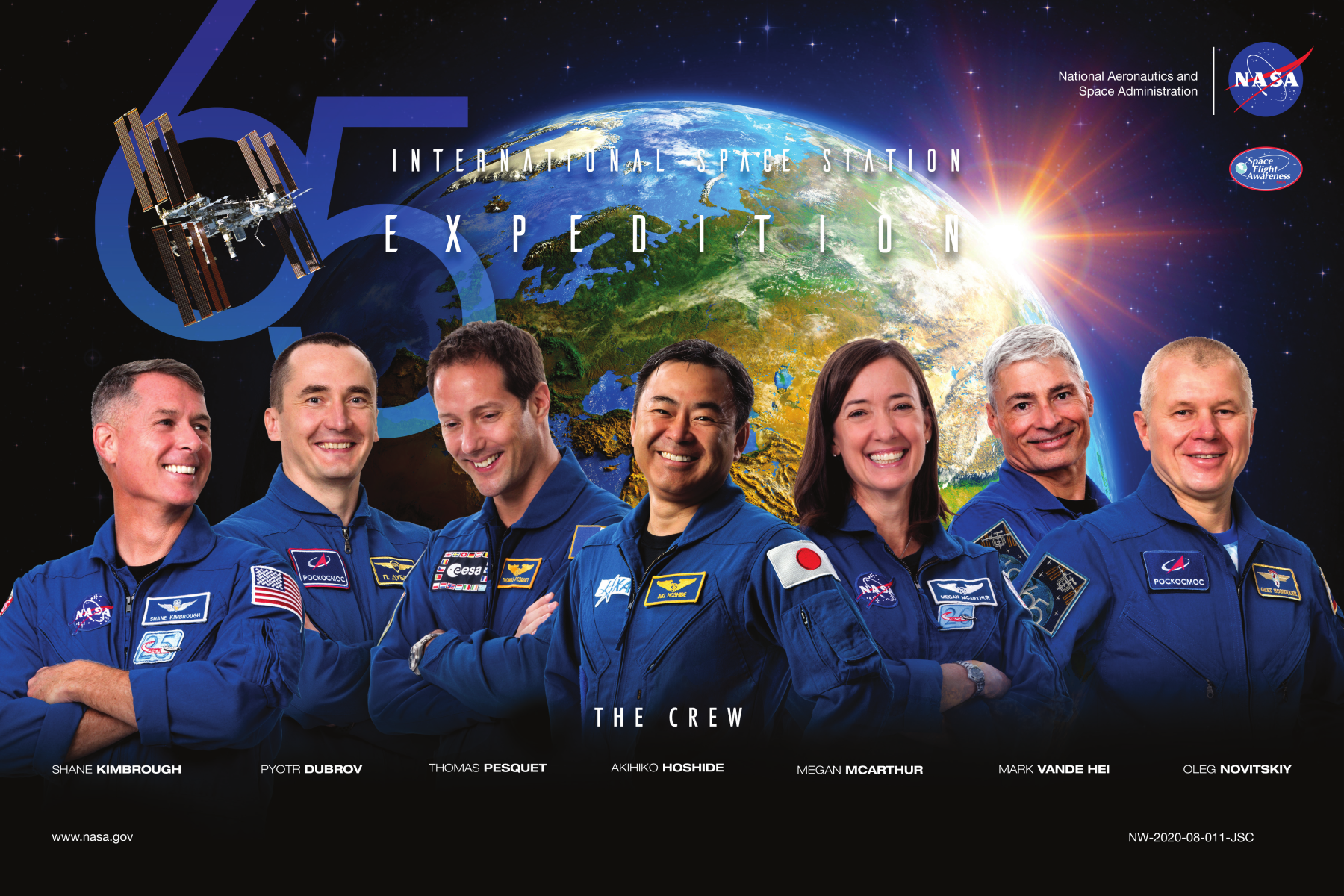
Promotional poster
Mission typeLong-duration expedition
OperatorNASA / Roscosmos
Mission duration182 days, 23 hours and 39 minutes
Expedition
Space stationInternational Space Station
Began17 April 2021, 01:34:04 UTC[1]
Ended17 October 2021, 01:14 UTC[1]
Arrived aboardSpaceX Crew-1
Soyuz MS-18
SpaceX Crew-2
Soyuz MS-19
Departed aboardSpaceX Crew-1
Soyuz MS-18
Crew
Crew size7-11
Members
EVAs≥4 (planned)[2][3]
7[1]
EVA duration50 hours[1]

Expedition 65 mission patch

Expedition 65 crew portrait

Expedition 65 was the 65th long duration expedition to the International Space Station. The mission began on 17 April 2021 with the departure of Soyuz MS-17[4] and was initially commanded by NASA astronaut Shannon Walker serving as the third female ISS commander, who launched in November 2020 aboard SpaceX Crew-1 alongside NASA astronauts Mike Hopkins and Victor Glover,[5] as well as JAXA astronaut Soichi Noguchi. They were joined by the crew of Soyuz MS-18, which is made up of Russian cosmonauts Oleg Novitsky and Pyotr Dubrov, as well as NASA astronaut Mark Vande Hei.[6]

In accordance with Crew Dragon Resilience's departure on May 2, 2021, Crew-1's crew was replaced by the crew of SpaceX Crew-2, which launched on April 23, 2021. JAXA astronaut Akihiko Hoshide took Walker's place as station commander, making Walker the shortest-serving ISS commander - holding the position for just 11 days. From October 4, 2021, ESA astronaut Thomas Pesquet surpassed Hoshide as commander, becoming the fourth European astronaut to command the ISS and the first French astronaut to command the orbital laboratory.[7] The expedition ended with the departure of Soyuz MS-18 on October 17, 2021.[8]

Visiting modules, vehicles, crews, and spacewalks

[edit]
View of Earth taken during ISS Expedition 65

Expedition 65 occurred during a very busy time in the ISS's schedule, with the expedition expected to host two SpaceX Crew Dragon missions, Crew-1 and Crew-2, as well as two Soyuz flights, Soyuz MS-18 and Soyuz MS-19.

When the expedition began with the undocking of Soyuz MS-17 in April 2021, two vehicles were present on the station, Crew Dragon Resilience, carrying the SpaceX Crew-1 crew, and the Soyuz MS-18 spacecraft. Crew-1 mission specialist Shannon Walker initially commanded the station until she and her three crewmates, Mike Hopkins, Victor Glover and Soichi Noguchi, departed the station following the arrival of Crew Dragon Endeavour, carrying SpaceX Crew-2 in April 2021. Following the departure of Crew-1, Crew-2 mission specialist Akihiko Hoshide took over as station commander, making him the second Japanese citizen to command the ISS. On 5 October 2021, Soyuz MS-19 launched, carrying Russian cosmonaut Anton Shkaplerov, film director Klim Shipenko and actress Yulia Peresild. The latter two spent 12 days onboard the station as part of a movie project.

Three spacewalks were conducted by Thomas Pesquet and Shane Kimbrough on 16, 20, and 25 June from the US Orbital Segment (USOS) of the space station to install the first two Roll Out Solar Arrays (iROSA) for the station.[3][9] They were delivered by SpaceX CRS-22 on 3 June 2021.[10] The June 16 spacewalk to place an array on the 2B power channel and mast can of the P6 truss[11] was successful until three hours into the task, when Kimbrough's suit encountered a computer problem and the spacewalkers had to return to the Quest airlock. The iROSA also encountered technical problems with deployment, resulting in the spacewalk being cut short early, having lasted 7 hours and 15 minutes.[12][1]

The 20 June spacewalk begun at 11:42 UTC and lasting 6 hours and 28 minutes and saw the first iROSA's successful deployment and connection to the station's power system.[13][14][1] The 25 June spacewalk begun at 11:52 UTC and lasting 6 hours and 45 minutes and saw the astronauts successfully install and deploy the second iROSA on the 4B mast can opposite the first iROSA.[15][1]

One more spacewalk, comprising a plasma measuring instrument replacement and a bracket installation on the P4 Truss for the next iROSA pair, was planned for 24 August to be conducted by Akihiko Hoshide and Mark Vande Hei.[8] It was postponed to 12 September after Vande Hei encountered "minor medical issues".[16] He was replaced by Thomas Pesquet. The spacewalk began at 13:15 UTC and lasted six hours and 45 minutes.[17]

Three spacewalks were conducted by Oleg Novitsky and Pyotr Dubrov from the Russian Orbital Segment (ROS) to facilitate the installation of Nauka with the European Robotic Arm aboard the station, as well as prepare the new module for the arrival of the Prichal docking node, which is scheduled to arrive during Expedition 66.[18] One spacewalk was conducted on 2 June beginning at 5:53 UTC and lasted 7 hours and 19 minutes.[19][1] Two more were conducted on 3 and 9 September, the former beginning at 14:41 UTC and lasting 7 hours and 54 minutes, and the latter beginning at 14:51 UTC and lasting 7 hours and 25 minutes.[8][18]

Crew

[edit]
Flight Astronaut First part
(17  – 24 April 2021)
Second part
(24 April – 2 May 2021)
Third part
(2 May – 4 October 2021)
Fourth part
(4  – 5 October 2021)
Fifth part
(5  – 17 October 2021)
Soyuz MS-18 Russia Oleg Novitsky, Roscosmos
Third spaceflight
Flight engineer
Russia Pyotr Dubrov, Roscosmos
First spaceflight
Flight engineer
United States Mark T. Vande Hei, NASA
Second spaceflight
Flight engineer
SpaceX Crew-1 United States Mike Hopkins, NASA
Second and last spaceflight
Flight engineer Off station
United States Victor Glover, NASA
First spaceflight
Flight engineer Off station
Japan Soichi Noguchi, JAXA
Third and last spaceflight
Flight engineer Off station
United States Shannon Walker, NASA
Second and last spaceflight
Commander Off station
SpaceX Crew-2 United States Shane Kimbrough, NASA
Third and last spaceflight
Off station Flight engineer
United States Megan McArthur, NASA
Second and last spaceflight
Off station Flight engineer
Japan Akihiko Hoshide, JAXA
Third spaceflight
Off station Flight engineer Commander Flight engineer
France Thomas Pesquet, ESA
Second spaceflight
Off station Flight engineer Commander
Soyuz MS-19 Russia Anton Shkaplerov, Roscosmos
Fourth and last spaceflight
Off station Flight engineer

References

[edit]
Revisions and contributorsEdit on WikipediaRead on Wikipedia
from Grokipedia
Expedition 65 was the 65th long-duration expedition to the (ISS), a multinational orbital laboratory, which took place from April 2021 to October 2021. This mission featured a rotating crew who conducted a wide range of scientific research and maintenance activities in microgravity. The expedition began on April 17, 2021, following the undocking and departure of the Soyuz MS-17 , marking the transition from Expedition 64. It initially included four members from the previous expedition (Michael Hopkins, Victor Glover, , and ) along with three arrivals from Soyuz MS-18 (Oleg Novitskiy, Pyotr Dubrov, and Mark Vande Hei). After the arrival of on April 24 and the departure of Crew-1 on May 2, the crew stabilized at seven: , Megan McArthur, and (from Crew-2), (ESA), plus Novitskiy, Dubrov, and Vande Hei. It concluded on October 17, 2021, with the undocking of Soyuz MS-18, handing over command to Expedition 66. During this period, there were three commanders: of (April 15 to 27), of (April 28 to October 4), and of ESA (October 4 to October 17). Key objectives focused on advancing capabilities through experiments in , , human health, physical sciences, and development. Notable research included using tissue chips to investigate microgravity's effects on the , studying plant growth in space for future , and testing enhanced techniques for medical diagnostics in space. Crew members also installed roll-out solar arrays to upgrade the station's power system, enhancing its longevity. Major events encompassed the arrival of the Nauka multipurpose laboratory module on July 29, 2021, which docked autonomously and expanded the Russian segment of the ISS. The team performed seven spacewalks totaling 50 hours, including upgrades to the station's truss structure and solar arrays. Additionally, the mission supported multiple vehicle operations, such as the docking of on April 24, on October 5, and the departure of Cygnus NG-15 on June 29. These activities contributed to ongoing preparations for deep-space exploration, including goals.

Mission Overview

Background and Objectives

Expedition 65 marked a pivotal phase in the (ISS) program's evolution, transitioning from on April 17, 2021, following the undocking and departure of the Soyuz MS-17 spacecraft carrying Sergey Ryzhikov, Kate Rubins, and Sergey Kud-Sverchkov. This handover ensured uninterrupted human presence aboard the ISS, a core tenet of the multinational effort involving , , , ESA, and emerging commercial partners like . The expedition aligned with broader ISS objectives to advance long-duration spaceflight capabilities, incorporating commercial crew vehicles such as SpaceX's Crew Dragon, which docked during the mission to bolster crew rotation and logistics. The primary objectives of Expedition 65 centered on maintaining continuous human occupancy of the ISS to facilitate microgravity scientific research, routine station maintenance, and preparations for infrastructure expansions, including the integration of the Russian Nauka multipurpose module. Crew members conducted experiments in advanced , space , and technology to yield insights applicable to Earth-based healthcare and , while also performing essential upkeep to sustain orbital operations. A key focus was supporting the arrival and outfitting of Nauka, launched on July 21, 2021, and docked on July 29, which expanded research capabilities and docking ports for future missions. Secondary goals emphasized technology demonstrations and international collaboration, exemplified by the installation of new roll-out solar arrays (iROSA) to enhance power generation for the aging station. These upgrades, conducted via extravehicular activities, represented a step toward sustaining ISS operations beyond 2024 and preparing for commercial and deep-space transitions. The mission underscored partnerships among space agencies, with contributions from , , , and ESA, alongside SpaceX's role in crew transport. Planning for Expedition 65 began with crew assignments announced in December 2020 for the Soyuz MS-18 increment, integrating NASA astronaut Mark Vande Hei with Roscosmos cosmonauts Oleg Novitskiy and Pyotr Dubrov, while SpaceX Crew-2 assignments had been detailed earlier in the year. Training occurred at NASA's Johnson Space Center in Houston for U.S. segment operations and simulations, complemented by sessions at Russia's Star City Gagarin Cosmonaut Training Center for Soyuz proficiency and joint ISS procedures, ensuring seamless multinational coordination.

Timeline

Expedition 65 commenced on April 17, 2021, at 01:34 UTC, marked by the undocking of the Soyuz MS-17 spacecraft from the International Space Station's Poisk module, carrying crew members Sergey Ryzhikov, Sergey Kud-Sverchkov, and Kate Rubins back to Earth. This event transitioned command of the station to astronaut , initiating the core phase of the expedition with a crew of seven, including Walker, Michael Hopkins, Victor Glover, , Oleg Novitskiy, Pyotr Dubrov, and Mark Vande Hei. On April 9, 2021, prior to the official start but during the transitional period, Soyuz MS-18 docked to the Rassvet module, delivering Novitskiy, Dubrov, and Vande Hei to join the station crew and support ongoing operations into Expedition 65. The arrival of NASA's mission followed on April 24, 2021, when the autonomously docked to the module's forward port at approximately 05:08 UTC, bringing commander , pilot Megan McArthur, and mission specialists and ; this temporarily expanded the onboard crew to 11 members during handover activities. Commander handover occurred on April 27, 2021, when Walker transferred station command to Hoshide during a ceremony at 17:25 UTC, ahead of the Crew-1 departure. Shortly thereafter, on May 2, 2021, at 00:35 UTC, the Crew Dragon Resilience carrying , Glover, Walker, and undocked from the station, concluding their mission and reducing the crew size back toward seven. In June 2021, significant upgrades began with the installation of the first Roll-Out Solar Arrays (iROSAs); spacewalks on June 16, June 20, and June 25 facilitated the mounting and partial deployment of these new solar arrays on the station's port-6 , enhancing power generation capabilities. A major milestone arrived on July 29, 2021, at 13:29 UTC, when Russia's Nauka multipurpose laboratory module autonomously docked to the forward port of the Zvezda service module after launch on , expanding the Russian segment and providing new research facilities despite initial thruster anomalies that briefly affected station orientation. size fluctuated throughout, peaking at 11 during overlapping vehicle arrivals and departures. On October 4, 2021, Hoshide handed over command to Pesquet during a ceremony, preparing for the next phase as Soyuz MS-19 launched on October 5, 2021, at 08:55 UTC from Baikonur Cosmodrome, carrying Anton Shkaplerov, Julia Peresild, and Klim Shipenko; it docked to the Rassvet module approximately three hours later at 12:12 UTC, temporarily increasing the crew to 10 for film production and handover activities. Expedition 65 concluded on October 17, 2021, at 01:14 UTC, with the undocking of Soyuz MS-18 from the Prichal module—after its earlier relocation from Rassvet on September 28—carrying Novitskiy, Peresild, and Shipenko for landing in Kazakhstan, marking the end of the 182-day, 23-hour, 39-minute expedition.

Crew Composition

Commanders and Flight Engineers

Expedition 65 featured a rotating command structure with three commanders overseeing the mission's operations from April 2021 to October 2021, reflecting the International Space Station's (ISS) continuous crew transitions. The initial commander was Shannon Walker from the , who assumed command on April 15, 2021, following the change from , and handed over responsibilities on April 27, 2021. Walker, a veteran of the , coordinated the integration of arriving spacecraft and crew during this brief period, ensuring seamless handover amid overlapping expeditions. Command then passed to Akihiko Hoshide of the Aerospace Exploration Agency (), who led the station from April 27 to October 4, 2021, marking the second Japanese national to serve as ISS commander. Hoshide, drawing on his prior long-duration mission experience, directed a diverse multinational team through key phases including multiple spacewalks and scientific payloads, emphasizing international collaboration in station management. On October 4, 2021, command transferred to Thomas Pesquet of the (ESA) from , who served until the conclusion of Expedition 65 on October 17, 2021, becoming the first French astronaut to command the ISS. Pesquet's leadership focused on finalizing Expedition 65 research objectives and preparing for , highlighting ESA's growing role in station command. The flight engineers supporting these commanders were professional astronauts and cosmonauts responsible for executing daily research, maintenance, and extravehicular activities (EVAs), with rotations ensuring seven-person crews throughout the mission. The core group included astronauts Michael S. Hopkins, Victor J. Glover, Mark Vande Hei, Shane Kimbrough, and Megan McArthur from the United States; astronauts Soichi Noguchi and Akihiko Hoshide from ; ESA astronaut Thomas Pesquet from ; and cosmonauts Oleg Novitskiy, Pyotr Dubrov, and Anton Shkaplerov from . These engineers handled critical tasks such as systems monitoring, experiment operations, and EVA support, contributing to the mission's success in advancing microgravity science and station upgrades.
NameAgencyNationalityRoleKey Contribution Period
Michael S. HopkinsApril–May 2021; led early maintenance and research handover
Victor J. GloverApril–May 2021; supported initial EVAs and crew integration
Soichi NoguchiApril–May 2021; assisted in scientific payload operations
Oleg NovitskiyApril–October 2021; coordinated Russian segment activities
Pyotr DubrovApril–October 2021; performed long-duration monitoring and EVAs
Mark Vande HeiApril–October 2021; focused on biomedical experiments
Shane KimbroughApril–October 2021; led multiple US segment EVAs
Megan McArthurApril–October 2021; managed robotics and research facilities
Akihiko HoshideApril–October 2021; commanded station from April 27 to October 4
Thomas PesquetESAApril–October 2021; commanded station from October 4 to October 17
Anton ShkaplerovOctober 2021; supported late-mission operations and handover
This structure allowed for up to 11 professional crew members at peak overlap, enabling efficient task distribution while commanders maintained overall operational oversight.

Visiting Crew and Guests

During Expedition 65, the hosted its first short-duration spaceflight participants dedicated to commercial film production: Russian actress and director , who arrived aboard on October 5, 2021. These visitors, classified as non-professional crew, joined the ongoing Expedition 65 team for a 12-day stay focused on shooting key scenes for the The Challenge (also known as Vyzov), marking the first narrative movie filmed in orbit. Peresild portrayed a performing an emergency operation on a cosmonaut aboard the station, while Shipenko directed the production, capturing approximately 30 hours of footage during their mission. The mission's purpose extended beyond entertainment, demonstrating the feasibility of integrating artistic endeavors with space operations and highlighting Russia's advancements in commercial . Peresild became the first woman to perform as an actor in space, and the project predated similar Hollywood initiatives, such as the planned Tom Cruise-NASA collaboration. To prepare, both participants underwent an accelerated four-month regimen that included medical evaluations, zero-gravity simulations, sessions for high-G tolerance, vibration tests, and emergency procedure drills to ensure compliance with ISS safety standards for non-professional visitors. On station, Peresild and Shipenko relied on assistance from the Expedition 65 professional crew, including Russian cosmonauts Oleg Novitskiy, , and Pyotr Dubrov, who provided operational support during filming to maintain spacecraft safety and efficiency. This collaboration involved coordinating shoots around ongoing research and maintenance activities, with the visitors adhering to strict protocols limiting their involvement in critical systems. The duo departed the ISS on October 17, 2021, aboard Soyuz MS-18 alongside Novitskiy, splashing down in after completing their objectives without incident. No other significant short-duration human visitors, such as additional space tourists or participants, arrived during Expedition 65; routine cargo resupply missions like Progress M-UM and Cygnus NG-16 involved no crewed elements.

Launch and Docking Operations

Arriving Spacecraft

During Expedition 65, several crewed and uncrewed spacecraft arrived at the International Space Station (ISS) to deliver personnel and essential supplies, supporting the mission's research objectives from April to October 2021. The primary crewed vehicles included Russia's Soyuz MS-18 and MS-19, along with NASA's SpaceX Crew-2 Dragon, while cargo resupply was handled by SpaceX's Commercial Resupply Services (CRS) missions and Russia's Progress spacecraft. These arrivals ensured continuous crew rotation and logistical support without interrupting station operations. The Soyuz MS-18 spacecraft, launched on April 9, 2021, from the aboard a Soyuz-2.1a rocket, docked to the ISS's Rassvet module later that day, marking the first crewed arrival associated with the expedition. It carried three crew members: commander Oleg Novitskiy, flight engineer Pyotr Dubrov, and flight engineer Mark Vande Hei. The Soyuz series, operated by , has a capacity for three astronauts and features a habitable volume of approximately 9 cubic meters across its descent, orbital, and service modules, with a total length of 7.2 meters and diameter of 2.7 meters. Propulsion is provided by the KTDU-440 main engine for orbital maneuvers and attitude control thrusters, while life support systems include lithium hydroxide canisters for CO2 scrubbing, water storage, and oxygen generation via electrochemical cells. The MS-18 variant incorporated upgraded Kurs-NA docking antennas for automated rendezvous. NASA's SpaceX Crew-2 mission, utilizing the Crew Dragon Endeavour capsule, launched on April 23, 2021, from Kennedy Space Center's Launch Complex 39A on a rocket and docked to the Harmony module the following day. It transported four astronauts: commander Shane , pilot Megan McArthur, mission specialist Akihiko , and ESA mission specialist Thomas . The Crew Dragon is designed for up to seven passengers in operational missions, though this flight carried four, with a pressurized volume of 9.3 cubic meters, height of 8.1 meters, and diameter of 4 meters. Its propulsion system includes 16 Draco thrusters for precise orbital adjustments and eight engines for launch abort capabilities, complemented by an integrated environmental control and (ECLSS) that recycles water, removes CO2 via sorbent beds, and generates oxygen electrolytically. The arrived on October 5, 2021, launched from on a Soyuz-2.1a rocket and docking to the Rassvet module's nadir port after a two-orbit rendezvous. This flight delivered commander along with spaceflight participants and , who were filming the movie The Challenge. Sharing the design, it maintained the standard three-person capacity, modular structure, and systems for automated docking and environmental control as described for MS-18. Cargo deliveries began with SpaceX CRS-22, launched June 3, 2021, from on a and autonomously docking to the module on June 5. The Cargo Dragon variant carried over 3,300 kilograms of payload, including the first pair of International Space Station Rollout Solar Arrays (iROSA) for enhanced power generation, scientific experiments, and crew provisions. Like its crewed counterpart, the Cargo Dragon features Draco thrusters for maneuvering and a trunk section for unpressurized cargo, but lacks seats and full , with a pressurized volume of 9.3 cubic meters. Russia's 78 (Progress MS-17) launched June 29, 2021, from and docked to the Zvezda module on July 1 after a two-day flight profile. It delivered more than 1,600 kilograms of food, water, clothing, and equipment, plus propellant for station refueling. Derived from the Soyuz design, the Progress is uncrewed with a cargo capacity exceeding 2.5 metric tons, a of 7.6 meters, and diameter of 2.7 meters; it uses the same KTDU propulsion for rendezvous and includes fuel transfer lines in its refueling module, with no return capability as it deorbits after unloading. An additional cargo arrival occurred with SpaceX CRS-23, launched August 29, 2021, from and docking to the station on August 30. This mission supplied approximately 3,000 kilograms of materials, hardware, and supplies to sustain the crew's activities. The Cargo Dragon's systems mirrored those of CRS-22, emphasizing autonomous operations and efficient payload delivery.

Docking Events

The Expedition 65 docking events primarily involved the arrival of crewed that expanded the station's resident complement and facilitated crew rotations. The first major docking during the expedition occurred on April 24, 2021, when the SpaceX Crew Dragon Endeavour carrying the Crew-2 astronauts autonomously docked to the forward port of the module at 09:08 UTC. This maneuver utilized the NASA Docking System (NDS), marking the second operational use of the system for crewed missions, with the spacecraft completing a fully automated approach and capture after a 27-hour flight from launch. Post-docking leak checks and hook engagements were completed without issues, allowing hatch opening approximately two hours later and the integration of the four new crew members into the station's operations. Earlier in the month, on April 9, 2021, the Soyuz MS-18 spacecraft had docked to the nadir port of the Rassvet module at 11:05 UTC, delivering three crew members who would form the core of Expedition 65 following the departure of the previous expedition's crew. This docking followed a rapid three-hour rendezvous profile using the Kurs-NA automated system, with no reported anomalies during the approach or capture sequence. The incoming crew participated in a standard handover period with the outgoing members, including safety briefings and systems familiarization, which lasted several days before the Soyuz MS-17 undocking on April 17 that officially began Expedition 65. The final crewed docking of the expedition took place on October 5, 2021, when arrived at the Rassvet port at 12:22 UTC after a three-hour, two-orbit rendezvous. Unlike previous automated dockings, the Kurs system encountered a malfunction during the final approach, prompting commander to switch to manual TORU controls for a successful capture, demonstrating the reliability of backup procedures. This event delivered two long-duration cosmonauts and two short-term visitors for a film production, followed by a handover focused on operational briefings for the arriving long-stay crew members, lasting about a week amid preparations for subsequent departures. Minor pre-docking delays for stemmed from weather considerations at the launch site, but the overall timeline remained on schedule. To accommodate this arrival, Soyuz MS-18 had been relocated on September 28, 2021, from Rassvet to the forward port of the newly integrated Nauka module via a short free-flight maneuver and automated redocking, ensuring port availability without disrupting station activities. These docking operations highlighted the interoperability of U.S. and Russian systems on the , with post-arrival activities including joint crew photographs and initial systems checks to support the expanded seven-person team. Preparations for undockings, such as transfers and reconfiguration, began shortly after each arrival to align with departure timelines detailed in subsequent mission phases.

Extravehicular Activities

United States Segment EVAs

During Expedition 65, NASA-led extravehicular activities (EVAs) in the Orbital Segment focused on upgrading the 's power generation capabilities through the installation and preparation of International Space Station Roll-Out Solar Arrays (iROSAs). These upgrades aimed to augment the station's aging solar arrays, providing up to 20 kW of additional power per array to support future missions, including increased electrical demands from new modules and experiments. Four such EVAs were conducted, totaling 27 hours and 22 minutes, with all objectives successfully met despite minor technical challenges. The EVAs primarily involved mounting iROSA arrays on the port-6 , connecting cabling, and modifying support systems to integrate the new arrays with existing power channels. Crew members utilized the Quest for egress and ingress, wearing (EMU) spacesuits. These activities built on prior robotic preparations using the Canadarm2, enhancing the station's longevity beyond 2030.
EVA NumberDateCrew (EV1/EV2)DurationPrimary Tasks and Outcomes
74June 16, 2021 (ESA) / ()7 hours, 15 minutesBegan installation of iROSA 2B on the port-6 (P6) , including mounting and initial cabling connections; array deployment partially completed, with full unrolling deferred to subsequent EVAs due to time constraints; Kimbrough experienced a spacesuit cooling system issue, resolved by switching to a loop, but it limited some get-ahead tasks. The EVA advanced power channel 2B upgrades, marking the first iROSA integration.
75June 20, 2021 (ESA) / ()6 hours, 28 minutesCompleted iROSA 2B deployment and cabling on power channel 2B; prepared mounting site for iROSA 4B, including adapter installations and wire routing; all primary objectives achieved, with additional get-ahead work on modification kits for future . This EVA ensured the first new was fully operational, boosting station power output.
76June 25, 2021 (ESA) / ()6 hours, 45 minutesInstalled iROSA 4B on the P6 , including assembly, cabling connections, and final modifications to power channel 4B; successfully deployed and integrated, completing the initial pair of upgrades. Minor tasks like stowing tools were also finished, with no significant issues reported. These now provide enhanced efficiency in low-light conditions compared to legacy panels.
77September 12, 2021Akihiko Hoshide () / (ESA)6 hours, 54 minutesModified the port-4 (P4) for iROSA 4A preparation, installing a support , removing legacy components, and routing cables on power channel 4A; tasks included disconnecting old solar blankets to facilitate future rollout. All goals accomplished, setting the stage for subsequent iROSA additions; the EVA highlighted international collaboration between and ESA.
These EVAs represented a critical step in the station's power augmentation program, with the iROSAs designed for easier deployment and higher efficiency using silicon-based photovoltaics. Post-EVA inspections confirmed structural integrity and electrical performance, contributing to the overall mission's engineering objectives.

Russian Segment EVAs

During Expedition 65, three extravehicular activities (EVAs) were conducted in the Russian Orbital Segment (ROS) by Roscosmos cosmonauts Oleg Novitskiy and Pyotr Dubrov, focusing on preparations for and integration of the Nauka multipurpose laboratory module and the European Robotic Arm (ERA). These EVAs marked the first spacewalks for both cosmonauts and were essential for expanding the ROS capabilities, including enhanced research facilities and robotic operations. The first ROS EVA, designated Russian EVA-48, occurred on June 2, 2021, lasting 7 hours and 19 minutes. Novitskiy and Dubrov exited through the Poisk airlock to perform tasks in support of the upcoming Nauka module arrival, including deactivating the Pirs docking compartment by disconnecting cables and fluid lines, installing a fluid flow regulator panel on the Zarya module to manage thermal control systems, and deploying a high-precision antenna on the Zvezda service module. These activities facilitated the relocation of Pirs and prepared the ROS for Nauka's integration, including initial steps for radiator deployment configurations. The second ROS EVA, Russian EVA-49, took place on September 3, 2021, and lasted 7 hours and 54 minutes. Following Nauka's docking on July 29, 2021, the cosmonauts again egressed from Poisk to outfit the module, connecting power and Ethernet cables between Zvezda and Nauka, installing a antenna for external communications, and setting up cameras and a tool platform on Nauka's exterior for the . This work enabled initial data and power transfer to the new module, supporting its operational activation within the ROS. Russian EVA-50 followed on , 2021, with a duration of 7 hours and 25 minutes. Novitskiy and Dubrov continued Nauka integration by completing cable connections for power and between Nauka and Zvezda, installing additional handrails for future mobility, photographing Progress cargo vehicle antennas, and performing final configurations for the , including latching mechanisms and preparatory alignments. These steps finalized the robotic arm's external setup, allowing it to support payload handling and maintenance across the ROS. The three EVAs accumulated a total of 22 hours and 38 minutes of extravehicular time, advancing the ROS expansion by fully integrating Nauka as a hub and operational base for the . However, planning and execution were complicated by thruster malfunctions on Nauka shortly after its docking, which unexpectedly fired and tilted the ISS, requiring ground teams to stabilize the station and adjust timelines for subsequent integration tasks, including these spacewalks.

Research and Experiments

Engineering and Technology

During Expedition 65, crew members installed the first two Rollout Solar Arrays (iROSAs) to augment the station's power generation capacity. These flexible photovoltaic arrays, each capable of producing more than 20 kilowatts of electricity at the beginning of life, were delivered aboard the CRS-22 mission and deployed following three extravehicular activities in June 2021 led by astronauts and . The installations positioned the arrays in front of existing rigid solar panels on the P6 truss, increasing the overall ISS power output by approximately 20-30% to support future experiments and hardware. The integration of the Russian Nauka multipurpose laboratory module with the marked a significant engineering milestone for Expedition 65. Nauka docked to the ISS Zvezda module on July 29, 2021, but approximately three hours later, an unintended thruster firing due to a software glitch caused the station to briefly lose attitude control and reorient end-over-end for about 45 minutes before Russian ground teams regained stability. The , a 11-meter-long manipulator with seven joints and 10 , was externally mounted on Nauka and underwent initial setup and outfitting in September 2021, including the removal of launch locks and covers, to enable future robotic operations across the Russian segment. Commissioning activities during the expedition prepared the arm for payload handling and extravehicular support, enhancing the station's automation capabilities. Crew members tested advanced ultrasound technology focused on remote guidance for in microgravity, evaluating its potential for autonomous use by non-experts during long-duration missions. The experiment assessed probe handling, image quality, and just-in-time protocols via ground-based tele-ultrasound , building on prior validation in parabolic flights to adapt procedures for zero-gravity conditions. This aimed to enable real-time expert oversight from Earth, reducing reliance on onboard medical specialists. An implantable, remote-controlled system was evaluated in a dedicated facility aboard the ISS, representing a step toward precision medicine for extended . The device, activated wirelessly to release payloads into simulated physiological environments like saline solution, was tested for controlled dosing without mechanical pumps, potentially lasting up to a year per refill while minimizing systemic side effects. This test highlighted applications for chronic management in isolated settings. Fluid physics experiments conducted in the Microgravity Science Glovebox (MSG) investigated effects and material behaviors under microgravity, with a focus on processes. The Solidification Using a Baffle in Sealed Ampoules (SUBSA) study examined melt solidification techniques to reduce fluid motion and improve subcomponent distribution in semiconductors, while complementary work on colloidal assembly analyzed particle interactions in liquids for advanced materials development. These tests provided insights into low-gravity , informing designs for efficient and manufacturing systems.

Biological and Medical Sciences

During Expedition 65, the crew conducted extensive research in to advance sustainable production for long-duration missions. The Plant Habitat-04 (PH-04) investigation grew Hatch plants in the Advanced Plant Habitat facility, marking the longest such experiment in history at 137 days. This study examined growth, , and nutritional yield in microgravity, providing data on optimizing crops for . Advanced medical research focused on mitigating , a key physiological challenge in microgravity. The MYOTONES experiment utilized myotonometry to measure changes in , stiffness, and elasticity among members before and after exercise sessions. Complementing this, the Cardinal Muscle investigation cultured engineered human muscle tissues to model mechanisms and test potential therapeutics, revealing accelerated degradation in space compared to ground controls. The InSPACE-4 experiment observed aggregation and formation processes in microgravity, which differ from due to reduced sedimentation, offering insights into designing more effective carriers for pharmaceuticals. Investigations into microscopic animals highlighted mechanisms relevant to biological . The Cell Science-04 (CS-04) experiment analyzed tardigrades (water bears), exposing them to space stressors while feeding them to assess multigenerational survival and gene activation for and tolerance. These resilient organisms serve as models for developing radiation-protective strategies in closed-loop ecosystems. Human physiology studies emphasized exercise countermeasures. Crew members routinely used the Advanced Resistive Exercise Device (ARED) to simulate gravitational loading, preserving bone density and muscle mass. The Faraday Nanofluidic Implant Communication Experiment (Faraday-NICE) tested an implantable, remote-controlled system using saline-filled reservoirs as proxies for therapeutics. This device enables precise, wireless dosing adjustments, potentially for managing inflammation or other chronic conditions in remote environments like space. Additional efforts included microscopic life-support system evaluations tied to algal and cultures in CS-04, testing integrated bioregenerative components for oxygen production and waste recycling in future habitats.

Notable Events and Milestones

Module Integrations

During Expedition 65, the integration of new modules significantly expanded the Russian segment of the (ISS), enhancing research capabilities and docking infrastructure. The primary focus was on the Nauka multipurpose laboratory module, which arrived and was activated during this period to support ongoing and future operations. These integrations involved complex docking maneuvers, troubleshooting of technical anomalies, and outfitting activities conducted by the crew. The Nauka module, launched on July 21, 2021, aboard a rocket from , , represented Russia's first major ISS addition in over a decade. It successfully docked autonomously to the aft port of the Zvezda service module on July 29, 2021, at 13:25 UTC, after an eight-day free flight. However, approximately three hours after docking, Nauka experienced a software that triggered unplanned firings of its attitude control thrusters, causing the ISS to rotate approximately 540 degrees and briefly lose its orientation. Ground teams at NASA's Mission Control and quickly responded by commanding thrusters on the nearby Progress MS-16 resupply vehicle to counteract the motion, stabilizing the station within 45 minutes; Nauka's thrusters were then remotely disabled to prevent further incidents. Post-docking activation of Nauka began immediately, with crew members entering the module on , 2021, to initiate pressurization checks, power transfers, and internal outfitting. The module was equipped for scientific research, featuring dedicated laboratory spaces for experiments in , physics, and , along with enhancements including a new with capabilities and additional crew quarters that could accommodate for maintaining astronaut health in microgravity. External outfitting included the relocation and activation of the European Robotic Arm (ERA), a 11-meter manipulator delivered attached to Nauka's exterior, which was tested and positioned for future handling during crew spacewalks in September 2021. This process followed the deorbit of the aging Pirs docking module on July 26, 2021, via the MS-16 , which cleared the Zvezda aft port for Nauka and marked the first intentional disposal of an ISS element. These module integrations increased the pressurized volume of the Russian segment by approximately 70 cubic meters from Nauka alone, bringing the total ISS habitable to over 1,000 cubic meters and enabling long-term research in a more spacious environment.

Cultural and Educational Activities

During Expedition 65, the crew participated in various cultural and educational initiatives to engage global audiences and inspire interest in exploration. A highlight was the production of the Russian feature film The Challenge (Vyzov), marking the first professional movie filmed entirely . Actress Yulia Peresild and director/producer Klim Shipenko arrived at the on October 5, 2021, aboard alongside cosmonaut , as part of the mission's visiting crew. Filming occurred from October 5 to 16, 2021, primarily in the Russian segment, where scenes depicted a surgeon performing an emergency in microgravity. The production captured approximately 35–40 minutes of footage, overcoming challenges like weightless camera handling and script adaptations for orbital conditions, before departed on October 17, 2021, aboard Soyuz MS-18 with cosmonaut Oleg Novitskiy, completing their 12-day mission. The film The Challenge was released in on April 20, 2023. Educational outreach efforts included live downlink events connecting the crew with students and organizations. On July 22, 2021, Expedition 65 members discussed daily life aboard the station with the popular YouTube channel , answering questions from young viewers about and space travel. Similarly, on August 6, 2021, the crew held a session with the , sharing insights on adapting to space living and drawing parallels to wilderness survival. These interactions, facilitated through NASA's program, aimed to foster STEM interest among diverse audiences. Media and public engagement activities featured crew photo sessions and Earth imagery shared via official channels. Expedition 65 Flight Engineer of the captured numerous high-resolution photographs of Earth during his , highlighting phenomena like auroras and wildfires, which were disseminated through ESA and platforms to promote environmental awareness. Live Q&A sessions, such as a July 22, 2021, interview with French outlet , allowed the crew to address public queries on mission experiences. Additionally, art projects contributed to cultural outreach; Commander of incorporated creative elements like observational sketches into his educational demonstrations, enhancing visual storytelling of station life.

Crew Departures

Undocking and Landing Events

The Expedition 65 period included several crew departures, beginning with the undocking of Soyuz MS-17 on April 17, 2021, at 01:34 UTC from the Poisk module's space-facing port. The spacecraft, carrying cosmonauts Sergey Ryzhikov and Sergey Kud-Sverchkov along with astronaut Kate Rubins, executed a nominal deorbit burn and landed safely on the at 04:57 UTC after a mission duration of 185 days. This departure marked the official start of Expedition 65, following a handover period with the arriving astronauts who docked on April 24, 2021, ensuring continuity in station operations. A subsequent departure occurred with SpaceX Crew Dragon Resilience (Crew-1 mission) undocking from the module's forward port on May 2, 2021, at 00:35 UTC. The crew— astronauts Michael Hopkins, Victor Glover, and , along with astronaut —experienced a brief with their Crew-2 replacements during a four-day overlap aboard the station. The return was delayed from late due to forecasted high winds and rough seas off Florida's coast, prioritizing safe recovery conditions. Resilience performed a controlled reentry using its profile, followed by deployment, resulting in a in the at 06:56 UTC on May 2, 2021, off the coast of . Recovery teams from and retrieved the crew without incident after 167 days in orbit. Expedition 65 concluded with the undocking of Soyuz MS-18 on October 17, 2021, at 01:14 UTC from the Nauka module's port. The departing crew consisted of cosmonaut Oleg Novitskiy, along with spaceflight participants and , who had arrived via on October 5, 2021, for a short 12-day film production mission. A brief handover occurred during their overlap with the station crew, focusing on operational knowledge transfer for the Russian segment. The Soyuz executed a ballistic reentry profile—contrasting the Dragon's guided descent—culminating in a parachute-assisted landing at 04:36 UTC near Zhezkazgan, , after Novitskiy's 10-month stay and the film crew's abbreviated flight. This event transitioned the station to without reported challenges beyond routine reentry dynamics.

Mission Legacy

The crew departures during Expedition 65 demonstrated the reliability of diverse return vehicles, including Soyuz ballistic reentries and Crew Dragon descents, contributing to operational continuity through effective handovers. The short 12-day mission of the film crew highlighted the ISS's adaptability for brief visitor operations, while the extended stays of long-duration crew underscored advancements in health monitoring. These rotations optimized station staffing and supported ongoing international cooperation, with all landings nominal and recovery teams performing efficiently.

References

Add your contribution
Related Hubs
User Avatar
No comments yet.