Hubbry Logo
Quintus Fabius Maximus VerrucosusQuintus Fabius Maximus VerrucosusMain
Open search
Quintus Fabius Maximus Verrucosus
Community hub
Quintus Fabius Maximus Verrucosus
logo
8 pages, 0 posts
0 subscribers
Be the first to start a discussion here.
Quintus Fabius Maximus Verrucosus
from Wikipedia

Quintus Fabius Maximus Verrucosus (/ˈfbiəs/[1]), surnamed Cunctator (c. 280 – 203 BC), was a Roman statesman and general of the third century BC. He was consul five times (233, 228, 215, 214, and 209 BC) and was appointed dictator in 221 and 217 BC. He was censor in 230 BC. His agnomen, Cunctator, usually translated as "the delayer", refers to the strategy that he employed against Hannibal's forces during the Second Punic War. Facing an outstanding commander with superior numbers, he pursued a then-novel strategy of targeting the enemy's supply lines, and accepting only smaller engagements on favourable ground, rather than risking his entire army on direct confrontation with Hannibal himself. As a result, he is regarded as the originator of many tactics used in guerrilla warfare.[2]

Key Information

Beginnings

[edit]

Born at Rome c. 280 BC, Fabius was a descendant of the ancient patrician Fabia gens. He was the son or grandson[i] of Quintus Fabius Maximus Gurges, three times consul and princeps senatus, and grandson or great-grandson of Quintus Fabius Maximus Rullianus, a hero of the Samnite Wars, who like Verrucosus held five consulships, as well as the offices of dictator and censor. Many earlier ancestors had also been consuls. His cognomen, Verrucosus, or "warty", used to distinguish him from other members of his family, derived from a wart on his upper lip.[3]

According to Plutarch, Fabius possessed a mild temper and slow speech. As a child, he learned with difficulty, was cautious in sports and appeared timid in demeanor. Superficially, he seemed hapless, but Plutarch judges these as traits of a prudent and firm mind and a leonine temper. By the time he reached adulthood and was roused by the challenges of public life, his virtues exerted themselves.[4][5]

While still a youth in 265 BC, Fabius was consecrated an augur.[6] It is unknown whether he participated in the First Punic War, fought between the Roman Republic and Carthage from 264 to 241 BC, or what his role might have been. Fabius' political career began in the years following that war. He was probably quaestor in 237 or 236 BC, and curule aedile about 235.[7] During his first consulship, in 233 BC, Fabius was awarded a triumph for his victory over the Ligurians, whom he defeated and drove into the Alps. He was censor in 230, then consul a second time in 228.[8] It is possible that he held the office of dictator for a first time around this time: according to Livy, Fabius's tenure of the dictatorship in 217 was his second term in that office, with Gaius Flaminius as his deputy and magister equitum during the first term:[9] however Plutarch suggests that Flaminius was deputy instead to Marcus Minucius Rufus[10] – presumably Fabius's great political rival of that name, who later served as deputy to Fabius himself (see below). It is of course possible that Flaminius was successively deputy to both, after Minucius's apparently premature deposition following bad augural omens: and also possible that little of note (other than, possibly, holding elections during the absence of consuls) was accomplished during either dictatorship.

According to Livy, in 218 BC Fabius took part in an embassy to Carthage, sent to demand redress for the capture of the supposedly neutral town of Saguntum in Spain. Fabius then demanded that Hannibal and his officers would be turned over to Roman custody. The Carthaginian senate refused and Fabius held up two ends of his toga, one stood for peace, the other for war. He let the Carthaginian senate choose but they insisted that Fabius would decide.[11] After the delegation had received the Carthaginians' reply, it was Fabius himself who, addressing the Carthaginian senate, issued a formal declaration of war between Carthage and the Roman Republic.[12] However, Cassius Dio, followed by Zonaras, calls the ambassador Marcus Fabius, suggesting that it was his cousin, Marcus Fabius Buteo, who issued the declaration of war against the Carthaginians.[13]

Dictatorship during the Second Punic War

[edit]
Quintus Fabius Maximus Before the Senate of Carthage

When the consul Tiberius Sempronius Longus was defeated in the Battle of the Trebia in December 218 BC, Fabius advised that the Romans should simply bide their time and deny Hannibal any chance at a general engagement, instead letting the invasion peter out while making sure the cities of their Italian Allies were supported or protected. However, consul Gaius Flaminius opposed this plan and joined his colleague Gnaeus Servilius Geminus in raising two consular armies to confront Hannibal in central Italy. Flaminius' plan came to a disastrous end when he was killed during the decisive Roman defeat at the Battle of Lake Trasimene in 217 BC, with panic sweeping Rome.

With consular armies destroyed in these two major battles, and Hannibal approaching Rome's gates, the Romans feared the imminent destruction of their city. The Roman Senate decided to appoint a dictator, and chose Fabius for the role – possibly for the second time, though evidence of a previous term seems to be conflicting – in part due to his advanced age and experience. However, he was not allowed to appoint his own Magister Equitum; instead, the Romans chose a political enemy, Marcus Minucius.

Fabius sought to calm the Roman people promptly by asserting himself as a strong dictator, in a crisis perceived as the worst in Roman history. He asked the Senate to allow him to ride on horseback, which dictators were never allowed to do. He then caused himself to be accompanied by the full complement of twenty-four lictors, and ordered the surviving consul, Gnaeus Servilius Geminus, to dismiss his lictors (in essence, acknowledging the seniority of the dictator), and to present himself before Fabius as a private citizen.

Plutarch tells us that Fabius believed that the disaster at Lake Trasimene was due, in part, to the fact that the gods had become neglected. Before that battle, a series of omens had been witnessed, including a series of lightning bolts, which Fabius had believed were warnings from the gods. He had warned Flaminius of this, but Flaminius had ignored the warnings. And so Fabius, as dictator, next sought to please the gods. He ordered a massive sacrifice of the whole product of the next harvest season throughout Italy, in particular that of cows, goats, swine, and sheep. In addition, he ordered that musical festivities be celebrated, and then told his fellow citizens to each spend a precise sum of 333 sestertii and 333 denarii. Plutarch isn't sure exactly how Fabius came up with this number, although he believes it was to honor the perfection of the number three, as it is the first of the odd numbers and one of the first of the prime numbers. It is not known if Fabius truly believed that these actions had won the gods over to the Roman side, although the actions probably did (as intended) convince the average Roman that the gods had finally been won over.[14]

Fabian strategy

[edit]

Fabius respected Hannibal's military genius and so refused to engage him directly in pitched battle. Instead, he kept his troops close to Hannibal, hoping to exhaust him in a long war of attrition. Fabius was able to harass the Carthaginian foraging parties, limiting Hannibal's ability to wreak destruction while conserving his own military force, and implementing a "scorched earth" practice to prevent Hannibal's forces from obtaining grain and other resources.

The Romans were unimpressed with this defensive strategy and at first gave Fabius his epithet Cunctator (delayer) as an insult. The strategy was in part ruined because of a lack of unity in the command of the Roman army, since Fabius' Master of the Horse, Minucius, was a political enemy of Fabius. At one point, Fabius was called by the priests to assist with certain sacrifices, so Fabius left the command of the army in the hands of Minucius during his absence. Fabius had told Minucius not to attack Hannibal in his absence, but Minucius disobeyed and attacked anyway.

The attack, though of no strategic value, resulted in the retreat of several enemy units, and so the Roman people, desperate for good news, believed Minucius to be a hero. On hearing of this, Fabius became enraged, and as dictator, could have ordered Minucius' execution for his disobedience. One of the plebeian tribunes (chief representatives of the people) for the year, Metilius, was a partisan of Minucius, and as such he sought to use his power to help Minucius. The plebeian tribunes were the only officials independent of the dictator, and so with his protection, Minucius was relatively safe. Plutarch states that Metilius "boldly applied himself to the people in the behalf of Minucius", and had Minucius granted powers equivalent to those of Fabius. By this, Plutarch probably means that as a plebeian tribune, Metilius had the Plebeian Council, a popular assembly which only tribunes could preside over, grant Minucius quasi-dictatorial powers.

Hannibal counting the rings of the Roman senators killed during the Battle of Cannae, statue by Sébastien Slodtz, 1704, Louvre

Fabius did not attempt to fight the promotion of Minucius, but rather decided to wait until Minucius' rashness caused him to run headlong into some disaster. He realized what would happen when Minucius was defeated in battle by Hannibal. Fabius, we are told, reminded Minucius that it was Hannibal, and not he, who was the enemy. Minucius proposed that they share the joint control of the army, with command rotating between the two every other day. Fabius rejected this, and instead let Minucius command half of the army, while he commanded the other half. Minucius openly claimed that Fabius was cowardly because he failed to confront the Carthaginian forces.

Near Larinum in Samnium, Hannibal had taken up position in a town called Geronium. In the leadup to the Battle of Geronium, Minucius decided to make a broad frontal attack on Hannibal's troops in the valley between Larinum and Geronium. Several thousand men were involved on either side. It appeared that the Roman troops were winning, but Hannibal had set a trap. Soon the Roman troops were being slaughtered. Upon seeing the ambush of Minucius' army, Fabius cried "O Hercules! how much sooner than I expected, though later than he seemed to desire, hath Minucius destroyed himself!" On ordering his army to join the battle and rescue their fellow Romans, Fabius exclaimed "we must make haste to rescue Minucius, who is a valiant man, and a lover of his country."

Fabius rushed to his co-commander's assistance and Hannibal's forces immediately retreated. After the battle, there was some feeling that there would be conflict between Minucius and Fabius; however, the younger soldier marched his men to Fabius' encampment and is reported to have said, "My father gave me life. Today you saved my life. You are my second father. I recognize your superior abilities as a commander."[15] When Fabius' term as dictator ended, consular government was restored, and Gnaeus Servilius Geminus and Marcus Atilius Regulus assumed the consulship for the remainder of the year.

The once-looked-down-upon tactics employed by Fabius came then to be respected. It is said, asserts Plutarch, that even Hannibal acknowledged and feared the Fabian strategy and the Roman inexhaustible manpower. After Fabius lured him away from Apulia into the Bruttian territory and then proceeded to besiege Tarentum by treachery in 209 BC, Hannibal commented, "It seems that the Romans have found another Hannibal, for we have lost Tarentum in the same way that we took it."[16]

After his dictatorship

[edit]

Shortly after Fabius had laid down his dictatorship, Gaius Terentius Varro and Lucius Aemilius Paullus were elected as consuls. They rallied the people through the assemblies, and won their support for Varro's plan to abandon Fabius' strategy, and engage Hannibal directly. Varro's rashness did not surprise Fabius, but when Fabius learned of the size of the army (eighty-eight thousand soldiers) that Varro had raised, he became quite concerned. Unlike the losses that had been suffered by Minucius, a major loss by Varro had the potential to kill so many soldiers that Rome might have had no further resources with which to continue the war. Fabius had warned the other consul for the year, Aemilius Paullus, to make sure that Varro remained unable to directly engage Hannibal. According to Plutarch, Paullus replied to Fabius that he feared the votes in Rome more than Hannibal's army.

When word reached Rome of the disastrous Roman defeat under Varro and Paullus at the Battle of Cannae in 216 BC, the Senate and the People of Rome turned to Fabius for guidance. They had believed his strategy to be flawed before, but now they thought him to be as wise as the gods. He walked the streets of Rome, assured as to eventual Roman victory, in an attempt to comfort his fellow Romans. Without his support, the senate might have remained too frightened to even meet. He placed guards at the gates of the city to stop the frightened Romans from fleeing, and regulated mourning activities. He set times and places for this mourning, and ordered that each family perform such observances within their own private walls, and that the mourning should be complete within a month; following the completion of these mourning rituals, the entire city was purified of its blood-guilt in the deaths.[17] Although he did not again hold the office of dictator – and indeed, it was granted to others over him – he might as well have been one unofficially at this time, because whatever measures he proposed were immediately adopted with little or no further debate.

Honors and death

[edit]

Cunctator became an honorific title, and his delaying tactic was followed in Italy for the rest of the war. Fabius' own military success was small, aside from the reconquest of Tarentum in 209 BC. For this victory, Plutarch tells us, he was awarded a second triumph that was even more splendid than the first. When Marcus Livius Macatus, the governor of Tarentum, claimed the merit of recovering the town, Fabius rejoined, "Certainly, had you not lost it, I would have never retaken it."[18][19] After serving as dictator, he served as a consul twice more (in 215 BC and 214 BC), and for a fifth time in 209 BC. He was also chief augur (at a very young age) and pontifex, but never pontifex maximus according to Gaius Stern (citing Livy on Fabius).[20] The holding of seats in the two highest colleges was not repeated until either Julius Caesar or possibly Sulla.[21]

In the senate, he opposed the young and ambitious Scipio Africanus, who wanted to carry the war to Africa. Fabius continued to argue that confronting Hannibal directly was too dangerous. Scipio planned to take Roman forces to Carthage itself and force Hannibal to return to Africa to defend the city. Scipio was eventually given limited approval, despite continuous opposition from Fabius, who blocked levies and restricted Scipio's access to troops. Fabius wished to ensure that sufficient forces remained to defend Roman territory if Scipio was defeated. Another motive mentioned by Plutarch was personal jealousy of Scipio's popularity, so that Fabius continued to argue against the African expedition even after its initial successes. Fabius became gravely ill and died in 203 BC, shortly after Hannibal's army left Italy, and before the eventual Roman victory over Hannibal at the Battle of Zama won by Scipio.

Part of his eulogy is preserved on a fragment, which praised his delaying strategy in his altercations with Hannibal during the Second Punic War. The inscription reads as follows: "...[as censor] he conducted the first revision of the senate membership and held committal elections in the consulship of Marcus Junius Pera and Marcus Barbula; he besieged and recaptured Tarentum and the strong-hold of Hannibal, and [obtained enormous booty?]; he won surpassing glory by his military [exploits?]."[22]

Legacy

[edit]

Later, he became a legendary figure and the model of a tough, courageous Roman, and was bestowed the honorific title, "The Shield of Rome" (similar to Marcus Claudius Marcellus being named the "Sword of Rome"). According to Ennius, unus homo nobis cunctando restituit rem – "one man, by delaying, restored the state to us." Virgil, in the Aeneid, has Aeneas' father Anchises mention Fabius Maximus while in Hades as the greatest of the many great Fabii, quoting the same line.

While Hannibal is mentioned in the company of history's greatest generals, military professionals have bestowed Fabius' name on an entire strategic doctrine known as "Fabian strategy". Renaissance condottiero Prospero Colonna was regarded as the new "Cunctator" due to his similar tactics,[23] while George Washington was also called "the American Fabius".[24][25][26][27] Mikhail Kutuzov has likewise been called "the Russian Fabius" for his strategy against Napoleon.[28]

According to its own ancient legend, the Roman princely family of Massimo descends from Fabius Maximus.[29]

See also

[edit]

Footnotes

[edit]

References

[edit]

Further reading

[edit]
[edit]
Revisions and contributorsEdit on WikipediaRead on Wikipedia
from Grokipedia
Quintus Fabius Maximus Verrucosus (c. 280–203 BC), surnamed Verrucosus from a on his upper lip, was a Roman statesman and general of the patrician gens Fabia who served as five times (233, 228, 215, 214, and 209 BC) and twice (221 and 217 BC). Appointed following the catastrophic Roman defeat at Lake Trasimene in 217 BC, Fabius implemented a strategy of attrition against the invading Carthaginian forces under Hannibal Barca, avoiding direct pitched battles while systematically harassing supply lines and foraging parties to wear down the enemy without risking the Republic's legions in open confrontation. This approach, later termed the Fabian strategy, earned him the cognomen Cunctator ("the Delayer") and prevented Hannibal from capturing despite the general's tactical brilliance, though it provoked sharp controversy among Roman traditionalists who favored decisive engagements and temporarily led to his magister equitum, Minucius Rufus, being granted equal authority, resulting in a near-disaster that vindicated Fabius's caution. His methodical leadership preserved Roman manpower and resources during the Second Punic War's early crises, laying the groundwork for eventual victory under successors like Publius Cornelius Scipio Africanus, while exemplifying a shift toward strategic patience over impulsive valor in Roman military doctrine.

Origins and Formative Years

Ancestry and Physical Traits

Quintus Fabius Maximus Verrucosus belonged to the ancient patrician gens Fabia, one of Rome's most venerable families, which traced its legendary origins to and a named Fabia who consorted with him by the River. The family name derived from faba (bean pod), symbolizing the pods she offered , though earlier traditions linked it to Fodii, from their practice of digging pitfalls to trap wild beasts. By the early Republic, the Fabii had amassed significant influence, producing multiple consuls and holding key priesthoods, with their collective valor exemplified by the near-extinction of 306 Fabii at the in 477 BC against the Veientes. Verrucosus descended in the fourth generation from , a five-time (322–301 BC) renowned for victories in the , including the decisive in 295 BC; ancient accounts vary slightly on the precise lineage, with some identifying him as Rullianus's grandson via his son Gurges, while others position him as a great-grandson. This heritage embedded him in a lineage of strategic commanders who emphasized discipline and attrition over engagements, traits that would later define his own . His Verrucosus ("") stemmed from a distinctive physical feature: a small wart above his upper . In , he acquired the affectionate Ovicula ("lambkin"), reflecting his mild, deliberate temperament—he spoke slowly, learned with apparent difficulty, and approached play with unusual gravity and caution, traits that masked an inner resolve and led contemporaries to initially view him as dull or unambitious.

Entry into Public Service

Quintus Fabius Maximus Verrucosus commenced his public service through the conventional patrician trajectory of the Roman , commencing with military and administrative roles that underscored his noble lineage from the Fabii gens. Records indicate he served twice as , twice as —likely around 237 or 236 BC, managing fiscal and logistical duties in provincial or senatorial contexts—and as curule circa 235 BC, overseeing public games, infrastructure maintenance, and market regulations in . These positions, typical for ambitious patricians in the post-First Punic War era, honed administrative acumen and built senatorial alliances without notable controversies or triumphs recorded at the time. His elevation to the consulship in 233 BC marked his debut in the highest magistracy, paired with Marcus Pomponius Matho amid ongoing tensions with northern Italic tribes. Proconsular command followed, directing legions against Ligurian raiders who threatened Roman trade routes and allied territories in . Fabius orchestrated a decisive engagement, the forces and survivors into Alpine strongholds, thereby securing the without prolonged occupation. This campaign demonstrated early tactical restraint, prioritizing decisive strikes over risky pursuits, and earned him a full triumph in , celebrated with processions of spoils and captives. Parallel to these secular offices, Fabius held the augurate, a prestigious priesthood interpreting divine auspices for state decisions, with tenure extending over 62 years from an early appointment, reflecting sustained trust in his judgment. Such religious roles complemented political ascent, as augurs influenced consular elections and military initiations, though specific early interventions remain unrecorded. His unremarkable yet steady progression through junior ranks contrasted with flashier contemporaries, positioning him as a reliable steward of Republican norms rather than a populist innovator.

Ascent in Republican Politics

Early Consulships and Commands

Quintus Fabius Maximus Verrucosus first held the consulship in 233 BC alongside Tiberius Sempronius Blaesus. During this term, he led Roman forces against the Ligurians in , defeating them in battle and inflicting heavy casualties that compelled the survivors to retreat into the , thereby halting their raids on Italian territories. For this success, Fabius celebrated a triumph in upon his return. In his second consulship in 228 BC, with Lucius Aemilius Q.R. Papus as colleague, Fabius commanded legions in a period of relative stability, with no major recorded battles or territorial expansions attributed directly to his leadership. His military activities focused on maintaining Roman influence in central and amid ongoing border tensions, though primary accounts emphasize administrative duties over field engagements. Fabius received appointment as in 221 BC specifically to conduct consular elections, as the serving consuls were absent from , a procedural role that underscored his rising stature in senatorial circles without involving active military command. This brief , later deemed vitiated in some records, highlighted the Republic's reliance on patrician figures like Fabius for constitutional continuity during administrative gaps.

Censor Duties and Pre-War Engagements

Quintus Fabius Maximus Verrucosus held the prestigious office of censor in 230 BC, a role that entailed conducting the quinquennial of Roman citizens, registering the , letting contracts for , and exercising oversight over the through the lectio senatus. This appointment, typically reserved for elder statesmen of proven integrity, underscored his rising influence within the Roman nobility at an advanced age, estimated around 50 years old. While specific actions during his censorship, such as expulsions from the Senate or notable financial reforms, are not prominently recorded in surviving accounts, the position reinforced his authority in fiscal and ethical matters amid Rome's expanding republican administration. Prior to the Second Punic War, Fabius's military engagements highlighted his competence in frontier campaigns. During his first consulship in 233 BC, alongside Marcus Aemilius Barbula, he commanded legions against the Ligurians, a tribal confederation in the rugged terrain of and the , defeating them decisively in battle and compelling their submission. These victories, achieved through methodical operations rather than rash assaults, earned him a triumph in , a rare honor that celebrated his suppression of the revolt and secured Roman control over Alpine passes vital for trade and defense. In the same year, as , Fabius opposed the radical agrarian reforms proposed by the Gaius Flaminius, arguing against the distribution of public land in to veterans, a stance reflecting his conservative approach to property and expansion that foreshadowed his later strategic caution. His second consulship in 228 BC, shared with Sempronius Blaesus, involved administrative duties amid ongoing provincial governance, though major military exploits are sparsely documented, suggesting a focus on consolidation rather than new conquests. Fabius likely oversaw aspects of Roman administration in or , regions of recent acquisition, contributing to the Republic's stabilization efforts before escalating tensions with . As tensions mounted over Iberian affairs, Fabius participated in the Roman embassy to in 218 BC, dispatched to demand reparations for the Carthaginian siege of Saguntum, an allied city; the mission's failure precipitated war declarations, marking his final pre-war diplomatic role. These engagements collectively positioned Fabius as a reliable patrician leader, blending martial success with political restraint.

Dictatorship During National Emergency

Appointment in the Wake of Disaster

The , fought on June 21, 217 BC, represented a catastrophic defeat for during the Second Punic War, as Carthaginian general Barca ambushed the consular army led by Gaius Flaminius Nepoticus in a fog-shrouded narrow pass along the northern shore of the lake in . positioned his forces—approximately 50,000 and , including Numidian light horse—concealed on the hillsides, enveloping Flaminius's roughly 25,000–30,000 legionaries and allies as they advanced blindly into the trap without proper scouting. Roman losses were devastating, with ancient historian Polybius recording over 15,000 killed outright, including Flaminius himself, and an additional 6,000–10,000 captured or drowned in the lake under the weight of their armor; Carthaginian casualties numbered fewer than 2,500, mostly among auxiliary Gauls. This ambush, the largest in recorded history by scale of forces involved, followed the prior disaster at Trebia in late 218 BC and shattered Roman confidence, fueling panic in the capital over Hannibal's unchecked advance through central Italy and threats to Rome itself. In the ensuing crisis, perceived as the gravest threat to the Republic since its founding, the and bypassed conventional procedures to appoint Quintus Fabius Maximus Verrucosus as , granting him extraordinary powers for six months to muster legions, command without appeal, and dictate . Fabius, then in his mid-50s and a seasoned from 233 and 228 BC, had long advocated restraint against Hannibal's superior mobility and had criticized aggressive engagements like Flaminius's; his selection reflected desperation for a steady hand amid calls for vengeance that risked further annihilation. Fabius promptly named Marcus Minucius Rufus as his (), assembling a new army of four legions plus allies while enjoining religious rites to restore morale and divine favor. This dictatorship marked a rare invocation of the office in wartime, underscoring the Trasimene debacle's role in elevating Fabius from political elder to supreme commander.

Core Tenets of the Fabian Approach

The core tenets of the Fabian approach, as implemented by Quintus Fabius Maximus Verrucosus in 217 BC following the Roman disaster at Lake Trasimene, emphasized the avoidance of pitched battles against Hannibal's numerically inferior but tactically superior Carthaginian forces. Fabius recognized that direct confrontation risked further catastrophic losses, given Hannibal's demonstrated ability to exploit Roman with enveloping maneuvers and dominance, as evidenced in prior engagements. Instead, he prioritized the preservation of Roman manpower by declining battle invitations, adhering to a of calculated restraint that later described as maintaining forces on to neutralize Hannibal's mobility advantages. Central to this strategy was persistent of the enemy's detachments and supply efforts, conducted through ambushes on parties and patrols to disrupt logistical sustainability. Fabius positioned his legions to shadow Hannibal's movements closely enough for but at a safe interval, enabling selective strikes against isolated units while evading main force commitments; recounts how this compelled to forgo sustained plunder, as Roman light troops intercepted raiders and protected allied territories from defection. By encamping in defensible, elevated —such as above Allifae—Fabius restricted Hannibal's operational , forcing the Carthaginians into resource-scarce maneuvers without decisive gains. Underlying these tactics was a commitment to attrition over aggression, leveraging Rome's superior reserves and home advantage against an expeditionary force distant from Carthage and unable to secure reinforcements or secure bases in Italy. Fabius endorsed measures to deny Hannibal forage, including tacit allowance for crop devastation in invaded regions, which strained the invader's endurance without risking Roman armies in open fields where Hannibal excelled. This prolonged delay, termed cunctatio by contemporaries, aimed to exhaust Hannibal's cohesion through time, isolation, and cumulative small losses, as Plutarch notes in highlighting Fabius's success in sustaining allied loyalty and preventing territorial collapse despite public impatience in Rome. The approach's efficacy lay in its realism: Hannibal's army, though victorious in battles, could not conquer Italy outright without supply security or pitched triumphs to demoralize Rome, allowing Fabius to restore strategic equilibrium.

Tactical Maneuvers and Supply Disruptions

Fabius Maximus, upon assuming the in late 217 BC following the disaster at Lake Trasimene, positioned Roman forces to shadow 's army through the Samnite hills and into , encamping on elevated terrain to observe and restrict Carthaginian movements without risking open engagement. This maneuver allowed Roman legions to maintain , preventing from advancing unchecked toward while conserving manpower against a superior invader. By adhering to and natural strongholds, such as near Allifae, Fabius denied opportunities for decisive ambushes or battles, compelling the Carthaginian to expend resources fruitlessly in pursuit. To disrupt supplies, Fabius implemented a policy of denying and provisions to Hannibal's forces, instructing allied populations to evacuate and harvestable crops to fortified areas, thereby implementing elements of scorched-earth tactics in Hannibal's path. Roman detachments ambushed Carthaginian parties and patrols, capturing supplies and prisoners while inflicting attrition without committing to pitched fights, which limited Hannibal's ability to sustain his army amid Italy's late summer scarcity. These hit-and-run operations targeted vulnerable supply trains, exacerbating the invaders' logistical strains as Hannibal's and infantry relied on local requisitions distant from Carthaginian ports. A notable application occurred around Casilinum, where Fabius deliberately prolonged a Carthaginian of a small Roman by refusing negotiations, pinning in the and diverting his forces from broader campaigns while Roman maneuvers continued to sever regional supply routes. This containment tactic, combined with the destruction of villages and fields in , forced to winter in unharvested lands, weakening his host's cohesion and foreshadowing long-term attrition over immediate confrontation. notes Fabius's judicious restraint as key to frustrating 's tactical versatility, preserving Roman resilience despite senatorial impatience.

Clashes with Subordinates and Senate Dissent

Marcus Minucius Rufus, appointed as Fabius's in 217 BC, openly challenged the dictator's of attrition and avoidance of direct confrontation, labeling it as excessive caution verging on cowardice and accusing Fabius of prioritizing personal safety over Roman victory. Minucius, emboldened by successful skirmishes against Carthaginian foraging parties near Geronium—conducted against Fabius's explicit orders—exaggerated these gains in dispatches to Rome, portraying them as proof of the efficacy of bold action rather than the dictator's restraint. Fabius rebuked Minucius for endangering the army unnecessarily, emphasizing that preserving forces amid Hannibal's superiority in open battle outweighed temporary tactical successes. This discord escalated when Minucius's reports fueled agitation in Rome, where Tribune Marcus Metilius denounced Fabius before the Senate and people as a traitor intent on prolonging the war for private gain, decrying the strategy as one that let allies perish while Hannibal roamed freely. Amid widespread frustration over unchecked Carthaginian depredations—exacerbated by prior defeats at Trebia and Trasimene—the plebeian assembly voted to grant Minucius equal authority with Fabius, effectively dividing the dictatorship's command and splitting the army into two independent halves, with Minucius taking the first and fourth legions to a separate camp at Geronium. Fabius acquiesced to the decision but warned of the perils, refusing to share in what he viewed as reckless division. The split proved disastrous for Minucius, who, pursuing aggressive maneuvers, fell into Hannibal's at Geronium in late 217 BC; encircled and on the verge of after successes his forces into a trap, Minucius's legions were extricated only by Fabius's timely intervention with his contingent, which repelled the Carthaginians through coordinated foraging denial and relief attacks. Humbled, Minucius publicly yielded precedence to Fabius, addressing him as "father" and reuniting the armies under unified command, an outcome that quelled immediate military dissent but underscored the persistent Senate-level skepticism toward the delaying tactics. Despite this vindication, voices in the Senate continued to favor decisive engagements, reflecting broader impatience with a strategy that prioritized long-term survival over immediate retribution against Hannibal's invasions.

Renewed Leadership in Prolonged Conflict

Subsequent Consulships and Alliances

In 214 BC, Quintus Fabius Maximus was elected consul for the fourth time, serving alongside amid ongoing Roman efforts to counter Hannibal's presence in . The consuls raised four new legions to defenses, recapturing the town of Casilinum from rebels allied with and conducting operations in to suppress local defections. Fabius commanded forces in the central regions, including and , where he focused on harassing Carthaginian foragers and securing loyalty among Italian allies through a combination of military pressure and restraint from major engagements, complementing Marcellus's more aggressive pursuits in the south. This division of efforts reflected a pragmatic alignment between the two consuls, with Fabius's methodical approach preserving Roman manpower while Marcellus tested Hannibal's flanks, earning later poetic description as the "shield" to Marcellus's "sword" in Roman historiography. During his fifth consulship in 209 BC, paired with Quintus Fulvius Flaccus, Fabius targeted Tarentum, a key port that had defected to in 212 BC and served as a vital supply hub for Carthaginian forces. Exploiting a nighttime by pro-Roman conspirators within the , Fabius's legions infiltrated and seized Tarentum on December 25, 209 BC, slaughtering the garrison and garrisoning the citadel held by Marcus Livius, the Roman commander who had endured a prolonged siege there. This victory disrupted Hannibal's alliances with southern Greek-influenced cities and restored Roman naval access in the Ionian Sea, while Fabius coordinated indirectly with Publius Cornelius Scipio's campaigns in Hispania by tying down reinforcements that might otherwise support Carthaginian efforts abroad. The recapture underscored Fabius's emphasis on strategic patience, as he avoided direct confrontation with Hannibal, who was then besieging Canusium, thereby preventing the consolidation of a broader anti-Roman coalition in Magna Graecia.

Key Victories and Territorial Recoveries

In his third consulship in 215 BC, shared with Tiberius Sempronius Gracchus, Fabius Maximus conducted operations in and , harassing Carthaginian supply lines and supporting the defense of against Hannibal's repeated assaults, thereby averting further territorial losses in the region. These maneuvers, emphasizing attrition over , maintained Roman footholds amid ongoing pressures from Hannibal's campaigns. Fabius' fourth consulship in 214 BC, alongside , involved coordinated efforts to contain in southern Italy, including joint defenses that repelled Carthaginian advances near and preserved Roman control over key strongholds. By avoiding decisive engagements while disrupting enemy , Fabius contributed to a stabilization of the front, setting the stage for later offensives elsewhere in the war. The most notable territorial recovery under Fabius' command occurred during his fifth and final consulship in 209 BC, when Roman forces, leveraging treachery within the Carthaginian garrison, recaptured Tarentum—a major port city that had rebelled against and fallen to 's control in 212 BC. Fabius besieged the city strategically, exploiting the betrayal by garrison leader Carthalo, who opened the gates; this allowed Roman troops to seize the fortifications with negligible casualties, capturing or killing the approximately 3,000–5,000 Carthaginian defenders and securing substantial spoils including gold and armaments. , marching urgently from Bruttium to relieve the siege, arrived too late to intervene, marking a significant reversal in Carthaginian dominance over . This reconquest restored Roman naval access in the , deprived of a vital supply base, and bolstered morale after years of defensive warfare; Fabius was subsequently granted a triumph and elevated to for the achievement. While no other major independent victories are attributed to Fabius in these years, his persistent pressure facilitated broader Roman recoveries, complementing Publius Cornelius Scipio's successes in and .

Closing Phase and Recognition

Advisory Influence in Twilight Years

In the later stages of the Second Punic War, following his final consulship in 209 BC, Quintus Fabius Maximus Verrucosus exerted significant advisory influence in the Roman Senate as an elder statesman, advocating continued caution against Hannibal Barca's presence in Italy. Around 205 BC, he vehemently opposed Publius Cornelius Scipio's proposal to transfer the war to Africa, arguing in speeches to the Senate and populace that such a diversion risked abandoning the homeland to Hannibal's forces, whose departure from Italy remained uncertain and perilous. Fabius warned that Scipio's plan stemmed from rash ambition rather than sound strategy, emphasizing the need to prioritize wearing down the Carthaginian invader on Italian soil before contemplating overseas expeditions. Fabius sought to constrain Scipio's initiative by obstructing military levies and proposing limitations on the expedition's forces, such as restricting reinforcements to troops already in and a contingent of 300 Spanish veterans, thereby preserving Roman strength in . Initially, he persuaded the to adopt a more restrained approach, reflecting his enduring reputation for prudential delay; however, popular support for Scipio's bolder offensive ultimately prevailed, allowing the to proceed despite Fabius's reservations. attributes Fabius's initial opposition to genuine caution amid evident dangers but suggests it intensified due to personal rivalry with the younger commander. Fabius's advisory efforts persisted until his death in 203 BC, shortly after Hannibal's withdrawal from Italy but before Scipio's decisive victory at Zama in 202 BC. The Roman populace honored him posthumously by voluntarily contributing small sums—equivalent to the quadrans coin—for his state funeral, a rare tribute underscoring his perceived role in preserving the republic through protracted vigilance rather than decisive gambles. His steadfast advocacy for attrition over expeditionary risks highlighted a persistent tension in Roman strategy between defensive endurance and aggressive pursuit, influencing debates even as events vindicated Scipio's divergence.

Death and Funerary Honors

Quintus Fabius Maximus Verrucosus died in 203 BC from illness, at an advanced age estimated around 77 years, shortly before the that concluded the Second Punic War. His death occurred after Hannibal's departure from but prior to Rome's ultimate victory over , depriving him of witnessing the war's end despite his pivotal role in its prolongation and attrition. Rather than a state-funded burial, the Roman populace collectively contributed the smallest denomination of currency—the as—to fund his funeral, a gesture symbolizing communal mourning for a paternal figure. Plutarch records that "the people felt that it was burying a father, whose death thus received honour and regard befitting his life," underscoring the personal esteem in which Fabius was held for his prudent leadership amid national crisis. Livy similarly describes an extended obituary lamenting his passing as that of the pater patriae, reflecting widespread senatorial and popular veneration for his strategic restraint that preserved Roman resilience. These honors, drawn from primary accounts by Hellenistic and Roman historians, affirm Fabius's enduring legacy as a defender of the republic, unmarred by the era's typical ostentatious public rites.

Historical Appraisal

Perspectives from Primary Chroniclers

, the Greek historian who drew on contemporary Roman and Carthaginian accounts, commended Fabius Maximus's strategy as a rational response to Hannibal's tactical superiority following the disaster at Lake Trasimene in 217 BC. In Histories 3.89–91, he recounts Fabius's appointment as and his adoption of a to trail Hannibal's forces at a distance, intercepting supplies and foragers while eschewing open battle, thereby compelling the invader to consume his resources in unproductive maneuvers across . emphasizes that this method alone could counter Hannibal's reliance on decisive engagements, noting how it neutralized the Carthaginian's attempts to provoke combat, such as feigned retreats and cattle-driven diversions. In Histories 3.103–105, details the discord with Minucius Rufus, whose aggressive foray nearly resulted in and defeat; Fabius's timely intervention rescued the detached force, prompting Minucius to concede the superiority of caution over rashness. 's account, informed by proximity to the era and access to official records, portrays Fabius not as inert but as prescient, crediting his restraint with preventing immediate Roman collapse and buying time for recovery, though he acknowledges popular frustration with the slow pace. Titus Livius, in Ab Urbe Condita Book 22, offers a Roman-centric of Fabius's , chronicling his systematic shadowing of from northward, where he fortified positions and disrupted foraging parties without risking infantry clashes. senatorial and , exemplified by Minucius's accusations of timidity in 22.12–14, which led to equal , yet vindicates Fabius through Minucius's near-annihilation at Geronium and subsequent rescue in 22.24–30, after which the people hailed Fabius as . assigns the Cunctator ("Delayer") to reflect this duality of initial derision and later acclaim, framing Fabius's approach as instrumental in staving off despair before the catastrophe. Plutarch, synthesizing earlier sources in Life of Fabius Maximus, depicts Fabius as embodying Stoic virtues of temperance and foresight, slow in speech and action yet resolute, advising to "suffer the culminating vigour of Hannibal to sink and expire of itself" rather than hazard depleted legions. He recounts Fabius's toward Minucius post-rescue—"you have on this day won two victories"—and his recapture of Tarentum in 209 BC via blockade and betrayal, yielding 30,000 slaves and substantial plunder. appraises Fabius as Rome's "," whose preserved the state amid near-ruin, though he opposed Scipio Africanus's bold African expedition; upon Fabius's death in 203 BC, the honored him with public mourning and familial burial contributions. While 's biographical lens amplifies moral exemplars, his reliance on and underscores a consensus on Fabius's strategic acumen over impulsive alternatives.

Long-Term Military and Strategic Influence

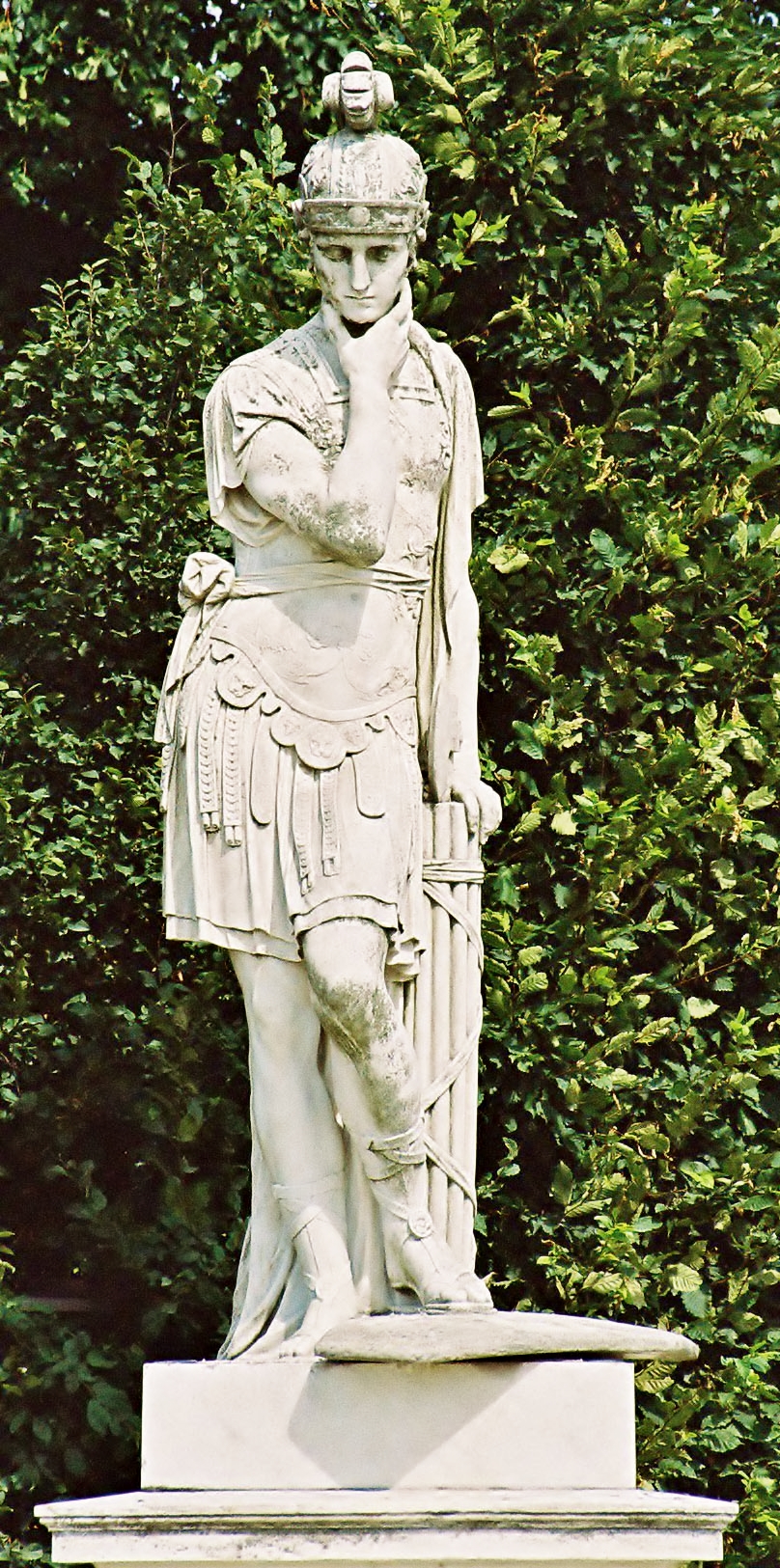
![Quintus Fabius Maximus Verrucosus][float-right] The strategy of attrition and evasion pioneered by Quintus Fabius Maximus Verrucosus during the Second Punic War (218–201 BC), involving the avoidance of pitched battles in favor of supply line disruptions, foraging party ambushes, and territorial denial to Hannibal's forces, established a paradigm for weaker powers confronting invaders with superior tactical prowess. This approach, later termed the Fabian strategy, prioritized preserving one's own forces while exploiting the enemy's logistical vulnerabilities over seeking immediate decisive victory, thereby trading space for time to erode the opponent's sustainability. Within the Roman context, Fabius's methods exerted immediate doctrinal influence by compelling the Republic to adopt protracted defense after early defeats like Trasimene (217 BC) and (216 BC), enabling manpower recovery from approximately 50,000 to over 200,000 legionaries by 212 BC through levies and avoiding further annihilation. This restraint facilitated the eventual counteroffensive, as invaded in 204 BC, drawing from and culminating in victory at Zama (202 BC), where Roman forces numbering 34,000 infantry defeated Carthage's 45,000 despite ongoing numerical disadvantages. Historians such as , drawing from firsthand accounts, credited such caution with preventing Rome's , contrasting it against the hubris of aggressive subordinates like Varro. Fabius's legacy extended to subsequent conflicts, notably informing George Washington's campaigns during the (1775–1783), where, after losses in New York (1776), he evaded British General Howe's main army, conducted raids on supply convoys, and focused on militia harassment to maintain cohesion amid desertions and shortages. This mirroring of Fabian tactics contributed to British overextension, morale erosion, and strategic victories like Saratoga (1777), which secured French alliance and ultimately compelled Cornwallis's surrender at Yorktown (1781). Similar applications appeared in Robert the Bruce's guerrilla attrition against English occupation in (1306–1314), prolonging resistance until (1314). In enduring military doctrine, the underscores the causal primacy of and endurance over bold maneuvers when asymmetries favor the defender, influencing analyses in works like Carl Clausewitz's (), which advocates selective based on force ratios, and modern U.S. reviews adapting it for against numerically superior foes. Empirical outcomes, such as Rome's survival despite Hannibal's 50,000-strong invasion force versus initial Roman fragments under 20,000, validate its utility in denying the quick needed for political , though critics like Minucius contemporaries highlighted risks of perceived inaction fostering internal .

Weighing Prudential Success Against Charges of Inertia

Fabius Maximus's appointment as dictator in 217 BC, following the catastrophic Roman defeat at Lake Trasimene where approximately 15,000 soldiers perished, marked the implementation of a emphasizing attrition over . By positioning forces in defensible hilly , shadowing Hannibal's without engaging in pitched battles, and employing scorched-earth tactics to deny foraging opportunities, Fabius systematically eroded Carthaginian supply lines and isolated outposts while preserving Roman manpower. This approach frustrated Hannibal's attempts to force decisive engagements or besiege key cities, compelling the invader to expend resources in hostile territory without achieving strategic dominance beyond tactical victories like the escape from Ager Falernus in January 217 BC. Contemporary detractors, including soldiers who derisively dubbed Fabius "Hannibal's pedagogue" for his reluctance to pursue aggressive action, leveled charges of and cowardice against him. Tribune Metilius and elements within the accused him of treasonous delay, amplifying public frustration amid Hannibal's unopposed maneuvers; this culminated in the controversial grant of equal authority to Marcus Minucius Rufus, who favored direct assaults. Minucius's subsequent rash engagement nearly resulted in his army's annihilation, only averted by Fabius's timely intervention to extricate the trapped forces, prompting Minucius to concede the superiority of caution. The prudential efficacy of Fabius's methods is empirically substantiated by Rome's survival and eventual resurgence, contrasting sharply with the disasters of open-field battles: Trasimene's losses and the even graver in 216 BC, where 50,000 to 70,000 Romans fell under consuls who rejected delay. Post-, the reinstated Fabian principles, recognizing that unchecked aggression had invited annihilation while attrition isolated in southern Italy, depleting his reinforcements and enabling subsequent Roman offensives under Publius Cornelius Scipio. later appraised this as "divine intelligence" that "by delaying restored the state," underscoring that accusations of inertia misconstrued strategic patience—rooted in the causal reality of 's tactical superiority in maneuver and cavalry—as mere hesitation, when it demonstrably forestalled collapse and aligned with Rome's resource advantages in a protracted conflict.

References

Add your contribution
Related Hubs
User Avatar
No comments yet.