Hubbry Logo
search
logo
Falx
Falx
current hub
2053574

Falx

logo
Community Hub0 Subscribers
Read side by side
from Wikipedia

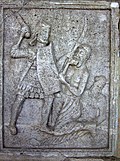
Dacian warriors wielding a two-handed falx on the Tropaeum Traiani

The falx was a weapon with a curved blade that was sharp on the inside edge used by the Thracians and Dacians. The name was later applied to a siege hook used by the Romans.

Etymology

[edit]

Falx is a Latin word originally meaning 'sickle' but was later used to mean any of a number of tools that had a curved blade that was sharp on the inside edge like a sickle. Falx was thus also used to mean the weapon of the Thracians and Dacians, and the Roman siege hook.

Dacian falx

[edit]
Dacian weaponry including a falx (top) exhibited in Cluj National History Museum[1]

In Latin texts, the weapon was described as an ensis falcatus (whence falcata) by Ovid in Metamorphose and as a falx supina by Juvenal in Satiriae.

The Dacian falx came in two sizes: one-handed and two-handed. The shorter variant was called sica[2] (sickle) in the Dacian language (Valerius Maximus, III, 2.12) with a blade length that varied but was usually around 16 inches (41 cm) long with a handle one-third longer than the blade. The two-handed falx was a polearm. It consisted of a 3-foot-long (0.91 m) wooden shaft with a long curved iron blade of nearly-equal length attached to the end. Archaeological evidence indicates that the one-handed falx was also used two-handed.[3]

The blade was sharpened only on the inside and was reputed to be devastatingly effective. However, it left its user vulnerable because, being a two-handed weapon, the warrior could not also make use of a shield. It may be imagined that the length of the two-handed falx allowed it to be wielded with great force, the point piercing helmets and the blade splitting shields – it was said to be capable of splitting a shield in two at a single blow. Alternatively, it might have been used as a hook, pulling away shields and cutting at vulnerable limbs, or striking the edge of a strong shield. The inward curving point was still able to pierce the armour or flesh of the target behind the shield, rendering even the most reinforced shields much less effective against a falx wielder.

Trajan's column is a monument to the emperor's conquest of Dacia. The massive base is covered with reliefs of trophies of Dacian weapons and includes several illustrations of the two-handed falx. The column itself has a helical frieze that tells the story of the Dacian wars. On the frieze, almost all the Dacians that are armed have shields and therefore cannot be using two-handed falx. The exact weapon of those few shown without shields cannot be determined with certainty. The frieze of Trajan's column also shows Dacians using smaller, sword-sized falx. However, this column is also largely stylized, with the sculptor believed to have worked from Trajan's now lost commentary and unlikely to have witnessed the events himself. A further problem is that most of the weapons on the monument were made of metal, which have since disappeared.[4]

The Adamclisi monument, built by Trajan to commemorate the Romans who lost their lives in the Dacian counterattack in Moesia, is thought to have been constructed by the soldiers who fought there, so it may be more accurate. This column shows four distinct types of falx, whereas Trajan's shows only one type that does not resemble any on the Adamclisi monument. Because of this, historians disagree on which depiction is correct, but it has been pointed out that if the Trajan's column falx are correct, then there would have been no need to modify Roman armour.[5] Both columns show the Dacians fighting with no armour apart from a shield, although some on the Adamclisi are wearing helmets. Some historians believe that armour was not depicted to differentiate Dacians from Romans, as both used the same style of shield. Other sources indicate that Dacians by this time had undergone Romanisation, used Roman military tactics, and sometimes wore Roman style scale armour. It is likely that the nobles at least wore armour and, combined with the falx, the Dacians would have been a formidable threat.[6]

Effectiveness

[edit]

Marcus Cornelius Fronto described the large gaping wounds that a falx inflicted, and experiments have shown that a blow from a falx easily penetrated the Romans' lorica segmentata, enough to incapacitate or kill a majority of opponents. These experiments also show that the falx was most efficient when targeting the head, shoulders, legs and especially the right (sword) arm, which was generally exposed. A legionary who had lost the use of his right arm became a serious liability to his unit in battle.[3]

During the conquest of Dacia by Trajan the Roman army adapted personal equipment while on campaign, and it seems likely that this was a response to this deadly weapon. Roman legionaries had transverse reinforcing iron straps applied to their helmets - it is clear that these are late modifications because they are roughly applied across existing embossed decoration. The legions also reintroduced the wearing of lorica hamata and lorica squamata for the Dacia campaign as both were more flexible than the newer segmentata armour which was able to distribute damage more widely. In addition, both these older armour styles had unique modifications, a row of pteruges was added to the sleeves, a double row of pteruges was added to the skirt and a heavily padded vestment was worn underneath them. Roman armour of the time left limbs unprotected; Trajan introduced the use of greaves and an arm protector (manica) for the right arm, which had previously been used only by gladiators, and which was never used again by soldiers once the Dacia campaign concluded.[7][contradictory]

Thracian falx

[edit]

The Thracians also made use of the falx. They also used the rhomphaia, a weapon very similar to the two-handed falx but less curved.

Development

[edit]
Falx, drawing based on the Adamclisi monument

The two-handed falx is clearly related to the Thracian rhomphaia. It is a derivative of both the sword and the spear, having evolved from a spear to a polearm before becoming more dramatically curved to facilitate a superior cutting action.[citation needed] This drastic curve rendered the falx a purely offensive weapon to be used against a broken or routing force.[citation needed] Typically, an enemy would be broken by a sustained hail of missile fire from javelin, dart, bow, sling, and stone throwing troops before being chased down and cut to pieces by the falx wielders.[citation needed]

The ancestor of the two-handed falx may have been a farming implement used as an improvised weapon, in a manner analogous to the bill-guisarme.[citation needed] The single-handed falx might have been inspired by the sickle, although agricultural sickles of the time were typically quite small – no more than 30 cm or so in length.[citation needed]

At the time of the Dacian wars, producing a long, sharp blade was technically challenging.[citation needed] As such, it might be that the larger two-handed falx was a high-status weapon and used only by the best warriors.[citation needed]

Other variations

[edit]

Similarly, there are the sica and the rhomphaia. The sica is a much smaller variation, some with very dramatic curves or bends. The rhomphaia is often larger and used with two hands, though there were some one handed ones.

[edit]

See also

[edit]

References

[edit]
[edit]
Revisions and contributorsEdit on WikipediaRead on Wikipedia
from Grokipedia
The falx was a two-handed, forward-curving bladed weapon used by Dacian warriors, consisting of a long haft and a sickle-shaped iron blade sharpened along its concave inner edge for powerful slashing and hooking attacks.[1] Primarily deployed during the Dacian Wars against Rome (101–106 AD) under Emperor Trajan, the falx exploited vulnerabilities in Roman legionary armor and helmets, with its momentum-driven strikes capable of cleaving through segmented plates and cranial protection.[2][3] Archaeological evidence from Dacian sites indicates variations in length, often exceeding six feet overall, while contemporary depictions on the Tropaeum Traiani monument and Trajan's Column illustrate its battlefield role against shielded formations.[2] The weapon's design, possibly evolved from agricultural sickles, emphasized reach and leverage over thrusting, making it ill-suited for tight Roman phalanxes but devastating in open engagements or ambushes.[4] Forged by skilled Dacian smiths from high-quality iron, falces were symbols of warrior prowess and resistance, contributing to heavy Roman casualties in initial clashes.[4][5] Reports of its impact prompted tactical shifts, including the adoption of reinforced helmet crossbars and manica arm defenses by Trajan's legions, though some historians debate the extent of direct causation versus broader evolutionary armor trends.[2][6] Similar curved blades, like the Thracian rhomphaia, suggest regional influences, but the falx remains distinctly tied to Dacian martial culture and Rome's conquest of their Carpathian strongholds.[1][3]

Terminology and Etymology

Etymology

The term falx originates from Latin, denoting a sickle or scythe-shaped implement, particularly curved blades used for cutting or hooking, as in agricultural tools like the falx messoria for reaping grain. This root reflects a broader Roman linguistic application to any sharpened, inwardly curved metal edge, extending beyond farming to tools and early weaponry, with attestations in classical texts from the Republic onward. In the 1st–2nd centuries AD, Roman observers adapted falx to describe the specialized curved blades of Dacian and Thracian combatants encountered during Trajan's Dacian Wars (101–106 AD), distinguishing these inward-edged weapons from straight swords or outer-curved sickles.[7] The 2nd-century AD rhetorician Cornelius Fronto employed the phrase falcibus Dacorum ("Dacian sickles") to evoke these arms in rhetorical contexts, marking an early weapon-specific usage that prioritized morphological similarity over etymological ties to harvest tools.[7] This nomenclature persisted in later Roman military literature, underscoring a descriptive rather than indigenous terminological choice imposed by Latin speakers on foreign implements.

Classifications and Nomenclature

The falx is principally classified as a two-handed curved blade weapon, functioning as either a polearm or longsword, wielded by Dacian warriors and characterized by its inward-curving edge optimized for slashing and hooking. This form, often termed the falx suprema in modern typology, measures approximately 1.5 to 2 meters in total length, distinguishing it from shorter one-handed variants sometimes grouped under the broader category of curved Dacian blades. It must be differentiated from the sica, a compact curved dagger typically 25-35 cm in blade length used for thrusting and close combat by both Thracians and Dacians, and the rhomphaia, a Thracian two-handed weapon with a straighter or less pronounced curve exceeding 2 meters, which prioritized thrusting alongside slashing.[8] In Roman nomenclature, falx—Latin for "sickle"—served as the primary descriptor for Dacian weapons, potentially functioning as a generic label for various curved-edged implements employed by barbarian groups rather than a precise indigenous term. Ancient references, such as M. Cornelius Fronto's phrase Dacorum falcibus, encompass a spectrum of tools and arms including sickles, scythes, bill-hooks, fighting knives, the sica dagger, and longer sword forms, suggesting Roman observers applied the term broadly to denote any inwardly curved blade irrespective of exact morphology or cultural origin. No surviving epigraphic or textual evidence attests to specific Dacian or Thracian native nomenclature, with classifications thus inferred from Roman literary sources and iconographic depictions on monuments like Trajan's Column, where the falx symbolizes Dacian martial identity.[8] Modern scholarship debates the specificity of falx versus its generality, with archaeological typologies proposing subdivisions based on blade length and curvature—such as war scythes (1.5-2 m), medium swords (around 66 cm as found at Sarmizegetusa), and dagger-like forms—while cautioning against conflation with the sica due to functional and dimensional disparities. Some researchers argue for a unified "falx dacica" tradition encompassing all curved Dacian weapons, supported by burial finds and representational art, whereas others emphasize morphological distinctions to avoid anachronistic nationalistic interpretations that overemphasize a singular "national" weapon. These ambiguities arise from the paucity of labeled artifacts and reliance on Roman-centric accounts, which prioritized perceptual similarities over ethnic precision.[8][3]

Design and Construction

Blade Features

The falx blade exhibited a distinctive inward-facing curvature, with the sharpened edge on the concave side, facilitating powerful slashing motions. Archaeological reconstructions and depictions indicate blade lengths typically ranging from 50 to 66 centimeters, tapering from a wider base to a pointed, hooked tip designed for hooking and pulling maneuvers. [9] [10] This hooked configuration, more pronounced than in related Thracian rhomphaia, allowed the blade to engage and dislodge shields or armor during combat. [11] Metallurgical examination of Dacian blade fragments reveals construction from wrought iron, frequently incorporating pattern-welding to produce resilient edges capable of penetrating Roman helmets and mail. [2] The blade's ergonomic curvature optimized leverage in downward arcs, enabling strikes to arc over defensive shields, as evidenced by combat scenes on the Tropaeum Traiani metopes and Trajan's Column reliefs. [12]

Pole and Ergonomics

The falx employed a wooden pole typically ranging from 1 to 2 meters in length, enabling a two-handed grip that maximized reach and generated substantial momentum for overhead or lateral strikes in dense infantry formations.[13] This extended shaft design distinguished it from shorter swords, allowing users to target vulnerabilities above Roman scutum shields while maintaining spacing in phalanx-like arrays.[14] Blade attachment to the pole occurred primarily through a robust tang inserted into a slotted wooden haft, often reinforced with rivets or metal bindings to endure repeated high-impact swings without fracturing.[11] Similar Thracian rhomphaiae artifacts exhibit partial sockets with rivet holes for secure fixation, suggesting comparable engineering to distribute torsional forces during use.[15] The pole's material, likely dense hardwoods suited to regional availability, provided the necessary rigidity and slight flex to absorb shocks, though direct archaeological preservation of complete hafts remains rare due to organic decay. Ergonomically, the falx's pole demanded exceptional wielder strength and coordination for its characteristic sweeping trajectories, which leveraged the full body for concussive force rather than isolated arm thrusts.[16] This contrasted sharply with the gladius's compact, one-handed ergonomics optimized for stabbing in shield walls, requiring Dacian fighters to undergo intensive conditioning to sustain prolonged engagements without fatigue compromising control.[17] The tapered grip end facilitated rotation and balance shifts mid-swing, but its mass and arc radius limited rapid recovery, underscoring the weapon's reliance on disciplined, formation-based tactics over individualistic dueling.

Materials and Forging Techniques

The falx blade was predominantly forged from wrought iron, produced through bloomery smelting of local Carpathian iron ores, which were abundant in the Dacian territories and yielded blooms of variable purity depending on ore quality and reduction techniques.[18] These ores, often hematite or limonite deposits, were processed in small-scale furnaces using charcoal as fuel and reducing agents, resulting in heterogeneous iron with low carbon content (typically under 0.5%) that required further smithing for usability.[19] To achieve edge durability against repeated impacts, Dacian smiths incorporated pattern-welding, layering wrought iron with higher-carbon iron strips forge-welded together, twisted, and hammered to create a composite structure that combined toughness with localized hardness.[2] This technique, evidenced in metallographic examinations of Iron Age weapon fragments from Dacian sites, allowed for sharper cutting edges without overall brittleness, though not all falces exhibited it due to resource constraints in peripheral regions. The pole was typically ash or oak wood, socketed and secured with iron rivets or bindings for structural integrity.[20] Forging commenced with heating iron blooms to welding temperature (around 900–1100°C) and hammering them into elongated billets, from which the curved blade profile was formed by selective heating along the inner edge and repeated upsetting strikes to induce the sickle-like bend.[2] Post-shaping, differential heat treatment involved normalizing the body for flexibility while quenching the edge in water or oil to harden it selectively, preventing cracking under combat stress; archaeological analyses of Dacian iron artifacts confirm this through observed Widmanstätten structures indicating controlled cooling rates. Quality varied regionally, with central Dacian examples demonstrating finer grain structures and better slag removal per slag inclusion studies, reflecting advanced local workshops at sites like Sarmizegetusa Regia.[21]

Origins and Development

Prehistoric and Early Influences

The curved blade morphology of the falx likely originated from Bronze Age sickles prevalent in the Carpathian and Balkan regions, where such tools, cast or forged from bronze, featured inward arcs designed for efficient harvesting of crops like grain. Archaeological discoveries of these sickles, dating to circa 1300–1000 BC in areas encompassing modern Romania and Bulgaria, demonstrate blade curvatures analogous to the falx's cutting edge, suggesting an initial adaptation of agricultural implements for rudimentary warfare amid resource scarcity and tribal conflicts.[7][3] Interactions with steppe nomad groups, including Scythians and possibly Cimmerians during migrations around 800–600 BC, introduced broader metallurgical exchanges that may have reinforced the weaponization of curved forms, as evidenced by parallel arc-shaped daggers and short swords in Pontic steppe assemblages influencing peripheral cultures. These exchanges are inferred from shared stylistic elements in regional metalwork, such as reinforced tangs and hooked tips, though direct causal links remain speculative due to limited artifact overlap.[22][23] By the early Iron Age transition circa 700 BC, Thracian smithing communities in the Haemus Peninsula advanced these prototypes through superior iron forging, enabling longer, more robust poles and blades that presaged the falx's two-handed configuration, as indicated by early iron sickles and blade fragments showing improved quench-hardening techniques for edge retention. This period marks a shift from bronze utility tools to specialized iron armaments, driven by local ore resources and trade networks rather than wholesale foreign imposition.[22][1]

Evolution in the Iron Age

During the Iron Age in the Balkans, from roughly the 8th century BC onward, precursors to the falx emerged among Thracian populations as iron replaced bronze in weapon forging, transitioning from straight daggers and sickles to curved single-edged blades optimized for slashing. Archaeological finds from Thracian sites, such as iron daggers with incipient curvature dated to the 5th-4th centuries BC, illustrate this shift, where early bloomery iron—initially brittle and prone to cracking—began yielding viable combat edges through basic carburization and hammering techniques.[22][3] By the 3rd century BC, refinements in ironworking, including selective quenching and folding to improve homogeneity, enabled thinner profiles and sharper inward hooks without structural failure, as seen in typological series of sica-like daggers from Padea-Panagjurski kolonii contexts ending around 200 BC. These developments standardized the falx's core form in Thracian-Dacian territories, with blade lengths stabilizing at 50-70 cm and the concave edge sharpened for pulling cuts, distinguishing it from contemporaneous Greek machaira (outward-curved) or Celtic imports.[3][7] In proto-Dacian regions during the late La Tène period (c. 150-50 BC), longer poles—up to 1.5 meters—appeared on select variants, extending leverage for reach while preserving the hooked tip, amid exchanges with Celtic migrants who introduced similar curved daggers but lacked the falx's pronounced inward arc. This evolution reflected adaptive metallurgy rather than wholesale adoption, with artifacts from Transylvanian hoards showing consistent morphology despite regional variations in hafting.[13][24]

Military Applications

Dacian Usage

The falx served as a distinctive two-handed slashing weapon in the Dacian military, employed primarily by warriors during the late Iron Age and early Roman imperial period. Archaeological fragments from Dacian sites, such as those analyzed for pattern-welding and differential hardening techniques, indicate its construction from high-quality iron, enabling it to deliver devastating blows in close-quarters combat.[2][25] Its curved, single-edged blade, often measuring 75–100 cm in length excluding the handle, was optimized for hooking and severing, distinguishing it from straighter Dacian swords like the falcata-influenced types found in greater numbers.[3][26] In Dacian warfare, the falx complemented lighter weapons such as the sica, with evidence suggesting its use by specialized troops to breach enemy lines, particularly against heavily armored formations. Iconographic representations on Trajan's Column, erected around 113 AD to commemorate the Dacian Wars (101–102 AD and 105–106 AD), depict Dacian fighters wielding the falx in sweeping overhead strikes against Roman legionaries, bypassing the scutum shield's protection.[3][27] These reliefs, alongside metopes from the Tropaeum Traiani monument, provide primary visual evidence of its deployment in pitched battles under King Decebalus. The weapon's tactical role emphasized aggressive charges to disrupt tight infantry formations, leveraging its reach and momentum for armor-piercing effects, though actual artifacts remain scarce, with curved blades underrepresented in graves relative to straight swords, implying selective elite usage rather than universal adoption.[6][25] Roman responses during the wars included helmet reinforcements with iron crossbars and enhanced arm guards, adaptations inferred from evolving legionary equipment documented in contemporary reliefs, underscoring the falx's impact despite Dacia's ultimate conquest.[3][2]

Deployment in the Dacian Wars

The falx saw prominent deployment by Dacian forces during Emperor Trajan's campaigns against King Decebalus from 101 to 102 AD and 105 to 106 AD.[28] Dacian warriors wielded the two-handed falx in infantry engagements, leveraging its curved blade to hook over Roman scuta and deliver slashing blows to limbs or heads, as evidenced by reliefs on Trajan's Column portraying such combat tactics.[27] These depictions show falx users operating in close formation against legionary shield walls, aiming to disrupt tightly packed Roman lines.[2] Archaeological and monumental evidence from the Tropaeum Traiani at Adamclisi, commemorating Roman victories in the region, further illustrates falx employment in battles like those near the Danube frontier and in mountain passes such as Tapae in 101 AD.[25] However, the weapon appears to have been utilized by specialized shock troops rather than as standard issue, given the scarcity of falx artifacts compared to straight swords and spears in Dacian arsenals.[25] Roman responses included enhanced armor, such as reinforced helmet ridges and manicae arm defenses, adopted during these wars to mitigate the falx's capacity to shear through traditional equipment.[29] Despite these adaptations and the falx's localized effectiveness in melee, Dacian armies could not halt Trajan's advance, culminating in the siege and fall of Sarmizegetusa in 106 AD.[28]

Tactical Effectiveness and Limitations

The falx demonstrated significant tactical effectiveness in Dacian warfare, particularly during the Dacian Wars (101–106 AD), due to its design facilitating strikes over Roman shields and against unprotected areas. Its forward-curved blade, often exceeding 1 meter in length on a pole up to 2 meters, allowed wielders to hook and displace the scutum shield or crested helmets, exposing legionaries to subsequent slashing or cleaving blows that could sever limbs or penetrate armor gaps. Archaeological depictions on the Tropaeum Traiani metopes illustrate falx users engaging Roman formations, suggesting its role in disrupting tight infantry lines by exploiting the overhead vulnerability of Roman equipment. Historical analyses posit that such impacts contributed to high casualties among Roman troops, as inferred from the heavy losses reported in Trajan's campaigns despite ultimate Roman victory.[2] This effectiveness prompted hypothesized adaptations in Roman gear, including reinforced helmet ridges and enhanced lorica segmentata plating to counter cleaving forces, though direct causation remains debated among scholars, with some attributing changes to broader evolutionary trends rather than solely the falx. Modern reconstructions and impact tests on period armor replicas confirm the weapon's capacity to damage segmented plates and split unprotected helmets, underscoring its disruptive potential in melee against shield walls. In Dacian tactics, falx-equipped warriors likely operated in shock roles, charging to break formations before lighter-armed troops exploited breaches, leveraging the weapon's reach advantage over shorter Roman gladii.[6] Despite these strengths, the falx had notable limitations inherent to its two-handed polearm configuration, rendering users highly vulnerable without a shield for personal defense. Dacian falx bearers lacked the protection afforded by the scutum, exposing them to Roman pila javelins, arrows, or pilum throws during approach, which could decimate unshielded infantry before close engagement. The weapon's length and curvature also hindered its use in confined spaces or dense scrums, where thrusting was less effective than slashing, and recovery from swings could leave wielders open to counterattacks by shorter, more maneuverable gladii.[30] Furthermore, the falx's reliance on momentum for power made it less versatile against agile or mounted foes, and post-adaptation Roman armor mitigated some cleaving threats, reducing its battlefield dominance in prolonged conflicts. Tactical analyses suggest that while devastating in initial clashes, Dacian forces incorporating falces struggled against disciplined Roman reserves or artillery, contributing to their eventual defeat despite early successes. These drawbacks highlight the falx as a specialized assault tool rather than a universal infantry weapon, effective in offensive surges but ill-suited for defensive or sustained combat.[31][32]

Thracian and Regional Variants

Thracian forces employed the rhomphaia, a regional variant featuring a straight or slightly curved single-edged blade affixed to a pole, used two-handed for close combat as early as the 5th century BC. This design supported both hacking slashes and thrusts, distinguishing it from the more sickle-like curvature of the Dacian falx.[33] Archaeological recoveries from Thracian tumuli graves reveal iron examples accompanying warrior interments, indicating widespread adoption among heavy infantry. A shorter variant, the sica, functioned as a curved dagger or knife for Thracian light troops and assassins, evidenced in Balkan burials from the La Tène D period through the Augustan era.[3] Historical records document its use by Thracian mercenaries, such as in the 130 BC Battle of Leucae, where it enabled ritualistic kills to preserve enemy honor.[3] These weapons exhibited typological consistency across Balkan regions, with variations in haft shapes and blade profiles reflecting local adaptations among Thracian tribes and related groups like the Getae.[3]

Integration in Thracian Armies

Thracian military organization integrated the rhomphaia into phalanx-like heavy infantry units, pairing it with shields and lighter projectile arms for versatile battlefield roles against Greek city-states and Macedonian forces from the 4th century BC onward.[33] Peltast skirmishers supplemented these with the sica for close-quarters finishing, leveraging terrain advantages in guerrilla tactics prevalent in the rugged Balkans.[3] Such deployment contributed to Thracian successes in mercenary service, including campaigns under Philip II of Macedon.

Comparative Performance

The rhomphaia's straighter profile conferred advantages in thrusting over the falx's optimized slashing arc, potentially enhancing penetration against segmented armor, though direct empirical comparisons remain constrained by archaeological scarcity.[33] Both weapons inflicted severe wounds on Roman troops, prompting defensive innovations like the galea helmet's reinforced brow guard during Trajan's era, but the rhomphaia's polearm potential extended its reach beyond the falx's dedicated sword form. Limitations included vulnerability to disciplined spear walls, as noted in Hellenistic accounts of Thracian engagements.[33]

Integration in Thracian Armies

The rhomphaia, a Thracian bladed weapon featuring a straight or slightly curved single-edged blade mounted on a pole or as a long sword, served as a key close-combat implement in Thracian armies from approximately 400 BC onward. Archaeological finds, such as blade specimens dated to around 421 BC in the Xanthe Museum, indicate its early adoption for assault roles among Thracian warriors.[34] In tribal levies, it was primarily wielded by heavier infantry who transitioned from javelin skirmishing to melee, enhancing the army's capacity for decisive charges after initial missile exchanges.[33] Thracian tactics, often involving hit-and-run raids and ambushes as described by classical sources like Xenophon and Polyaenus, integrated the rhomphaia to exploit disorder in enemy lines. Elite units, termed rhomphaiaphoroi in later references, employed it two-handed without shields, prioritizing reach and power over defense; warriors wore reinforced armor to compensate, allowing sweeping slashes and thrusts effective against shielded formations.[34] This configuration made the weapon suitable for breaking phalanxes or legionary cohesion, though its effectiveness depended on numerical superiority and terrain favoring Thracian mobility.[35] As Thracians increasingly served as mercenaries in Macedonian and Hellenistic forces from the 4th century BC, the rhomphaia influenced allied contingents, providing shock troops for flanks or pursuits. A late 4th to mid-3rd century BC example from the Western Rhodopes underscores its role in regional warfare, bridging tribal customs with broader military evolutions. Despite sparse literary details on specific battles, the weapon's reputation for lethality prompted Roman adaptations, such as reinforced helmets during encounters with Thracian-influenced auxiliaries.

Comparative Performance

The rhomphaia, a Thracian variant of the falx characterized by its straight or slightly curved single-edged blade mounted on a long polearm-like handle, demonstrated superior cutting power compared to the Roman gladius in experimental reconstructions, leveraging greater reach and two-handed momentum to deliver blows capable of penetrating or deforming early imperial helmets and shields.[33][36] Archaeological interpretations and modern tests indicate the weapon's design allowed it to hook and bypass convex shields like the scutum, targeting limbs or necks with slashing arcs that exceeded the gladius's short-thrusting range in open engagements.[2][29] However, its performance diminished in the disciplined Roman manipular formations, where the gladius's one-handed use alongside shield and pilum enabled tighter spacing and quicker stabs, exploiting the rhomphaia's commitment to wide swings that left wielders exposed to counterattacks.[37] Thracian armies integrating rhomphaia relied on shock tactics in looser arrays, achieving localized breakthroughs against legionary armor prior to mid-1st century AD reinforcements, but faltered against pila volleys and testudo adaptations that neutralized overhead or hooking strikes.[32] Roman responses to falx-like weapons, including Thracian encounters, prompted helmet modifications such as crosswise iron bars on Weisenau-type galeae by the Trajanic era (circa 101-106 AD), enhancing resistance to cleaving impacts without fully adopting the rhomphaia, as its length hindered legionary close-quarters doctrine.[38][29] In comparative trials, the rhomphaia inflicted deeper incisions on segmentata lorica equivalents than equivalent-weight gladii, yet required more space and stamina, underscoring its niche efficacy in tribal warfare over sustained imperial campaigns.[2]

Archaeological and Historical Evidence

Key Discoveries and Artifacts

Archaeological excavations at Sarmizegetusa Regia, the Dacian capital, have yielded curved iron blades dated to the 1st-2nd centuries AD, consistent with the falx morphology depicted in Roman monuments. One such artifact, discovered in a pit within a metallurgical workshop, exhibits a hooked curvature suitable for both agricultural and martial use, reflecting advanced local ironworking techniques.[39] Similar blades were found in the western civilian settlement on the site's 6th terrace, underscoring the weapon's prevalence in Dacian society prior to the Roman conquest in 106 AD.[40] Two curved weapons, identified as potential falces, were unearthed at the Dacian fortress of Divici, providing further evidence of regional production and distribution during the late 1st century AD. Metallurgical studies of iron artifacts from Dacian sites, including those linked to falx-like blades, indicate the use of Carpathian-sourced ores processed through pattern-welding for enhanced durability, as analyzed in examinations of military equipment from the province of Dacia (106-270 AD).[41][42] Iconographic artifacts corroborate these finds, with Trajan's Column, dedicated in 113 AD, featuring multiple panels depicting Dacian warriors wielding two-handed falces against Roman forces. Reliefs on the Tropaeum Traiani monument at Adamclisi, erected around 109 AD to commemorate the 101-102 AD Dacian War, show falx use in combat, including metopes illustrating the weapon's curved blade in action. A Roman denarius issued in 107 AD bears the reverse image of a Dacian soldier with a falx, marking the conquest and serving as numismatic evidence of the weapon's recognition.[43] Earlier Thracian-influenced examples include curved blades from Getic tombs in the Dobruja region, dated to the 3rd century BC, though these shorter variants differ from the elongated Dacian falx and may represent precursors like the sica or romphaia.[44]

Interpretations and Debates

Scholars have contested the portrayal of the falx as a revolutionary "superweapon" capable of single-handedly challenging Roman superiority, arguing that its impact was overstated in popular and nationalist narratives. While depictions on Trajan's Column and accounts from Cassius Dio highlight its capacity to cleave shields and helmets, archaeological evidence indicates it was not a mass-produced arm but a specialized tool for select warriors, limiting its battlefield dominance.[25][20] Roman equipment modifications during the Dacian Wars (101–106 AD), including the addition of cross-bracing to helmets like the Weisenau type and the reintroduction of the manica arm guard for the sword arm, provide tangible evidence of the falx's threat to unprotected limbs and heads in close combat. These adaptations, visible in Trajanic-era artifacts from sites such as the Saalburg and Corbridge, suggest pragmatic responses to observed vulnerabilities rather than a wholesale reinvention of legionary kit, as older armor types continued in use alongside enhancements. Critics note that such changes aligned with ongoing evolutions in Roman gear against various slashing weapons, not uniquely the falx.[20][2] The scarcity of falx remains—fewer than a dozen complete examples from key Dacian sites like Sarmizegetusa Regia—undermines claims of its ubiquity, pointing instead to a role in elite or auxiliary units designed for breaching formations. This paucity counters historiographical emphases in Romanian scholarship, which elevated the weapon as a symbol of Dacian ingenuity and resistance, often prioritizing cultural identity over empirical data from excavations.[25] Ultimately, the falx's success in engagements stemmed from Dacian tactics exploiting its reach and hooking action to disrupt Roman shield walls, amplified by warrior aggression and terrain advantages, rather than intrinsic superiority to the gladius, which excelled in thrusting within disciplined ranks. Experimental tests confirm its chopping force against wood and light mail but reveal vulnerabilities in sustained melee against shielded opponents, aligning with Roman victories through superior logistics and numbers.[20][6]

Variations and Influences

Structural Variants

The falx displayed variations in overall length and handle design, influencing whether it was wielded one-handed or two-handed. Dacian examples typically featured extended handles, often exceeding 1 meter, paired with blades of 50-70 cm, resulting in a total length up to approximately 2 meters for optimal two-handed sweeping strikes that maximized leverage against armored foes.[7][12] In Thracian contexts, particularly among auxiliaries, shorter variants prevailed with blade lengths of 50-65 cm and compact handles suited for one-handed use alongside a shield, enhancing maneuverability in close-quarters infantry engagements.[5] Blade curvature formed another key structural element, with the inner concave edge sharpened to facilitate hooking and pulling motions, though exact hook angles varied by craftsmanship and regional forging traditions, generally forming a pronounced sickle-like arc for deep incisions.[5][1] Some eastern production centers produced broader-bladed forms, potentially adapted for countering cavalry by enabling wider slashing arcs to unhorse riders, as inferred from artifact morphologies in Thrace and Moesia.[1] Distinct from combat iterations, Roman adaptations repurposed the falx designation for siege implements: pole-mounted hooks or pry bars, often 2-3 meters long with reinforced iron tips, designed to dismantle walls or tents by leveraging rather than cutting, marking a utilitarian divergence from the original handheld weapon.[45][46] These engineering variants prioritized durability over sharpness, reflecting tactical shifts in siegecraft post-Dacian conflicts.[47] The falx shares morphological and functional affinities with Thracian weapons like the rhomphaia and sica, indicative of cultural interactions among Balkan groups during the Iron Age. The rhomphaia, attested from approximately 400 BC, featured a long, relatively straight blade mounted on a pole, allowing for both slashing and thrusting, and was grouped with sickle-derived arms including the falx.[48] The sica, a short, curved dagger used by Thracians and Dacians, emphasized stabbing in close combat and later influenced gladiatorial equipment, highlighting regional adaptations of curved blades from agricultural origins.[3] These parallels arose from shared Thracian-Dacian linguistic and material exchanges, as Dacians, considered a northern Thracian branch, inhabited adjacent territories and traded metallurgical techniques from the 1st millennium BC.[48] Broader influences may trace to Scythian migrations and trade networks penetrating the Balkans around 500 BC, where nomadic curved sickles and akinakes daggers could have inspired local smiths, though archaeological linkages to the falx remain indirect and primarily evidenced by imported arrowheads and horse gear among Getae tribes.[49] Typological resemblances also appear with the Iberian falcata, a forward-curving sword favored by Celtiberians circa 300 BC, suggesting convergent Indo-European designs prioritizing inward-facing edges for draw cuts, without substantiated direct diffusion to Dacian contexts.[50] Post-conquest, the falx's hooked form echoed in medieval European billhooks and bills, polearms with chopping hooks emerging by the 14th century AD, but these derived independently from pruning tools rather than Roman-era continuity, as evidenced by their widespread agricultural roots across Eurasia.[51]

Modern Reconstructions and Legacy

Experimental Archaeology

Modern reconstructions of the falx, forged in Romania during the 2010s using bloomery iron analogous to ancient Dacian metallurgy, have been subjected to controlled tests against replica Roman equipment to assess combat efficacy.[52] These replicas, produced by smiths such as Iamandi, feature inward-curved blades sharpened on the concave edge, weighing approximately 1.5-2 kg with hafts extending 1-1.5 meters for two-handed use. Experimental archaeologist David Sim's tests demonstrated that such falces could deliver crippling blows to the arm protected by the Roman manica, exploiting vulnerabilities in segmented bronze or iron plates through shear force at joints or edges.[20] Further evaluations by reenactment groups, including the Thegns of Thrand, involved striking ballistic gelatin analogs of human tissue, period-style scuta (shields), and lorica hamata (chainmail) equivalents. Results showed the falx penetrating wooden scuta up to 20-30 cm deep in a single overhead swing, severing layered linen and wood reinforcements, while slicing through maille rings to embed in underlying gel, simulating deep lacerations.[53] Against lorica segmentata replicas, impacts generated high localized kinetic energy—estimated from swing mechanics exceeding 800 J—but primarily deformed plates, disrupted girth hoops, or caused concussive trauma rather than outright severance of ferrous plates hardened to 200-300 Vickers.[2] Tests also highlighted ergonomic limitations, with wielders reporting rapid onset of shoulder and grip fatigue after 10-15 full-power swings due to the weapon's mass distribution and torque demands, reducing sustained combat viability in prolonged engagements. This aligns with observations that the falx exploited exposed limbs or helmet crowns but proved less decisive against fully articulated Trajanic upgrades, including reinforced galeae with cross-bracing, confirming arm vulnerabilities without rendering Roman infantry invincible.[6] Such experiments underscore the falx's role as a shock weapon effective in initial charges but tempered by user exertion and armor countermeasures.[54]

Cultural and Historical Impact

The Dacian falx's deployment during Trajan's campaigns against Decebalus (101–102 and 105–106 AD) is hypothesized to have driven evolutionary changes in Roman protective gear, particularly after reports of helmets being split and limbs hewn despite shields.[2] Post-conquest artifacts, including late 1st- to early 2nd-century helmets with reinforced transverse ridges, suggest adaptations to mitigate downward chopping impacts from such curved blades.[55] Similarly, the manica—segmented arm defenses—saw expanded adoption and uniformity among legionaries, addressing vulnerabilities in the weapon arm exposed by the falx's reach and leverage.[55] These modifications, while not exclusively attributable to the falx, aligned with a post-Dacian push toward standardized imperial kit resilient to asymmetric threats from iron-age polities.[55] In Roman iconography, the falx symbolized the ingenuity of "barbarian" foes, contrasting with prevailing views of peripheral groups as technologically stagnant; metopes at Tropaeum Traiani (completed circa 109 AD) depict it as a hallmark of Dacian martial identity, emphasizing organized resistance over disorganized savagery.[1] This portrayal on monuments and coinage, such as denarii issued in 107 AD commemorating Dacia's annexation, framed the weapon as emblematic of a credible existential challenge, thereby heightening imperial awareness of adaptive tactics beyond the Danube.[1] Such representations persisted in auxiliary contexts, influencing perceptions of Thracian-Dacian kin as sources of both peril and incorporable prowess, without romanticizing their threat as supernatural. The falx's enduring resonance underscores a legacy of pragmatic counter-innovation over mythic dread, informing later assessments of pre-industrial warfare where localized designs compelled systemic responses.[37] In this vein, its historical role highlights causal dynamics of material and tactical interplay, rather than isolated terror, shaping scholarly emphasis on empirical vulnerabilities in empire-building.[56]

References

User Avatar
No comments yet.