



Community hub
Recent from talks
Contribute something
Nothing was collected or created yet.
Floating-gate MOSFET
View on WikipediaThe floating-gate MOSFET (FGMOS), also known as a floating-gate MOS transistor or floating-gate transistor, is a type of metal–oxide–semiconductor field-effect transistor (MOSFET) where the gate is electrically isolated, creating a floating node in direct current, and a number of secondary gates or inputs are deposited above the floating gate (FG) and are electrically isolated from it. These inputs are only capacitively connected to the FG. Since the FG is surrounded by highly resistive material, the charge contained in it remains unchanged for long periods[1] of time, typically longer than 10 years in modern devices. Usually Fowler-Nordheim tunneling and hot-carrier injection mechanisms are used to modify the amount of charge stored in the FG.
The FGMOS is commonly used as a floating-gate memory cell, the digital storage element in EPROM, EEPROM and flash memory technologies. Other uses of the FGMOS include a neuronal computational element in neural networks,[2][3] analog storage element,[2] digital potentiometers and single-transistor DACs.
History
[edit]The first MOSFET was invented by Mohamed Atalla and Dawon Kahng at Bell Labs in 1959, and presented in 1960.[4] The first report of a FGMOS was later made by Dawon Kahng and Simon Min Sze at Bell Labs, and dates from 1967.[5] The earliest practical application of FGMOS was floating-gate memory cells, which Kahng and Sze proposed could be used to produce reprogrammable ROM (read-only memory).[6] Initial applications of FGMOS was digital semiconductor memory, to store nonvolatile data in EPROM, EEPROM and flash memory.
In 1989, Intel employed the FGMOS as an analog nonvolatile memory element in its electrically trainable artificial neural network (ETANN) chip,[3] demonstrating the potential of using FGMOS devices for applications other than digital memory.
Three research accomplishments laid the groundwork for much of the current FGMOS circuit development:
- Thomsen and Brooke's demonstration and use of electron tunneling in a standard CMOS double-poly process[7] allowed many researchers to investigate FGMOS circuits concepts without requiring access to specialized fabrication processes.
- The νMOS, or neuron-MOS, circuit approach by Shibata and Ohmi[8] provided the initial inspiration and framework to use capacitors for linear computations. These researchers concentrated on the FG circuit properties instead of the device properties, and used either UV light to equalize charge, or simulated FG elements by opening and closing MOSFET switches.
- Carver Mead's adaptive retina[2] gave the first example of using continuously-operating FG programming/erasing techniques, in this case UV light, as the backbone of an adaptive circuit technology.
Structure
[edit]
An FGMOS can be fabricated by electrically isolating the gate of a standard MOS transistor, so that there are no resistive connections to its gate. A number of secondary gates or inputs are then deposited above the floating gate (FG) and are electrically isolated from it. These inputs are only capacitively connected to the FG, since the FG is completely surrounded by highly resistive material. So, in terms of its DC operating point, the FG is a floating node.
For applications where the charge of the FG needs to be modified, a pair of small extra transistors are added to each FGMOS transistor to conduct the injection and tunneling operations. The gates of every transistor are connected together; the tunneling transistor has its source, drain and bulk terminals interconnected to create a capacitive tunneling structure. The injection transistor is connected normally and specific voltages are applied to create hot carriers that are then injected via an electric field into the floating gate.
FGMOS transistor for purely capacitive use can be fabricated on N or P versions. [9] For charge modification applications, the tunneling transistor (and therefore the operating FGMOS) needs to be embedded into a well, hence the technology dictates the type of FGMOS that can be fabricated.
Modeling
[edit]Large signal DC
[edit]The equations modeling the DC operation of the FGMOS can be derived from the equations that describe the operation of the MOS transistor used to build the FGMOS. If it is possible to determine the voltage at the FG of an FGMOS device, it is then possible to express its drain to source current using standard MOS transistor models. Therefore, to derive a set of equations that model the large signal operation of an FGMOS device, it is necessary to find the relationship between its effective input voltages and the voltage at its FG.
Small signal
[edit]An N-input FGMOS device has N−1 more terminals than a MOS transistor, and therefore, N+2 small signal parameters can be defined: N effective input transconductances, an output transconductance and a bulk transconductance. Respectively:
![{\displaystyle g_{mi}={\frac {C_{i}}{C_{T}}}g_{m}\quad {\mbox{for}}\quad i=[1,N]}](https://wikimedia.org/api/rest_v1/media/math/render/svg/e194d0688d39a0f12d724e488ee4ce3ab966bbde)
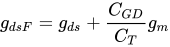
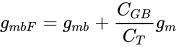
where is the total capacitance seen by the floating gate. These equations show two drawbacks of the FGMOS compared with the MOS transistor:

- Reduction of the input transconductance
- Reduction of the output resistance
Simulation
[edit]Under normal conditions, a floating node in a circuit represents an error because its initial condition is unknown unless it is somehow fixed. This generates two problems:
- It is not easy to simulate these circuits
- An unknown amount of charge might stay trapped at the floating gate during the fabrication process which will result in an unknown initial condition for the FG voltage.
Among the many solutions proposed for the computer simulation, one of the most promising methods is an Initial Transient Analysis (ITA) proposed by Rodriguez-Villegas,[10] where the FGs are set to zero volts or a previously known voltage based on the measurement of the charge trapped in the FG after the fabrication process. A transient analysis is then run with the supply voltages set to their final values, letting the outputs evolve normally. The values of the FGs can then be extracted and used for posterior small-signal simulations, connecting a voltage supply with the initial FG value to the floating gate using a very-high-value inductor.
Applications
[edit]The usage and applications of the FGMOS can be broadly classified in two cases. If the charge in the floating gate is not modified during the circuit usage, the operation is capacitively coupled.
In the capacitively coupled regime of operation, the net charge in the floating gate is not modified. Examples of application for this regime are single transistor adders, DACs, multipliers and logic functions, and variable threshold inverters.
Using the FGMOS as a programmable charge element, it is commonly used for non-volatile storage such as flash, EPROM and EEPROM memory. In this context, floating-gate MOSFETs are useful because of their ability to store an electrical charge for extended periods of time without a connection to a power supply. Other applications of the FGMOS are neuronal computational element in neural networks, analog storage element and e-pots.
See also
[edit]References
[edit]- ^ "Tunneling: New Floating Gate Memory with Excellent Retention Characteristics". Wiley Online Library. doi:10.1002/aelm.201800726. S2CID 139369906. Retrieved 19 June 2019.
- ^ a b c Mead, Carver A.; Ismail, Mohammed, eds. (May 8, 1989). Analog VLSI Implementation of Neural Systems (PDF). The Kluwer International Series in Engineering and Computer Science. Vol. 80. Norwell, MA: Kluwer Academic Publishers. doi:10.1007/978-1-4613-1639-8. ISBN 978-1-4613-1639-8.
- ^ a b M. Holler, S. Tam, H. Castro, and R. Benson, "An electrically trainable artificial neural network with 10240 'floating gate' synapses", Proceedings of the International Joint Conference on Neural Networks, Washington, D.C., vol. II, 1989, pp. 191–196
- ^ "1960 - Metal Oxide Semiconductor (MOS) Transistor Demonstrated". The Silicon Engine. Computer History Museum.
- ^ Kahng, Dawon; Sze, Simon Min (1967). "A floating gate and its application to memory devices". The Bell System Technical Journal. 46 (6): 1288–1295. doi:10.1002/j.1538-7305.1967.tb01738.x.
- ^ "1971: Reusable semiconductor ROM introduced". Computer History Museum. Retrieved 19 June 2019.
- ^ A. Thomsen and M.A. Brooke, "A floating-gate MOSFET with tunneling injector fabricated using a standard double-polysilicon CMOS process," IEEE Electron Device Letters, vol. 12, 1991, pp. 111-113
- ^ T. Shibata and T. Ohmi, "A functional MOS transistor featuring gate-level weighted sum and threshold operations", IEEE Transactions on Electron Devices, vol. 39, no. 6, 1992, pp. 1444–1455
- ^ Janwadkar, Sudhanshu (2017-10-24). "Fabrication of Floating Gate MOS (FLOTOX)". www.slideshare.net.
- ^ Rodriguez-Villegas, Esther. Low Power and Low Voltage Circuit Design with the FGMOS Transistor
External links
[edit]Floating-gate MOSFET
View on GrokipediaHistorical Development
Invention and Early Concepts
The floating-gate MOSFET was invented in 1967 by Dawon Kahng and Simon M. Sze at Bell Laboratories, where it was developed as a non-volatile memory element capable of storing charge semi-permanently without external power. This innovation built directly on the metal-oxide-semiconductor field-effect transistor (MOSFET), which had been demonstrated earlier in 1959 by Mohamed M. Atalla and Dawon Kahng at the same institution, providing the foundational insulated-gate structure for controlling conductivity in silicon devices. Kahng and Sze's work addressed the need for compact, semiconductor-based alternatives to bulky magnetic core memories prevalent in 1960s computing, proposing the floating-gate device as a means to trap electrons on an isolated conductor to modify device behavior persistently.[5][6][7] The core early concept centered on an isolated floating gate—a conductive layer embedded within the MOSFET and fully insulated by thin oxide layers from the control gate, channel, and substrate—enabling charge trapping to shift the transistor's threshold voltage and represent binary states. Unlike a standard MOSFET, which relies on a directly connected gate for transient control, the floating-gate variant incorporates this additional insulated electrode to retain trapped charge, allowing non-volatile operation where stored information persists after power removal. Charge injection onto the floating gate was envisioned through mechanisms such as Fowler-Nordheim tunneling under high electric fields or hot-carrier (avalanche) injection, with erasure via thermal or optical emission; initial experiments demonstrated reprogrammable functionality by altering the threshold voltage between high and low states, effectively creating a semiconductor-based read-only memory (ROM) that could be modified.[6][8][9] In their 1967 publication, Kahng and Sze fabricated and tested prototype devices on silicon, observing memory holding times longer than one hour, which validated the principle of semi-permanent charge storage and laid the groundwork for subsequent enhancements in retention and scalability. This demonstration highlighted the device's potential for dense, integrated memory arrays, distinguishing it from volatile alternatives by emphasizing electrical isolation for enduring charge confinement.[6]Key Milestones and Commercialization
The commercialization of floating-gate MOSFET technology began in earnest in the early 1970s, marking a pivotal shift from experimental concepts to practical, market-ready non-volatile memory devices. In 1971, Intel introduced the world's first commercial erasable programmable read-only memory (EPROM), the 1702, a 2K-bit device that utilized floating-gate avalanche-injection MOS (FAMOS) cells for ultraviolet light erasable storage, enabling reusable programming in integrated circuits and revolutionizing firmware development for microprocessors.[10][11] This innovation, developed by Dov Frohman at Intel, addressed the limitations of one-time programmable ROMs by allowing multiple erase-write cycles, though requiring external UV exposure for erasure.[10] Building on this foundation, the late 1970s saw advancements in electrical erasability, eliminating the need for UV light. In 1980, Intel introduced the 2816, the first commercial electrically erasable programmable read-only memory (EEPROM), employing a floating-gate structure with Fowler-Nordheim tunneling for byte-level electrical programming and erasing, which facilitated in-system updates and boosted adoption in embedded systems and peripherals.[12][13] This device, designed by George Perlegos, offered greater flexibility than EPROMs and paved the way for denser non-volatile storage, with Hughes Aircraft also introducing a complementary 8K-bit CMOS EEPROM that year.[12] The 1980s witnessed the emergence of flash memory architectures, dramatically increasing density and performance for mass storage applications. In 1987, Fujio Masuoka and his team at Toshiba invented NAND flash, a serial-access architecture using floating-gate cells arranged in strings for high-density, block-erasable storage, which was first commercialized in 1989 and became dominant for consumer devices like SSDs due to its cost efficiency.[12] Concurrently, Intel developed NOR flash in 1988 under the ETOX trademark, featuring parallel access and random byte addressing via floating-gate cells, ideal for code execution in embedded applications such as BIOS and firmware.[12] These architectures, both rooted in floating-gate technology, propelled the non-volatile memory market, with Intel and Toshiba leading shipments and enabling the portable electronics boom.[12] Beyond storage, floating-gate MOSFETs found early applications in analog computing. In 1989, Intel researchers introduced the Electrically Trainable Analog Neural Network (ETANN) chip, incorporating 10,240 floating-gate synapses for analog weight storage in hardware neural networks, demonstrating multilevel charge storage for synaptic weights and marking one of the first commercial uses in neuromorphic hardware.[14] In the post-2000 era, aggressive scaling extended floating-gate technology to sub-10 nm nodes in planar NAND flash, achieving densities exceeding 128 Gb per die by the mid-2010s through optimized cell interference management and thinner tunnel oxides, though facing reliability challenges like charge leakage.[15] To overcome planar scaling limits, 3D NAND stacking emerged, with commercial introductions in the 2010s; for instance, Intel and Micron's 2015 3D NAND used floating-gate cells in stacked layers for enhanced endurance.[16] Integration with FinFET transistors further advanced embedded flash, enabling low-power, high-reliability non-volatile storage in SoCs at 14 nm and below, as seen in automotive and IoT applications.[17] By the 2020s, while high-density NAND has largely shifted to charge-trap alternatives for better 3D scalability—exemplified by Samsung's 2013 V-NAND, the first mass-produced 3D vertical NAND at 128 Gb using charge-trap flash—floating-gate MOSFETs persist in embedded flash for their mature ecosystem and suitability in low-density, radiation-hardened environments like microcontrollers and space electronics.[18] Ongoing patents, such as those for enhanced floating-gate uniformity in embedded processors (e.g., TSMC's 2021 innovations), underscore hybrid designs combining floating gates with advanced nodes for continued relevance through 2025, alongside recent 2024-2025 research into multi-bit and tunable floating-gate devices for neuromorphic applications.[19][20][21]Device Structure and Physics
Physical Construction
The floating-gate MOSFET builds upon the standard metal-oxide-semiconductor field-effect transistor (MOSFET) architecture by incorporating an isolated conductive layer, known as the floating gate, for charge storage. In cross-section, the device consists of a p-type silicon substrate with heavily doped n+ source and drain regions separated by a channel region. Over the channel lies a thin tunnel oxide layer, typically 8-10 nm thick and composed of SiO₂, which electrically isolates the substrate from the floating gate made of n+-doped polycrystalline silicon (poly-Si), approximately 100-150 nm thick. Above the floating gate is the interpoly dielectric (IPD), a thicker insulating layer (10-20 nm equivalent oxide thickness, often an oxide-nitride-oxide or SiO₂ stack) that separates it from the control gate, another layer of n+-doped poly-Si. This stacked configuration ensures the floating gate remains electrically isolated while allowing capacitive interaction with surrounding electrodes.[22] The floating gate is capacitively coupled to the control gate via the IPD capacitor (denoted as C_CG), which dominates the overall gate capacitance, and to the source and drain regions through overlap capacitances (C_SD) formed by the gate edges extending over the doped areas. These couplings enable voltage transfer from the control gate to the floating gate without direct electrical connection, a key feature for non-volatile operation. In modern implementations, channel lengths typically range from 10 to 100 nm to support device scaling, while oxide thicknesses are precisely controlled (e.g., tunnel oxide at ~8 nm) to balance tunneling efficiency during programming with long-term reliability by preventing excessive charge leakage over 10-year retention periods.[2][24] Fabrication of the floating-gate MOSFET is highly compatible with standard complementary metal-oxide-semiconductor (CMOS) processes, facilitating integration with logic circuitry. The process begins with thermal oxidation to grow the tunnel oxide on the silicon substrate, followed by low-pressure chemical vapor deposition (LPCVD) to deposit the first poly-Si layer for the floating gate, doped via phosphorus implantation. The IPD is then formed through sequential deposition of SiO₂, Si₃N₄, and another SiO₂ layer (for ONO stacks), after which the second poly-Si layer for the control gate is deposited and doped. Photolithographic patterning and reactive ion etching define the gate stack, with self-aligned source/drain implantation completing the structure. Variations include stacked-gate designs, where the entire multilayer stack is etched as a unit for uniform alignment in NOR-type flash memories, and split-gate designs, which involve additional masking and etching steps to offset the floating and control gates, reducing programming voltages in EEPROM applications.[24][25] Traditional materials emphasize SiO₂ for both the tunnel oxide and IPD due to its compatibility with silicon and excellent insulating properties, paired with poly-Si gates for their conductivity and ease of doping. However, as scaling challenges intensify below 20 nm nodes, emerging designs incorporate high-k dielectrics like HfO₂ (dielectric constant ~25) to replace or augment SiO₂ in the IPD and tunnel layers, achieving thinner physical thicknesses while preserving capacitance and reducing leakage currents. This material shift, often via atomic layer deposition (ALD) of HfO₂, enhances scalability without compromising reliability, as demonstrated in nanocrystal-enhanced floating-gate structures.[26][24]Charge Storage Mechanism
The floating gate in a floating-gate MOSFET serves as an isolated conductive layer, typically polycrystalline silicon, surrounded by insulating oxide layers that electrically isolate it from the control gate, channel, and substrate. This structure enables the storage of charge carriers, primarily electrons or holes, which are injected onto or removed from the floating gate through quantum mechanical processes. The trapped charge modulates the threshold voltage of the underlying MOSFET channel, with the shift approximated by , where is the total capacitance seen by the floating gate. This voltage shift encodes binary or multilevel data states, forming the basis for nonvolatile memory operation.[27][6] Charge retention on the floating gate is maintained by the high energy barrier at the silicon-SiO₂ interface, approximately 3.1 eV for electrons, which suppresses thermal emission and leakage under normal conditions. At room temperature, this results in data retention exceeding 10 years, though retention degrades at elevated temperatures due to accelerated charge loss mechanisms. The isolation provided by the surrounding oxide layers, such as the tunnel oxide and inter-poly dielectric, minimizes leakage paths, ensuring long-term stability essential for nonvolatile applications.[28][4] Quantum effects dominate charge injection and potential leakage in the floating gate. For thicker tunnel oxides (typically >4 nm or 40 Å), Fowler-Nordheim tunneling prevails, where electrons tunnel through a triangular potential barrier under high electric fields (~10 MV/cm). In thinner oxides (<4 nm), direct tunneling becomes significant, allowing charge carriers to traverse a rectangular barrier without field-induced bending, though this increases power consumption and limits scalability. A key reliability concern is stress-induced leakage current (SILC), arising from oxide traps generated during repeated programming/erasing cycles, which creates localized conduction paths and accelerates charge loss, contributing to retention failure.[29][30] The efficiency of voltage application to the floating gate is governed by the capacitance coupling factor , where is the control gate-to-floating gate capacitance. This factor, typically ranging from 0.6 to 0.8 in standard designs, determines how effectively the control gate voltage couples to the floating gate potential, influencing programming efficiency and threshold control. Higher values enhance voltage transfer but require optimized oxide thicknesses to balance coupling and isolation.[2]Operation Principles
Programming and Erasing
Programming of a floating-gate MOSFET involves injecting electrons onto the floating gate to store negative charge, which increases the threshold voltage (V_th) of the device, representing the programmed state. One common method is channel hot-electron injection, where high drain-source voltage (V_ds > 5 V) and gate voltage (V_g > 10 V) accelerate electrons in the channel, allowing a fraction to gain sufficient energy to overcome the gate oxide barrier and inject into the floating gate.[31] This technique, originally developed for EPROM cells, achieves a threshold voltage shift of typically 2-5 V in milliseconds.[32] Another programming mechanism is Fowler-Nordheim tunneling, employed in EEPROM and flash memory devices, where a high positive gate voltage (V_g > 15 V) applied for pulses of about 1 ms causes electrons to quantum-mechanically tunnel from the substrate or channel through a thin tunnel oxide (typically 7-10 nm) into the floating gate.[33] This method provides efficient charge injection without requiring high drain currents, enabling denser memory arrays, and also results in a V_th shift of 2-5 V.[31] Erasing removes electrons from the floating gate to restore the original low V_th state. In EPROM devices, erasing is accomplished by exposing the chip to ultraviolet (UV) light, which generates photoelectrons that discharge the floating gate over minutes to hours through the passivation layer. For electrically erasable devices like EEPROM and flash, erasing uses reverse Fowler-Nordheim tunneling with a high negative gate voltage (V_g < -15 V), tunneling electrons from the floating gate back to the substrate or source/drain regions in pulses lasting milliseconds.[33] This process shifts V_th back to its initial value, completing the erase operation.[31] Repeated programming and erasing degrade the tunnel oxide due to trapped charges and stress-induced leakage, limiting device endurance to approximately 10^5 to 10^6 cycles before significant V_th window closure occurs from oxide wear-out. Variations in erase operations include byte-level erasing in EEPROM for individual cell access and sector-level erasing in NAND flash, where entire blocks (typically 512 bytes to several kilobytes) are erased simultaneously to optimize performance and density.[34]Read Operation
In the read operation of a floating-gate MOSFET, a positive control gate voltage is applied, typically in the range of 3-5 V, while the drain-source voltage is kept low at approximately 1 V to avoid any charge modification. The floating-gate potential is then determined by capacitive coupling from the control gate and the stored charge: where is the control-gate coupling coefficient (typically 0.6-0.8), is the charge on the floating gate, and is the total capacitance seen by the floating gate.[35] This modulates the channel inversion, effectively controlling the transistor's threshold voltage .[36] The stored negative charge on the floating gate from programming increases (e.g., shifting it by several volts), reducing the drain-source current in the programmed state, while the erased state (minimal charge) results in a lower and higher . This leads to a current difference of one or more orders of magnitude between programmed ("0") and erased ("1") states, enabling reliable state discrimination.[37] The read process is non-destructive, as the low voltages prevent charge tunneling or injection, preserving the stored charge; sense amplifiers detect the or associated shift to output the logical state without altering it.[38] Charge retention on the floating gate ensures stable readout over time.[36] Modern floating-gate-based flash memories achieve read times below 50 ns, supporting high-speed applications, with margining techniques incorporated to maintain reliability by avoiding over-programming and ensuring sufficient separation between state distributions.[39]Electrical Modeling
Large-Signal DC Model
The large-signal DC model for a floating-gate MOSFET captures the steady-state current-voltage characteristics under applied biases, incorporating the effects of charge stored on the isolated floating gate. This model treats the device as a conventional MOSFET with an effective gate voltage determined by capacitive coupling from the control gate and other terminals to the floating gate, enabling prediction of drain current as a function of terminal voltages and stored charge. The floating gate voltage is obtained from charge conservation on the floating gate, expressed as where is the total capacitance associated with the floating gate, , , , and are the control-gate-to-floating-gate, drain-to-floating-gate, source-to-floating-gate, and body-to-floating-gate capacitances, respectively, , , , and are the corresponding terminal voltages, and is the net charge on the floating gate.[40] The threshold voltage observed at the control gate is shifted due to , given by where is the threshold voltage without stored charge (including body effect dependence on ) and is the total control-gate-to-floating-gate capacitance. This formulation links the stored charge directly to the device's turn-on behavior. The drain current follows the standard long-channel MOSFET equations, with referring to the control-gate-to-source voltage and the shifted threshold. In the linear region (), and in saturation (), where is the carrier mobility, is the channel aspect ratio, and subthreshold operation can be modeled using exponential dependence on . These expressions assume level-1 MOSFET physics but can be extended with more advanced surface-potential-based models for accuracy. here is the oxide capacitance per unit area for the channel. Programming and erasing operations induce shifts in () proportional to the injected charge , as , enabling non-volatile storage of multiple threshold states for memory applications. The magnitude of typically ranges from 2–5 V for reliable distinction between programmed and erased states, depending on the charge injection mechanism and coupling efficiency.[40]Small-Signal AC Model
The small-signal AC model of the floating-gate MOSFET is derived by linearizing the nonlinear device equations around a chosen DC operating point, accounting for the capacitive coupling between the control gate and the isolated floating gate. This coupling introduces a voltage division effect that scales the AC response relative to a standard MOSFET. The model highlights how the floating nature of the gate reduces intrinsic device parameters, such as gain, through the coupling coefficient , where is the control-gate to floating-gate capacitance and is the total capacitance seen by the floating gate (including oxide, overlap, and parasitic capacitances).[41] The effective transconductance, which relates small changes in control-gate voltage to drain current variations, is given by , where is the intrinsic transconductance evaluated at the floating-gate voltage in the saturation region, with as carrier mobility, as the oxide capacitance per unit area, as the aspect ratio, as the effective gate-source voltage, and as the threshold voltage. The output conductance remains similar to that of a conventional MOSFET but is augmented by coupling from the gate-drain capacitance, yielding , where is the floating-gate to drain capacitance; this term arises from feedback through the floating node. Effective capacitances, such as the gate-source capacitance, are modified by the capacitive divider, reflecting the dependence on . The floating gate thus reduces the intrinsic voltage gain by the factor , typically 0.6–0.8 in practical devices.[41][42] The small-signal equivalent circuit represents the floating gate as an internal node capacitively coupled to the control gate (), drain (), source (), and bulk (), with the channel current source driven by the floating-gate voltage and including conductances and . A large resistance (effectively infinite for AC analysis) models the charge isolation on the floating gate. Input-referred noise in this model stems from thermal fluctuations in the stored charge and parasitic capacitances, manifesting as voltage noise at the control gate scaled by , though the fixed charge minimizes low-frequency contributions compared to standard MOSFETs.[2][43] Frequency dependence in the model arises from the RC time constants associated with the oxide layers and interconnects; the control and tunnel oxides exhibit time constants on the order of picoseconds, enabling valid operation up to GHz frequencies before parasitic effects dominate, limited primarily by the effective bandwidth , where incorporates the coupled capacitances.[43]Simulation Techniques
Challenges in Simulation
Simulating floating-gate MOSFETs presents unique challenges due to the isolated floating gate, which lacks a direct current (DC) path to ground or other reference nodes. In standard circuit simulators like SPICE, this floating node can lead to undefined initial conditions and convergence failures during DC analysis, as the solver struggles to establish a valid operating point without a conductive path for charge equilibration.[44] To mitigate this, models often introduce artificial high-resistance paths or dummy nodes, but these approximations can introduce numerical instabilities, particularly in transient simulations where charge dynamics must be preserved.[44] A critical aspect of accurate simulation involves explicit tracking of the floating-gate charge to ensure charge conservation, as the device's threshold voltage and operation depend directly on this stored quantity. Standard steady-state models fail to capture transient effects from programming or erasing operations, such as Fowler-Nordheim tunneling or hot-carrier injection, which alter over time and require iterative updates in each simulation time step.[45] Without explicit charge conservation mechanisms, like voltage-controlled current sources tied to , simulations may exhibit non-physical charge loss or drift, complicating reliability predictions for retention and endurance.[45] Scaling simulations to multi-device arrays, such as those in NAND flash memory blocks, introduces further complexities from statistical variations in key parameters like oxide thickness and trapped charge distribution. These variations lead to threshold voltage () fluctuations across cells, necessitating probabilistic modeling to account for granularity effects in stored charge, which can widen bit distributions and degrade multi-level cell performance.[46] Handling such arrays demands computationally intensive Monte Carlo-like approaches to capture inter-device coupling and process-induced nonuniformities, often resulting in prohibitive runtime for large-scale designs.[46] Pre-2020 simulation models for floating-gate MOSFETs frequently overlooked three-dimensional (3D) effects, such as edge fringing fields and non-uniform charge distribution in polysilicon gates, leading to inaccuracies in capacitance extraction and electric field profiles for scaled devices.[15] Additionally, these models exhibited gaps in accurately representing quantum tunneling through ultra-thin oxides in sub-10 nm nodes, underestimating direct tunneling currents and barrier lowering, which are essential for reliable programming efficiency and leakage assessment in advanced scaling scenarios.[15][47]Methods and Tools
Simulation of floating-gate MOSFET circuits often employs the Initial Transient Analysis (ITA) method to accurately capture charge storage dynamics. In ITA, a short voltage pulse is applied to the control gate to induce charge injection or tunneling onto the floating gate, thereby setting the floating-gate charge , followed by a steady-state DC analysis to evaluate the resulting threshold voltage shift and current characteristics. This approach is particularly useful in BSIM-based models, where the floating-gate voltage is derived from the initial charge state and integrated into standard MOSFET simulations for circuit-level verification.[48] Behavioral modeling using Verilog-A and Verilog-AMS languages provides a flexible framework for simulating floating-gate MOSFETs at the system level, encapsulating the floating-gate voltage and charge dynamics through compact equations that account for tunneling currents and capacitive coupling. These models enable mixed-signal simulations by representing the non-volatile charge retention and programmable threshold shifts without requiring detailed physical geometries. Cadence Spectre and Synopsys tools natively support Verilog-A/AMS for such behavioral descriptions, allowing seamless integration into larger analog-digital circuits for performance analysis.[49] Advanced simulation techniques leverage Technology Computer-Aided Design (TCAD) tools like Sentaurus for three-dimensional physics-based modeling of floating-gate MOSFETs, incorporating quantum mechanical effects such as Fowler-Nordheim tunneling and trap-assisted charge transport across the tunnel oxide. Sentaurus Device simulates the full device structure, including polysilicon floating gates and control gates, to predict programming/erasing efficiencies and retention times under varying bias conditions.[50] As of 2025, simulation methods have evolved to support neuromorphic applications through integration with specialized frameworks like NeuroSim, which benchmarks hybrid analog-digital circuits using floating-gate MOSFETs as synaptic elements for energy-efficient pattern recognition tasks. These tools model stochastic charge fluctuations and weight updates in floating-gate arrays, facilitating co-simulation with SPICE for large-scale neuromorphic systems.[51][52]Applications
Non-Volatile Memory Devices
Floating-gate MOSFETs form the foundational technology for several types of non-volatile memory devices, enabling data retention without power supply by trapping charge on an isolated polysilicon gate within the MOSFET structure.[6] This charge modulates the threshold voltage of the transistor, allowing binary states to be stored and read via standard MOSFET operations. The concept originated from the 1967 demonstration by Dawon Kahng and Simon Sze at Bell Laboratories, where a floating gate was shown to enable semipermanent charge storage in a MOSFET for memory applications.[6] The earliest practical implementation was the Erasable Programmable Read-Only Memory (EPROM), introduced by Dov Frohman-Bentchkowsky at Intel in 1971. EPROM cells use a thick oxide layer around the floating gate, with programming achieved by hot-electron injection to store negative charge, shifting the threshold voltage to represent a logic '0'. Erasure requires ultraviolet (UV) light exposure through a quartz window to photoemit trapped electrons, resetting the cell to a logic '1' state. Designed for single-use programming in applications like firmware, EPROM offered densities up to 1 Mb but became obsolete by the 1990s due to the inconvenience of UV erasure and the rise of electrical alternatives. Electrically Erasable Programmable Read-Only Memory (EEPROM) advanced the technology by enabling byte-level electrical erasure, invented by Eli Harari at Hughes Microelectronics between 1976 and 1978. EEPROM cells incorporate a thin tunnel oxide region for Fowler-Nordheim tunneling, allowing electrons to be injected or removed from the floating gate using moderate voltages (around 15-20 V) without UV light. This permitted in-circuit reprogramming, making EEPROM suitable for applications requiring infrequent updates, such as BIOS chips, smart cards, and configuration storage. Typical densities reached 1 Mb, with endurance of about 10^5 to 10^6 program/erase (P/E) cycles per cell, though higher costs limited its use to low-density scenarios compared to flash. Flash memory, a high-density evolution, was pioneered by Fujio Masuoka at Toshiba, with NOR flash demonstrated in 1984 and NAND flash in 1987. Both types use floating-gate cells with tunnel oxides for electrical programming and erasure but operate on block-level erasure to improve efficiency and density. NOR flash architecture connects cells in parallel for fast random access, suiting code storage and execution in embedded systems like microcontrollers. In contrast, NAND flash arranges cells in series for higher density, ideal for mass storage in SSDs, USB drives, and mobile devices, where sequential access predominates. By 2025, TLC (triple-level cell) and QLC (quad-level cell) NAND flash dies achieve densities up to 2 Tb, enabling SSD capacities exceeding 100 TB through multi-die stacking and 3D architectures.[53][54] Reliability in floating-gate memories is constrained by oxide degradation from repeated charge injection, limiting P/E endurance to 10^3-10^5 cycles for QLC NAND and up to 10^6 for NOR, primarily due to stress-induced leakage current and charge trapping. Wear-leveling algorithms distribute writes evenly across cells to prevent premature failure in heavily used blocks, while error correction codes (ECC), such as BCH or LDPC, mitigate bit errors from retention loss or read disturbs, achieving effective bit error rates below 10^{-15}. These techniques, combined with overprovisioning, ensure multi-year data integrity in commercial devices.[55]Analog and Mixed-Signal Circuits
Floating-gate MOSFETs enable programmable analog and mixed-signal circuits by leveraging capacitive coupling to multiple inputs and the ability to store charge that tunes the threshold voltage, allowing reconfiguration for functions like amplification and signal processing without discrete components. This programmability arises from the floating-gate potential, which is a weighted sum of input voltages scaled by coupling capacitances, facilitating continuous analog adjustments in integrated circuits. Such devices have been integral to low-voltage designs since the 1990s, supporting applications in reconfigurable systems where traditional resistor-based tuning is power-intensive or area-consuming.[56] In programmable gain amplifiers and filters, the floating-gate charge modulates the MOSFET's threshold voltage, thereby adjusting transconductance and enabling variable gain or cutoff frequency without external feedback elements. This approach is particularly advantageous for low-power operation, as demonstrated in a 500 nW floating-gate amplifier achieving programmable gains up to 16 through charge sharing on the floating gate. Similarly, rail-to-rail programmable-gain amplifiers operating at 1.5 V have utilized arrays of floating-gate pFETs to tune gain over a 20 dB range, reducing offset and improving linearity in mixed-signal systems. These circuits reference small-signal parameters, such as adjusted gm, to model performance in operational transconductance amplifiers.[57][58] Digital-to-analog converters (DACs) benefit from multi-input floating-gate MOSFETs, where multiple control gates capacitively couple to the floating node for weighted voltage summation, directly implementing analog output proportional to digital inputs. A 1 V CMOS DAC architecture using this principle in a matrix current cell has achieved 8-bit resolution with low distortion, suitable for portable mixed-signal ICs. An 8-bit low-voltage DAC further exploits floating-gate programmability to eliminate resistors, operating at 1 V supply while maintaining integral nonlinearity below 0.5 LSB, as shown in 0.35 μm CMOS implementations. Early neural chips from the 1990s employed such multi-input structures to store synaptic weights as floating-gate charges, enabling adaptive analog computation in VLSI.[59][60] Adders and multipliers in analog domains use capacitive inputs to the floating gate for charge redistribution, performing arithmetic operations via linear superposition of input signals on the floating node. A four-quadrant analog multiplier based on multi-input floating-gate MOSFETs has realized low-voltage operation below 1 V, with total harmonic distortion under 1% for inputs up to 0.5 Vpp, using source-coupled configurations for improved matching. Capacitive adders leverage the same weighted summation for charge-domain arithmetic, as in 1990s VLSI chips where resistorless designs reduced power to sub-μW levels per operation. These techniques highlight advantages like resistor elimination, leading to compact, low-power mixed-signal blocks in field-programmable analog arrays from that era.[61]Emerging Uses
Floating-gate MOSFETs have gained traction in neuromorphic computing as analog synapses for spiking neural networks, enabling efficient in-memory computation by storing synaptic weights as tunable charge levels on the floating gate. These devices mimic biological synaptic plasticity through mechanisms like long-term potentiation and depression, achieved via hot-electron injection or Fowler-Nordheim tunneling to modulate threshold voltages with high precision and low power. For instance, multinanodot floating-gate MOSFET circuits have been proposed to implement integrate-and-fire neuron models, demonstrating spike-timing-dependent plasticity suitable for pattern recognition tasks. Recent 2020s research highlights reconfigurable two-dimensional floating-gate field-effect transistors based on van der Waals heterostructures, which support highly integrated in-memory computing with 11-bit resolution and robust data retention exceeding 10 years, outperforming traditional digital synapses in energy efficiency for edge-based neural processing.[62][63][64] In quantum and cryogenic applications, floating-gate MOSFETs leverage their stable charge states for precise qubit control and readout in silicon quantum dots, operating reliably at millikelvin temperatures. Post-2022 prototypes integrate floating-gate transistors into quantum dot control circuitry, where trapped charges enable fine-tuned electrostatic potentials for tuning tunnel barriers and spin states without continuous bias, reducing cryogenic power dissipation. Cryogenic characterization of CMOS floating-gate devices has confirmed their reliable operation at 4 K, supporting suitability for scalable qubit arrays. A trilinear quantum dot architecture further utilizes floating gates for charge storage akin to DRAM but with extended retention, facilitating multi-qubit entanglement gates in semiconductor-based quantum processors.[65][66][67] Radiation-hardened designs exploit the inherent charge retention of floating-gate MOSFETs for space and aerospace applications, where total ionizing dose levels exceed 100 krad without significant data loss. These devices maintain floating-gate potentials stable against proton and gamma irradiation, with retention times over a decade in geosynchronous orbits, due to the insulating oxide barrier shielding trapped charges from radiation-induced leakage. Comparative studies of floating-gate versus charge-trapping memories reveal advantages for FG structures in radiation environments, enabling reliable non-volatile storage in satellites for telemetry and fault-tolerant computing. Optimization techniques, such as thickened tunnel oxides, further enhance single-event upset immunity while preserving programming speeds below 1 μs.[68][69][70] Hybrid floating-gate architectures combined with charge-trap flash are emerging for AI accelerators, bridging the gap between high-retention FG storage and faster charge-trap dynamics to support vector-matrix multiplications in neural networks. These hybrids use FG layers for long-term weight persistence and charge-trap sites for incremental updates, achieving linearity in conductance modulation with endurance cycles exceeding 10^6. In 2025 trends, integration of such devices into edge AI systems enables low-power inference on wearables and IoT sensors, with optimized split-gate FG memories delivering compute-in-memory performance at 55 nm nodes.[71][72][73]References
- https://www.[sciencedirect](/page/ScienceDirect).com/science/article/pii/S2090447922002283