Hubbry Logo
FontanelleFontanelleMain
Open search
Fontanelle
Community hub
Fontanelle
logo
8 pages, 0 posts
0 subscribers
Be the first to start a discussion here.
Contribute something
Fontanelle
Fontanelle
from Wikipedia

Fontanelle
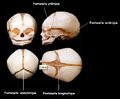
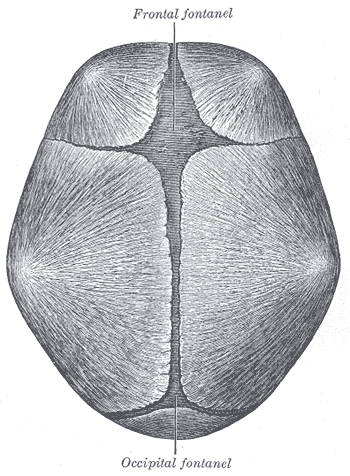
The skull at birth, showing the anterior and posterior fontanelles
The skull at birth, showing the lateral fontanelles
Details
Identifiers
Latinfonticuli cranii
MeSHD055762
TA98A02.1.00.027
TA2431
FMA75437
Anatomical terminology

A fontanelle (or fontanel) (colloquially, soft spot) is an anatomical feature of the infant human skull comprising soft membranous gaps (sutures) between the cranial bones that make up the calvaria of a fetus or an infant.[1] Fontanelles allow for stretching and deformation of the neurocranium both during birth and later as the brain expands faster than the surrounding bone can grow.[2] Premature complete ossification of the sutures is called craniosynostosis.

After infancy, the anterior fontanelle is known as the bregma.

Structure

[edit]

An infant's skull consists of five main bones: two frontal bones, two parietal bones, and one occipital bone. These are joined by fibrous sutures, which allow movement that facilitates childbirth and brain growth.

  • Posterior fontanelle is triangle-shaped. It lies at the junction between the sagittal suture and lambdoid suture. At birth, the skull features a small posterior fontanelle with an open area covered by a tough membrane, where the two parietal bones adjoin the occipital bone (at the lambda). The posterior fontanelles ossify within 6–8 weeks after birth. This is called intramembranous ossification. The mesenchymal connective tissue turns into bone tissue.
  • Anterior fontanelle is a diamond-shaped membrane-filled space located between the two frontal and two parietal bones of the developing fetal skull. It persists until approximately 18 months after birth. It is at the junction of the coronal suture and sagittal suture. The fetal anterior fontanelle may be palpated until 18 months. In cleidocranial dysostosis, however, it is often late in closing at 8–24 months or may never close. Examination of an infant includes palpating the anterior fontanelle.
  • Two smaller fontanelles are located on each side of the head, more anteriorly the sphenoidal or anterolateral fontanelle (between the sphenoid, parietal, temporal, and frontal bones) and more posteriorly the mastoid or posterolateral fontanelle (between the temporal, occipital, and parietal bones).

During birth, fontanelles enable the bony plates of the skull to flex, allowing the child's head to pass through the birth canal. The ossification of the bones of the skull causes the anterior fontanelle to close over by 9 to 18 months.[3] The sphenoidal and posterior fontanelles close during the first few months of life. The closures eventually form the sutures of the neurocranium. Other than the anterior and posterior fontanelles, the mastoid fontanelle and the sphenoidal fontanelle are also significant.

Closure

[edit]

In humans, the sequence of fontanelle closure is as follows:[2][4]

  1. The posterior fontanelle generally closes 2 to 3 months after birth;
  2. The sphenoidal fontanelle is the next to close around 6 months after birth;
  3. The mastoid fontanelle closes next from 6 to 18 months after birth; and
  4. The anterior fontanelle is generally the last to close between 12 and 18 months.

Clinical significance

[edit]
Normal pulsation of the anterior fontanelle in a 4-month-old infant

The fontanelle may pulsate, and although the precise cause of this is not known, it is normal and seems to echo the heartbeat, perhaps via the arterial pulse within the brain vasculature, or in the meninges. This pulsating action is how the soft spot got its name – fontanelle is borrowed from the old French word fontenele, which is a diminutive of fontaine, meaning "spring". It is assumed that the term spring is used because of the analogy of the dent in a rock or earth where a spring arises.[5]

Parents may worry that their infant may be more prone to injury at the fontanelles. In fact, although they may colloquially be called "soft spots", the membrane covering the fontanelles is extremely tough and difficult to penetrate.[6]

Fontanelles allow the infant brain to be imaged using ultrasonography. Once they are closed, most of the brain is inaccessible to ultrasound imaging, because the bony skull presents an acoustic barrier.[6]

Disorders

[edit]

Bulging

[edit]

A very tense or bulging anterior fontanelle indicates raised intracranial pressure. Increased cranial pressure in infants may cause the fontanelles to bulge or the head to begin to enlarge abnormally.[7] It can occur due to:[4]

Sunken

[edit]

A sunken (also called "depressed") fontanelle indicates dehydration or malnutrition.[9]

Anterior fontanelle of a 1-month-old infant

Enlarged

[edit]

The fontanelles may be enlarged, may be slow to close, or may never close, most commonly due to causes like:[10]

Rarer causes include:[10]

Third

[edit]

Sometimes there is a third bigger fontanelle other than posterior and anterior ones in a newborn. In one study, the frequency of third fontanelles in an unselected population of newborn infants was 6.3%. It is very common in Down syndrome and some congenital infections. If present, the physician should rule out serious conditions associated with the third fontanelle.[11]

Other animals

[edit]

Primates

[edit]

In apes the fontanelles fuse soon after birth. In chimpanzees the anterior fontanelle is fully closed by 3 months of age.[2]

Dogs

[edit]

One of the more serious problems that can affect canines is known as an "open fontanelle", which occurs when the skull bones at the top of the head fail to close. The problem is often found in conjunction with hydrocephalus, which is a condition in which too much fluid is found within and around the brain, placing pressure on the brain and surrounding tissues. Often the head will appear dome-shaped, and the open fontanelle is noticeable as a "soft spot" on the top of the dog's head. The fluid-filled spaces within the brain, known as ventricles, also become swollen. The increased pressure damages or prevents the development of brain tissue.[12]

Not all open fontanelles are connected with hydrocephalus. In many young dogs the skull bones are not fused at birth, but instead will close slowly over a three- to six-month period. Occasionally these bones fail to close, but the dog is still healthy. In these cases, however, the dog's owners need to be very careful, since any injury or bumps to the animal's head could cause significant brain damage, as well as conditions like epilepsy.

An open fontanelle, known as a molera, is a recognized feature of the Chihuahua breed. The American Kennel Club breed standard states that the skull of the Chihuahua should be domed, with or without the molera being present.[13] However, the Fédération Cynologique Internationale (FCI) standard for the Chihuahua lists an open fontanelle as a disqualification.[14]

Additional images

[edit]

References

[edit]
Revisions and contributorsEdit on WikipediaRead on Wikipedia
from Grokipedia
A fontanelle (or fontanel) is a soft, membranous gap between the bones of an infant's , allowing flexibility during birth and accommodating rapid growth in the early months of life. These structures, covered by tough membranes and skin, are present at birth and typically number six, with the anterior and posterior fontanelles being the most prominent and clinically observable. The , located at the top of the head where the frontal and parietal bones meet, is diamond- or rhomboid-shaped and measures approximately 2.1 cm on average (ranging from 0.6 to 3.6 cm), closing between 13 and 24 months of age. The , situated at the back of the head between the parietal and occipital bones, is triangular and smaller (about 0.5 cm in infants of Caucasian descent and 0.7 cm in those of African descent), usually closing by 2 to 3 months. The paired anterolateral (sphenoidal) fontanelles lie at the junctions of the frontal, parietal, temporal, and sphenoid bones, while the paired posterolateral (mastoid) fontanelles are at the temporal, parietal, and occipital junctions; both pairs generally close by 6 months and 6 to 18 months, respectively. Fontanelles form during embryonic development from mesenchymal tissue and ossify through , enabling the to mold during and expand as the doubles in size within the first year. In clinical practice, they serve as vital indicators of an infant's health: a sunken fontanelle may signal , while bulging can indicate increased from conditions such as , , or . Abnormal closure—either premature (as in ) or delayed (as in or )—requires medical evaluation to assess neurological development and prevent complications.

Anatomy

Locations and types

The features six fontanelles, which are membranous gaps at the junctions of the cranial bones, consisting of one anterior, one posterior, and two pairs of lateral fontanelles. These structures are visible in superior and lateral views of the neonatal cranium, with the anterior and posterior fontanelles located along the midline and the lateral ones positioned bilaterally. The , also known as the bregmatic fontanelle, is situated at of the two frontal bones and the two parietal bones. It has a diamond shape and measures approximately 0.6 to 3.6 cm in diameter at birth, with a mean size of 2.1 cm. Its boundaries are formed by the coronal sutures anteriorly and laterally, the posteriorly, and the frontal (metopic) suture inferiorly. The lies at the junction of the two parietal bones and the . It is triangular in shape and typically measures about 0.5 cm in Caucasian infants or 0.7 cm in those of African descent at birth, generally less than 1 cm across. Its boundaries are defined by the lambdoid sutures. In the first few weeks of life, its size may show minor variations due to natural head molding resolution. The two anterolateral fontanelles, or sphenoidal fontanelles, are paired structures located near the orbits, at the convergence of the sphenoid, frontal, parietal, and temporal bones. They are wedge-shaped and smaller than the midline fontanelles, typically closing early in infancy. Their boundaries include the sphenofrontal, sphenoparietal, and sphenotemporal sutures. As seen in frontal views of the , they are positioned lateral to the . The two posterolateral fontanelles, known as mastoid fontanelles, are located behind the ears at the intersection of the parietal, occipital, and temporal (mastoid process) bones. They have an irregular shape and are also relatively small compared to the . Their boundaries are formed by the parieto-occipital, occipitomastoid, and temporoparietal sutures. In superior and posterior views, they appear posterolateral to the . Sizes of both lateral fontanelles may exhibit slight adjustments in the initial weeks postpartum as the adapts.

Structure and composition

Fontanelles consist of a soft, membranous structure formed by dense fibrous that spans the gaps between unfused cranial bones, lacking any ossified elements. This tissue is primarily composed of fibers arranged in a layered configuration, with an outer fibrous layer resembling and an inner layer contributed by the , providing tensile strength and protection to the underlying . Histologically, the fontanelle membrane features abundant fibroblasts that synthesize and maintain the collagen matrix, resulting in a tough yet pliable material without an epithelial covering, as it is overlain by scalp . The biomechanical properties of fontanelles emphasize their elasticity, enabling significant deformation during mechanical stresses without fracturing, due to the viscoelastic nature of the fibrous under tension from adjacent cranial sutures. This elasticity allows the to mold adaptively during to facilitate passage through the birth canal. Surrounding sutures, also composed of dense fibrous tissue, anchor the fontanelle edges, distributing forces and preventing excessive strain on the . Functionally, fontanelles accommodate the rapid postnatal expansion of the , which increases approximately threefold in during the first year of life, from about 25% to nearly 75% of adult size, by permitting non-rigid growth without impeding neural development. Additionally, their membranous composition facilitates non-invasive clinical evaluations, such as transfontanellar to monitor cerebral blood flow and structure through the echolucent tissue. These properties collectively ensure while supporting dynamic physiological demands in infancy.

Development and closure

Embryonic origins

The fontanelles originate during embryonic development as membranous gaps in the calvaria, formed through the process of of the bones. This ossification begins between the 8th and 9th gestational weeks, when mesenchymal cells derived primarily from cells and paraxial differentiate into osteoblasts, leading to the direct formation of bone spicules around the developing brain. However, incomplete ossification in specific regions results in the persistence of these unossified areas, which are the fontanelles, becoming evident by around 12 weeks of as the flat bones of the —such as the frontal, parietal, and occipital—expand but leave suture-adjacent gaps. These fontanelles play a critical role in accommodating rapid fetal growth, which reaches approximately 25% of adult size by birth, allowing the to expand without mechanical constraint during the third trimester. Genetic regulation of this process involves key genes such as FGFR2 and TWIST1, which pattern the cranial sutures and influence the timing and extent of ossification gaps; mutations in these genes can disrupt suture patency and fontanelle formation, underscoring their necessity for balanced calvarial development. From an evolutionary perspective, fontanelles are a conserved feature among mammals, retained from ancestral lineages to facilitate viviparous birth by enabling cranial bone molding and compression through the maternal birth canal, a particularly pronounced in humans due to our disproportionately large -to-body ratio. In , the delayed of these gaps compared to other supports extended postnatal brain expansion, providing a selective advantage for encephalization. Prenatal imaging can detect fontanelle patency as early as the second trimester, around 15-16 weeks, through visualization of the membranous regions between ossifying bones in sagittal and transverse planes.

Normal closure timeline

The closure of fontanelles in healthy infants follows a predictable sequence influenced by the rate of and expansion. The , located at the back of the head, typically closes between 1 and 2 months of age, with full often complete by 3 months. The paired anterolateral (sphenoidal) fontanelles close around 6 months, while the paired posterolateral (mastoid) fontanelles close between 6 and 18 months. The , the largest and most prominent, remains patent longer to accommodate rapid growth, closing on average between 13 and 24 months. Approximately 1% of anterior fontanelles close by 3 months, 38% by the end of the first year, and 96% by 24 months. Several factors modulate this timeline in normal development. Brain growth rate drives the need for delayed closure, particularly of the , as the triples in size during the first year. Nutritional status, including adequate calcium and intake, supports ; deficiencies can subtly prolong patency without . Genetic predispositions also play a role, with variations in genes influencing timing. Demographic differences contribute to slight variations. Males tend to exhibit earlier closure than females, by about 1 to 2 months on average. Infants of African descent often have larger fontanelles at birth. These ethnic patterns reflect genetic and environmental interactions rather than deviations from normal. Pediatric monitoring ensures alignment with these milestones through routine well-child visits. Examinations at 2, 4, 6, 9, and 12 months include and measurement of fontanelle patency to confirm progressive closure without irregularities.

Clinical assessment

Examination methods

Examination of fontanelles begins with , the cornerstone of clinical assessment, where the healthcare provider uses gentle digital pressure to evaluate the anterior and posterior fontanelles for size, shape, tension, and pulsation. The is ideally positioned upright or held in a calm state to minimize tension from , allowing for a more accurate evaluation; in the , the head may be slightly elevated for better access. During , the index finger is placed lightly over the fontanelle without excessive force, noting a normal soft, flat consistency—even when the cries—and a mild arterial pulsation synchronous with the heartbeat. Size assessment during palpation provides an initial estimate, with the anterior fontanelle typically measuring 0.6 to 3.6 cm in diameter (mean 2.1 cm) in term newborns, though values decrease with age to approximately 2-3 cm by 6 months in healthy infants. More precise measurement protocols involve serial evaluations using calipers to record the average of anteroposterior and transverse diameters, often integrated with head circumference tracking via standardized growth charts to monitor development over time. The Popich and Smith method, a validated technique, entails marking the fontanelle's borders with washable ink while the infant is upright, transferring the outline to paper, and measuring the diameters with a ruler accurate to the nearest millimeter; this approach ensures reproducibility and is performed at routine well-child visits. Imaging modalities complement when deeper evaluation is required, particularly through the open fontanelles. Cranial is the preferred noninvasive technique in , utilizing the as an acoustic window: a coated in clear is gently pressed against the soft spot while the lies , allowing high-frequency sound waves to visualize structures such as ventricles and without ; this is routinely conducted at the bedside in neonatal intensive care units. For with closed fontanelles or complex cases, (MRI) or computed tomography (CT) may be employed post-palpation, though these are less common due to the need for and higher resource demands. Age-specific approaches tailor the examination to the infant's developmental stage. In newborns, all fontanelles—including the posterior, which typically closes by 2 months—are palpated and measured to establish baseline parameters, with often incorporated for high-risk cases like prematurity. In older infants beyond 2 months, focus shifts primarily to the , with serial palpation and measurements at 2-, 4-, and 6-month checkups to track progressive reduction in size and tension.

Normal variations and palpation

During routine , the typically feels flat or slightly concave in a quiet, calm , with firm edges corresponding to the underlying cranial sutures. A soft, subtle pulsation is normally palpable, reflecting cerebral blood flow, though the fontanelle should remain non-tense. Slight bulging may occur during crying due to transient increases in venous pressure, resolving promptly upon calming. The measures 0.6 to 3.6 cm at birth, with a mean size of 2.1 cm; of African descent tend to have larger anterior fontanelles (mean approximately 2.5 cm). Size may slightly increase in the first few months before gradually reducing, often reaching 1 to 2 cm by 12 months as closure approaches. The fontanelle appears more prominent when the is and may temporarily soften following feeding due to minor hydration shifts. Upon full closure, typically varying between 9 and 21 months, the site leaves palpable ridges from the persistent sutures, with no remaining gaps by 2 years of age.

Pathological conditions

Abnormal size or closure

Delayed closure of fontanelles, particularly the , can occur due to various underlying conditions that impair normal processes. Common causes include , a affecting growth; , which disrupts metabolic functions necessary for skeletal development; (trisomy 21), characterized by chromosomal abnormalities leading to delayed bone maturation; , often resulting from that hinders mineralization; and increased (e.g., ). These conditions may result in fontanelles remaining larger than 2 cm in diameter beyond 18 months of age, which deviates from the typical closure timeline where the closes between 13 and 24 months. Delayed closure may be associated with , where head circumference exceeds the 97th percentile, potentially leading to neurological complications if due to increased from underlying conditions. Premature closure of fontanelles is primarily associated with , the early fusion of cranial sutures that restricts expansion and brain growth. This condition is classified as syndromic, often linked to genetic mutations in syndromes such as (FGFR2 gene) or (FGFR2 gene), which involve multiple suture fusions and extracranial anomalies, or nonsyndromic, affecting a single suture without systemic features. Premature closure of the , typically involving the metopic suture, can lead to , while fusion results in , a long, narrow . Surgical intervention, such as strip craniectomy or remodeling, is recommended before 1 year of age to alleviate and allow normal brain development, with outcomes improving when performed early. Enlarged fontanelles may arise from congenital or acquired etiologies, distinct from mere delays in closure. Congenitally, cleidocranial dysplasia ( gene mutation) presents with persistently large, wide-open fontanelles that may remain patent throughout life due to defective ossification of membranous bones. Acquired enlargement often relates to , where excess accumulation stretches the fontanelles, signaling underlying ventricular dilation. Additionally, a third fontanelle, appearing as a small accessory midline defect along the (sometimes associated with persistent parietal foramina) between the anterior and posterior fontanelles, occurs in approximately 6% of newborns; though generally benign and resolving spontaneously without intervention, it may be associated with conditions such as or congenital infections, requiring evaluation. Diagnosis of abnormal fontanelle size or closure relies on clinical combined with and genetic studies. Head computed (CT) is the gold standard for visualizing suture fusion in suspected , confirming bony bridging and associated skull deformities. For syndromic cases, targeting genes like FGFR2 or is essential to identify mutations and guide management. Serial measurements of head circumference and fontanelle dimensions, compared against normative data, help differentiate pathological enlargement from normal variations.

Bulging and sunken fontanelles

A bulging fontanelle is characterized by a tense, convex elevation of the soft spot on an 's , typically indicating increased (ICP). Common causes include , , head trauma, and , with acute presentations often linked to infections and chronic ones to tumors. This abnormality is assessed when the infant is calm and upright, deviating from the normal flat or slightly concave appearance. Associated symptoms frequently include , , poor feeding, and seizures, signaling urgent neurological involvement. Management of a bulging fontanelle requires prompt diagnostic evaluation, including such as , CT, or MRI to identify the underlying cause, and often to analyze , particularly in suspected infectious cases. Treatment focuses on addressing the root pathology; for instance, empiric antibiotics are initiated for bacterial before confirmatory tests, alongside supportive measures like ICP monitoring. The fontanelle serves as a non-invasive proxy for ICP changes, allowing ongoing clinical monitoring during therapy. In contrast, a sunken fontanelle presents as a concave depression, primarily signifying or volume depletion in infants. It commonly results from conditions like , , or , with severe cases seen in where tissue wasting exacerbates the appearance. Accompanying signs include , dry mucous membranes, sunken eyes, and reduced skin turgor, highlighting systemic fluid loss. Management prioritizes rehydration to reverse the sunken state, starting with oral rehydration solutions for mild cases and progressing to intravenous fluids if severe or persists. In malnourished infants, nutritional support alongside fluid therapy aids recovery, with the fontanelle's return to normal indicating successful repletion. Early intervention typically resolves the condition without long-term sequelae if addressed promptly.

Comparative anatomy

In primates

In non-human primates, fontanelles are present at birth but vary in size and closure timing across species, providing evolutionary parallels to human cranial development. All great apes, including chimpanzees, , and orangutans, exhibit anterior and posterior fontanelles at birth that are analogous to the bregmatic and lambdoid fontanelles, extending across the medial to lateral axes of the cranium and facilitating initial accommodation of brain growth. In contrast, monkeys, such as macaques, have smaller fontanelles that are nearly or completely closed at birth, reflecting differences in neonatal maturity. Closure of fontanelles occurs more rapidly in non-human primates than in humans, correlating with reduced postnatal expansion. In chimpanzees, the fully closes by 3 months of age, compared to 12-18 months in humans, while similar patterns hold for and orangutans with fusion shortly after birth. This accelerated timeline is adapted to the relatively smaller proportion of brain growth occurring postnatally in these species, which experience less extended altricial development than humans. Functionally, fontanelles in non-human serve a role similar to that in humans by enabling cranial molding during birth, allowing the bones to shift and deform for passage through the maternal , though this process is less prolonged due to differences in altricial versus more precocial developmental strategies. Research on skulls indicates that sphenoidal fontanelles close prenatally, further emphasizing the compressed timeline of cranial in monkeys compared to great apes.

In other mammals

In most non-primate mammals, fontanelles consist of membranous gaps between the cranial bones, providing flexibility for passage through the birth canal; these gaps are typically fewer in number than in humans and ossify soon after birth in many species. For example, domestic animals like dogs and cats exhibit an anterior (bregmatic) fontanelle at birth, which allows brain expansion during early growth, but multiple fontanelles are less common compared to primates. In dogs, the bregmatic fontanelle normally closes by 3 months of age, though persistent fontanelles—termed molera—are prevalent in brachycephalic toy breeds such as Chihuahuas and apple-headed varieties, affecting 20–92% of individuals depending on the population studied. These persistent openings, which may remain into adulthood, are linked to for shortened skulls and can increase susceptibility to head trauma or , though many affected dogs remain clinically normal. In most non-brachycephalic dogs, full closure occurs by 3 months of age. Cats possess a small at birth that typically closes within a few months of age, with rare persistence in brachycephalic breeds like Peke-face Persians associated with cranial defects. In precocial such as ungulates, fontanelles undergo rapid shortly after birth, reflecting adaptations to larger birth sizes. Congenital persistence of fontanelles in these is uncommon but has been observed in cases of or developmental anomalies. Veterinarily, fontanelles in neonatal mammals are assessed via gentle to monitor closure and detect early signs of or trauma risk, particularly in high-risk breeds like Chihuahuas where open molera warrants caution during handling. Surgical intervention for closure is rare and generally reserved for cases with severe neurological complications, as most persistent fontanelles do not require treatment.

References

Add your contribution
Related Hubs
Contribute something
User Avatar
No comments yet.