Hubbry Logo
Four-leaf cloverFour-leaf cloverMain
Open search
Four-leaf clover
Community hub
Four-leaf clover
logo
8 pages, 0 posts
0 subscribers
Be the first to start a discussion here.
Four-leaf clover
Four-leaf clover
from Wikipedia

4-leaf white clover (Trifolium repens L.)

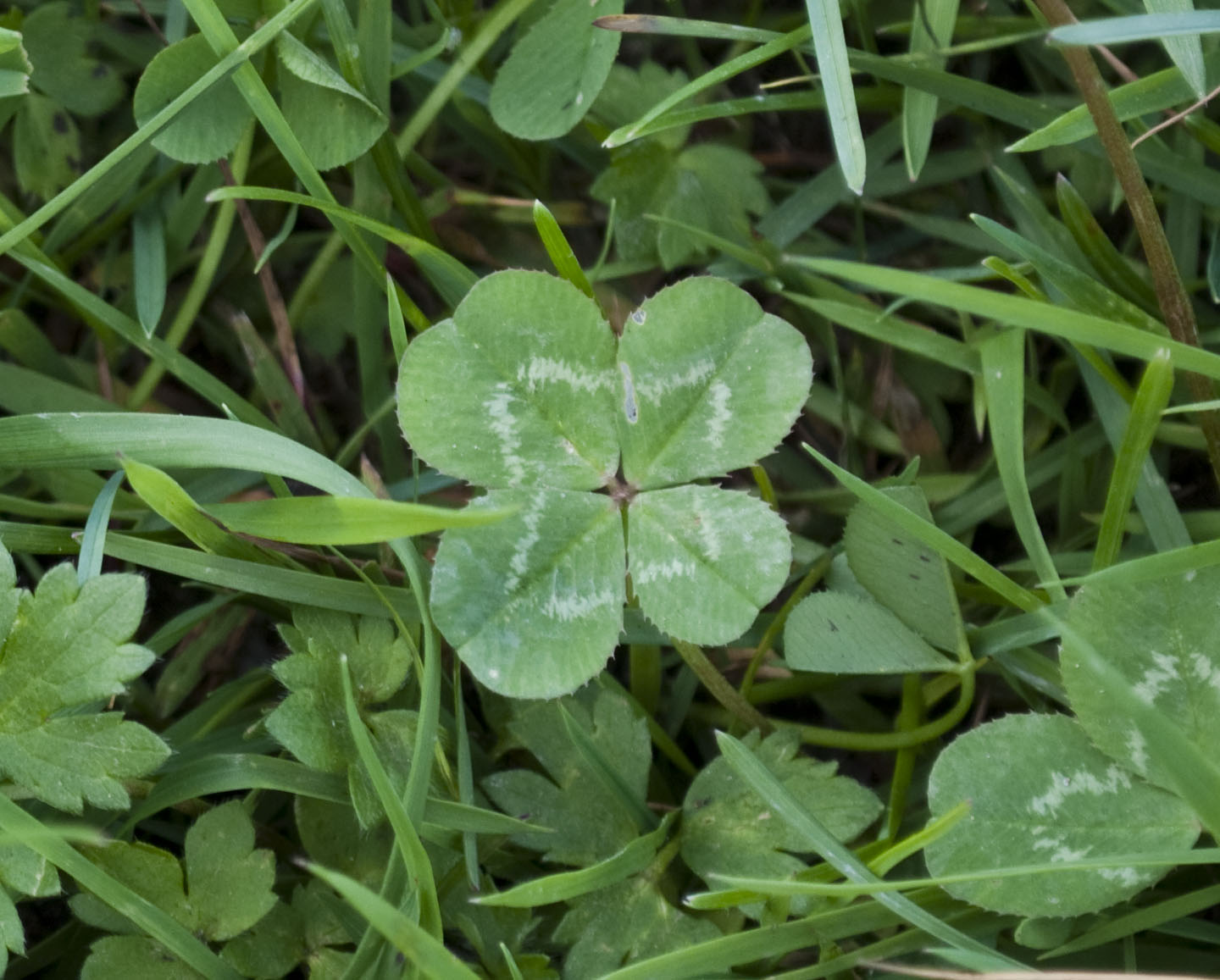
The four-leaf clover is a rare mutation of the common three-leaf clover that has four leaflets instead of three. According to traditional sayings, such clovers bring good luck,[1] a belief that dates back to at least the 17th century.[a]

The term four-leaf is botanically a misnomer, as cloverplants have multiple leaves (multiple clovers), each consisting of a varying number of leaflets, typically three.

Occurrence

[edit]

A 2017 survey of approximately 5.7 million clovers in six European countries found the frequency of 4-leaf clovers to be around 5000 to 1 (one 4-leaf clover for every 5076 normal 3-leaf clovers), almost twice the commonly stated probability of 10,000 to 1. According to this survey, the frequency of a 5-leaf clover is 24,390 to 1, and that of a 6-leaf clover is 312,500 to 1.[3]

A pressed-dried six-leaf clover from the species Trifolium repens L.

According to Guinness World Records, the clover with the most leaflets ever found had 63 of them, and was discovered by Yoshiharu Watanabe of Nasushiobara city, Tochigi prefecture, Japan, on 2 August 2023. The clover was from the species Trifolium repens L., or the white clover;[4] beating the previous record, a 56-leaf clover (of the same species) found by Shigeo Obara of Hanamaki city, Iwate prefecture, Japan, on 10 May 2009.[5][6] Both men obtained clovers with such a number of leafleats through crossbreeding clover plants with a high rate of clovers with an abnormal number of leaflets, causing that, on average, cloverplants generated clovers with a higher and higher number of leaflets in each generation. Shigeo Obara used the method of natural crossbreeding, while Yoshiharu Watanabe used both natural crossbreeding and manual crossbreeding.[7][8]

In 2019, American Gabriella Gerhardt set the record for collecting the most 4-leaf clovers in one hour by an individual (451). Previously, in 2018, she set the record for finding the most 4-leaf clovers in eight hours by an individual (887). On January 1, 2023, she certified two more records: the largest collection of 6-leaf clovers (1,437, surpassing the previous record of 43) and the largest collection of 7-leaf clovers (209, surpassing the previous record of 17). In 2023, she broke the record for the largest collection of 4-leaf clovers with 118,791, exceeding the previous record of 111,060 held by American Edward Martin.[9] In total Gabriella Gerhardt holds five Guinness World Records.[10][11][12][13][14]

As stated, clovers can have more than four leaflets. 5-leaf clovers are less commonly found naturally than 4-leaf clovers;[15][16] however, they too have been successfully cultivated.[17] Some 4-leaf clover collectors, particularly in Ireland, regard the 5-leaf clover, known as a rose clover, as a particular prize.[18]

A red clover (Trifolium pratense L.) with five leaflets

Cause

[edit]
A 4-leaf clover amongst others with three leaflets

It is debated whether the fourth leaflet is caused genetically or environmentally. Its relative rarity (1 in ~5,000 clovers[3]) suggests a possible recessive gene appearing at a low frequency. Alternatively, four-leaf clovers could be caused by somatic mutation or a developmental error of environmental causes. They could also be caused by the interaction of several genes that happen to segregate in the individual plant. It is possible all four explanations could apply to individual cases. This means that multiple four-leaf clovers could be found in the same cloverplant, and a cloverplant that already has a clover with an abnormal number of leaflets has a higher chance of growing or having another abnormal clover than a cloverplant that doesn't have any.[19]

Researchers from the University of Georgia have reported finding the gene that turns ordinary three-leaf clovers into the coveted four-leaf types. Masked by the three-leaf gene and strongly influenced by environmental conditions, molecular markers now make it possible to detect the presence of the gene for four-leaves and for breeders to work with it. The results of the study, which also located two other leaf traits in the white-clover genome, were reported in the July/August 2010 edition of Crop Science, published by the Crop Science Society of America.[20]

The other leaf traits, the red fleck mark and red midrib, a herringbone pattern that streaks down the center of each leaflet in a bold red color, were mapped to nearby locations, resolving a century-old question as to whether these leaf traits were controlled by one gene or two separate genes. White clover has many genes that affect leaflet color and shape, and the three in the study were very rare. These traits can be quite attractive, particularly if combined with others, and can turn clover into an ornamental plant for use in flower beds.[21]

A 5-leaf clover from the species Trifolium repens. Notice the slightly reddish or rusty coloration of the leaf.

According to an experiment made in 2019 by the, at that moment, 17-year old Minori Mori, from Tsukuba, Japan, four-leaf clovers seem to be more likely to appear in well-fertilized soil. Phosphates (a common ingredient in fertilizers) have been proved to play a role in the frequency of development of four-leaf clovers in cloverplants. A plant hormone called auxin, which plays an important role in plant development, has also been shown to increase the probability of mutations in clovers, especially the development of clovers with more than four leaflets. One study reportedly achieved clovers with five to eight leaflets (within a ten day span) using double of the regular dose of phosphate fertilizer and seeds from a cultivar that produces clovers with four leaflets more frequently. Auxin was also given to the plants with their water, with a concentration of 0.7%.[22]

There are reports of farms in the US which specialize in four-leaf clovers, producing as many as 10,000 a day (to be sealed in plastic as "lucky charms") by introducing a genetically engineered ingredient to the plants to encourage the aberration (there are, however, widely available cultivars that regularly produce leaves with multiple leaflets – see below).[23]

Multi-leaved cultivars

[edit]

There are some cultivars of white clover (Trifolium repens) which regularly produce more than three leaflets, including purple-leaved T. repens "Purpurascens Quadrifolium" and green-leaved T. repens "Quadrifolium".[24]

Some clovers have more spade-shaped leaves, rather than the usual rounded ones. This may be a genetic mutation. Some other genetic mutations in clovers include a rusty color on the leaves. Trifolium repens "Good Luck" is a cultivar which has three, four, or five green, dark-centered leaflets per leaf.[25]

Other species

[edit]

Other plants may be mistaken for, or misleadingly sold as, "4-leaf clovers"; for example, Oxalis tetraphylla is a species of wood sorrel with leaves resembling a 4-leaf clover.[26][27] Other species that have been sold as "4-leaf clovers" include Marsilea quadrifolia.[28][29]

As a good luck charm

[edit]

A description from 1869 says that 4-leaf clovers were "gathered at night-time during the full moon by sorceresses, who mixed it with vervain and other ingredients, while young girls in search of a token of perfect happiness made quest of the plant by day."[30] In an 1877 letter to St. Nicholas Magazine, an 11-year-old girl wrote, "Did the fairies ever whisper in your ear, that a 4-leaf clover brought good luck to the finder?"[31]

Symbolic usage

[edit]
4-leaf clover pictured in the coat of arms of Lääne-Nigula Parish
The 4-leaf clover is used as a symbol by multiple agrarian political parties in Northern and Eastern Europe

Meanings

[edit]

Some folk traditions assign a different attribute to each leaflet of a clover. The leaves have been used by Christians to represent hope, faith, love and luck.[41] Others say that 4-leaf clovers granted the power to see fairies.[42][43]

See also

[edit]

Notes

[edit]

References

[edit]
Revisions and contributorsEdit on WikipediaRead on Wikipedia
from Grokipedia
The four-leaf clover is a rare somatic mutation in the white clover plant (Trifolium repens), which typically produces trifoliate leaves consisting of three leaflets, resulting in an occasional quadrifoliate form with four leaflets per leaf. This variation arises from recessive genetic factors interacting with environmental influences, with the trait linked to specific genomic regions that suppress the default three-leaflet development. Estimates of its natural occurrence range from approximately one in 5,000 to one in 10,000 white clover plants, though the precise probability varies by location and conditions due to the mutation's heritability and expression. Culturally, the four-leaf clover has been associated with good fortune since at least the 17th century, particularly in Irish and broader European folklore, where the four leaves are often interpreted as representing faith, hope, love, and luck—though this attribution stems from later Christian symbolism rather than ancient Druidic origins. Despite its rarity and symbolic appeal, no empirical evidence supports claims of supernatural luck, positioning it as a product of observable biological anomaly rather than causal mysticism.

Botanical and Genetic Foundations

Definition and Basic Morphology

The four-leaf clover is a rare variant of the white clover species , a herbaceous legume in the family, distinguished by leaves bearing four leaflets rather than the typical three. This occurs somatically during leaf development, affecting individual leaves or sectors of the plant without altering the . Trifolium repens exhibits a prostrate growth habit, forming dense mats through stoloniferous stems that root at nodes, with erect flowering stems rising 5–25 cm high. Leaves are alternate, long-petiolate, and palmately compound, with leaflets that are obovate to elliptical, 8–20 mm long, and finely serrate along the margins; many bear a distinctive pale V-shaped or chevron mark near the base. In the four-leaf form, the additional leaflet arises from the same petiole, mirroring the shape, size, and venation of the others, though occasionally smaller or asymmetrically positioned. The plant's inflorescences consist of globular heads of 20–100 sessile, white to pinkish flowers on axillary peduncles.

Occurrence, Rarity, and Environmental Factors

The four-leaf clover occurs predominantly as a somatic mutation in Trifolium repens, the white clover, a species native to Europe and naturalized in temperate grasslands, lawns, and pastures worldwide where conditions favor its growth. In wild populations, quadrifoliate (four-leaved) plants appear sporadically within typical trifoliate stands, with observed frequencies varying by locale but generally low due to the recessive or mutable nature of the underlying genetics. Estimates of rarity in natural settings place the probability at approximately 1 in 10,000 white clover plants exhibiting four leaves, though some analyses of large samples suggest slightly higher rates, such as 1 in 5,076 based on examinations of millions of specimens across European sites. This variation underscores that local and microhabitat differences can influence detection rates, with higher concentrations occasionally reported in certain fields without artificial selection. Expression of the four-leaf depends not only on but also on environmental modulators, including and photoperiod. Research demonstrates that four-leaved stems are roughly twice as common under warm summer conditions compared to winter outdoors, with environments mitigating cold-induced suppression. Warmer s and sufficient daylight enhance leaf primordia development, increasing the likelihood of multifoliate outcomes, while suboptimal cues like cold or short days can prevent trait manifestation even in predisposed genotypes. Although factors such as or mild stressors have been hypothesized to promote mutations, empirical support remains limited primarily to correlative observations rather than controlled causation.

Genetic Mechanisms and Causes

The quadrifoliate in Trifolium repens, the white clover species most commonly exhibiting four-leaf clovers, results from rare somatic mutations or recessive genetic variants that alter leaflet formation during early leaf development in the shoot apical meristem. These mutations disrupt the standard trifoliate pattern, leading to an extra leaflet, and occur at a frequency of approximately 1 in 5,000 to 10,000 plants in natural populations. Due to T. repens' allotetraploid genome (2n=4x=32 chromosomes, derived from hybridization of ancestral diploids), inheritance deviates from simple Mendelian patterns, involving multiple alleles across homeologous chromosomes and requiring homozygosity at key loci for stable expression. Molecular studies have identified quantitative trait loci (QTLs) influencing leaflet number, with genetic mapping in segregating populations revealing clusters on specific linkage groups correlated with multifoliate traits. Induced , such as 60Co gamma-ray irradiation, has generated stable four-leaf lines demonstrating partial (around 60% ), confirming a polygenic basis potentially involving regulatory s like class I KNOX homologs that control activity and leaf complexity, though no single causative has been definitively isolated. Epigenetic modifications and activity may contribute to variable expressivity and chimeric sectors, where multifoliate leaves revert or coexist with trifoliate ones on the same plant. Environmental factors interact with these genetic predispositions, enhancing rates or trait expression; for instance, warmer temperatures (e.g., summer conditions versus winter) double the incidence of four-leaf stems by suppressing a three-leaf-promoting , as observed in controlled trials with 178 . Somatic mutations predominate in wild settings, yielding non-heritable chimeras, whereas transmission enables propagation of true-breeding lines through . This interplay underscores the trait's evolutionary rarity, as buffers against deleterious effects but limits fixation without human intervention.

Variations and Cultivation

Multi-Leaved Mutations and Records

Multi-leaved clovers, featuring five or more leaflets per petiole in Trifolium repens, arise from somatic mutations or recessive genetic variations that disrupt the typical trifoliate structure, extending the four-leaflet phenotype to produce additional leaflets. These mutations often involve alterations in genes regulating leaflet number, such as those inhibiting development, with heritability demonstrated in mutagenized populations where four-leaf expression reached approximately 60%. Such variants occur at frequencies far lower than four-leaf clovers, estimated at 1 in millions for five-leaf forms in wild populations, due to the cumulative rarity of multiple genetic events or environmental triggers like soil chemistry and . Records for the highest leaflet counts on a single clover stem have been documented and verified by , primarily from cultivated specimens in . The current record stands at 63 leaflets, achieved by Yoshiharu in 2024 through selective cross-pollination of strains, surpassing the prior mark of 56 leaflets set by Shigeo Obara in 2009. Earlier notable finds include a 14-leaflet clover reported in 2010 from , confirmed botanically but not a . These extreme multi-leaved forms typically exhibit clustered leaflets radiating from a central petiole, though viability decreases with higher counts, often resulting in smaller or deformed leaflets. Verification of records relies on photographic and physical evidence submitted to , emphasizing natural or minimally induced rather than artificial manipulation, though cross-breeding from parents is permitted. No peer-reviewed studies quantify the genetic upper limit, but allotetraploidy in T. repens—with four sets—facilitates such polyphenic expressions under stress or mutagenic conditions. Claims of higher counts, such as unverified reports exceeding 100 leaflets, lack independent confirmation and are dismissed due to absence of botanical validation.

Developed Cultivars and Breeding Efforts

In 2010, researchers at the and the Samuel Roberts Noble Foundation identified a specific variant in that suppresses the default three-leaflet form, enabling the development of four-leaf traits through targeted breeding rather than relying solely on rare spontaneous mutations. This discovery, published in Crop Science, provided genetic markers for selecting plants with higher propensities for four leaflets, facilitating ornamental breeding programs despite the trait's polygenic and environmentally influenced inheritance. Mutation induction techniques have yielded notable cultivars. Korean researchers developed "Jeju Lucky-1" (also denoted JL-1) via chemical and , resulting in plants producing four-leaflet leaves in approximately 60% of cases compared to 40% three-leaflet, with the variety maintained through vegetative propagation due to its instability in seed reproduction. Similarly, a U.S. describes the "Lucky Together" , bred by treating sterilized stolons of wild-type white clover with ethyl methane sulfonate (0.1-0.3 μg/L) and growth regulators like , followed by five generations of propagation; this annual variety features uniform four heart-shaped light-green leaflets (0.3-2.5 cm), rapid growth under high light, and enhanced soil-improving qualities. Breeding efforts at institutions like the continue to focus on ornamental T. repens lines incorporating four-leaf traits alongside traits such as red leaf markings and altered flower colors, using under controlled conditions like LED lighting to enhance mutation stability. These approaches prioritize vegetative spread over seed-based fixation, as the four-leaf often reverts in progeny due to recessive and somatic instability, limiting large-scale agricultural adoption beyond novelty markets. No widely commercialized cultivars exist, as higher leaflet counts do not consistently confer agronomic benefits like improved protein content without trade-offs in vigor.

Comparisons with Other Clover Species

The four-leaf mutation primarily manifests in white clover (Trifolium repens), a stoloniferous with creeping stems and trifoliolate leaves featuring V-shaped white leaf marks, where additional leaflets arise sporadically at frequencies estimated between 1 in 5,000 and 1 in 10,000 plants depending on environmental and genetic factors. In comparison, red clover (), an upright biennial or short-lived used extensively in , also produces trifoliate leaves but with ovate to elliptic leaflets lacking the distinctive white marks common in T. repens; four-leaf variants occur but at lower natural rates, attributed to differing polygenic controls over leaflet number. Morphological differences further distinguish the species: T. repens stipules are lanceolate and fused to the petiole base, enabling its prostrate growth in lawns and pastures, whereas T. pratense has triangular stipules and denser flower heads, adapting it to hay production rather than turf. Other Trifolium species, such as alsike clover (Trifolium hybridum), exhibit similar baseline trifoliate morphology with long-petioled leaves but show even rarer multifoliolate expressions, with genetic studies highlighting that leaflet proliferation in the genus generally stems from somatic mutations or recessive alleles disrupting activity, most readily observable and heritable in T. repens. Unlike T. repens, where has yielded cultivars with up to 60% four-leaf expression, T. pratense breeding focuses less on leaf mutations due to its primary agronomic value in and pollinator support, resulting in fewer documented stable variants. These interspecies variations underscore that while the four-leaf trait is not unique to white clover, its prevalence and cultural prominence derive from T. repens's ubiquity in human-altered habitats like mowed fields, where mutations persist clonally via stolons.

Cultural History and Symbolism

Ancient and Historical Origins

The purported ancient origins of the four-leaf clover's symbolic significance are rooted in unverified folklore attributing its use to Celtic Druids, who allegedly carried it as a charm against evil spirits and to enable vision of fairies due to its rarity compared to the common three-leaf variety. These claims lack substantiation from primary ancient sources, such as Druidic texts or artifacts, and appear to stem from 19th-century romantic interpretations of pre-Christian Celtic practices rather than empirical historical records. Similarly, legends linking the four-leaf clover to biblical times—such as Eve carrying one from the as a token of paradise—circulate in European oral traditions but find no support in scriptural or archaeological evidence, functioning more as moral allegories than historical fact. Claims of its use in for marital blessings among newlyweds also derive from anecdotal retellings without corroboration from Egyptian records or papyri. The earliest verifiable written reference to the four-leaf clover conferring good luck appears in 1620, in English writer Sir John Melton's Astrologaster, where he noted: "If a man walking in the fields finds any four-leafed grass, he shall in a small while after find some good thing." This early modern attestation marks the superstition's emergence in documented literature, predating its widespread association with Irish identity. By the 17th and 18th centuries, the motif persisted in European agronomic and folk texts, with symbolizing rare fortune amid abundant fields, though it remained distinct from the three-leaf shamrock's Christian trinitarian symbolism introduced by around 432 CE. Historical herbal compendia, such as those by 16th-century botanists like William Turner, describe clover variants but omit attributions, indicating the belief crystallized post-medievally through oral rather than scholarly or ecclesiastical endorsement.

Symbolic Meanings Across Cultures

In Celtic folklore, the four-leaf clover held protective qualities, with ancient Druids reportedly carrying it as a charm to ward off evil spirits and enhance , viewing its rarity as a sign of divine favor. Each leaf traditionally represented one of four virtues: , and , a attribution persisting in Irish cultural narratives despite the clover's botanical distinction from the three-leaf used by St. Patrick to illustrate the Holy Trinity. This symbolism emphasized harmony with nature and intervention, as evidenced in pre-Christian Celtic practices where clovers were gathered to attract benevolent fairies or ensure safe passage through enchanted realms. Beyond Celtic regions, the four-leaf clover's association with good fortune extended into broader European traditions by the 17th century, where it symbolized and in agrarian societies reliant on natural omens. In some accounts of ancient Egyptian customs, priests allegedly presented four-leaf clovers to newlywed couples as tokens of eternal love and , though such claims lack corroboration from primary archaeological sources and may reflect later interpretive rather than direct historical evidence. Similarly, in modern Japanese contexts, the motif has been adopted as a emblem, often through Western rather than indigenous , appearing in media and consumer products to denote rarity and positive outcomes. Cross-cultural adoption remains limited, with no substantial pre-colonial evidence in Native American or Asian societies predating European contact; instead, the clover's symbolism aligns primarily with temperate-zone European herbalism and Christian-infused pagan remnants, underscoring its role as a localized rather than a universal . Attributions in non-Western contexts often stem from 20th-century globalization, such as commercialization via exports, highlighting how empirical rarity—occurring in approximately 1 in clovers—fuels perceptual value over inherent constancy.

Adoption as a Good Luck Charm

The association of the four-leaf clover with good luck originated in ancient Celtic traditions, where Druids regarded it as a protective charm capable of warding off evil spirits and revealing invisible fairies to those who carried it. This belief positioned the rare mutation as a talisman for fortune, with its scarcity—occurring in approximately 1 in 5,000 to 10,000 clovers—enhancing its perceived mystical value among early practitioners. By the , the had formalized in , with traditional sayings explicitly linking the four leaves to good luck, though precise documentation of the earliest written references remains elusive. In Ireland, where white clover (Trifolium repens) is native, the symbol gained prominence centuries ago, evolving to represent , and luck or success in its four leaflets—a reinterpretation that blended pre-Christian lore with Christian virtues. Unlike the three-leaved tied to , the four-leaf variant emerged independently as a broader of , not specifically Irish national identity. The charm's adoption spread beyond Celtic regions through 19th-century and , where it symbolized and protection, evidenced by its use in personal talismans and decorative motifs. Soldiers during carried pressed four-leaf clovers as amulets for survival, illustrating practical integration into modern contexts despite lacking empirical basis for efficacy. This enduring appeal persists in contemporary customs, such as pressing found specimens for preservation, though historical claims of ancient Egyptian or universal pre-Celtic origins lack substantiated primary evidence and appear as later embellishments.

Superstitions, Commercialization, and Scientific Scrutiny

Traditional Beliefs and Folklore

The belief that finding a four-leaf clover confers good luck has persisted in since at least the , with earlier possible roots in Celtic traditions, though definitive ancient evidence remains elusive. In traditional accounts, the rarity of the —estimated at approximately one in 10,000 clovers—contributed to its mystique, symbolizing fortune for the finder. Proponents of the often attribute protective qualities to it, claiming possession wards off spirits or misfortune. Medieval , particularly in Irish and broader European contexts, expanded these ideas, asserting that a four-leaf clover granted the ability to detect invisible fairies, identify witches, or reveal hidden demons. This protective role aligned with Druidic practices, where clovers were reportedly used in rituals to avert harm, though such claims lack primary ancient texts and may reflect later romanticized interpretations rather than verifiable historical records. By the , poetic traditions formalized symbolic meanings for the leaves: , and , reinforcing its status as a carried for personal prosperity or safe travels. These beliefs influenced customs like pressing found clovers in books for preservation or gifting them as charms, practices documented in 19th-century European accounts but predating widespread commercialization. Despite the absence of empirical validation—later scrutinized scientifically for genetic rather than causes—such underscores a cultural of ascribing rarity to divine or fateful intervention, unmarred by institutional reinterpretations.

Empirical Debunking of Luck Claims

The rarity of four-leaf clovers, occurring in approximately 1 in 5,000 to 10,000 white clover (Trifolium repens) plants, arises from recessive genetic or somatic cell variations during leaf development, influenced by both genetic and environmental factors such as conditions and temperature. These do not confer any adaptive advantage or property but represent natural deviations from the typical three-leaf structure, with no evidence of a mechanism linking them to probabilistic advantages in human affairs. Claims of originating from Druidic or Celtic folklore lack empirical validation, as the perceived fortune aligns instead with baseline randomness in life events, unaffected by possession of the plant. No peer-reviewed studies establish a statistical between finding or carrying four-leaf clovers and measurable improvements in outcomes like financial success, health, or accident avoidance; the absence of such data, despite widespread cultural belief, indicates the effect is illusory rather than causal. Attributions of often stem from , where finders disproportionately recall subsequent positive coincidences while disregarding negatives, a cognitive documented in on superstitions. Additionally, the skill of spotting four-leaf clovers—honed through familiarity with leaf and targeted searching in dense patches—elevates perceived , as probability models show that initial discoveries cluster due to localized genetic expression, not mystical intervention. Controlled tests of , including plant-based talismans, consistently yield null results beyond placebo-driven confidence boosts, with meta-analyses confirming no replicable impact on random events or under uncertainty. The persistence of myths reflects cultural transmission rather than evidentiary support, as first-hand accounts remain anecdotal and fail under scrutiny for selection effects, such as increased searching after a find amplifying further discoveries in the same area.

Modern Commercial Uses and Misrepresentations

Four-leaf clovers are extensively marketed in jewelry and accessories as emblems of , with products including pendants, charms for bracelets and necklaces, and dangle earrings featuring accents sold by major retailers. Preserved genuine specimens from white clover () are laminated and offered as souvenirs, often accompanied by certificates of authenticity to verify their rarity as natural mutations. In , the four-leaf clover appears in to symbolize fortune, as seen in the Lucky Brand clothing company's emblem, which centers a stylized four-leaf to align with its name and appeal to consumers seeking auspicious associations. The motif also features in promotional items like keyrings and custom apparel, capitalizing on its cultural cachet for events such as celebrations. A prevalent misrepresentation involves conflating the four-leaf clover with the shamrock in Irish-themed merchandise, despite the shamrock being a three-leaf variety—typically white clover—symbolizing the Christian Holy Trinity and linked to St. Patrick since the 5th century, whereas the four-leaf form represents through its genetic aberration occurring in approximately 1 in 10,000 . This error persists in , exemplified by Guinness's 2016 St. Patrick's Day campaigns, which substituted a four-leaf clover for the traditional shamrock, prompting public backlash for cultural inaccuracy. Commercially sold "four-leaf clovers" frequently deviate from authentic mutations, with artificial faux versions crafted from plastic or other materials marketed for decor without disclosing their synthetic nature, thus exploiting the symbol's rarity for profit. Some preserved items purported as genuine may originate from non-clover species like or involve manual alteration, undermining claims of natural luck-conferring properties that lack empirical support beyond . Such practices prioritize sales over botanical fidelity, as verified real four-leaf clovers require specific genetic conditions rather than common fabrication techniques.

References

Add your contribution
Related Hubs
User Avatar
No comments yet.