Hubbry Logo
Frangible bulletFrangible bulletMain
Open search
Frangible bullet
Community hub
Frangible bullet
logo
8 pages, 0 posts
0 subscribers
Be the first to start a discussion here.
Frangible bullet
Frangible bullet
from Wikipedia
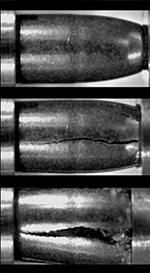
A sequence of photos showing a frangible bullet fracturing when subjected to high velocity strain waves

Frangible bullets are intended to disintegrate into tiny particles upon target impact to minimize their penetration of other objects. Small particles are slowed more rapidly by air resistance, and are less likely to cause injury or damage to persons and objects distant from the point of bullet impact.

Most frangible bullets are subject to brittle failure upon striking a hard target. This mechanism has been used to minimize the tendency of malleable lead and copper bullets to ricochet from hard targets as large, cohesive particles. Brittle failure may occur at subsonic velocity. Attempting to crimp a brittle frangible bullet into the cartridge case may break the bullet.[1] Brittle frangible bullets may break during the self-loading cycle of semi-automatic firearms;[2] and those fired from revolvers often break as the bullet encounters the barrel forcing cone after leaving the cylinder.[3]

Manufacturing

[edit]
Frangible bullets may be lighter or longer than conventional bullets of the same calibre. The jacketed frangible bullet in the centre is longer than the outer soft-point bullets with traditional lead cores. Each of the three .30 calibre (7.62 mm) bullets weighs 150 grains (9.7 g) but the lower density frangible core requires greater volume.

Powder metallurgy techniques fabricate bullets from mixtures of powdered metals such as tin, copper, zinc and tungsten compressed at room temperature to produce a high-density material. Mechanical interlocking and cold welding bond the metal powders together such that they can be pressed directly to shape, or into bar stock that can be swaged into projectiles, with or without jacketing.[4]

Alternative manufacturing techniques include sintering (heating and compressing powdered metals at temperatures below the melting point), or binding the powdered metal with an adhesive polymer in an injection moulding machine.[5]

Target damage

[edit]

The mechanism of bullet disintegration varies with the energy transfer at the time of impact. With sufficient velocity, bullets may be vaporized upon impact. Few firearms can propel bullets at sufficient velocity to cause reliable vaporization at the target, and air resistance causes bullet velocity to decrease with increasing distance from the firing point; so frangible bullets typically rely upon other mechanisms for disintegration at lower velocities. Target characteristics are an important aspect of interaction with the bullet. Energy available to initiate the disintegration mechanism is limited by the rate at which the target slows the bullet; so bullets may pass through flexible, fragile or low-density materials without slowing the bullet enough to cause disintegration. Bullets must resist disintegration during handling, loading, and firing to reliably hit the target; so high-velocity loads may require a non-frangible jacket to protect a frangible core from disintegration prior to target impact. The jacket may ricochet, but should have reduced range without the weight of the frangible core.[5] Frangible hollow-point bullets may penetrate clothing, drywall, and light sheet metal; but often disintegrate upon striking glass.[6]

Hard targets may be damaged by frangible bullets. Extent of damage increases with velocity of bullet impact. Energy transfer at the point of impact may break brittle targets, and may temporarily soften and permanently deform malleable materials. Target crystalline structure may be changed to increase target damage by subsequent bullets. Steel targets designed to withstand rifle ammunition may be damaged by bullet velocities over 2,700 feet (820 m) per second; and lower velocity bullets may damage steel targets intended for pistol or rimfire ammunition.[5]

Frangible bullets striking animal targets create wounds similar to conventional bullets.[7] Some penetrate soft tissue similar to full metal jacket bullets. Some may disintegrate upon striking bone. Hunting bullets include a frangible core designed to disintegrate when a protective jacket is opened by softer tissue or fluid.[8] Frangible bullets disintegrating in flesh cause very serious wounds with persistent effects.[9]

Frangible bullets may represent an unconventional threat to personal armour intended to resist traditional lead bullets. At the request of the National Institute of Justice, staff of the Office of Law Enforcement Standards, located at the National Institute of Standards and Technology, has conducted a limited series of tests evaluating the performance of frangible ammunition against body armor. This preliminary study was designed to attempt to establish the validity of claims that these types of rounds pose a potential safety threat to personal body armor. The true scope and relevance of this threat was not known as of November 2002.[4]

Uses

[edit]

Frangible bullets offer improved safety for specialized combat simulation training, which involves one or more shooters engaging multiple steel targets from various directions while moving through a 360 degree range, due to the decreased risk of ricochet, overpenetration, as well as decreasing lead exposure.[3][4] Frangible bullets are also used in reduced ricochet, limited penetration (RRLP) loads intended to reduce risk to friendly forces and innocent persons during close quarters military or police actions in urban areas, aboard ships or aircraft, or in hazardous material environments like oil platforms and chemical or nuclear plants.[4]

History

[edit]

Injuries from lead bullet fragments ricocheting off metal targets at 20th-century amusement park shooting galleries encouraged development of frangible bullets in specialized .22 Short gallery loads including Peters Krumble Ball, Remington Spatter-Less, Western Kant-Splash, and Winchester Spatterpruf.[10] The United States used frangible lead/Bakelite M22 bullets in aircraft .30 caliber machine guns for target practice at armored RP-63 manned target aircraft.[11] The lower density M22 bullets were of the same shape as conventional M2 bullets for reliable function through self-loading machine guns, but weighed only 110 grains (7.1 g) in comparison to 152 grains (9.8 g) for the M2 bullets.[12]

In the early 21st-century, the United States military began using frangible bullets to reduce ricochet risk during small arms training. These bullets use nylon as a binding agent for a core of powdered copper and tungsten contained within a gilding metal jacket.[13] A tungsten/nylon projectile core was developed by Ecomass Technologies to replace the lead core in the 3-part M855 5.56mm projectile and placed in service between 2000 and 2003. This projectile core performed similar to the lead core with the same, or better, accuracy.

References

[edit]
Revisions and contributorsEdit on WikipediaRead on Wikipedia
from Grokipedia
A frangible bullet is a specialized type of engineered to disintegrate into small particles or powder upon striking a hard surface, thereby reducing the risks of and excessive penetration. These bullets are typically manufactured from compressed powders of metals like , tin, or alloys, often bound with adhesives or formed through processes, which allow them to maintain structural integrity during firing but shatter on impact. Unlike conventional lead-core bullets jacketed in , frangible designs prioritize safety in controlled environments by producing low-mass fragments with minimal residual energy. The concept of frangible ammunition originated in the 1930s for use in shooting galleries, where injuries prompted the development of .22-caliber rounds that broke apart on impact. Modern frangible bullets trace their widespread adoption to the , with the introduction of the in 1974 by Glaser Safety Slug, Inc., specifically for and hostage rescue scenarios requiring reduced over-penetration. Further advancements in the and 1990s, including non-toxic variants like the tin-tungsten "" developed by the Interagency , addressed environmental concerns over lead contamination in training ranges. By the early 2000s, copper-based, lead-free frangible ammunition became standard in military and applications, driven by health and ecological regulations. Frangible bullets are primarily employed for training purposes in indoor or close-quarters settings, such as military close-quarters battle (CQB) exercises, operations, and recreational shooting at steel targets, where their fragmentation minimizes hazards to bystanders and infrastructure. They are available in common calibers like 9mm, , 5.56mm, and , often as cost-effective alternatives to standard rounds for high-volume practice. While effective for reducing —producing no measurable bearing surface after impact—their limited makes them unsuitable for most or applications, where deeper tissue damage is required. Ongoing research focuses on enhancing their ballistic performance and environmental safety, particularly in lead-free compositions to mitigate airborne particle exposure during firing.

Definition and Principles

Definition

A frangible bullet is a type of engineered to disintegrate into small particles or powder upon impacting a hard or semi-hard target, with the primary purpose of minimizing and reducing the risk of . This design ensures that the bullet breaks apart rather than remaining intact or deforming, thereby limiting its ability to pass through barriers or cause unintended secondary impacts. Key characteristics of frangible bullets include a non-deforming structure that prioritizes shattering over expansion or penetration, distinguishing them from other ammunition types such as (FMJ) bullets, which are built for deep penetration and target passage, or hollow-point bullets, which expand upon impact to increase . Unlike FMJ rounds that maintain integrity for reliable feeding and over-penetration in various scenarios, or hollow points that mushroom to transfer energy efficiently in , frangibles fragment to enhance safety in controlled environments. Frangible bullets are available in a range of common calibers suitable for firearms from handguns to rifles, including 9mm for pistols, .223/5.56mm for intermediate rifles, and .308 for larger platforms. These variants maintain standard ballistic profiles during flight but achieve their fragmentation effect upon target contact.

Principles of Operation

Frangible bullets achieve their intended function through a mechanism of controlled disintegration, relying on the brittle properties and engineered internal stress points within the . Upon striking a , the bullet's exceeds the tensile strength of the binding matrix, causing rapid fragmentation into small particles rather than deforming or penetrating intact. This process is driven by the 's low , where weak inter-particle bonds—often formed during compression of metal powders—fail under the sudden application of force, leading to shear and breakup. The underlying physics involves the efficient transfer of the bullet's during impact, which initiates brittle failure as opposed to the deformation typical of jacketed lead bullets. Shockwaves propagate through the brittle structure, propagating fractures along predetermined weak planes and redistributing to create numerous low-mass fragments. These fragments rapidly decelerate due to their reduced size and mass, minimizing secondary penetration or risks while still delivering initial impact . Several factors influence the reliability of this fragmentation process. The minimum impact velocity required for reliable fragmentation varies by and ; for example, some frangible bullets like the achieve reliable disintegration at velocities below 1,000 fps (305 m/s), while higher velocities ensure more complete breakup in rifle s. These thresholds vary significantly with the bullet's composition and intended ; sintered metal powders often require higher velocities for complete disintegration compared to polymer-matrix designs. The angle of impact affects the distribution of forces, with perpendicular strikes promoting more uniform disintegration, while oblique angles can lead to partial fragmentation. Target surface hardness is equally important; optimal performance is observed on rigid s like or , where the abrupt deceleration maximizes stress, whereas softer media such as or tissue may result in incomplete breakup due to energy absorption without sufficient resistance. Conceptually, the bullet's internal structure can be visualized as a compressed aggregate of fine particles, such as metal powders, held by minimal cohesive forces that act as predefined points. Under impact loading, these bonds shear sequentially, converting the projectile's integrity into a of dispersed fragments that lose coherence almost immediately.

Manufacturing and Materials

Production Methods

Frangible bullets are primarily produced using techniques, particularly , which allows for the creation of brittle, porous structures that fragment upon impact without fully melting the materials. This process begins with the mixing of fine metal powders, such as and tin, to achieve the desired composition and ensure uniform distribution. The powders are then compacted into bullet-shaped molds under , typically ranging from 400 to 600 MPa (equivalent to approximately 30 to 45 tons per ), to form a compact with sufficient for handling, often around 7.5 to 8.5 g/cm³. Following compaction, the green compacts undergo in a , such as , at temperatures between 260°C and 900°C (approximately 500°F to 1,650°F) for 30 minutes to 1 hour, depending on the ; lower temperatures around 260–300°C are common for copper-tin s to form brittle phases like Cu₃Sn without excessive softening. This heating step fuses the particles at their contact points, enhancing strength while maintaining that promotes . An optional coating, such as with polymers or lubricants, may be applied post- to improve handling, feeding in firearms, and environmental stability. Alternative production methods include composite formation through binding, where metal powders are blended with binders and processed via injection molding or thermal extrusion to create lead-free variants that disintegrate on impact. For environmentally focused options, lead-free variants often use powder compaction and of non-toxic alloys, such as or composites, to achieve controlled brittleness. Quality control in frangible bullet production emphasizes to verify fragmentation at targeted impact energies, typically 50–200 ft-lbs, while ensuring structural integrity during barrel passage to prevent premature breakup; this involves compression, drop-weight, or ballistic impact simulations on sample lots.

Materials and Composition

Frangible bullets are primarily constructed from sintered metal powders to achieve their characteristic disintegration upon impact, avoiding traditional lead cores due to environmental and health concerns associated with lead toxicity. Common core materials include powdered copper, tin, tungsten, often formulated as alloys such as a 90% copper and 10% tin bronze to provide sufficient density while maintaining frangibility. These powders are compressed and sintered, forming a brittle structure without the ductility of lead. Composition varies between pure metal formulations and composites that incorporate binders for enhanced cohesion during handling and firing. Pure metal frangibles rely on high-purity copper-tin or copper-tungsten powders, while composites may include or binders to stabilize the powder matrix, typically comprising less than 1% by weight of the total material. Density ranges from 7.0 to 8.5 g/cm³ across these variations, approximating the ballistic behavior of standard while remaining lower than lead's 11.3 g/cm³ to prioritize shatter properties. Lead-free adaptations emphasize non-toxic alternatives like or alloys, often combined with tin to mitigate excessive brittleness in bismuth formulations. Recent advancements include advanced polymer-metal composites for improved environmental safety in lead-free variants (as of 2024). These options, such as zinc-tin composites, support use in indoor environments by eliminating lead vapor and residue that could pose respiratory risks. Key material properties include high with low , enabling fragmentation rather than deformation, and controlled of 10-20% that facilitates energy absorption and crack upon impact. is tailored, often reaching values around 94 HRF in copper-tin alloys, to ensure structural integrity in the barrel while shattering at targeted thresholds.

Ballistics and Performance

Terminal Ballistics

Frangible bullets demonstrate distinct due to their design, which promotes rapid disintegration upon impact to limit penetration and collateral effects. When striking hard targets, such as or , these projectiles fragment into numerous small particles, often with sizes under 1 mm, occurring within 1-2 inches of initial contact; this behavior is quantified through factors that measure the proportion of impact used for disintegration, with higher factors indicating more complete breakup. In simulations of soft tissue, penetration depths are significantly reduced compared to (FMJ) rounds, typically achieving less than 6 inches for high-velocity examples like .223 Remington frangibles, versus over 12 inches for conventional FMJ . For instance, certain .223 frangible soft-point loads "explode" after 2-3 inches in gel, creating extensive temporary and permanent channels through fragment dispersion. On soft targets mimicking human tissue, frangible bullets generate temporary cavities via the radial spread of fragments, which shred internal structures and often result in no exit wounds, as observed in gel tests where the projectile expends its energy internally without over-penetration. Against hard barriers like steel plates or walls, fragmentation leads to minimal ricochet risk, as the bullet's energy is largely dissipated through breakup rather than rebound, enhancing safety in confined environments. Over-penetration risk is notably lower than with standard rounds, with gel tests showing frangible loads like Sinterfire .380 ACP achieving averages of about 11 inches while fragments halt shortly after, compared to deeper FMJ trajectories. Testing adheres to standards such as FBI ballistic gelatin protocols (10% ordnance gelatin at 10°C), which reveal irregular wound channels from fragment paths rather than uniform bullet tracks; these protocols emphasize penetration consistency and cavity formation, though frangibles often fall below the 12-18 inch ideal due to their design. Post-impact, fragments experience rapid velocity decay, slowing rapidly due to increased drag on small particles, often reaching low velocities (under 300 fps) within inches, limiting their range and lethality beyond the target. Performance varies by caliber, with higher-velocity rounds like .223/5.56 mm exhibiting more complete fragmentation and powdering than lower-velocity calibers such as 9 mm, where a Mann-Whitney U-test on cranial impacts confirmed significantly greater fragment count for 5.56 mm (p=0.002). This velocity-dependent behavior stems from increased promoting finer breakup in rounds, while 9 mm frangibles may retain larger chunks in softer media.

Advantages and Limitations

Frangible bullets offer several key advantages, particularly in safety-critical environments. Their design promotes disintegration upon impact with hard surfaces, significantly reducing the risk of compared to traditional (FMJ) rounds, making them suitable for indoor shooting ranges and close-quarters training. This fragmentation also minimizes over-penetration in soft targets, lowering the potential for in urban or home defense scenarios where bystanders may be present. Additionally, many frangible bullets are lead-free, composed of compressed metal powders like or tin, which aids environmental compliance by reducing toxic residue and lead exposure during use. These properties lower barriers to safe training on steel targets, as the bullets break apart without excessive splash-back or rebound. Despite these benefits, frangible bullets have notable limitations that affect their versatility. They are typically 2-3 times more expensive than standard FMJ due to specialized processes involving powdered metals and binders, which can limit accessibility for frequent . In soft targets, frangible bullets often exhibit inconsistent , as they fragment without the expansion seen in hollow-point designs, potentially requiring multiple hits for incapacitation. Their effectiveness diminishes against armored threats, where most soft and hard rated for calibers stops frangible rounds as readily as conventional , due to the lack of . At distances greater than 50 yards, the lighter weight and tendency to disintegrate reduce accuracy and terminal performance, rendering them unsuitable for long-range applications. Comparative ballistic data highlights these trade-offs. Frangible bullets pose significantly less risk of over-penetration than FMJ rounds in simulations, as fragments lack the to traverse barriers like walls or bodies fully. However, tissue simulations indicate lower energy transfer to soft targets compared to expanding projectiles, due to rapid fragmentation that dissipates superficially rather than through deeper channels. Ballistic test results, such as those in 10% ordnance , confirm frangibles achieve adequate penetration for close-range threats but underperform in scenarios requiring sustained . To mitigate these limitations, users can pair frangible bullets with firearms optimized for lighter projectiles, such as those with adjusted springs, or opt for hybrid loads that balance fragmentation with controlled expansion for improved reliability in varied conditions.

Applications

and Range Use

Frangible bullets are primarily employed in indoor and close-quarters environments to minimize damage to backstops and range infrastructure. By disintegrating upon impact with hard surfaces, these projectiles reduce penetration risks, allowing safe use in confined spaces like shoot houses or ranges without compromising structural . This design also enables engagement of plate targets at reduced distances, eliminating spalling and hazards that could endanger shooters or bystanders. In practice sessions, frangible supports high-volume firing by incorporating lead-free compositions, thereby limiting shooter exposure to airborne lead particles and environmental contamination in enclosed ranges. Additionally, their reduced residue production makes them highly compatible with suppressors, decreasing and maintenance needs during extended drills. Military units adopt frangible rounds, such as the 5.56mm M1037 Short Range Training Ammunition (SRTA), for simulations including urban combat exercises, where prevention is critical in simulated close-quarters scenarios. ranges often mandate non-penetrating frangible ammo to comply with safety protocols, facilitating realistic practice without the need for specialized facilities. However, frangible bullets have limitations in contexts, particularly their shorter —typically under 100 yards—for maintaining accuracy comparable to standard , restricting their utility to close-range skill development rather than long-distance marksmanship.

and Tactical Applications

Frangible bullets offer advantages in home defense scenarios due to their reduced penetration through common building materials, such as , where they typically disintegrate upon impact rather than exiting the room and endangering others. This characteristic minimizes the risk of in confined spaces, though their use is debated due to variable terminal performance in tissue; while some designs achieve 12-14 inches of penetration in to meet minimum standards for incapacitation, others penetrate only 4-6 inches, potentially limiting effectiveness against threats. For instance, in testing with 9mm loads like the Inceptor 65-grain +P ARX, these rounds have demonstrated adequate penetration while fragmenting against wall studs, thus stopping within the target area. Their popularity in 9mm calibers for stems from this balance of reduced over-penetration risks and defensive capabilities in close quarters, though they are not suitable for all scenarios requiring deeper tissue damage. In and operations, frangible ammunition is widely employed in close-quarters battle (CQB) situations, particularly within structures, to reduce ricochets and over-penetration during room clearing. Tactical teams, including those in , utilize calibers such as 9mm and 5.56mm for these purposes, as the bullets break apart on hard surfaces like walls or , enhancing safety for operators and non-combatants. Examples include the adoption of frangible loads in .300 Blackout for suppressed rifles in dynamic entry scenarios, where they provide comparable terminal to standard rounds while limiting fragmentation hazards in urban terrain. This application supports operations like (VBSS) and counter-narcotics raids, where confined spaces amplify the need for controlled . For applications, frangible bullets are suitable primarily for varmint control and small , where their rapid disintegration upon impact causes extensive tissue disruption with minimal penetration beyond the target, reducing risks in populated areas. This makes them ethically appropriate for pest management, such as on or small predators in agricultural fields near residential zones. Varmint hunters often select high-velocity loads, like 50-grain bullets exceeding 3,000 fps, to ensure quick, humane kills without excessive environmental hazards; however, they are unsuitable for larger due to limited penetration. Regulatory considerations for frangible bullets emphasize their compliance with international standards for military use, as they are classified as non-expanding projectiles that do not flatten or in the body, aligning with Convention's prohibition on expanding in warfare. , frangible is legal for defense and civilian ownership across all 50 states, though users should verify local restrictions, such as those in states like that limit certain defensive rounds but generally permit frangibles due to their safety profile. Military and adoption further underscores their vetted status under protocols like those from the .

History and Developments

Origins and Early History

While frangible concepts date back to the early for use in shooting galleries, where .22-caliber rounds that broke apart on impact reduced injuries, their military application emerged during as a solution to the dangers of in aerial gunnery training. In 1943, under Operation , the U.S. Army Air Forces sought to develop ammunition that would disintegrate upon impact with armored targets, allowing safe practice against manned tow-target without risking damage to towing planes or pilots. Chemists and Marcus Hobbs at , in collaboration with the Bakelite Corporation, created the initial frangible bullet using a compressed mixture of lead powder and resin, forming a brittle matrix that mimicked the of standard .30-caliber rounds while shattering on hard surfaces. This innovation resulted in the Cartridge, Caliber .30, Ball, Frangible, designated during testing and later standardized as M22, produced at starting in 1944. The M22 bullet weighed approximately 105-109 grains and was fired from .30-caliber machine guns on modified aircraft, dubbed "Pinballs," which simulated enemy fighters in close-quarters mock attacks on bombers. Approximately 332 such aircraft were built for the program, enabling thousands of gunnery training missions by war's end, significantly reducing training accidents compared to live-fire alternatives. The frangible design proved effective against steel-armored targets but had limitations in accuracy and velocity, leading to its primary use in controlled environments. Following the war, frangible ammunition saw expanded adoption in the for ground-based training, including and gunnery drills, to minimize ricochets on indoor ranges and armored exercises. The U.S. adapted the technology to the new cartridge, repurposing surplus .30-06 components into frangible loads with green-and-white bullet tips for observation and safety in close-quarters practice. By the mid-, these rounds were in routine use for rifle and familiarization, allowing safer training in confined spaces without the need for extensive backstops. A key milestone occurred in the with the development and production of the 7.62mm M160 frangible cartridge at , weighing 108 grains and optimized for across -allied forces. This round, using a similar powdered metal composition, facilitated standardized protocols for , reducing injury risks in multinational exercises. While not formally codified as a NATO standard like ammunition, the M160's widespread issuance supported alliance-wide adoption for ricochet-free practice by the late .

Modern Innovations

In the 1980s and 1990s, frangible bullet technology advanced through the refinement of -bound designs, building on earlier concepts like the , which originated in 1974 for low-penetration applications and evolved under Cor-Bon to include variations with lead shot encased in a matrix for controlled fragmentation in defensive scenarios. These -bound frangibles improved upon traditional sintered metals by enhancing structural integrity while ensuring disintegration on impact, reducing risks in training environments. Concurrently, lead-free mandates in military and sectors, driven by environmental and health concerns, spurred the development of copper-tin powder composites; SinterFire, Inc., established in 1998, pioneered this with a patented process using a copper-tin mixture compacted and sintered for frangible projectiles that fragment reliably without lead residue. Entering the 2010s, manufacturers expanded frangible offerings for broader tactical applications, with Federal Premium introducing the BallistiClean line in 2019, featuring lead-free frangible slugs and buckshot designed for realistic training that mimics lethal performance while minimizing over-penetration and environmental hazards. For , companies like DRT Ammunition developed lead-free frangible rounds in the 2020s, combining fragmentation with tissue disruption for reduced in confined spaces. Industry leaders like SinterFire continued innovating with copper-tin hollow-point frangibles for duty use, while recent patents, including a 2024 filing for advanced frangible projectiles using composite formulations, have focused on precise fragment control through optimized particle binding to enhance terminal effects without excessive spread. Looking toward future trends as of 2025, frangible technology continues to evolve alongside broader innovations in small-caliber , such as smart systems incorporating for programmable trajectories and real-time feedback in , and programs like the U.S. Army's Next Generation Squad Weapons, which emphasize enhanced performance and . Environmental regulations, including stricter lead bans in ranges and waterways, are accelerating biodegradable and recyclable options, with manufacturers prioritizing non-toxic copper-based frangibles and eco-friendly casings to comply with global standards.

References

Add your contribution
Related Hubs
User Avatar
No comments yet.