


Community hub
Recent from talks
Contribute something
Nothing was collected or created yet.
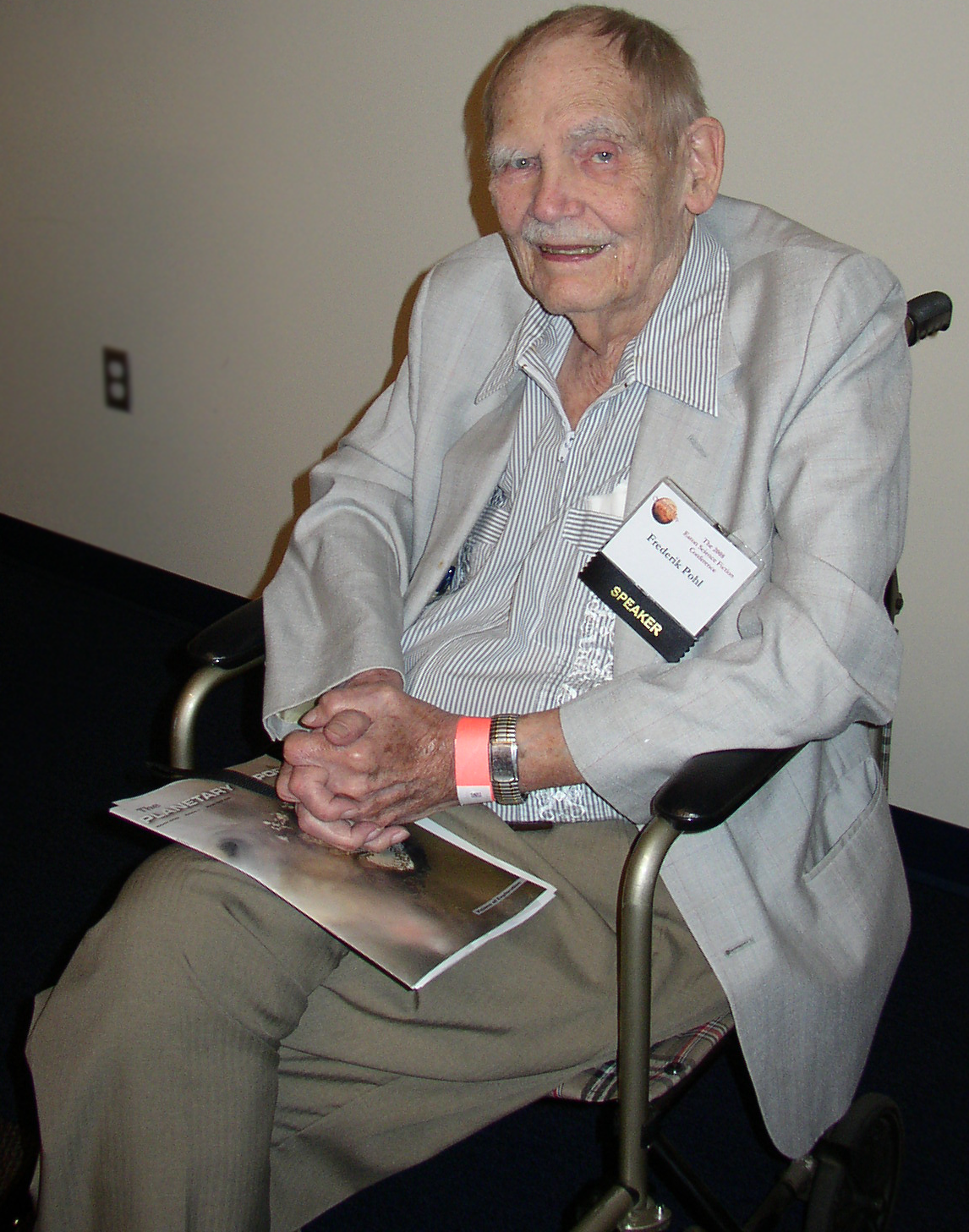
Frederik Pohl
View on Wikipedia
Frederik George Pohl Jr. (/poʊl/; November 26, 1919 – September 2, 2013) was an American science-fiction writer, editor, and fan, with a career spanning nearly 75 years—from his first published work, the 1937 poem "Elegy to a Dead Satellite: Luna", to the 2011 novel All the Lives He Led.[1]
Key Information


From about 1959 until 1969, Pohl edited Galaxy and its sister magazine If; the latter won three successive annual Hugo Awards as the year's best professional magazine.[2] His 1977 novel Gateway won four "year's best novel" awards: the Hugo voted by convention participants, the Locus voted by magazine subscribers, the Nebula voted by American science-fiction writers, and the juried academic John W. Campbell Memorial Award.[2] He won the Campbell Memorial Award again for the 1984 collection of novellas The Years of the City, one of two repeat winners during the first 40 years. For his 1979 novel Jem, Pohl won a U.S. National Book Award in the one-year category Science Fiction,[3] and it was a finalist for three other year's best novel awards.[2] He won four Hugo and three Nebula Awards,[2] including receiving both for the 1977 novel Gateway. He won the inaugural Locus Award for Best Non-fiction in 1979 for his autobiography The Way the Future Was.[4]
The Science Fiction and Fantasy Writers of America named Pohl its 12th recipient of the Damon Knight Memorial Grand Master Award in 1993[5] and he was inducted by the Science Fiction and Fantasy Hall of Fame in 1998, its third class of two dead and two living writers.[6][a]
Pohl won the Hugo Award for Best Fan Writer in 2010, for his blog, "The Way the Future Blogs".[2][7][8]
Early life and family
[edit]Pohl was the son of Frederik (originally Friedrich) George Pohl (a salesman of German descent) and Anna Jane Mason.[9] Pohl Sr. held various jobs, and the Pohls lived in such far-flung locations as Texas, California, New Mexico, and the Panama Canal Zone. The family settled in Brooklyn when Pohl was around seven.[10]
He attended Brooklyn Technical High School, and dropped out at 17.[11] In 2009, he was awarded an honorary diploma from Brooklyn Tech.[12]
While a teenager, he co-founded the New York–based Futurians fan group, and began lifelong friendships with Donald Wollheim, Isaac Asimov, and others who would become important writers and editors.[13][14] Pohl later said that other "friends came and went and were gone, [but] many of the ones I met through fandom were friends all their lives – Isaac, Damon Knight, Cyril Kornbluth, Dirk Wylie, [and] Dick Wilson. In fact, there are one or two – Jack Robins, Dave Kyle – whom I still count as friends, seventy-odd years later...." He published a science-fiction fanzine called Mind of Man.[15]
In 1936, Pohl joined the Young Communist League because of its positions in support of unions and against racial prejudice, Adolf Hitler, and Benito Mussolini. He became president of the local Flatbush III Branch of the YCL in Brooklyn. Pohl said he left the YCL after Molotov–Ribbentrop Pact of 1939, when the communist position changed to partnership with Hitler.[16]
During World War II, Pohl served in the United States Army from April 1943 until November 1945, rising to sergeant as an elite Air Corps weatherman. After training in Illinois, Oklahoma, and Colorado, he was mainly stationed in Italy with the 456th Bombardment Group.[17]
Pohl was married five times. His first wife, Leslie Perri, was another Futurian; they were married in August 1940, and divorced in 1944. He then married Dorothy Les Tina in Paris in August 1945 while both were serving in the military in Europe; the marriage ended in 1947. During 1948, he married Judith Merril; they had a daughter, Ann. Pohl and Merril divorced in 1952. In 1953, he married Carol M. Ulf Stanton, with whom he had three children and collaborated on several books; they separated in 1977 and were divorced in 1983. From 1984 until his death, Pohl was married to science-fiction expert and academic Elizabeth Anne Hull.
He fathered four children – Ann (m. Walter Weary), Frederik III (born and died in 1954, aged one month[18]), Frederik IV (a Los Angeles-based actor, writer, and producer),[19] and Kathy.[20] Grandchildren include Canadian writer Emily Pohl-Weary and chef Tobias Pohl-Weary.[21]
From 1984 on, he lived in Palatine, Illinois, a suburb of Chicago. He was previously a longtime resident of Middletown, New Jersey.[22]
Career
[edit]
Early writing
[edit]Pohl began writing in the late 1930s, using pseudonyms for most of his early works. His first publication was the poem "Elegy to a Dead Satellite: Luna" under the name of Elton Andrews, in the October 1937 issue of Amazing Stories, edited by T. O'Conor Sloane.[1][23][24] (Pohl asked readers 30 years later, "we would take it as a personal favor if no one ever looked it up".[25]) His first story, the collaboration with C.M. Kornbluth "Before the Universe", appeared in 1940 under the pseudonym S.D. Gottesman.[5]
Editor and agent
[edit]Pohl started a career as a literary agent in 1937, but it was a sideline for him until after World War II, when he began doing it full-time. Pohl stopped being Asimov's agent—the only one the latter ever had[26]—when he became editor from 1939 to 1943 of two pulp magazines, Astonishing Stories and Super Science Stories.[27] In his autobiography, Pohl said that he stopped editing the two magazines at roughly the time of the German invasion of the Soviet Union in 1941.
Stories by Pohl often appeared in these magazines, but never under his own name. Work written in collaboration with Cyril M. Kornbluth was credited to S. D. Gottesman or Scott Mariner; other collaborative work (with any combination of Kornbluth, Dirk Wylie, or Robert A. W. Lownes) was credited to Paul Dennis Lavond. For Pohl's solo work, stories were credited to James MacCreigh (or for one story only, Warren F. Howard.)[23] Works by "Gottesman", "Lavond", and "MacCreigh" continued to appear in various science-fiction pulp magazines throughout the 1940s.
He also worked as an advertising copywriter and then as a copywriter and book editor for Popular Science.[11]
Pohl co-founded the Hydra Club, a loose collection of science-fiction professionals and fans who met during the late 1940s and 1950s.[28]
From the early 1960s until 1969, Pohl served as editor of Galaxy Science Fiction and Worlds of If magazines, taking over after the ailing H. L. Gold could no longer continue working "around the end of 1960".[29] Under his leadership, If won the Hugo Award for Best Professional Magazine for 1966, 1967 and 1968.[30] Pohl hired Judy-Lynn del Rey as his assistant editor at Galaxy and If. He also served as editor of Worlds of Tomorrow from its first issue in 1963 until it was merged into If in 1967.[31]
In the mid-1970s, Pohl acquired and edited novels for Bantam Books, published as "A Frederik Pohl Selection"; these included Samuel R. Delany's Dhalgren and Joanna Russ's The Female Man. He also edited a number of science-fiction anthologies.
Novelist
[edit]Though he retired his pen names "Gottesman", "Lavond", and "MacCreigh" by the early 1950s, Pohl still occasionally used pseudonyms, even after he began to publish work under his real name. These occasional pseudonyms, all of which date from the early 1950s to the early 1960s, included Charles Satterfield, Paul Flehr, Ernst Mason, Jordan Park (two collaborative novels with Kornbluth), and Edson McCann (one collaborative novel with Lester del Rey).
In the 1970s, Pohl re-emerged as a novel writer in his own right, with books such as Man Plus and the Heechee Saga series. He won back-to-back Nebula Awards with Man Plus in 1976 and Gateway, the first Heechee novel, in 1977. In 1978, Gateway swept the other two major novel honors, also winning the Hugo Award for Best Novel and John W. Campbell Memorial Award for the best science-fiction novel. Two of his stories have also earned him Hugo Awards: "The Meeting" (with Kornbluth) tied in 1973 and "Fermi and Frost" won in 1986. Another award-winning novel is Jem (1979), winner of the National Book Award.
His works include not only science fiction, but also articles for Playboy and Family Circle magazines and nonfiction books. For a time, he was the official authority for Encyclopædia Britannica on the subject of Emperor Tiberius. (He wrote a book on the subject of Tiberius, as "Ernst Mason".)[32]
Some of his short stories take a satirical look at consumerism and advertising in the 1950s and 1960s: "The Wizards of Pung's Corners", where flashy, over-complex military hardware proved useless against farmers with shotguns, and "The Tunnel under the World", where an entire community of seeming-humans is held captive by advertising researchers. ("The Wizards of Pung's Corners" was freely translated into Chinese and then freely translated back into English as "The Wizard-Masters of Peng-Shi Angle" in the first edition of Pohlstars [1984]).
In his 1969 novel The Age of the Pussyfoot, Pohl speculated about a society where everyone could access knowledge and the means to communicate with others through a small handheld device similar to a smartphone. Although he set the novel 500 years in the future, he noted in an afterword that it might be as few as fifty years away. A short story "Day Million" suggested that society in the year 2737 might be as alien to us as contemporary society would be to someone from ancient times.
Pohl's Law is "Nothing is so good that somebody, somewhere will not hate it".[33]
He was a frequent guest on Long John Nebel's radio show from the 1950s to the early 1970s, and an international lecturer.[34]
Starting in 1995, when the Theodore Sturgeon Memorial Award became a juried award, Pohl served first with James Gunn and Judith Merril, and since then with several others until retiring in 2013.[35] Pohl was associated with Gunn since the 1940s, becoming involved in 1975 with what later became Gunn's Center for the Study of Science Fiction at the University of Kansas. There, he presented many talks, recorded a discussion about "The Ideas in Science Fiction" in 1973[36] for the Literature of Science Fiction Lecture Series,[37] and served the Intensive Institute on Science Fiction and Science Fiction Writing Workshop.[38]
Pohl received the second annual J. W. Eaton Lifetime Achievement Award in Science Fiction from the University of California, Riverside Libraries at the 2009 Eaton Science Fiction Conference, "Extraordinary Voyages: Jules Verne and Beyond".[39][40]
Pohl's work has been an influence on a wide variety of other science fiction writers, some of whom appear in the 2010 anthology, Gateways: Original New Stories Inspired by Frederik Pohl, edited by Elizabeth Anne Hull.[41]
Pohl's last novel, All the Lives He Led, was released on April 12, 2011.[42]
At the time of his death, he was working to finish a second volume of his autobiography The Way the Future Was (1979), along with an expanded version of the latter.[43]
In July 2020, an academic description reported on the nature and rise of the "robot prosumer", derived from modern-day technology and related participatory culture, that, in turn, was substantially predicted earlier by science fiction writers, most notably by Pohl.[44][45][46]
Collaborative work
[edit]In addition to his solo writings, Pohl was also well known for his collaborations, beginning with his first published story. Before and following the war, Pohl did a series of collaborations with his friend Cyril Kornbluth, including a large number of short stories and several novels, among them The Space Merchants, a dystopian satire of a world ruled by the advertising agencies.[47]
In the mid-1950s, he began a long-running collaboration with Jack Williamson, eventually resulting in 10 collaborative novels over five decades.
Other collaborations included a novel with Lester Del Rey, Preferred Risk (1955). This novel was solicited for a contest by Galaxy–Simon & Schuster when the judges did not think any of the contest submissions was good enough to win their contest. It was published under the joint pseudonym Edson McCann.[48] He also collaborated with Thomas T. Thomas on a sequel to his award-winning novel Man Plus. He wrote two short stories with Isaac Asimov in the 1940s, both published in 1950.[49]
He finished a novel begun by Arthur C. Clarke, The Last Theorem, which was published on August 5, 2008.
Death
[edit]Pohl went to the hospital in respiratory distress on the morning of September 2, 2013, and died that afternoon[50][51][52][53] at the age of 93.[54]
Works
[edit]Notes
[edit]- ^ Among the living, Hal Clement and Pohl were preceded in the Hall of Fame by A. E. van Vogt and Jack Williamson, Arthur C. Clarke, and Andre Norton.[6]
References
[edit]- ^ a b Frederik Pohl at the Internet Speculative Fiction Database (ISFDB). Retrieved April 4, 2013.
- ^ a b c d e "Pohl, Frederick" Archived February 25, 2015, at the Wayback Machine. The Locus Index to SF Awards: Index to Literary Nominees. Locus Publications. Retrieved April 25, 2012.
- ^ "1980 National Book Awards Winners and Finalists, The National Book Foundation". Nationalbook.org. Retrieved August 10, 2014.
- ^ "Locus Awards 1979". Retrieved June 23, 2025.
- ^ a b "Damon Knight Memorial Grand Master" Archived July 1, 2011, at the Wayback Machine. Science Fiction and Fantasy Writers of America (SFWA). Retrieved March 26, 2013.
- ^ a b "Science Fiction and Fantasy Hall of Fame" Archived May 21, 2013, at the Wayback Machine. Mid American Science Fiction and Fantasy Conventions, Inc. Retrieved March 26, 2013. This was the official website of the hall of fame to 2004.
- ^ "The Way the Future Blogs, an online memoir by science fiction writer Frederik Pohl". Archived from the original on November 18, 2018.
- ^ "Final Ballot for the 2010 Hugo Awards and John W. Campbell Award for Best New Writer". Aussiecon 4. 2020. Archived from the original on June 16, 2010.
- ^ Reginald, R. (September 2010). Science Fiction and Fantasy Literature - R. Reginald. Wildside Press LLC. ISBN 9780941028776. Retrieved April 29, 2013.
- ^ "Let There Be Fandom, Part 3: A Brooklyn Boyhood". Thewaythefutureblogs.com. October 2, 2009. Archived from the original on September 3, 2012. Retrieved September 8, 2012.
- ^ a b "The Way the Future Blogs, an online memoir by science fiction writer Frederik Pohl - Blog Archive - My Life as Book Editor for Popular Science". Thewaythefutureblogs.com. July 28, 2011. Archived from the original on July 23, 2012. Retrieved September 8, 2012.
- ^ Dominus, Susan (August 24, 2009). "Big City - At 89, Frederik Pohl, Sci-Fi Author, Gets Brooklyn Tech Diploma". New York Times. Retrieved August 24, 2009.
- ^ "The Way the Future Blogs, an online memoir by science fiction writer Frederik Pohl - Blog Archive - The Quadrumvirate". Thewaythefutureblogs.com. May 8, 2009. Retrieved August 10, 2014.
- ^ "Isaac". The Way the Future Blogs. January 25, 2010. Archived from the original on July 28, 2010. Retrieved March 14, 2011.
- ^ "Poetry Corner". Thewaythefutureblogs.com. June 11, 2009. Retrieved September 8, 2012.
- ^ The Way the Future Was, Frederik Pohl (Ballantine Books, 1978), pp. 93, 113.
- ^ "Hal Clement: Major Harry Stubbs". The Way the Future Blogs. March 1, 2011. Archived from the original on July 23, 2012. Retrieved September 8, 2012.
- ^ Page, Michael (2015). Frederik Pohl. University of Illinois Press. p. 58. ISBN 9780252097744.
- ^ Frederik Pohl IV, IMDB.com
- ^ Contemporary Authors Online, Gale, 2009. Reproduced in Biography Resource Center. Farmington Hills, Mich.: Gale, 2009. Document Number: H1000078817
- ^ Eat at Red Canoe Bistro, The Way the Future Blogs, May 5, 2010: "The proprietor and head chef is the talented Tobias Pohl Weary, who has not only been winning awards for his cuisine but is also my grandson, of whom I am really proud."
- ^ [ Displaying Abstract ] (May 15, 1966). "A Correction - Article - NYTimes.com". The New York Times. Retrieved August 10, 2014.
- ^ a b "Fred's Pen Names". Thewaythefutureblogs.com. May 14, 2010. Archived from the original on May 16, 2010. Retrieved September 8, 2012.
- ^ "Elegy to a Dead Planet: Luna (The Poetry Corner)". Thewaythefutureblogs.com. January 30, 2009. Retrieved September 8, 2012.
- ^ Pohl, Frederik (October 1967). "Thirty Long Years". Galaxy Science Fiction. p. 4.
- ^ Asimov, Isaac (1972). The early Asimov; or, Eleven years of trying. Garden City NY: Doubleday. pp. 142–145.
- ^ "Frederik Pohl: Chasing Science". Locus Online. October 2000.
- ^ David A. Kyle. "The Legendary Hydra Club". Mimosa 25. Rich and Nikki Lynch. Retrieved August 7, 2014.
- ^ Pohl, Frederik. The Way the Future Was (New York: Ballantine Books, 1978), pp. 221-2
- ^ "The Hugo Awards by Category". worldcon.
- ^ Ashley, Mike, Transformations: The Story of the Science Fiction Magazines from 1950 to 1970, Liverpool University Press (2005), ISBN 0-85323-779-4, p. 207.
- ^ "Congratulations to Britannica Contributor and 2010 Hugo Award Winner Frederik Pohl | Britannica Blog". Britannica Blog. September 8, 2010. Archived from the original on September 11, 2010. Retrieved November 18, 2024.
- ^ "Pohls Law Quotes". Searchquotes.com. August 9, 2012. Retrieved September 8, 2012.
- ^ Pohl, Frederik. The Way the Future Was (New York: Ballantine Books, 1978), pp. 238-39, 269-70, 280.
- ^ "Sturgeon Award". Archived from the original on October 1, 2012. Retrieved May 29, 2023.
- ^ Literature of Science Fiction lecture. Literature of Science Fiction series. 1973. OCLC 11611519.
- ^ "Literature of Science Fiction lecture". Archived from the original on July 31, 2020. Retrieved September 3, 2013.
- ^ "Science Fiction Writers Workshop". Speculative Fiction Writing Workshop.
- ^ "Press Release" (Press release). University of California, Riverside: The 2009 Eaton Science Fiction Conference. September 19, 2008.
- ^ "The Eaton Awards" Archived May 3, 2013, at the Wayback Machine. Eaton Science Fiction Conference. University of California, Riverside (ucr.edu). Retrieved 2013-04-06.
- ^ "Table of contents for 'Gateways'", "More About 'Gateways'". Thewaythefutureblogs.com. June 14, 2010. Archived from the original on November 26, 2017. Retrieved September 8, 2012.
- ^ "All the Lives He Led". Macmillan Publishers. July 9, 2012. Archived from the original on September 10, 2011. Retrieved September 8, 2012.
- ^ "Frederik Pohl, Nov. 26, 1919-Sept. 2, 2013". Thewaythefutureblogs.com. September 4, 2013. Archived from the original on September 7, 2013. Retrieved September 7, 2013.
- ^ Lancaster University (July 24, 2020). "Sci-fi foretold social media, Uber and Augmented Reality, offers insights into the future - Science fiction authors can help predict future consumer patterns". EurekAlert!. Retrieved July 26, 2020.
- ^ Ryder, M.J. (July 23, 2020). "Lessons from science fiction: Frederik Pohl and the robot prosumer" (PDF). Journal of Consumer Culture. 22: 246–263. doi:10.1177/1469540520944228. Archived (PDF) from the original on September 13, 2020.
- ^ Ryder, Mike (July 26, 2020). Citizen robots:biopolitics, the computer, and the Vietnam period. Lancaster University (phd). Retrieved July 26, 2020.
- ^ A belated sequel, The Merchants' War (1984) was written by Pohl alone, after Kornbluth's death. Pohl's The Merchants of Venus was an unconnected 1972 novella that includes biting satire on runaway free-market capitalism and first introduced the Heechee.
- ^ Frederik Pohl, The Way the Future Was, Ballantine Books (1978),
- ^ Asimov, Isaac (1974). The Early Asimov Volume 2, Panther Books, pp. 134 and 197-198. ISBN 0-586-03936-8
- ^ Smith, Dick; Zeldes, Leah (September 2, 2013). ""Farewell...." The Way the Future Blogs". Thewaythefutureblogs.com. Archived from the original on September 5, 2013. Retrieved September 2, 2013.
- ^ Jonas, Gerald (September 3, 2013). "Frederik Pohl, Worldly-Wise Master of Science Fiction, Dies at 93". The New York Times. Archived from the original on January 2, 2022. Retrieved September 3, 2013.
- ^ Staff (September 3, 2013). "In Memoriam Frederik Pohl". SFWA. Retrieved September 3, 2013.
- ^ Pohl-Weary, Emily (September 2, 2013). "Twitter / emilypohlweary: Rest in peace to my beloved grandfather, Frederik Pohl". Twitter. Retrieved September 3, 2013.
- ^ Barnett, David (September 3, 2013). "Frederik Pohl, grandmaster of science fiction, dies aged 93". The Guardian. Retrieved September 3, 2013.
Further reading
[edit]Critical studies, reviews, and biography
[edit]- Williams, Sheila (February 2014). "Remembering Frederik Pohl". Asimov's Science Fiction. 38 (2): 4–5. Archived from the original on July 27, 2020. Retrieved May 1, 2019.
- Anon. (April 2014). "Remembering Frederik Pohl, 1919-2013". Analog Science Fiction and Fact. 134 (4): 31.
- Frederik Pohl by Michael R. Page (2015). University of Illinois Press
- Ryder, Mike (2022). "Lessons from science fiction: Frederik Pohl and the robot prosumer". Journal of Consumer Culture. 22 (1): 246–263. doi:10.1177/1469540520944228. S2CID 210540732.
Derivative works
[edit]- Gateways: Original New Stories Inspired by Frederik Pohl (2010), edited by Elizabeth Anne Hull. ISBN 978-0765326621
- Elizabeth Anne Hull, Introduction
- David Brin, "Shoresteading"
- Phyllis and Alex Eisenstein, "Von Neumann's Bug"
- Isaac Asimov, Appreciation
- Joe Haldeman, "Sleeping Dogs"
- Larry Niven, "Gates (Variations)"
- Gardner Dozois, Appreciation
- James Gunn, "Tales from the Spaceship Geoffrey"
- Gregory Benford and Elisabeth Malartre, "Shadows of the Lost"
- Connie Willis, Appreciation
- Vernor Vinge, "A Preliminary Assessment of the Drake Equation, Being an Excerpt from the Memories of Star Captain Y.T. Lee"
- Greg Bear, "Warm Sea"
- Robert J. Sawyer, Appreciation
- Frank M. Robinson, "The Errand Boy"
- Gene Wolfe, "King Rat"
- Robert Silverberg, Appreciation
- Harry Harrison, "The Stainless Steel Rat and the Pernicious Porcuswine"
- Jody Lynn Nye, "Virtually, A Cat"
- David Marusek, Appreciation
- Brian W. Aldiss, "The First-Born"
- Ben Bova, "Scheherezade and the Storytellers"
- Joan Slonczewski, Appreciation
- Sheri S. Tepper, "The Flight of the Denartesestel Radichan"
- Neil Gaiman, "The [Backspace] Merchants"
- Emily Pohl-Weary, Appreciation
- Mike Resnick, "On Safari"
- Cory Doctorow, "Chicken Little"
- James Frenkel, Afterword
External links
[edit]

- Official website
- The Way the Future Blogs – by Pohl, January 2009 to September 2013; by his widow Elizabeth Anne Hull
- Works by Frederik Pohl in eBook form at Standard Ebooks
- Works by Frederik Pohl at Project Gutenberg
- Works by or about Frederik Pohl at the Internet Archive
- Works by Frederik Pohl at LibriVox (public domain audiobooks)

- "Frederik Pohl biography". Science Fiction and Fantasy Hall of Fame.


Frederik Pohl
View on GrokipediaEarly Life
Childhood and Education
Frederik George Pohl Jr. was born on November 26, 1919, in New York City to Fred George Pohl, a traveling salesman, and Anna Jane Mason Pohl; he was their only child.[5][4] His early years involved frequent relocations driven by his father's occupation, including stints in Panama, Texas, and New Mexico, before the family settled in Brooklyn around 1926 when Pohl was about seven years old.[6][7] As a child in Brooklyn, Pohl displayed an early affinity for reading, particularly developing a taste for science fiction through pulp magazines and adventure stories, which shaped his lifelong engagement with the genre.[7] This self-directed immersion in literature occurred amid a modest family background, with no formal higher education in the arts or sciences influencing his initial pursuits.[8] Pohl attended Brooklyn Technical High School, a specialized institution focused on science and engineering, but dropped out at age 17 around 1936, forgoing further conventional schooling to pursue interests in writing and science fiction fandom.[9][10] His education thus relied heavily on autodidactic efforts, including voracious reading and early involvement in fan communities, rather than structured academic credentials.[9]Involvement in Fandom and Early Political Affiliations
Pohl entered science fiction fandom as a teenager in New York during the 1930s, amid the Great Depression, where he engaged with like-minded enthusiasts through amateur publishing and club activities.[11] In the late 1930s, he co-founded the Futurians, a influential New York-based fan group dedicated to promoting science fiction literature and ideas, which included future notables like Isaac Asimov and Donald Wollheim.[12] The group emphasized progressive ideals and utopian themes in SF, fostering debates on social issues alongside literary criticism.[13] Pohl's fandom involvement extended to practical contributions, including editing pulp magazines such as Astonishing Stories and Super-Science Stories by age 19 in 1939, marking his early transition from fan to professional.[14] A notable incident occurred at the inaugural World Science Fiction Convention in July 1939, where Pohl was among six Futurians barred from entry—the "Exclusion Act"—after attempting to distribute a leaflet critiquing the convention's committee for alleged monopolistic practices and conservative biases.[15] This event highlighted tensions between radical fans and establishment figures in early SF community dynamics.[16] Parallel to his fandom pursuits, Pohl developed early political affiliations influenced by economic hardship and leftist ideologies prevalent among intellectuals. In 1936, at age 17, he joined the Young Communist League (YCL), the youth arm of the Communist Party USA (CPUSA), and soon became president of his local chapter, drawn by promises of social reform and anti-fascist activism.[17] He progressed to full CPUSA membership, participating in party activities that intersected with Futurian circles, where several members shared communist sympathies.[18] Pohl later disaffiliated around 1939, citing disillusionment with internal dogmas and the Soviet-Nazi pact, though he retained a critical sympathy for socialist critiques of capitalism evident in his later writings.[19] These experiences shaped his worldview, blending utopian aspirations with skepticism toward authoritarian implementations.[4]Career
Early Writing and Publishing
Frederik Pohl's initial foray into publishing occurred at age 17 with the poem "Elegy to a Dead Satellite: Luna," which appeared in the October 1937 issue of Amazing Stories.[10][20] This early work, published under the pseudonym Elton V. Andrews, marked his entry into professional science fiction outlets amid his involvement in New York fandom circles.[20] Pohl's first short story, "Before the Universe," co-written with C. M. Kornbluth, followed in the July 1940 issue of Super Science Stories under the house name S. D. Gottesman.[20] His early fiction output primarily consisted of pulp-era stories, often collaborative efforts with Kornbluth and other Futurians, submitted to magazines like Astonishing Stories and Super Science Stories using pseudonyms such as James MacCreigh for solo pieces and Paul Dennis Lavond or Dirk Wylie for joint works.[20] These publications, typical of the era's formulaic adventure tales, filled the pages of low-budget pulps during World War II, when Pohl balanced writing with editorial duties.[20] By late 1939 or early 1940, at age 20, Pohl had assumed the editorship of Astonishing Stories and Super Science Stories, roles he held until fall 1941, during which he commissioned and sometimes placed his own material to meet publication quotas.[9][20] This dual role as editor and contributor honed his professional skills but also highlighted the commercial pressures of the pulp market, where pseudonyms obscured authorship and quantity often trumped innovation.[20]Roles as Editor and Literary Agent
Pohl operated as a literary agent from 1946 to 1953, representing prominent science fiction authors including Isaac Asimov, Ray Bradbury, and Lester del Rey through his agency, which handled a significant portion of the genre's leading talents during the post-World War II boom.[2] His agency, initially known as the Dirk Wylie Agency, nearly achieved a monopoly in science fiction literary representation by negotiating contracts and sales for writers whose works filled the pages of emerging pulp magazines.[21] Transitioning to editing, Pohl served as editor of Galaxy Science Fiction and its companion magazine If from late 1961 to mid-1969, succeeding H. L. Gold amid the former's health issues and steering both toward innovative content that emphasized satirical and socially critical narratives.[4] Under his direction, If secured Hugo Awards for Best Professional Magazine in 1966, 1967, and 1968, reflecting its elevated quality and influence in showcasing emerging authors like Larry Niven and Joanna Russ.[20] He also launched Worlds of Tomorrow in 1963, editing it until 1967 as a quarterly outlet for experimental longer fiction, and briefly oversaw International Science Fiction from 1967 to 1968.[20] In subsequent years, Pohl continued editorial work as executive editor at Ace Books from 1971 to 1973 and as science fiction editor for Bantam Books in the mid-1970s, where select titles bore the imprint "A Frederik Pohl Selection" to highlight his curatorial choices.[22] Earlier, in the 1950s, he had edited the Star Science Fiction anthology series for Ballantine Books, compiling original stories that bypassed traditional magazine slush piles to feature established names.[23] These roles collectively positioned Pohl as a gatekeeper who nurtured the genre's commercial and artistic growth, often prioritizing market viability alongside literary merit.[7]Development as Novelist
Pohl's initial forays into novel-length fiction occurred through collaborations in the early 1950s, building on his experience with short stories and magazine editing. His partnership with Cyril M. Kornbluth produced The Space Merchants (serialized in Galaxy Science Fiction in 1952–1953 and published as a novel in 1953), a satirical depiction of a consumer-driven future that marked an early success in extended narrative form.[20] Subsequent joint efforts included Gladiator at Law (1955) and Wolfbane (1959), which honed Pohl's ability to blend social commentary with speculative plotting over novel-length scopes.[24] These works, often serialized in magazines like Galaxy, leveraged Pohl's editorial insight to structure complex critiques of capitalism and technology.[23] Transitioning to solo authorship, Pohl published Slave Ship in 1957, serialized earlier that year in Galaxy, followed by Drunkard's Walk in 1960 and A Plague of Pythons in 1962 (initially under the pseudonym Charles S. Dyal).[20] These early independent novels explored themes of psychological manipulation and societal control but received modest critical and commercial reception compared to his collaborations, reflecting Pohl's ongoing refinement of voice amid his primary roles as agent and editor.[7] By the mid-1960s, works like The Age of Pussyfoot (1965) and Inside the Tormented World (as by Paul Dennis Lavond, 1965) demonstrated growing confidence in standalone narratives, often drawing from serialized origins to test expansive world-building.[23] Pohl's maturation as a novelist accelerated in the 1970s, coinciding with a shift away from intensive editing duties. Man Plus (1976) introduced cybernetic augmentation in a hard science framework, earning a Nebula Award nomination and signaling technical sophistication.[20] The breakthrough came with Gateway (1977), a novel about prospecting alien artifacts that won the Hugo, Nebula, and John W. Campbell Memorial Awards, validating Pohl's evolution toward probabilistic storytelling and character-driven exploration of risk.[23] This success spawned the Heechee series, with sequels like Beyond the Blue Event Horizon (1980), expanding his scope to multi-volume sagas while maintaining satirical edges refined over decades.[20] His later output, including All the Lives He Led (2011), sustained productivity into advanced age, underscoring a career arc from collaborative foundations to acclaimed solo mastery.[7]Notable Collaborations
Pohl's most prominent collaborations occurred with Cyril M. Kornbluth, a fellow science fiction writer and Futurian, beginning in the early 1950s. Their partnership produced four science fiction novels noted for sharp satirical critiques of consumerism, bureaucracy, and social decay: The Space Merchants (serialized in Galaxy Science Fiction in 1952 and published in book form in 1953), Search the Sky (1954), Gladiator-at-Law (1955), and Wolfbane (1959).[25][24] These works, particularly The Space Merchants, which depicts a dystopian future dominated by advertising conglomerates, are regarded as classics of the genre for their prescient economic commentary and collaborative polish, with Pohl handling plotting and Kornbluth excelling in prose style.[20][26] Kornbluth's death in 1958 at age 34 ended their direct collaboration, though Pohl later completed Wolfbane based on their joint outline.[27] Pohl and Kornbluth also co-wrote numerous short stories, including "The Meeting" (awarded a posthumous Hugo in 1973 for Kornbluth) and contributions to anthologies like Our Best: The Best of Frederik Pohl and C.M. Kornbluth (1977).[28][29] Later collaborations included the Starchild trilogy with Jack Williamson: The Reefs of Space (1964), Starchild (1965), and Rogue Star (1969), which explored themes of rebellion against authoritarian planning economies in space habitats.[30] Pohl partnered with Lester del Rey on Preferred Risk (1955), a novella critiquing insurance monopolies in a welfare state.[31] In non-fiction, he co-authored Our Angry Earth (1991) with Isaac Asimov, addressing environmental degradation through scientific analysis.[32] His final novel, The Last Theorem (2008), was completed with Arthur C. Clarke, blending mathematics and interstellar adventure.[20] These partnerships leveraged Pohl's editorial acumen and thematic interests, enhancing the speculative rigor of the resulting works.[28]Literary Themes and Style
Satirical Critiques of Society and Economy
Pohl's satirical works frequently targeted the excesses of consumer-driven economies and corporate dominance, portraying futures where market forces distort human priorities and exacerbate social inequalities. In The Space Merchants (1952, co-authored with C. M. Kornbluth), he depicted a resource-scarce Earth ruled by advertising conglomerates that wield greater influence than governments, with ubiquitous propaganda promoting overconsumption amid famine and overpopulation.[26] The novel's protagonist, a high-ranking ad executive, navigates a world where "conservationists" are branded as subversives and products like "cancer cures" are marketed aggressively, highlighting how unchecked commercialism prioritizes profit over sustainability and rationality.[33] This critique extended to economic inequality and institutional power in Gladiator-at-Law (1955, also with Kornbluth), which envisioned a stratified society divided between a wealthy elite in fortified enclaves and a impoverished underclass sustained by welfare and gladiatorial spectacles funded by corporate monopolies.[34] The story satirized predatory corporate practices, such as leveraged buyouts and legal manipulations that concentrate wealth, while portraying violence as commodified entertainment to pacify the masses, akin to historical bread-and-circuses tactics but amplified by modern economic mechanisms.[35] Unlike outright condemnations of capitalism, Pohl's narrative implied that systemic flaws stemmed from insufficient restraints on competition and greed, advocating implicit reforms rather than abolition.[35] Pohl's shorter fiction reinforced these themes, often lampooning "robot-like" consumer conformity and the specter of overproduction leading to societal collapse, as in tales where automated economies produce abundance but foster dependency and irrational demand.[36] [37] His humor blended exaggeration with plausible extrapolations from mid-20th-century trends, such as the rise of mass advertising and suburban sprawl, to underscore causal links between economic incentives and cultural decay without prescribing ideological solutions.[38]Exploration of Technology and Human Nature
Pohl's science fiction often interrogated the interplay between technological innovation and unalterable aspects of human psychology, such as ambition, fear, and adaptability, portraying technology not as a panacea but as an amplifier of human frailties. In novels like Man Plus (1976), he depicted the transformation of astronaut Roger Torraway into a cyborg adapted for Mars colonization, emphasizing the psychological disintegration and identity erosion resulting from cybernetic enhancements amid resource scarcity and geopolitical tensions.[39] This narrative underscored ethical quandaries in human augmentation, questioning whether such interventions preserve or erode core human essence, as Torraway grapples with sensory overload and detachment from natural bodily functions.[36] Similarly, in Gateway (1977), Pohl explored humanity's encounter with abandoned alien spacecraft, where prospectors risk lethal voyages via a probabilistic lottery system, revealing innate drives like greed and thrill-seeking that propel technological exploitation despite high mortality rates exceeding 90% for uncharted routes.[40] The protagonist's therapy sessions expose the mental toll of uncertainty and survivor's guilt, illustrating how advanced artifacts magnify human impulsivity and existential dread rather than fostering rational progress.[7] Pohl's extrapolations from contemporary computing and space tech warned of societal disruptions, critiquing overreliance on machines that mimic yet fail to transcend human irrationality.[36] Across the Heechee Saga, initiated with Gateway, Pohl extended this scrutiny to interstellar scales, where human expansion via extraterrestrial engineering confronts biological and motivational limits, such as population pressures and short-termism, without resorting to implausible alterations of human behavior.[41] His portrayals consistently highlighted causal chains wherein technological access exacerbates conflicts over resources and status, as seen in the competitive frenzy over Heechee stations, reflecting realistic incentives absent in utopian visions.[7] Pohl thereby advocated a skeptical realism, drawing on observable human tendencies to forecast that innovations like AI or cybernetics would likely entrench divisions unless tempered by awareness of innate limitations.[36]Criticisms and Limitations of Pohl's Approach
Critics have noted that Pohl's satirical approach, while incisive in critiquing consumerism and societal excesses as in The Space Merchants (1952, co-authored with C. M. Kornbluth), often emphasized ugliness and misery to the exclusion of positive elements like love or beauty, rendering resolutions unconvincing after prolonged dystopian buildup.[42] Arthur C. Clarke specifically faulted the novel for its hostility toward women, an element not as pronounced in Pohl's solo works, suggesting collaborative dynamics amplified such flaws.[42] This heavy-handed focus on the "seamy side" of society limited the persuasive power of his social commentary, as the abrupt happy endings failed to inspire belief in feasible alternatives.[42][43] In later works like Gateway (1977), Pohl's narrative structure drew complaints of tedious exposition, particularly through repetitive therapy sessions that prioritized psychological argumentation over emotional engagement, often requiring readers to skim for momentum.[44] Character portrayals suffered from shallowness, with protagonist Robinette Broadhead depicted as sociopathic and unrelatable—marked by acts like physical abuse and abandoning crew—without sufficient depth to foster empathy, reducing figures to mere outlines.[44] World-building inconsistencies further undermined immersion, such as discrepancies in the availability of Heechee ships relative to mission failure rates, and a failure to richly explore alien histories or novel environments despite the premise's promise.[44] Pohl's reliance on satire across novels like Man Plus (1976) and Undersea City (1958, with Jack Williamson) was occasionally critiqued as heavy-handed, with parodies of scientific or genre clichés overwhelming subtlety and leading to labored prose that strained reader tolerance.[45][46] In All the Lives He Led (2011), inconsistencies in maintaining his characteristic wry, detached voice slipped into overt narration, highlighting challenges in sustaining stylistic consistency over full-length works.[47] While Pohl's predictions of cultural trends proved prescient, these elements—cynical tonal dominance, underdeveloped empathy, and occasional structural lapses—constrained the emotional resonance and literary polish of his output compared to more balanced speculative fiction.[43][46]Political Views
Early Marxist Influences and Communist League Membership
During the Great Depression era, Frederik Pohl, born in 1919, encountered Marxist ideas amid widespread economic hardship and labor unrest in the United States. Influenced by the ideological currents of the 1930s, which emphasized class struggle and critiques of capitalism, Pohl joined the Young Communist League (YCL), the youth organization affiliated with the Communist Party USA, in 1936 at the age of 17.[4] As a committed participant, he became a card-carrying member and engaged actively in its activities for approximately four years.[48] Pohl's involvement extended to leadership roles within the YCL; by the mid-to-late 1930s, he headed a local chapter in Brooklyn's Flatbush neighborhood.[49] Through the league, he absorbed core Marxist-Leninist principles, including dialectical materialism and the advocacy for proletarian revolution, which shaped his early worldview and intersected with his burgeoning interest in science fiction. He co-organized the Committee for the Political Advancement of Science Fiction, aiming to align the genre with leftist causes by recruiting fellow writers and fans, such as members of the Futurian science fiction club, to the YCL's platform.[4][48] This period marked Pohl's immersion in communist organizing efforts, where he viewed science fiction as a potential vehicle for propagating Marxist critiques of societal structures. However, his enthusiasm waned as he grew disillusioned with the organization's rigid doctrines and internal dynamics, leading him to depart around 1939 or 1940.[4] Despite this early phase, the influences persisted in subtle ways in his initial writings, reflecting a youthful optimism about collectivist solutions to economic inequities.[48]Evolution Toward Skepticism of Utopias and Centralized Planning
Pohl's initial attraction to Marxist ideals during his teenage years in the 1930s, including membership in the Young Communist League starting in 1936, reflected a common enthusiasm among science fiction fans for radical social change amid the Great Depression. However, by the early 1940s, disillusionment set in due to internal factionalism within leftist groups and the realities of Stalinist authoritarianism, which he later characterized in his 1978 autobiography The Way the Future Was as an "anomalous" youthful phase rather than a enduring commitment.[50][4] This shift marked the beginning of a broader skepticism toward ideologies promising frictionless societal perfection through top-down control. Experiences in World War II military service and postwar observations of both capitalist excesses and Soviet inefficiencies further eroded faith in centralized planning, as evidenced by Pohl's satirical portrayals of bureaucratic overreach and resource mismanagement in his fiction. In The Space Merchants (1952, co-authored with C.M. Kornbluth), he lampooned advertising-driven consumerism as a perverse incentive structure, yet the novel's dystopia implicitly critiqued the hubris of any system—market or planned—that ignored dispersed human knowledge and motivations.[7] Later works amplified this, with Jem (1979) illustrating how idealistic Earth colonists, pursuing a multicultural utopia on an alien world, descended into violent resource wars and ecological ruin, exposing the causal fragility of enforced harmony amid scarcity and self-interest.[7] By the 1970s, Pohl's writings and public statements consistently rejected utopian blueprints, favoring narratives where technological progress clashed with unalterable human flaws like greed and shortsightedness, rendering comprehensive planning illusory. In a 1977 interview, he decried government-led space programs as wasteful mechanisms ill-suited to genuine discovery, prioritizing political prestige over efficient outcomes—a view aligned with empirical failures of large-scale interventions observed in real-world economies.[21] This evolution positioned him as a critic of both socialist collectivism and overreaching state capitalism, emphasizing adaptive, decentralized responses to complexity over ideological fiat.[51]Views on Capitalism, Consumerism, and Government Intervention
Pohl's science fiction frequently critiqued the excesses of capitalism and consumerism, portraying them as drivers of social dysfunction rather than inherent evils. In The Space Merchants (1953, co-authored with C. M. Kornbluth), he depicted a dystopian society dominated by advertising conglomerates that manipulate consumer desires to fuel endless production, leading to environmental degradation and resource scarcity on a colonized Venus.[26] Similarly, in the novella "The Midas Plague" (1954), Pohl envisioned a post-scarcity economy where citizens are compelled by social norms and robotic servants to consume vast quantities of goods to match production levels, inverting traditional scarcity to highlight the absurdity of obligatory materialism.[51] These works reflect Pohl's observation of mid-20th-century American consumer culture, where advertising and planned obsolescence propelled economic growth but eroded individual autonomy, though he grounded such satires in extrapolations from observable trends like postwar suburban expansion and corporate marketing rather than ideological rejection of markets.[52] While Pohl lampooned unregulated markets' potential for abuse, his later fiction and personal reflections indicated wariness of government intervention as a corrective force. In "The Merchants of Venus" (1972), he satirized "runaway free-market capitalism" on Venus, where opportunistic entrepreneurs exploit alien artifacts for profit amid bureaucratic inertia, suggesting that pure laissez-faire invites exploitation but state oversight stifles innovation. By contrast, The Years of the City (1984) presented libertarian-leaning reforms in a futuristic New York, emphasizing decentralized decision-making and individual incentives over top-down planning to address urban decay.[53] This ambivalence stemmed from Pohl's early disillusionment with communism; his teenage involvement in the Young Communist League fostered lifelong suspicion of "grand schemes of social engineering," including expansive government programs that presume to perfect society through coercion.[7] He advocated human perfectibility through personal effort rather than institutional fiat, viewing both corporate overreach and statist interventions as threats to voluntary cooperation and pragmatic adaptation.[7]Awards and Recognition
Major Literary Awards
Frederik Pohl won three Nebula Awards for his fiction, administered by the Science Fiction and Fantasy Writers of America (SFWA) to recognize excellence in science fiction and fantasy. These included the Best Novel award for Man Plus in 1977 and for Gateway in 1978, as well as the Best Novella award for "The Meeting," co-authored with C. M. Kornbluth, in 1972.[1][3] Pohl secured four Hugo Awards, voted by members of the World Science Fiction Society at annual Worldcons, for his literary works. Notable wins were the Best Novel for Gateway in 1978 and Best Short Story for "Fermi and Frost" in 1986.[54][1] He also received the Hugo for Best Professional Magazine as editor of If in 1967, reflecting his dual role as writer and editor.[55] In 1980, Pohl was awarded the National Book Award in the inaugural Science Fiction category for his novel Jem, the only year the award included such a division before its discontinuation.[56] Additionally, in 1993, SFWA honored him with the Damon Knight Memorial Grand Master Award for lifetime achievement in science fiction writing.[1]| Award | Work | Year |
|---|---|---|
| Nebula Award (Best Novel) | Man Plus | 1977 |
| Nebula Award (Best Novella) | "The Meeting" (with C. M. Kornbluth) | 1972 |
| Nebula Award (Best Novel) | Gateway | 1978 |
| Hugo Award (Best Novel) | Gateway | 1978 |
| Hugo Award (Best Short Story) | "Fermi and Frost" | 1986 |
| National Book Award (Science Fiction) | Jem | 1980 |
| SFWA Grand Master | Lifetime achievement | 1993 |