


Community hub
Recent from talks
Contribute something
Nothing was collected or created yet.
Fredd Wayne
View on WikipediaFredd Wayne (born Frederick Searle Wiener;[1] October 17, 1924 – August 27, 2018) was an American actor with a career spanning seven decades on Broadway, radio, television, movies, and recorded works. He appeared on television as a guest star, and portrayed Benjamin Franklin, originally in his one-man show Benjamin Franklin, Citizen, on television, recordings, and live appearances.
Key Information


Early life
[edit]Fredd Wayne was born in Akron, Ohio[1] to working-class parents Celia (Mirman) and salesman Charles Theodore Wiener. Two days after graduating from John R. Buchtel High School he took a bus to Hollywood in hopes of working for cousin Lester Cowan who had produced My Little Chickadee and several Marx Brothers films. He recalls sitting in the lobby of Columbia Studios for three days before Cowan dismissed him with: "I got nuthin’ for you, kid." After Wayne's money and graduation watch were stolen, a neighbor who worked at Warner Brothers drove him to the studio where he was hired as a mail boy for $18 a week. Soon he was drafted into the U.S. Army.[citation needed]
World War II
[edit] |
Following basic training Wayne was made a Special Services non-com (Entertainment Specialist) for the 253rd Infantry Regiment of the 63rd Infantry Division. For the duration of his two-year hitch he ran movie projectors, wrote, produced and performed in soldier shows in Mississippi, attended courses at Fort McPherson, Georgia, and Washington and Lee University in Virginia (where he was classmates with future director Arthur Penn); Wayne also acted as booking agent of a hugely successful GI orchestra led by Ralph Cerasuolo, a sophisticated jazz violinist formerly known in New York City as "Leonardo of the Stork Club". Despite a 14-year age difference, they became close friends. Elements of the 63rd Infantry Division, including Wayne and the band, landed in Marseilles, France, on December 8, 1944, and were rushed north to support Americans locked in the Battle of the Bulge. Wayne was assigned to GRO (Graves Registration Office) to retrieve the bodies of fallen soldiers. On April 2, 1945, he discovered Cerasuolo, who had been killed by a single sniper shot to the forehead.
G.I. Carmen
[edit]Shortly after VE Day, Wayne was directed to put together an entertainment for the men. In response to his notices, 45 combat veterans of his 253rd Infantry Regiment turned in rifles for grease paint to create G.I. Carmen – destined to become, with the exception of This Is the Army, the most successful G.I. show of World War II.

With half the cast as women in ill-fitting costumes and scraggly wigs, the show was to run for only three nights in Tauberbishofsheim, Germany[2] but its raucous, bawdy humor, robust singing, and dancing made it a roaring success that the Army recognized at once.[3] In addition to writing, producing and co-directing duties, Wayne had to play the title role when no other G.I. would touch it. The cast included several pre-war professionals, including Hal Edwards, who had danced in 20th Century Fox musicals, and Ray Richardson, a tenor with the Chicago Lyric Opera. Most of Ralph's band, now led by Marty Faloon, were onstage as well, among them guitarist Charlie Byrd. After raiding Stadttheater Heidelberg for colorful costumes, proper wigs, and scenery, the army sent the troupe on an extended eight-month tour throughout Germany,[4][5] Belgium, France, Italy, and Austria including stops at leading theatres in Berlin, Brussels, Paris,[6] Rome, and Vienna. The show closed in Nuremberg on January 24, 1946. GI Carmen’s cast was kept together throughout 142 performances before audiences totaling well over 250,000 G.I. and allied troops and countless civilians, including Gertrude Stein and Alice B. Toklas in Paris and Marlene Dietrich in Berlin.
Professional career
[edit] | This section needs additional citations for verification. (April 2025) |
Back in the states Fredd Wayne settled in New York with a job at J.C. Penney offices by day and acting classes at the American Theatre Wing after hours. (Lee Marvin, James Whitmore, and Martin Balsam were classmates; Eileen Heckart and Jean Stapleton were among the volunteer actresses). Roles there included Polonius in Hamlet at age 23. As an usher at Broadway's Alvin Theatre Wayne watched Ingrid Bergman star in Joan of Lorraine, and fetched tea for José Ferrer during the latter's celebrated run in Cyrano de Bergerac. (Ten years later for Universal's Revue Productions, Wayne performed the character in a TV pilot called The Sword.[7][8] It never sold.) Following the Cyrano run Ferrer cast Wayne in his production of the Czech play The Insect Comedy whose performers included Ray Walston, Werner Klemperer, and Don Murray. Fredd Wayne's big Broadway break came when he went to audition for Shakespeare's As You Like It starring Katharine Hepburn but was mistakenly pulled in to read for the Johnny Mercer – Bobby Dolan musical Texas, L’il Darlin’.
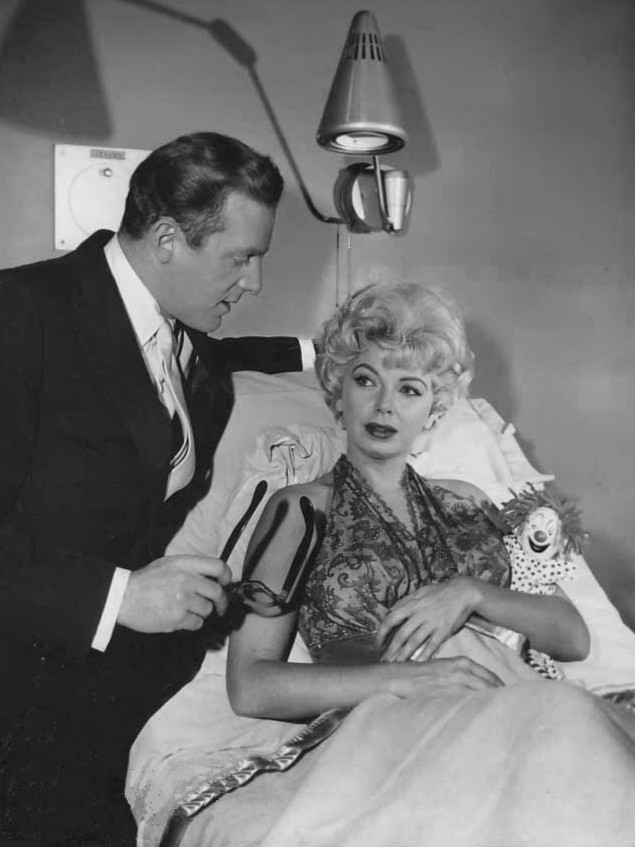
His G.I. Carmen musical skills helped land a leading role. Critical success led to more Broadway credits such as Not For Children by Elmer Rice and following Ray Walston as Luther Billis opposite Mary Martin in the original London production of South Pacific. Wayne's success in London – including a concurrent extended engagement at The Berkeley Cabaret – was followed by a role opposite Gene Kelly in MGM's Crest of the Wave, filmed in England and the Channel Islands. It also led to American productions of South Pacific playing Billis opposite Gisele MacKenzie in Dallas, Vikki Carr in Kansas City, and Jane Powell in St. Paul, Minnesota. Returning to New York Wayne co-starred opposite Ralph Bellamy in Oh Men!, Oh Women! and became embroiled in the Golden Age of Television, when dramas and comedies were not videotaped or filmed but miscues were part of the tension and grandeur of performing live before millions of people. Wayne appeared in such shows as Playhouse 90, Studio One, Pulitzer Prize Playhouse, The Defenders, Kraft Theatre, Danger, We the People, Robert Montgomery Presents, The Victor Borge Show, and The Nurses. He also made six guest appearances on Perry Mason, all shot in Hollywood, including the role of murder victim Jack Hardisty in the 1958 episode, "The Case of the Buried Clock". Wayne appeared in S1 E21 "The Annie MacGregor Story" on "Wagon Train" 1958. He played Barney, the agent for Barbara Nichols' showgirl character Liz Powell in S2 E17 "Twenty Two" on The Twilight Zone 1961, as depicted in the photo above.
Benjamin Franklin, Citizen
[edit]Out of these creative years Fredd Wayne developed the role for which he's probably best known. The idea came to him while flying to New York from Los Angeles in 1964; he went straight to the New York Public Library from JFK to begin research and was directed to the Editor of The Papers of Benjamin Franklin at Yale University in New Haven, Connecticut. After six weeks of study and appearances as Franklin on the Tonight Show and Today Show,[9] he began breaking in his one-man show Benjamin Franklin, Citizen in upstate New York and Ohio. By the time he reached Los Angeles the production was running smoothly and Wayne was hired to play Franklin in a two-part episode of Bewitched on ABC-TV.[10]Wayne's Benjamin Franklin, Citizen also had a long run in Hollywood's Ivar Theatre[11][12][13] which led to a well-received U.S. State Department tour of Europe[14][15] and subsequent college tours throughout America during the Bicentennial era and beyond. His work as Franklin on Bob Hope's America is 200 Years Old...And There's Still Hope! recorded on May 4, 1976, led to appearances in multiple roles on four subsequent Bob Hope Television Specials including an appearance as Brandon Tartikoff opposite Brandon Tartikoff. Fredd Wayne has also appeared frequently as Franklin at IBM, GE, and other industrial conventions. His recording of The Autobiography of Benjamin Franklin (Audio Partners) was selected as one of the top audiotapes of 1997.[16]
Writings
[edit]As a writer Fredd Wayne's articles have appeared in The New York Times,[17] Playboy,[18] The Los Angeles Times,[19][20] Performing Arts,[21] Westways,[22] The Arizona Republic,[23] and numerous other publications. Wayne has titled his upcoming fictionalized memoir "Blinky's Great Adventure".
Death
[edit]Wayne died at an assisted-living facility in Santa Monica on August 27, 2018, aged 93.[24]
Selected stage credits
[edit]| Year | Production | Role | Notes |
|---|---|---|---|
| 1945 | G.I. Carmen | Carmen | 142 performances in Germany, Belgium, France, Italy and Austria, June 9, 1945 - January 24, 1946, produced by the U.S. Army |
| 1947 | Hamlet | Polonius | American Theatre Wing |
| 1948 | The Insect Comedy | José Ferrer, director | |
| 1949 | Texas, Li'l Darlin' | Brewster Ames II | 293 performances, Nov 25, 1949 - Sep 9, 1950 |
| 1951 | Not for Children | Hugh McHugh | by Elmer Rice |
| 1952 | South Pacific | Luther Billis | original London production, Theatre Royal, Drury Lane |
| Have Tuxedo, Will Travel | himself | a one-man show at The Berkeley Cabaret | |
| 1954 | Oh Men!, Oh Women! | with Ralph Bellamy | |
| 1964 | Benjamin Franklin, Citizen | Benjamin Franklin | in theatres throughout the United States and Europe |
| 1969 | Go Fly a Kite | conceiver / actor | Tambellini's Gate Theatre |
| 1984 | A Taste for the Forbidden | Drama-Logue Award for performance, L.A.A.T. Half-Stage |
Filmography
[edit]Film
[edit]| Year | Title | Role | Notes |
|---|---|---|---|
| 1954 | Crest of the Wave | Seaman N. Sam 'Shorty' Kaminsky (USN) | Metro-Goldwyn-Mayer British Studios, with Gene Kelly |
| 1956 | The Man Is Armed | Egan | Republic Pictures |
| The Girl He Left Behind | Sgt. Sheridan | Warner Bros., with Tab Hunter and Natalie Wood | |
| 1958 | Torpedo Run | Orville 'Goldy' Goldstein | Metro-Goldwyn-Mayer (MGM) |
| 1961 | Twenty Plus Two | Harris Toomey | Allied Artists Pictures |
| 1962 | The Spiral Road | Van Bloor | Universal International Pictures, with Rock Hudson and Gena Rowlands |
| 1964 | Seven Days in May | Henry Whitney | Uncredited, with Kirk Douglas and Burt Lancaster |
| Sex and the Single Girl | Frank | Uncredited, with Tony Curtis and Natalie Wood | |
| 1966 | Chamber of Horrors | Charlie Benton | Uncredited, with Patrick O'Neal, Wilfrid Hyde-White and Suzy Parker |
| 1974 | Hangup | Felder | Warner Bros. |
| 1981 | American Pop | voiced 7 roles | Uncredited, Bakshi Productions, animated motion picture |
| 1987 | Dutch Treat | the Judge | |
| 1989 | A More Perfect Union: America Becomes a Nation | Benjamin Franklin | |
| 1999 | Man on the Moon | Bland Doctor | (final film role) |
Television
[edit]| Year | Title | Role | Notes |
|---|---|---|---|
| 1949 | We the People | ||
| The Philco Television Playhouse | Season 1, Episode 28: What Makes Sammy Run?, with José Ferrer | ||
| Kraft Theatre | performed in productions in 3 separate seasons: 1949, 1954 & 1955 | ||
| 1950 | Musical Comedy Time | Sir Evelyn Oakley | Season 1, Episode 1: Anything Goes |
| 1951 | The Victor Borge Show | ||
| Pulitzer Prize Playhouse | Detour, with Dorothy Gish | ||
| Corb | The Thousand Yard Look, with Richard Kiley | ||
| The Wisdom Tooth, with Howard Freeman | |||
| Schlitz Playhouse | Season 1, Episode 4: Still Life, with Margaret Sullavan | ||
| 1952 | Lux Video Theatre | Bert Oliver | Season 2, Episode 23: For Goodness Sake |
| Celanese Theatre | Season 1, Episode 13: Saturday's Children, with Mickey Rooney | ||
| 1953 | The Ford Television Theatre | Season 1, Episode 39: The People Versus Johnston | |
| Studio One | The Agent | Season 6, Episode 11: Confessions of a Nervous Man | |
| 1954 | Armstrong Circle Theatre | Season 4, Episode 6: Evening Star | |
| Kraft Theatre | March Hare | Season 7, Episode 36: Alice in Wonderland, with Art Carney | |
| Robert Montgomery Presents | Season 6, Episode 2: A Dream of Summer, with Jackie Cooper | ||
| Omnibus | Master Adam Fumie | Season 3, Episode 2: The Man Who Married a Dumb Wife, with Alistair Cooke | |
| Armstrong Circle Theatre | Season 5, Episode 16: Ring Twice for Christmas | ||
| 1955 | Kraft Theatre | Season 8, Episode 29: Now, Where Was I?, with Robert Webber | |
| Armstrong Circle Theatre | Season 6, Episode 1: The Strange War of Sergeant Krezner, with Richard Kiley | ||
| 1956 | Matinee Theatre | Season 1, Episode 52: The Century Plant, with Constance Ford | |
| Front Row Center | Bill Tyler | Season 2, Episode 6: The Teacher and Hector Hodge | |
| Dr. Humphries | Season 2, Episode 4: The Ainsley Case | ||
| Lux Video Theatre | George | Season 6, Episode 23: Here Comes the Groom | |
| Star Stage | Season 1, Episode 32: Being Nice to Emily | ||
| Medic | Sydney Phillips | Season 2, Episode 26: The Good Samaritan | |
| Lux Video Theatre | Pat | Season 6, Episode 41: A Marriage Day | |
| Matinee Theatre | Season 2, Episode 20: The Alumni Reunion | ||
| Wire Service | O'Brien | Season 1, Episode 3: Hideout | |
| The Joseph Cotten Show aka On Trial | Asst. District Attorney | Season 1, Episode 4: Twice in Peril | |
| Gunsmoke | Sam Kertcher | Season 2, Episode 5: Young Man with a Gun | |
| G.E. True Theater | Hugh | Season 5, Episode 9: The Charlatan | |
| Schlitz Playhouse | Pollack | Season 6, Episode 11: Washington Incident | |
| The Millionaire | Harry Denison | Season 3, Episode 15: The Mildred Kester Story | |
| The Danny Thomas Show aka Make Room for Daddy | Rod Fowler | Season 4, Episode 14: Liz's Boyfriend | |
| 1957 | Dr. Hudson's Secret Journal | Episode: Brenthurst Story | |
| Lux Video Theatre | Inspector | Season 7, Episode 20: The Undesirable | |
| G.E. True Theater | Clyde | Season 5, Episode 21: The Town with a Past, with James Stewart | |
| Schlitz Playhouse | Cyrano de Bergerac | Season 6, Episode 36: The Sword | |
| Code 3 | Sgt. Bill Hollis | Season 1, Episode 12: Oil Well Incident | |
| Season 1, Episode 14: Suspect Number One | |||
| Season 1, Episode 17: The Trap | |||
| Lt. Bill Hollis | Season 1, Episode 28: The Man with Many Faces | ||
| Telephone Time | Hicks | Season 3, Episode 7: Under Seventeen | |
| Alcoa Theatre | Lt. Brackett | Season 1, Episode 4: On Edge | |
| Maverick | Carl Jimson | Season 1, Episode 7: Relic of Fort Tejon | |
| 1958 | Richard Diamond, Private Detective | Tom Tanner | Season 2, Episode 4: Double Jeopardy |
| Perry Mason | Ernie Tanner | Season 1, Episode 19: The Case of the Haunted Husband | |
| Maverick | Kingsley | Season 1, Episode 18: Diamond in the Rough | |
| M Squad | Eddie Rocco | Season 1, Episode 20: Dolly's Bar | |
| Perry Mason | Jack Hardisty | Season 2, Episode 6: The Case of the Buried Clock | |
| 1959 | The Grand Jury | Jordan | Season 1, Episode 31: Baby for Sale |
| Deadline | Gilgo | Episode: Massacre | |
| State Trooper | Frank Nagel | Season 3, Episode 20: While Jerome Burned | |
| 21 Beacon Street | Season 1, Episode 6: The Execution | ||
| Tightrope | Danny | Season 1, Episode 1: Getaway Day | |
| Bourbon Street Beat | Lt. Fontaine | Season 1, Episode 1: The Taste of Ashes | |
| Whirlybirds | Season 3, Episode 31: Man, You Kill Me | ||
| The Untouchables | Joe Carroll | Season 1, Episode 4: The George 'Bugs' Moran Story | |
| Sugarfoot | 'Bull' Borgland | Season 3, Episode 5: The Canary Kid, Inc. | |
| 1960 | The Loretta Young Show | Ed Crawley | Season 7, Episode 14: The Grenade |
| Goodyear Theatre | Season 3, Episode 8: Omaha Beach - Plus 15 | ||
| The Alaskans | Burton | Season 1, Episode 14: The Trial of Reno McKee | |
| Alcoa Presents: One Step Beyond | Lt. Barnes | Season 2, Episode 23: Vanishing Point | |
| Perry Mason | William Gowrie | Season 3, Episode 18: The Case of the Singing Skirt | |
| The Man from Blackhawk | Garrison | Season 1, Episode 33: Trial by Combat | |
| Hawaiian Eye | Edward Demming | Season 1, Episode 29: Typhoon | |
| Markham | Commissioner Fred Clayton | Season 1, Episode 48: The Silken Cord | |
| The Untouchables | |||
| Surfside 6 | Allan Abbott | Season 1, Episode 1: Country Gentleman | |
| The Ann Sothern Show | Chuck Dunphy | Season 3, Episode 4: The Pinch-Hitter | |
| 77 Sunset Strip | Mike Ransome | Season 3, Episode 7: The Laurel Canyon Caper | |
| 1961 | Have Gun – Will Travel | Ben | Season 4, Episode 17: A Quiet Night in Town: Part 1 |
| Season 4, Episode 18: A Quiet Night in Town: Part 2 | |||
| The Twilight Zone | Barney | Season 2, Episode 17: Twenty Two | |
| Perry Mason | Roger Phillips | Season 4, Episode 17: The Case of the Wintry Wife | |
| Bachelor Father | Bart Anderson | Season 4, Episode 32: Hilda Rides Again | |
| Miami Undercover | Joe Danzig | Season 1, Episode 29: Room 9 | |
| The Real McCoys | Mr. Perry | Season 4, Episode 37: How to Win Friends | |
| The Twilight Zone | Paul Malloy | Season 3, Episode 2: The Arrival | |
| Dr. Kildare | Salesman | Season 1, Episode 4: Winter Harvest | |
| Hawaiian Eye | Tony Ward | Season 3, Episode 11: Two for the Money | |
| 1962 | Bachelor Father | Don Lambert | Season 5, Episode 18: How Howard Won His C |
| Alcoa Premiere | Ted Morley | Season 1, Episode 14: Mr. Easy, with Fred Astaire | |
| Cain's Hundred | Marty | Season 1, Episode 27: A Creature Lurks in Ambush | |
| Perry Mason | |||
| The Doctors and the Nurses | Dr. Mason | Season 1, Episode 8: A Strange and Distant Place | |
| The Defenders | District Attorney | Season 2, Episode 15: Death Takes the Stand | |
| 1963 | Rawhide | Calhoun | Season 5, Episode 22: Incident of the Pale Rider |
| Perry Mason | |||
| The Bill Dana Show | Cliff | Season 1, Episode 9: The Poker Game | |
| 1964 | Grindl | Season 1, Episode 16: Grindl, Private Eye | |
| Perry Mason | |||
| An Hour with Robert Goulet | himself | TV special (CBS) | |
| 1965 | Hogan's Heroes | Sgt. Kristman | Season 1, Episode 16: Anchors Aweigh, Men of Stalag 13 |
| 1966 | My Three Sons | Dr. Killebrew | Season 6, Episode 30: The Wrong Robbie |
| Hawk | Detective | Season 1, Episode 1: Do Not Mutilate or Spindle | |
| Bewitched | Benjamin Franklin | Season 3, Episode 13: My Friend Ben | |
| Season 3, Episode 14: Samantha for the Defense | |||
| 1967 | The Monroes | Winton | Season 1, Episode 18: To Break a Colt |
| 1969 | Daniel Boone | Benjamin Franklin | Season 6, Episode 5: The Printing Press |
| Walt Disney's Wonderful World of Color | Jim Durden | Season 16, Episode 8: Secrets of the Pirates' Inn: Part 1 | |
| Season 16, Episode 9: Secrets of the Pirates' Inn: Part 2 | |||
| 1970 | The Return of the Smothers Brothers | himself | TV special (NBC) |
| Bracken's World | Ned Singer | Season 2, Episode 7: Hey, Gringo... Hey, Ponco | |
| Nanny and the Professor | Mr. Jackwith | Season 2, Episode 10: The Visitor | |
| 1971 | The Young Lawyers | Kimber | Season 1, Episode 24: I've Got a Problem |
| Room 222 | Season 2, Episode 26: A Sort of Loving | ||
| Ironside | Arthur Green | Season 5, Episode 14: Class of '57 | |
| 1972 | Cade's County | Mark Walters | Season 1, Episode 21: Jessie |
| 1973 | Banacek | Stein | Season 1, Episode 8: The Two Million Clams of Cap'n Jack |
| A Picture of Us | George Washington | TV movie won Emmy for Outstanding Achievement in Children's Programming | |
| Nightside | TV movie with John Cassavetes and Alexis Smith | ||
| 1974 | The Phantom of Hollywood | Clyde | TV movie with Jack Cassidy and Jackie Coogan |
| 1975 | Judgement: The Court Martial of Lieutenant William Calley | TV movie with Richard Basehart and Harrison Ford | |
| 1976 | Law and Order | Sgt. Haran | TV movie with Darren McGavin and Keir Dullea |
| 1978 | The Rockford Files | Curtis Meyer | Season 4, Episode 15: The Gang at Don's Drive-In |
| Rhoda | |||
| The New Adventures of Wonder Woman | J.J. MacConnell | Season 3, Episode 7: Time Bomb | |
| 1980 | The Dream Merchants | Mr. Humber | TV movie with Mark Harmon, Vincent Gardenia and Morgan Fairchild |
| Trapper John, M.D. | Pathologist | Season 2, Episode 4: Call Me Irresponsible | |
| 1981 | Bob Hope's 30th Anniversary Special | ||
| Strike Force | Season 1, Episode 6: Night Nurse | ||
| 1982 | The Day the Bubble Burst | TV movie with Richard Crenna (NBC) | |
| Quincy M.E. | Michael Gurelnik | Season 7, Episode 15: Clear the Air | |
| Lou Grant | Charles Bolsa | Season 5, Episode 18: Law | |
| Bob Hope Special | |||
| One Day at a Time | Ralph | Season 8, Episode 4: Catcher in the Mud | |
| Voyagers! | Ben Franklin | Season 1, Episode 3: Bully and Billy | |
| 1985 | Bob Hope Special | Hal Linden, Donna Mills, Morgan Fairchild and George Burns | |
| It's a Living | State Department Man | Season 3, Episode 7: From Russia with Love | |
| Bob Hope Special | as NBC President Brandon Tartikoff | with Lynda Carter, Danny Thomas, Brandon Tartikoff and Milton Berle | |
| 1986 | Simon & Simon | Benjamin Franklin | Season 5, Episode 24: The Apple Doesn't Fall Far from the Tree |
| St. Elsewhere | Pat McGroyn | Season 5, Episode 7: Up and Down | |
| 1987 | Cagney & Lacey | ||
| 1988 | Matlock | Warren Coates | Season 2, Episode 13: The Reunion |
| Cagney & Lacey | Factory Manager | Season 7, Episode 12: Shadow of a Doubt | |
| 1989 | Small Wonder | Mr. Willis | Season 4, Episode 21: The Tattletale |
| 1992 | Cheers | Dr. Bramwell | Season 10, Episode 20: Smotherly Love |
| The Trials of Rosie O'Neill | Season 2, Episode 13: Heartbreak Hotel | ||
| 1994 | Cagney & Lacey: The Return | Gerald Fradin | TV movie (CBS) |
| 1998 | Encore! Encore! | Leland | Season 1, Episode 6: The Dairy with Nathan Lane, Joan Plowright and Glenne Headly |
Audio recordings
[edit]| Year | Program | Role | Notes |
|---|---|---|---|
| 1976 | America is 200 Years Old...And There's Still Hope! | Benjamin Franklin | Bob Hope comedy album (LP) |
| Benjamin Franklin, Citizen | Benjamin Franklin | audiotape of Wayne's one-man show | |
| 1997 | The Autobiography of Benjamin Franklin | Benjamin Franklin | audiotape recognized by Publishers Weekly as one of the best of 1997 |
| 2003 | The Grapes of Wrath (play) | audio CD produced and distributed by L.A. Theatre Works |
References
[edit]- ^ a b French, Betty (May 26, 1947). "Shirley Undertakes Heavy Drama". The Akron Beacon Journal. Ohio, Akron. p. 8. Retrieved July 10, 2018 – via Newspapers.com.

- ^ Redcat, A 253rd Infantry Regiment Weekly, Vol. 1 No. 1, Germany, 15 June 1945
- ^ "Photos of the 63rd Infantry Division on occupation duty". 63rdinfdiv.com. p. 3.
- ^ The Stars and Stripes, Germany Edition, July 17, 1945
- ^ Time, The Weekly News Magazine, August 6, 1945
- ^ The Stars and Stripes, Paris, November 4, 1945
- ^ The New York Times, Feb. 8, 1957
- ^ The Hollywood Reporter, June 3, 1957
- ^ The New York Times, Sept. 9, 1964
- ^ Variety, Hollywood Edition, Oct. 20, 1966
- ^ The Hollywood Reporter, Oct. 27, 1966
- ^ Variety, Hollywood Edition, Oct. 27, 1966
- ^ Los Angeles Times, Oct. 27, 1966
- ^ The Hollywood Reporter, Feb. 22, 1967
- ^ The New York Times, Mar. 1, 1967
- ^ Publishers Weekly, Jan. 5, 1998
- ^ The New York Times, "A Ben Franklin Tour With 'Ben Franklin'", Sunday, June 1, 1975
- ^ Playboy, "How to Avoid Making Out in Hollywood" (under the nom de plume, 'Kelton Holloway'), January 1958
- ^ Los Angeles Times, Calendar section, "Vaudeville Isn't Dead - It's Going to College", Sunday, June 22, 1969
- ^ Los Angeles Times, Calendar section, "'Godfather' Casting: An Italian Uprising", Sunday, February 28, 1971
- ^ Performing Arts, Center Theatre Group, Mark Taper Forum, February 1976
- ^ Westways, "Cambria at Play", May 1977
- ^ The Arizona Republic, "Picketing hard on feet of Writers Guild members", May 13, 1973
- ^ Fredd Wayne, Who Played Benjamin Franklin on 'Bewitched,' Dies at 93: Hollywood Reporter. Retrieved August 28, 2018.

External links
[edit]- Fredd Wayne at IMDb
- Fredd Wayne at the Internet Broadway Database
- Fredd Wayne at the Internet Off-Broadway Database (archived)
| International | |
|---|---|
| National | |
| Artists | |
| Other | |

Fredd Wayne
View on GrokipediaEarly years
Childhood and education
Fredd Wayne was born Frederick Searle Wiener on October 17, 1924, in Akron, Ohio, to working-class Jewish parents Celia Mirman and salesman Charles Theodore Wiener.[5][6] Raised in a modest household during the Great Depression, Wayne's early years were shaped by the industrial city's vibrant cultural scene, which sparked his lifelong passions for theater, acting, and literature.[1] His creative inclinations emerged prominently during his school years. In the eighth grade, Wayne wrote, directed, and starred in a production of Anthony Adverse for his fellow students, demonstrating an early aptitude for dramatic storytelling and performance.[1] These experiences in Akron's public schools nurtured his interest in writing and the performing arts, laying the foundation for his future career. Wayne graduated from John R. Buchtel High School in 1942, where his enthusiasm for literature and theater continued to develop amid the challenges of wartime America.[2] Shortly after, he briefly pursued opportunities in Hollywood before enlisting in the military.[2]World War II service
Following his graduation from John R. Buchtel High School in Akron, Ohio, in 1942, Wayne briefly worked as a delivery boy at Warner Bros. studios in Hollywood before being drafted into the U.S. Army in 1943.[1] He underwent basic training and was subsequently assigned as a Special Services non-commissioned officer (entertainment specialist) with the 253rd Infantry Regiment of the 63rd Infantry Division, where his duties included organizing morale-boosting activities for troops.[7] The 63rd Infantry Division, including elements of the 253rd Regiment, deployed to Europe in late 1944, with the advance party arriving at Marseille in southern France on December 8 as part of the ongoing Allied campaign following Operation Dragoon.[8] Wayne's unit saw combat during the division's push northward through harsh winter conditions, participating in operations in the Alsace region, including the Colmar Pocket offensive, in early 1945 to breach German defenses in Alsace-Lorraine, and later advancing to the Rhine River, which the division crossed near Worms on March 28, 1945, amid fierce resistance.[9][10] During these campaigns, Wayne contributed to unit efforts by running movie projectors and coordinating entertainment, while also performing grim tasks such as retrieving fallen soldiers from the front lines, including a close friend who led his orchestra.[1] In the spring of 1945, as combat subsided after V-E Day, Wayne channeled his theatrical interests into creating G.I. Carmen, a satirical all-male operetta parodying Bizet's Carmen with American G.I. slang and military themes; he wrote, produced, co-directed, and starred in the title role, drawing on 45 combat veterans from his regiment to form the cast.[11] The production premiered in Tauberbischofsheim, Germany, in June 1945 and toured extensively for eight months across France, Germany, Belgium, Paris, Rome, and Vienna, performing approximately 150 times to an estimated 250,000 Allied troops and personnel.[12] Wayne later reflected that the wartime experiences, particularly the high-stakes improvisation and performance demands of G.I. Carmen amid postwar occupation duties, sharpened his acting abilities under pressure and directly propelled his postwar career, securing him an early Broadway role in Texas, Li'l Darlin' upon his return to the United States in 1946.[1]Professional career
Stage and theater work
Fredd Wayne's stage career began shortly after his discharge from military service in 1946, with early appearances in stock and regional productions that built his foundation in character acting. By 1947, he had taken on roles such as Polonius in Hamlet, demonstrating his ability to portray authoritative figures at the young age of 23. His wartime involvement in the G.I. version of Carmen further sharpened his performance skills for live theater.[1] Wayne made his Broadway debut in 1949 as Brewster Ames II in the musical comedy Texas, Li'l Darlin', which opened at the Mark Hellinger Theatre and ran for 293 performances through September 1950.[13] The production, with music by Robert Emmett Dolan and lyrics by Johnny Mercer, marked his breakthrough in New York theater, showcasing his comedic timing in a Western-themed satire.[14] Following this success, he appeared in 1951's Not for Children by Elmer Rice at the Coronet Theatre, playing Hugh McHugh in the satirical comedy that critiqued juvenile delinquency and ran for just five performances.[15] In 1952, Wayne expanded his international profile by portraying the boisterous Luther Billis in the original London production of South Pacific at the Theatre Royal, Drury Lane, alongside Mary Martin as Nellie Forbush.[16] The Rodgers and Hammerstein musical, which premiered in November 1951 and continued until September 1953 for over 1,200 performances, highlighted his physical comedy and character depth in the role of the opportunistic Seabees sailor.[17] He reprised Billis in subsequent U.S. tours and regional stagings, contributing to the show's enduring popularity. Over the ensuing decades, Wayne maintained an active presence in theater, embracing versatile character roles in revivals and regional works that spanned comedy, drama, and musicals. His career, extending from 1947 into the 1980s, emphasized reliable supporting performances across diverse venues, including off-Broadway and stock companies, where he excelled in portraying eccentric or authoritative personalities.[3]Portrayal of Benjamin Franklin
Fredd Wayne developed his one-man show Benjamin Franklin, Citizen in 1964, drawing inspiration from the Founding Father's life during a flight to New York, after which he conducted extensive research on over 30,000 of Franklin's letters housed at Yale University.[18][2] The production, which Wayne conceived, wrote, produced, and directed, debuted publicly with a portrayal of a 49-year-old Franklin on NBC's Today show on September 10, 1964, marking the beginning of nationwide tours that began as lectures at clubs and colleges before evolving into full theatrical performances.[19][18] The show's popularity surged during the U.S. bicentennial celebrations in 1976, with Wayne performing across diverse venues to emphasize Franklin's intellect, inventions, and diplomatic wit, often incorporating educational elements to engage audiences on American history.[18][7] The portrayal extended to television adaptations, including a two-part guest role on Bewitched in 1966—the program's first color episodes—where Franklin time-travels to defend himself in court, and appearances on Daniel Boone in 1969, Simon & Simon in 1986, and Voyagers! in 1982.[18][2] A planned 1971 NBC special was ultimately canceled due to sponsorship issues, but Wayne featured as Franklin in a 1976 bicentennial television special hosted by Bob Hope.[2][18] Complementing these efforts, audio recordings captured the essence of the stage show, including a 1976 taping and a 1995 cassette release by Audio Partners that incorporated music from Franklin's invented glass armonica, performed by a European specialist, to highlight his inventive legacy.[4][20] These recordings supported educational outreach, such as school and community tours that promoted Franklin's life, writings, and contributions to science and governance.[18][20] Wayne's depiction relied on meticulous historical accuracy, with the script sourced directly from Franklin's public writings and private correspondence to balance his public achievements—like diplomacy and inventions—with personal humanity and humor.[18][20] For authenticity, Wayne wore period attire including a waistcoat, knee breeches, a long powdered wig, spectacles, a rubber bald cap, and a latex chin appliance to mimic Franklin's features.[18] Critics praised the production for its engaging blend of history and entertainment, with Variety calling it "consistently entertaining" in comparison to Hal Holbrook's Mark Twain Tonight!, and the Arizona Daily Star noting its tactful handling of Franklin's personal life as a valuable addition to audio history.[20] This role became the cornerstone of Wayne's later career, defining his legacy through repeated revivals on stage, screen, and audio, where he embodied Franklin's enduring appeal as a multifaceted American icon.[2][20]Film and television roles
Fredd Wayne made his film debut in the 1954 war drama Crest of the Wave, portraying Seaman N. Sam "Shorty" Kaminsky, a torpedoman's mate in a story involving U.S. Navy experiments with the British Royal Navy.[6] His early screen work often featured supporting roles in military-themed productions, such as Torpedo Run (1958), where he played Orville "Goldy" Goldstein, a crew member on a submarine hunting a Japanese carrier during World War II, collaborating with stars Glenn Ford and Ernest Borgnine under director Joseph Pevney. These parts highlighted Wayne's ability to embody everyman characters in tense, ensemble-driven narratives, reflecting his post-war transition from stage acting to Hollywood.[2] On television, Wayne built a prolific career through guest appearances on anthology series and procedurals, amassing credits from the 1950s through the early 2000s. He appeared in four episodes of Perry Mason between 1958 and 1961, including roles as the embezzler Jack Hardisty in "The Case of the Buried Clock" and Tanner in "The Case of the Haunted Husband," often portraying flawed professionals entangled in legal intrigue.[21] In 1961, he guest-starred in two episodes of The Twilight Zone: as Liz's Doctor in the supernatural thriller "Twenty Two," directed by Jack Smight and featuring Barbara Nichols, and as public relations officer Paul Malloy in the mystery "The Arrival," helmed by Boris Sagal with Harold J. Stone.[22][23] These roles underscored a recurring theme in his TV work—supporting enigmatic or authoritative figures in suspenseful, character-driven stories.[2] Wayne's screen persona frequently leaned toward historical or quirky character parts, exemplified by his portrayal of Benjamin Franklin in the 1966 Bewitched two-part episode "My Friend Ben," where the Founding Father time-travels to the modern era, causing magical mishaps alongside Elizabeth Montgomery's Samantha Stephens. Later credits included the time-travel TV movie The Two Worlds of Jennie Logan (1979), a supporting role in the animated American Pop (1981), and a brief appearance as a bland doctor in the biographical comedy Man on the Moon (1999), marking one of his final on-screen efforts opposite Jim Carrey's Andy Kaufman. Over five decades, his collaborations with directors like Robert Wise (in Torpedo Run) and actors such as Gene Kelly (in Crest of the Wave) emphasized versatile, scene-stealing contributions to both big-screen ensembles and episodic television.[6]Writings and journalism
Fredd Wayne contributed articles and opinion pieces to prominent publications, offering insights into theater, historical figures, and cultural reflections drawn from his extensive career in the performing arts. His writings, spanning personal essays and tributes, often bridged his on-stage experiences with broader commentary on American history and entertainment. In a 1975 travel article for The New York Times, Wayne documented a journey tracing Benjamin Franklin's life across key sites from Boston to Philadelphia, blending historical anecdotes with his own portrayals of the Founding Father. The piece highlighted Franklin's inventive spirit, such as his early experiments with swimming fins, and included excerpts from Franklin's correspondence and self-written epitaph, illustrating how Wayne's research for acting roles enriched his journalistic output.[24] Wayne frequently penned letters to the editor of the Los Angeles Times, providing concise, evocative remembrances of colleagues and cultural milestones. In 2001, he recalled working with Ray Walston in a 1940s production of The Corn Is Green, emphasizing Walston's talent during their early struggles in New York theater.[25] Similarly, after Arthur Miller's death in 2005, Wayne described attending the 1949 premiere of Death of a Salesman and its profound impact on his understanding of dramatic storytelling.[26] In 2002, he eulogized actress Eileen Heckart, noting her effusive compassion and infectious laugh as hallmarks of her presence in the industry.[27] These pieces, along with others critiquing political rhetoric—such as a 1987 letter on presidential accountability—demonstrated Wayne's ability to weave personal anecdotes with cultural critique.[28] His journalistic work complemented his acting by allowing deeper exploration of themes like historical innovation and theatrical legacy, often informed by roles that required meticulous character study, such as his long association with Benjamin Franklin.[24]Later life and death
Post-retirement activities
After winding down his primary acting career, Fredd Wayne entered semi-retirement in Santa Monica, California, where he resided in his later years.[2] Wayne's enduring interest in history and literature, which had informed much of his career, continued to shape his personal pursuits during this period.[1]Death and tributes
Fredd Wayne passed away on August 27, 2018, at the age of 93 in an assisted-living facility in Santa Monica, California.[2] The announcement was made by his longtime friend and fellow entertainment professional Stu Shostak.[2] Following his death, Wayne's remains were cremated, with his ashes scattered at sea.[6] Tributes highlighted Wayne's enduring portrayal of Benjamin Franklin, a role he reprised in his one-man show Benjamin Franklin, Citizen and on television, including in Bewitched. The Hollywood Reporter obituary noted his creation, direction, and starring performance in the production, which toured internationally and solidified his reputation as the definitive interpreter of the Founding Father.[2] In the Los Angeles Times, his cousin Barry Allen paid personal tribute, describing Wayne as "a great actor and a great human being" and recalling the impact of his Benjamin Franklin performance at the Ivar Theatre.[1] At the time of his death, reflections on Wayne's legacy emphasized a professional career that spanned seven decades across stage, film, television, and audio recordings, leaving a lasting mark on American entertainment.[2]Credits and recordings
Selected stage credits
Fredd Wayne's stage career spanned from wartime productions to one-man shows, with notable appearances on Broadway, in London, and in regional theater.Filmography
Fredd Wayne's film career spanned from 1954 to 1999, encompassing 14 feature films, primarily in supporting roles, with several uncredited appearances in prominent productions.[4]| Year | Title | Role | Director |
|---|---|---|---|
| 1954 | Crest of the Wave | Seaman N. Sam "Shorty" Kaminsky | Roy Baker |
| 1956 | The Man Is Armed | Egan | Franklin Adreon |
| 1956 | The Girl He Left Behind | Sgt. Sheridan | David Butler |
| 1958 | Torpedo Run | Orville "Goldy" Goldstein | Joseph Pevney[29] |
| 1961 | Twenty Plus Two | Harris Toomey | Joseph M. Newman |
| 1964 | Sex and the Single Girl | Frank (uncredited) | Richard Quine |
| 1964 | Seven Days in May | Henry Whitney (uncredited) | John Frankenheimer |
| 1966 | Chamber of Horrors | Charlie Benton (uncredited) | Hy Averback |
| 1969 | Secrets of the Pirates' Inn | Jim Durden | William Rowland[30] |
| 1974 | Hangup | Felder | Henry Hathaway |
| 1981 | American Pop | Various voices (uncredited) | Ralph Bakshi |
| 1987 | Dutch Treat | L.A. Judge | Joe Michaels |
| 1989 | A More Perfect Union: America Becomes a Nation | Benjamin Franklin | Peter W. Davis[31] |
| 1999 | Man on the Moon | Bland Doctor (uncredited) | Miloš Forman[32] |
Television appearances
Fredd Wayne appeared in various television series and specials from the 1950s through the 1980s, frequently guest-starring in supporting roles and notably portraying Benjamin Franklin in several productions. His television work often highlighted his versatility as a character actor, with recurring emphasis on historical and comedic parts.| Year | Show | Episode(s) | Role | Notes |
|---|---|---|---|---|
| 1958 | Perry Mason | "The Case of the Haunted Husband" (Season 1, Episode 19; January 25) | Ernie Tanner | Guest appearance as a butler involved in a murder case.[33] |
| 1958 | Perry Mason | "The Case of the Buried Clock" (Season 2, Episode 6; November 1) | Jack Hardisty | Portrayed the murder victim, an embezzler.[34] |
| 1960 | Perry Mason | "The Case of the Singing Skirt" (Season 4, Episode 4; October 15) | William Gowrie | Supporting role in a legal drama involving a singer. |
| 1961 | Perry Mason | "The Case of the Wintry Wife" (Season 4, Episode 17; February 18) | Roger Phillips | Appeared as a brother-in-law in a divorce-related mystery.[35] |
| 1961 | The Twilight Zone | "Twenty Two" (Season 2, Episode 17; February 10) | Doctor | Played a hospital doctor in a supernatural nightmare story.[22] |
| 1961 | The Twilight Zone | "The Arrival" (Season 3, Episode 2; September 22) | Paul Malloy | Guest-starred as a federal investigator in a UFO-themed episode.[23] |
| 1966 | Bewitched | "My Friend Ben" (Season 3, Episode 13; December 1) and "Samantha for the Defense" (Season 3, Episode 14; December 8) | Benjamin Franklin | Two-part episode where Franklin is summoned by magic to fix a lamp and later stands trial; based on Wayne's one-man stage show.[36] |
| 1969 | Daniel Boone | "The Printing Press" (Season 6, Episode 5; October 23) | Benjamin Franklin | Assisted Daniel Boone with supplies using counterfeit notes in a historical adventure.[37] |
| 1976 | America Is 200 Years Old...And There's Still Hope! | N/A (Bicentennial special; aired July 4) | Benjamin Franklin | Appeared in Bob Hope's NBC special celebrating the U.S. bicentennial.[2] |
| 1982 | Voyagers! | "Bully and Billy" (Season 1, Episode 3; October 24) | Benjamin Franklin | Helped with a kite experiment during a time-travel adventure involving Teddy Roosevelt and Billy the Kid.[38] |
| 1986 | Simon & Simon | "The Apple Doesn't Fall Far from the Tree" (Season 5, Episode 24; May 1) | Benjamin Franklin | Cameo in a treasure-hunt episode reflecting on the Simon brothers' family history.[39] |
Audio recordings
Fredd Wayne's audio recordings highlighted his distinctive voice and long-honed portrayal of Benjamin Franklin, extending his stage and television work into narrated performances and historical interpretations. These recordings captured the essence of Franklin's multifaceted life, blending narration, dramatic reading, and musical elements to engage listeners. A key contribution was his 1995 recording of Benjamin Franklin, Citizen, an abridged audiobook adaptation of his one-man stage show, produced by Blackstone Publishing and released on cassette and later CD formats.[40] In this 70-minute production, Wayne portrayed Franklin from age 15 to 84, drawing on the Founding Father's writings, letters, and inventions; he incorporated period songs, such as one dedicated to Franklin's wife, and demonstrated the glass harmonica, an instrument Franklin helped popularize.[41] Wayne also narrated the unabridged The Autobiography of Benjamin Franklin for Audio Partners in 1997, available initially on cassette and later digitized for CD and digital platforms.[42] This 6-hour recording, praised for Wayne's engaging and authentic delivery, was selected for Publishers Weekly's list of the best spoken-word audios of 1997.[43] Throughout his career, Wayne lent his voice to radio dramas, contributing to dramatic series that showcased his versatility in character roles.[3]Key Audio Recordings
| Title | Release Year | Format | Publisher |
|---|---|---|---|
| Benjamin Franklin, Citizen | 1995 | Cassette, CD | Blackstone Publishing |
| The Autobiography of Benjamin Franklin | 1997 | Cassette, CD, Digital | Audio Partners |